Linux on RISC-V
Drew Fustini
drew@beagleboard.org
Twitter: @pdp7
Slides: https://github.com/pdp7/talks/blob/master/rv-pint.pdf
with open source hardware and open source FPGA tools
Raspberry Pint (May 26th
, 2020)
Statement of Principles:
Hardware whose design is
made publicly available so
that anyone can study,
modify, distribute, make,
and sell the design or
hardware based on that design
Documentation required for electronics:
Schematics Board Layout
Editable source files for CAD software such as KiCad or EAGLE
Bill of Materials (BoM)
Not strict requirement, but best practice is for all components available from
distributors in low quantity
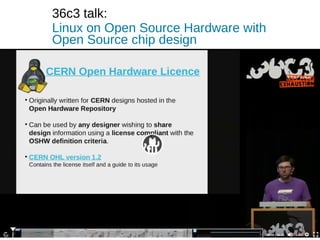
36c3 talk:
Linux on Open Source Hardware with
Open Source chip design
Section:
RISC-V
the instruction set for everything?
Slides: https://github.com/pdp7/talks/blob/master/fossn20.pdf
●
When you write a C or C++ program, it is
compiled into instructions for the
microprocessor (CPU) to execute.
●
How does the compiler know what instructions
the CPU understands?
– defined by the Instruction Set Architecture
– The ISA is a standard, a set of rules that define
the tasks the processor can perform.
– Examples: x86 (Intel/AMD) and ARM
●
Both are proprietary and need commercial licensing
●
RISC-V: Free and Open RISC Instruction Set
Arch
– “new instruction set architecture (ISA) that was
originally designed to support computer architecture
research and education and is now set to become a
standard open architecture for industry”
●
RISC-V: Free and Open RISC Instruction Set
Arch
●
Instruction Sets Want To Be Free: A Case for RISC-V
– David Patterson, UC Berekely – co-creator of the original RISC!
– https://www.youtube.com/watch?v=mD-njD2QKN0
●
RISC-V Summit 2019: State of the Union
– Krste Asanovic, UC Berkeley
– https://www.youtube.com/watch?v=jdkFi9_Hw-c
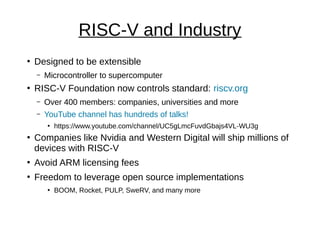
RISC-V and Industry
●
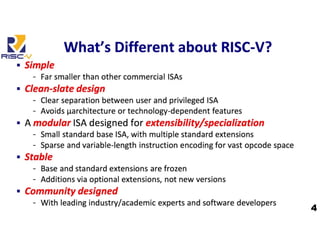
Designed to be extensible
– Microcontroller to supercomputer
●
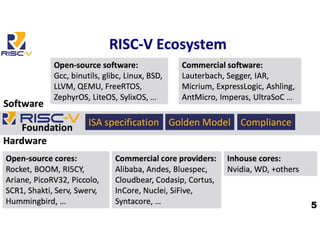
RISC-V Foundation now controls standard: riscv.org
– Over 400 members: companies, universities and more
– YouTube channel has hundreds of talks!
●
https://www.youtube.com/channel/UC5gLmcFuvdGbajs4VL-WU3g
●
Companies like Nvidia and Western Digital will ship millions of
devices with RISC-V
●
Avoid ARM licensing fees
●
Freedom to leverage open source implementations
●
BOOM, Rocket, PULP, SweRV, and many more
●
lowRISC is a not-for-profit organisation whose goal
is to produce a fully open source System-on-Chip
(SoC) in volume
– “We will produce a SoC design to populate a low-cost
community development board and to act as an ideal
starting point for derivative open-source and
commercial designs”
●
OpenTitan project with Google
– Announcing OpenTitan, the First Transparent Silicon Root of Trust
●
My column in the Hackspace Magazine is an
introduction to RISC-V and how it is enabling
open source chip design:
– hackspace.raspberrypi.org/issues/27/
SiFive
●
“founded by the creators of the free and open
RISC-V architecture as a reaction to the end of
conventional transistor scaling and escalating
chip design costs”
●
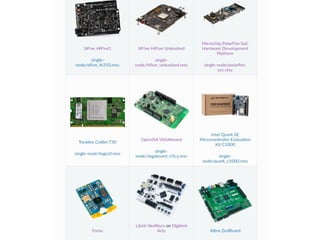
HiFive1: Arduino-Compatible RISC-V Dev Kit
SiFive FE310 microcontroller
Section:
Linux-capable RISC-V chips
●
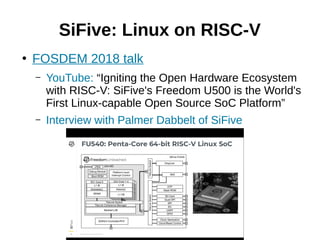
FOSDEM 2018 talk
– YouTube: “Igniting the Open Hardware Ecosystem
with RISC-V: SiFive's Freedom U500 is the World's
First Linux-capable Open Source SoC Platform”
– Interview with Palmer Dabbelt of SiFive
SiFive: Linux on RISC-V
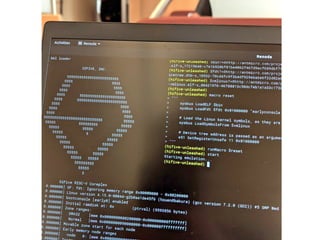
●
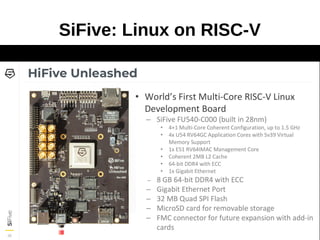
HiFive Unleashed on Crowd Supply
SiFive: Linux on RISC-V
RISC-V Summit 2019: Linux on RISC V Fedora and
Firmware Status Update
●
https://www.youtube.com/watch?v=WC6e3g8uWdk
●
Wei Fu – Software Engineer, Red Hat
●
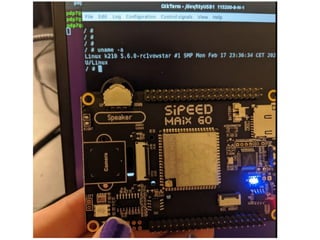
Linux now runs the low cost Kendryte K210
RISC-V processor
– dual core 64-bit RISC-V at 400MHz with 8MB SRAM
– Sipeed MAix BiT for RISC-V is only $13!
– Damien Le Moal at Linux Plumbers Conf:
RISC-V NOMMU and M-mode Linux
●
youtube.com/watch?v=ycG592N9EMA&t=10394
●
jump to 2h 53m
– Many RISC-V Improvements Ready For Linux 5.5: M-
Mode, SECCOMP, Other Features
– How to Build & Run Linux on Kendryte K210 RISC-V
NOMMU Processor
●
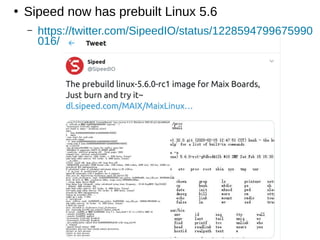
Sipeed now has prebuilt Linux 5.6
– https://twitter.com/SipeedIO/status/1228594799675990
016/
●
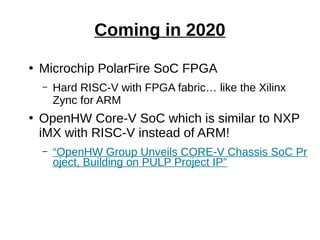
Microchip PolarFire SoC FPGA
– Hard RISC-V with FPGA fabric… like the Xilinx
Zync for ARM
●
OpenHW Core-V SoC which is similar to NXP
iMX with RISC-V instead of ARM!
– “OpenHW Group Unveils CORE-V Chassis SoC Pr
oject, Building on PULP Project IP”
Coming in 2020
Coming in 2020?
Section:
Open Source FPGA tools
Slides: https://github.com/pdp7/talks/blob/master/rv-munich.pdf
●
Keynote at Hackday Supercon 2019 by
Dr. Megan Wachs of SiFive
●
“RISC-V and FPGAs: Open Source Hardware
Hacking”
– https://www.youtube.com/watch?v=vCG5_nxm2G4
●
Project IceStorm for Lattice iCE40
●
“A Free and Open Source Verilog-to-Bitstream Flow for iC
E40 FPGAs”
by Claire Wolf (oe1cxw) at 32c3
Open Source toolchains for FPGAs
●
Project Trellis for Lattice ECP5
– “Project Trellis and nextpnr FOSS FPGA flow for the
Lattice ECP5”
- David Shah (@fpga_dave)
●
youtube.com/watch?v=0se7kNes3EU
Open Source toolchains for FPGAs
●
Project X-Ray & SymbiFlow for Xilinix Series 7
– Timothy ‘mithro’ Ansell: “Xilinx Series 7 FPGAs Now
Have a Fully Open Source Toolchain!” (almost)
●
youtube.com/watch?v=EHePto95qoE
Open Source toolchains for FPGAs
●
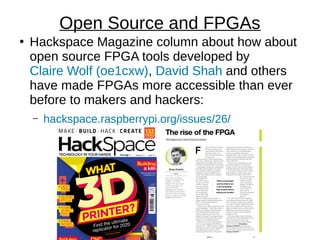
Hackspace Magazine column about how about
open source FPGA tools developed by
Claire Wolf (oe1cxw), David Shah and others
have made FPGAs more accessible than ever
before to makers and hackers:
– hackspace.raspberrypi.org/issues/26/
Open Source and FPGAs
Section:
Linux on the Hackaday Badge
Slides: https://github.com/pdp7/talks/blob/master/rv-munich.pdf
Hackaday 2019 Supercon badge
●
RISC-V “soft” core on ECP5 FPGA
●
Gigantic FPGA In A Game Boy Form Factor
“Team Linux on Badge”
●
Blog post: Hackaday Supercon badge boots Linux
using SDRAM cartridge
– https://blog.oshpark.com/2019/12/20/boot-linux-on-this-
hackaday-supercon-badge-with-this-sdram-cartridge/
●
Michael Welling (@QwertyEmedded), Tim Ansell
(@mithro), Sean Cross (@xobs), Jacob Creedon
(@jacobcreedon)
●
First attempt: use the built-in 16MB SRAM…
no luck :(
– (though xobs now might have a way to do it)
“Team Linux on Badge”
●
Second attempt:
– Jacob Creedon designed an a cartridge board that
adds 32MB of SDRAM to the Hackaday Supercon
badge… before the event!
“Team Linux on Badge”
●
Second attempt:
– Jacob Creedon designed an a cartridge board that
adds 32MB of SDRAM to the Hackaday Supercon
badge… before the event!
Designing Hardware in Python?
●
Yes!
●
“Using Python for creating hardware to record
FOSS conferences!”
●
Tim “mithro” Ansell
●
youtube.com/watch?v=MkVX_mh5dOU
Slides: https://github.com/litex-hub/fpga_101
●
LiteX used to build cores, create SoCs and full
FPGA designs.
●
LiteX is based on Migen
●
Migen lets you do FPGA design in Python!
●
https://github.com/enjoy-digital/litex
https://github.com/litex-hub/fpga_101
Slides: https://github.com/litex-hub/fpga_101
Linux on LiteX-VexRiscv
●
VexRiscv: 32-bit Linux Capable RISC-V CPU
●
SoC built using VexRiscv core and LiteX
moduels like LiteDRAM, LiteEth, LiteSDCard, ...
– github.com/litex-hub/linux-on-litex-vexriscv
●
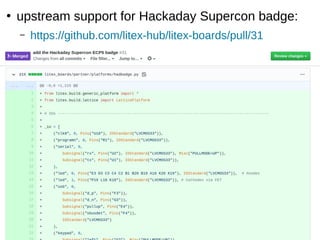
upstream support for Hackaday Supercon badge:
– https://github.com/litex-hub/litex-boards/pull/31
●
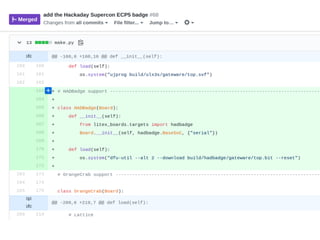
upstream support for Hackaday Supercon badge:
– https://github.com/litex-hub/litex-boards/pull/31
●
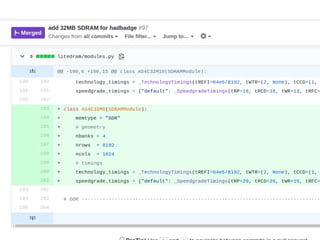
upstream support for Hackaday Supercon badge:
– https://github.com/litex-hub/litex-boards/pull/31
●
Greg Davill got the screen working with LiteVideo!
– twitter.com/GregDavill/status/1231082623633543168
Open Source boards with
ECP5 FPGA
(can run Linux)
Slides: https://github.com/pdp7/talks/blob/master/rv-munich.pdf
●
Radiona.org ULX3S
●
https://www.crowdsupply.com/radiona/ulx3s
Open Source ECP5 boards
●
Lattice ECP5 FPGA in Adafruit Feather form
factor and 128MB DDR RAM:
– Orange Crab by Greg Davill
●
https://github.com/gregdavill/OrangeCrab
●
https://groupgets.com/campaigns/710-orangecrab
Open Source ECP5 boards
●
Orange Crab by Greg Davill
●
https://groupgets.com/campaigns/710-orangecrab
Open Source ECP5 boards
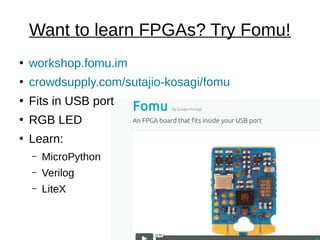
Want to learn FPGAs? Try Fomu!
●
workshop.fomu.im
●
crowdsupply.com/sutajio-kosagi/fomu
●
Fits in USB port
●
RGB LED
●
Learn:
– MicroPython
– Verilog
– LiteX
No hardware? Try Renode!
●
https://renode.io/
No hardware? Try Renode!
●
https://renode.io/
●
Become a
●
Slides:
github.com/pdp7/talks/blob/master/rv-pint.pdf
●
Contact: @pdp7 || drew@oshpark.com
●
36c3 talk

Linux on RISC-V

  • 1.
    Linux on RISC-V DrewFustini drew@beagleboard.org Twitter: @pdp7 Slides: https://github.com/pdp7/talks/blob/master/rv-pint.pdf with open source hardware and open source FPGA tools Raspberry Pint (May 26th , 2020)
  • 2.
    Statement of Principles: Hardwarewhose design is made publicly available so that anyone can study, modify, distribute, make, and sell the design or hardware based on that design
  • 3.
    Documentation required forelectronics: Schematics Board Layout Editable source files for CAD software such as KiCad or EAGLE Bill of Materials (BoM) Not strict requirement, but best practice is for all components available from distributors in low quantity
  • 4.
    36c3 talk: Linux onOpen Source Hardware with Open Source chip design
  • 5.
    Section: RISC-V the instruction setfor everything? Slides: https://github.com/pdp7/talks/blob/master/fossn20.pdf
  • 6.
    ● When you writea C or C++ program, it is compiled into instructions for the microprocessor (CPU) to execute. ● How does the compiler know what instructions the CPU understands? – defined by the Instruction Set Architecture – The ISA is a standard, a set of rules that define the tasks the processor can perform. – Examples: x86 (Intel/AMD) and ARM ● Both are proprietary and need commercial licensing
  • 7.
    ● RISC-V: Free andOpen RISC Instruction Set Arch – “new instruction set architecture (ISA) that was originally designed to support computer architecture research and education and is now set to become a standard open architecture for industry”
  • 8.
    ● RISC-V: Free andOpen RISC Instruction Set Arch ● Instruction Sets Want To Be Free: A Case for RISC-V – David Patterson, UC Berekely – co-creator of the original RISC! – https://www.youtube.com/watch?v=mD-njD2QKN0 ● RISC-V Summit 2019: State of the Union – Krste Asanovic, UC Berkeley – https://www.youtube.com/watch?v=jdkFi9_Hw-c
  • 11.
    RISC-V and Industry ● Designedto be extensible – Microcontroller to supercomputer ● RISC-V Foundation now controls standard: riscv.org – Over 400 members: companies, universities and more – YouTube channel has hundreds of talks! ● https://www.youtube.com/channel/UC5gLmcFuvdGbajs4VL-WU3g ● Companies like Nvidia and Western Digital will ship millions of devices with RISC-V ● Avoid ARM licensing fees ● Freedom to leverage open source implementations ● BOOM, Rocket, PULP, SweRV, and many more
  • 12.
    ● lowRISC is anot-for-profit organisation whose goal is to produce a fully open source System-on-Chip (SoC) in volume – “We will produce a SoC design to populate a low-cost community development board and to act as an ideal starting point for derivative open-source and commercial designs” ● OpenTitan project with Google – Announcing OpenTitan, the First Transparent Silicon Root of Trust
  • 13.
    ● My column inthe Hackspace Magazine is an introduction to RISC-V and how it is enabling open source chip design: – hackspace.raspberrypi.org/issues/27/
  • 14.
    SiFive ● “founded by thecreators of the free and open RISC-V architecture as a reaction to the end of conventional transistor scaling and escalating chip design costs”
  • 15.
    ● HiFive1: Arduino-Compatible RISC-VDev Kit SiFive FE310 microcontroller
  • 16.
  • 17.
    ● FOSDEM 2018 talk –YouTube: “Igniting the Open Hardware Ecosystem with RISC-V: SiFive's Freedom U500 is the World's First Linux-capable Open Source SoC Platform” – Interview with Palmer Dabbelt of SiFive SiFive: Linux on RISC-V
  • 18.
    ● HiFive Unleashed onCrowd Supply SiFive: Linux on RISC-V
  • 19.
    RISC-V Summit 2019:Linux on RISC V Fedora and Firmware Status Update ● https://www.youtube.com/watch?v=WC6e3g8uWdk ● Wei Fu – Software Engineer, Red Hat
  • 25.
    ● Linux now runsthe low cost Kendryte K210 RISC-V processor – dual core 64-bit RISC-V at 400MHz with 8MB SRAM – Sipeed MAix BiT for RISC-V is only $13! – Damien Le Moal at Linux Plumbers Conf: RISC-V NOMMU and M-mode Linux ● youtube.com/watch?v=ycG592N9EMA&t=10394 ● jump to 2h 53m – Many RISC-V Improvements Ready For Linux 5.5: M- Mode, SECCOMP, Other Features – How to Build & Run Linux on Kendryte K210 RISC-V NOMMU Processor
  • 28.
    ● Sipeed now hasprebuilt Linux 5.6 – https://twitter.com/SipeedIO/status/1228594799675990 016/
  • 29.
    ● Microchip PolarFire SoCFPGA – Hard RISC-V with FPGA fabric… like the Xilinx Zync for ARM ● OpenHW Core-V SoC which is similar to NXP iMX with RISC-V instead of ARM! – “OpenHW Group Unveils CORE-V Chassis SoC Pr oject, Building on PULP Project IP” Coming in 2020
  • 30.
  • 31.
    Section: Open Source FPGAtools Slides: https://github.com/pdp7/talks/blob/master/rv-munich.pdf
  • 32.
    ● Keynote at HackdaySupercon 2019 by Dr. Megan Wachs of SiFive ● “RISC-V and FPGAs: Open Source Hardware Hacking” – https://www.youtube.com/watch?v=vCG5_nxm2G4
  • 34.
    ● Project IceStorm forLattice iCE40 ● “A Free and Open Source Verilog-to-Bitstream Flow for iC E40 FPGAs” by Claire Wolf (oe1cxw) at 32c3 Open Source toolchains for FPGAs
  • 35.
    ● Project Trellis forLattice ECP5 – “Project Trellis and nextpnr FOSS FPGA flow for the Lattice ECP5” - David Shah (@fpga_dave) ● youtube.com/watch?v=0se7kNes3EU Open Source toolchains for FPGAs
  • 36.
    ● Project X-Ray &SymbiFlow for Xilinix Series 7 – Timothy ‘mithro’ Ansell: “Xilinx Series 7 FPGAs Now Have a Fully Open Source Toolchain!” (almost) ● youtube.com/watch?v=EHePto95qoE Open Source toolchains for FPGAs
  • 37.
    ● Hackspace Magazine columnabout how about open source FPGA tools developed by Claire Wolf (oe1cxw), David Shah and others have made FPGAs more accessible than ever before to makers and hackers: – hackspace.raspberrypi.org/issues/26/ Open Source and FPGAs
  • 38.
    Section: Linux on theHackaday Badge Slides: https://github.com/pdp7/talks/blob/master/rv-munich.pdf
  • 39.
    Hackaday 2019 Superconbadge ● RISC-V “soft” core on ECP5 FPGA ● Gigantic FPGA In A Game Boy Form Factor
  • 40.
  • 41.
    “Team Linux onBadge” ● Blog post: Hackaday Supercon badge boots Linux using SDRAM cartridge – https://blog.oshpark.com/2019/12/20/boot-linux-on-this- hackaday-supercon-badge-with-this-sdram-cartridge/ ● Michael Welling (@QwertyEmedded), Tim Ansell (@mithro), Sean Cross (@xobs), Jacob Creedon (@jacobcreedon) ● First attempt: use the built-in 16MB SRAM… no luck :( – (though xobs now might have a way to do it)
  • 42.
    “Team Linux onBadge” ● Second attempt: – Jacob Creedon designed an a cartridge board that adds 32MB of SDRAM to the Hackaday Supercon badge… before the event!
  • 43.
    “Team Linux onBadge” ● Second attempt: – Jacob Creedon designed an a cartridge board that adds 32MB of SDRAM to the Hackaday Supercon badge… before the event!
  • 45.
    Designing Hardware inPython? ● Yes! ● “Using Python for creating hardware to record FOSS conferences!” ● Tim “mithro” Ansell ● youtube.com/watch?v=MkVX_mh5dOU
  • 49.
  • 50.
  • 51.
    ● LiteX used tobuild cores, create SoCs and full FPGA designs. ● LiteX is based on Migen ● Migen lets you do FPGA design in Python! ● https://github.com/enjoy-digital/litex
  • 52.
  • 53.
    Linux on LiteX-VexRiscv ● VexRiscv:32-bit Linux Capable RISC-V CPU ● SoC built using VexRiscv core and LiteX moduels like LiteDRAM, LiteEth, LiteSDCard, ... – github.com/litex-hub/linux-on-litex-vexriscv
  • 55.
    ● upstream support forHackaday Supercon badge: – https://github.com/litex-hub/litex-boards/pull/31
  • 56.
    ● upstream support forHackaday Supercon badge: – https://github.com/litex-hub/litex-boards/pull/31
  • 57.
    ● upstream support forHackaday Supercon badge: – https://github.com/litex-hub/litex-boards/pull/31
  • 64.
    ● Greg Davill gotthe screen working with LiteVideo! – twitter.com/GregDavill/status/1231082623633543168
  • 65.
    Open Source boardswith ECP5 FPGA (can run Linux) Slides: https://github.com/pdp7/talks/blob/master/rv-munich.pdf
  • 66.
  • 67.
    ● Lattice ECP5 FPGAin Adafruit Feather form factor and 128MB DDR RAM: – Orange Crab by Greg Davill ● https://github.com/gregdavill/OrangeCrab ● https://groupgets.com/campaigns/710-orangecrab Open Source ECP5 boards
  • 69.
    ● Orange Crab byGreg Davill ● https://groupgets.com/campaigns/710-orangecrab Open Source ECP5 boards
  • 70.
    Want to learnFPGAs? Try Fomu! ● workshop.fomu.im ● crowdsupply.com/sutajio-kosagi/fomu ● Fits in USB port ● RGB LED ● Learn: – MicroPython – Verilog – LiteX
  • 71.
    No hardware? TryRenode! ● https://renode.io/
  • 72.
    No hardware? TryRenode! ● https://renode.io/
  • 75.