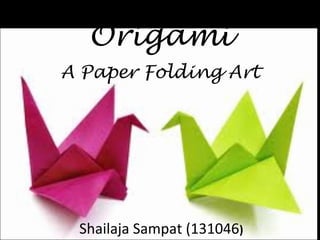
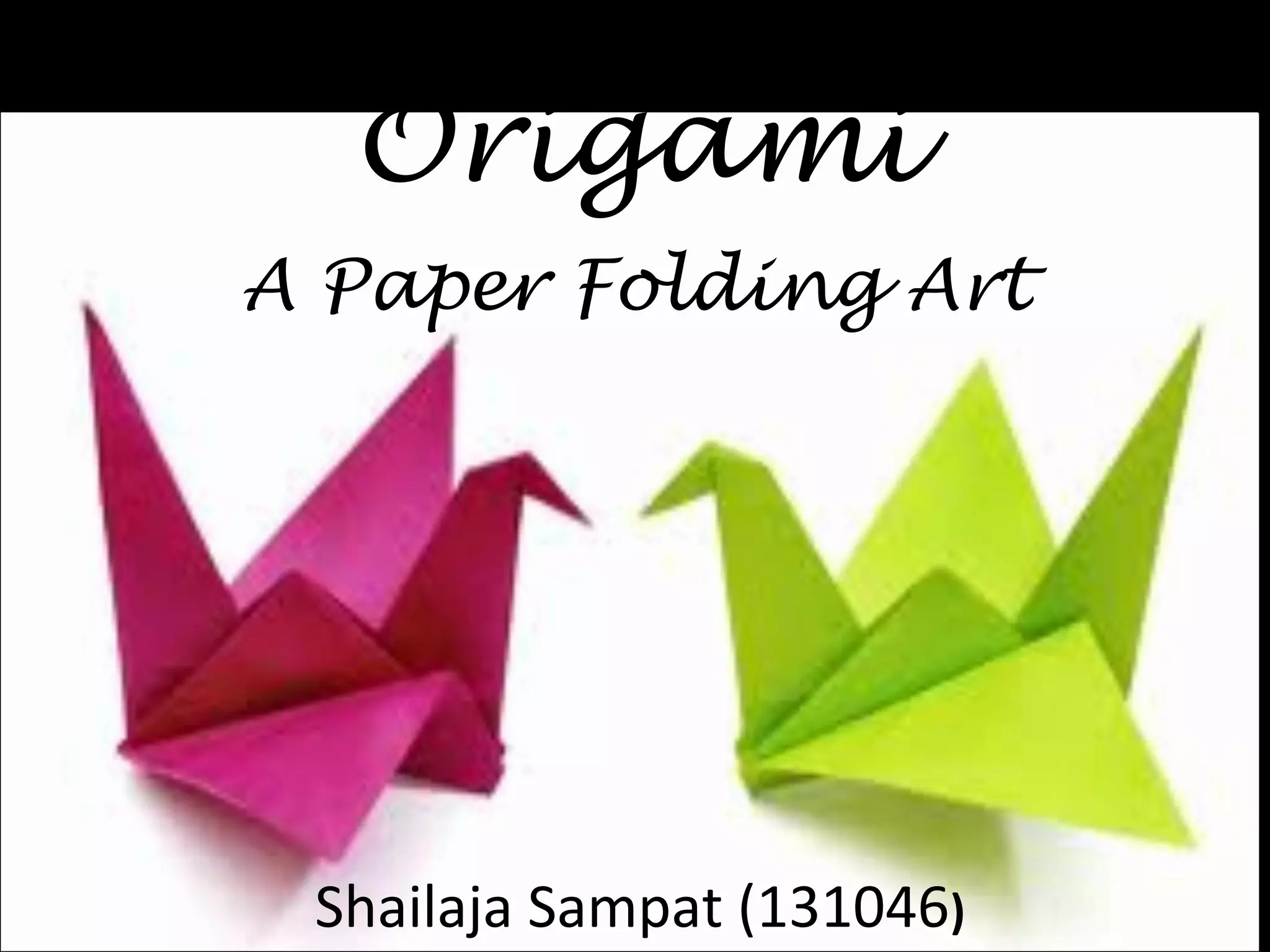
Origami
A Paper Folding Art

Shailaja Sampat (131046)
Objectives
 I was amazed to see how a small piece of
paper can turn into creation by different
techniques of Origami. I desired to learn
Origami in its real sense which is not a
common art form in India.

2
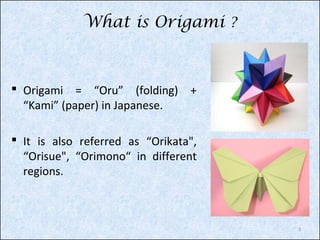
What is Origami ?

 Origami = “Oru” (folding) +
“Kami” (paper) in Japanese.
 It is also referred as “Orikata",
“Orisue", “Orimono“ in different
regions.

3
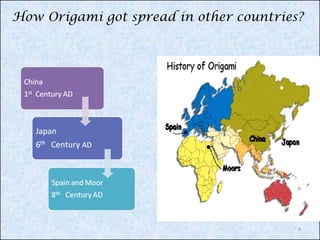
How Origami got spread in other countries?

4
Magic of Origami
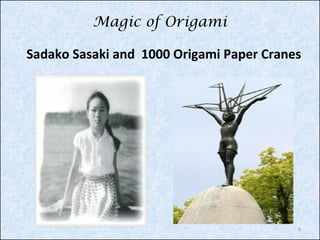
Sadako Sasaki and 1000 Origami Paper Cranes
Sadako Sasaki- a twelve year old Japanese girl was suffering
from leukemia due to radiation produced by atomic bombing on
Hiroshima on 6th August, 1945.
It is a belief in Japan that if any person makes 1000 paper cranes
(“senbazuru”), god grants him/her a wish.
She decided to make 1000 paper cranes and wished for world
peace.
But unfortunately, she passed away after making 644 paper
cranes.
Her friends and family members decided to make all thousand
cranes in her honour. She was buried with all thousand cranes.
5
In her memory, Japanese Government has developed her statue
Magic of Origami
Sadako Sasaki and 1000 Origami Paper Cranes

6
Origami in Japan
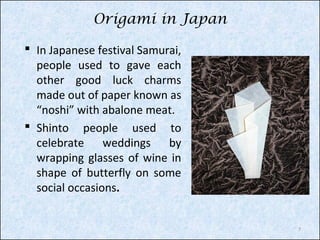
 In Japanese festival Samurai,
people used to gave each
other good luck charms
made out of paper known as
“noshi” with abalone meat.
 Shinto people used to
celebrate weddings by
wrapping glasses of wine in
shape of butterfly on some
social occasions.
7
Origami-Documentation
• ”The Secret of 1000 Cranes Origami” - Oldest
book for Origami (1797)(Anonymous)
-the first written set of Origami instruction
-having 150 Origami models
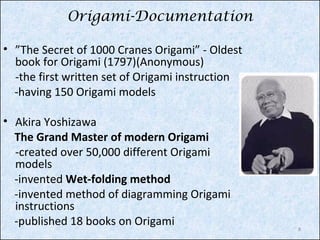
• Akira Yoshizawa
The Grand Master of modern Origami
-created over 50,000 different Origami
models
-invented Wet-folding method
-invented method of diagramming Origami
instructions
-published 18 books on Origami

8
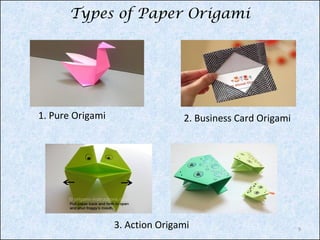
Types of Paper Origami

1. Pure Origami

2. Business Card Origami

3. Action Origami

9
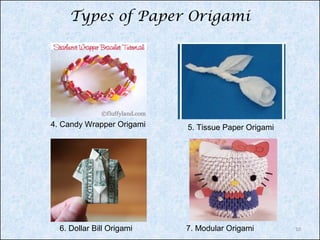
Types of Paper Origami

4. Candy Wrapper Origami

6. Dollar Bill Origami

5. Tissue Paper Origami

7. Modular Origami

10
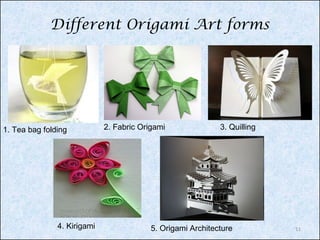
Different Origami Art forms

1. Tea bag folding

4. Kirigami

2. Fabric Origami

3. Quilling

5. Origami Architecture

11
Amazing Facts about Origami
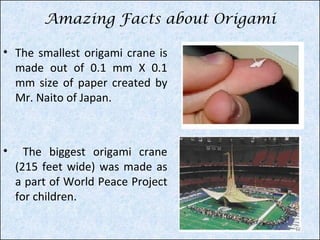
• The smallest origami crane is
made out of 0.1 mm X 0.1
mm size of paper created by
Mr. Naito of Japan.

•

The biggest origami crane
(215 feet wide) was made as
a part of World Peace Project
for children.
12
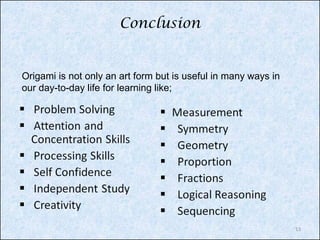
Conclusion

Origami is not only an art form but is useful in many ways in
our day-to-day life for learning like;

13
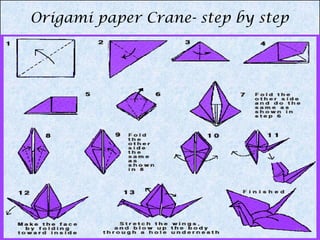
Origami paper Crane- step by step

14
Webliography
•
•
•
•
•
•
•
•
•

http://en.origami-club.com/
http://www.origami-resource-center.com/origami-factoids.html
http://origamihistory.wordpress.com/
http://www.origamiwithrachelkatz.com/links/links.asp
http://www.origami-instructions.com/
http://en.wikipedia.org/wiki/Origami
http://library.thinkquest.org/5402/history.html
http://www.langorigami.com/art/art.php
http://www.enchantedlearning.com/crafts/origami/

Bibliography
• ”My Origami Creations (Swan +Turtle + Butterfly)” by Dimitris Dalas
• “Origami collection of near 300 models” (e-book) posted by
anonymous.
• “The Complete Book Of Origami” (e-book) by X Kagebunshin
15
Image references
Slide Number and Reference
1

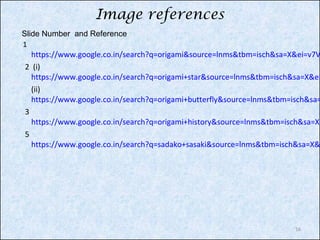
https://www.google.co.in/search?q=origami&source=lnms&tbm=isch&sa=X&ei=v7V
2 (i)
https://www.google.co.in/search?q=origami+star&source=lnms&tbm=isch&sa=X&ei
(ii)
https://www.google.co.in/search?q=origami+butterfly&source=lnms&tbm=isch&sa=
3
https://www.google.co.in/search?q=origami+history&source=lnms&tbm=isch&sa=X&
5
https://www.google.co.in/search?q=sadako+sasaki&source=lnms&tbm=isch&sa=X&

16
Image references
Slide Number and Reference

6

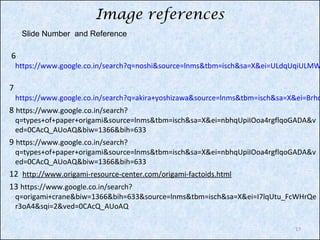
https://www.google.co.in/search?q=noshi&source=lnms&tbm=isch&sa=X&ei=ULdqUqiULMW

7

https://www.google.co.in/search?q=akira+yoshizawa&source=lnms&tbm=isch&sa=X&ei=Brhq

8 https://www.google.co.in/search?

q=types+of+paper+origami&source=lnms&tbm=isch&sa=X&ei=nbhqUpiIOoa4rgflqoGADA&v
ed=0CAcQ_AUoAQ&biw=1366&bih=633

9 https://www.google.co.in/search?

q=types+of+paper+origami&source=lnms&tbm=isch&sa=X&ei=nbhqUpiIOoa4rgflqoGADA&v
ed=0CAcQ_AUoAQ&biw=1366&bih=633

12 http://www.origami-resource-center.com/origami-factoids.html
13 https://www.google.co.in/search?

q=origami+crane&biw=1366&bih=633&source=lnms&tbm=isch&sa=X&ei=I7lqUtu_FcWHrQe
r3oA4&sqi=2&ved=0CAcQ_AUoAQ
17
THANK YOU

18

Origami-a paper folding art

  • 1.
    Origami A Paper FoldingArt Shailaja Sampat (131046)
  • 2.
    Objectives  I wasamazed to see how a small piece of paper can turn into creation by different techniques of Origami. I desired to learn Origami in its real sense which is not a common art form in India. 2
  • 3.
    What is Origami?  Origami = “Oru” (folding) + “Kami” (paper) in Japanese.  It is also referred as “Orikata", “Orisue", “Orimono“ in different regions. 3
  • 4.
    How Origami gotspread in other countries? 4
  • 5.
    Magic of Origami SadakoSasaki and 1000 Origami Paper Cranes Sadako Sasaki- a twelve year old Japanese girl was suffering from leukemia due to radiation produced by atomic bombing on Hiroshima on 6th August, 1945. It is a belief in Japan that if any person makes 1000 paper cranes (“senbazuru”), god grants him/her a wish. She decided to make 1000 paper cranes and wished for world peace. But unfortunately, she passed away after making 644 paper cranes. Her friends and family members decided to make all thousand cranes in her honour. She was buried with all thousand cranes. 5 In her memory, Japanese Government has developed her statue
  • 6.
    Magic of Origami SadakoSasaki and 1000 Origami Paper Cranes 6
  • 7.
    Origami in Japan In Japanese festival Samurai, people used to gave each other good luck charms made out of paper known as “noshi” with abalone meat.  Shinto people used to celebrate weddings by wrapping glasses of wine in shape of butterfly on some social occasions. 7
  • 8.
    Origami-Documentation • ”The Secretof 1000 Cranes Origami” - Oldest book for Origami (1797)(Anonymous) -the first written set of Origami instruction -having 150 Origami models • Akira Yoshizawa The Grand Master of modern Origami -created over 50,000 different Origami models -invented Wet-folding method -invented method of diagramming Origami instructions -published 18 books on Origami 8
  • 9.
    Types of PaperOrigami 1. Pure Origami 2. Business Card Origami 3. Action Origami 9
  • 10.
    Types of PaperOrigami 4. Candy Wrapper Origami 6. Dollar Bill Origami 5. Tissue Paper Origami 7. Modular Origami 10
  • 11.
    Different Origami Artforms 1. Tea bag folding 4. Kirigami 2. Fabric Origami 3. Quilling 5. Origami Architecture 11
  • 12.
    Amazing Facts aboutOrigami • The smallest origami crane is made out of 0.1 mm X 0.1 mm size of paper created by Mr. Naito of Japan. • The biggest origami crane (215 feet wide) was made as a part of World Peace Project for children. 12
  • 13.
    Conclusion Origami is notonly an art form but is useful in many ways in our day-to-day life for learning like; 13
  • 14.
    Origami paper Crane-step by step 14
  • 15.
  • 16.
    Image references Slide Numberand Reference 1 https://www.google.co.in/search?q=origami&source=lnms&tbm=isch&sa=X&ei=v7V 2 (i) https://www.google.co.in/search?q=origami+star&source=lnms&tbm=isch&sa=X&ei (ii) https://www.google.co.in/search?q=origami+butterfly&source=lnms&tbm=isch&sa= 3 https://www.google.co.in/search?q=origami+history&source=lnms&tbm=isch&sa=X& 5 https://www.google.co.in/search?q=sadako+sasaki&source=lnms&tbm=isch&sa=X& 16
  • 17.
    Image references Slide Numberand Reference 6 https://www.google.co.in/search?q=noshi&source=lnms&tbm=isch&sa=X&ei=ULdqUqiULMW 7 https://www.google.co.in/search?q=akira+yoshizawa&source=lnms&tbm=isch&sa=X&ei=Brhq 8 https://www.google.co.in/search? q=types+of+paper+origami&source=lnms&tbm=isch&sa=X&ei=nbhqUpiIOoa4rgflqoGADA&v ed=0CAcQ_AUoAQ&biw=1366&bih=633 9 https://www.google.co.in/search? q=types+of+paper+origami&source=lnms&tbm=isch&sa=X&ei=nbhqUpiIOoa4rgflqoGADA&v ed=0CAcQ_AUoAQ&biw=1366&bih=633 12 http://www.origami-resource-center.com/origami-factoids.html 13 https://www.google.co.in/search? q=origami+crane&biw=1366&bih=633&source=lnms&tbm=isch&sa=X&ei=I7lqUtu_FcWHrQe r3oA4&sqi=2&ved=0CAcQ_AUoAQ 17
  • 18.