This document discusses the theoretical and numerical analysis of a vibration isolator subjected to harmonic excitation. It presents equations to model the isolator and calculate the force and displacement transmissibility. The analysis considers varying the damping coefficient and spring stiffness. MATLAB is used to generate transmissibility curves matching the theoretical analysis. An experimental setup is proposed to validate the results and consider nonlinearities not included in the theoretical model.
![International Journal of Research in Advent Technology, Vol.2, No.7, July 2014
E-ISSN: 2321-9637
53
Theoretical and Numerical Analysis of Vibration
Isolator Subjected to Harmonic Excitation
Mr. Rajendra Kerumali1, Prof. Dr. S. H. Sawant2
1PG Student, Department of Mechanical Engineering, Dr.J.J.Magdum College of Engineering, Jaysingpur,
India.
2Professor, Department of Mechanical Engineering, Dr.J.J.Magdum College of Engineering, Jaysingpur, India.
Email: rajukerumali49@gmail.com1
Abstract- Vibration isolation is a method of adding a tuned spring-mass damper to a system to decrease the
force transmitted from the vibrating machine to the foundation or vice versa. The dynamic vibration isolator is
designed in such a way that the force transmitted from the exciter to the foundation should be minimized. In this
paper theoretical and numerical analysis of vibration isolator subjected to harmonic excitation is carried out.
Proposed experimental setup for dynamic vibration isolator is also designed.
Index Terms- Dynamic, Exciter, Harmonic Excitation, Vibration Isolator
1. INTRODUCTION:
The purpose of vibration isolation is to control
unwanted vibrations so that the adverse effects are
kept within acceptable limits. Transmissibility is a
concept widely used in the design of vibration
isolators to measure the vibration transmission at
different frequencies [1].
Vibration isolation concerns means to bring about a
reduction in a vibratory effect. A vibration isolator in
its most elementary form may be considered as a
resilient member connecting the equipment and
foundation. The function of an isolator is to reduce the
magnitude of motion transmitted from a vibrating
foundation to the equipment or to reduce the
magnitude of force transmitted from the equipment to
its foundation [6].
Inserting the vibration isolator between the source of
vibration and the vibration receiver is one of the
fundamental ways to reduce the unwanted vibrations
and to protect the equipment’s from disturbance. The
basic concept of the vibration isolator is that, when
the frequency of excitation is larger than √2ωn, where
ωn is the undamped natural frequency of the isolator,
the transmitted force, Ft (or the transmitted
displacement, Xt) reaches a value less than the
excitation force, Fi (or the excitation displacement,
Xi). The ratio Ft/Fi and Xt/Xi are denoted as force
transmissibility and displacement transmissibility
respectively [2].
In the design and analysis of vibration isolator the
damping coefficient and spring stiffness of isolator
plays important role. In this paper the effect of the
damping coefficient and spring stiffness on force and
displacement transmissibility will be done and
verification of the same will be done through
MATLAB. For this analysis vibration isolator system
is excited by harmonic Excitation.
2. THEORETICAL BACKGROUND:
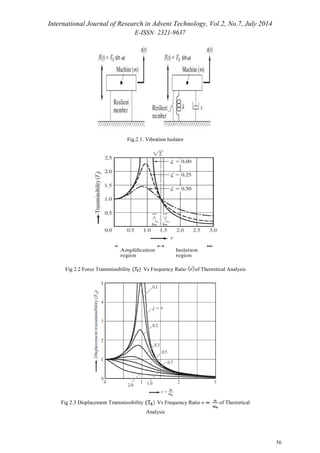
Mathematical model of vibration isolator is as shown
in Fig. 2.1 below [3].
Where,
Mass of system
Stiffness of the spring
Damping coefficient
Force Transmissibility: The force transmissibility is
defined as the ratio of the force transmitted to the
foundation to that impressed upon the system [3].
It is assumed that the operation of the machine gives
rise to a harmonically varying force.
(1)
The equation of motion of the machine (of mass m) is
given by
(2)
Since the transient solution dies out after some time,
only the steady-state solution will be left. The steady-state
solution of Eq. (2) is given by
(3)
where
(4)
and
The force transmitted to the foundation through the
spring and the dashpot, is given by
(5)](https://image.slidesharecdn.com/paperid-27201423-140904033552-phpapp01/85/Paper-id-27201423-1-320.jpg)
![International Journal of Research in Advent Technology, Vol.2, No.7, July 2014
E-ISSN: 2321-9637
54
The magnitude of the total transmitted force (Ft) is
given by
(6)
The transmissibility or transmission ratio of the
isolator is defined as the ratio of the magnitude of
the force transmitted to that of the exciting force:
(7)
Where,
is the frequency ratio.
From equation (7) it is clear that when i.e.
system frequency is zero the For various
values of damping coefficient, force transmissibility
versus frequency ratio curve is shown in Fig. 2.2.
The following observations can be made from Fig. 2.2
1. The magnitude of the force transmitted to the
foundation can be reduced by decreasing the natural
frequency of the system
2. The force transmitted to the foundation can also be
reduced by decreasing the damping ratio. However,
since vibration isolation requires the
machine should pass through resonance during start-up
and stopping. Hence, some damping is essential to
avoid infinitely large amplitudes at resonance.
3. Although damping reduces the amplitude of the
mass (X) for all frequencies, it reduces the maximum
force transmitted to the foundation only if
Above that value, the addition of
damping increases the force transmitted.
Displacement Transmissibility: The displacement
transmissibility is defined as the ratio of absolute
amplitude of the mass to the base excitation amplitude
[4].
In many applications, the isolation is required to
reduce the motion of the mass (machine) under the
applied force. The displacement amplitude of the
mass m due to the force F(t), given by Eq. (4), can be
expressed as:
(8)
Where is called, in the present context, the
displacement transmissibility or amplitude ratio and
indicates the ratio of the amplitude of the mass, X, to
the static deflection under the constant force
The variation of the displacement
transmissibility with the frequency ratio r for several
values of the damping ratio is shown in Fig. 2.3.
The following observations can be made from Fig. 2.3
1) The displacement transmissibility increases to a
maximum value at
(9)
Equation (8) shows that, for small values of damping
ratio the displacement transmissibility will be
maximum at or Thus the value of r is
to be avoided in practice. In most cases, the excitation
frequency is fixed and hence we can avoid by altering
the value of the natural frequency which can be
accomplished by changing the value of either or both
of m and k.
2) The amplitude of the mass, X, approaches zero as r
increases to a large value. The reason is that at large
values of r, the applied force varies very rapidly
and the inertia of the mass prevents it from following
the fluctuating force.
Table 2.1. Various Parameters of the Vibration
Isolator System.
Parameter Value
m 10 kg
k 5510 N/m
c 66.39 N-s/m
wn 33.196 rad/s
ζ 1.2
3. NUMERICAL ANALYSIS:
In order to carry out numerical analysis of vibration
isolator MATLAB software is used. MATLAB
integrates mathematical computing, visualization, and
a powerful language to provide a flexible environment
for technical computing. The open architecture makes
it easy to use MATLAB and its companion products
to explore data, create algorithms, and create custom
tools that provide early insights and competitive
advantages. MATLAB program has been developed
to model the vibration isolator system [5].
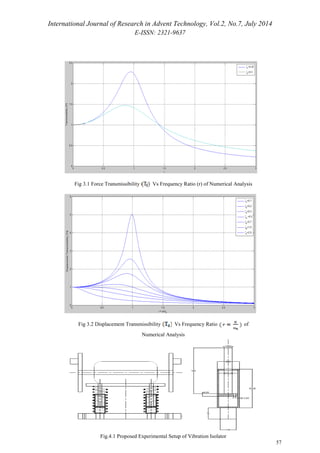
Using MATLAB, Transmissibility of vibration
isolator for Eq. (7) as functions of the frequency ratio
is plotted as shown in Fig 3.1
Using MATLAB, Displacement Transmissibility of
vibration isolator for Eq. (8) as functions of the
frequency ratio is plotted as shown in Fig 3.2
4. EXPERIMENTAL SETUP
Proposed experimental setup for vibration isolator is
developed by considering the parameters given in the
table. Base structure is designed to support the](https://image.slidesharecdn.com/paperid-27201423-140904033552-phpapp01/85/Paper-id-27201423-2-320.jpg)
![International Journal of Research in Advent Technology, Vol.2, No.7, July 2014
E-ISSN: 2321-9637
55
vibration isolator system. The transmissibility curves
of vibration isolator are plotted using FFT analyzer.
The result obtained will be real because in theoretical
and numerical analysis effect of nonlinearities is not
considered, and the effect of nonlinearities on
transmissibility will be evaluated by experimental
analysis.
5. CONCLUSION:
In this paper theoretical and numerical analysis of
design of vibration isolator is carried out. Proposed
experimental setup for vibration isolator is also
designed. Transmissibility curves obtained from
numerical analysis and theoretical analysis are
matching. The analysis can be carried out for
vibration isolator subjected to random excitation. By
carrying experimental analysis for vibration isolator
subjected to random excitation the result are validated
with theoretical and numerical analysis.
REFERENCES:
[1] Z Q. Lang, X. J. Jing, S. A. Billings, G. R.
Tomlinson, Z. K. Peng, “Theoretical Study of the
Effects of Nonlinear Viscous Damping on
Vibration Isolation of SDoF Systems”, Journal of
Sound and Vibration, pp. 352–365, 2009.
[2] Zhenlong Xiao, Xingjian Jing, Li Cheng, “The
Transmissibility of Vibration Isolators with Cubic
Nonlinear Damping under both Force and Base
Excitations”, Journal of Sound and Vibration,
pp.1335-1354, 2013.
[3] S. S. Rao, “Mechanical Vibrations”, 5th ed.
Addison-Wesley Publishing Company (1995).
[4] G.K.Groover and A.K.Nigam, “Mechanical
Vibrations”, Edition-2001.
[5] Rao V. Dukkipati, “Solving Vibration Problems
using MATLAB”, New Age International
Publishers,ISBN (13) : 978-81-224-2484-3rd
Edition-2006
[6] Charles E. Crede and Jerome E. Ruzicka “Theory
of Vibration Isolation”](https://image.slidesharecdn.com/paperid-27201423-140904033552-phpapp01/85/Paper-id-27201423-3-320.jpg)


![mechanical_vibration,_unit_2_ppt,_krishna_R [1].pptx](https://cdn.slidesharecdn.com/ss_thumbnails/mechanicalvibrationunit2pptkrishnar1-241012094100-79ebc2a2-thumbnail.jpg?width=640&height=640&fit=bounds)


