NAME:- VALA ASHA TIDABHAI.
ROLL NO:- 41.
SEM:- 1 (M.A.)
PAPER NO:- COURSE NO-3.
BATCH:- 2015-17.
TOPIC:- DIFFERENCE BETWEEN
POEM & POETRY.
SUBMITTED:- S.B.GARDI
DEPARTMENT OF
ENGLISH M.K.B.U.
IMAIL ID-
valaasha10@gmail.com
LITERARRY THEORY &
CRITICISM.
Samuel Taylor Coleridge
His criticism
Biographia Literaria.
(1815 – 1817)
Coleridge & Criticism.
 Coleridge’s new Technique of criticism
is called ‘Appreciative criticism.’
 It is new criticism for new poetry which
provided by Coleridge.
 Coleridge led the way in new method in
criticism.
 It sought not to judge but to Appreciate
& interpret.
 He illustrates the tendency of romantic
criticism to stress the effect of art upon
the critic’s emotions.
 Coleridge regarded art as a source of
“Moral & philosophical
wisdom.”
Coleridge’s Biographia
literaria.
 It is critical work of Coleridge.
 It contained in 24 chapter.
 It is not only work of criticism, but also
with theory.
 In the chapter-14, where as he highlight
the Difference between poem & poetry.
Difference between poem &
poetry.
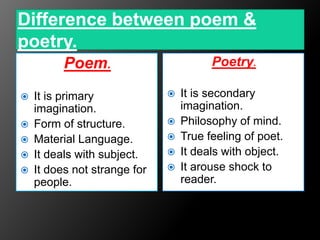
Poem.
 It is primary
imagination.
 Form of structure.
 Material Language.
 It deals with subject.
 It does not strange for
people.
Poetry.
 It is secondary
imagination.
 Philosophy of mind.
 True feeling of poet.
 It deals with object.
 It arouse shock to
reader.
Coleridge,
 A poem is merely one of the forms of its
expression, a verbal expression of that activity,
and poetic activity is basically an activity of
the imagination.
 As David Daiches points out, ‘poetry’ for
Coleridge is a wider category than a ‘poem’
;that is, poetry is a kind of activity which can be
engaged in by painters or philosophers or
scientists and is not confined to those who
employ metrical language,
 even to those who employ language of
any kind. Poetry, in this larger sense,
brings, ‘the whole soul of man; into
activity, with each faculty playing its
proper part according to its ‘relative
worth and dignity’.
To conclude.
 He endeavored ‘to establish the
principles of writing rather than to furnish
rules about how to pass judgment on
what had been written by other.
 “ Poetry: The best word in the best
order.”
paper 3 Literarry theory and criticism

paper 3 Literarry theory and criticism

  • 1.
    NAME:- VALA ASHATIDABHAI. ROLL NO:- 41. SEM:- 1 (M.A.) PAPER NO:- COURSE NO-3. BATCH:- 2015-17. TOPIC:- DIFFERENCE BETWEEN POEM & POETRY. SUBMITTED:- S.B.GARDI DEPARTMENT OF ENGLISH M.K.B.U. IMAIL ID- valaasha10@gmail.com LITERARRY THEORY & CRITICISM.
  • 2.
    Samuel Taylor Coleridge Hiscriticism Biographia Literaria. (1815 – 1817)
  • 3.
    Coleridge & Criticism. Coleridge’s new Technique of criticism is called ‘Appreciative criticism.’  It is new criticism for new poetry which provided by Coleridge.  Coleridge led the way in new method in criticism.
  • 4.
     It soughtnot to judge but to Appreciate & interpret.  He illustrates the tendency of romantic criticism to stress the effect of art upon the critic’s emotions.  Coleridge regarded art as a source of “Moral & philosophical wisdom.”
  • 5.
    Coleridge’s Biographia literaria.  Itis critical work of Coleridge.  It contained in 24 chapter.  It is not only work of criticism, but also with theory.  In the chapter-14, where as he highlight the Difference between poem & poetry.
  • 6.
    Difference between poem& poetry. Poem.  It is primary imagination.  Form of structure.  Material Language.  It deals with subject.  It does not strange for people. Poetry.  It is secondary imagination.  Philosophy of mind.  True feeling of poet.  It deals with object.  It arouse shock to reader.
  • 7.
    Coleridge,  A poemis merely one of the forms of its expression, a verbal expression of that activity, and poetic activity is basically an activity of the imagination.  As David Daiches points out, ‘poetry’ for Coleridge is a wider category than a ‘poem’ ;that is, poetry is a kind of activity which can be engaged in by painters or philosophers or scientists and is not confined to those who employ metrical language,
  • 8.
     even tothose who employ language of any kind. Poetry, in this larger sense, brings, ‘the whole soul of man; into activity, with each faculty playing its proper part according to its ‘relative worth and dignity’.
  • 9.
    To conclude.  Heendeavored ‘to establish the principles of writing rather than to furnish rules about how to pass judgment on what had been written by other.  “ Poetry: The best word in the best order.”