(IJACSA) International Journal of Advanced Computer Science and Applications,
Vol. 5, No. 4, 2014
76 | P a g e
www.ijacsa.thesai.org
Comparative Performance Analysis of Wireless
Communication Protocols for Intelligent Sensors
and Their Applications
Chakkor Saad
Department of Physics,
Team: Communication and Detection Systems,
University of Abdelmalek Essaâdi, Faculty of Sciences,
Tetouan, Morocco
El Ahmadi Cheikh
Department of Physics,
Team: Communication and Detection Systems,
University of Abdelmalek Essaâdi, Faculty of Sciences,
Tetouan, Morocco
Baghouri Mostafa
Department of Physics,
Team: Communication and Detection Systems,
University of Abdelmalek Essaâdi, Faculty of Sciences,
Tetouan, Morocco
Hajraoui Abderrahmane
Department of Physics,
Team: Communication and Detection Systems,
University of Abdelmalek Essaâdi, Faculty of Sciences,
Tetouan, Morocco
Abstract—The systems based on intelligent sensors are
currently expanding, due to theirs functions and theirs
performances of intelligence: transmitting and receiving data in
real-time, computation and processing algorithms, metrology
remote, diagnostics, automation and storage measurements…The
radio frequency wireless communication with its multitude offers
a better solution for data traffic in this kind of systems. The
mains objectives of this paper is to present a solution of the
problem related to the selection criteria of a better wireless
communication technology face up to the constraints imposed by
the intended application and the evaluation of its key features.
The comparison between the different wireless technologies (Wi-
Fi, Wi-Max, UWB, Bluetooth, ZigBee, ZigBeeIP, GSM/GPRS)
focuses on their performance which depends on the areas of
utilization. Furthermore, it shows the limits of their
characteristics. Study findings can be used by the developers/
engineers to deduce the optimal mode to integrate and to operate
a system that guarantees quality of communication, minimizing
energy consumption, reducing the implementation cost and
avoiding time constraints.
Keywords—Wireless communications; Performances; Energy;
Protocols; Intelligent sensors; Applications
I. INTRODUCTION
Wireless technologies have made significant progress in
recent years, allowing many applications in addition to
traditional voice communications and the transmission of
high-speed data with sophisticated mobile devices and smart
objects. In fact, they also changed the field of metrology
especially the sensor networks and the smart sensors. The
establishment of an intelligent sensor system requires the
insertion of wireless communication which has changed the
world of telecommunications. It can be used in many
situations where mobility is essential and the wires are not
practical.
Today, the emergence of radio frequency wireless
technologies suggests that the expensive wiring can be reduced
or eliminated. Various technologies have emerged providing
communication differently. This difference lies in the quality
of service and in some constraints related on the application
and it environment. The main constraints to be overcome in
choosing a wireless technology revolve around the following
conditions [1], [2]:
 Range
 Reliability
 Bandwidth
 conformity (standards)
 Security
 Cost
 Energy consumption
 Speed and transmission type (synchronous,
asynchronous)
 Network architecture (topology)
 Environment (noise, obstacles, weather, hypsometry)
In this work, we studies using a comparative analysis, the
different parameters which influence the performance and
quality of a wireless communication system based on
intelligent sensors taking into our consideration the cost and
the application requirements.
We can classify the requirements of applications using
smart sensors into three main categories as shown in table I.
(IJACSA) International Journal of Advanced Computer Science and Applications,
Vol. 5, No. 4, 2014
77 | P a g e
www.ijacsa.thesai.org
TABLE I. NEEDS BASED APPLICATIONS
II. RELATED WORK
In the related work, many research studies in [3-8] have
been focused on wireless sensor networks to improve
communication protocols in order to solve the energy
constraint, to increase the level of security and precision and to
expand autonomy for accuracy, feasibility and profitability
reasons. On the other side, the field of intelligent sensors
remains fertile and opens its doors to research and innovation,
it is a true technological challenge in so far as the topology and
the infrastructure of the systems based on intelligent sensors
are greatly different compared to wireless sensor networks,
particularly in terms of size (number of nodes) and routing. In
fact, to preserve the quality of these networks, it is very
difficult even inconceivable to replace regularly the faulty
nodes, which would result in a high cost of maintenance. The
concept of energy efficiency appears therefore in
communication protocols, [5-9]. Thus, it is very useful to
search the optimization of data routing and to limit
unnecessary data sending and the collisions [6], [9]. The aim
challenge for intelligent sensors systems is to overcome the
physical limitations in data traffic such as system noise, signal
attenuation, response dynamics, power consumption, and
effective conversion rates etc… This paper emphasis on the
metrics of performance for wireless protocols which stands for
superior measurement, more accuracy and reliability. The
object of this study is for realizing an advanced intelligent
sensors strategy that offers many system engineering and
operational advantages which can offer cost-effective solutions
for an application.
III. NEW CONSTRAINTS OF INTELLIGENT SENSORS SYSTEM
An intelligent sensor is an electronic device for taking
measurements of a physical quantity as an electrical signal, it
intelligence lie in the ability to check the correct execution of a
metrology algorithm, in remote configurability, in its functions
relating to the safety, diagnosis, control and communication.
The intelligent sensor can be seen consisting of two parts
[10-13]:
1) A measuring chain controlled by microcontroller
2) A bidirectional communication interface with the
network, providing the connection of the sensor to a central
computer
The communication part reflects all the information
collected by an intelligent sensor and allows the user to
configure the sensor for operation. It is therefore absolutely
essential that this interface be robust and reliable. Figure 1
illustrates the intelligent sensor with its wireless
communicating component. A variety of communication
interfaces (wireless modules) is available, but not all sensors
support these interfaces. The designer must select an interface
that provides the best integration of the sensor with the others
components of the system taking in our account the costs and
the constraints of reliability required for a particular
application.
There are others solutions to collect remote measurements
such mobile and satellite communications. The main problems
related to the quality of communications are: attenuation
problems (distance, obstacles, rain ...), interference and
multipath. The realization of the systems based on smart
sensors dedicated to the applications mentioned in section I,
requires the techniques and the protocols that take into account
the following constraints [3]:
 The nodes are deployed in high numbers
 At any time, the nodes may be faulty or inhibited
 The topology changes very frequently
 The communication is broadcast
Fig. 1. Block diagram of an intelligent sensor communication
The sensors are limited in energy, in computing capacity,
and in memory. In ad-hoc networks, energy consumption was
considered as an aim factor but not essential because energy
resources can be replaced by the user. These networks are
more focused on the QoS than the energy consumption.
Contrariwise, in sensor networks, the transmission time and
energy consumption are two important performance metrics
since generally the sensors are deployed in inaccessible areas.
IV. SENSORS TECHNOLOGY AND OPTIMAL TOPOLOGY
The communication topology of the intelligent sensor
systems is divided into two categories:
A. Direct Communication
The intelligent sensors deployed in a capture zone
communicate directly with the base station via a radio link as
shown in figure 2, the server collect and processes the
measurements data and stores it in a database.
Types of application Specifications and Needs
Environmental
monitoring
 Measurement and regular sending
 Few data
 Long battery life
 Permanent connection
Event detection
 Alerte message
 Priority
 Confirmation statuts
 Few data
 Permanent connection
Tracking
 Mobility
 Few data
 Localization
 Permanent connection
(IJACSA) International Journal of Advanced Computer Science and Applications,
Vol. 5, No. 4, 2014
78 | P a g e
www.ijacsa.thesai.org
Fig. 2. Direct communication with the monitoring center
Fig. 3. Indirect communication with the monitoring center
B. Indirect Communication
In this case, the intelligent sensor communicates, via a
GPRS network providing Internet connectivity, with the server
of the monitoring center as shown in figure 3. With this
architecture, it is possible to establish communications for
applications that have a wider monitoring area which spreads
for kilometers or when the application requires large
dimensions.
V. THE COMPARATIVE PERFORMANCE ANALYSIS
In this section, we put importance with a comparative
study the following wireless protocols: Bluetooth, UWB,
ZigBee, ZigBeeIP, Wi-Fi, Wi-Max, GSM/GPRS which
correspond to the standards IEEE 802.15.1, 802.15.3,
802.15.4, 802.11a/b/g, 802.16 and 850-900 DCS PCS
respectively [14], [15]. Based on the characteristics of each
standard, obviously noticed that the UWB, Wi-Fi and Wi-Max
protocols provides a higher data rate, while Bluetooth, ZigBee
and GPRS provide a lower level.
Contrariwise, Bluetooth, UWB and ZigBee are intended
for WPAN communication due to their range of coverage
which reaches 10 m, while Wi-Fi is oriented WLAN with a
range of about 100 m. However, Wi-Max and GPRS have a
coverage radius of a few tens of kilometers for a WMAN
network. Table II summarizes the main differences between
the mentioned protocols.
TABLE II. COMPARISON OF CHARACTERISTICS FOR DIFFERENT WIRELESS PROTOCOLS
Protocols
Bluetooth
[2], [14], [17], [18]
UWB
[14], [19]
ZigBee/IP
[2], [14], [17-23]
Wi-Fi
[1], [2], [14], [24],
[25]
Wi-Max
[17], [25-28]
GSM/GPRS
[29-33]
Frequency band 2.4 GHz 3.1-10.6 GHz
868/915 MHz;
2.4 GHz
2.4; 5 GHz
2.4;
5.1- 66 GHz
850/900;
1800/1900 MHz
Max signal rate 720 Kb/s 110 Mb/s 250 Kb/s 54 Mb/s 35-70 Mb/s 168 Kb/s
Nominal range 10 m 10-102 m 10 - 1000 m 10-100 m 0.3-49 Km 2-35 Km
Nominal TX power 0 - 10 dBm
-41.3
dBm/MHz
-25 - 0 dBm 15 - 20 dBm 23 dBm 0-39 dBm
Number of RF
channels
79 (1-15) 1/10; 16
14 (2.4 GHz)
64 (5 GHz)
4;8
10;20
124
Channel bandwidth 1 MHz 0.5- 7.5 GHz
0.3/0.6 MHz;
2 MHz
25-20 MHz 20;10 MHz 200 kHz
Modulation type
GFSK, CPFSK,
8-DPSK, π/4-
DQPSK
BPSK, PPM,
PAM, OOK,
PWM
BPSK
QPSK,
O-QPSK
BPSK, QPSK,
OFDM,
M-QAM
QAM16/64,
QPSK, BPSK,
OFDM
GMSK, 8PSK
Spreading FHSS
DS-UWB, MB-
OFDM
DSSS
MC-DSSS, CCK,
OFDM
OFDM, OFDMA TDMA, DSSS
Basic cell Piconet Piconet Star BSS Single-cell Single-cell
Extension of the basic
cell
Scatternet Peer-to-Peer Cluster tree, Mesh ESS
PTMP, PTCM,
Mesh
Cellular
system
Max number of cell
nodes
8 236 > 65000 2007 1600 1000
Encryption E0 stream cipher
AES block
cipher
(CTR, counter
mode)
AES block cipher
(CTR, counter
mode)
RC4 stream
cipher
(WEP),
AES block cipher
AES-CCM cipher
GEA,
MS-SGSN,
MS-host
(IJACSA) International Journal of Advanced Computer Science and Applications,
Vol. 5, No. 4, 2014
79 | P a g e
www.ijacsa.thesai.org
Authentication Shared secret
CBC-MAC
(CCM)
CBC-MAC
(ext. of CCM)
WPA2 (802.11i)
EAP-SIM, EAP-
AKA, EAP-TLS
or X.509
PIN; ISP;
Mobility
Management (GSM
A3);
RADIUS
Data protection 16-bit CRC
32-bit
CRC
16-bit
CRC
32-bit CRC
AES based
CMAC,
MD5-based
HMAC,
32-bit CRC
GPRS-A5 Algorithm
Success metrics Cost, convenience
Throughput,
power, cost
Reliability, power,
cost
Speed,
Flexibility
Throughput,
Speed,
Range
Range,
Cost,
Convenience,
Application focus
Cable
replacement
Monitoring,
Data network,
Monitoring, control
Data network,
Internet,
Monitoring,
Internet,
Monitoring,
Network
Service,
Internet,
Monitoring,
control
VI. CHARACTERISTICS OF WIRELESS COMMUNICATION
PROTOCOLS
We present in this section the different metrics to measure
the performance of a wireless protocol.
A. Network Size
The size of the GPRS network can be balanced according
to the interference level, the size of data packets during traffic,
the transmission protocols implemented and the number of
users connected to the GSM voice services, this influences the
number of GPRS open sessions which can reach 1000 to a
single cell. ZigBee star network take the first rank for the
maximum number of nodes that exceeds 65000, in second
place there is the Wi-Fi network with a number 2007 of nodes
in the BSS structure, while the Wi-Max network has a size of
1600 nodes, UWB allows connection for 236 nodes in the
piconet structure, finally we found the Bluetooth which built
its piconet network with 8 nodes. All these protocols have a
provision for more complex network structures built from
basic cells which can be used to extend the size of the
network.
B. Transmission Time
The transmission time depends on the data rate, the
message size, and the distance between two nodes. The
formula of transmission time in (µs) can be described as
follows:
data
tx data ovhd
maxPld
N
T N N
N
bit propT T
  
       
  
(1)
Ndata the data size
NmaxPld the maximum payload size
Novhd the overhead size
Tbit the bit time
Tprop
the propagation time between two nodes to be
neglected in this paper
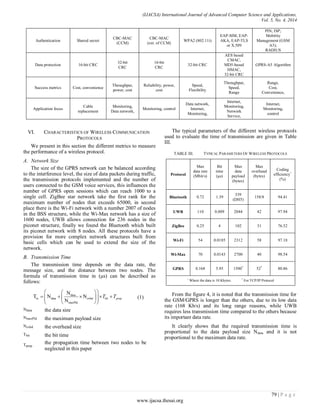
The typical parameters of the different wireless protocols
used to evaluate the time of transmission are given in Table
III.
TABLE III. TYPICAL PARAMETERS OF WIRELESS PROTOCOLS
Protocol
Max
data rate
(Mbit/s)
Bit
time
(μs)
Max
data
payload
(bytes)
Max
overhead
(bytes)
Coding
efficiency+
(%)
Bluetooth 0.72 1.39
339
(DH5)
158/8 94.41
UWB 110 0.009 2044 42 97.94
ZigBee 0.25 4 102 31 76.52
Wi-Fi 54 0.0185 2312 58 97.18
Wi-Max 70 0.0143 2700 40 98.54
GPRS 0.168 5.95 1500*
52*
80.86
+
Where the data is 10 Kbytes. *
For TCP/IP Protocol
From the figure 4, it is noted that the transmission time for
the GSM/GPRS is longer than the others, due to its low data
rate (168 Kb/s) and its long range reasons, while UWB
requires less transmission time compared to the others because
its important data rate.
It clearly shows that the required transmission time is
proportional to the data payload size Ndata and it is not
proportional to the maximum data rate.
(IJACSA) International Journal of Advanced Computer Science and Applications,
Vol. 5, No. 4, 2014
80 | P a g e
www.ijacsa.thesai.org
Fig. 4. Comparison of transmission time relative to the data size
C. Transmission power and range
In wireless transmissions, the relationship between the
received power and the transmitted power is given by the Friis
equation as follows [1], [33], [36-40]:
2
r
t r
t
P
G G
P 4 D


 
  
 
(2)
Pt the transmitted power
Pr the received power
Gt the transmitting omni basic antenna gain
Gr the receiving antenna gain
D the distance between the two antennas
λ the wavelength of the signal
From equation (2) yields the formula the range of coverage
as follows:
r
t t r
1
D
P4
P G G



(3)
We note that as the frequency increases, the range
decreases. The figure 5 shows the variation of signal range
based on the transmission frequency for a fixed power. The
most revealing characteristic of this graph is the non-linearity.
The signals of GSM/GPRS with 900MHz propagate much
better than ZigBee, Wi-Fi, Bluetooth with 2.4GHz and UWB
with 3.1GHz vice to vice coverage area.
Fig. 5. Range evolution according to the transmission frequency
D. Energy consumption
The energy consumption for intelligent sensor involves
three steps: acquisition, communication, computation and data
aggregation. This consumption in the acquisition operation
depends on the nature of the application [3]. Data traffic,
particularly in the transmission, consumes more energy than
the other operations. It also depends on the distance between
the transmitter and receiver [4], [5].
The model governing the energy consumption E(p) of an
intelligent sensor p depending on the communication range
d(p) is given as follows:
   . 2dE p k d p E
   (4)
k the packet size
α the signal attenuation coefficient
Ed the transmission energy costs
According to the radio energy model, [6], [38-44] the
transmission power of a k bit message to a distance d is given
by:
 
2
0
4
0
. . .
E ,
. . .
fs Elec
TX
amp Elec
k d k E d d
k d
k d k E d d


  
 
 
(5)
0
fs
amp
d


 (6)
EElec electronic energy
εfs, εamp amplification energy
0 2000 4000 6000 8000 10000
10
-4
10
-2
10
0
10
2
10
4
10
6
Data Payload Size (Bytes)
TransmissionTime(µs)
Bleutooth
UWB
ZigBee
Wi-Fi
Wi-Max
GSM/GPRS
(IJACSA) International Journal of Advanced Computer Science and Applications,
Vol. 5, No. 4, 2014
81 | P a g e
www.ijacsa.thesai.org
The electronic energy EElec depends on several factors such
as digital coding, modulation, filtering, and signal propagation,
while the amplifier energy depends on the distance to the
receiver and the acceptable bit error rate. If the message size
and the range of communication are fixed, then if the value of
α grow, the required energy to cover a given distance increase
also.
The figure 6 illustrates the evolution of the energy
consumption for ZigBee protocol based on the signal range.
We can say that an increase in data packet size allows then an
increase of the transmission energy. The equations (4) and (5)
can be generalized for the all wireless mentioned protocols.
The simulation parameters are given in table IV.
TABLE IV. THE SIMULATION PARAMETERS
Parameters Value
EElec 50 nJ/bit
εfs 10 pJ/bit/m2
εamp 0.0013 pJ/bit/m4
Fig. 6. The energy consumption depending on the signal range
The predicted received power by an intelligent sensor for
each data packet according to the communication range d is
given by the Two-Ray Ground and the Friss free space models
[3], [35], [40] as follows:
   
2
2
2 2
4
4
P
t t r
c
r
t t r t r
c
PG G
d d
d L
d
PG G h h
d d
d





 


(7)
4 r t
c
Lh h
d


 (8)
L the path loss
ht the height of the transmitter antenna
hr the height of the receiver antenna
d the distance between transmitter and receiver
The figure 7 shows the evolution of the reception power
based on the signal range for the different studied protocols for
a fixed data packet size:
TABLE V. THE SIMULATION PARAMETERS
Parameters Value
L 1
Gt=Gr 1
ht=hr 1.5 m
Protocols
Transmitted
Power (Watt)
Bluetooth 0.1
UWB 0.04
ZigBee 0.0063
Wi-Fi 1
Wi-Max 0.25
GSM/GPRS 2
According to this figure, it is noted that when the distance
between the transmitter and the receiver increases, the
received power decreases, this is justified by the power loss in
the path. The ZigBee, UWB and Bluetooth have low power
consumption while Wi-Max, Wi-Fi and GPRS absorb more
power due to theirs high communication range reason.
Fig. 7. The received power depending on the signal range with fixed
message size
E. Chipset power consumption
To compare practically the power consumption, we are
presents in the table VI the detailed representative
characteristics of particular chipset for each protocol [44-
49]. The figure 8 shows the consumption power in (mW) for
each protocol. Obviously we note that Bluetooth and ZigBee
consume less power compared to UWB, Wi-Fi, Wi-Max and a
GPRS connection. The difference between the transmission
power and reception power for the protocols GPRS and Wi-
Max is justified by the power loss due to the attenuation of the
0 10 20 30 40 50 60 70 80 90 100
1
2
3
4
5
6
7
8
9
10
x 10
-4
Range (m)
Energy(J)
Energy dependence on Range
k=4000 bits
k=5000 bits
0 10 20 30 40 50 60 70 80 90 100
10
-12
10
-10
10
-8
10
-6
10
-4
10
-2
Range (m)
Power(Watt)
Bluetooth f=2.49 GHz
UWB f=3.1 GHz
ZigBee f=915 MHz
WiFi f=5.5 GHz
Wimax f=3.58 GHz
GPRS f=900 MHz
(IJACSA) International Journal of Advanced Computer Science and Applications,
Vol. 5, No. 4, 2014
82 | P a g e
www.ijacsa.thesai.org
signal in the communication path since both of these protocols
have a large coverage area.
TABLE VI. POWER CONSUMPTION CHARACTERISTICS OF CHIPSETS
Protocols Chipset VDD
(volt)
ITX
(mA)
IRX
(mA)
Bit
rate
(Mb/s)
Bluetooth BlueCore2 1.8 57 47 0.72
UWB XS110 3.3 ~227 ~227 114
ZigBee CC2430 3.0 24.7 27 0.25
Wi-Fi CX53111 3.3 219 215 54
Wi-Max
AT86
RF535A
3.3 320 200 70
GSM/GPRS SIM300 3 350*
230*
0.164*
*
For GSM 900 DATA mode, GPRS ( 1 Rx,1 Tx )
Fig. 8. Comparison of chipset power consumption for each protocol
Based on the data rate of each protocol, the normalized
energy consumption in (mJ/Mb) is shown in the figure 9,
shows clearly in this figure that the UWB, Wi-Fi and Wi-Max
have better energy efficiency. In summary, we can say that
Bluetooth and ZigBee are suitable for low data rate
applications with a limited battery power, because of their low
energy consumption which promotes a long lifetime.
Contrariwise for implementations of high data rate, UWB, Wi-
Fi and Wi-Max would be the best solution due to their low
normalized energy consumption. While for monitoring and
surveillance applications with low data rate requiring large
area coverage, GPRS would be an adequate solution.
F. Bit error rate
The transmitted signal is corrupted by white noise AWGN
(Additive White Gaussian Noise) to measure the performance
of the digital transmissions (OQ-B-Q-PSK, 4PAM, 16QAM,
GMSK, GFSK, 8DPSK, 8PSK and OFDM), seen in the table
II, by calculating the bit error probability. The purpose of a
modulation technique is not only the transfer of a data packet
by a radio channel, but also achieves this operation with a
better quality, energy efficiency and less bandwidth as
possible.
Fig. 9. Comparing the chipset normalized energy consumption for each
protocol
The bit error rate is a very good way to measure the
performance of the modulation used by a communication
system and therefore helps to improve its robustness. It is
calculated by the following formula:
BER Err
TXBits
N
N
 (9)
NErr the number of errors
NTXBits the number of transmitted bits
The figure 10 shows the BER of the differents modulations
used in wireless technologies mentioned above according on
signal to noise ratio Eb/N0.
The BER for all systems decreases monotonically with
increasing values of Eb/N0, the curves defining a shape similar
to the shape of a waterfall [36], [38]. The BER for QPSK and
OQPSK is the same as for BPSK. We note that the higher
order modulations exhibit higher error rates which thus leads
to a compromise with the spectral efficiency.
QPSK and GMSK seem the best compromise between
spectral efficiency and BER followed by other modulations.
These two robust modulations are used in Wi-MAX, ZigBee,
Wi-Fi and in GPRS network, can be employed in the noisy
channels and in the noisy environments. However, because of
their sensitivity to noise and non-linearities, the modulations
4PAM and 8DPSK remain little used compared to other
modulations.
Concerning the QAM modulation, it uses more efficiently
the transmitted energy when the number of bits per symbol
increases; this provides a better spectral efficiency and a high
bit rate. As for the frequency hopping FSK modulations, the
increase of the symbols will enable reduction of the BER but
also increase the spectral occupancy. The main fault of these
FSK modulations is their low spectral efficiency.
(IJACSA) International Journal of Advanced Computer Science and Applications,
Vol. 5, No. 4, 2014
83 | P a g e
www.ijacsa.thesai.org
Fig. 10. Bit Error Rate for differents modulations
On the other side, the GMSK modulation has been
developed in order to increase the spectral efficiency [50]. It
has a satisfactory performance in terms of BER and noise
resistance. This modulation is applied in the data transmission
systems (MODEM), in The GSM networks [9], [35], [37],
[39], [41]. The table VII gives the values of Eb/N0 which
cancel the BER for each modulation. Furthermore, the lower
bit error probability is obtained to the detriment of the number
of users. We must investigate the relationship between the
transmission quality and the number of users served [50].
TABLE VII. EB/N0 VALUES WHICH CANCELS BER FOR THE DIFFERENT
MODULATIONS
Modulation Eb /N0 (dB) B.E.R
B-OQ-QPSK 7,8 10-6
GMSK 12,7 10-6
FSK 13,3 10-6
8PSK 13,8 10-6
OFDM 14,3 10-6
16QAM 14,8 10-6
GFSK 15,7 10-6
4PAM 17,6 10-6
8DPSK 22,6 10-6
G. Data coding efficiency
The coding efficiency can be calculated from the following
formula:
data
cdeff
data
data ovhd
maxPld
N
P 100
N
N N
N
 
  
    
  
(10)
Based on the figure 11, the coding efficiency increases
when the data size increase. For small data size, Bluetooth and
ZigBee is the best solution while for high data sizes GPRS,
UWB, Wi-Max and Wi-Fi protocols have efficiency around
94%.
In the applications point of view, for the automation
industrial systems based on intelligent sensors, since most data
monitoring and industrial control have generally a small size,
such the pressure or the temperature measurements that don't
pass 4 bytes and that don't require an important data rate,
Bluetooth, ZigBee and GPRS can be a good choice due to their
coding efficiency and their low data rate. On the other hand,
for applications requiring a large cover zone as the borders
monitoring, the persons tracking or the environmental
monitoring or the event detection, GPRS and Wi-Max are an
adequate solution, whereas for the multimedia applications
requiring an important data rate such the video monitoring,
Wi-Fi, UWB and Wi-Max form a better solution.
Fig. 11. Coding efficiency depending on data size
VII. CONCLUSION
We have presented in this paper a comparative
performance analysis of six wireless protocols: Bluetooth,
UWB, ZigBee, Wi-Fi, Wi-Max and GSM/GPRS. However, it
exists others wireless protocols as 6LoWPAN, DASH,
HiperLAN…We have chosen therefore to land just the most
popular ones. A quantitative evaluation of the transmission
time, the data coding efficiency, the bite error rate, and the
power and the energy consumption in addition of the network
size permitted us to choose the best protocol which is suitable
for an application based on intelligent sensor.
Furthermore, the adequacy of these protocols is influenced
strongly by many others factors as the network reliability, the
link capacity between several networks having different
protocols, the security, the chipset price, the conformity with
the application and the cost of installation that must be taking
in consideration. Facing the fact that several types of wireless
technologies can coexist in a capture environment, the
challenge which requires is to develop a gateway (multi-
standard transceiver) that enables the data exchange between
these heterogeneous infrastructures with a good quality of
service. This approach would allow the implementation of
solutions for maintaining and for monitoring while minimizing
the necessary resources and avoiding the costs associated to
the compatibility testing. Solving this challenge is a
0 5 10 15 20 25 30
10
-6
10
-5
10
-4
10
-3
10
-2
10
-1
10
0
BER
Bit Error Rate depending on Eb/No
Eb/N0(dB)
Q-OQ-B-PSK
16QAM
GFSK
GMSK
8DPSK
4PAM
FSK
8PSK
OFDM
10
0
10
1
10
2
10
3
10
4
0
20
40
60
80
100
Data Payload Size (Bytes)
Datacodingefficiency(%)
Bleutooth
UWB
ZigBee
Wi-Fi
Wi-Max
GSM/GPRS
(IJACSA) International Journal of Advanced Computer Science and Applications,
Vol. 5, No. 4, 2014
84 | P a g e
www.ijacsa.thesai.org
perspective and a continuation of this work. It turns out that
the choice of a modulation type is always determined by the
constraints and the requirements of the application. The BER
is a parameter which gives an excellent performance indication
of a radio data link.
REFERENCES
[1] Jean-Paul M., G. Linmartz's, “Wireless Communication, The Interactive
Multimedia CD-ROM”, Baltzer Science Publishers, P.O.Box 37208,
1030 AE Amsterdam, ISSN 1383 4231, Vol. 1 (1996), No.1
[2] Helen Fornazier et al., “Wireless Communication : Wi-Fi, Bluetooth,
IEEE 802.15.4, DASH7”, ROSE 2012 ELECINF344 / ELECINF381,
Télécom ParisTech, web site : http://rose.eu.org/2012/category/admin
[3] Lehsaini Mohamed, “Diffusion et couverture basées sur le clustering
dans les réseaux de capteurs : application à la domotique ”, Thèse de
Doctorat, Université de Franche-Comté Besançon, U.F.R Sciences et
Techniques, École Doctorale SPIM, Juillet 2009
[4] Trevor Pering et al., CoolSpots: “Reducing the Power Consumption of
Wireless Mobile Devices with Multiple Radio Interfaces”, ACM 1-
59593-195-3/06/0006, MobiSys'06, June 19–22, 2006, Uppsala, Sweden
[5] Travis Collins et al., “A Green Approach to a Multi-Protocol Wireless
Communications Network”, Major Qualifying Project to obtain the
Degree in Bachelor of Science in Electrical and Computer Engineering,
Faculty of Worcester Polytechnic Institute, University of Limerick 2011,
http://www.wpi.edu/Academics/Projects.
[6] Wendi B. Heinzelman et al., “An Application-Specific Protocol
Architecture for Wireless Microsensor Networks”, IEEE
TRANSACTIONS ON WIRELESS COMMUNICATIONS, VOL. 1,
NO. 4, OCTOBER 2002
[7] Baghouri Mostafa, Chakkor Saad, Hajraoui Abderrahmane, “Fuzzy logic
approach to improving Stable Election Protocol for clustered
heterogeneous wireless sensor networks”, Journal of Theoretical and
Applied Information Technology, Vol. 53 No.3, July 2013
[8] El Ahmadi Cheikh, Chakkor Saad et al, “New Approach to Improving
Lifetime in Heterogeneous Wireless Sensor Networks Based on
Clustering Energy Efficiency Algorithm”, Journal of Theoretical and
Applied Information Technology, Vol. 61 No.2, March 2014
[9] Crepin Nsiala Nzeza, “ RÉCEPTEUR ADAPTATIF MULTI-
STANDARDS POUR LES SIGNAUX A ÉTALEMENT DE SPECTRE
EN CONTEXTE NON COOPÉRATIF ”, thèse de Doctorat,
UNIVERSITÉ de Bretagne Occidentale, Juillet 2006
[10] Guillaume Terrasson, “CONTRIBUTION A LA CONCEPTION
D’EMETTEUR- RECEPTEUR POUR MICROCAPTEURS
AUTONOMES”, thèse de Doctorat, UNIVERSITÉ BORDEAUX 1,
Novembre 2008
[11] Creed Huddleston, “Intelligent Sensor Design Using the Microchip
dsPIC (Embedded Technology)”, Newnes 2007
[12] Elmostafa Ziani, “CONCEPTION ET REALISATION D’UN
INSTRUMENT ULTRASONORE INTELLIGENT DEDIE A LA
MESURE DE DEBITS D’ECOULEMENT A SURFACE LIBRE”,
Thèse de doctorat en cotutelle, Université abdelmalek essaadi, Faculté
des sciences et techniques de Tanger, Université de paris 13
Villetaneuse, Institut universitaire de technologie de Saint- denis 2005
[13] Fei Hu, Qi Hao, “Intelligent Sensor Networks: The Integration of Sensor
Networks”, Signal Processing and Machine Learning, CRC Press 2012
[14] Jin-Shyan Lee et al., “A Comparative Study of Wireless Protocols:
Bluetooth, UWB, ZigBee”, and Wi-Fi, The 33rd Annual Conference of
the IEEE Industrial Electronics Society (IECON), Taipei, Taiwan,
November 5-8, 2007
[15] Adil Koukab et al., “A GSM-GPRS/UMTS FDD-TDD/WLAN 802.11a-
b-g Multi-Standard Carrier Generation System”, IEEE JOURNAL OF
SOLID-STATE CIRCUITS, VOL. 41, NO. 7, JULY 2006
[16] Jin-Shyan Lee, “Performance Evaluation of IEEE 802.15.4 for Low-
Rate Wireless Personal Area Networks”, IEEE Transactions on
Consumer Electronics, Vol. 52, No. 3, AUGUST 2006
[17] Klaus Gravogl et al., “Choosing the best wireless protocol for typical
applications”, 2nd Workshop on Ultra-low Power Wireless Sensor
Networks (WUPS 2011) February 2011, Como, Italy,
http://geodes.ict.tuwien.ac.at/PowerSavingHandbook/
[18] Z. Mammeri, “ Réseaux sans fils Caractéristiques et principaux standards
”, M1 Info Cours de Réseaux, IRIT, Université Paul Sabatier, Toulouse
http://www.irit.fr/ Zoubir.Mammeri/Chap WLAN.pdf
[19] Ghobad Heidari, “WiMedia UWB: Technology of Choice for Wireless
USB and Bluetooth”, edition John Wiley & Sons Ltd 2008, ISBN 978-
11-470-51814-2 (HB)
[20] Ms. Dharmistha, D. Vishwakarma, “IEEE 802.15.4 and ZigBee: A
Conceptual Study”, International Journal of Advanced Research in
Computer and Communication Engineering, ISSN : 2278 – 1021, Vol. 1,
Issue 7, September 2012
[21] Vaddina Prakash Rao, “The simulative Investigation of Zigbee/IEEE
802.15.4”, Master Thesis of Science, DRESDEN UNIVERSITY OF
TECHNOLOGY, FACULTY OF ELECTRICAL ENGINEERING AND
INFORMATION TECHNOLOGY, Department of Electrical
Engineering and Information Technology, Chair of Telecommunications,
September, 2005
[22] http://www.zigbee.org/Specifications/ZigBeeIP/Overview.aspx
[23] Reen-Cheng Wang et al., “Internetworking Between ZigBee/802.15.4
and IPv /802.3 Network”, ACM 978-1-59593-790-2/07/0008, IPv ’07,
August 31, 2007, Kyoto, Japan.
[24] Aurélien Géron, “WIFI PROFESSIONNEL La norme 802.11, le
déploiement, la sécurité ”, 3ème édition DUNOD
[25] Bhavneet Sidhu et al., “Emerging Wireless Standards - WiFi, ZigBee
and WiMAX”, World Academy of Science, Engineering and
Technology 25 2007
[26] Michèle Germain, “WiMAX à l'usage des communications haut débit”,
Forum atena, lulu.com, Paris, 2009
[27] Loutfi Nuaymi, “WiMAX : Technology for Broadband Wireless
Access”, Wiley, 2007
[28] Marwa Ibrahim et al., “Performance investigation of Wi-Max 802.16m
in mobile high altitude platforms”, Journal of Theoretical and Applied
Information Technology, 10th June 2013. Vol. 52 No.1
[29] Xavier Lagrange et al., “ Réseaux GSM : des principes à la norme ”,
Éditions Hermès Sciences, 2000, ISBN 2-7462-0153-4
[30] Timo Halonen et al., “GSM, GPRS Performance and EDGE, Evolution
Towards 3G/UMTS”, Second Edition, John Wiley & Sons Ltd 2003,
ISBN 0-470-86694-2
[31] Brahim Ghribi, Luigi Logrippo, “Understanding GPRS: the GSM packet
radio service”, Elsevier Computer Networks 34 (2000) 7 3 - 779
[32] Christian Bettstetter et al., “GSM phase 2+general packet radio service
GPRS: architecture, protocols, and air interface”, IEEE Communications
Surveys, Third Quarter 1999, vol. 2 no. 3,
http://www.comsoc.org/pubs/surveys
[33] Joseph Ho et al., “Throughput and Buffer Analysis for GSM General
Packet Radio Service (GPRS)”, Wireless Communications and
Networking Conference New Orleans, LA, 1999. WCNC. 1999 IEEE,
Pages 1427 - 1431 vol.3, ISSN: 1525-3511, ISBN: 0-7803-5668-3
[34] Constantine A. Balanis, “Antenna Theory: Analysis and Design” (2nd
edition), John Wiley and Sons, Inc 1997
[35] François de Dieuleveult, Olivier Romain, “ ÉLECTRONIQUE
APPLIQUÉE AUX HAUTES FRÉQUENCES ” Principes et
applications, 2e édition, Dunod, Paris 2008, ISBN 978-2-10-053748-8
[36] DR. Kamilo Feher, “Wireless Digital Communications (Modulation &
Spread spectrum Applications)”, PHI Learning, Prentice Hall PTR, 1995
[37] Simon Haykin, “Communication Systems”, 4Th Edition with Solutions
Manual, John Wiley and Sons, Inc 2001.
[38] Proakis, J. G., “Digital Communications”, 3rd edition, New York,
McGraw-Hill, 1995.
[39] Sklar, B., “Digital Communications: Fundamentals and Applications”,
Englewood Cliffs, NJ, Prentice-Hall, 1988
[40] Rappaport T.S., “Wireless Communications Principles and Practice”,
2nd Edition, Prentice Hall, 2001.
[41] Andreas F. Molisch, “WIRELESS COMMUNICATIONS”, John Wiley
& Sons Ltd., Second Edition 2011, ISBN: 978-0-470-74187-0
[42] Prakash C. Gupta, “Data Communications and Computer Networks”,
(IJACSA) International Journal of Advanced Computer Science and Applications,
Vol. 5, No. 4, 2014
85 | P a g e
www.ijacsa.thesai.org
PHI Learning, Prentice-Hall of India 2006, ISBN 81-203-2846-9
[43] Nitin Mittal et al., “IMPROVED LEACH COMMUNICATION
PROTOCOL FOR WSN”, NCCI 19-20 March 2010, National
Conference on Computational Instrumentation CSIO Chandigarh,
INDIA
[44] Cambridge Silicon Radio, BlueCore2-External Product Data Sheet.
Cambridge, UK, Aug. 2006.
[45] [45] Freescale, XS110 UWB Solution for Media-Rich Wireless
Applications. San Diego, CA, Dec. 2004.
[46] Chipcon, CC2430 Preliminary Data Sheet (rev. 1.03). Oslo, Norway,
2006.
[47] Conexant, Single-Chip WLAN Radio CX53111. Newport Beach, CA,
2006.
[48] SIMCOM Ltd, SIM300 Hardware Specification, 27th Dec 2005.
[49] ATMEL, WiMax Transceiver 802.16-2004, AT86RF535A Preliminary
Data Sheet, 2006
[50] David K. Asano, Subbarayan Pasupathy, “Optimization of Coded GMSK
Systems”, IEEE Transactions on Information Theory, VOL. 48, NO. 10,
OCTOBER 2002
[51] “Guide of MATLAB” 7.8.0 (R2009a), www.mathworks.com

Comparative Performance Analysis of Wireless Communication Protocols for Intelligent Sensors and Their Applications

  • 1.
    (IJACSA) International Journalof Advanced Computer Science and Applications, Vol. 5, No. 4, 2014 76 | P a g e www.ijacsa.thesai.org Comparative Performance Analysis of Wireless Communication Protocols for Intelligent Sensors and Their Applications Chakkor Saad Department of Physics, Team: Communication and Detection Systems, University of Abdelmalek Essaâdi, Faculty of Sciences, Tetouan, Morocco El Ahmadi Cheikh Department of Physics, Team: Communication and Detection Systems, University of Abdelmalek Essaâdi, Faculty of Sciences, Tetouan, Morocco Baghouri Mostafa Department of Physics, Team: Communication and Detection Systems, University of Abdelmalek Essaâdi, Faculty of Sciences, Tetouan, Morocco Hajraoui Abderrahmane Department of Physics, Team: Communication and Detection Systems, University of Abdelmalek Essaâdi, Faculty of Sciences, Tetouan, Morocco Abstract—The systems based on intelligent sensors are currently expanding, due to theirs functions and theirs performances of intelligence: transmitting and receiving data in real-time, computation and processing algorithms, metrology remote, diagnostics, automation and storage measurements…The radio frequency wireless communication with its multitude offers a better solution for data traffic in this kind of systems. The mains objectives of this paper is to present a solution of the problem related to the selection criteria of a better wireless communication technology face up to the constraints imposed by the intended application and the evaluation of its key features. The comparison between the different wireless technologies (Wi- Fi, Wi-Max, UWB, Bluetooth, ZigBee, ZigBeeIP, GSM/GPRS) focuses on their performance which depends on the areas of utilization. Furthermore, it shows the limits of their characteristics. Study findings can be used by the developers/ engineers to deduce the optimal mode to integrate and to operate a system that guarantees quality of communication, minimizing energy consumption, reducing the implementation cost and avoiding time constraints. Keywords—Wireless communications; Performances; Energy; Protocols; Intelligent sensors; Applications I. INTRODUCTION Wireless technologies have made significant progress in recent years, allowing many applications in addition to traditional voice communications and the transmission of high-speed data with sophisticated mobile devices and smart objects. In fact, they also changed the field of metrology especially the sensor networks and the smart sensors. The establishment of an intelligent sensor system requires the insertion of wireless communication which has changed the world of telecommunications. It can be used in many situations where mobility is essential and the wires are not practical. Today, the emergence of radio frequency wireless technologies suggests that the expensive wiring can be reduced or eliminated. Various technologies have emerged providing communication differently. This difference lies in the quality of service and in some constraints related on the application and it environment. The main constraints to be overcome in choosing a wireless technology revolve around the following conditions [1], [2]:  Range  Reliability  Bandwidth  conformity (standards)  Security  Cost  Energy consumption  Speed and transmission type (synchronous, asynchronous)  Network architecture (topology)  Environment (noise, obstacles, weather, hypsometry) In this work, we studies using a comparative analysis, the different parameters which influence the performance and quality of a wireless communication system based on intelligent sensors taking into our consideration the cost and the application requirements. We can classify the requirements of applications using smart sensors into three main categories as shown in table I.
  • 2.
    (IJACSA) International Journalof Advanced Computer Science and Applications, Vol. 5, No. 4, 2014 77 | P a g e www.ijacsa.thesai.org TABLE I. NEEDS BASED APPLICATIONS II. RELATED WORK In the related work, many research studies in [3-8] have been focused on wireless sensor networks to improve communication protocols in order to solve the energy constraint, to increase the level of security and precision and to expand autonomy for accuracy, feasibility and profitability reasons. On the other side, the field of intelligent sensors remains fertile and opens its doors to research and innovation, it is a true technological challenge in so far as the topology and the infrastructure of the systems based on intelligent sensors are greatly different compared to wireless sensor networks, particularly in terms of size (number of nodes) and routing. In fact, to preserve the quality of these networks, it is very difficult even inconceivable to replace regularly the faulty nodes, which would result in a high cost of maintenance. The concept of energy efficiency appears therefore in communication protocols, [5-9]. Thus, it is very useful to search the optimization of data routing and to limit unnecessary data sending and the collisions [6], [9]. The aim challenge for intelligent sensors systems is to overcome the physical limitations in data traffic such as system noise, signal attenuation, response dynamics, power consumption, and effective conversion rates etc… This paper emphasis on the metrics of performance for wireless protocols which stands for superior measurement, more accuracy and reliability. The object of this study is for realizing an advanced intelligent sensors strategy that offers many system engineering and operational advantages which can offer cost-effective solutions for an application. III. NEW CONSTRAINTS OF INTELLIGENT SENSORS SYSTEM An intelligent sensor is an electronic device for taking measurements of a physical quantity as an electrical signal, it intelligence lie in the ability to check the correct execution of a metrology algorithm, in remote configurability, in its functions relating to the safety, diagnosis, control and communication. The intelligent sensor can be seen consisting of two parts [10-13]: 1) A measuring chain controlled by microcontroller 2) A bidirectional communication interface with the network, providing the connection of the sensor to a central computer The communication part reflects all the information collected by an intelligent sensor and allows the user to configure the sensor for operation. It is therefore absolutely essential that this interface be robust and reliable. Figure 1 illustrates the intelligent sensor with its wireless communicating component. A variety of communication interfaces (wireless modules) is available, but not all sensors support these interfaces. The designer must select an interface that provides the best integration of the sensor with the others components of the system taking in our account the costs and the constraints of reliability required for a particular application. There are others solutions to collect remote measurements such mobile and satellite communications. The main problems related to the quality of communications are: attenuation problems (distance, obstacles, rain ...), interference and multipath. The realization of the systems based on smart sensors dedicated to the applications mentioned in section I, requires the techniques and the protocols that take into account the following constraints [3]:  The nodes are deployed in high numbers  At any time, the nodes may be faulty or inhibited  The topology changes very frequently  The communication is broadcast Fig. 1. Block diagram of an intelligent sensor communication The sensors are limited in energy, in computing capacity, and in memory. In ad-hoc networks, energy consumption was considered as an aim factor but not essential because energy resources can be replaced by the user. These networks are more focused on the QoS than the energy consumption. Contrariwise, in sensor networks, the transmission time and energy consumption are two important performance metrics since generally the sensors are deployed in inaccessible areas. IV. SENSORS TECHNOLOGY AND OPTIMAL TOPOLOGY The communication topology of the intelligent sensor systems is divided into two categories: A. Direct Communication The intelligent sensors deployed in a capture zone communicate directly with the base station via a radio link as shown in figure 2, the server collect and processes the measurements data and stores it in a database. Types of application Specifications and Needs Environmental monitoring  Measurement and regular sending  Few data  Long battery life  Permanent connection Event detection  Alerte message  Priority  Confirmation statuts  Few data  Permanent connection Tracking  Mobility  Few data  Localization  Permanent connection
  • 3.
    (IJACSA) International Journalof Advanced Computer Science and Applications, Vol. 5, No. 4, 2014 78 | P a g e www.ijacsa.thesai.org Fig. 2. Direct communication with the monitoring center Fig. 3. Indirect communication with the monitoring center B. Indirect Communication In this case, the intelligent sensor communicates, via a GPRS network providing Internet connectivity, with the server of the monitoring center as shown in figure 3. With this architecture, it is possible to establish communications for applications that have a wider monitoring area which spreads for kilometers or when the application requires large dimensions. V. THE COMPARATIVE PERFORMANCE ANALYSIS In this section, we put importance with a comparative study the following wireless protocols: Bluetooth, UWB, ZigBee, ZigBeeIP, Wi-Fi, Wi-Max, GSM/GPRS which correspond to the standards IEEE 802.15.1, 802.15.3, 802.15.4, 802.11a/b/g, 802.16 and 850-900 DCS PCS respectively [14], [15]. Based on the characteristics of each standard, obviously noticed that the UWB, Wi-Fi and Wi-Max protocols provides a higher data rate, while Bluetooth, ZigBee and GPRS provide a lower level. Contrariwise, Bluetooth, UWB and ZigBee are intended for WPAN communication due to their range of coverage which reaches 10 m, while Wi-Fi is oriented WLAN with a range of about 100 m. However, Wi-Max and GPRS have a coverage radius of a few tens of kilometers for a WMAN network. Table II summarizes the main differences between the mentioned protocols. TABLE II. COMPARISON OF CHARACTERISTICS FOR DIFFERENT WIRELESS PROTOCOLS Protocols Bluetooth [2], [14], [17], [18] UWB [14], [19] ZigBee/IP [2], [14], [17-23] Wi-Fi [1], [2], [14], [24], [25] Wi-Max [17], [25-28] GSM/GPRS [29-33] Frequency band 2.4 GHz 3.1-10.6 GHz 868/915 MHz; 2.4 GHz 2.4; 5 GHz 2.4; 5.1- 66 GHz 850/900; 1800/1900 MHz Max signal rate 720 Kb/s 110 Mb/s 250 Kb/s 54 Mb/s 35-70 Mb/s 168 Kb/s Nominal range 10 m 10-102 m 10 - 1000 m 10-100 m 0.3-49 Km 2-35 Km Nominal TX power 0 - 10 dBm -41.3 dBm/MHz -25 - 0 dBm 15 - 20 dBm 23 dBm 0-39 dBm Number of RF channels 79 (1-15) 1/10; 16 14 (2.4 GHz) 64 (5 GHz) 4;8 10;20 124 Channel bandwidth 1 MHz 0.5- 7.5 GHz 0.3/0.6 MHz; 2 MHz 25-20 MHz 20;10 MHz 200 kHz Modulation type GFSK, CPFSK, 8-DPSK, π/4- DQPSK BPSK, PPM, PAM, OOK, PWM BPSK QPSK, O-QPSK BPSK, QPSK, OFDM, M-QAM QAM16/64, QPSK, BPSK, OFDM GMSK, 8PSK Spreading FHSS DS-UWB, MB- OFDM DSSS MC-DSSS, CCK, OFDM OFDM, OFDMA TDMA, DSSS Basic cell Piconet Piconet Star BSS Single-cell Single-cell Extension of the basic cell Scatternet Peer-to-Peer Cluster tree, Mesh ESS PTMP, PTCM, Mesh Cellular system Max number of cell nodes 8 236 > 65000 2007 1600 1000 Encryption E0 stream cipher AES block cipher (CTR, counter mode) AES block cipher (CTR, counter mode) RC4 stream cipher (WEP), AES block cipher AES-CCM cipher GEA, MS-SGSN, MS-host
  • 4.
    (IJACSA) International Journalof Advanced Computer Science and Applications, Vol. 5, No. 4, 2014 79 | P a g e www.ijacsa.thesai.org Authentication Shared secret CBC-MAC (CCM) CBC-MAC (ext. of CCM) WPA2 (802.11i) EAP-SIM, EAP- AKA, EAP-TLS or X.509 PIN; ISP; Mobility Management (GSM A3); RADIUS Data protection 16-bit CRC 32-bit CRC 16-bit CRC 32-bit CRC AES based CMAC, MD5-based HMAC, 32-bit CRC GPRS-A5 Algorithm Success metrics Cost, convenience Throughput, power, cost Reliability, power, cost Speed, Flexibility Throughput, Speed, Range Range, Cost, Convenience, Application focus Cable replacement Monitoring, Data network, Monitoring, control Data network, Internet, Monitoring, Internet, Monitoring, Network Service, Internet, Monitoring, control VI. CHARACTERISTICS OF WIRELESS COMMUNICATION PROTOCOLS We present in this section the different metrics to measure the performance of a wireless protocol. A. Network Size The size of the GPRS network can be balanced according to the interference level, the size of data packets during traffic, the transmission protocols implemented and the number of users connected to the GSM voice services, this influences the number of GPRS open sessions which can reach 1000 to a single cell. ZigBee star network take the first rank for the maximum number of nodes that exceeds 65000, in second place there is the Wi-Fi network with a number 2007 of nodes in the BSS structure, while the Wi-Max network has a size of 1600 nodes, UWB allows connection for 236 nodes in the piconet structure, finally we found the Bluetooth which built its piconet network with 8 nodes. All these protocols have a provision for more complex network structures built from basic cells which can be used to extend the size of the network. B. Transmission Time The transmission time depends on the data rate, the message size, and the distance between two nodes. The formula of transmission time in (µs) can be described as follows: data tx data ovhd maxPld N T N N N bit propT T               (1) Ndata the data size NmaxPld the maximum payload size Novhd the overhead size Tbit the bit time Tprop the propagation time between two nodes to be neglected in this paper The typical parameters of the different wireless protocols used to evaluate the time of transmission are given in Table III. TABLE III. TYPICAL PARAMETERS OF WIRELESS PROTOCOLS Protocol Max data rate (Mbit/s) Bit time (μs) Max data payload (bytes) Max overhead (bytes) Coding efficiency+ (%) Bluetooth 0.72 1.39 339 (DH5) 158/8 94.41 UWB 110 0.009 2044 42 97.94 ZigBee 0.25 4 102 31 76.52 Wi-Fi 54 0.0185 2312 58 97.18 Wi-Max 70 0.0143 2700 40 98.54 GPRS 0.168 5.95 1500* 52* 80.86 + Where the data is 10 Kbytes. * For TCP/IP Protocol From the figure 4, it is noted that the transmission time for the GSM/GPRS is longer than the others, due to its low data rate (168 Kb/s) and its long range reasons, while UWB requires less transmission time compared to the others because its important data rate. It clearly shows that the required transmission time is proportional to the data payload size Ndata and it is not proportional to the maximum data rate.
  • 5.
    (IJACSA) International Journalof Advanced Computer Science and Applications, Vol. 5, No. 4, 2014 80 | P a g e www.ijacsa.thesai.org Fig. 4. Comparison of transmission time relative to the data size C. Transmission power and range In wireless transmissions, the relationship between the received power and the transmitted power is given by the Friis equation as follows [1], [33], [36-40]: 2 r t r t P G G P 4 D          (2) Pt the transmitted power Pr the received power Gt the transmitting omni basic antenna gain Gr the receiving antenna gain D the distance between the two antennas λ the wavelength of the signal From equation (2) yields the formula the range of coverage as follows: r t t r 1 D P4 P G G    (3) We note that as the frequency increases, the range decreases. The figure 5 shows the variation of signal range based on the transmission frequency for a fixed power. The most revealing characteristic of this graph is the non-linearity. The signals of GSM/GPRS with 900MHz propagate much better than ZigBee, Wi-Fi, Bluetooth with 2.4GHz and UWB with 3.1GHz vice to vice coverage area. Fig. 5. Range evolution according to the transmission frequency D. Energy consumption The energy consumption for intelligent sensor involves three steps: acquisition, communication, computation and data aggregation. This consumption in the acquisition operation depends on the nature of the application [3]. Data traffic, particularly in the transmission, consumes more energy than the other operations. It also depends on the distance between the transmitter and receiver [4], [5]. The model governing the energy consumption E(p) of an intelligent sensor p depending on the communication range d(p) is given as follows:    . 2dE p k d p E    (4) k the packet size α the signal attenuation coefficient Ed the transmission energy costs According to the radio energy model, [6], [38-44] the transmission power of a k bit message to a distance d is given by:   2 0 4 0 . . . E , . . . fs Elec TX amp Elec k d k E d d k d k d k E d d          (5) 0 fs amp d    (6) EElec electronic energy εfs, εamp amplification energy 0 2000 4000 6000 8000 10000 10 -4 10 -2 10 0 10 2 10 4 10 6 Data Payload Size (Bytes) TransmissionTime(µs) Bleutooth UWB ZigBee Wi-Fi Wi-Max GSM/GPRS
  • 6.
    (IJACSA) International Journalof Advanced Computer Science and Applications, Vol. 5, No. 4, 2014 81 | P a g e www.ijacsa.thesai.org The electronic energy EElec depends on several factors such as digital coding, modulation, filtering, and signal propagation, while the amplifier energy depends on the distance to the receiver and the acceptable bit error rate. If the message size and the range of communication are fixed, then if the value of α grow, the required energy to cover a given distance increase also. The figure 6 illustrates the evolution of the energy consumption for ZigBee protocol based on the signal range. We can say that an increase in data packet size allows then an increase of the transmission energy. The equations (4) and (5) can be generalized for the all wireless mentioned protocols. The simulation parameters are given in table IV. TABLE IV. THE SIMULATION PARAMETERS Parameters Value EElec 50 nJ/bit εfs 10 pJ/bit/m2 εamp 0.0013 pJ/bit/m4 Fig. 6. The energy consumption depending on the signal range The predicted received power by an intelligent sensor for each data packet according to the communication range d is given by the Two-Ray Ground and the Friss free space models [3], [35], [40] as follows:     2 2 2 2 4 4 P t t r c r t t r t r c PG G d d d L d PG G h h d d d          (7) 4 r t c Lh h d    (8) L the path loss ht the height of the transmitter antenna hr the height of the receiver antenna d the distance between transmitter and receiver The figure 7 shows the evolution of the reception power based on the signal range for the different studied protocols for a fixed data packet size: TABLE V. THE SIMULATION PARAMETERS Parameters Value L 1 Gt=Gr 1 ht=hr 1.5 m Protocols Transmitted Power (Watt) Bluetooth 0.1 UWB 0.04 ZigBee 0.0063 Wi-Fi 1 Wi-Max 0.25 GSM/GPRS 2 According to this figure, it is noted that when the distance between the transmitter and the receiver increases, the received power decreases, this is justified by the power loss in the path. The ZigBee, UWB and Bluetooth have low power consumption while Wi-Max, Wi-Fi and GPRS absorb more power due to theirs high communication range reason. Fig. 7. The received power depending on the signal range with fixed message size E. Chipset power consumption To compare practically the power consumption, we are presents in the table VI the detailed representative characteristics of particular chipset for each protocol [44- 49]. The figure 8 shows the consumption power in (mW) for each protocol. Obviously we note that Bluetooth and ZigBee consume less power compared to UWB, Wi-Fi, Wi-Max and a GPRS connection. The difference between the transmission power and reception power for the protocols GPRS and Wi- Max is justified by the power loss due to the attenuation of the 0 10 20 30 40 50 60 70 80 90 100 1 2 3 4 5 6 7 8 9 10 x 10 -4 Range (m) Energy(J) Energy dependence on Range k=4000 bits k=5000 bits 0 10 20 30 40 50 60 70 80 90 100 10 -12 10 -10 10 -8 10 -6 10 -4 10 -2 Range (m) Power(Watt) Bluetooth f=2.49 GHz UWB f=3.1 GHz ZigBee f=915 MHz WiFi f=5.5 GHz Wimax f=3.58 GHz GPRS f=900 MHz
  • 7.
    (IJACSA) International Journalof Advanced Computer Science and Applications, Vol. 5, No. 4, 2014 82 | P a g e www.ijacsa.thesai.org signal in the communication path since both of these protocols have a large coverage area. TABLE VI. POWER CONSUMPTION CHARACTERISTICS OF CHIPSETS Protocols Chipset VDD (volt) ITX (mA) IRX (mA) Bit rate (Mb/s) Bluetooth BlueCore2 1.8 57 47 0.72 UWB XS110 3.3 ~227 ~227 114 ZigBee CC2430 3.0 24.7 27 0.25 Wi-Fi CX53111 3.3 219 215 54 Wi-Max AT86 RF535A 3.3 320 200 70 GSM/GPRS SIM300 3 350* 230* 0.164* * For GSM 900 DATA mode, GPRS ( 1 Rx,1 Tx ) Fig. 8. Comparison of chipset power consumption for each protocol Based on the data rate of each protocol, the normalized energy consumption in (mJ/Mb) is shown in the figure 9, shows clearly in this figure that the UWB, Wi-Fi and Wi-Max have better energy efficiency. In summary, we can say that Bluetooth and ZigBee are suitable for low data rate applications with a limited battery power, because of their low energy consumption which promotes a long lifetime. Contrariwise for implementations of high data rate, UWB, Wi- Fi and Wi-Max would be the best solution due to their low normalized energy consumption. While for monitoring and surveillance applications with low data rate requiring large area coverage, GPRS would be an adequate solution. F. Bit error rate The transmitted signal is corrupted by white noise AWGN (Additive White Gaussian Noise) to measure the performance of the digital transmissions (OQ-B-Q-PSK, 4PAM, 16QAM, GMSK, GFSK, 8DPSK, 8PSK and OFDM), seen in the table II, by calculating the bit error probability. The purpose of a modulation technique is not only the transfer of a data packet by a radio channel, but also achieves this operation with a better quality, energy efficiency and less bandwidth as possible. Fig. 9. Comparing the chipset normalized energy consumption for each protocol The bit error rate is a very good way to measure the performance of the modulation used by a communication system and therefore helps to improve its robustness. It is calculated by the following formula: BER Err TXBits N N  (9) NErr the number of errors NTXBits the number of transmitted bits The figure 10 shows the BER of the differents modulations used in wireless technologies mentioned above according on signal to noise ratio Eb/N0. The BER for all systems decreases monotonically with increasing values of Eb/N0, the curves defining a shape similar to the shape of a waterfall [36], [38]. The BER for QPSK and OQPSK is the same as for BPSK. We note that the higher order modulations exhibit higher error rates which thus leads to a compromise with the spectral efficiency. QPSK and GMSK seem the best compromise between spectral efficiency and BER followed by other modulations. These two robust modulations are used in Wi-MAX, ZigBee, Wi-Fi and in GPRS network, can be employed in the noisy channels and in the noisy environments. However, because of their sensitivity to noise and non-linearities, the modulations 4PAM and 8DPSK remain little used compared to other modulations. Concerning the QAM modulation, it uses more efficiently the transmitted energy when the number of bits per symbol increases; this provides a better spectral efficiency and a high bit rate. As for the frequency hopping FSK modulations, the increase of the symbols will enable reduction of the BER but also increase the spectral occupancy. The main fault of these FSK modulations is their low spectral efficiency.
  • 8.
    (IJACSA) International Journalof Advanced Computer Science and Applications, Vol. 5, No. 4, 2014 83 | P a g e www.ijacsa.thesai.org Fig. 10. Bit Error Rate for differents modulations On the other side, the GMSK modulation has been developed in order to increase the spectral efficiency [50]. It has a satisfactory performance in terms of BER and noise resistance. This modulation is applied in the data transmission systems (MODEM), in The GSM networks [9], [35], [37], [39], [41]. The table VII gives the values of Eb/N0 which cancel the BER for each modulation. Furthermore, the lower bit error probability is obtained to the detriment of the number of users. We must investigate the relationship between the transmission quality and the number of users served [50]. TABLE VII. EB/N0 VALUES WHICH CANCELS BER FOR THE DIFFERENT MODULATIONS Modulation Eb /N0 (dB) B.E.R B-OQ-QPSK 7,8 10-6 GMSK 12,7 10-6 FSK 13,3 10-6 8PSK 13,8 10-6 OFDM 14,3 10-6 16QAM 14,8 10-6 GFSK 15,7 10-6 4PAM 17,6 10-6 8DPSK 22,6 10-6 G. Data coding efficiency The coding efficiency can be calculated from the following formula: data cdeff data data ovhd maxPld N P 100 N N N N              (10) Based on the figure 11, the coding efficiency increases when the data size increase. For small data size, Bluetooth and ZigBee is the best solution while for high data sizes GPRS, UWB, Wi-Max and Wi-Fi protocols have efficiency around 94%. In the applications point of view, for the automation industrial systems based on intelligent sensors, since most data monitoring and industrial control have generally a small size, such the pressure or the temperature measurements that don't pass 4 bytes and that don't require an important data rate, Bluetooth, ZigBee and GPRS can be a good choice due to their coding efficiency and their low data rate. On the other hand, for applications requiring a large cover zone as the borders monitoring, the persons tracking or the environmental monitoring or the event detection, GPRS and Wi-Max are an adequate solution, whereas for the multimedia applications requiring an important data rate such the video monitoring, Wi-Fi, UWB and Wi-Max form a better solution. Fig. 11. Coding efficiency depending on data size VII. CONCLUSION We have presented in this paper a comparative performance analysis of six wireless protocols: Bluetooth, UWB, ZigBee, Wi-Fi, Wi-Max and GSM/GPRS. However, it exists others wireless protocols as 6LoWPAN, DASH, HiperLAN…We have chosen therefore to land just the most popular ones. A quantitative evaluation of the transmission time, the data coding efficiency, the bite error rate, and the power and the energy consumption in addition of the network size permitted us to choose the best protocol which is suitable for an application based on intelligent sensor. Furthermore, the adequacy of these protocols is influenced strongly by many others factors as the network reliability, the link capacity between several networks having different protocols, the security, the chipset price, the conformity with the application and the cost of installation that must be taking in consideration. Facing the fact that several types of wireless technologies can coexist in a capture environment, the challenge which requires is to develop a gateway (multi- standard transceiver) that enables the data exchange between these heterogeneous infrastructures with a good quality of service. This approach would allow the implementation of solutions for maintaining and for monitoring while minimizing the necessary resources and avoiding the costs associated to the compatibility testing. Solving this challenge is a 0 5 10 15 20 25 30 10 -6 10 -5 10 -4 10 -3 10 -2 10 -1 10 0 BER Bit Error Rate depending on Eb/No Eb/N0(dB) Q-OQ-B-PSK 16QAM GFSK GMSK 8DPSK 4PAM FSK 8PSK OFDM 10 0 10 1 10 2 10 3 10 4 0 20 40 60 80 100 Data Payload Size (Bytes) Datacodingefficiency(%) Bleutooth UWB ZigBee Wi-Fi Wi-Max GSM/GPRS
  • 9.
    (IJACSA) International Journalof Advanced Computer Science and Applications, Vol. 5, No. 4, 2014 84 | P a g e www.ijacsa.thesai.org perspective and a continuation of this work. It turns out that the choice of a modulation type is always determined by the constraints and the requirements of the application. The BER is a parameter which gives an excellent performance indication of a radio data link. REFERENCES [1] Jean-Paul M., G. Linmartz's, “Wireless Communication, The Interactive Multimedia CD-ROM”, Baltzer Science Publishers, P.O.Box 37208, 1030 AE Amsterdam, ISSN 1383 4231, Vol. 1 (1996), No.1 [2] Helen Fornazier et al., “Wireless Communication : Wi-Fi, Bluetooth, IEEE 802.15.4, DASH7”, ROSE 2012 ELECINF344 / ELECINF381, Télécom ParisTech, web site : http://rose.eu.org/2012/category/admin [3] Lehsaini Mohamed, “Diffusion et couverture basées sur le clustering dans les réseaux de capteurs : application à la domotique ”, Thèse de Doctorat, Université de Franche-Comté Besançon, U.F.R Sciences et Techniques, École Doctorale SPIM, Juillet 2009 [4] Trevor Pering et al., CoolSpots: “Reducing the Power Consumption of Wireless Mobile Devices with Multiple Radio Interfaces”, ACM 1- 59593-195-3/06/0006, MobiSys'06, June 19–22, 2006, Uppsala, Sweden [5] Travis Collins et al., “A Green Approach to a Multi-Protocol Wireless Communications Network”, Major Qualifying Project to obtain the Degree in Bachelor of Science in Electrical and Computer Engineering, Faculty of Worcester Polytechnic Institute, University of Limerick 2011, http://www.wpi.edu/Academics/Projects. [6] Wendi B. Heinzelman et al., “An Application-Specific Protocol Architecture for Wireless Microsensor Networks”, IEEE TRANSACTIONS ON WIRELESS COMMUNICATIONS, VOL. 1, NO. 4, OCTOBER 2002 [7] Baghouri Mostafa, Chakkor Saad, Hajraoui Abderrahmane, “Fuzzy logic approach to improving Stable Election Protocol for clustered heterogeneous wireless sensor networks”, Journal of Theoretical and Applied Information Technology, Vol. 53 No.3, July 2013 [8] El Ahmadi Cheikh, Chakkor Saad et al, “New Approach to Improving Lifetime in Heterogeneous Wireless Sensor Networks Based on Clustering Energy Efficiency Algorithm”, Journal of Theoretical and Applied Information Technology, Vol. 61 No.2, March 2014 [9] Crepin Nsiala Nzeza, “ RÉCEPTEUR ADAPTATIF MULTI- STANDARDS POUR LES SIGNAUX A ÉTALEMENT DE SPECTRE EN CONTEXTE NON COOPÉRATIF ”, thèse de Doctorat, UNIVERSITÉ de Bretagne Occidentale, Juillet 2006 [10] Guillaume Terrasson, “CONTRIBUTION A LA CONCEPTION D’EMETTEUR- RECEPTEUR POUR MICROCAPTEURS AUTONOMES”, thèse de Doctorat, UNIVERSITÉ BORDEAUX 1, Novembre 2008 [11] Creed Huddleston, “Intelligent Sensor Design Using the Microchip dsPIC (Embedded Technology)”, Newnes 2007 [12] Elmostafa Ziani, “CONCEPTION ET REALISATION D’UN INSTRUMENT ULTRASONORE INTELLIGENT DEDIE A LA MESURE DE DEBITS D’ECOULEMENT A SURFACE LIBRE”, Thèse de doctorat en cotutelle, Université abdelmalek essaadi, Faculté des sciences et techniques de Tanger, Université de paris 13 Villetaneuse, Institut universitaire de technologie de Saint- denis 2005 [13] Fei Hu, Qi Hao, “Intelligent Sensor Networks: The Integration of Sensor Networks”, Signal Processing and Machine Learning, CRC Press 2012 [14] Jin-Shyan Lee et al., “A Comparative Study of Wireless Protocols: Bluetooth, UWB, ZigBee”, and Wi-Fi, The 33rd Annual Conference of the IEEE Industrial Electronics Society (IECON), Taipei, Taiwan, November 5-8, 2007 [15] Adil Koukab et al., “A GSM-GPRS/UMTS FDD-TDD/WLAN 802.11a- b-g Multi-Standard Carrier Generation System”, IEEE JOURNAL OF SOLID-STATE CIRCUITS, VOL. 41, NO. 7, JULY 2006 [16] Jin-Shyan Lee, “Performance Evaluation of IEEE 802.15.4 for Low- Rate Wireless Personal Area Networks”, IEEE Transactions on Consumer Electronics, Vol. 52, No. 3, AUGUST 2006 [17] Klaus Gravogl et al., “Choosing the best wireless protocol for typical applications”, 2nd Workshop on Ultra-low Power Wireless Sensor Networks (WUPS 2011) February 2011, Como, Italy, http://geodes.ict.tuwien.ac.at/PowerSavingHandbook/ [18] Z. Mammeri, “ Réseaux sans fils Caractéristiques et principaux standards ”, M1 Info Cours de Réseaux, IRIT, Université Paul Sabatier, Toulouse http://www.irit.fr/ Zoubir.Mammeri/Chap WLAN.pdf [19] Ghobad Heidari, “WiMedia UWB: Technology of Choice for Wireless USB and Bluetooth”, edition John Wiley & Sons Ltd 2008, ISBN 978- 11-470-51814-2 (HB) [20] Ms. Dharmistha, D. Vishwakarma, “IEEE 802.15.4 and ZigBee: A Conceptual Study”, International Journal of Advanced Research in Computer and Communication Engineering, ISSN : 2278 – 1021, Vol. 1, Issue 7, September 2012 [21] Vaddina Prakash Rao, “The simulative Investigation of Zigbee/IEEE 802.15.4”, Master Thesis of Science, DRESDEN UNIVERSITY OF TECHNOLOGY, FACULTY OF ELECTRICAL ENGINEERING AND INFORMATION TECHNOLOGY, Department of Electrical Engineering and Information Technology, Chair of Telecommunications, September, 2005 [22] http://www.zigbee.org/Specifications/ZigBeeIP/Overview.aspx [23] Reen-Cheng Wang et al., “Internetworking Between ZigBee/802.15.4 and IPv /802.3 Network”, ACM 978-1-59593-790-2/07/0008, IPv ’07, August 31, 2007, Kyoto, Japan. [24] Aurélien Géron, “WIFI PROFESSIONNEL La norme 802.11, le déploiement, la sécurité ”, 3ème édition DUNOD [25] Bhavneet Sidhu et al., “Emerging Wireless Standards - WiFi, ZigBee and WiMAX”, World Academy of Science, Engineering and Technology 25 2007 [26] Michèle Germain, “WiMAX à l'usage des communications haut débit”, Forum atena, lulu.com, Paris, 2009 [27] Loutfi Nuaymi, “WiMAX : Technology for Broadband Wireless Access”, Wiley, 2007 [28] Marwa Ibrahim et al., “Performance investigation of Wi-Max 802.16m in mobile high altitude platforms”, Journal of Theoretical and Applied Information Technology, 10th June 2013. Vol. 52 No.1 [29] Xavier Lagrange et al., “ Réseaux GSM : des principes à la norme ”, Éditions Hermès Sciences, 2000, ISBN 2-7462-0153-4 [30] Timo Halonen et al., “GSM, GPRS Performance and EDGE, Evolution Towards 3G/UMTS”, Second Edition, John Wiley & Sons Ltd 2003, ISBN 0-470-86694-2 [31] Brahim Ghribi, Luigi Logrippo, “Understanding GPRS: the GSM packet radio service”, Elsevier Computer Networks 34 (2000) 7 3 - 779 [32] Christian Bettstetter et al., “GSM phase 2+general packet radio service GPRS: architecture, protocols, and air interface”, IEEE Communications Surveys, Third Quarter 1999, vol. 2 no. 3, http://www.comsoc.org/pubs/surveys [33] Joseph Ho et al., “Throughput and Buffer Analysis for GSM General Packet Radio Service (GPRS)”, Wireless Communications and Networking Conference New Orleans, LA, 1999. WCNC. 1999 IEEE, Pages 1427 - 1431 vol.3, ISSN: 1525-3511, ISBN: 0-7803-5668-3 [34] Constantine A. Balanis, “Antenna Theory: Analysis and Design” (2nd edition), John Wiley and Sons, Inc 1997 [35] François de Dieuleveult, Olivier Romain, “ ÉLECTRONIQUE APPLIQUÉE AUX HAUTES FRÉQUENCES ” Principes et applications, 2e édition, Dunod, Paris 2008, ISBN 978-2-10-053748-8 [36] DR. Kamilo Feher, “Wireless Digital Communications (Modulation & Spread spectrum Applications)”, PHI Learning, Prentice Hall PTR, 1995 [37] Simon Haykin, “Communication Systems”, 4Th Edition with Solutions Manual, John Wiley and Sons, Inc 2001. [38] Proakis, J. G., “Digital Communications”, 3rd edition, New York, McGraw-Hill, 1995. [39] Sklar, B., “Digital Communications: Fundamentals and Applications”, Englewood Cliffs, NJ, Prentice-Hall, 1988 [40] Rappaport T.S., “Wireless Communications Principles and Practice”, 2nd Edition, Prentice Hall, 2001. [41] Andreas F. Molisch, “WIRELESS COMMUNICATIONS”, John Wiley & Sons Ltd., Second Edition 2011, ISBN: 978-0-470-74187-0 [42] Prakash C. Gupta, “Data Communications and Computer Networks”,
  • 10.
    (IJACSA) International Journalof Advanced Computer Science and Applications, Vol. 5, No. 4, 2014 85 | P a g e www.ijacsa.thesai.org PHI Learning, Prentice-Hall of India 2006, ISBN 81-203-2846-9 [43] Nitin Mittal et al., “IMPROVED LEACH COMMUNICATION PROTOCOL FOR WSN”, NCCI 19-20 March 2010, National Conference on Computational Instrumentation CSIO Chandigarh, INDIA [44] Cambridge Silicon Radio, BlueCore2-External Product Data Sheet. Cambridge, UK, Aug. 2006. [45] [45] Freescale, XS110 UWB Solution for Media-Rich Wireless Applications. San Diego, CA, Dec. 2004. [46] Chipcon, CC2430 Preliminary Data Sheet (rev. 1.03). Oslo, Norway, 2006. [47] Conexant, Single-Chip WLAN Radio CX53111. Newport Beach, CA, 2006. [48] SIMCOM Ltd, SIM300 Hardware Specification, 27th Dec 2005. [49] ATMEL, WiMax Transceiver 802.16-2004, AT86RF535A Preliminary Data Sheet, 2006 [50] David K. Asano, Subbarayan Pasupathy, “Optimization of Coded GMSK Systems”, IEEE Transactions on Information Theory, VOL. 48, NO. 10, OCTOBER 2002 [51] “Guide of MATLAB” 7.8.0 (R2009a), www.mathworks.com