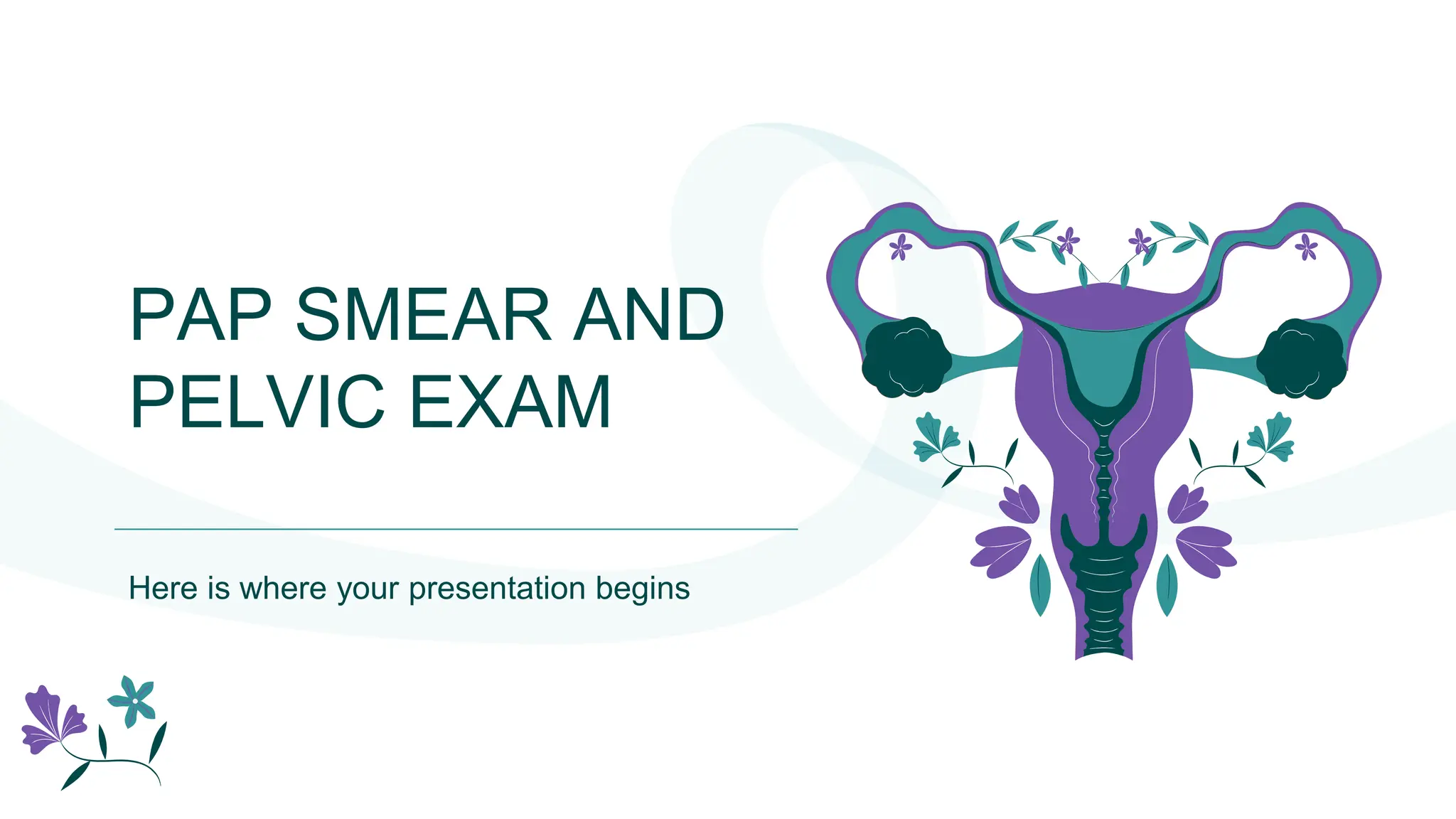
PAP SMEAR AND
PELVIC EXAM
Here is where your presentation begins
Table of contents
01
04
02
05
03
06
Introduction of pap
smear and PV
Definition of pap
smear and PV
Indications of pap
smear and PV
Contraindications
of pap smear and
PV
How often do you
take this pap smear?
Preparation for the
test
Table of contents
07
10
08
11
09
12
Pre requisite and
Equipment of PV
Procedure of pap
amear and PV
Adverse effect of
pap smear
Result of pap
smear and PV
conclusion reasearch
Pelvic
examination
01
Introduction
Pathology potentially detectable
on the pelvic examination
includes malignancies (e.g.,
cervical, ovarian, uterine,
bladder, vaginal or vulvar);
infections (e.g., Chlamydia,
gonorrhea, warts, candidiasis,
bacterial vaginosis); pelvic
inflammatory disease (PID); or
other pathology (e.g., atrophic
vaginitis, cervical polyps, uterine
prolapse, fibroids). In addition,
pelvic examinations are often
performed prior to the provision
of hormonal contraception
Many women and providers believe that
the routine pelvic exam should be
included in an annual comprehensive
well-woman visit. The exam consists of
inspection of the external genitalia,
speculum examination of the vagina and
cervix, bimanual examination (placement
of two fingers into the vagina with
simultaneous abdominal pressure
provided by the examiner's other hand),
and sometimes rectal or rectovaginal
examination. Traditionally, the
examination in the asymptomatic average
risk women has been used to screen for
pathology through palpation, visualization,
and specimen collection.
.
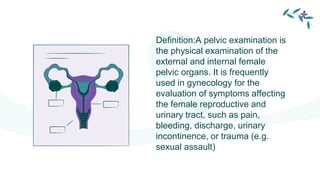
Definition:A pelvic examination is
the physical examination of the
external and internal female
pelvic organs. It is frequently
used in gynecology for the
evaluation of symptoms affecting
the female reproductive and
urinary tract, such as pain,
bleeding, discharge, urinary
incontinence, or trauma (e.g.
sexual assault)
You can divide the content
1-During menstrual period.
2-Sever (acute type) pelvic infections.
3-Contact bleeding with clotting defect.
-
• Cervical erosions
• Cervical carcinoma.
4-Acute vaginal, cervical, uterine
injuries and Infections.
5-H/O Antenatal hemorrhage (APH),
Habitual abortion.
•All Gynecological cases for diagnosis.
1-Cases with - Genital pathology.
-Developmental or congenital
- Acquired Traumatic
- Infection
2-Before vaginal medication & surgery
-Douching, Swabbing, & Therapeutic.
,
3-Routine during pregnancy to
Diagnosis & assessment of pregnancy
conditions.
Indications ContraIndications
Pre-Requisites
a. A female attendant or nurse, her husband should be
present.
b. Doctor should explain to patient or her guardian, what is he
going to do.
c. Examine to minor/ unmarried - consent from the parent or
guardian should be required.
d. Bladder and Rectum should preferably be empty by herself
or by catheterization and enema.
e. Sterilized Equipments and Solutions must be readily
available.
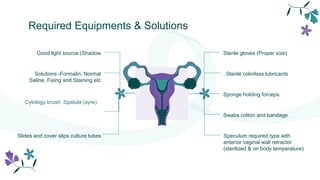
Required Equipments & Solutions
Good light source (Shadow Sterile gloves (Proper size)
. Sterile colorless lubricants
Sponge holding forceps.
Swabs cotton and bandage.
Speculum required type with
anterior vaginal wall retractor
(sterilized & on body temperature)
Solutions -Formalin, Normal
Saline, Fixing and Staining etc
Slides and cover slips culture tubes
Cytology brush, Spatula (ayre)
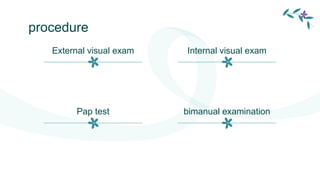
External visual exam
Pap test
Internal visual exam
bimanual examination
procedure
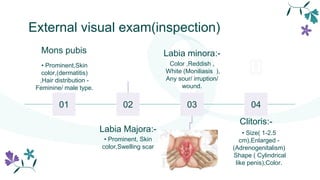
External visual exam(inspection)
01
Mons pubis
• Prominent,Skin
color,(dermatitis)
,Hair distribution -
Feminine/ male type.
02
Labia Majora:-
• Prominent, Skin
color,Swelling scar
03
Labia minora:-
Color ,Reddish ,
White (Moniliasis ),
Any sour/ irruption/
wound.
04
Clitoris:-
• Size( 1-2.5
cm),Enlarged -
(Adrenogenitalism)
Shape ( Cylindrical
like penis),Color.
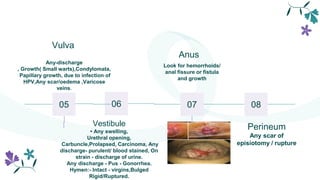
05
Vulva
Any-discharge
, Growth( Small warts),Condylomata,
Papillary growth, due to infection of
HPV,Any scar/oedema ,Varicose
veins.
06
Vestibule
• Any swelling,
Urethral opening,
Carbuncle,Prolapsed, Carcinoma, Any
discharge- purulent/ blood stained, On
strain - discharge of urine.
Any discharge - Pus - Gonorrhea.
Hymen:- Intact - virgins,Bulged
Rigid/Ruptured.
07
Anus
Look for hemorrhoids/
anal fissure or fistula
and growth
08
Perineum
Any scar of
episiotomy / rupture
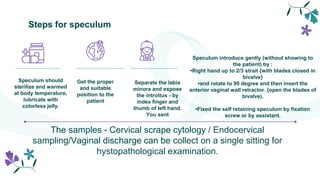
Steps for speculum
Speculum should
sterilize and warmed
at body temperature,
lubricate with
colorless jelly.
Get the proper
and suitable
position to the
patient
Speculum introduce gently (without showing to
the patient) by :
•Right hand up to 2/3 strait {with blades closed in
bivalve}
•and rotate to 90 degree and then insert the
anterior vaginal wall retractor. {open the blades of
bivalve).
•Fixed the self retaining speculum by fixation
screw or by assistant.
Separate the labia
minora and expose
the introitus - by
index finger and
thumb of left hand.
You sent
The samples - Cervical scrape cytology / Endocervical
sampling/Vaginal discharge can be collect on a single sitting for
hystopathological examination.
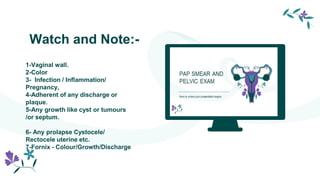
Watch and Note:-
1-Vaginal wall.
2-Color
3- Infection / Inflammation/
Pregnancy,
4-Adherent of any discharge or
plaque.
5-Any growth like cyst or tumours
/or septum.
6- Any prolapse Cystocele/
Rectocele uterine etc.
7-Fornix - Colour/Growth/Discharge
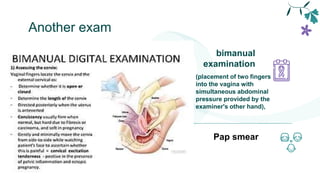
Another exam
bimanual
examination
(placement of two fingers
into the vagina with
simultaneous abdominal
pressure provided by the
examiner's other hand),
Pap smear
Pap smear
introduction
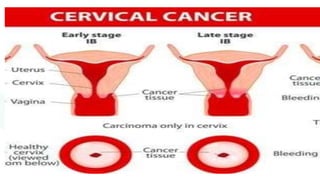
Worldwide, approximately 600,000 new cases of cervical cancer and
342,000 deaths are attributable to cervical cancer yearly, making cervical
cancer the fourth most common cancer in women.
Fortunately, the incidence of cervical cancer has decreased by more than
50% in the past 30+ years, largely due to the increasing use of cervical
cancer screening with cervical cytology. Rates have stabilized over the
past decade, but rates in women 30–44 years old have increased 1.7%
each year from 2012 to 2019. In contrast, rates declined 11% each year
for women 20–24 years old.
The mainstay of cervical cancer screening for the last 60+ years has
been the Papanicolaou test. The Papanicolaou test, also known as the
Pap test or the Pap smear.
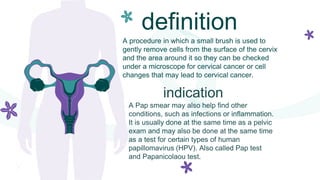
definition
A procedure in which a small brush is used to
gently remove cells from the surface of the cervix
and the area around it so they can be checked
under a microscope for cervical cancer or cell
changes that may lead to cervical cancer.
indication
A Pap smear may also help find other
conditions, such as infections or inflammation.
It is usually done at the same time as a pelvic
exam and may also be done at the same time
as a test for certain types of human
papillomavirus (HPV). Also called Pap test
and Papanicolaou test.
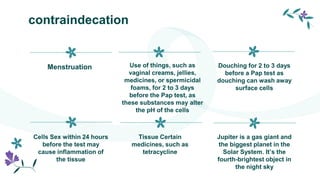
contraindecation
Menstruation Use of things, such as
vaginal creams, jellies,
medicines, or spermicidal
foams, for 2 to 3 days
before the Pap test, as
these substances may alter
the pH of the cells
Cells Sex within 24 hours
before the test may
cause inflammation of
the tissue
Tissue Certain
medicines, such as
tetracycline
Douching for 2 to 3 days
before a Pap test as
douching can wash away
surface cells
Jupiter is a gas giant and
the biggest planet in the
Solar System. It’s the
fourth-brightest object in
the night sky
recommend repeating Pap testing every
three years for women ages 21 to 65.
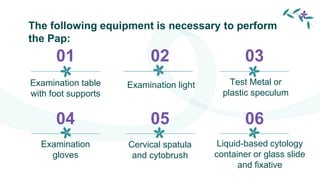
The following equipment is necessary to perform
the Pap:
01
04
02
05
03
06
Examination table
with foot supports
Examination light Test Metal or
plastic speculum
Examination
gloves
Cervical spatula
and cytobrush
Liquid-based cytology
container or glass slide
and fixative
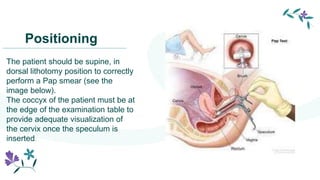
Positioning
The patient should be supine, in
dorsal lithotomy position to correctly
perform a Pap smear (see the
image below).
The coccyx of the patient must be at
the edge of the examination table to
provide adequate visualization of
the cervix once the speculum is
inserted.
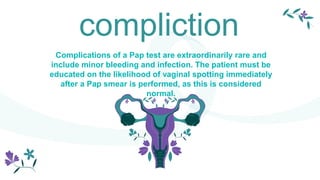
compliction
Complications of a Pap test are extraordinarily rare and
include minor bleeding and infection. The patient must be
educated on the likelihood of vaginal spotting immediately
after a Pap smear is performed, as this is considered
normal.
Click to watch the video
result
research
Cervical cancer screening in Jordan; a review of the past and an outlook
to the future – facts and figures 2023This study aims to assess the
attitude, knowledge, and behaviour of Jordanian women toward cervical
cancer screening and its phenomenal role in preventing the disease,
and to identify the defects and obstacles in the national screening
programs for early detection of this manageable kind of
malignancy.Results:Among 655 women who responded to the
questionnaire, 340 (51.9%) reported having no idea about the smear,
350 (53.4%) had completed higher education, 84 (12.84%) were not
happy to be screened, and 53 (8.09%) were afraid of the result being
positive for malignancy. The shocking and scandalous upshots reported
that 600 women (91.6%) had no idea about the role of vaccination
against this threatening disease
referance
https://emedicine.medscape.com/article/1947979-
overview?form=fpf
https://www.termedia.pl/Cervical-cancer-screening-
in-Jordan-a-review-of-the-past-and-an-outlook-to-the-
future-facts-and-figures,4,50485,0,1.html
Varney s midwifery ( sixth edition)
conclusion
CREDITS: This presentation template was created by Slidesgo, and
includes icons by Flaticon, and infographics & images by Freepik
Thanks!
any questions?

pap smear and pelvic examination presentation

  • 1.
    PAP SMEAR AND PELVICEXAM Here is where your presentation begins
  • 2.
    Table of contents 01 04 02 05 03 06 Introductionof pap smear and PV Definition of pap smear and PV Indications of pap smear and PV Contraindications of pap smear and PV How often do you take this pap smear? Preparation for the test
  • 3.
    Table of contents 07 10 08 11 09 12 Prerequisite and Equipment of PV Procedure of pap amear and PV Adverse effect of pap smear Result of pap smear and PV conclusion reasearch
  • 4.
  • 5.
    Introduction Pathology potentially detectable onthe pelvic examination includes malignancies (e.g., cervical, ovarian, uterine, bladder, vaginal or vulvar); infections (e.g., Chlamydia, gonorrhea, warts, candidiasis, bacterial vaginosis); pelvic inflammatory disease (PID); or other pathology (e.g., atrophic vaginitis, cervical polyps, uterine prolapse, fibroids). In addition, pelvic examinations are often performed prior to the provision of hormonal contraception Many women and providers believe that the routine pelvic exam should be included in an annual comprehensive well-woman visit. The exam consists of inspection of the external genitalia, speculum examination of the vagina and cervix, bimanual examination (placement of two fingers into the vagina with simultaneous abdominal pressure provided by the examiner's other hand), and sometimes rectal or rectovaginal examination. Traditionally, the examination in the asymptomatic average risk women has been used to screen for pathology through palpation, visualization, and specimen collection. .
  • 6.
    Definition:A pelvic examinationis the physical examination of the external and internal female pelvic organs. It is frequently used in gynecology for the evaluation of symptoms affecting the female reproductive and urinary tract, such as pain, bleeding, discharge, urinary incontinence, or trauma (e.g. sexual assault)
  • 7.
    You can dividethe content 1-During menstrual period. 2-Sever (acute type) pelvic infections. 3-Contact bleeding with clotting defect. - • Cervical erosions • Cervical carcinoma. 4-Acute vaginal, cervical, uterine injuries and Infections. 5-H/O Antenatal hemorrhage (APH), Habitual abortion. •All Gynecological cases for diagnosis. 1-Cases with - Genital pathology. -Developmental or congenital - Acquired Traumatic - Infection 2-Before vaginal medication & surgery -Douching, Swabbing, & Therapeutic. , 3-Routine during pregnancy to Diagnosis & assessment of pregnancy conditions. Indications ContraIndications
  • 8.
    Pre-Requisites a. A femaleattendant or nurse, her husband should be present. b. Doctor should explain to patient or her guardian, what is he going to do. c. Examine to minor/ unmarried - consent from the parent or guardian should be required. d. Bladder and Rectum should preferably be empty by herself or by catheterization and enema. e. Sterilized Equipments and Solutions must be readily available.
  • 9.
    Required Equipments &Solutions Good light source (Shadow Sterile gloves (Proper size) . Sterile colorless lubricants Sponge holding forceps. Swabs cotton and bandage. Speculum required type with anterior vaginal wall retractor (sterilized & on body temperature) Solutions -Formalin, Normal Saline, Fixing and Staining etc Slides and cover slips culture tubes Cytology brush, Spatula (ayre)
  • 10.
    External visual exam Paptest Internal visual exam bimanual examination procedure
  • 11.
    External visual exam(inspection) 01 Monspubis • Prominent,Skin color,(dermatitis) ,Hair distribution - Feminine/ male type. 02 Labia Majora:- • Prominent, Skin color,Swelling scar 03 Labia minora:- Color ,Reddish , White (Moniliasis ), Any sour/ irruption/ wound. 04 Clitoris:- • Size( 1-2.5 cm),Enlarged - (Adrenogenitalism) Shape ( Cylindrical like penis),Color.
  • 12.
    05 Vulva Any-discharge , Growth( Smallwarts),Condylomata, Papillary growth, due to infection of HPV,Any scar/oedema ,Varicose veins. 06 Vestibule • Any swelling, Urethral opening, Carbuncle,Prolapsed, Carcinoma, Any discharge- purulent/ blood stained, On strain - discharge of urine. Any discharge - Pus - Gonorrhea. Hymen:- Intact - virgins,Bulged Rigid/Ruptured. 07 Anus Look for hemorrhoids/ anal fissure or fistula and growth 08 Perineum Any scar of episiotomy / rupture
  • 13.
    Steps for speculum Speculumshould sterilize and warmed at body temperature, lubricate with colorless jelly. Get the proper and suitable position to the patient Speculum introduce gently (without showing to the patient) by : •Right hand up to 2/3 strait {with blades closed in bivalve} •and rotate to 90 degree and then insert the anterior vaginal wall retractor. {open the blades of bivalve). •Fixed the self retaining speculum by fixation screw or by assistant. Separate the labia minora and expose the introitus - by index finger and thumb of left hand. You sent The samples - Cervical scrape cytology / Endocervical sampling/Vaginal discharge can be collect on a single sitting for hystopathological examination.
  • 14.
    Watch and Note:- 1-Vaginalwall. 2-Color 3- Infection / Inflammation/ Pregnancy, 4-Adherent of any discharge or plaque. 5-Any growth like cyst or tumours /or septum. 6- Any prolapse Cystocele/ Rectocele uterine etc. 7-Fornix - Colour/Growth/Discharge
  • 15.
    Another exam bimanual examination (placement oftwo fingers into the vagina with simultaneous abdominal pressure provided by the examiner's other hand), Pap smear
  • 16.
  • 17.
    introduction Worldwide, approximately 600,000new cases of cervical cancer and 342,000 deaths are attributable to cervical cancer yearly, making cervical cancer the fourth most common cancer in women. Fortunately, the incidence of cervical cancer has decreased by more than 50% in the past 30+ years, largely due to the increasing use of cervical cancer screening with cervical cytology. Rates have stabilized over the past decade, but rates in women 30–44 years old have increased 1.7% each year from 2012 to 2019. In contrast, rates declined 11% each year for women 20–24 years old. The mainstay of cervical cancer screening for the last 60+ years has been the Papanicolaou test. The Papanicolaou test, also known as the Pap test or the Pap smear.
  • 18.
    definition A procedure inwhich a small brush is used to gently remove cells from the surface of the cervix and the area around it so they can be checked under a microscope for cervical cancer or cell changes that may lead to cervical cancer. indication A Pap smear may also help find other conditions, such as infections or inflammation. It is usually done at the same time as a pelvic exam and may also be done at the same time as a test for certain types of human papillomavirus (HPV). Also called Pap test and Papanicolaou test.
  • 19.
    contraindecation Menstruation Use ofthings, such as vaginal creams, jellies, medicines, or spermicidal foams, for 2 to 3 days before the Pap test, as these substances may alter the pH of the cells Cells Sex within 24 hours before the test may cause inflammation of the tissue Tissue Certain medicines, such as tetracycline Douching for 2 to 3 days before a Pap test as douching can wash away surface cells Jupiter is a gas giant and the biggest planet in the Solar System. It’s the fourth-brightest object in the night sky
  • 20.
    recommend repeating Paptesting every three years for women ages 21 to 65.
  • 21.
    The following equipmentis necessary to perform the Pap: 01 04 02 05 03 06 Examination table with foot supports Examination light Test Metal or plastic speculum Examination gloves Cervical spatula and cytobrush Liquid-based cytology container or glass slide and fixative
  • 22.
    Positioning The patient shouldbe supine, in dorsal lithotomy position to correctly perform a Pap smear (see the image below). The coccyx of the patient must be at the edge of the examination table to provide adequate visualization of the cervix once the speculum is inserted.
  • 24.
    compliction Complications of aPap test are extraordinarily rare and include minor bleeding and infection. The patient must be educated on the likelihood of vaginal spotting immediately after a Pap smear is performed, as this is considered normal.
  • 25.
    Click to watchthe video result
  • 26.
    research Cervical cancer screeningin Jordan; a review of the past and an outlook to the future – facts and figures 2023This study aims to assess the attitude, knowledge, and behaviour of Jordanian women toward cervical cancer screening and its phenomenal role in preventing the disease, and to identify the defects and obstacles in the national screening programs for early detection of this manageable kind of malignancy.Results:Among 655 women who responded to the questionnaire, 340 (51.9%) reported having no idea about the smear, 350 (53.4%) had completed higher education, 84 (12.84%) were not happy to be screened, and 53 (8.09%) were afraid of the result being positive for malignancy. The shocking and scandalous upshots reported that 600 women (91.6%) had no idea about the role of vaccination against this threatening disease
  • 27.
  • 28.
  • 29.
    CREDITS: This presentationtemplate was created by Slidesgo, and includes icons by Flaticon, and infographics & images by Freepik Thanks! any questions?