FEMALE GENITALIA
EXAMINATION
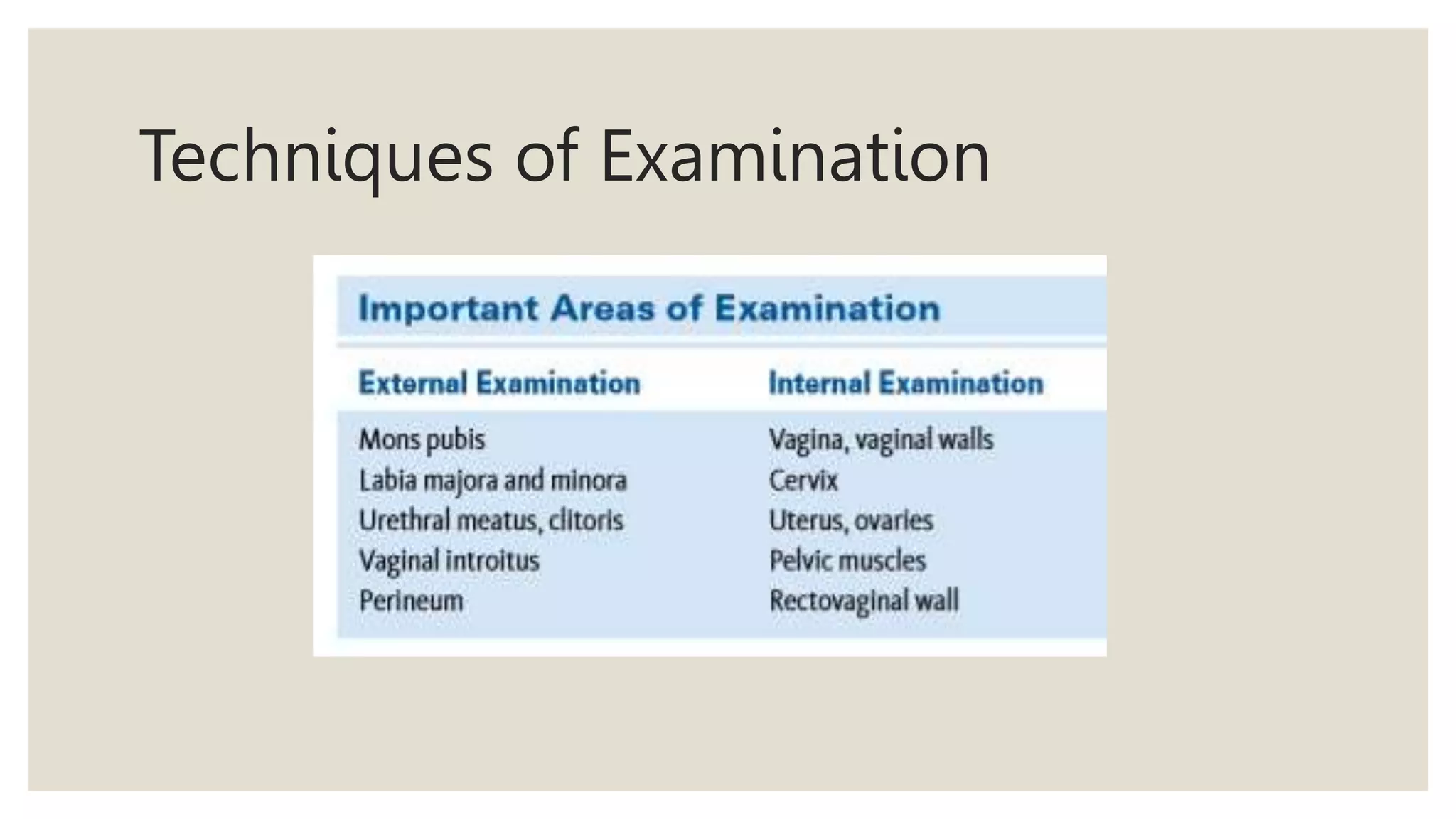
Techniques of Examination
INSPECTION OF THE EXTERNAL
GENITALIA
◦ Vulva- The external female genitalia,
includes
Approach to the Pelvic Examination
◦ Many students feel uneasy during their first pelvic examinations.
◦ Take steps to help a woman having her first pelvic examination know what to expect.
◦ The woman’s response to the pelvic examination may reveal clues about her feelings about the examination and
her sexuality.
◦ Helping the patient to relax is essential for an adequate examination
◦ Always wear gloves, both during the examination and when handling equipment and specimens.
◦ Male examiners should be accompanied by female chaperones.
◦ Pelvic examinations during adolescence should respond to indications such as menstrual abnormalities
(amenorrhea, excessive bleeding, or dysmenorrhea)
 unexplained abdominal pain
 vaginal discharge
 the prescription of contraceptives
 bacteriologic and cytologic studies in a sexually active girl
 the patient’s request for assessment
Sexual Assault
◦ Cases of sexual assault merit special evaluation.
◦ Sexual assault includes rape, unwanted genital touching, and forced exposure to pornography.
◦ Optimally, rape victims should receive care from a trained team at a rape crisis center or
emergency room that can provide support, treatment of injuries, and documentation of
evidence.
◦ Trauma may be extensive, and the time limit for evidence collection is usually 72 to 120 hours.
◦ Evidence collection requires patient permission at each step and involves multistep protocols
that can take up to 6 hours to perform.
◦ Emotional support and prevention of STIs and pregnancy should be addressed
Choosing Equipment
◦ Assemble the equipment below, and review the supplies and procedures of your own facility
before taking cultures and other samples. You will need:
◦ ■ A movable source of good light
◦ ■ A vaginal speculum of appropriate size
◦ ■ Water-soluble lubricant
◦ ■ Equipment for taking Pap smears, bacteriologic cultures and DNA probes, or other diagnostic
testing materials, such as potassium hydroxide and normal saline
Choosing Equipment
◦ Specula are either metal or plastic and come in two basic shapes, named for Pedersen and
Graves
◦ The medium Pedersen speculum is usually most comfortable for sexually active women.
◦ The narrowbladed Pedersen speculum is best for the patient with a small introitus, such as a virgin or an
elderly woman.
◦ The Graves specula are best for parous women with vaginal prolapse.
◦ Before using a speculum, practice opening and closing its blades, locking the blades in an open
position, and releasing them again.
◦ When using a plastic speculum, warn the patient that it typically makes a loud click and may
pinch when locked or released, causing discomfort.
Positioning the Patient
◦ Drape the patient appropriately and then assist her into the lithotomy position.
◦ Place one heel, then the other into the stirrups. She may be more comfortable in socks or shoes
than bare feet.
◦ Ask her to slide all the way down the examining table until her buttocks extend slightly beyond
the edge.
◦ Her thighs should be flexed, abducted, and externally rotated at the hips.
◦ Make sure her head is supported with a pillow.
External Examination
◦ Assess the Sexual Maturity of an Adolescent Patient - rate it according to the Tanner stages
◦ Examine the External Genitalia
◦ Inspect the mons pubis, labia, and perineum. Separate the labia and inspect:
◦ ■ The labia minora
◦ ■ The clitoris
◦ ■ The urethral meatus
◦ ■ The vaginal opening, or introitus
◦ Note any inflammation, ulceration, discharge, swelling, or nodules. Palpate any lesions.
External Examination
◦ Bartholin Glands
◦ If the patient reports labial swelling, examine the Bartholin glands.
◦ Insert your index finger into the vagina near the posterior introitus
◦ Place your thumb outside the posterior part of the labium majus.
◦ Palpate each side in turn, at approximately the “4-o’clock” and “8-o’clock”
positions, between your finger and thumb, checking for swelling or
tenderness.
◦ Note any discharge exuding from the duct opening of the gland. If any is
present, culture it.
Internal Examination
◦ Insert the Speculum.
◦ Select a speculum of appropriate size and shape, and moisten it with warm water. (Lubricants or gels may
interfere with cytologic studies and bacterial or viral cultures.)
◦ Let the patient know you are about to insert the speculum and apply downward pressure.
◦ With your other hand (usually the left), introduce the closed speculum past your fingers at a
downward slope (Fig. 14-9).
◦ Avoid pulling on the pubic hair or pinching the labia as you open and close the speculum.
Separating the labia majora with your right hand helps to avoid this.
Internal Examination
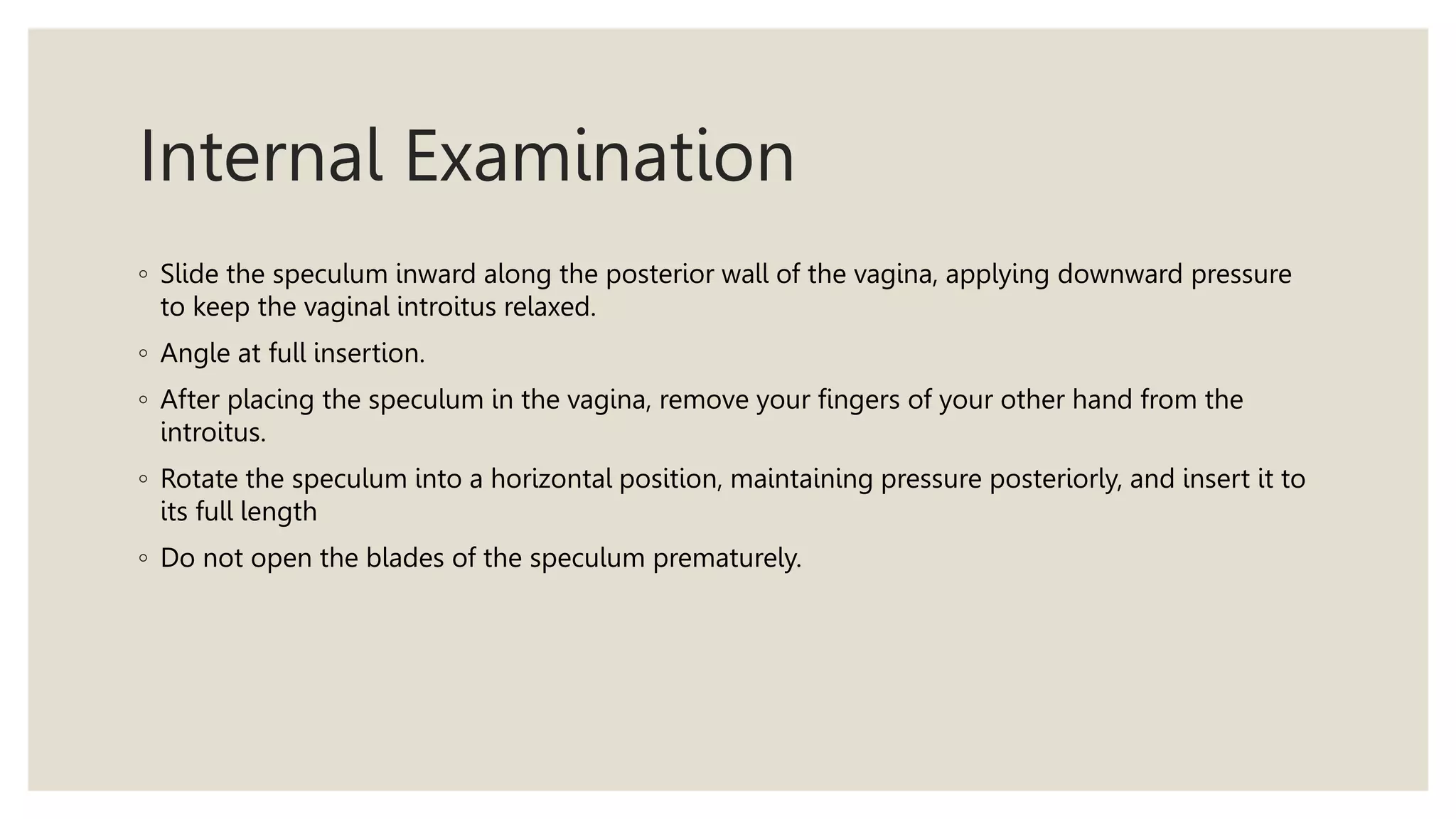
◦ Slide the speculum inward along the posterior wall of the vagina, applying downward pressure
to keep the vaginal introitus relaxed.
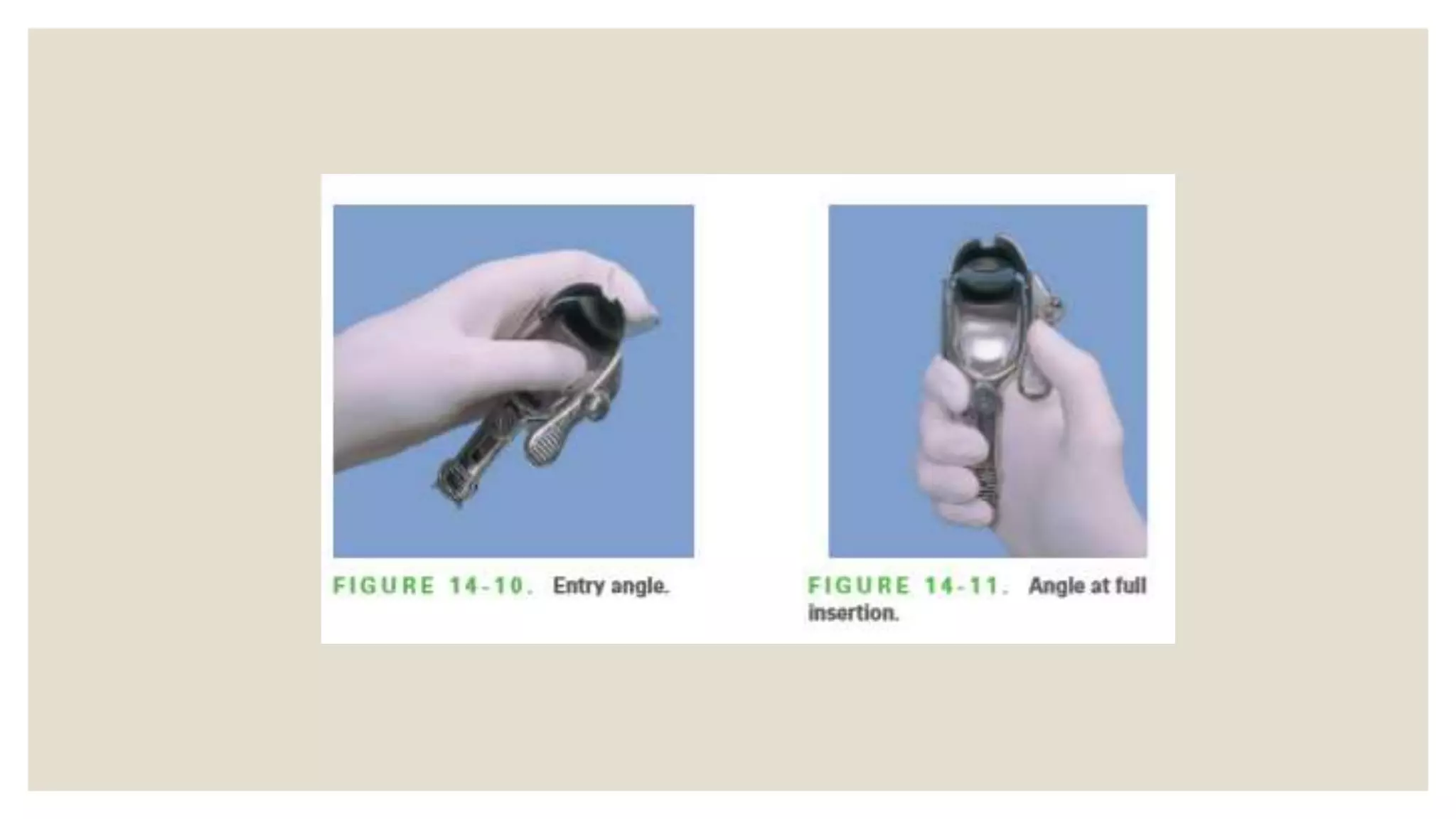
◦ Angle at full insertion.
◦ After placing the speculum in the vagina, remove your fingers of your other hand from the
introitus.
◦ Rotate the speculum into a horizontal position, maintaining pressure posteriorly, and insert it to
its full length
◦ Do not open the blades of the speculum prematurely.
Inspect the Cervix
◦ Open the speculum carefully.
◦ Rotate and adjust the speculum until it cups the cervix and brings it into full view
◦ Fix the speculum in its open position by tightening the thumbscrew.
◦ Position the light until you can see the cervix well.
◦ When the uterus is retroverted, the cervix points more anteriorly than illustrated.
◦ If you have difficulty finding the cervix, withdraw the speculum slightly and reposition it on a different
slope.
◦ If a discharge obscures your view, wipe it away gently with a large cotton swab.
◦ Note the color of the cervix; its position and surface characteristics; and any ulcerations,
nodules, masses, bleeding, or discharge.
◦ Inspect the cervical os for discharge.
Obtain Specimens for Cervical Cytology
(Pap Smears)
◦ Obtain one specimen from the endocervix and another from the ectocervix, or a combination
specimen using the cervical brush (“broom”).
◦ For best results the patient should not be menstruating.
◦ She should avoid intercourse and use of douches, tampons, contraceptive foams or creams, or
vaginal suppositories for 48 hours before the examination.
◦ For sexually active women ages 26 years or younger, and for other asymptomatic women at
increased risk of infection, plan to culture the cervix routinely for chlamydia.
Inspect the Vagina
◦ Withdraw the speculum slowly while observing the vaginal walls.
◦ As the speculum clears the cervix, release the thumbscrew and maintain the open position of
the speculum with your thumb.
◦ During withdrawal, inspect the vaginal mucosa, noting its color and any inflammation, discharge, ulcers,
or masses.
◦ Check for bulging in the vaginal wall.
◦ Remove either the upper or lower blade of the speculum (or use a single-blade speculum) and
ask the woman to bear down so that you can assess the location of vaginal wall relaxation or the
degree of uterine prolapse.
◦ Close the speculum as it emerges from the introitus, avoiding both excessive stretching or
pinching of the mucosa.
Perform a Bimanual Examination
◦ Lubricate the index and middle fingers of one of your gloved hands, and from a standing position,
insert your lubricated fingers into the vagina, again exerting pressure primarily posteriorly.
◦ Your thumb should be abducted, your ring and little fingers flexed into your palm. Note any
nodularity or tenderness in the vaginal wall, including the region of the urethra and the bladder
anteriorly.
◦ ■ Palpate the cervix, noting its position, shape, consistency, regularity, mobility, and tenderness.
Normally, the cervix can be moved somewhat without pain. Feel the fornices around the cervix.
◦ ■ Palpate the uterus. Place your other hand on the abdomen about midway between the umbilicus
and the symphysis pubis. While you elevate the cervix and uterus with your pelvic hand, press your
abdominal hand in and down, trying to grasp the uterus between your two hands (Fig. 14-14). Note
its size, shape, consistency, and mobility, and identify any tenderness or masses.
Perform a Bimanual Examination
◦ Now slide the fingers of your pelvic hand into the anterior fornix and palpate the body of the
uterus between your hands. In this position, your pelvic fingers can feel the anterior surface of
the uterus, and your abdominal hand can feel part of the posterior surface.
◦ If you cannot feel the uterus with either of these maneuvers, it may be tipped posteriorly
(retrodisplaced).
◦ Slide your pelvic fingers into the posterior fornix and feel for the uterus butting against your
fingertips.
◦ An obese or poorly relaxed abdominal wall may also prevent you from feeling the uterus even
when it is located anteriorly.
Perform a Bimanual Examination
◦ ■ Palpate each ovary. Place your abdominal hand on the right lower quadrant, and your pelvic
hand in the right lateral fornix (Fig. 14-15). Press your abdominal hand in and down, trying to
push the adnexal structures toward your pelvic hand.
◦ Try to identify the right ovary or any adjacent adnexal masses. By moving your hands slightly, slide the
adnexal structures between your fingers, if possible, and note their size, shape, consistency, mobility, and
tenderness.
◦ Repeat the procedure on the left side.
◦ Normal ovaries are somewhat tender. They are usually palpable in slender relaxed women, but
are difficult or impossible to feel in women who are obese or tense.
Assess the Pelvic Floor Muscles for
Strength and Tenderness
◦ After palpating the cervix, uterus, and ovaries, withdraw your examining fingers just clear of the
cervix. Then spread them against the vaginal walls.
◦ Ask the patient to squeeze around your fingers as long and as hard as she can. Snug
compression of your fingers, moving them upward and inward, that lasts 3 or more seconds is
full strength.
◦ Check for strength, tenderness during contraction, appropriate relaxation after contraction, and
endurance in all four vaginal quadrants.
◦ Then, with your fingers still placed against the vaginal walls inferiorly, ask the patient to cough several
times or to bear down (Valsalva maneuver).
◦ Look for any urinary leakage during increased abdominal pressure. Watch for abdominal muscle
overrecruitment or tightening of the adductor or gluteal muscles.
Perform a Rectovaginal Examination
◦ Perform a Rectovaginal Examination if Indicated.
◦ The rectovaginal examination has three primary purposes:
◦ to palpate a retroverted uterus, the uterosacral ligaments, cul-de-sac, and adnexa;
◦ to screen for colorectal cancer in women ages 50 years or older;
◦ and to assess pelvic pathology.
◦ After withdrawing your fingers from the bimanual examination, change your gloves and lubricate
your fingers as needed (see note below on lubricants).
◦ Slowly reintroduce your index finger into the vagina and your middle finger into the rectum. Ask the
patient to strain down as you do this to relax her anal sphincter.
◦ Apply pressure against the anterior and lateral walls with the examining fingers, and downward
pressure with the hand on the abdomen.
◦ Check the rectal vault for masses. If fecal blood testing is planned, change gloves to avoid contaminating fecal
material with any blood provoked by collecting the Pap smear.
Hernias
◦ Hernias of the groin occur in women as well as men, but they are much less common.
◦ The examination techniques are basically the same as for men
◦ A woman should also stand up to be examined. To feel an indirect inguinal hernia, however,
palpate in the labia majora and upward to just lateral to the pubic tubercles.
Special Techniques Assessing Urethritis
◦ To evaluate possible urethritis or inflammation of the paraurethral glands, insert your index
finger into the vagina and milk the urethra gently outward from the inside
◦ Note any discharge from or about the urethral meatus. If present, culture it.
Female_genitalia_examination-1.pptx

Female_genitalia_examination-1.pptx

  • 1.
  • 2.
  • 3.
    INSPECTION OF THEEXTERNAL GENITALIA ◦ Vulva- The external female genitalia, includes
  • 4.
    Approach to thePelvic Examination ◦ Many students feel uneasy during their first pelvic examinations. ◦ Take steps to help a woman having her first pelvic examination know what to expect. ◦ The woman’s response to the pelvic examination may reveal clues about her feelings about the examination and her sexuality. ◦ Helping the patient to relax is essential for an adequate examination ◦ Always wear gloves, both during the examination and when handling equipment and specimens. ◦ Male examiners should be accompanied by female chaperones. ◦ Pelvic examinations during adolescence should respond to indications such as menstrual abnormalities (amenorrhea, excessive bleeding, or dysmenorrhea)  unexplained abdominal pain  vaginal discharge  the prescription of contraceptives  bacteriologic and cytologic studies in a sexually active girl  the patient’s request for assessment
  • 6.
    Sexual Assault ◦ Casesof sexual assault merit special evaluation. ◦ Sexual assault includes rape, unwanted genital touching, and forced exposure to pornography. ◦ Optimally, rape victims should receive care from a trained team at a rape crisis center or emergency room that can provide support, treatment of injuries, and documentation of evidence. ◦ Trauma may be extensive, and the time limit for evidence collection is usually 72 to 120 hours. ◦ Evidence collection requires patient permission at each step and involves multistep protocols that can take up to 6 hours to perform. ◦ Emotional support and prevention of STIs and pregnancy should be addressed
  • 7.
    Choosing Equipment ◦ Assemblethe equipment below, and review the supplies and procedures of your own facility before taking cultures and other samples. You will need: ◦ ■ A movable source of good light ◦ ■ A vaginal speculum of appropriate size ◦ ■ Water-soluble lubricant ◦ ■ Equipment for taking Pap smears, bacteriologic cultures and DNA probes, or other diagnostic testing materials, such as potassium hydroxide and normal saline
  • 8.
    Choosing Equipment ◦ Speculaare either metal or plastic and come in two basic shapes, named for Pedersen and Graves ◦ The medium Pedersen speculum is usually most comfortable for sexually active women. ◦ The narrowbladed Pedersen speculum is best for the patient with a small introitus, such as a virgin or an elderly woman. ◦ The Graves specula are best for parous women with vaginal prolapse. ◦ Before using a speculum, practice opening and closing its blades, locking the blades in an open position, and releasing them again. ◦ When using a plastic speculum, warn the patient that it typically makes a loud click and may pinch when locked or released, causing discomfort.
  • 10.
    Positioning the Patient ◦Drape the patient appropriately and then assist her into the lithotomy position. ◦ Place one heel, then the other into the stirrups. She may be more comfortable in socks or shoes than bare feet. ◦ Ask her to slide all the way down the examining table until her buttocks extend slightly beyond the edge. ◦ Her thighs should be flexed, abducted, and externally rotated at the hips. ◦ Make sure her head is supported with a pillow.
  • 11.
    External Examination ◦ Assessthe Sexual Maturity of an Adolescent Patient - rate it according to the Tanner stages ◦ Examine the External Genitalia ◦ Inspect the mons pubis, labia, and perineum. Separate the labia and inspect: ◦ ■ The labia minora ◦ ■ The clitoris ◦ ■ The urethral meatus ◦ ■ The vaginal opening, or introitus ◦ Note any inflammation, ulceration, discharge, swelling, or nodules. Palpate any lesions.
  • 12.
    External Examination ◦ BartholinGlands ◦ If the patient reports labial swelling, examine the Bartholin glands. ◦ Insert your index finger into the vagina near the posterior introitus ◦ Place your thumb outside the posterior part of the labium majus. ◦ Palpate each side in turn, at approximately the “4-o’clock” and “8-o’clock” positions, between your finger and thumb, checking for swelling or tenderness. ◦ Note any discharge exuding from the duct opening of the gland. If any is present, culture it.
  • 13.
    Internal Examination ◦ Insertthe Speculum. ◦ Select a speculum of appropriate size and shape, and moisten it with warm water. (Lubricants or gels may interfere with cytologic studies and bacterial or viral cultures.) ◦ Let the patient know you are about to insert the speculum and apply downward pressure. ◦ With your other hand (usually the left), introduce the closed speculum past your fingers at a downward slope (Fig. 14-9). ◦ Avoid pulling on the pubic hair or pinching the labia as you open and close the speculum. Separating the labia majora with your right hand helps to avoid this.
  • 14.
    Internal Examination ◦ Slidethe speculum inward along the posterior wall of the vagina, applying downward pressure to keep the vaginal introitus relaxed. ◦ Angle at full insertion. ◦ After placing the speculum in the vagina, remove your fingers of your other hand from the introitus. ◦ Rotate the speculum into a horizontal position, maintaining pressure posteriorly, and insert it to its full length ◦ Do not open the blades of the speculum prematurely.
  • 19.
    Inspect the Cervix ◦Open the speculum carefully. ◦ Rotate and adjust the speculum until it cups the cervix and brings it into full view ◦ Fix the speculum in its open position by tightening the thumbscrew. ◦ Position the light until you can see the cervix well. ◦ When the uterus is retroverted, the cervix points more anteriorly than illustrated. ◦ If you have difficulty finding the cervix, withdraw the speculum slightly and reposition it on a different slope. ◦ If a discharge obscures your view, wipe it away gently with a large cotton swab. ◦ Note the color of the cervix; its position and surface characteristics; and any ulcerations, nodules, masses, bleeding, or discharge. ◦ Inspect the cervical os for discharge.
  • 21.
    Obtain Specimens forCervical Cytology (Pap Smears) ◦ Obtain one specimen from the endocervix and another from the ectocervix, or a combination specimen using the cervical brush (“broom”). ◦ For best results the patient should not be menstruating. ◦ She should avoid intercourse and use of douches, tampons, contraceptive foams or creams, or vaginal suppositories for 48 hours before the examination. ◦ For sexually active women ages 26 years or younger, and for other asymptomatic women at increased risk of infection, plan to culture the cervix routinely for chlamydia.
  • 23.
    Inspect the Vagina ◦Withdraw the speculum slowly while observing the vaginal walls. ◦ As the speculum clears the cervix, release the thumbscrew and maintain the open position of the speculum with your thumb. ◦ During withdrawal, inspect the vaginal mucosa, noting its color and any inflammation, discharge, ulcers, or masses. ◦ Check for bulging in the vaginal wall. ◦ Remove either the upper or lower blade of the speculum (or use a single-blade speculum) and ask the woman to bear down so that you can assess the location of vaginal wall relaxation or the degree of uterine prolapse. ◦ Close the speculum as it emerges from the introitus, avoiding both excessive stretching or pinching of the mucosa.
  • 24.
    Perform a BimanualExamination ◦ Lubricate the index and middle fingers of one of your gloved hands, and from a standing position, insert your lubricated fingers into the vagina, again exerting pressure primarily posteriorly. ◦ Your thumb should be abducted, your ring and little fingers flexed into your palm. Note any nodularity or tenderness in the vaginal wall, including the region of the urethra and the bladder anteriorly. ◦ ■ Palpate the cervix, noting its position, shape, consistency, regularity, mobility, and tenderness. Normally, the cervix can be moved somewhat without pain. Feel the fornices around the cervix. ◦ ■ Palpate the uterus. Place your other hand on the abdomen about midway between the umbilicus and the symphysis pubis. While you elevate the cervix and uterus with your pelvic hand, press your abdominal hand in and down, trying to grasp the uterus between your two hands (Fig. 14-14). Note its size, shape, consistency, and mobility, and identify any tenderness or masses.
  • 25.
    Perform a BimanualExamination ◦ Now slide the fingers of your pelvic hand into the anterior fornix and palpate the body of the uterus between your hands. In this position, your pelvic fingers can feel the anterior surface of the uterus, and your abdominal hand can feel part of the posterior surface. ◦ If you cannot feel the uterus with either of these maneuvers, it may be tipped posteriorly (retrodisplaced). ◦ Slide your pelvic fingers into the posterior fornix and feel for the uterus butting against your fingertips. ◦ An obese or poorly relaxed abdominal wall may also prevent you from feeling the uterus even when it is located anteriorly.
  • 27.
    Perform a BimanualExamination ◦ ■ Palpate each ovary. Place your abdominal hand on the right lower quadrant, and your pelvic hand in the right lateral fornix (Fig. 14-15). Press your abdominal hand in and down, trying to push the adnexal structures toward your pelvic hand. ◦ Try to identify the right ovary or any adjacent adnexal masses. By moving your hands slightly, slide the adnexal structures between your fingers, if possible, and note their size, shape, consistency, mobility, and tenderness. ◦ Repeat the procedure on the left side. ◦ Normal ovaries are somewhat tender. They are usually palpable in slender relaxed women, but are difficult or impossible to feel in women who are obese or tense.
  • 29.
    Assess the PelvicFloor Muscles for Strength and Tenderness ◦ After palpating the cervix, uterus, and ovaries, withdraw your examining fingers just clear of the cervix. Then spread them against the vaginal walls. ◦ Ask the patient to squeeze around your fingers as long and as hard as she can. Snug compression of your fingers, moving them upward and inward, that lasts 3 or more seconds is full strength. ◦ Check for strength, tenderness during contraction, appropriate relaxation after contraction, and endurance in all four vaginal quadrants. ◦ Then, with your fingers still placed against the vaginal walls inferiorly, ask the patient to cough several times or to bear down (Valsalva maneuver). ◦ Look for any urinary leakage during increased abdominal pressure. Watch for abdominal muscle overrecruitment or tightening of the adductor or gluteal muscles.
  • 31.
    Perform a RectovaginalExamination ◦ Perform a Rectovaginal Examination if Indicated. ◦ The rectovaginal examination has three primary purposes: ◦ to palpate a retroverted uterus, the uterosacral ligaments, cul-de-sac, and adnexa; ◦ to screen for colorectal cancer in women ages 50 years or older; ◦ and to assess pelvic pathology. ◦ After withdrawing your fingers from the bimanual examination, change your gloves and lubricate your fingers as needed (see note below on lubricants). ◦ Slowly reintroduce your index finger into the vagina and your middle finger into the rectum. Ask the patient to strain down as you do this to relax her anal sphincter. ◦ Apply pressure against the anterior and lateral walls with the examining fingers, and downward pressure with the hand on the abdomen. ◦ Check the rectal vault for masses. If fecal blood testing is planned, change gloves to avoid contaminating fecal material with any blood provoked by collecting the Pap smear.
  • 34.
    Hernias ◦ Hernias ofthe groin occur in women as well as men, but they are much less common. ◦ The examination techniques are basically the same as for men ◦ A woman should also stand up to be examined. To feel an indirect inguinal hernia, however, palpate in the labia majora and upward to just lateral to the pubic tubercles.
  • 35.
    Special Techniques AssessingUrethritis ◦ To evaluate possible urethritis or inflammation of the paraurethral glands, insert your index finger into the vagina and milk the urethra gently outward from the inside ◦ Note any discharge from or about the urethral meatus. If present, culture it.