Yiannis Sotiralis
INTRODUCTION
I have decided to present you my thoughts about panic attack which is a type of
anxiety disorder. I was diagnosed having this kind of disorder about 40 days ago.
I was in my private practice (Physical Therapy Clinic) doing some reading and taking
literature notes. Suddenly I felt chest and left arm burning sensations and my heart
started to race. I feared having a heart attack so my colleague took me to the nearest
hospital. There I was tested with a cardiogram, ultrasound and blood work out which
all came negative. Tow days later I had a heart treadmill test also negative for a heart
condition.
Then my doctor told me that I had a panic attack.
PANIC DISORDER
Panic disorder is a type of anxiety disorder. It causes panic attacks, which are sudden
feelings of terror when there is no real danger. You may feel as if you are losing control.
You may also have physical symptoms, such as
• Fast heartbeat Chest or stomach pain Breathing difficulty Weakness or dizziness
• Sweating Feeling hot or a cold chill Tingly or numb hands
Panic attacks can happen anytime, anywhere, and without warning. You may live in fear of
another attack and may avoid places where you have had an attack. For some people,
fear takes over their lives and they cannot leave their homes.
Panic disorder is more common in women than men. It usually starts when people are
young adults. Sometimes it starts when a person is under a lot of stress. Most people
get better with treatment. Therapy can show you how to recognize and change your
thinking patterns before they lead to panic. Medicines can also help.
NIH: National Institute of Mental Health
Feelings and
sensations that I
had in bold writing
PANIC DISORDER
Recent neuroscientific findings indicate that psychosomatic reactions, set off by a danger
situation, depend on the primitive circuit of fear (including the amygdala) characterised by
its speed, but lack accurate responses and may also be activated by harmless stimuli
perceived erroneously as dangerous. The traumatic terror is stored in implicit memory and
may be set off by a conditioned stimulus linked to a previous danger situation. In the panic
attack, the traumatic event is created by the imagination and this construction (a micro-
delusion), built in loneliness and anxiety, has the same power as the real trauma. A mutual
psychosomatic short-circuit between body and psyche, in which terror reinforces the
somatic reactions and the psychic construction, is established.
FEAR NETWORK
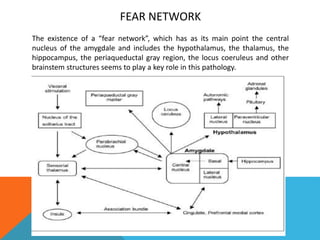
The existence of a “fear network”, which has as its main point the central
nucleus of the amygdale and includes the hypothalamus, the thalamus, the
hippocampus, the periaqueductal gray region, the locus coeruleus and other
brainstem structures seems to play a key role in this pathology.
FEAR NETWORK
A number of experiments have tried to study the responses with the use of panicogenic
agents and the conclusions are very interesting.
PD patients frequently complain about uncomfortable somatic sensations. The
administration of a panicogenic agent would correspond to a non-specific activation; as all
those agents acutely produce unpleasant physical sensations, the hypothesis is that they
act stimulating a sensitive brain network which was conditioned to respond to harmful
stimuli.
Along time, the projections of the central amygdaloid nucleus towards brainstem
centers such as the locus coeruleus, the periaqueductal gray and the hypothalamus
can become more or less sensitive. There may also be an inter-individual difference
in the strength of these afferent projections. Therefore, the pattern of
neuroendocrine and autonomic responses presented during panic attacks may vary
from one patient to the other, and in the same patient along time.
NEUROBIOLOGY OF EVERY DAY LIFE HELPED ME
BETTER UNDERSTAND PANIC DISORDER
For me as I can now understand some kind of excessive stress was responsible for the first
dysregulation of my autonomic nervous system and made the brain and body connection
problematic. Then the formation o a fearful memory played a key role for the situation o
fearing and having thoughts of waiting the next panic attack to appear.
The solution to this pathology is cognitive behavioral therapy alone or a combination with
drug therapy. I had a short scheme of CBT therapy and knowing the neurobiology of panic
attack helped to take control of my situation. For 15 days now I didn’t have another attack
besides some strange sensations and rarely a little heartbeat elevation but it last’s just
minutes.
I hope that everything will resolve good for me and thanks for sharing the knowledge of
neurobiology of everyday life.
REFERENCES
Neurobiology of panic and pH chemosensation in the brain John A. Wemmie, MD, PhD
www.dialogues-cns.org
The psychodynamic of panic attacks: a useful integration of psychoanalysis and
neuroscience. De Masi F. Int J Psychoanal. 2004 Apr;85(Pt 2):311-36.
Neuropsychological impairments in panic disorder: A systematic review.
O‫׳‬Sullivan K1, Newman EF2. J Affect Disord. 2014 Jun 18;167C:268-284. doi:
10.1016/j.jad.2014.06.024. [Epub ahead of print]

Panic attack

  • 1.
  • 2.
    INTRODUCTION I have decidedto present you my thoughts about panic attack which is a type of anxiety disorder. I was diagnosed having this kind of disorder about 40 days ago. I was in my private practice (Physical Therapy Clinic) doing some reading and taking literature notes. Suddenly I felt chest and left arm burning sensations and my heart started to race. I feared having a heart attack so my colleague took me to the nearest hospital. There I was tested with a cardiogram, ultrasound and blood work out which all came negative. Tow days later I had a heart treadmill test also negative for a heart condition. Then my doctor told me that I had a panic attack.
  • 3.
    PANIC DISORDER Panic disorderis a type of anxiety disorder. It causes panic attacks, which are sudden feelings of terror when there is no real danger. You may feel as if you are losing control. You may also have physical symptoms, such as • Fast heartbeat Chest or stomach pain Breathing difficulty Weakness or dizziness • Sweating Feeling hot or a cold chill Tingly or numb hands Panic attacks can happen anytime, anywhere, and without warning. You may live in fear of another attack and may avoid places where you have had an attack. For some people, fear takes over their lives and they cannot leave their homes. Panic disorder is more common in women than men. It usually starts when people are young adults. Sometimes it starts when a person is under a lot of stress. Most people get better with treatment. Therapy can show you how to recognize and change your thinking patterns before they lead to panic. Medicines can also help. NIH: National Institute of Mental Health Feelings and sensations that I had in bold writing
  • 4.
    PANIC DISORDER Recent neuroscientificfindings indicate that psychosomatic reactions, set off by a danger situation, depend on the primitive circuit of fear (including the amygdala) characterised by its speed, but lack accurate responses and may also be activated by harmless stimuli perceived erroneously as dangerous. The traumatic terror is stored in implicit memory and may be set off by a conditioned stimulus linked to a previous danger situation. In the panic attack, the traumatic event is created by the imagination and this construction (a micro- delusion), built in loneliness and anxiety, has the same power as the real trauma. A mutual psychosomatic short-circuit between body and psyche, in which terror reinforces the somatic reactions and the psychic construction, is established.
  • 5.
    FEAR NETWORK The existenceof a “fear network”, which has as its main point the central nucleus of the amygdale and includes the hypothalamus, the thalamus, the hippocampus, the periaqueductal gray region, the locus coeruleus and other brainstem structures seems to play a key role in this pathology.
  • 6.
    FEAR NETWORK A numberof experiments have tried to study the responses with the use of panicogenic agents and the conclusions are very interesting. PD patients frequently complain about uncomfortable somatic sensations. The administration of a panicogenic agent would correspond to a non-specific activation; as all those agents acutely produce unpleasant physical sensations, the hypothesis is that they act stimulating a sensitive brain network which was conditioned to respond to harmful stimuli. Along time, the projections of the central amygdaloid nucleus towards brainstem centers such as the locus coeruleus, the periaqueductal gray and the hypothalamus can become more or less sensitive. There may also be an inter-individual difference in the strength of these afferent projections. Therefore, the pattern of neuroendocrine and autonomic responses presented during panic attacks may vary from one patient to the other, and in the same patient along time.
  • 7.
    NEUROBIOLOGY OF EVERYDAY LIFE HELPED ME BETTER UNDERSTAND PANIC DISORDER For me as I can now understand some kind of excessive stress was responsible for the first dysregulation of my autonomic nervous system and made the brain and body connection problematic. Then the formation o a fearful memory played a key role for the situation o fearing and having thoughts of waiting the next panic attack to appear. The solution to this pathology is cognitive behavioral therapy alone or a combination with drug therapy. I had a short scheme of CBT therapy and knowing the neurobiology of panic attack helped to take control of my situation. For 15 days now I didn’t have another attack besides some strange sensations and rarely a little heartbeat elevation but it last’s just minutes. I hope that everything will resolve good for me and thanks for sharing the knowledge of neurobiology of everyday life.
  • 8.
    REFERENCES Neurobiology of panicand pH chemosensation in the brain John A. Wemmie, MD, PhD www.dialogues-cns.org The psychodynamic of panic attacks: a useful integration of psychoanalysis and neuroscience. De Masi F. Int J Psychoanal. 2004 Apr;85(Pt 2):311-36. Neuropsychological impairments in panic disorder: A systematic review. O‫׳‬Sullivan K1, Newman EF2. J Affect Disord. 2014 Jun 18;167C:268-284. doi: 10.1016/j.jad.2014.06.024. [Epub ahead of print]