

Presented by:
iseh musyafak
Afakabar59.blogspot.c
om





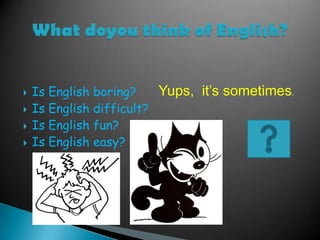
Yups, it’s sometimes.
Is English boring?
Is English difficult?
Is English fun?
Is English easy?
♫ Letter
♫ Word
♫ Clause
♫ Sentence
♫ Paragraph
♫ Essay
♫ Text

Who are they?
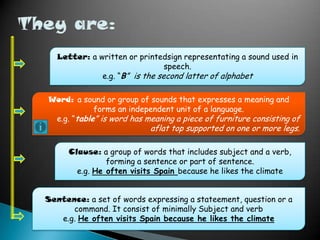
Letter: a written or printedsign representating a sound used in
speech.
e.g. “B” is the second latter of alphabet
Word: a sound or group of sounds that expresses a meaning and
forms an independent unit of a language.
e.g. “table” is word has meaning a piece of furniture consisting of

aflat top supported on one or more legs.

Clause: a group of words that includes subject and a verb,
forming a sentence or part of sentence.
e.g. He often visits Spain because he likes the climate
Sentence: a set of words expressing a stateement, question or a
command. It consist of minimally Subject and verb
e.g. He often visits Spain because he likes the climate
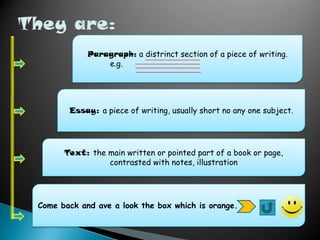
Paragraph: a distrinct section of a piece of writing.
e.g.

Essay: a piece of writing, usually short no any one subject.

Text: the main written or pointed part of a book or page,
contrasted with notes, illustration

Come back and ave a look the box which is orange.
Parts of speech
What
that?

is
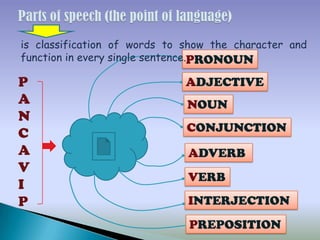
is classification of words to show the character and
function in every single sentence.PRONOUN

P
A
N
C
A
V
I
P

ADJECTIVE
NOUN
CONJUNCTION
ADVERB
VERB
INTERJECTION
PREPOSITION
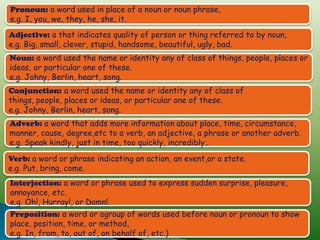
Pronoun: a word used in place of a noun or noun phrase,
e.g. I, you, we, they, he, she, it.
Adjective: a that indicates quality of person or thing referred to by noun,
e.g. Big, small, clever, stupid, handsome, beautiful, ugly, bad.
Noun: a word used the name or identity any of class of things, people, places or
ideas, or particular one of these.
e.g. Johny, Berlin, heart, song.
Conjunction: a word used the name or identity any of class of
things, people, places or ideas, or particular one of these.
e.g. Johny, Berlin, heart, song.
Adverb: a word that adds more information about place, time, circumstance,
manner, cause, degree,etc to a verb, an adjective, a phrase or another adverb.
e.g. Speak kindly, just in time, too quickly, incredibly..
Verb: a word or phrase indicating an action, an event,or a state.
e.g. Put, bring, come.
Interjection: a word or phrase used to express sudden surprise, pleasure,
annoyance, etc.
e.g. Oh!, Hurray!, or Damn!.
Preposition: a word or agroup of words used before noun or pronoun to show
place, position, time, or method,
e.g. In, from, to, out of, on behalf of, etc.)
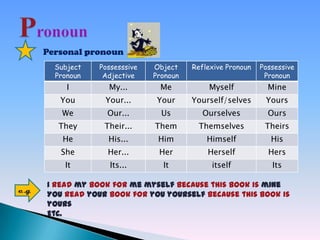
Personal pronoun
Subject
Pronoun

Object
Pronoun

Reflexive Pronoun

Possessive
Pronoun

I

My...

Me

Myself

Mine

You

Your...

Your

Yourself/selves

Yours

We

Our...

Us

Ourselves

Ours

They

Their...

Them

Themselves

Theirs

He

His...

Him

Himself

His

She

Her...

Her

Herself

Hers

It
e.g

Possesssive
Adjective

Its...

It

itself

Its

I read my book for me myself because this book is mine
You read your book for you yourself because this book is
yours
Etc.
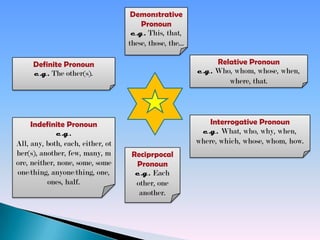
Demonstrative
Pronoun
e.g. This, that,
these, those, the...
Definite Pronoun
e.g. The other(s).

Relative Pronoun
e.g. Who, whom, whose, when,
where, that.

Indefinite Pronoun
e.g.
All, any, both, each, either, ot
her(s), another, few, many, m
ore, neither, none, some, some
one/thing, anyone/thing, one,
ones, half.

Interrogative Pronoun
e.g. What, who, why, when,
where, which, whose, whom, how.
Reciprpocal
Pronoun
e.g. Each
other, one
another.
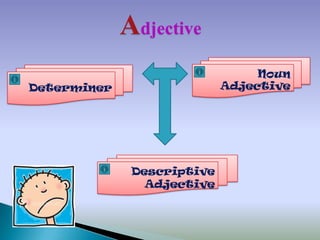
Adjective
Noun
Adjective

Determiner

Descriptive
Adjective
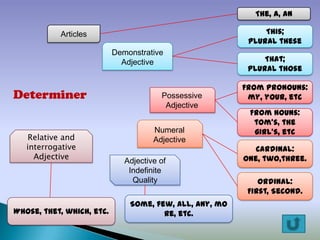
The, a, an
This;
plural these

Articles
Demonstrative
Adjective

Determiner
Relative and
interrogative
Adjective

Whose, thet, which, etc.

Possessive
Adjective
Numeral
Adjective

Adjective of
Indefinite
Quality
Some, few, all, any, mo
re, etc.

That;
plural those
From pronouns:
my, your, etc
From nouns:
tom’s, the
girl’s, etc
Cardinal:
One, two,three.
Ordinal:
First, Second.
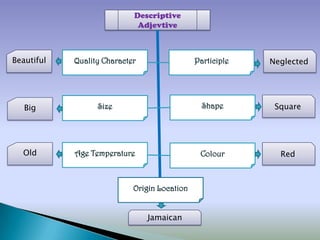
Descriptive
Adjevtive

Beautiful

Quality Character

Participle

Neglected

Big

Size

Shape

Square

Old

Age Temperature

Colour

Red

Origin Location
Jamaican
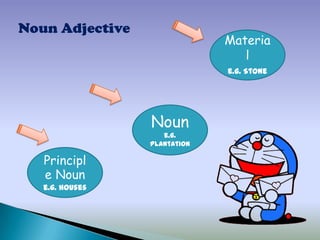
Noun Adjective

Materia
l
e.g. Stone

Noun

e.g.
plantation

Principl
e Noun
e.g. Houses
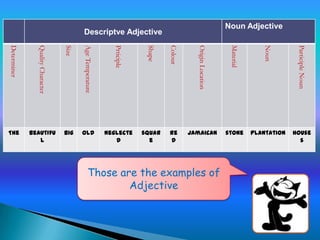
Noun Adjective

Descriptve Adjective
Determiner

Quality Character

Size

Age Temperature

Prticiple

Shape

Colour

Origin Location

Material

Noun

Participle Noun

The

beautifu
l

big

old

neglecte
d

squar
e

re
d

Jamaican

stone

plantation

house
s

Those are the examples of
Adjective
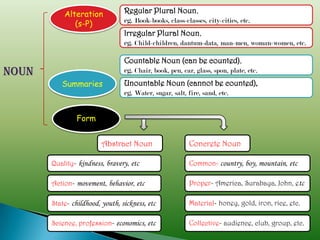
Alteration
(s-P)

Noun

Regular Plural Noun,
eg. Book-books, class-classes, city-cities, etc.
Irregular Plural Noun,
eg. Child-children, dantum-data, man-men, woman-women, etc.
Countable Noun (can be counted),
eg. Chair, book, pen, car, glass, spon, plate, etc.

Summaries

Unountable Noun (cannot be counted),
eg. Water, sugar, salt, fire, sand, etc.

Form
Abstract Noun

Concrete Noun

Quality- kindness, bravery, etc

Common- country, boy, mountain, etc

Action- movement, behavior, etc

Proper- America, Surabaya, John, etc

State- childhood, youth, sickness, etc

Material- honey, gold, iron, rice, etc.

Science, profession- economics, etc

Collective- audience, club, group, etc.
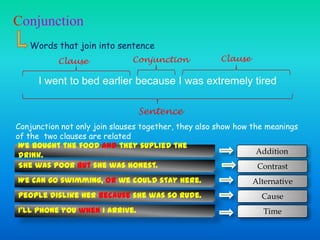
Conjunction
Words that join into sentence
Clause

Conjunction

Clause

I went to bed earlier because I was extremely tired
Sentence
Conjunction not only join slauses together, they also show how the meanings
of the two clauses are related
We bought the food and they suplied the
Addition
drink.
She was poor but she was honest.
Contrast
We can go swimming, or we could stay here.

Alternative

People dislike her because she was so rude.

Cause

I’ll phone you when I arrive.

Time
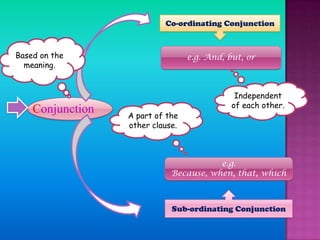
Co-ordinating Conjunction

Based on the
meaning.

Conjunction

e.g. And, but, or

A part of the
other clause.

Independent
of each other.

e.g.
Because, when, that, which

Sub-ordinating Conjunction
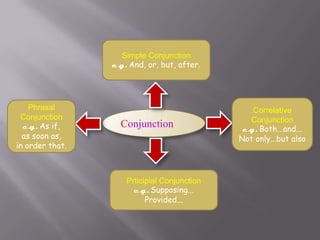
Simple Conjunction
e.g. And, or, but, after.

Phrasal
Conjunction
e.g. As if,
as soon as,
in order that.

Conjunction

Prticipial Conjunction
e.g. Supposing...
Provided...

Correlative
Conjunction
e.g. Both...and...
Not only...but also
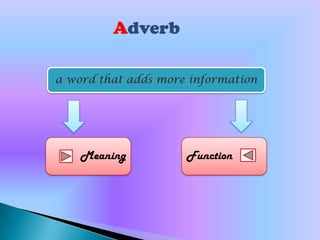
Adverb
a word that adds more information

Meaning

Function
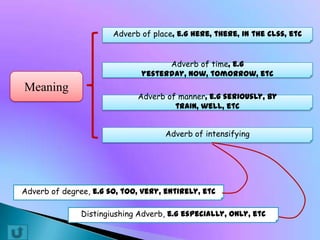
Adverb of place, e.g here, there, in the clss, etc
Adverb of time, e.g
yesterday, now, tomorrow, etc

Meaning

Adverb of manner, e.g seriously, by
train, well, etc

Adverb of intensifying

Adverb of degree, e.g so, too, very, entirely, etc
Distingiushing Adverb, e.g especially, only, etc
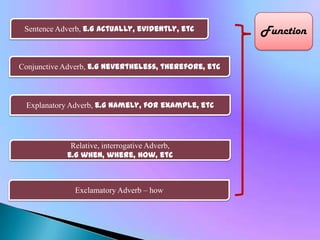
Sentence Adverb, e.g actually, evidently, etc

Conjunctive Adverb, e.g nevertheless, therefore, etc

Explanatory Adverb, e.g namely, for example, etc

Relative, interrogative Adverb,
e.g when, where, how, etc

Exclamatory Adverb – how

Function
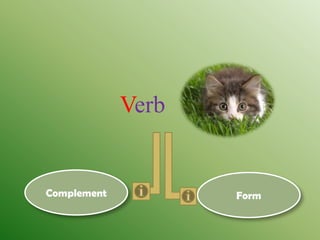
Verb

Complement

Form
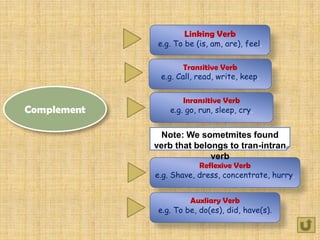
Linking Verb

e.g. To be (is, am, are), feel.
Transitive Verb
e.g. Call, read, write, keep.

Complement

Inransitive Verb
e.g. go, run, sleep, cry.

Note: We sometmites found
verb that belongs to tran-intran
verb

Reflexive Verb
e.g. Shave, dress, concentrate, hurry.
Auxliary Verb
e.g. To be, do(es), did, have(s).
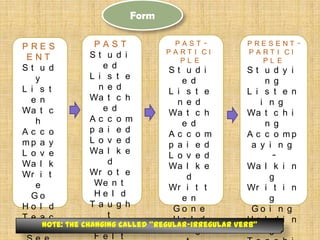
Form
PASTPRESENT PAST
PRES
PART I CI
PART I CI
St u d i
ENT
PL E
PL E
e d
St u d
St u d i
St u d y i
L i s t e
y
e d
n g
n e d
L i s t
L i s t e
L i s t e n
Wa t c h
e n
n e d
i n g
e d
Wa t c
Wa t c h
Wa t c h i
Ac c o m
h
e d
n g
p a i e d
Ac c o
Ac c o m
A c c o mp
L o v e d
mp a y
p a i e d
a y i n g
Wa l k e
L o v e
L o v e d
d
Wa l k
Wa l k e
Wa l k i n
Wr o t e
Wr i t
d
g
We n t
e
Wr i t t
Wr i t i n
He l d
Go
e n
g
Ta u g h
Ho l d
Go n e
Go i n g
t
Te a c
He l d
Ho l d i n
Note: the changing w
S a called “regular-irregular Verb”
h
Ta u g h
g
Fe l t
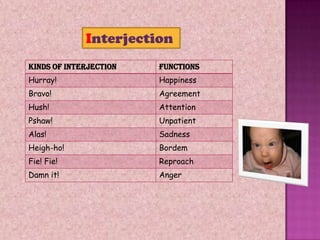
Interjection
Kinds of Interjection

Functions

Hurray!

Happiness

Bravo!

Agreement

Hush!

Attention

Pshaw!

Unpatient

Alas!

Sadness

Heigh-ho!

Bordem

Fie! Fie!

Reproach

Damn it!

Anger
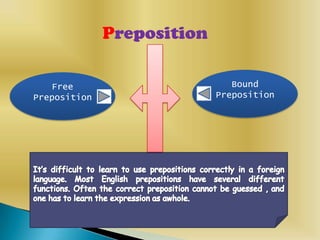
Preposition
Free
Preposition

Bound
Preposition
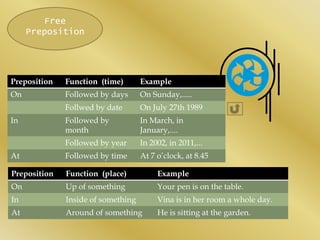
Free
Preposition

Preposition

Function (time)

Example

On

Followed by days

On Sunday,.....

Follwed by date

On July 27th 1989

Followed by
month

In March, in
January,....

Followed by year

In 2002, in 2011,...

At

Followed by time

At 7 o’clock, at 8.45

Preposition

Function (place)

Example

On

Up of something

Your pen is on the table.

In

Inside of something

Vina is in her room a whole day.

At

Around of something

He is sitting at the garden.

In
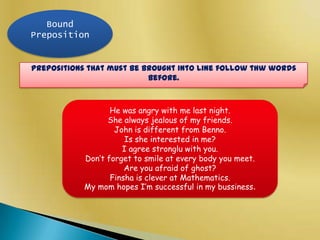
Bound
Preposition

Prepositions that must be brought into line follow thw words
before.

He was angry with me last night.
She always jealous of my friends.
John is different from Benno.
Is she interested in me?
I agree stronglu with you.
Don’t forget to smile at every body you meet.
Are you afraid of ghost?
Finsha is clever at Mathematics.
My mom hopes I’m successful in my bussiness.
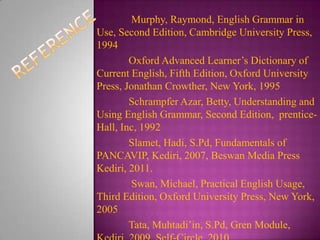
Murphy, Raymond, English Grammar in
Use, Second Edition, Cambridge University Press,
1994
Oxford Advanced Learner’s Dictionary of
Current English, Fifth Edition, Oxford University
Press, Jonathan Crowther, New York, 1995
Schrampfer Azar, Betty, Understanding and
Using English Grammar, Second Edition, prenticeHall, Inc, 1992
Slamet, Hadi, S.Pd, Fundamentals of
PANCAVIP, Kediri, 2007, Beswan Media Press
Kediri, 2011.
Swan, Michael, Practical English Usage,
Third Edition, Oxford University Press, New York,
2005
Tata, Muhtadi’in, S.Pd, Gren Module,
THANK YOU VERY MUCH
FOR YOR ATTENTION
See you
later........

To be continued..........

Pancavip composed by afakabar59

  • 1.
  • 2.
        Yups, it’s sometimes. IsEnglish boring? Is English difficult? Is English fun? Is English easy?
  • 3.
    ♫ Letter ♫ Word ♫Clause ♫ Sentence ♫ Paragraph ♫ Essay ♫ Text Who are they?
  • 4.
    Letter: a writtenor printedsign representating a sound used in speech. e.g. “B” is the second latter of alphabet Word: a sound or group of sounds that expresses a meaning and forms an independent unit of a language. e.g. “table” is word has meaning a piece of furniture consisting of aflat top supported on one or more legs. Clause: a group of words that includes subject and a verb, forming a sentence or part of sentence. e.g. He often visits Spain because he likes the climate Sentence: a set of words expressing a stateement, question or a command. It consist of minimally Subject and verb e.g. He often visits Spain because he likes the climate
  • 5.
    Paragraph: a distrinctsection of a piece of writing. e.g. Essay: a piece of writing, usually short no any one subject. Text: the main written or pointed part of a book or page, contrasted with notes, illustration Come back and ave a look the box which is orange.
  • 6.
  • 7.
    is classification ofwords to show the character and function in every single sentence.PRONOUN P A N C A V I P ADJECTIVE NOUN CONJUNCTION ADVERB VERB INTERJECTION PREPOSITION
  • 8.
    Pronoun: a wordused in place of a noun or noun phrase, e.g. I, you, we, they, he, she, it. Adjective: a that indicates quality of person or thing referred to by noun, e.g. Big, small, clever, stupid, handsome, beautiful, ugly, bad. Noun: a word used the name or identity any of class of things, people, places or ideas, or particular one of these. e.g. Johny, Berlin, heart, song. Conjunction: a word used the name or identity any of class of things, people, places or ideas, or particular one of these. e.g. Johny, Berlin, heart, song. Adverb: a word that adds more information about place, time, circumstance, manner, cause, degree,etc to a verb, an adjective, a phrase or another adverb. e.g. Speak kindly, just in time, too quickly, incredibly.. Verb: a word or phrase indicating an action, an event,or a state. e.g. Put, bring, come. Interjection: a word or phrase used to express sudden surprise, pleasure, annoyance, etc. e.g. Oh!, Hurray!, or Damn!. Preposition: a word or agroup of words used before noun or pronoun to show place, position, time, or method, e.g. In, from, to, out of, on behalf of, etc.)
  • 9.
  • 10.
    Demonstrative Pronoun e.g. This, that, these,those, the... Definite Pronoun e.g. The other(s). Relative Pronoun e.g. Who, whom, whose, when, where, that. Indefinite Pronoun e.g. All, any, both, each, either, ot her(s), another, few, many, m ore, neither, none, some, some one/thing, anyone/thing, one, ones, half. Interrogative Pronoun e.g. What, who, why, when, where, which, whose, whom, how. Reciprpocal Pronoun e.g. Each other, one another.
  • 11.
  • 12.
    The, a, an This; pluralthese Articles Demonstrative Adjective Determiner Relative and interrogative Adjective Whose, thet, which, etc. Possessive Adjective Numeral Adjective Adjective of Indefinite Quality Some, few, all, any, mo re, etc. That; plural those From pronouns: my, your, etc From nouns: tom’s, the girl’s, etc Cardinal: One, two,three. Ordinal: First, Second.
  • 13.
  • 14.
  • 15.
    Noun Adjective Descriptve Adjective Determiner QualityCharacter Size Age Temperature Prticiple Shape Colour Origin Location Material Noun Participle Noun The beautifu l big old neglecte d squar e re d Jamaican stone plantation house s Those are the examples of Adjective
  • 16.
    Alteration (s-P) Noun Regular Plural Noun, eg.Book-books, class-classes, city-cities, etc. Irregular Plural Noun, eg. Child-children, dantum-data, man-men, woman-women, etc. Countable Noun (can be counted), eg. Chair, book, pen, car, glass, spon, plate, etc. Summaries Unountable Noun (cannot be counted), eg. Water, sugar, salt, fire, sand, etc. Form Abstract Noun Concrete Noun Quality- kindness, bravery, etc Common- country, boy, mountain, etc Action- movement, behavior, etc Proper- America, Surabaya, John, etc State- childhood, youth, sickness, etc Material- honey, gold, iron, rice, etc. Science, profession- economics, etc Collective- audience, club, group, etc.
  • 17.
    Conjunction Words that joininto sentence Clause Conjunction Clause I went to bed earlier because I was extremely tired Sentence Conjunction not only join slauses together, they also show how the meanings of the two clauses are related We bought the food and they suplied the Addition drink. She was poor but she was honest. Contrast We can go swimming, or we could stay here. Alternative People dislike her because she was so rude. Cause I’ll phone you when I arrive. Time
  • 18.
    Co-ordinating Conjunction Based onthe meaning. Conjunction e.g. And, but, or A part of the other clause. Independent of each other. e.g. Because, when, that, which Sub-ordinating Conjunction
  • 19.
    Simple Conjunction e.g. And,or, but, after. Phrasal Conjunction e.g. As if, as soon as, in order that. Conjunction Prticipial Conjunction e.g. Supposing... Provided... Correlative Conjunction e.g. Both...and... Not only...but also
  • 20.
    Adverb a word thatadds more information Meaning Function
  • 21.
    Adverb of place,e.g here, there, in the clss, etc Adverb of time, e.g yesterday, now, tomorrow, etc Meaning Adverb of manner, e.g seriously, by train, well, etc Adverb of intensifying Adverb of degree, e.g so, too, very, entirely, etc Distingiushing Adverb, e.g especially, only, etc
  • 22.
    Sentence Adverb, e.gactually, evidently, etc Conjunctive Adverb, e.g nevertheless, therefore, etc Explanatory Adverb, e.g namely, for example, etc Relative, interrogative Adverb, e.g when, where, how, etc Exclamatory Adverb – how Function
  • 23.
  • 24.
    Linking Verb e.g. Tobe (is, am, are), feel. Transitive Verb e.g. Call, read, write, keep. Complement Inransitive Verb e.g. go, run, sleep, cry. Note: We sometmites found verb that belongs to tran-intran verb Reflexive Verb e.g. Shave, dress, concentrate, hurry. Auxliary Verb e.g. To be, do(es), did, have(s).
  • 25.
    Form PASTPRESENT PAST PRES PART ICI PART I CI St u d i ENT PL E PL E e d St u d St u d i St u d y i L i s t e y e d n g n e d L i s t L i s t e L i s t e n Wa t c h e n n e d i n g e d Wa t c Wa t c h Wa t c h i Ac c o m h e d n g p a i e d Ac c o Ac c o m A c c o mp L o v e d mp a y p a i e d a y i n g Wa l k e L o v e L o v e d d Wa l k Wa l k e Wa l k i n Wr o t e Wr i t d g We n t e Wr i t t Wr i t i n He l d Go e n g Ta u g h Ho l d Go n e Go i n g t Te a c He l d Ho l d i n Note: the changing w S a called “regular-irregular Verb” h Ta u g h g Fe l t
  • 26.
  • 27.
  • 28.
    Free Preposition Preposition Function (time) Example On Followed bydays On Sunday,..... Follwed by date On July 27th 1989 Followed by month In March, in January,.... Followed by year In 2002, in 2011,... At Followed by time At 7 o’clock, at 8.45 Preposition Function (place) Example On Up of something Your pen is on the table. In Inside of something Vina is in her room a whole day. At Around of something He is sitting at the garden. In
  • 29.
    Bound Preposition Prepositions that mustbe brought into line follow thw words before. He was angry with me last night. She always jealous of my friends. John is different from Benno. Is she interested in me? I agree stronglu with you. Don’t forget to smile at every body you meet. Are you afraid of ghost? Finsha is clever at Mathematics. My mom hopes I’m successful in my bussiness.
  • 30.
    Murphy, Raymond, EnglishGrammar in Use, Second Edition, Cambridge University Press, 1994 Oxford Advanced Learner’s Dictionary of Current English, Fifth Edition, Oxford University Press, Jonathan Crowther, New York, 1995 Schrampfer Azar, Betty, Understanding and Using English Grammar, Second Edition, prenticeHall, Inc, 1992 Slamet, Hadi, S.Pd, Fundamentals of PANCAVIP, Kediri, 2007, Beswan Media Press Kediri, 2011. Swan, Michael, Practical English Usage, Third Edition, Oxford University Press, New York, 2005 Tata, Muhtadi’in, S.Pd, Gren Module,
  • 31.
    THANK YOU VERYMUCH FOR YOR ATTENTION See you later........ To be continued..........