Presented By:
Aakriti Giri (078BAR001)
Adweta Amatya (078BAR007)
Arjun Timsina (078BAR010)
Ashok Shrestha (078BAR011)
Manoj Thapa (078BAR015)
Oshin Dura (078BAR024)
PRESENTATION ON CASE STUDY OF:
COMMERCIAL
COMPLEX
TABLE OF CONTENTS:
1. Literature Review
2. Case Study National
a. Manbhawan Complex, Kumaripati
b. United World Trade Center Tripureshwor
3. Case Study: International
a. The Lane 189
b. The Groove at Central City
4. Comparative Analysis
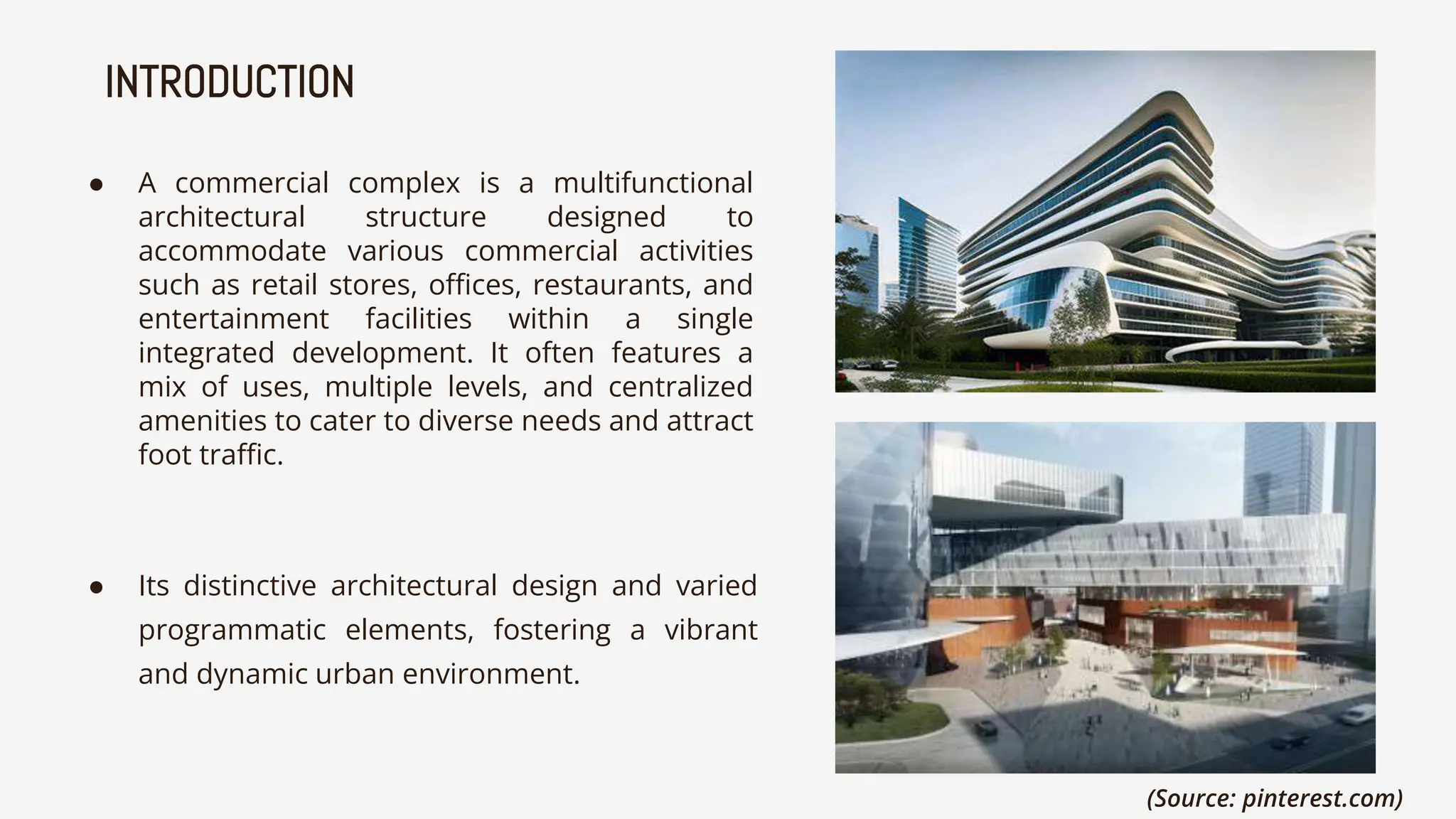
● A commercial complex is a multifunctional
architectural structure designed to
accommodate various commercial activities
such as retail stores, offices, restaurants, and
entertainment facilities within a single
integrated development. It often features a
mix of uses, multiple levels, and centralized
amenities to cater to diverse needs and attract
foot traffic.
INTRODUCTION
● Its distinctive architectural design and varied
programmatic elements, fostering a vibrant
and dynamic urban environment.
(Source: pinterest.com)
TIMELINE
Greek Agoras and Roman Forums
● A market place
● Craftsman and workshops
● Social and cultural exchange
01
02
03
Modern Commercial Centers
04
● Mixed use Developments
● Adaptive Reuse and Revitalization of Projects
● Sustainable architecture and green design
principles
● Smart Buildings
● Temporary Commercial Gatherings
● Wide Variety of Merchandise
Medieval Fairs And Bazaars
Future
● Virtual Commercial Complexes
● Wide Variety of Merchandise
HISTORY
Greek Agoras and Roman Forums Medieval Fairs And Bazaars
Futuristic Complex Modern Commercial Centers
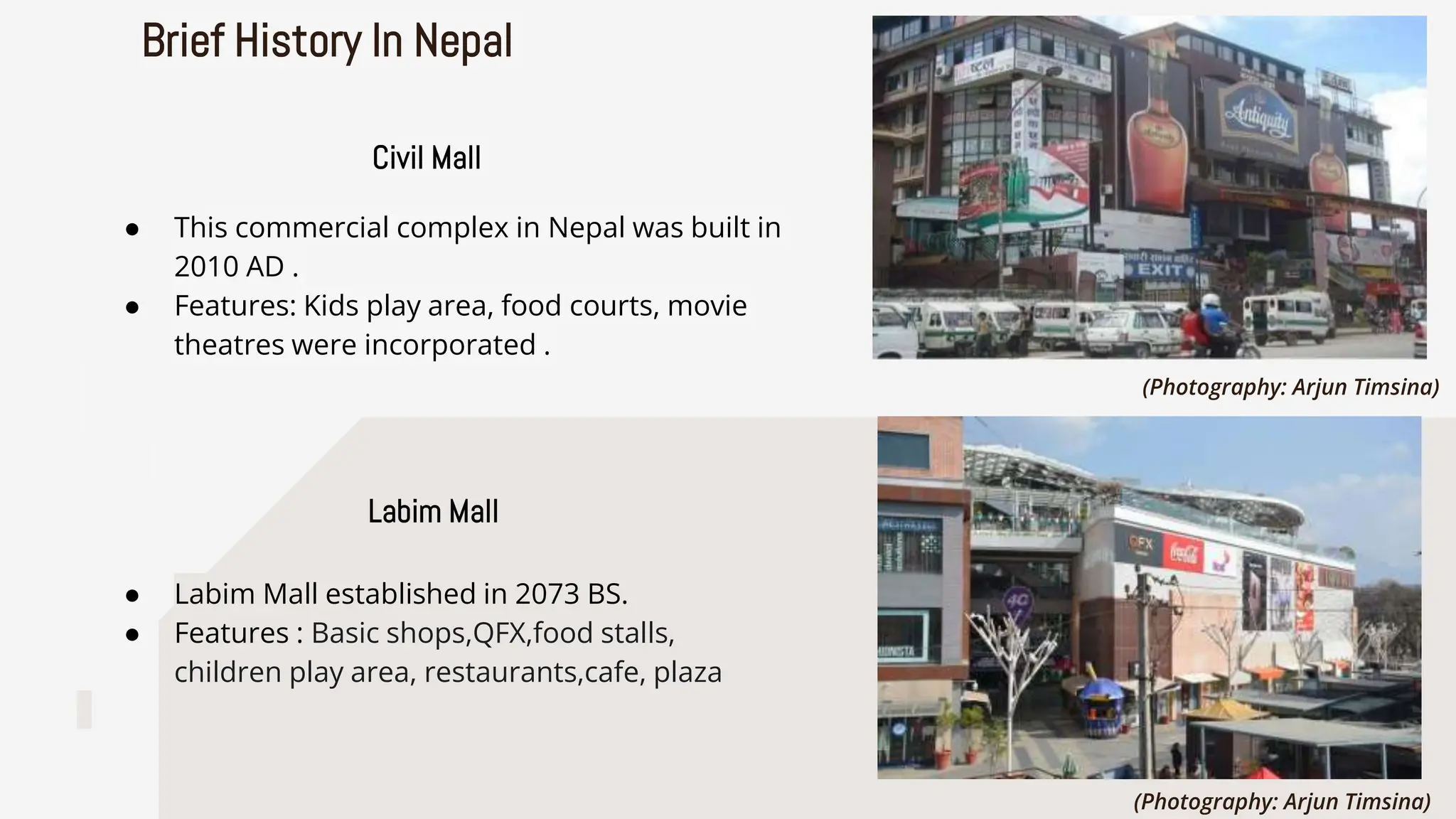
Brief History In Nepal
Bishal Bazar complex
● The 1st commercial complex in Nepal
built in 2026 BS.
● Features: basic shops, offices and resting
areas.
Bhatbhateni
● Bhatbhateni supermarket established ​in
2041 BS
● Features : basic shops, resting areas ​and
food courts
Source: wikipedia.com
Source: slideshare.com
Brief History In Nepal
Civil Mall
● This commercial complex in Nepal was built in
2010 AD .​
● Features: Kids play area, food courts, movie
theatres were incorporated .​
Labim Mall
● Labim Mall established ​in 2073 BS.
● Features : Basic shops,QFX,food stalls,
children play area, restaurants,cafe, plaza
(Photography: Arjun Timsina)
TYPES OF COMPLEX ACCORDING TO TIME SAVER
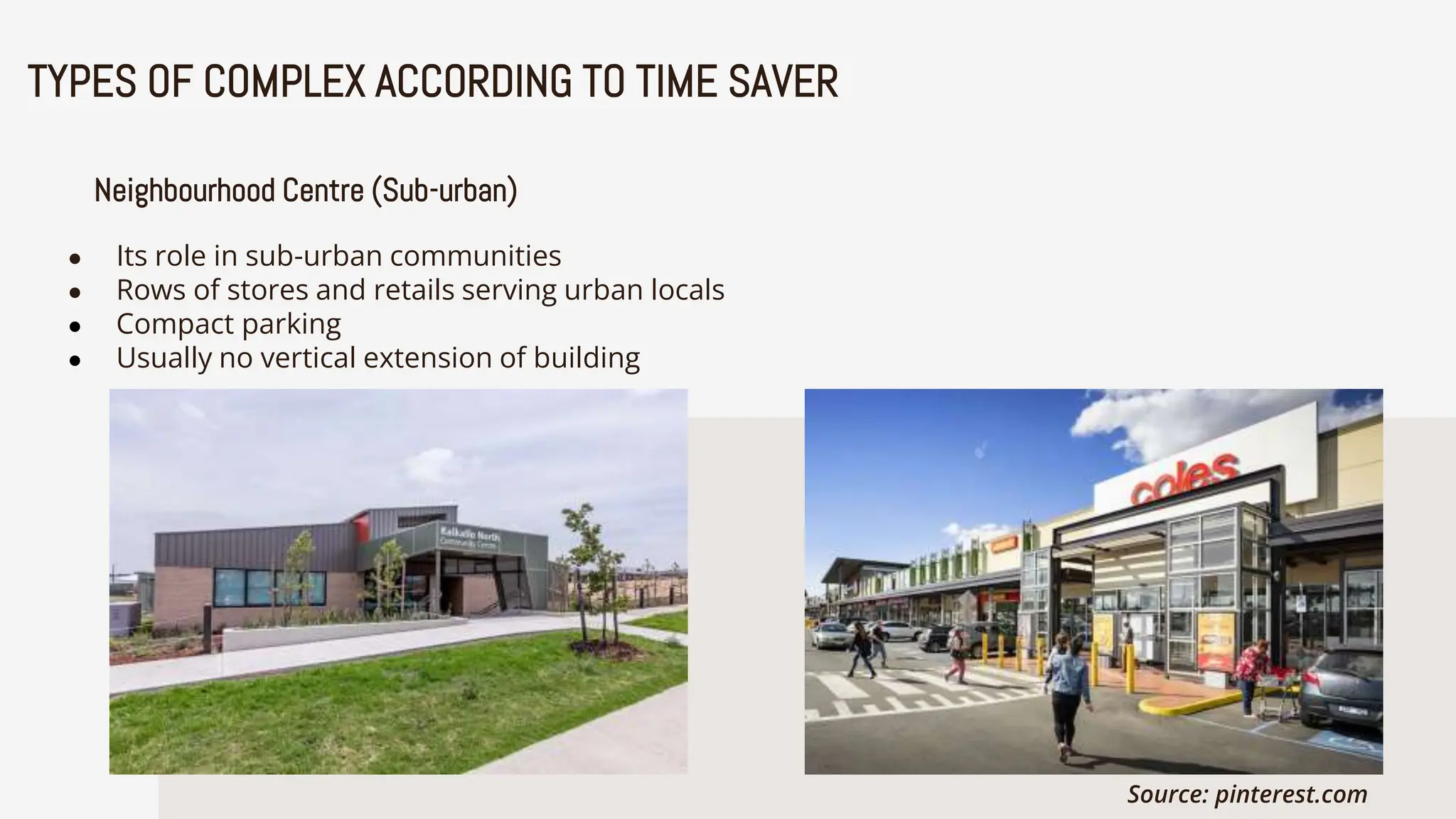
Neighbourhood Centre (Sub-urban)
● Its role in sub-urban communities
● Rows of stores and retails serving urban locals
● Compact parking
● Usually no vertical extension of building
Source: pinterest.com
TYPES OF COMPLEX ACCORDING TO TIME SAVER
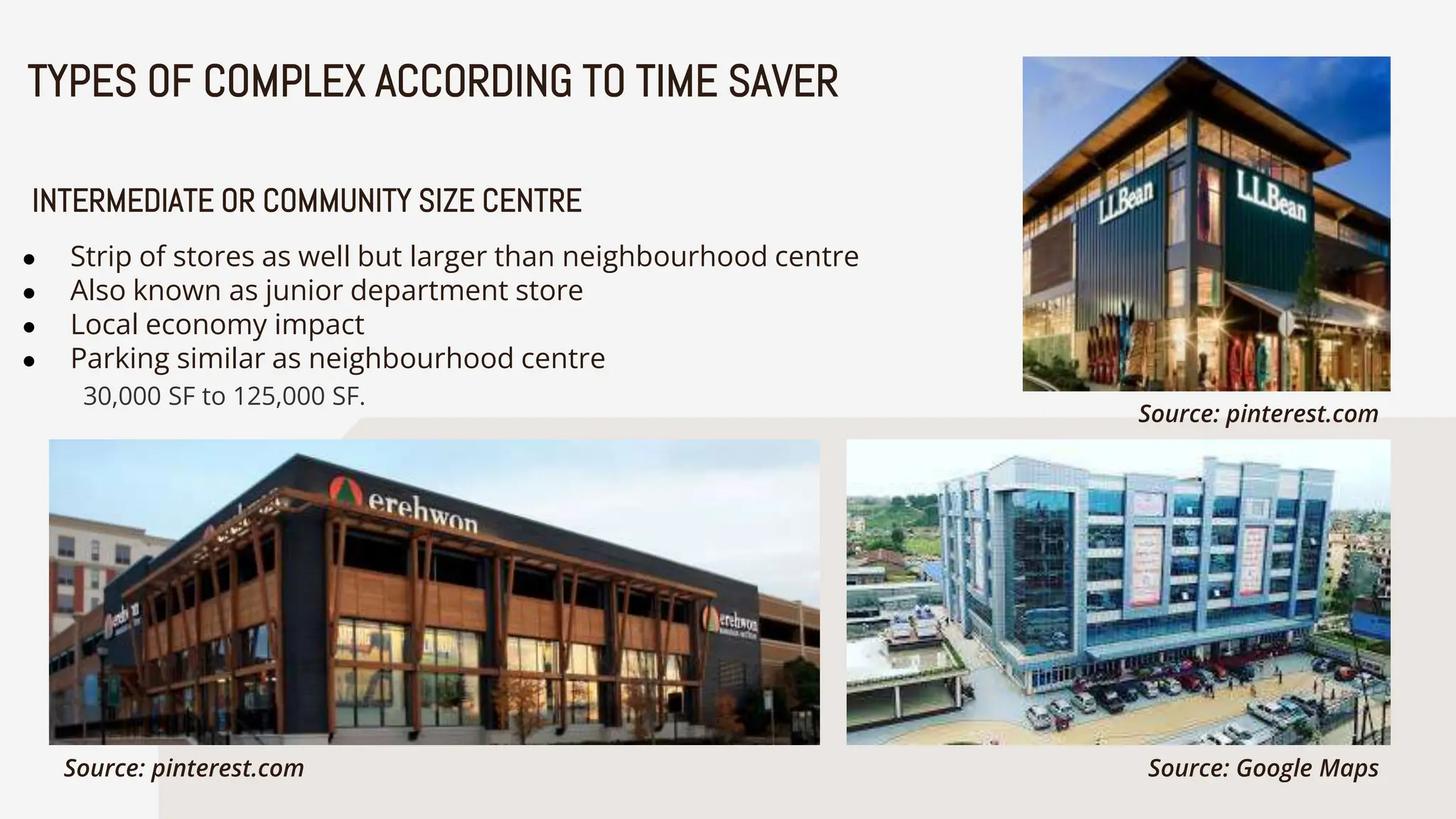
INTERMEDIATE OR COMMUNITY SIZE CENTRE
● Strip of stores as well but larger than neighbourhood centre
● Also known as junior department store
● Local economy impact
● Parking similar as neighbourhood centre
Source: pinterest.com Source: Google Maps
Source: pinterest.com
30,000 SF to 125,000 SF.
TYPES OF COMPLEX ACCORDING TO TIME SAVER
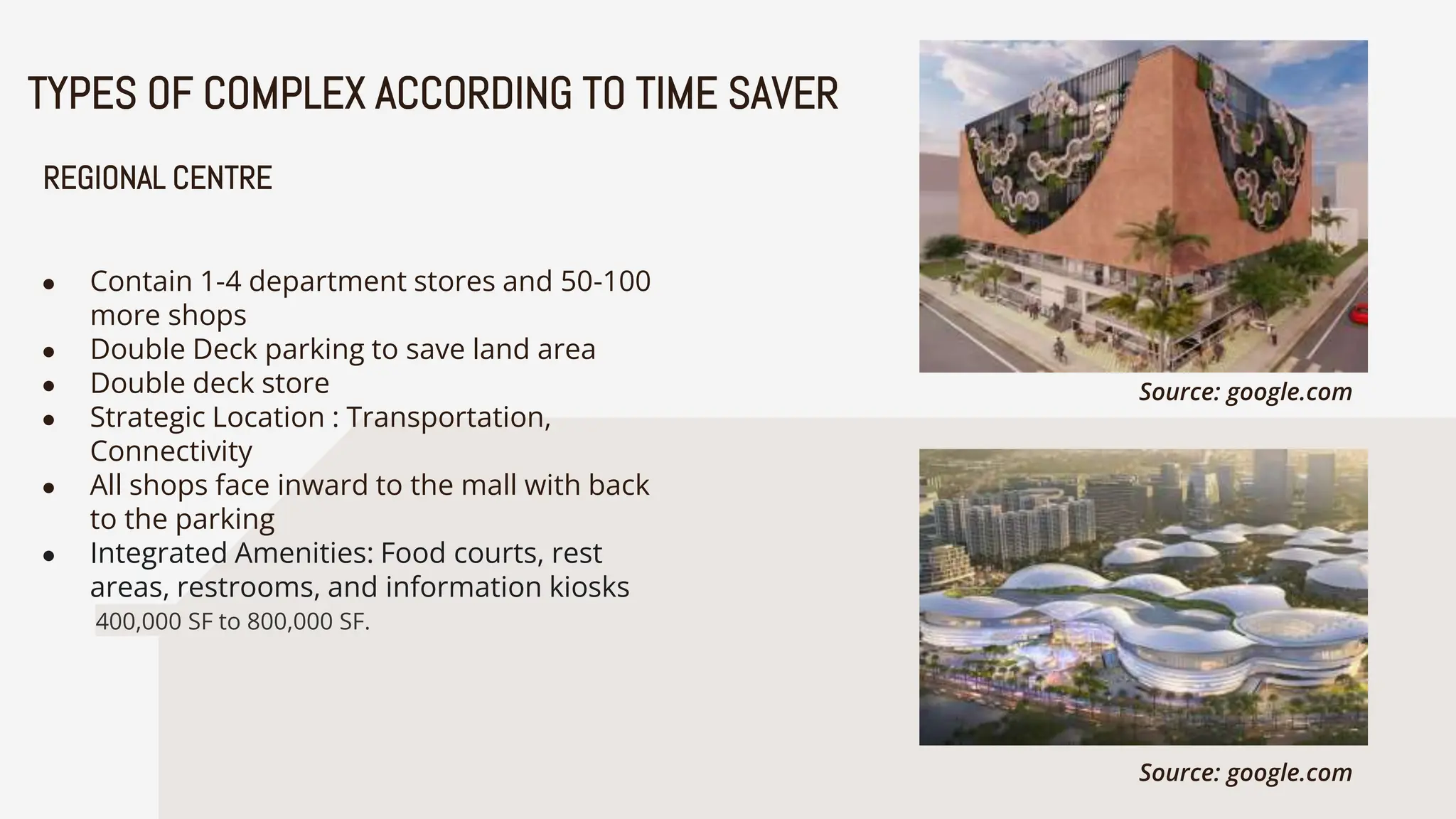
REGIONAL CENTRE
● Contain 1-4 department stores and 50-100
more shops
● Double Deck parking to save land area
● Double deck store
● Strategic Location : Transportation,
Connectivity
● All shops face inward to the mall with back
to the parking
● Integrated Amenities: Food courts, rest
areas, restrooms, and information kiosks
Source: google.com
Source: google.com
400,000 SF to 800,000 SF.
TYPES OF COMPLEX ACCORDING TO TIME SAVER
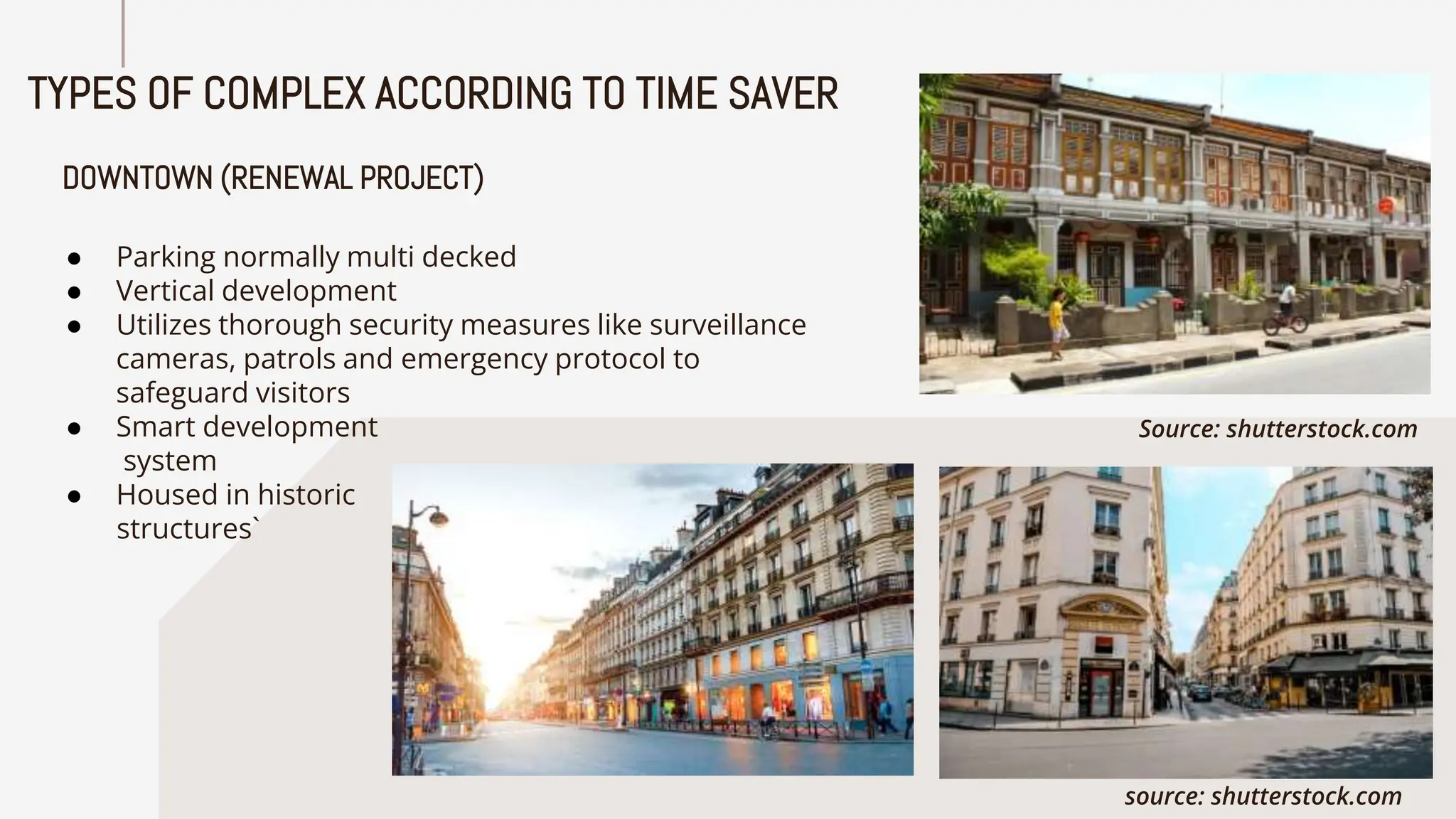
DOWNTOWN (RENEWAL PROJECT)
● Parking normally multi decked
● Vertical development
● Utilizes thorough security measures like surveillance
cameras, patrols and emergency protocol to
safeguard visitors
● Smart development
system
● Housed in historic
structures`
Source: shutterstock.com
source: shutterstock.com
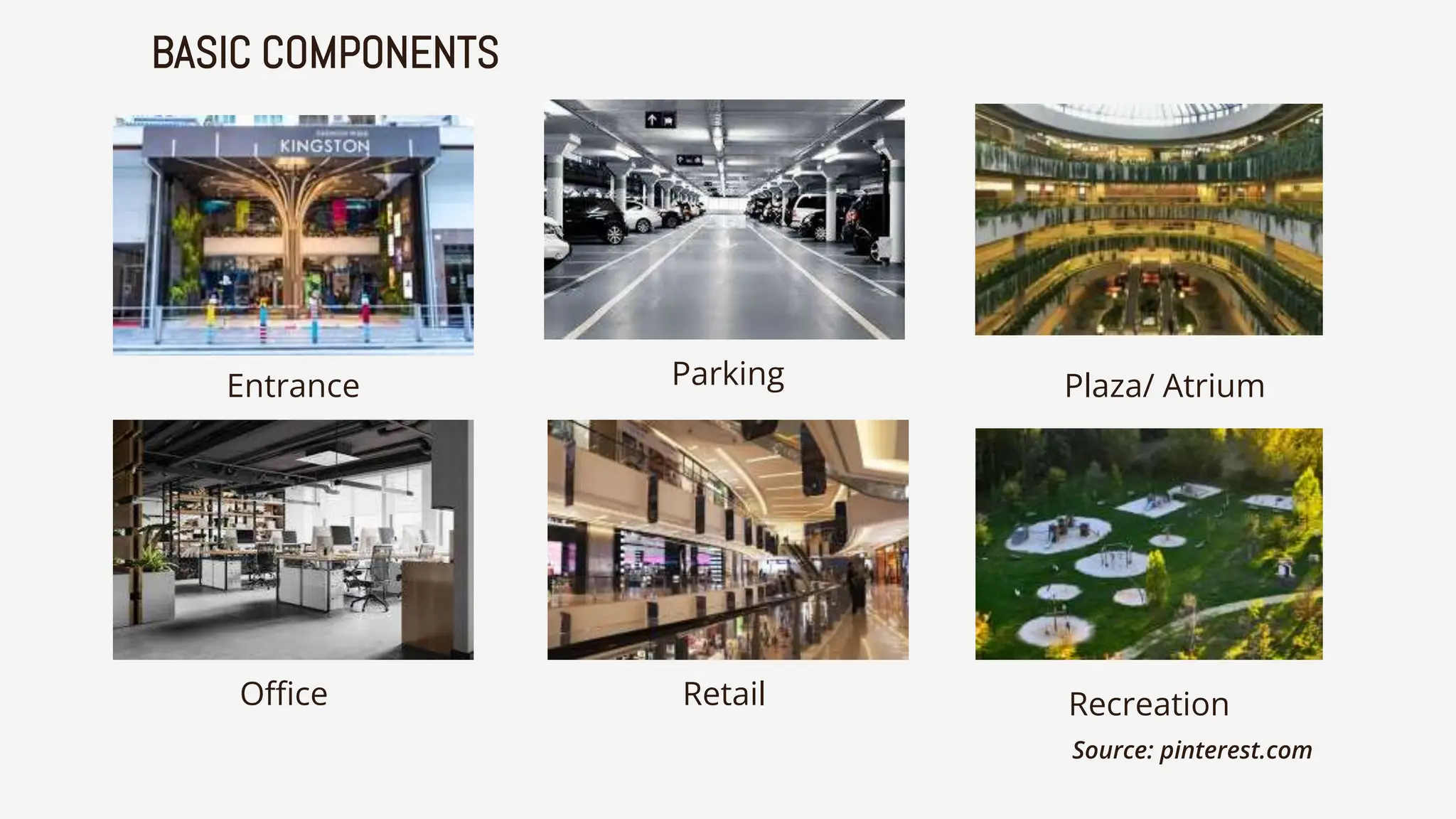
BASIC COMPONENTS
Entrance Parking Plaza/ Atrium
Office Retail Recreation
Source: pinterest.com
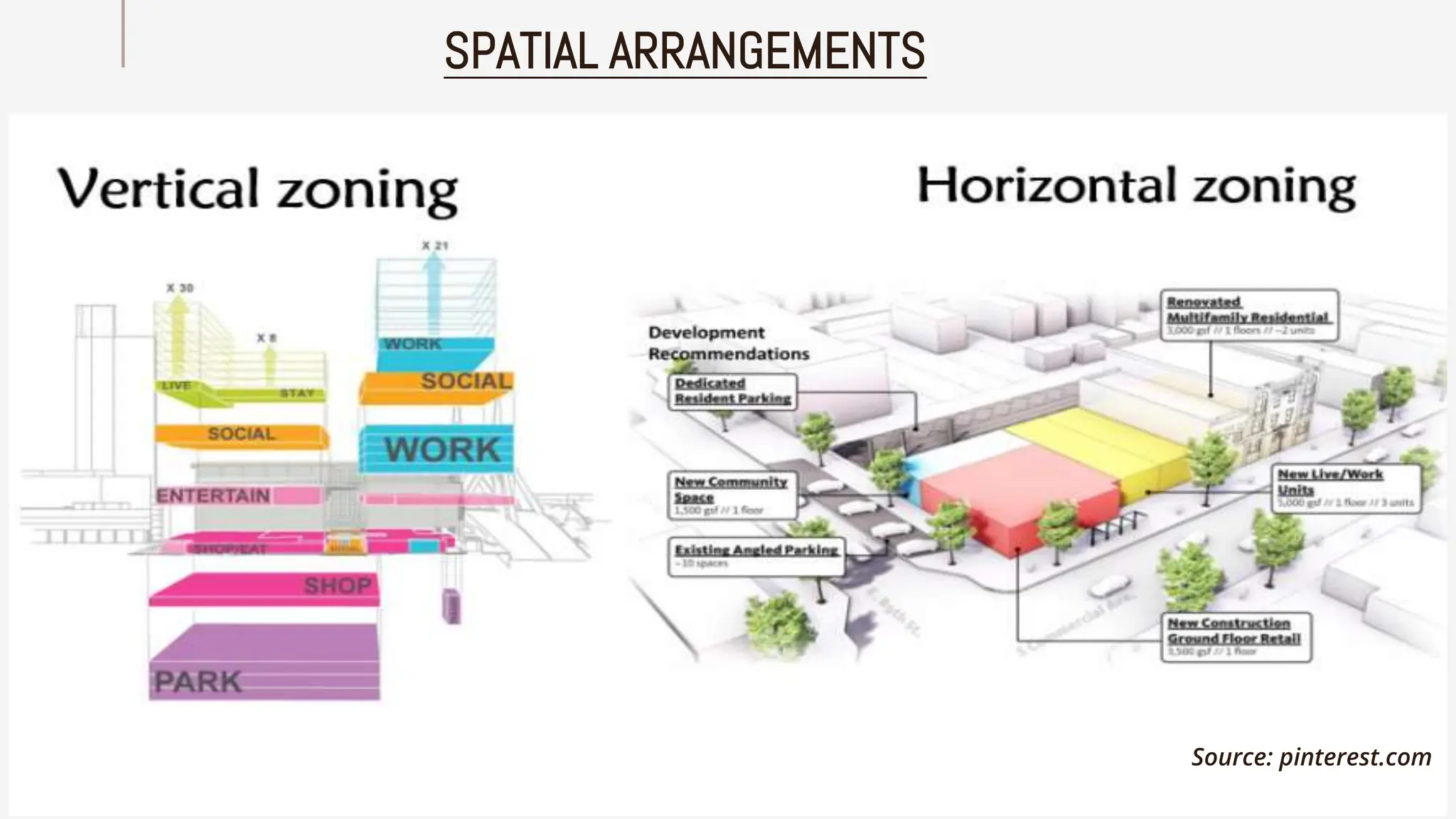
SPATIAL ARRANGEMENTS
VERTICAL ZONING HORIZONTAL ZONING
Source: pinterest.com
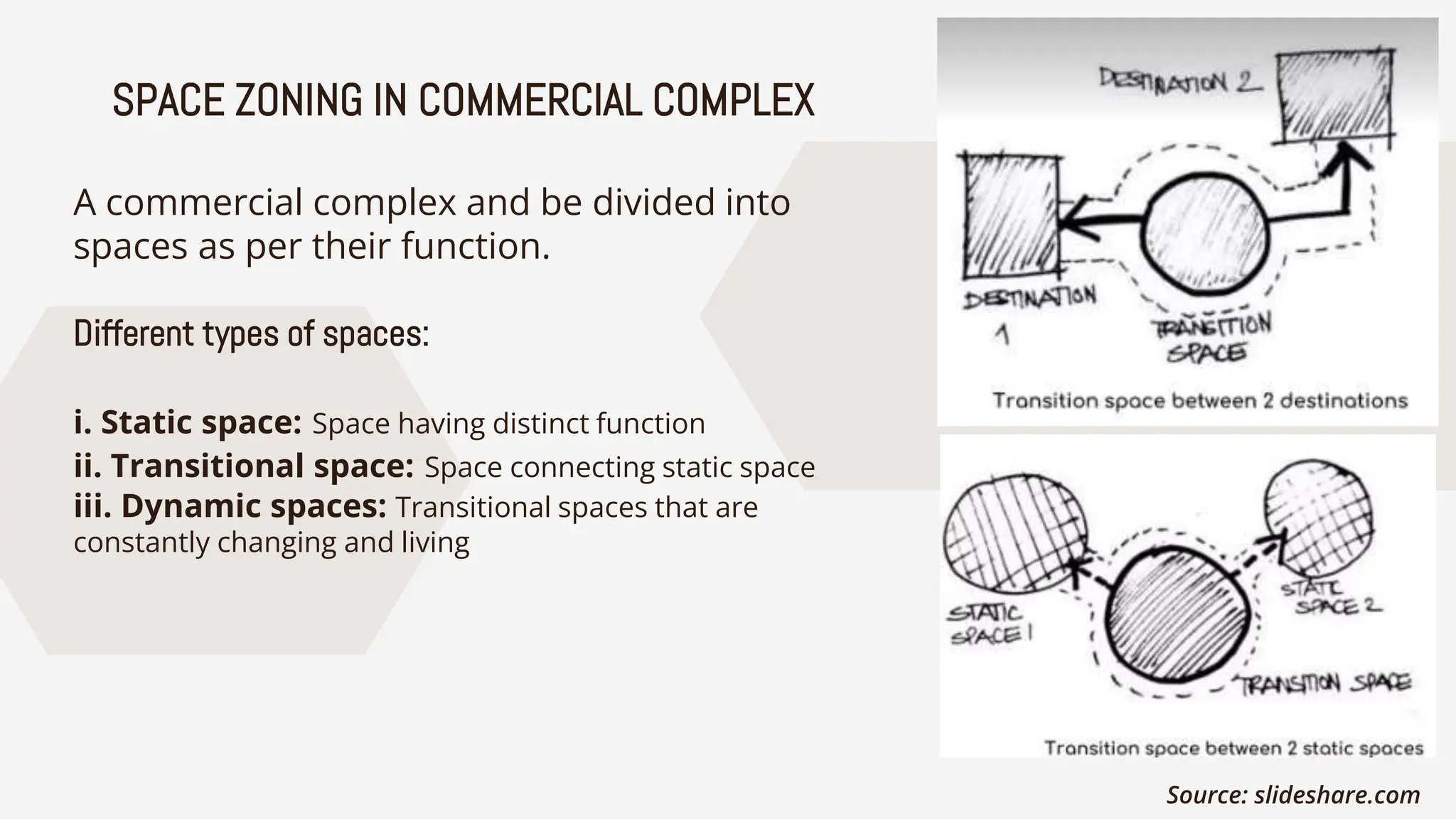
SPACE ZONING IN COMMERCIAL COMPLEX
A commercial complex and be divided into
spaces as per their function.
Different types of spaces:
i. Static space: Space having distinct function
ii. Transitional space: Space connecting static space
iii. Dynamic spaces: Transitional spaces that are
constantly changing and living
Source: slideshare.com
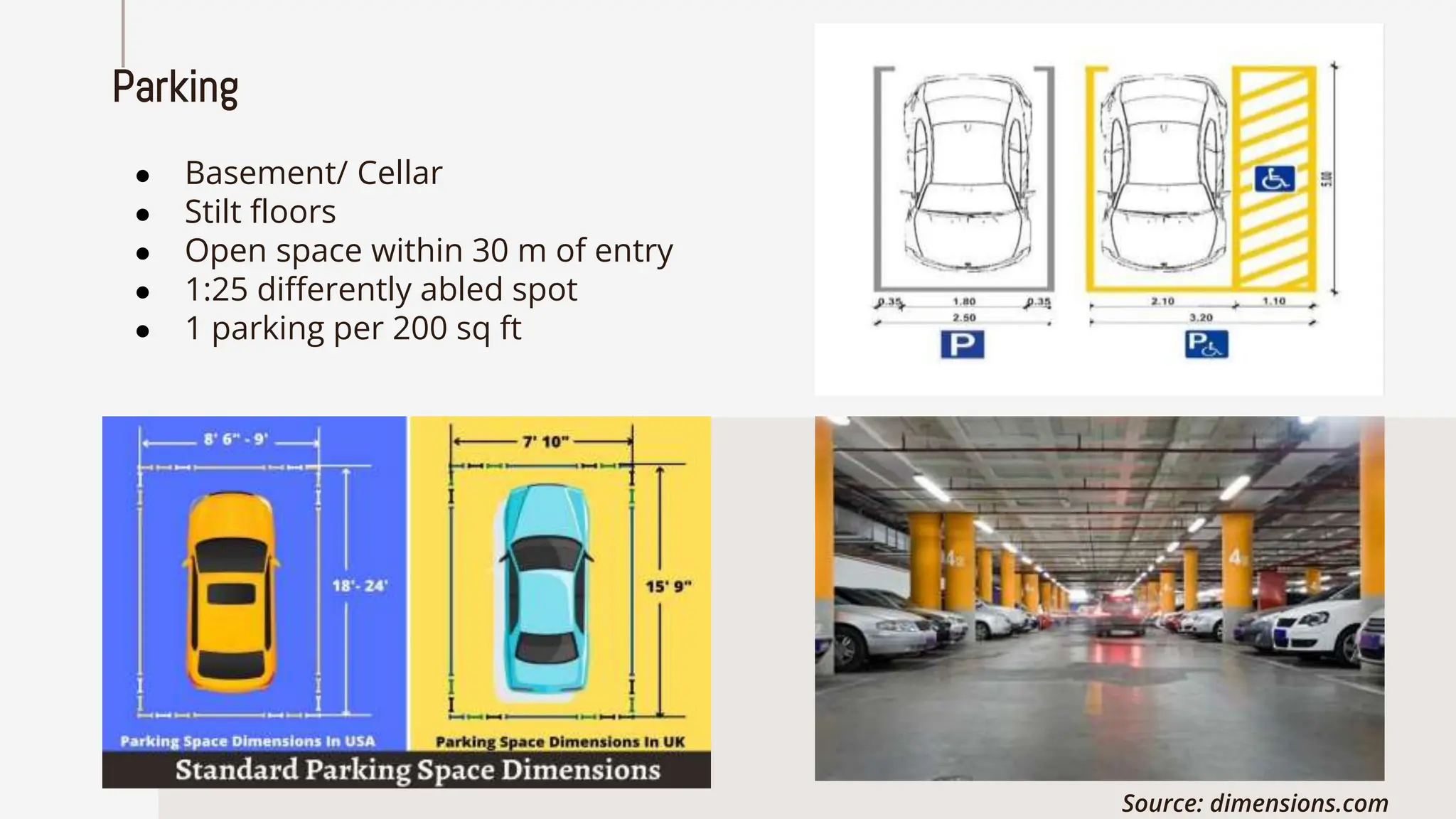
Parking
● Basement/ Cellar
● Stilt floors
● Open space within 30 m of entry
● 1:25 differently abled spot
● 1 parking per 200 sq ft
Source: dimensions.com
Source: Time Savers Standards for Building Types
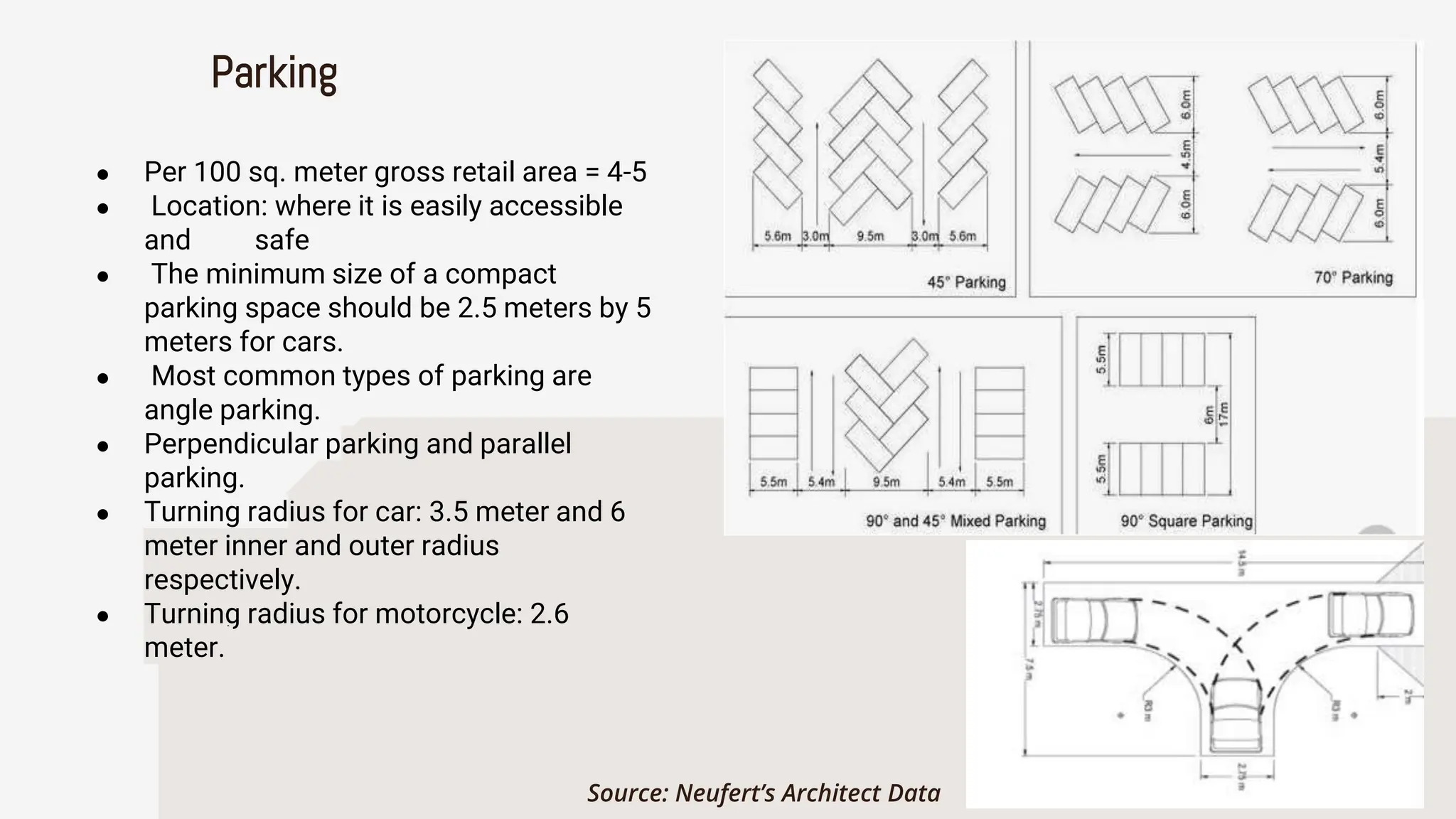
● Per 100 sq. meter gross retail area = 4-5
● Location: where it is easily accessible
and safe
● The minimum size of a compact
parking space should be 2.5 meters by 5
meters for cars.
● Most common types of parking are
angle parking.
● Perpendicular parking and parallel
parking.
● Turning radius for car: 3.5 meter and 6
meter inner and outer radius
respectively.
● Turning radius for motorcycle: 2.6
meter.
Parking
Source: Neufert’s Architect Data
● Escalators, found in malls, airports, and
train stations, are looped tracks with
moving steps.
● Width: 0.9-1.2m
● Length: 5.0-7.0m
● Step width: 0.6-0.8m
● Rise: 4.0-7.0m
● Speed: 0.5-0.7m/s
● Capacity: 20-30 passengers/min
● Sizes vary based on capacity and space.
Escalators
Source: dimensions.com
Lift
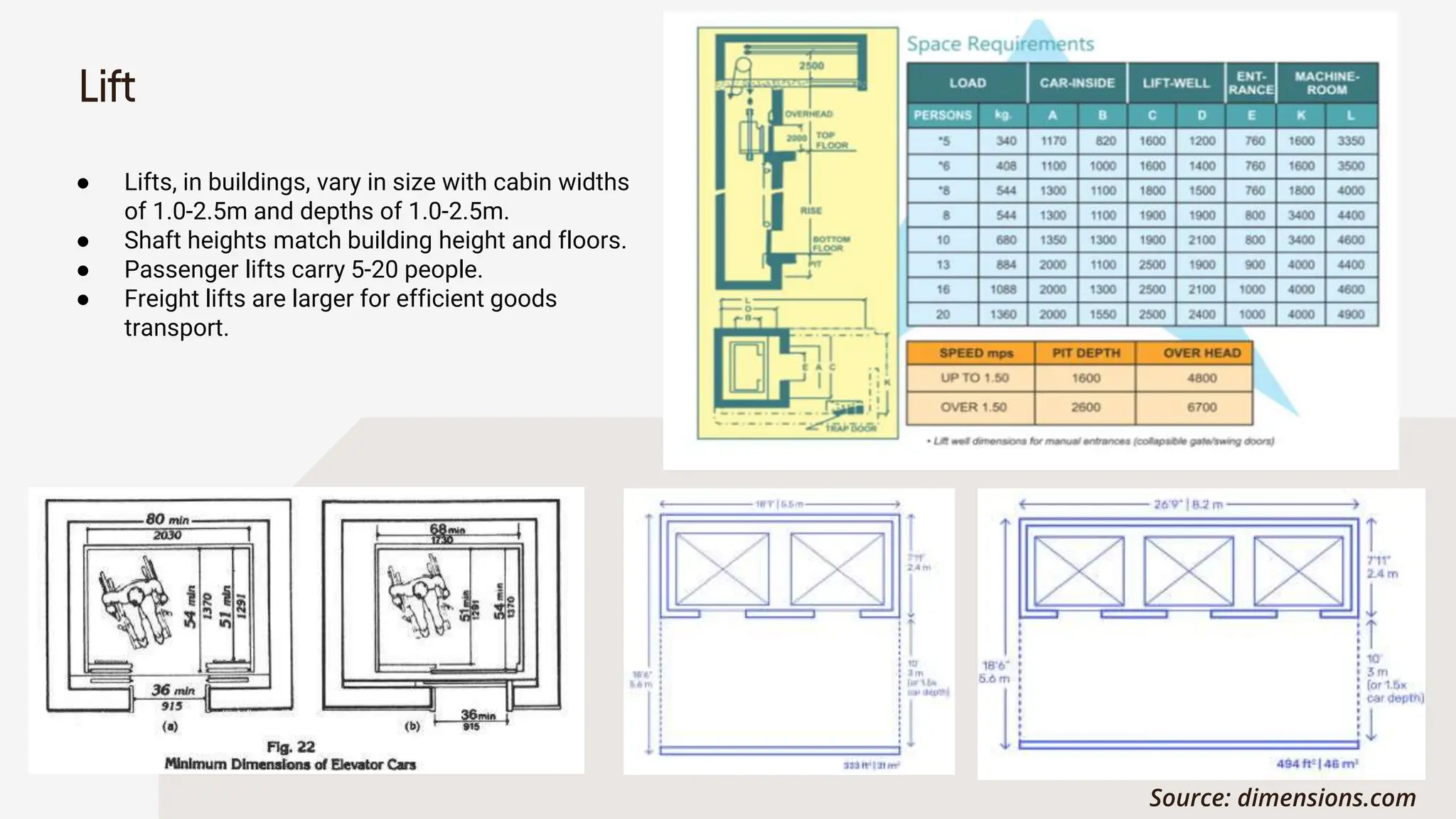
● Lifts, in buildings, vary in size with cabin widths
of 1.0-2.5m and depths of 1.0-2.5m.
● Shaft heights match building height and floors.
● Passenger lifts carry 5-20 people.
● Freight lifts are larger for efficient goods
transport.
Source: dimensions.com
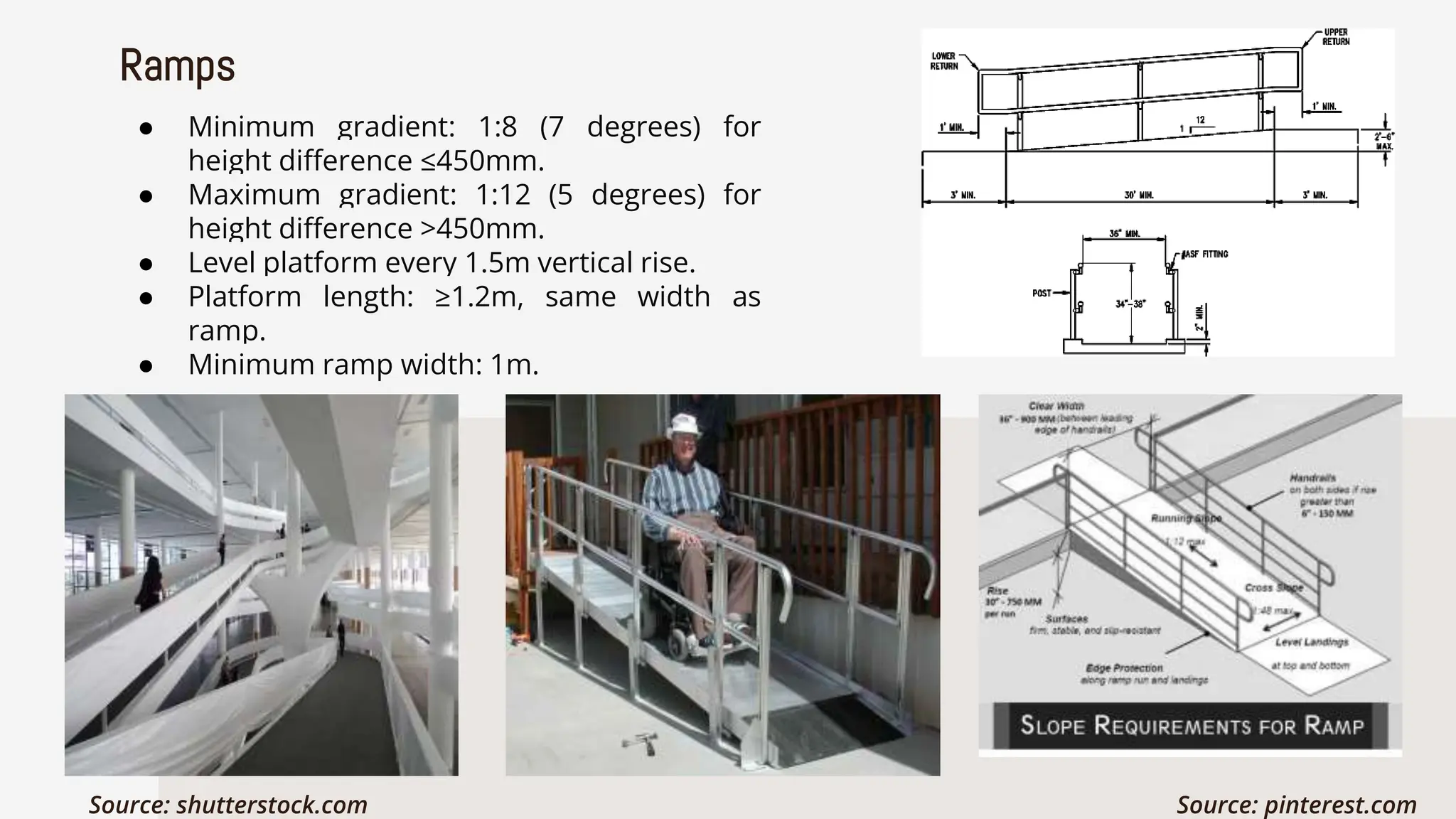
● Minimum gradient: 1:8 (7 degrees) for
height difference ≤450mm.
● Maximum gradient: 1:12 (5 degrees) for
height difference >450mm.
● Level platform every 1.5m vertical rise.
● Platform length: ≥1.2m, same width as
ramp.
● Minimum ramp width: 1m.
Ramps
Source: shutterstock.com Source: pinterest.com
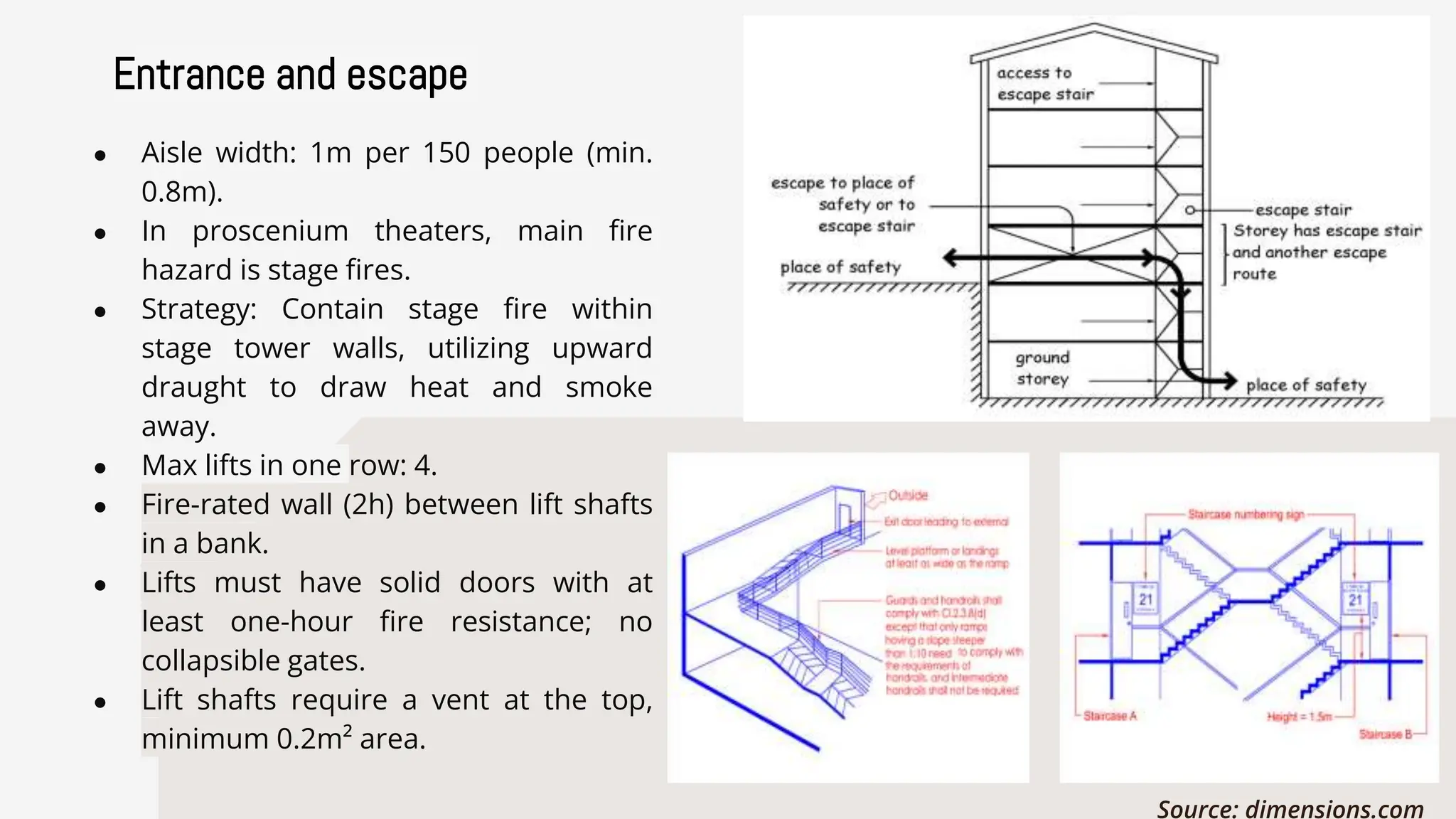
Entrance and escape
● Aisle width: 1m per 150 people (min.
0.8m).
● In proscenium theaters, main fire
hazard is stage fires.
● Strategy: Contain stage fire within
stage tower walls, utilizing upward
draught to draw heat and smoke
away.
● Max lifts in one row: 4.
● Fire-rated wall (2h) between lift shafts
in a bank.
● Lifts must have solid doors with at
least one-hour fire resistance; no
collapsible gates.
● Lift shafts require a vent at the top,
minimum 0.2m² area.
Source: dimensions.com
ENTRANCE
● Grandeur
● Welcoming/ Appealing
● Raised Plinth
● Entry canopy/ Porch
Source: facebook.com
Source: dreamtime.com
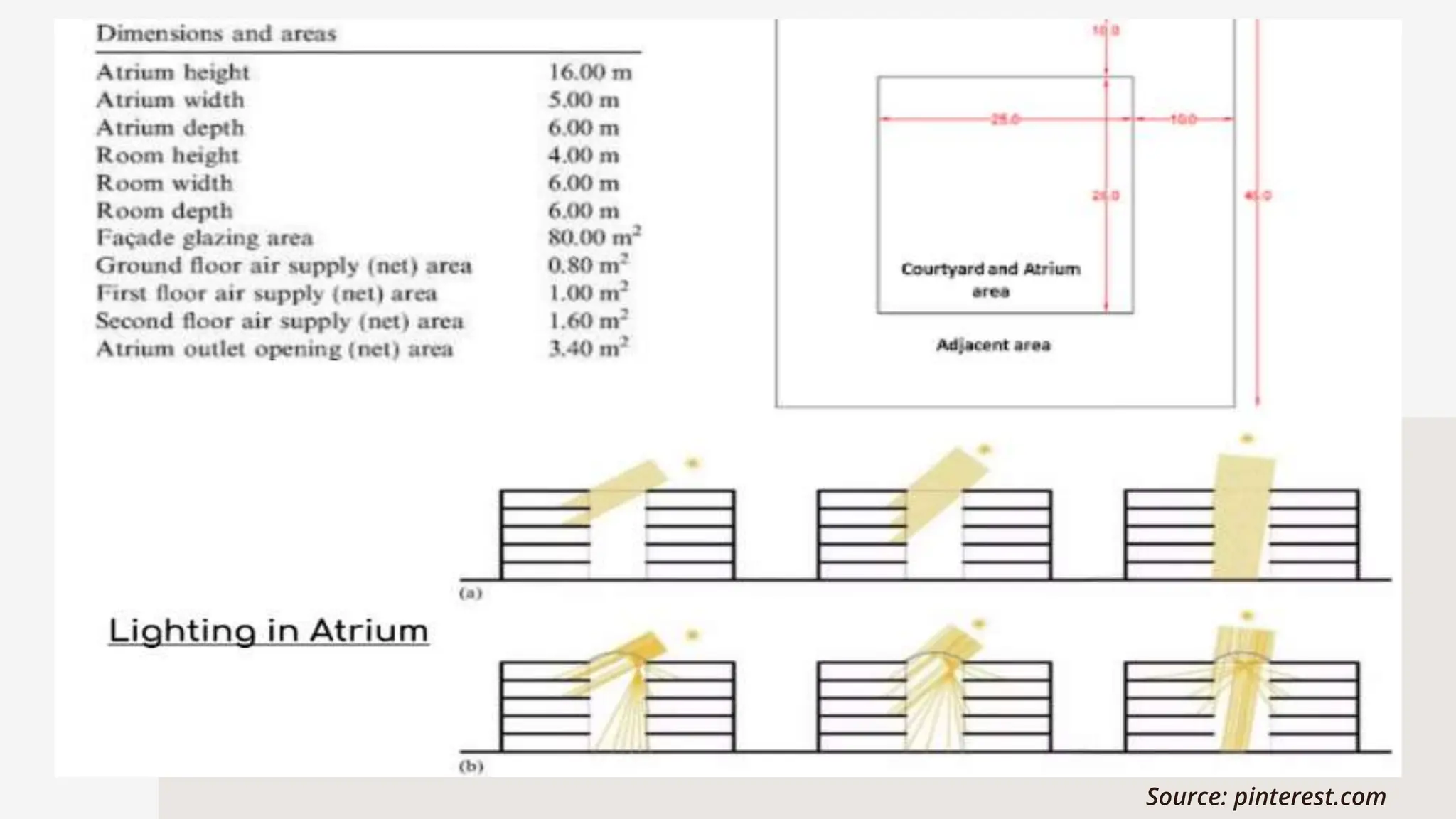
Plaza/ Atrium
● A space to admire building
● Public square
● Sit, Relax, Time Pass ( Breathing Space)
● Control flow of people
Source: archdaily.com
Source: pinterest.com
Offices
Hybrid
Co-working
Individual
Source: freepics.com
Source: slideshare.com
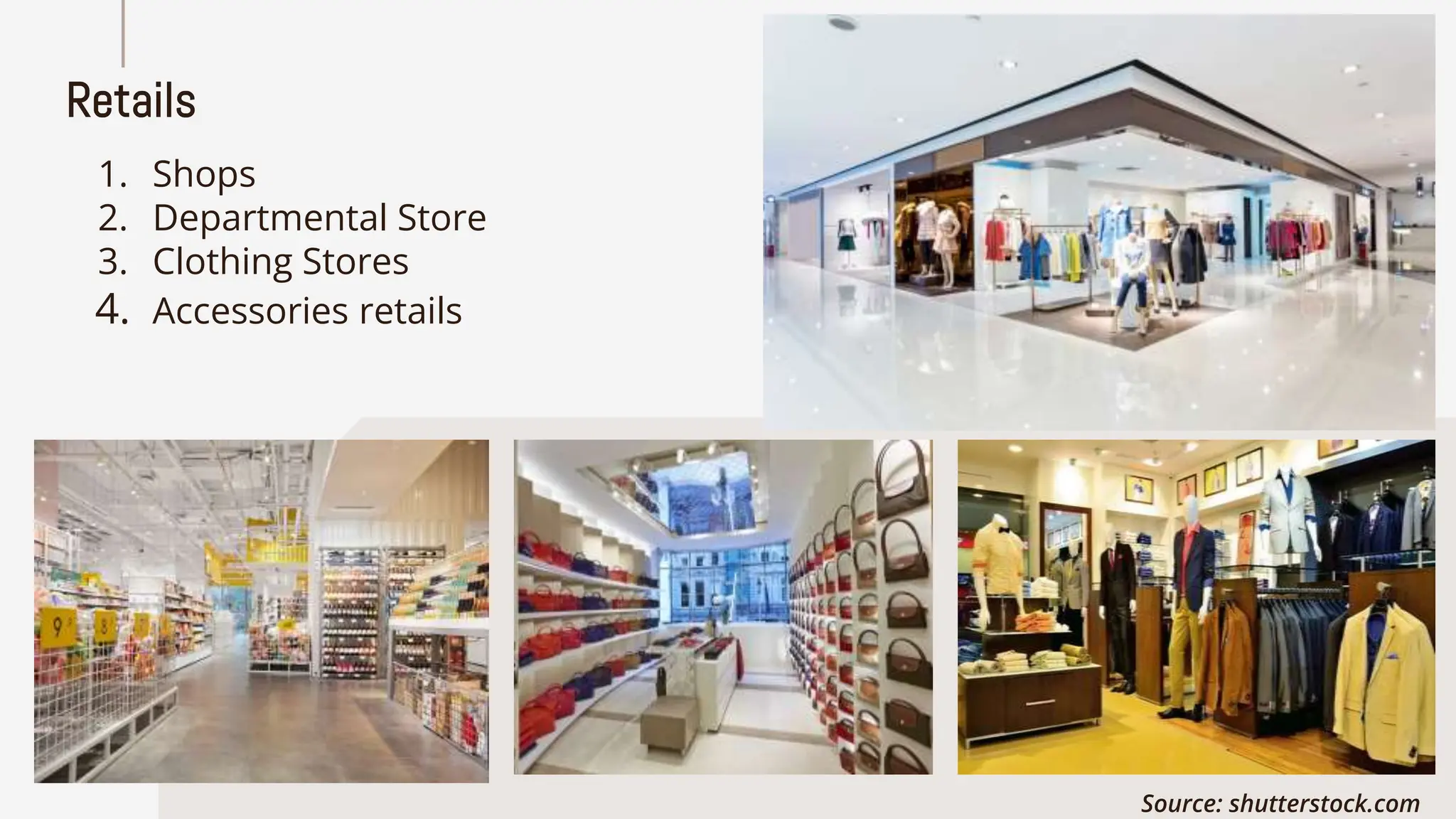
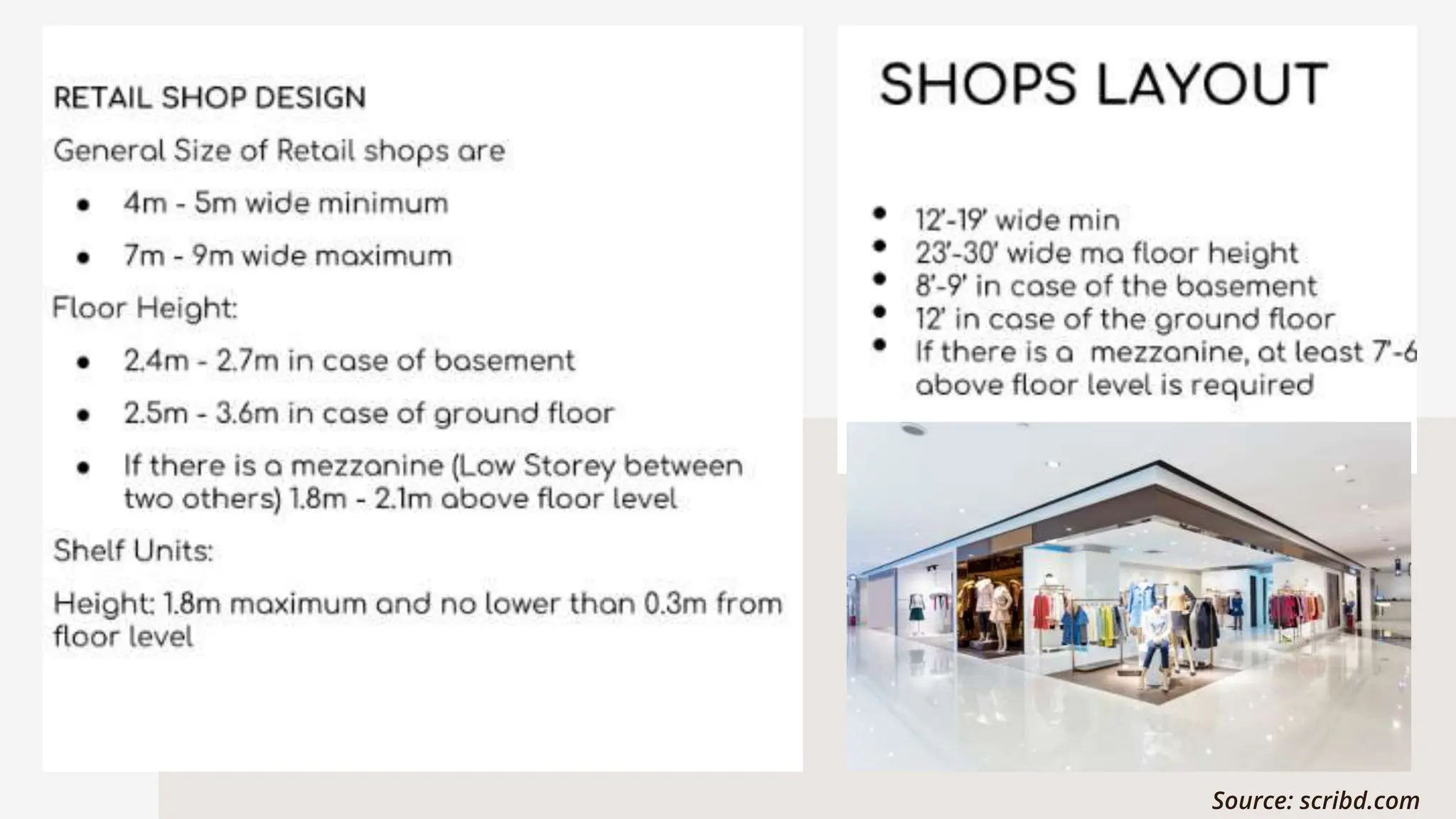
Retails
1. Shops
2. Departmental Store
3. Clothing Stores
4. Accessories retails
Source: shutterstock.com
Source: scribd.com
Retail TYPES OF LAYOUT:
Free Flow
Herring Bone
Grid
Loop
Source: freepik.com
Recreation
● Activity ( Bowling, Arcade, Trampoline, VR)
● Gaming zones
● Children play area
For Children
Age Group
0.6
0.5
0.9
0-6
6-12
12-18
Area ( M2)
Source: google.com
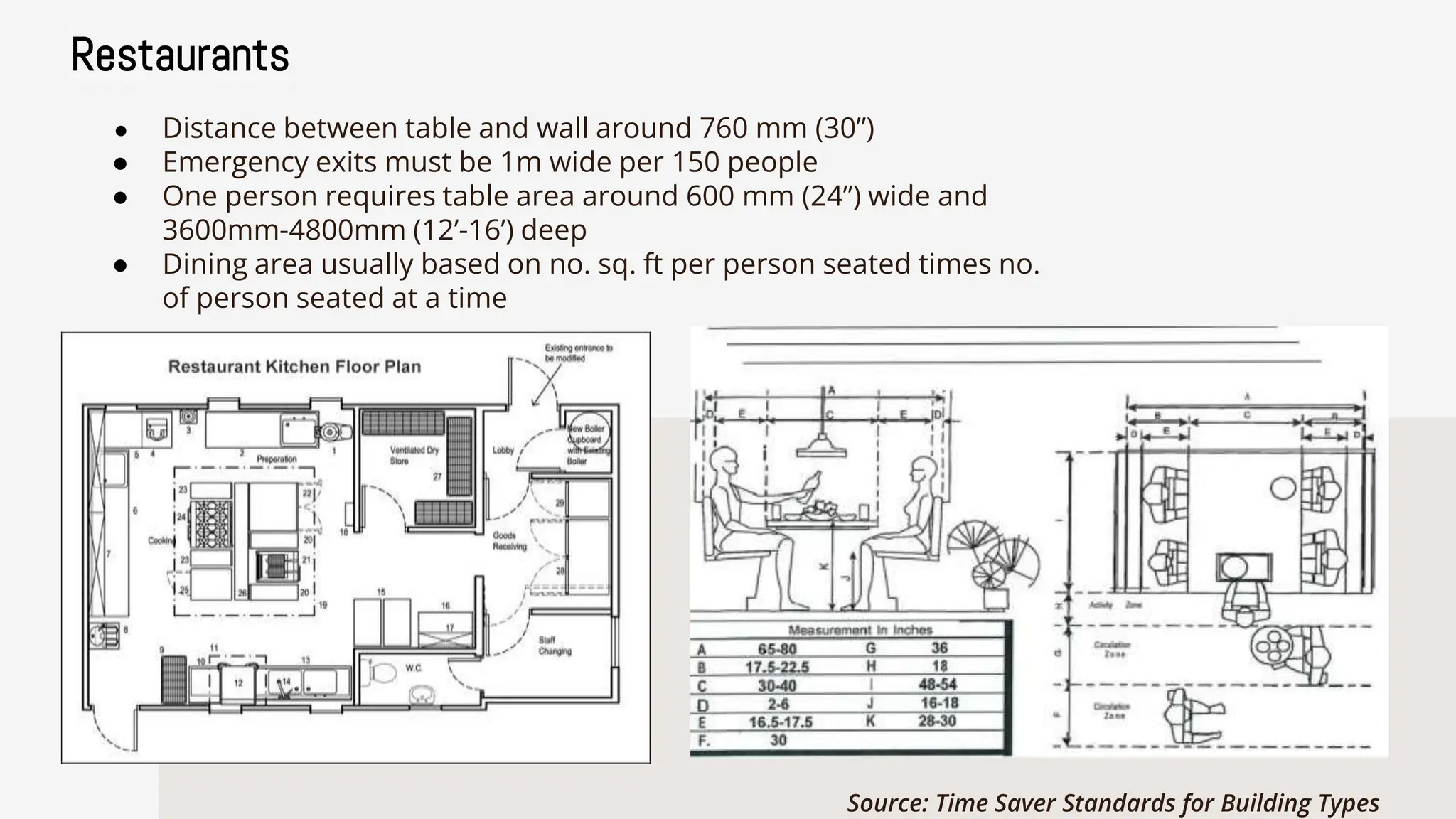
Restaurants
● Distance between table and wall around 760 mm (30”)
● Emergency exits must be 1m wide per 150 people
● One person requires table area around 600 mm (24”) wide and
3600mm-4800mm (12’-16’) deep
● Dining area usually based on no. sq. ft per person seated times no.
of person seated at a time
Source: Time Saver Standards for Building Types
Food Courts and Bar
● Activity ( Bowling, Arcade, Trampoline, VR)
● Gaming zones
● Children play area
Source: Time Saver Standards for Building Types
Services
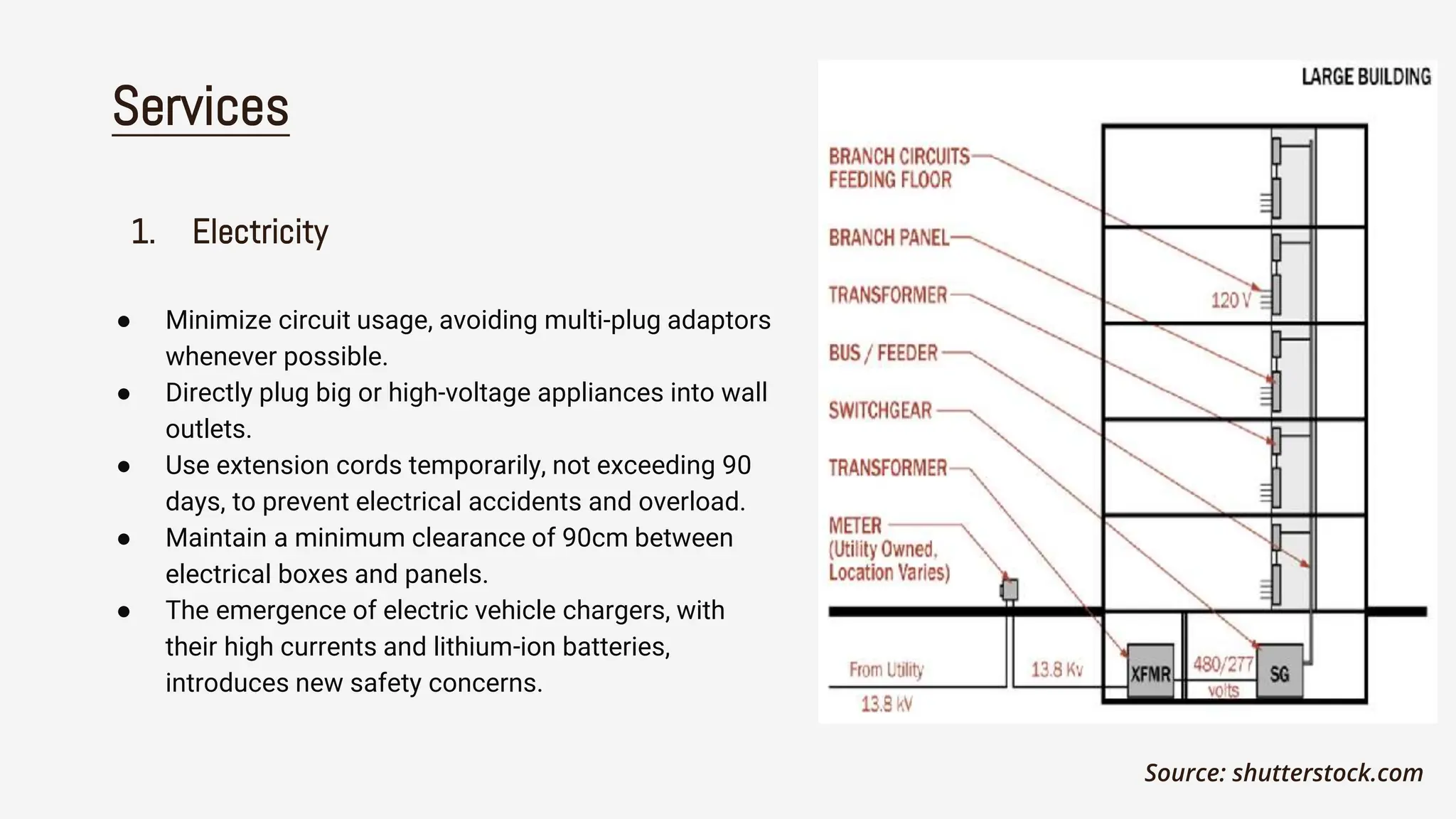
1. Electricity
● Minimize circuit usage, avoiding multi-plug adaptors
whenever possible.
● Directly plug big or high-voltage appliances into wall
outlets.
● Use extension cords temporarily, not exceeding 90
days, to prevent electrical accidents and overload.
● Maintain a minimum clearance of 90cm between
electrical boxes and panels.
● The emergence of electric vehicle chargers, with
their high currents and lithium-ion batteries,
introduces new safety concerns.
Source: shutterstock.com
Services
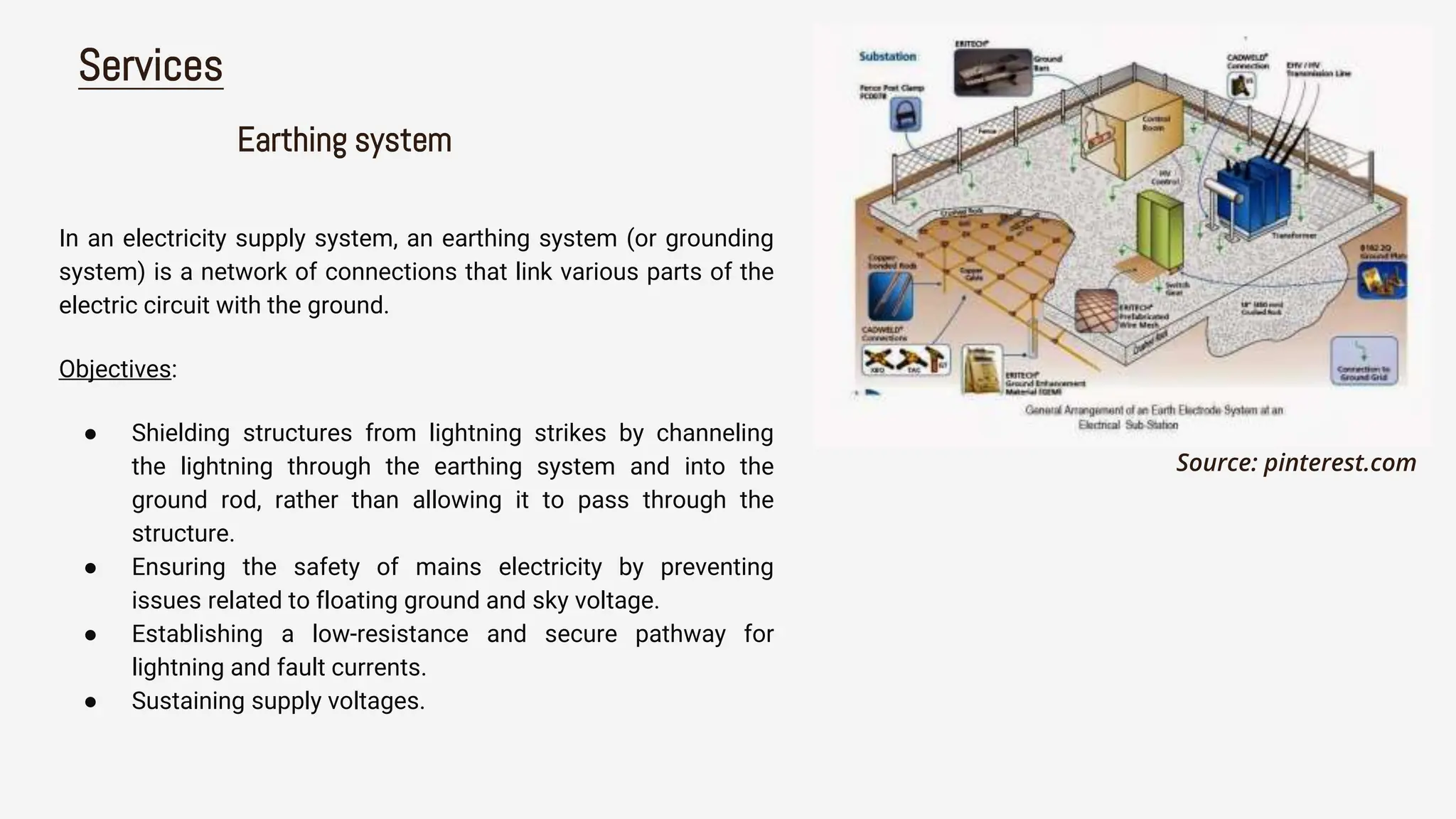
Earthing system
In an electricity supply system, an earthing system (or grounding
system) is a network of connections that link various parts of the
electric circuit with the ground.
Objectives:
● Shielding structures from lightning strikes by channeling
the lightning through the earthing system and into the
ground rod, rather than allowing it to pass through the
structure.
● Ensuring the safety of mains electricity by preventing
issues related to floating ground and sky voltage.
● Establishing a low-resistance and secure pathway for
lightning and fault currents.
● Sustaining supply voltages.
Source: pinterest.com
Services
2. HVAC system
● The HVAC system in commercial buildings is
responsible for cleaning the air by removing dust and
other particles.
● It also addresses odor control, localizing and eliminating
unwanted smells to maintain indoor air quality.
● They create a comfortable indoor climate.
● In retail areas, low noise levels are prioritized for
customer comfort.
● Ventilation components should be discreetly integrated
for aesthetic appeal.
● Simple maintenance is vital for efficient and long-lasting
operation.
Source: arch20.com
Services
3. Fire Safety
● Fire safety in buildings involves various systems
and measures.
● These include fire alarms, extinguishers,
emergency lighting, and sprinkler systems.
● Fire sprinkler systems, like water spray and mist,
gas and foam, deluge, and pre-action systems,
offer active fire suppression capabilities.
● Smoke control and compartmentation help
manage fire hazards.
● Regular training ensures preparedness among
occupants.
● Compliance with building codes ensures
effectiveness.
Source: google.com
Case Studies:
CASE 1
01
02
03
04
Manbhawan Complex,
Kumaripati
CASE 2 United WTC,
Tripureshwor
CASE 3
The Groove, Thailand
CASE 4
Lane 189, Shanghai
Case study : National
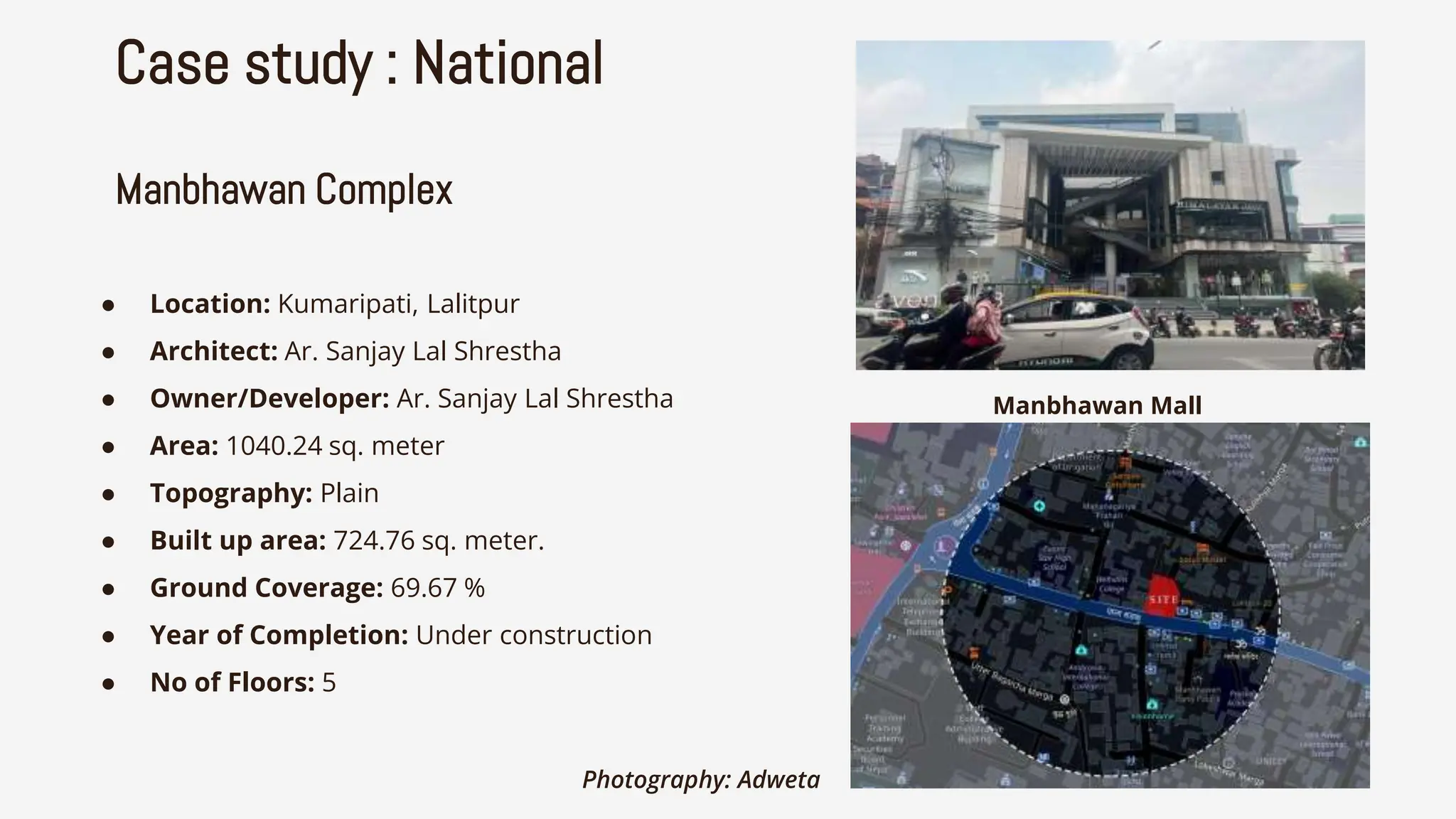
Manbhawan Complex
● Location: Kumaripati, Lalitpur
● Architect: Ar. Sanjay Lal Shrestha
● Owner/Developer: Ar. Sanjay Lal Shrestha
● Area: 1040.24 sq. meter
● Topography: Plain
● Built up area: 724.76 sq. meter.
● Ground Coverage: 69.67 %
● Year of Completion: Under construction
● No of Floors: 5
Manbhawan Mall
Photography: Adweta
Case study : National
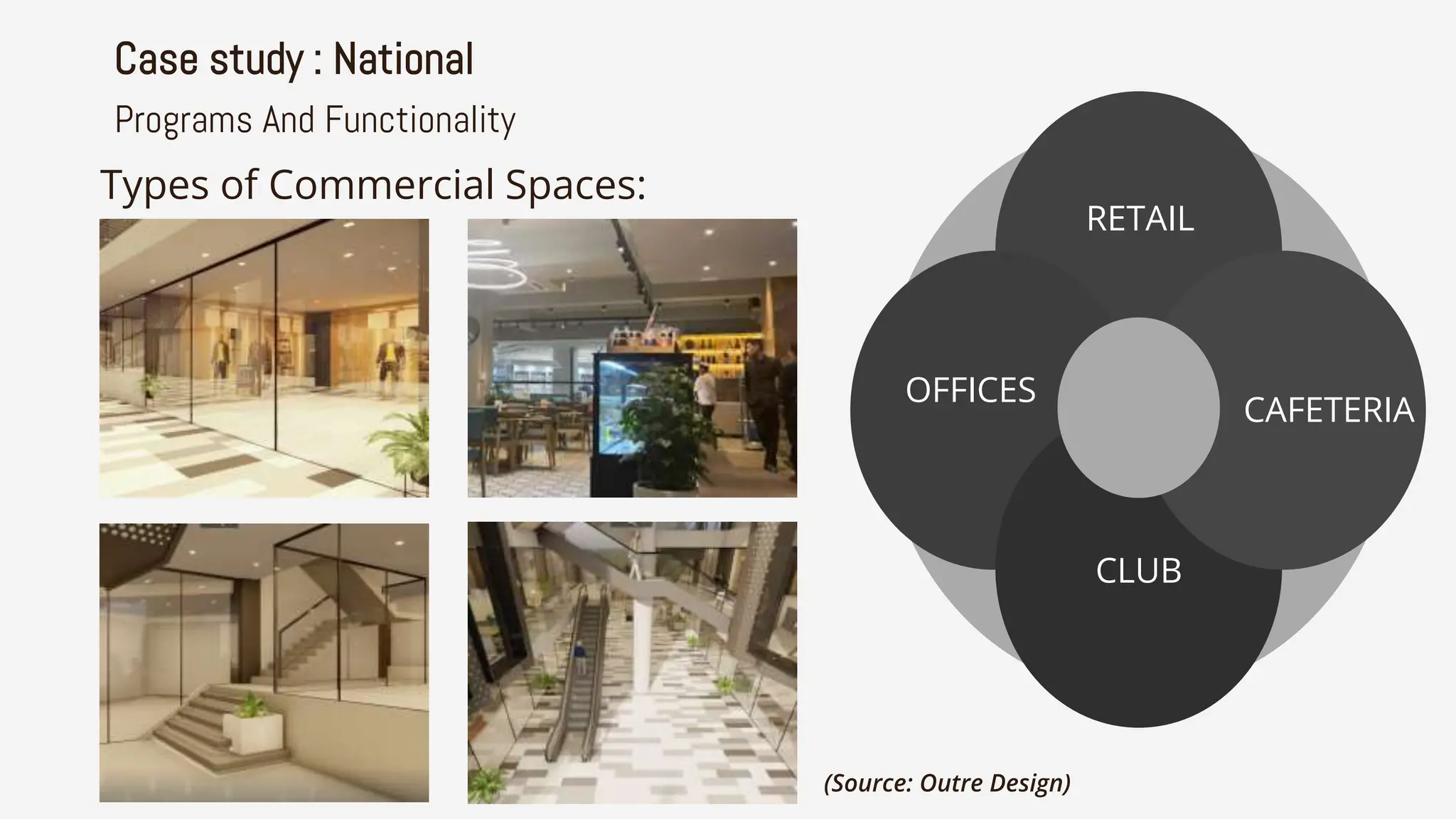
Programs And Functionality
RETAIL
Types of Commercial Spaces:
OFFICES
CAFETERIA
CLUB
(Source: Outre Design)
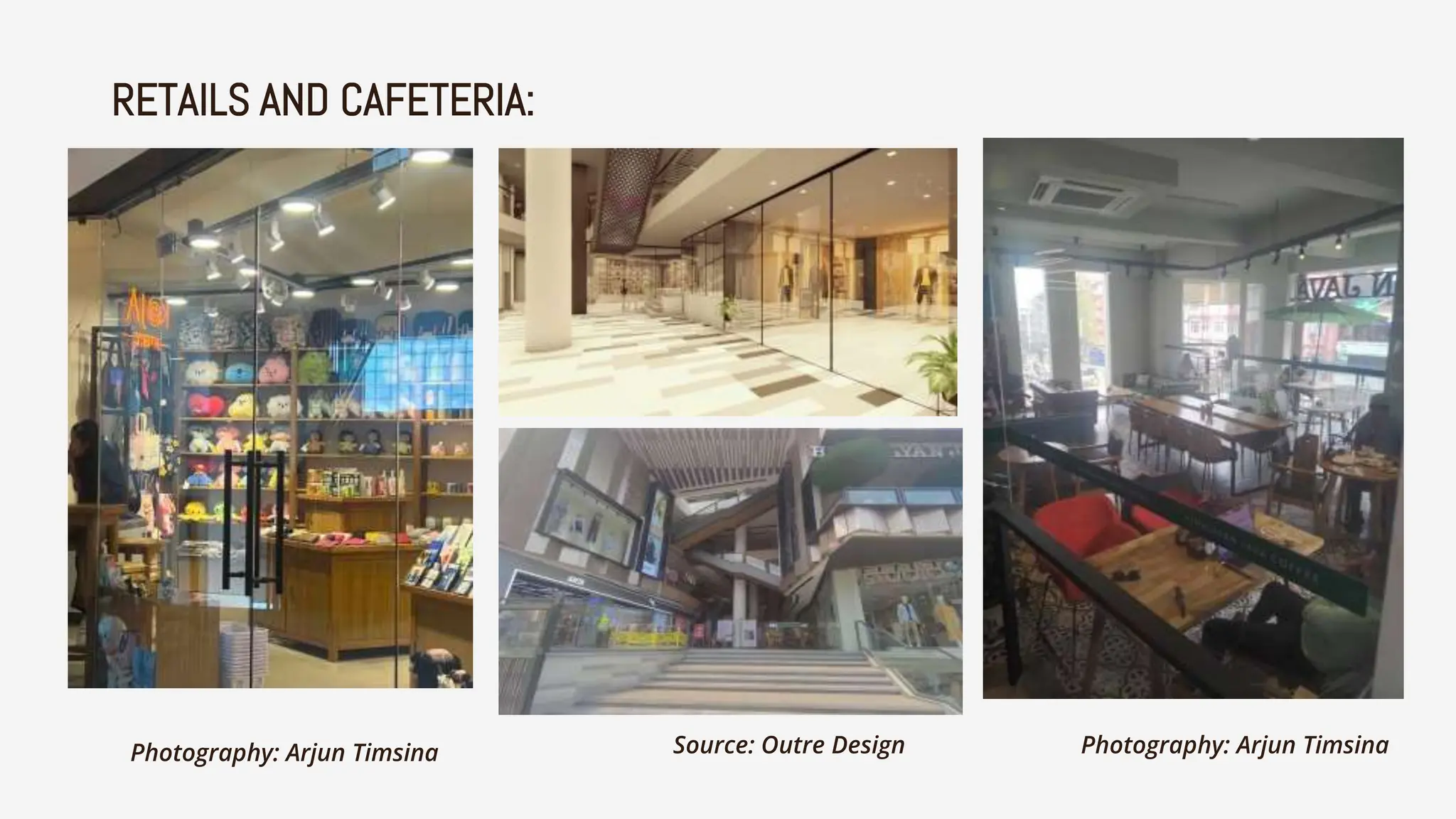
RETAILS AND CAFETERIA:
Photography: Arjun Timsina Source: Outre Design Photography: Arjun Timsina
Case study : National (Manbhawan)
Architectural Form and Massing
● A balance of mass and void can be observed
● Play of linear geometry
● Grand front facade hence creating welcoming entrance
● Designed such that shops inside can be seen from
outside
Sketched: Mr. Manoj Thapa
Case study : National (Manbhawan)
Space and Configuration
Zoning and Layout of the complex
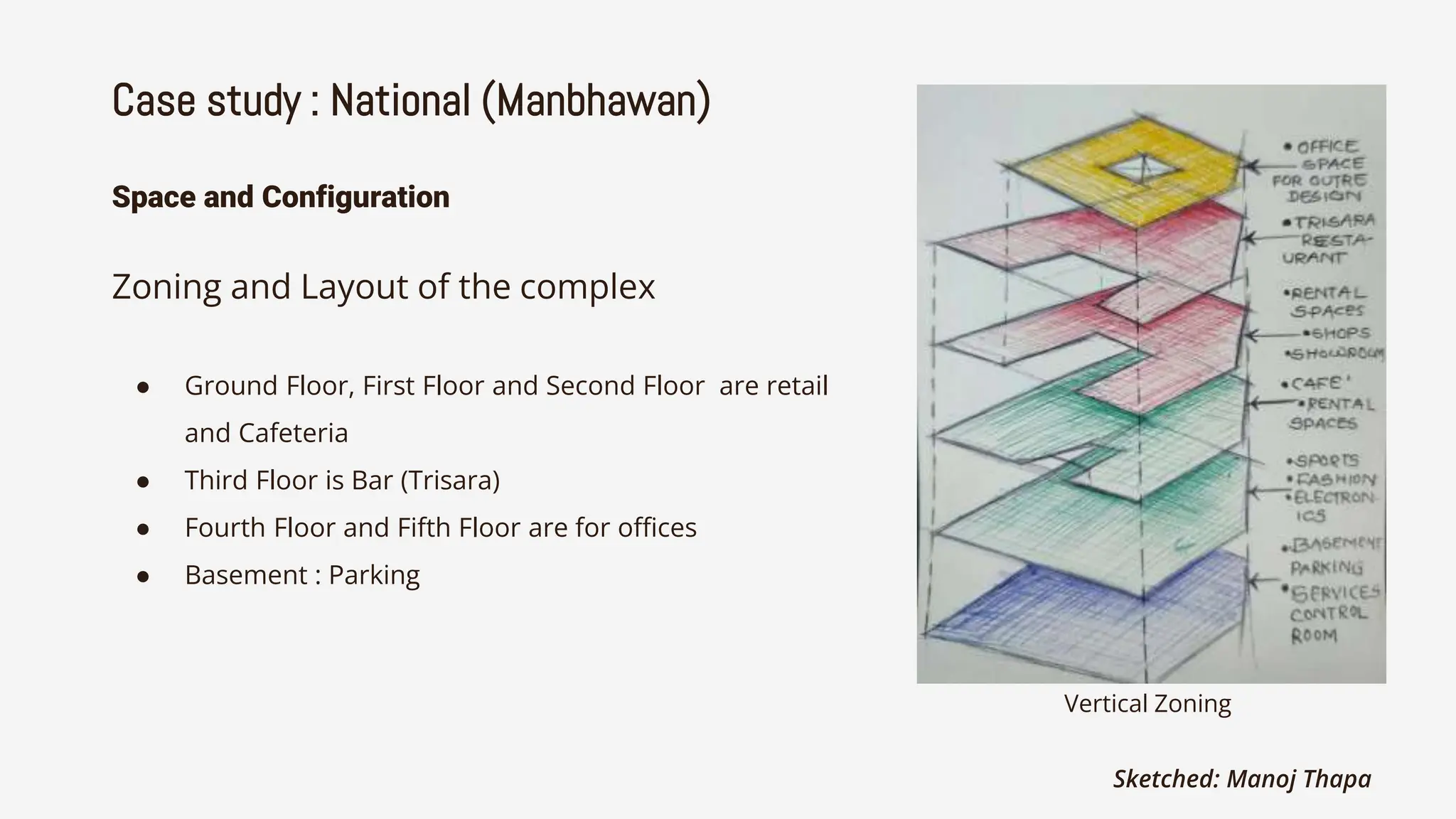
● Ground Floor, First Floor and Second Floor are retail
and Cafeteria
● Third Floor is Bar (Trisara)
● Fourth Floor and Fifth Floor are for offices
● Basement : Parking
Vertical Zoning
Sketched: Manoj Thapa
Case study : National
Size and Distribution of each Spaces
Size and Distribution of each Spaces:
Case study : National
Size and Distribution of each Spaces
Size and Distribution of each Spaces:
Size and Distribution of each Spaces
Case study : National
THIRD FLOOR PLAN
Size and Distribution of each Spaces:
Size and Distribution of each Spaces
Case study : National
Size and Distribution of each Spaces
Case study : National
Size and Distribution of each Spaces
Case study : National
Parking:
● Well lit
● Cool
● 2 Storey
Photography: Adweta Amatya
Parking Capacity:
Cars: 21 No.s (34
No.s with double
stack)
Bikes: 29 No.s
Case study : National
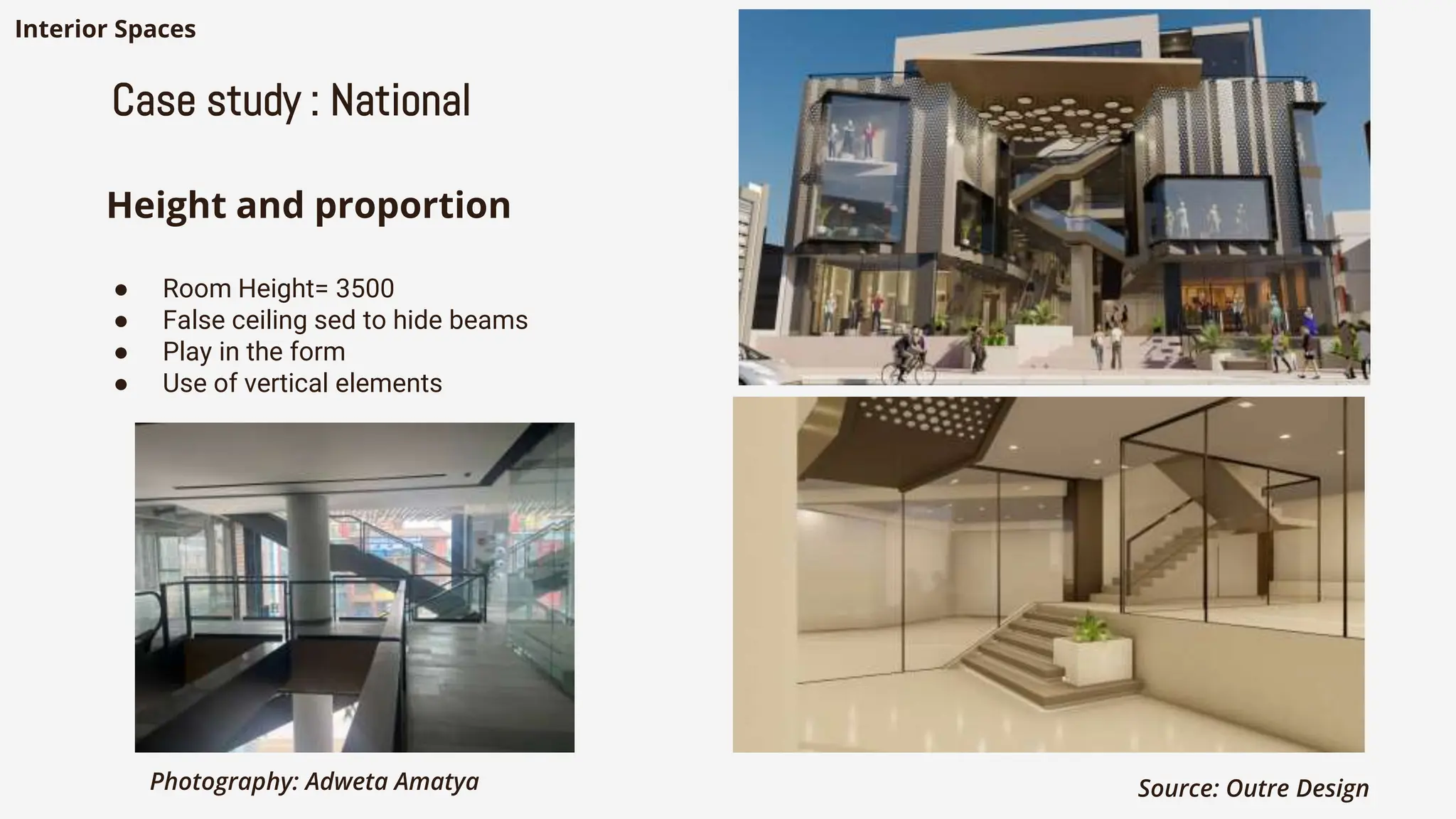
Height and proportion
Interior Spaces
● Room Height= 3500
● False ceiling sed to hide beams
● Play in the form
● Use of vertical elements
Source: Outre Design
Photography: Adweta Amatya
Case study : National
Structural system :
Steel Beam and Corrugated Sheets
Circular Columns
Photography: Adweta Amatya
RCC Framed Structure
Source: Outre Design
● column spacing, ranging from 3 meters to 6.5 meters
GRID PLAN
Source: Outre Design
Case study : National
Interior Spaces
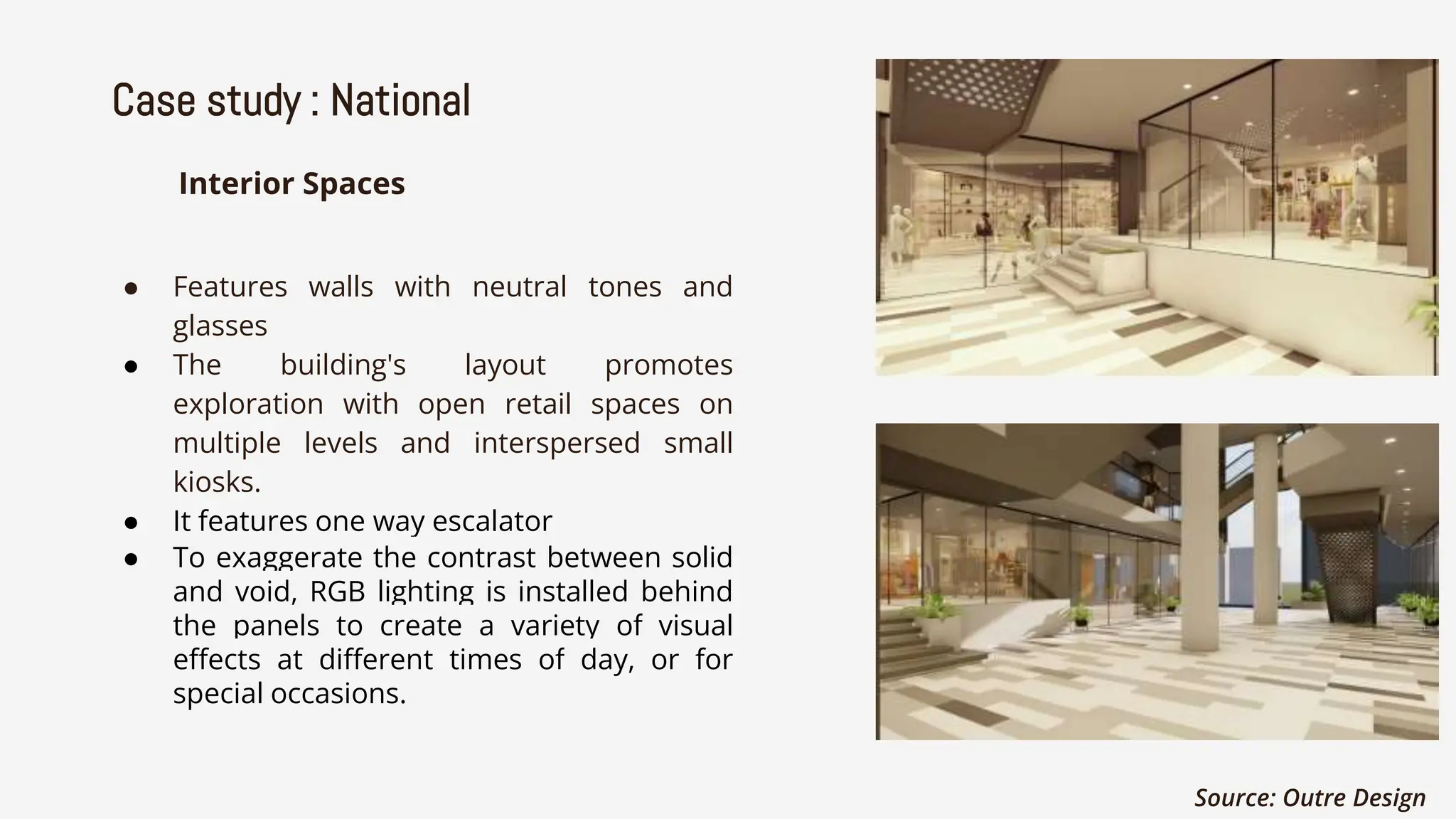
● Features walls with neutral tones and
glasses
● The building's layout promotes
exploration with open retail spaces on
multiple levels and interspersed small
kiosks.
● It features one way escalator
● To exaggerate the contrast between solid
and void, RGB lighting is installed behind
the panels to create a variety of visual
effects at different times of day, or for
special occasions.
Source: Outre Design
Case study : National
Facade Design
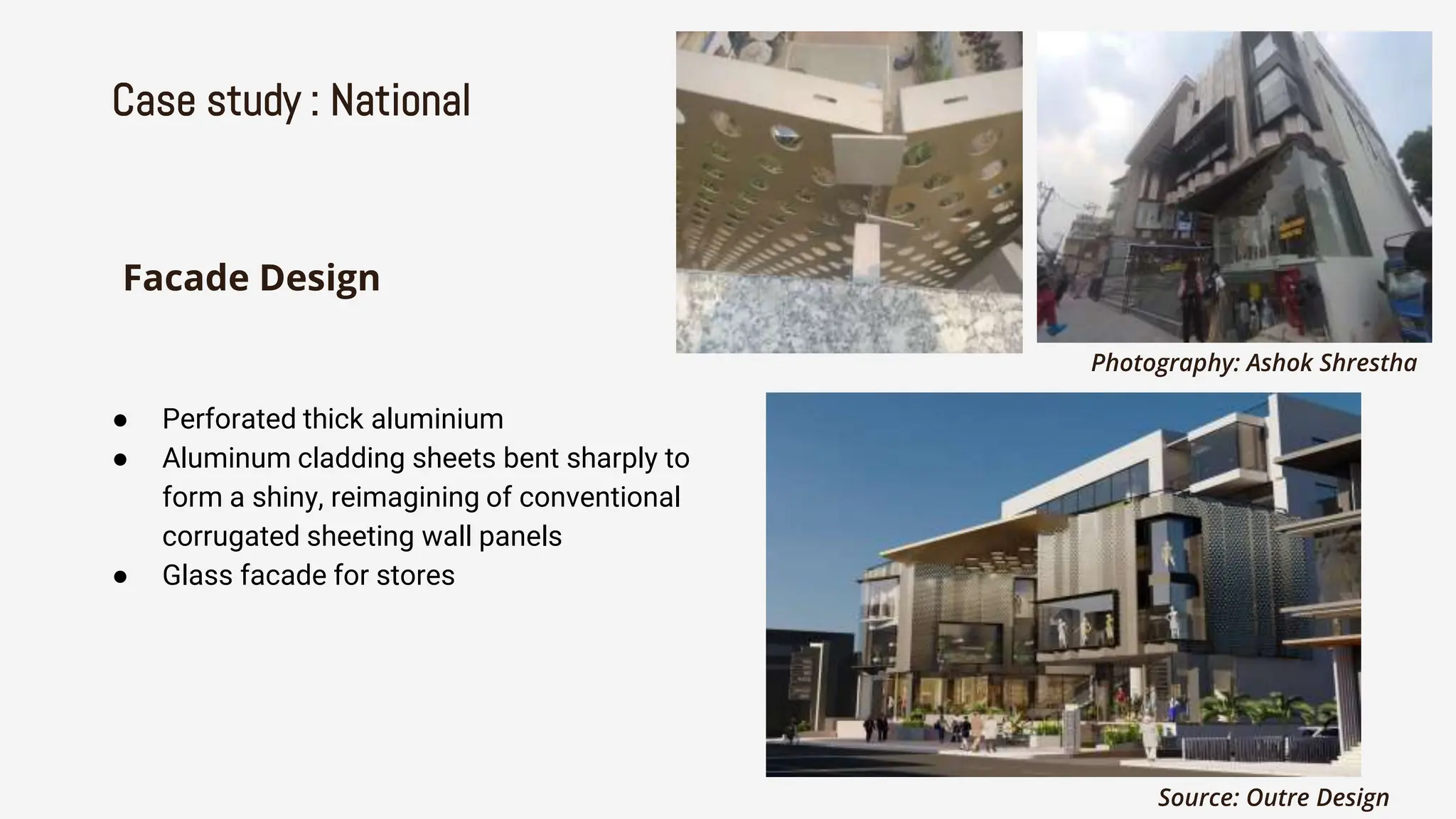
● Perforated thick aluminium
● Aluminum cladding sheets bent sharply to
form a shiny, reimagining of conventional
corrugated sheeting wall panels
● Glass facade for stores
Photography: Ashok Shrestha
Source: Outre Design
Case study : National
Interior Spaces
● CGI Sheet was used as
covering material for the
stairs that is visible from
the front facade
Photography: Aakriti Giri Source: Outre Design
Case study : National
Building Materials:
Glass Brick Marble
Glass Facade
Perforated Aluminium
Recycled Plastic Composite (RPC)
Gypsum Boards
Case study : National
Services and Utility:
Photography: Adweta Amatya
● Separate lift provided on
basement for service
purpose only.
● Void room from below to
top for placement of A/C
ducts and fire extinguishing
elements.
● Emergency Route and Fire
Safety
Case study : National
United World Trade Center
Location: Tripureshwor
Architect: Ar. Bishnu Pd Panthee
Area: 10-15-3-0 (Approx. 5400 Sq. meter)
Topography:Almost flat land
Built up area: 1839.95 sq meter
Ground Coverage: 61.3%
No of Floors: 5
Site Location
Case study : National
Concept:
Sketched: Manoj Thapa
1. Site Context: Understand site features like
topography, orientation, and surroundings.
1. Massing Manipulation: Adapt building mass to fit
function and blend with environment.
1. Orientation and Views: Position building for optimal
views, light, and climate considerations.
1. Distinct Entrance: Create visually striking entrance
to attract traffic and serve as a focal point.
1. Visual Impact: Enhance visual appeal with careful
design of form, materials, and details.
Case study : National
Programs And Functionality
Types of Commercial Spaces:
Ground floor:
● Food and Beverage
Outlets
● Koisks
● Entertainment Venues
● Retails Shops
● Restaurants
First floor: -
● Shops
● Retail Stores
● Entertainment Venues
● Service Providers
● Fitness Centers
● Pop-Up Shops
Second floor: -
● Office spaces
● Financial Branches Sketched: Manoj Thapa
Case study : National
Programs And Functionality
Types of Commercial Spaces
Third floor: -
● Office and Business spaces
Fourth floor:
● Occupied by DECC (Direction Exhibition Convention Center), it
contains seminar hall, multi-purpose hall, exhibition hall, Agni
hall of 500 capacity and food outlet to cater its customers.
● The floor has been planed and developed to provide different
utility sections to conduct different exhibition, seminar etc.
Fifth floor:-
● restaurant covering area
● party palace
● swimming pool
● fitness club
● spa center
Photography: Adweta Amatya
Case study : National
Size and Distribution of each
Spaces
Ground Floor
● Koisks: 50-200 sq. meter
● Resturants: 500-2000 sq. meter
● Retail Stores: 25 to 50 sq. meter
● Drinks Outlets: 15 to 40 sq. meter
● Entertainment Venues: 100 sq. meter
First Floor
● Retail Stores: 50-100 sq. meter
● Pop-Up Shops: 10-50 sq. meter
● Business Area: 20-40 sq. meter
Case study : National
Size and Distribution of each Spaces
Second Floor
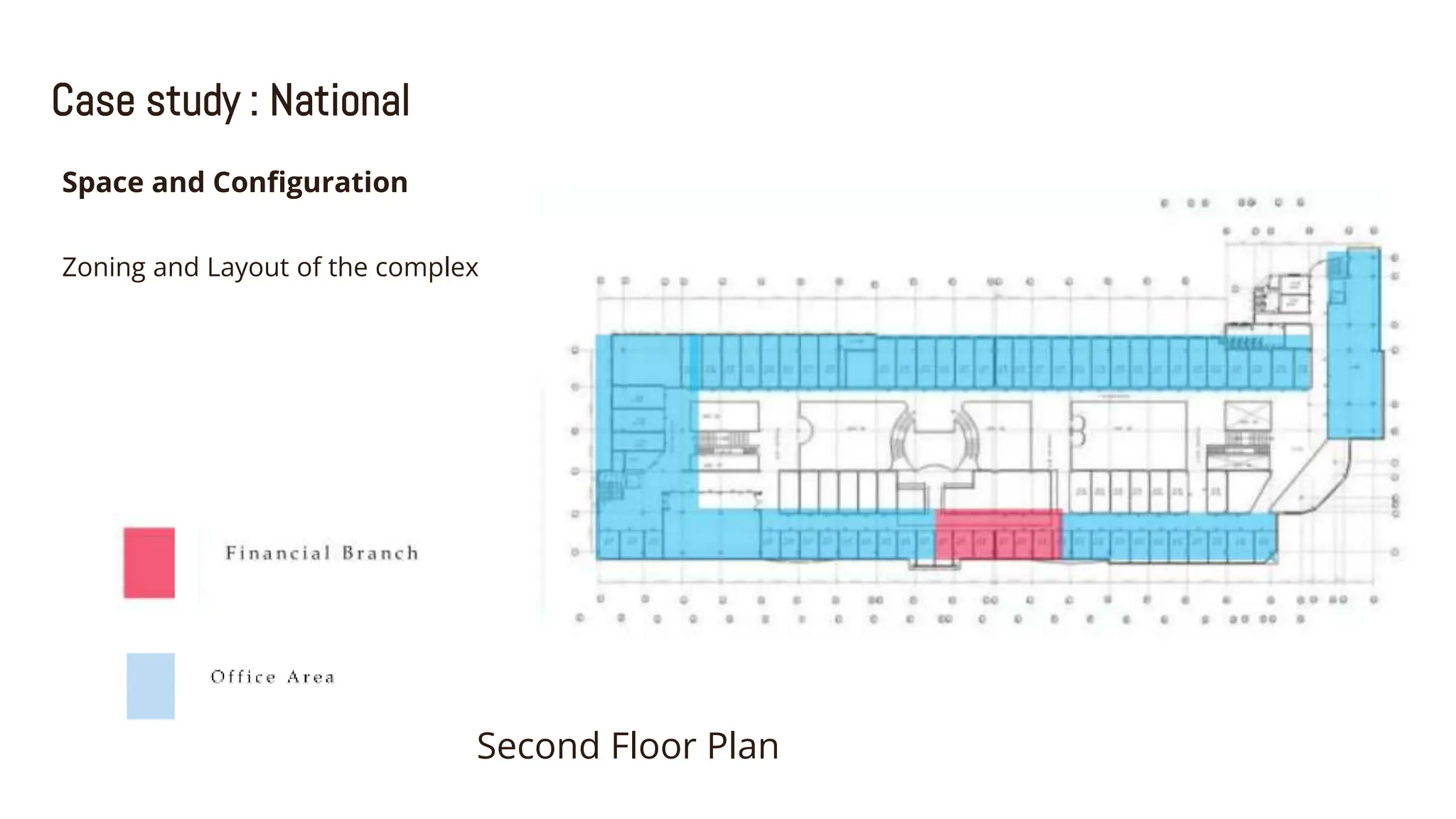
● Office Spaces: 200-500 sq. meter
● Financial Branches: 100-500 sq. meter
● Service Area : 100 sq meter
Third Floor
● Office Spaces: 10-200 sq. meter
● Business Centers: 100-500 sq meter
● Meeting Rooms: 50-100 sq. meter
● Retail/Office Hybrid Spaces: 50-100 sq. meter
Case study : National
Size and Distribution of each
Spaces
Fourth Floor
● Direction Exhibition and Convention
Center(DECC) at fourth floor (area 254540sq ft).
● Conduct event like, exhibition, trade fair and
seminar
Exhibition hall=12000 sq ft.
Capacity nearly 70 standard
● Seminar cum Banquet Hall =1650 sq.ft. (nearly
150 participants)
● Food outlet/kitchen=2425sq ft.
Capacity to cater to 100 customers at a time, a
special VIP suite, 12 business chamber
● Multi-purpose hall=1350 sq ft.
Fifth floor
● Restaurant covering area of200 capacity,
a party palace of 1000 capacity and UWTC office.
● Fitness club with 400 members and spa center
Case study : National
Space and Configuration
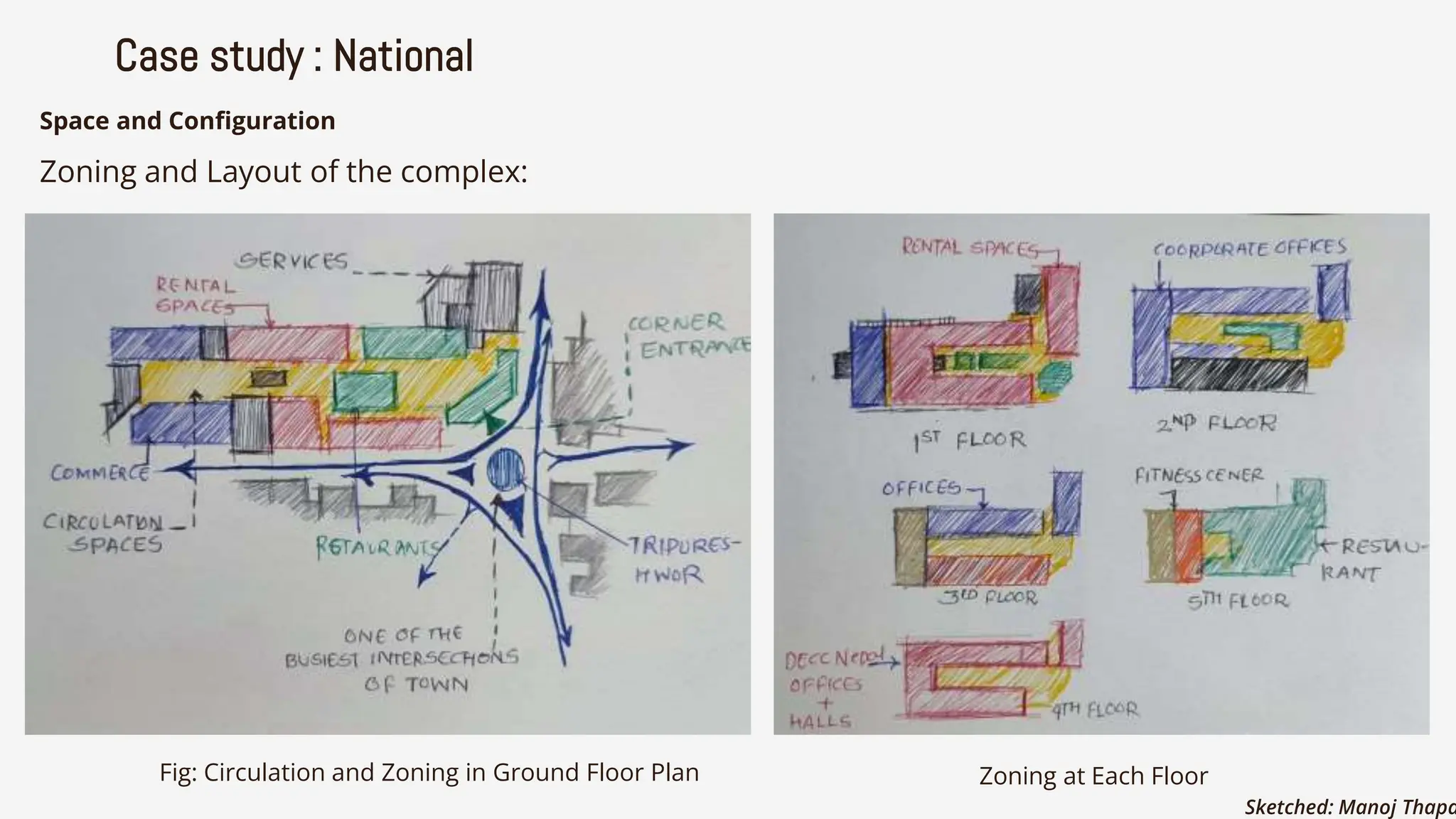
Zoning and Layout of the complex:
Zoning at Each Floor
Sketched: Manoj Thapa
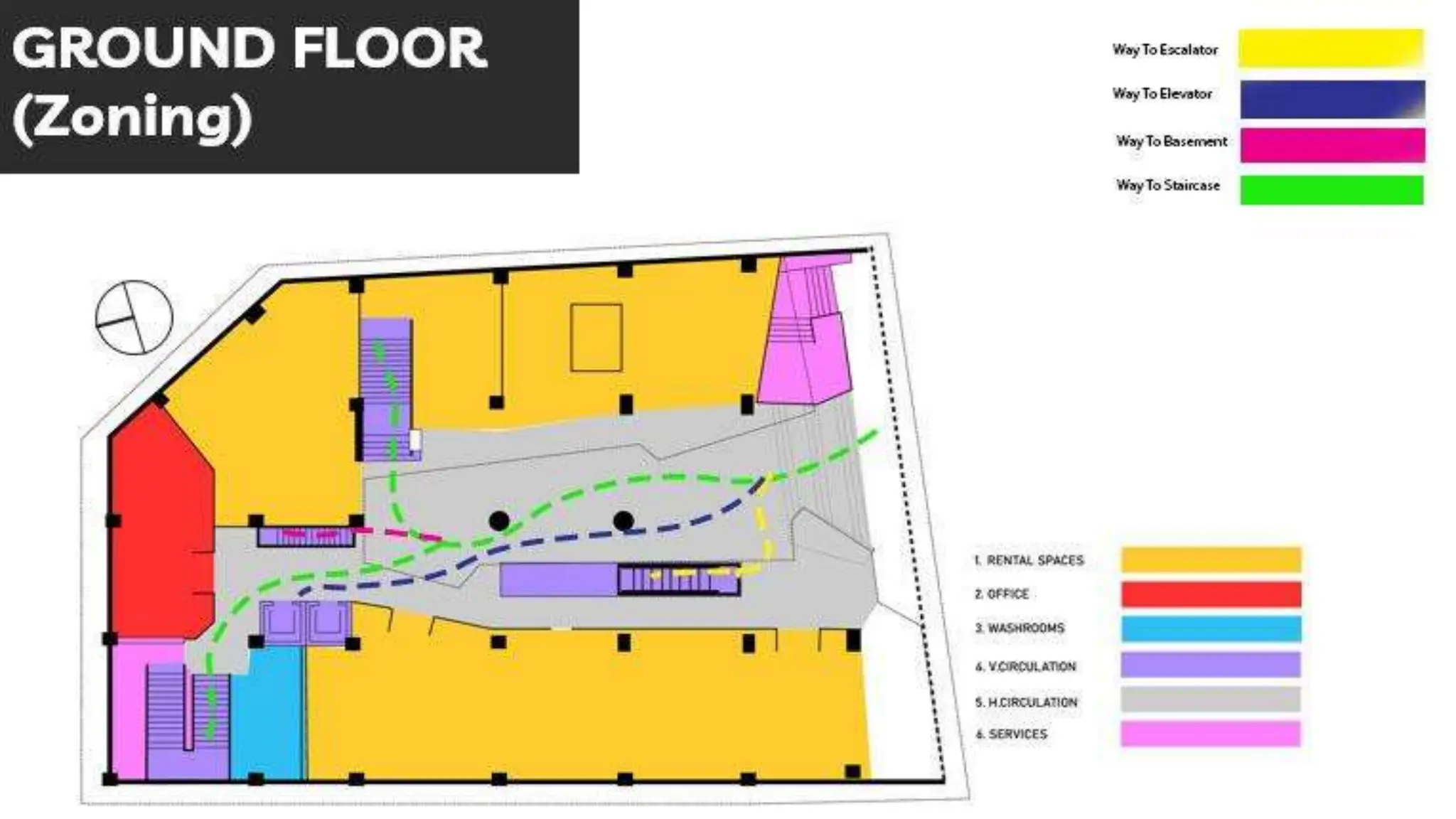
Fig: Circulation and Zoning in Ground Floor Plan
Case study : National
Space and Configuration
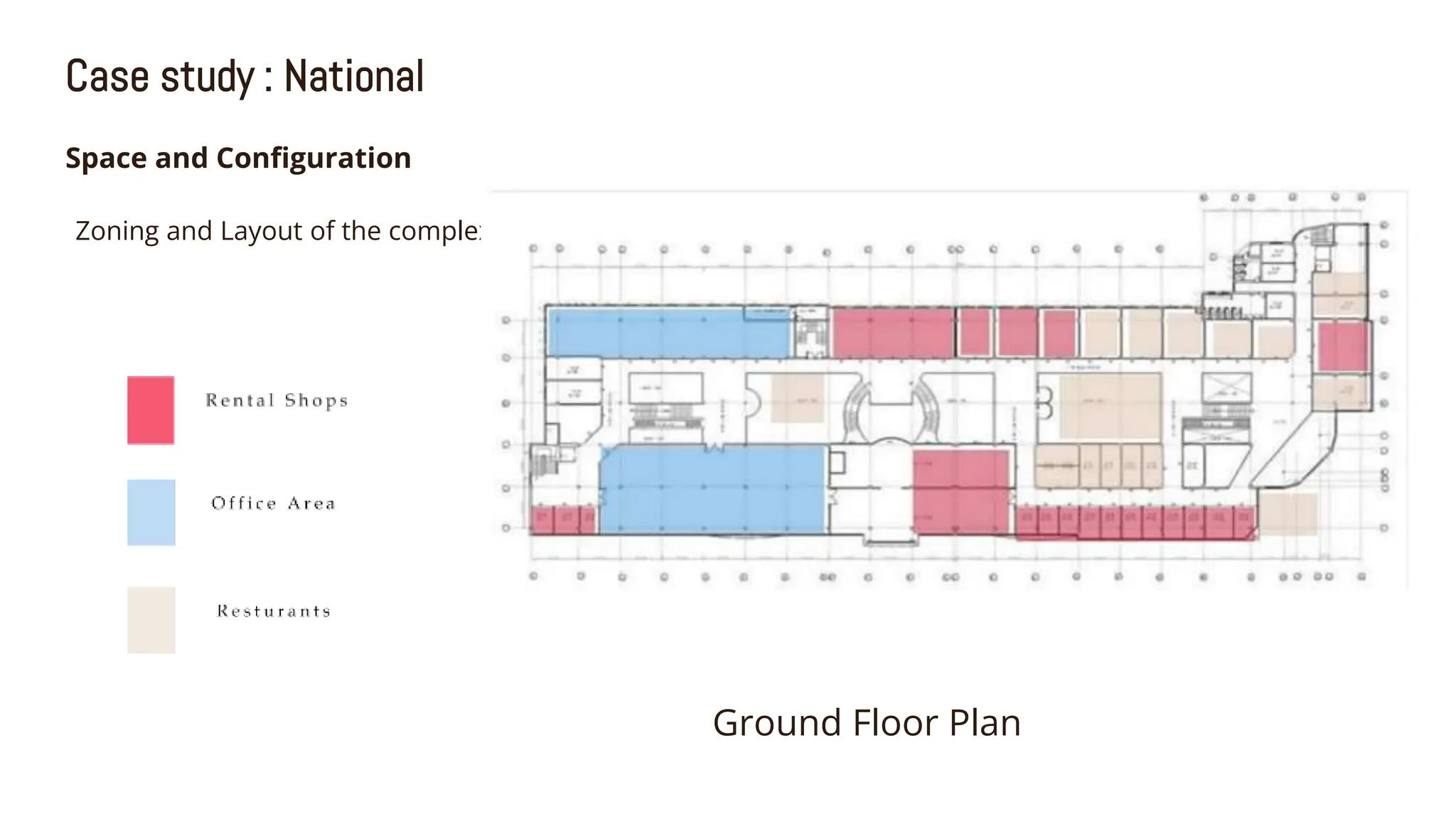
Zoning and Layout of the complex
Ground Floor Plan
Case study : National
Space and Configuration
Zoning and Layout of the complex
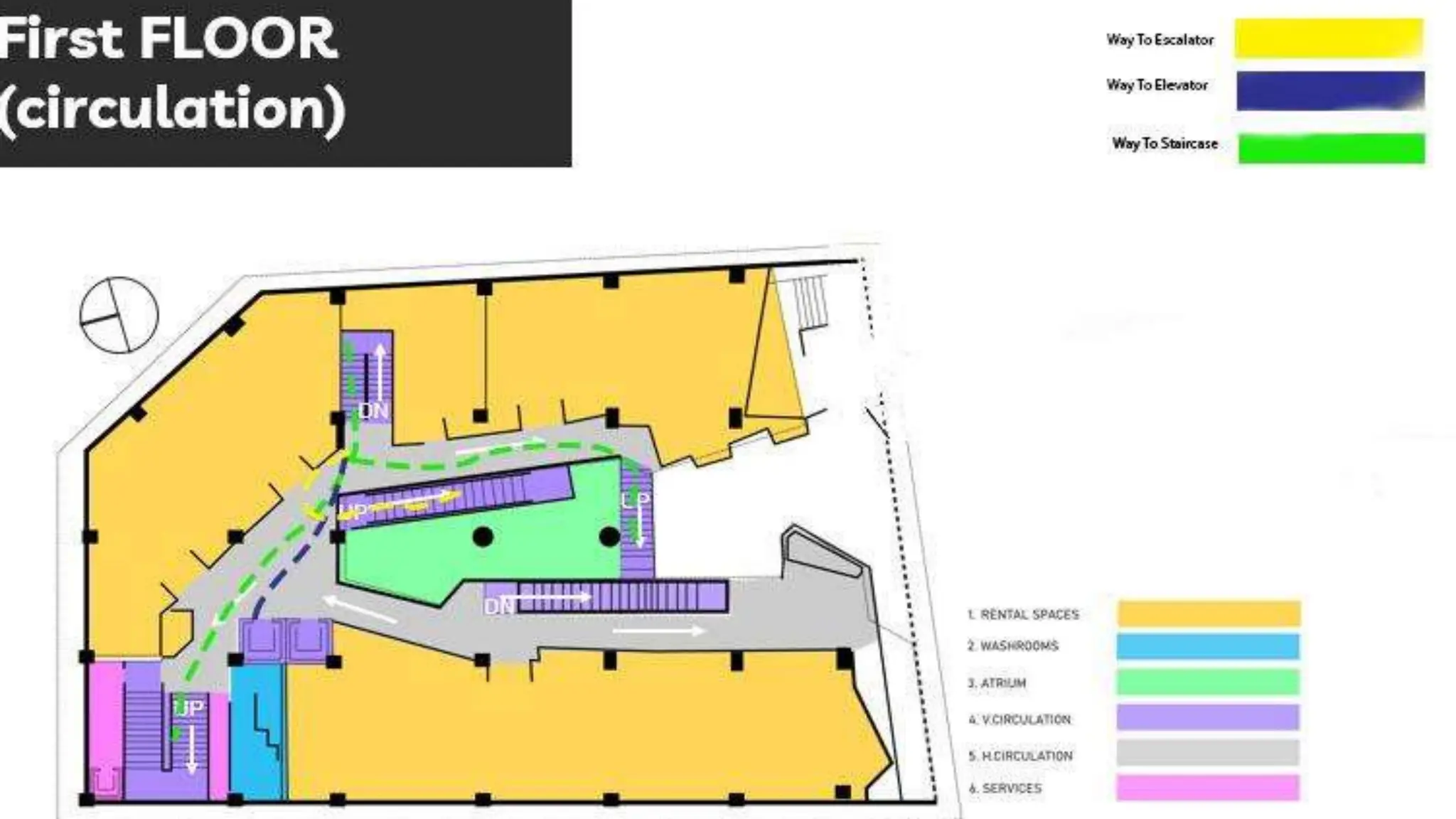
First Floor Plan
Case study : National
Space and Configuration
Zoning and Layout of the complex
Second Floor Plan
Case study : National
Space and Configuration
Zoning and Layout of the complex
Third and Fourth Floor Plan
Case study : National
Space and Configuration
Zoning and Layout of the complex
Fifth Floor Plan
Case study : National
Space and Configuration
Zoning and Layout of the complex
Basement Floor Plan
Case study : National
Space and Configuration
Circulation Patterns:
Circulation:
● Horizontal:wide and sufficent passage of
different width(1.5 m,1.9 m, 2.4 m,
3m,3.6 m,6.096 m)
● Vertical: Staircase, 4 lifts (4'-0"x4'-4")
8 people capacity (630 kg)
● Escalator of width 0.9 m, with railing of
0.8 m ht.
● Lobby space: 1.7m
Flow:
● The passenger arranged the outer
periphery of the two atrium.
● Free flowing pattern within the building
● Major mass flow occurs through the
staircase.
● The passage has also been used as a
bridge connection between the two parts
of each floor.
Photography: Adweta Amatya
Case study : National
Architectural Form and Massing
Overall architecture character:
● Play of linear geometry.
● Cutting edge space for an entrance improves
accessibility and visibility..
● Shops and restaurants inside visible from
outside.
● Efficient circulation layout for easy access.
● Integration of modern materials for durability
and aesthetics.
● Incorporation of public spaces for social
interaction.
● Sustainable design elements such as green
roofs or solar panel.
Case study : National
Architectural Form and Massing
Height and proportion
Interior Spaces
1. Varied building heights for visual interest.
2. Vertical emphasis through elements like column
3. Strategic placement of tall elements to create
focal points.
4. Proportional scaling of details to the building's
size.
6. Use of horizontal lines to enhance perceived
height.
Photography: Adweta Amatya
Case study : National
Building Material
Material used:
Structure:
● RCC
● Steel
● Tiles
Facade:
● Fibre glass
● ACP
Roof:
● CGI sheet
● Tubular truss
Photography: Adweta Amatya
Case study : National
Relation with Buildings
1. Urban reflection: Mimics surrounding urban
environment.
2. Street visibility: Activities visible from street
level.
3. Program diversity: Offers varied amenities.
4. Pedestrian invitation: Welcomes street-level
interaction.
5. Focal prominence: Central attraction in the
urban area.
6. Junction support: Integrates adjacent
elements.
7. Kiosk collaboration: Supports nearby kiosks.
8. Flashing screen feature: Enhances visibility.
9. Landmark status: Recognizable urban
landmark.
Photography: Adweta Amatya
Case study : National
Facade Design
● Elevate the corner entrance as a focal point,
integrating it into the urban landscape with striking
visual impact.
● Design a distinguished entrance with double-height
glass doors and a graceful canopy, blurring the line
between inside and out.
● Use a rhythmic vertical pattern with slender
mullions or fins to enhance the building's stature
and add sophistication.
● Complement with features like water bodies and
gardens to enhance environmental responsibility
and aesthetics.
Sketched: Manoj Thapa
Case study : National
Structural system
Column
● Circular : 0.45m diameter
● Rectangular-0.4572 meters x
0.4572 meters
● Spaced between - 6 meter
between columns
Slab
● Type : Plain/waffle slab
● Depth : 0.15 meter
● Placement : Grid:5.5 meter*5.5
meter
Floor to Floor Height : 3.35 meter
Basement analysis:
● Clearance ht: 2.5 meter
Photography: Adweta Amatya
Case study : National
Structural system
Frame structure :
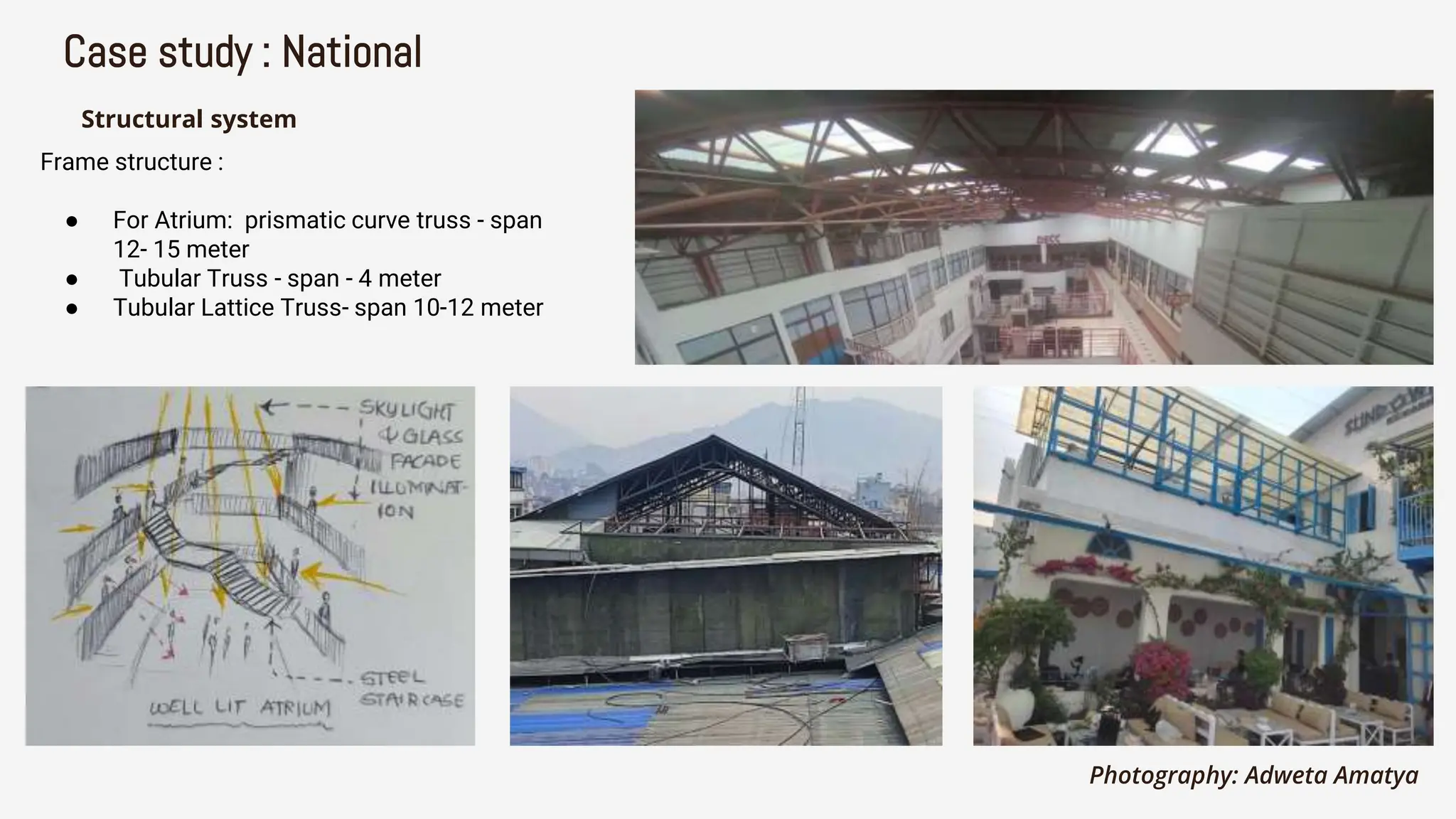
● For Atrium: prismatic curve truss - span
12- 15 meter
● Tubular Truss - span - 4 meter
● Tubular Lattice Truss- span 10-12 meter
Photography: Adweta Amatya
Case study : National
Structural system
Frame structure :
● Main and secondary flat beam
truss - spanning 4-5 meters
● Flat roof truss - span 5-6 meter
Photography: Adweta Amatya
Case study : National
Services
Parking
● 2 wheeler-100 Nos.
● 4 wheeler-200 Nos.
Staircase
● Width of staircase: 5'-10"
● Tread-11"
● Riser-6"
Fire escape stair:4'-3"(width)
● Riser :6"
● Used frequently
Photography: Adweta Amatya
Case study : National
Services
Rest room:
● At the one corner of each floor.
● Room well ventilated and use of natural light
● Men-4w/c, 3basins, 6urinals
● Women-3w/c, 2basins.
● Ducts are provided for the outlet of waste through pipes
● Provision of toilet.
Photography: Adweta Amatya
Case study : National
Services:
Provision of of storage area,
generator room, fire fighting,
electical room
● Provision of Guard room
● Provision of lifts in two
place.
● Speed breaker is provided.
● Turning radius: 20'
Photography: Adweta Amatya
Case study : International
Location: Shanghai, China (Opposite Of Chang
Shou Park)
Architect: Ben van Berkel, Hannes Pfau
Owner/Developer: CITIC Capital, Sanghai
Area: 6157 sq.m
Topography: Subtropical,Maritime Monsoon
Climate
Gross Floor Area: 38800sq.m
Year of Completion: 2016
No of Floors: 7
Lane 189, Shopping Center
Ref: Gallery of Lane 189 / UNStudio - 1
Case study : International
Concept:
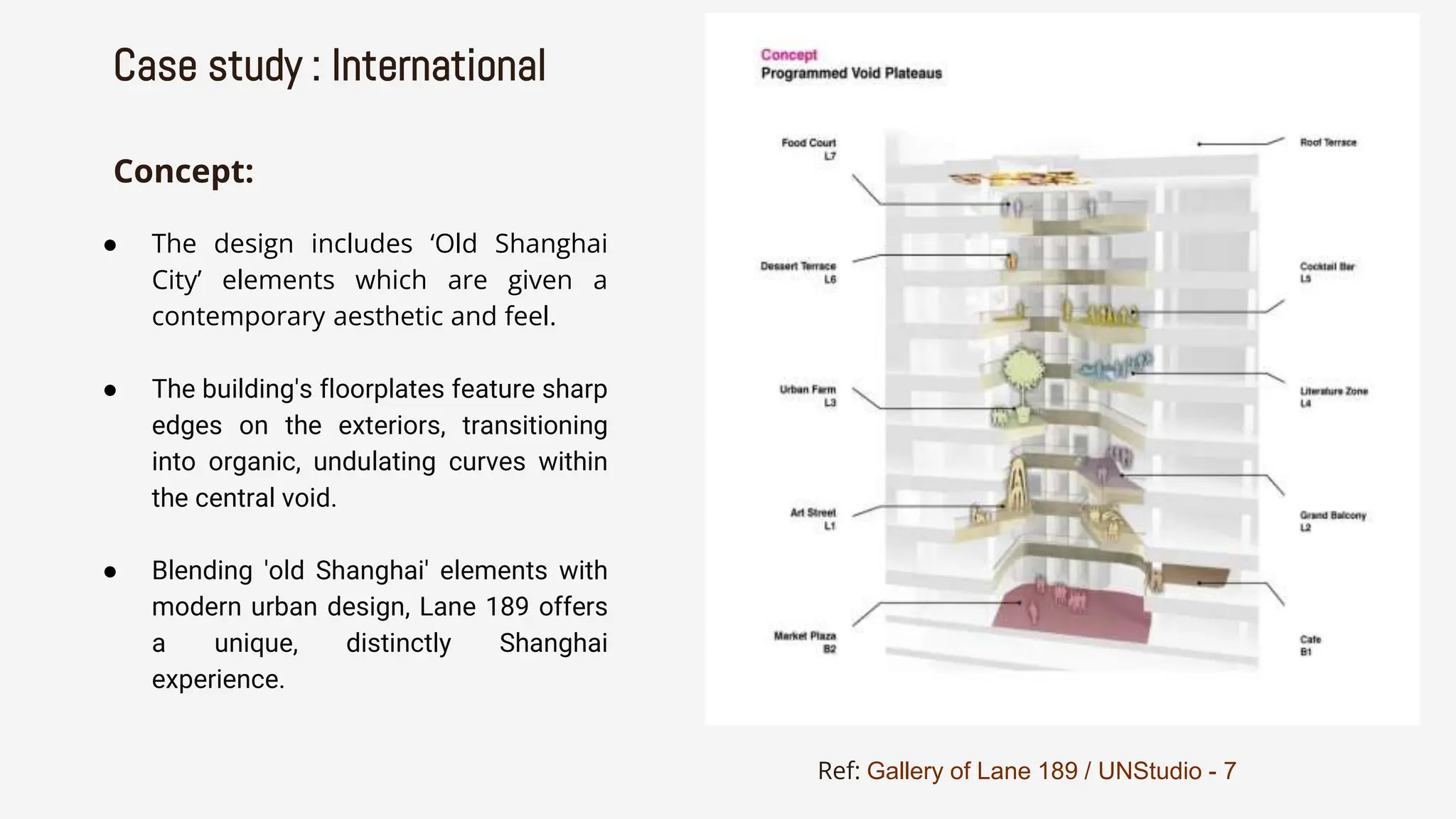
● The design includes ‘Old Shanghai
City’ elements which are given a
contemporary aesthetic and feel.
● The building's floorplates feature sharp
edges on the exteriors, transitioning
into organic, undulating curves within
the central void.
● Blending 'old Shanghai' elements with
modern urban design, Lane 189 offers
a unique, distinctly Shanghai
experience.
Ref: Gallery of Lane 189 / UNStudio - 7
● Double-height facade openings serve as "urban eyes," showcasing interior programs and
providing expansive display platforms for products while offering balconies with panoramic
views.
Ref: Gallery of Lane 189 / UNStudio - 7
Case study : International
Programs And Functionality
Entrance Design:
● A gradient transition from bigger to
smaller facade components
regulates the exposure of the
inside to the outside, and enhances
the main entrance of the building.
Sketch: Manoj Thapa
Case study : International
Programs And Functionality
Types of Commercial Spaces :
Ground floor:
Lane 189 has a grid span of 5.5m to 7m.
● The entire ground floor contains
shopping elements.
● Coffee shop
● Kiosks
● Marts
● Shops
● Restaurants
First floor: -
● Retail shops
● Art Street
Second floor:
● Retail shops.
● Grand Balcony Ref: Gallery of Lane 189 / UNStudio - 7
Third floor: -
● Office areas
Fourth floor:
● On the fourth floor, the literature zone
provides a tranquil space dedicated to
book lovers and literary enthusiasts.
● This area is enhanced by greenery,
creating a serene and inviting
atmosphere perfect for reading and
relaxation.
Ref: Gallery of Lane 189 / UNStudio - 7
Case study : International
Programs And
Functionality
Types of Commercial Spaces:
Fifth Floor:-
● Cocktail Bar & Restaurant
Sixt Floor
● Desert Space
Seventh Floor
● The building encourages
the visitor to stroll through
and explore the different
levels of the complex,
culminating in its rooftop
garden facilities.
Ref: Gallery of Lane 189 / UNStudio - 7
Case study : International
Size and Distribution of each Spaces
Case study : International
Size and Distribution of each Spaces
Case study : International
Space and Configuration
Zoning and Layout of the complex
● Art Street: Featuring art galleries,
exhibitions, and creative spaces in
first floor
● Literature Zone: Dedicated area for
bookstores, literary events, and
reading spaces.
● Roof Garden: A tranquil outdoor
space with greenery, seating areas,
and possibly panoramic views of the
surrounding area.
Ref: Gallery of Lane 189 / UNStudio - 7
Case study : International
Massing:
The central void organises vertical circulation and orientation, creates view across the different
levels and facilitates a clear view column from the second basement level up to the skylight art
installation.
Ref: Gallery of Lane 189 / UNStudio - 7
Case study : international
Architectural Form and Massing
Overall architecture character
● The design blends 'old Shanghai' elements
with a modern urban vibe for a uniquely
Shanghai destination.
● A hexagonal grid on the facade offers dynamic
perspectives.
● Two sunken façade holes, termed 'urban eyes,'
add distinctive features.
Ref: Gallery of Lane 189 / UNStudio - 7
Case study : International
Architectural Form and Massing
Height and
proportion
● Its design likely incorporates dynamic
architectural elements, such as sweeping
curves or geometric shapes, to create a
visually striking presence.
● showcases a contemporary design
integrating commercial spaces with
architectural flair, reflecting the dynamic
urban environment of the city.
● The “eyes” have the dual function of
being both ‘showcases’ for products and
balconies for wide views of the
surroundings
Ref: Gallery of Lane 189 / UNStudio - 7
Case study : International
Building Material
Material used:
• RCC, Glass
• Steel, Concrete
• Aluminium
Envelope:
Polyvinylidene fluoride(pvdf)-coated
aluminum panels, stainless steel pin
connector elements, Triple layer curtain
wall glazing system (3x 6 mm), Painted
render
Ref: Gallery of Lane 189 / UNStudio - 7
Case study : International
Relation with Buildings
● The building's vertical design mirrors the
area's small restaurants and boutiques,
making them visible from the street.
● The components of the façade to
adapt to the changing geometry of the
building and to give ever-changing
public perspectives.
Ref: Gallery of Lane 189 / UNStudio - 7
Case study : International
Facade Design:
● Incorporates 'old Shanghai' elements
with contemporary urban design for a
distinctly Shanghai feel.
● Uses a gradient facade transition with a
hexagonal grid and diamond-shaped
panels to control interior exposure and
highlight the main entrance.
Ref: Gallery of Lane 189 / UNStudio - 7
Case study : International
Parametric Facade:
● The design blends 'old Shanghai'
elements with modern urban
experiences, creating a unique
Shanghai atmosphere.
● It uses geometry, patterns, and
materials inspired by 'old Shanghai'.
● The facade, based on a hexagonal
grid, features articulated geometry
for dynamic perspectives.
Ref: Gallery of Lane 189 / UNStudio - 7
PSEUDO CODE:
● Construct Hexagonal grid of
two scales
● Rotate and move the grids to
get required pattern overlap
● Explode the hexagons into
their individual edges
● List and merge the
appropriate edges
● Loft the curves
● Cull the surfaces with
reference to the distance
from points
● Pipe the required hexagonal
grid
● Bake required surfaces
Grasshopper code:
Ref: Gallery of Lane 189 / UNStudio - 7
A gradient transition in facade components regulates
exposure and enhances the entrance, with a tensioned
hexagonal grid on the lower facade varying from single to
triple layers up to 400mm deep.
Ref: archdaily.comc
Case study : International
Interior Spaces
● Exterior: cold and metallic; Interior: warm
color scheme.
● Encourages exploration through open-
layout retail spaces and small kiosks.
● Curved floor plates around a large, skylit
atrium.
● RGB lighting behind panels creates varied
visual effects
Ref: Gallery of Lane 189 / UNStudio - 7
Case study : International
Interior Spaces
Retail Store & Kiosk Circulation Spaces
Ref: archdaily.com
Case study : International
Services and Utility
MEP:
Emergency Route and Fire Safety:
● Regular maintenance and monitoring
of MEP systems ensure optimal
performance and comfort for visitors
and occupants.
● Well-defined emergency routes and exits
strategically placed throughout Lane 189,
complying with safety regulations and
standards.
● Fire safety measures installed, including
fire alarms, extinguishers, and sprinkler
systems.
Ref: archdaily.com
Case study : International
Accessibility and Universal Design
● Convenient Location:
Situated within Jing'an District, ensuring
easy access via public transportation.
● Community Integration:
Close proximity to parks, residential areas,
and cultural institutions fosters a sense of
community.
● Streetscape Design:
Thoughtful design features pedestrian-
friendly walkways, green spaces, and
outdoor seating areas, promoting social
interaction and community engagement.
Ref: archdaily.com
Case study : International
Public Spaces and landscaping:
● Lane 189 includes landscaped areas, ponds,
or fountains for tranquil retreats.
● Architecture utilizes natural materials like
wood, stone, and glass.
● Surrounding area may feature eco-friendly
initiatives like community gardens and
urban farms.
● Water management systems help mitigate
runoff and promote groundwater recharge.
Ref: archdaily.com
Case study : International
Groove at central town
Location: Bangkok,Thailand
Architects: Synthesis Design+Architects
Local Architect: Architect 49,Foundry Space
Landscape architects: Trop Design
Owner/Developer: Central pattana
Topography: Low lying flat terrain, hot humid
climate
Built up area:12000 sq.m
Year of Completion:2012/2013
No of Floors: 2+ basement parking
(Source: archdaily.com)
Case study : International
Concept
● Located at the heart i.e. capital city of
Thailand .
● The expansion of one of the world’s
largest shopping mall (Central World).
● Client’s need: Talk of the town
● Architect’s revised as the walk of the
town.
● The intent was to capture the
atmospheric vibrancy of European cafe
culture and the energy and intimacy of
Bangkok's many Soi's (urban alleys) to
define a new contemporary Soi culture
of sophisticated outdoor dining and
lively pedestrian streets. Sketch: Manoj Thapa
Concept
1. Existing plaza
2. Parking
3. Existing Footpath
4. Guardrail
5. Existing Landform+ventilation
void
1.New retails at the top of Parking roof
2. Original entry bridge
(Source: archdaily.com)
1.The Green Plinth
2. Lower green plinth
1.Flat and clean walking surface
2.Existing trees
3. Additional trees
Diagram of the Ideas.
(Source: archdaily.com)
Case study : International
Design elements
● Facade and roof serve as the
building's graphic identity.
● Continuous horizontal lines on facade
accommodate openings for shops
and terracing areas.
Sketch: Manoj Thapa
Case study : International
Design elements
● Designed to interact with the high traffic
conditions of Ploenchit Road and BTS
Skytrain.
(Source: archdaily.com)
Case study : International
Programs And Functionality
● Enclosed retail shop
● Restaurant
● Bars
● Open courtyard space
Types of Commercial Spaces at groove
(Source: https://www.centralworld.co.th/en/groove-
Square grid:
But rooms are not even:
The concept was to Reflect
the irregular and complex
layout of urban public
spaces, then passageways
converge on a courtyard
(Source: archdaily.com)
Ground Floor Plan
Block A
1. Ent
rance
2. Hall
3. Spazio commerciale
Block B
1. Entrance
2. Hall
3. Retail Area
(Source: archdaily.com)
First Floor Plan
Block A
1. Entrance
2. Hall
3. Spazio commerciale
Block B
1. Entrance
2. Hall
3. Retail Area
(Source: archdaily.com)
Structural
Analysis
8000*9000
Skywalk
Total width=10m
Circulation length
=6m
Fire exit =2
(Source: archdaily.com)
Sections
(Source: archdaily.com)
Case study : International
Programs And Functionality
Other Commercial spaces at the
central world
● Central departmental
store
● SF cinema
● Ice ring
● Park
● Hotels
● Bookstore
● Largest fitness club in
south east asia
(Source: archdaily.com)
Case study : International
Architectural Form and Massing
Overall architecture character
● Exterior captures Bangkok's intensity
and movement.
● Interior combines European cafe
culture with Bangkok's Soi energy.
● Aims to create a contemporary Soi
culture of outdoor dining and lively
streets.
Facade of the groove
(Source: archdaily.com)
Case study : International
Building Material
https://www.theplan.it/
Case study : International
Relation with Buildings
Connection with the other tower of
central world :
● Zen tower
● CPN Tower( Office
building)
● Central World
● Groove
(Source: archdaily.com)
Case study : International
Facade Design
Exterior Perforated Facade Facade imitating the bangkok’s night road view
https://www.theplan.it/
Case study : International
Interior Spaces
Seating spaces Atrium Restaurant
(Source: archdaily.com)
Retail shops
(Source: archdaily.com)
Case study : International
Public Spaces and landscaping
Indoor Courtyard
Green Indoor elements
(Source: archdaily.com)
Case study : International
Public Spaces and landscaping
Walking space between groove and the vehicular road
(Source: archdaily.com) (Sketch Manoj Thapa)
Case study : International
Maintenance, resilience and
adaptability:
● Building utilizes a naturally ventilated
courtyard for energy efficiency.
● Open-air trellis facilitates airflow and
dappled sunlight.
● Retractable canopy offers additional
protection from rain and sun.
https://www.archdaily.com/
S
U
S
T
A
I
N
A
B
I
L
I
T
Y
(Source: archdaily.com)
Case study : International
User Experience and Community Impact
● Passageways converge on a courtyard,
mirroring urban layouts.
● Outdoor areas of restaurants, bars, and
clubs seamlessly connect.
● Opting for outdoor spaces provides an
authentic urban feel.
● Significant energy savings achieved by
eliminating air-conditioning.
Sketch: Manoj Thapa
Case study : International
Accessibility and Universal Design
Reference: http://www.centralworld.co.th/
Groove
Ground floor First floor
Case study : International
Parking
Underground parking
With drop off space at the site.
1. Level 1: This is where the Valet
Parking service is available.
2. Level B2: This is where you can
drop off your car for Valet
Parking, and there's a waiting
lounge provided for your
convenience while the valet
attendant parks your vehicle.
.
https://www.archdaily.com/
COMPARATIVE ANALYSIS:
1. QUANTITATIVE
2. QUALITATIVE
(Source: archdaily.com) , google .com
Surrounding landscape
Groove Lane 189
● Located in a dynamic urban environment with
residential and commercial activity.
● The project prioritizes the seamless integration
of plants and landscaping elements, enhancing
the architectural composition with greenery.
● Harmonizes with surroundings while
enhancing the well-being of occupants and
visitors.
● Positioned adjacent to Changshou Park
amidst greenery and open spaces.
● No specific mention of landscape
integration, focus more on the
building's facade.
● Serves as a prominent focal point in its
dynamic surroundings.
(Source: archdaily.com) , google .com
Facade
Contributes to the building's
prominence in the urban landscape
Represents a sophisticated and
innovative approach
Groove
Lane 189
● Distinguishes the structure, making it a standout
feature in the city.
● Minimalist, shades of grey and black, wooden
finishes, greenery, hexagonal grid skylight.
● A gradient transition from bigger to smaller facade
components regulates the exposure of the inside
to the outside, and enhances the main entrance of
the building.
(Source: archdaily.com) , google .com
Material
Stainless steel, steel-reinforced
concrete, stainless steel pin connectors,
PVDF-coated aluminum panels, Acrylic
boards.
The World Trade Center in Tripureshwor,
Kathmandu is constructed primarily using
reinforced concrete, glass, and steel, which
provide structural strength, durability, and a
modern aesthetic.
Lane 189, United World Trade Center
(Source: archdaily.com) , google .com
Layout and use of Spaces
Groove
● The Groove is designed around a central
open-air courtyard, enhancing horizontal
flow and creating a communal dining and
social space.
● Lane 189 is centered around a large
atrium, promoting vertical interaction
and maximizing natural light.
Lane 189
(Source: archdaily.com) , google .com
Sketch: Manoj Thapa
Emergency exit
National cases:
Manbhawan complex, UWTC
Emergency exit are not placed
appropriately.
International cases :
Groove, Lane 189
Design emphasises the placement
of emergency exits as per literature
review.
(Source: archdaily.com) , google .com
ll THANK YOU ll

Literature Review and Case Study of Commercial Complex Design.pptx

  • 1.
    Presented By: Aakriti Giri(078BAR001) Adweta Amatya (078BAR007) Arjun Timsina (078BAR010) Ashok Shrestha (078BAR011) Manoj Thapa (078BAR015) Oshin Dura (078BAR024) PRESENTATION ON CASE STUDY OF: COMMERCIAL COMPLEX
  • 2.
    TABLE OF CONTENTS: 1.Literature Review 2. Case Study National a. Manbhawan Complex, Kumaripati b. United World Trade Center Tripureshwor 3. Case Study: International a. The Lane 189 b. The Groove at Central City 4. Comparative Analysis
  • 3.
    ● A commercialcomplex is a multifunctional architectural structure designed to accommodate various commercial activities such as retail stores, offices, restaurants, and entertainment facilities within a single integrated development. It often features a mix of uses, multiple levels, and centralized amenities to cater to diverse needs and attract foot traffic. INTRODUCTION ● Its distinctive architectural design and varied programmatic elements, fostering a vibrant and dynamic urban environment. (Source: pinterest.com)
  • 4.
    TIMELINE Greek Agoras andRoman Forums ● A market place ● Craftsman and workshops ● Social and cultural exchange 01 02 03 Modern Commercial Centers 04 ● Mixed use Developments ● Adaptive Reuse and Revitalization of Projects ● Sustainable architecture and green design principles ● Smart Buildings ● Temporary Commercial Gatherings ● Wide Variety of Merchandise Medieval Fairs And Bazaars Future ● Virtual Commercial Complexes ● Wide Variety of Merchandise
  • 5.
    HISTORY Greek Agoras andRoman Forums Medieval Fairs And Bazaars Futuristic Complex Modern Commercial Centers
  • 6.
    Brief History InNepal Bishal Bazar complex ● The 1st commercial complex in Nepal built in 2026 BS. ● Features: basic shops, offices and resting areas. Bhatbhateni ● Bhatbhateni supermarket established ​in 2041 BS ● Features : basic shops, resting areas ​and food courts Source: wikipedia.com Source: slideshare.com
  • 7.
    Brief History InNepal Civil Mall ● This commercial complex in Nepal was built in 2010 AD .​ ● Features: Kids play area, food courts, movie theatres were incorporated .​ Labim Mall ● Labim Mall established ​in 2073 BS. ● Features : Basic shops,QFX,food stalls, children play area, restaurants,cafe, plaza (Photography: Arjun Timsina) (Photography: Arjun Timsina)
  • 8.
    TYPES OF COMPLEXACCORDING TO TIME SAVER Neighbourhood Centre (Sub-urban) ● Its role in sub-urban communities ● Rows of stores and retails serving urban locals ● Compact parking ● Usually no vertical extension of building Source: pinterest.com
  • 9.
    TYPES OF COMPLEXACCORDING TO TIME SAVER INTERMEDIATE OR COMMUNITY SIZE CENTRE ● Strip of stores as well but larger than neighbourhood centre ● Also known as junior department store ● Local economy impact ● Parking similar as neighbourhood centre Source: pinterest.com Source: Google Maps Source: pinterest.com 30,000 SF to 125,000 SF.
  • 10.
    TYPES OF COMPLEXACCORDING TO TIME SAVER REGIONAL CENTRE ● Contain 1-4 department stores and 50-100 more shops ● Double Deck parking to save land area ● Double deck store ● Strategic Location : Transportation, Connectivity ● All shops face inward to the mall with back to the parking ● Integrated Amenities: Food courts, rest areas, restrooms, and information kiosks Source: google.com Source: google.com 400,000 SF to 800,000 SF.
  • 11.
    TYPES OF COMPLEXACCORDING TO TIME SAVER DOWNTOWN (RENEWAL PROJECT) ● Parking normally multi decked ● Vertical development ● Utilizes thorough security measures like surveillance cameras, patrols and emergency protocol to safeguard visitors ● Smart development system ● Housed in historic structures` Source: shutterstock.com source: shutterstock.com
  • 12.
    BASIC COMPONENTS Entrance ParkingPlaza/ Atrium Office Retail Recreation Source: pinterest.com
  • 14.
    SPATIAL ARRANGEMENTS VERTICAL ZONINGHORIZONTAL ZONING Source: pinterest.com
  • 16.
    SPACE ZONING INCOMMERCIAL COMPLEX A commercial complex and be divided into spaces as per their function. Different types of spaces: i. Static space: Space having distinct function ii. Transitional space: Space connecting static space iii. Dynamic spaces: Transitional spaces that are constantly changing and living Source: slideshare.com
  • 17.
    Parking ● Basement/ Cellar ●Stilt floors ● Open space within 30 m of entry ● 1:25 differently abled spot ● 1 parking per 200 sq ft Source: dimensions.com
  • 18.
    Source: Time SaversStandards for Building Types
  • 19.
    ● Per 100sq. meter gross retail area = 4-5 ● Location: where it is easily accessible and safe ● The minimum size of a compact parking space should be 2.5 meters by 5 meters for cars. ● Most common types of parking are angle parking. ● Perpendicular parking and parallel parking. ● Turning radius for car: 3.5 meter and 6 meter inner and outer radius respectively. ● Turning radius for motorcycle: 2.6 meter. Parking Source: Neufert’s Architect Data
  • 20.
    ● Escalators, foundin malls, airports, and train stations, are looped tracks with moving steps. ● Width: 0.9-1.2m ● Length: 5.0-7.0m ● Step width: 0.6-0.8m ● Rise: 4.0-7.0m ● Speed: 0.5-0.7m/s ● Capacity: 20-30 passengers/min ● Sizes vary based on capacity and space. Escalators Source: dimensions.com
  • 21.
    Lift ● Lifts, inbuildings, vary in size with cabin widths of 1.0-2.5m and depths of 1.0-2.5m. ● Shaft heights match building height and floors. ● Passenger lifts carry 5-20 people. ● Freight lifts are larger for efficient goods transport. Source: dimensions.com
  • 22.
    ● Minimum gradient:1:8 (7 degrees) for height difference ≤450mm. ● Maximum gradient: 1:12 (5 degrees) for height difference >450mm. ● Level platform every 1.5m vertical rise. ● Platform length: ≥1.2m, same width as ramp. ● Minimum ramp width: 1m. Ramps Source: shutterstock.com Source: pinterest.com
  • 23.
    Entrance and escape ●Aisle width: 1m per 150 people (min. 0.8m). ● In proscenium theaters, main fire hazard is stage fires. ● Strategy: Contain stage fire within stage tower walls, utilizing upward draught to draw heat and smoke away. ● Max lifts in one row: 4. ● Fire-rated wall (2h) between lift shafts in a bank. ● Lifts must have solid doors with at least one-hour fire resistance; no collapsible gates. ● Lift shafts require a vent at the top, minimum 0.2m² area. Source: dimensions.com
  • 24.
    ENTRANCE ● Grandeur ● Welcoming/Appealing ● Raised Plinth ● Entry canopy/ Porch Source: facebook.com Source: dreamtime.com Source: dreamtime.com
  • 25.
    Plaza/ Atrium ● Aspace to admire building ● Public square ● Sit, Relax, Time Pass ( Breathing Space) ● Control flow of people Source: archdaily.com
  • 26.
  • 27.
  • 28.
  • 29.
    Retails 1. Shops 2. DepartmentalStore 3. Clothing Stores 4. Accessories retails Source: shutterstock.com
  • 30.
  • 31.
    Retail TYPES OFLAYOUT: Free Flow Herring Bone Grid Loop Source: freepik.com
  • 32.
    Recreation ● Activity (Bowling, Arcade, Trampoline, VR) ● Gaming zones ● Children play area For Children Age Group 0.6 0.5 0.9 0-6 6-12 12-18 Area ( M2) Source: google.com
  • 33.
    Restaurants ● Distance betweentable and wall around 760 mm (30”) ● Emergency exits must be 1m wide per 150 people ● One person requires table area around 600 mm (24”) wide and 3600mm-4800mm (12’-16’) deep ● Dining area usually based on no. sq. ft per person seated times no. of person seated at a time Source: Time Saver Standards for Building Types
  • 34.
    Food Courts andBar ● Activity ( Bowling, Arcade, Trampoline, VR) ● Gaming zones ● Children play area Source: Time Saver Standards for Building Types
  • 36.
    Services 1. Electricity ● Minimizecircuit usage, avoiding multi-plug adaptors whenever possible. ● Directly plug big or high-voltage appliances into wall outlets. ● Use extension cords temporarily, not exceeding 90 days, to prevent electrical accidents and overload. ● Maintain a minimum clearance of 90cm between electrical boxes and panels. ● The emergence of electric vehicle chargers, with their high currents and lithium-ion batteries, introduces new safety concerns. Source: shutterstock.com
  • 37.
    Services Earthing system In anelectricity supply system, an earthing system (or grounding system) is a network of connections that link various parts of the electric circuit with the ground. Objectives: ● Shielding structures from lightning strikes by channeling the lightning through the earthing system and into the ground rod, rather than allowing it to pass through the structure. ● Ensuring the safety of mains electricity by preventing issues related to floating ground and sky voltage. ● Establishing a low-resistance and secure pathway for lightning and fault currents. ● Sustaining supply voltages. Source: pinterest.com
  • 38.
    Services 2. HVAC system ●The HVAC system in commercial buildings is responsible for cleaning the air by removing dust and other particles. ● It also addresses odor control, localizing and eliminating unwanted smells to maintain indoor air quality. ● They create a comfortable indoor climate. ● In retail areas, low noise levels are prioritized for customer comfort. ● Ventilation components should be discreetly integrated for aesthetic appeal. ● Simple maintenance is vital for efficient and long-lasting operation. Source: arch20.com
  • 39.
    Services 3. Fire Safety ●Fire safety in buildings involves various systems and measures. ● These include fire alarms, extinguishers, emergency lighting, and sprinkler systems. ● Fire sprinkler systems, like water spray and mist, gas and foam, deluge, and pre-action systems, offer active fire suppression capabilities. ● Smoke control and compartmentation help manage fire hazards. ● Regular training ensures preparedness among occupants. ● Compliance with building codes ensures effectiveness. Source: google.com
  • 40.
    Case Studies: CASE 1 01 02 03 04 ManbhawanComplex, Kumaripati CASE 2 United WTC, Tripureshwor CASE 3 The Groove, Thailand CASE 4 Lane 189, Shanghai
  • 41.
    Case study :National Manbhawan Complex ● Location: Kumaripati, Lalitpur ● Architect: Ar. Sanjay Lal Shrestha ● Owner/Developer: Ar. Sanjay Lal Shrestha ● Area: 1040.24 sq. meter ● Topography: Plain ● Built up area: 724.76 sq. meter. ● Ground Coverage: 69.67 % ● Year of Completion: Under construction ● No of Floors: 5 Manbhawan Mall Photography: Adweta
  • 42.
    Case study :National Programs And Functionality RETAIL Types of Commercial Spaces: OFFICES CAFETERIA CLUB (Source: Outre Design)
  • 43.
    RETAILS AND CAFETERIA: Photography:Arjun Timsina Source: Outre Design Photography: Arjun Timsina
  • 44.
    Case study :National (Manbhawan) Architectural Form and Massing ● A balance of mass and void can be observed ● Play of linear geometry ● Grand front facade hence creating welcoming entrance ● Designed such that shops inside can be seen from outside Sketched: Mr. Manoj Thapa
  • 46.
    Case study :National (Manbhawan) Space and Configuration Zoning and Layout of the complex ● Ground Floor, First Floor and Second Floor are retail and Cafeteria ● Third Floor is Bar (Trisara) ● Fourth Floor and Fifth Floor are for offices ● Basement : Parking Vertical Zoning Sketched: Manoj Thapa
  • 48.
    Case study :National Size and Distribution of each Spaces
  • 49.
    Size and Distributionof each Spaces:
  • 50.
    Case study :National Size and Distribution of each Spaces
  • 51.
    Size and Distributionof each Spaces:
  • 52.
    Size and Distributionof each Spaces Case study : National
  • 53.
    THIRD FLOOR PLAN Sizeand Distribution of each Spaces:
  • 54.
    Size and Distributionof each Spaces Case study : National
  • 55.
    Size and Distributionof each Spaces Case study : National
  • 56.
    Size and Distributionof each Spaces Case study : National
  • 57.
    Parking: ● Well lit ●Cool ● 2 Storey Photography: Adweta Amatya Parking Capacity: Cars: 21 No.s (34 No.s with double stack) Bikes: 29 No.s
  • 58.
    Case study :National Height and proportion Interior Spaces ● Room Height= 3500 ● False ceiling sed to hide beams ● Play in the form ● Use of vertical elements Source: Outre Design Photography: Adweta Amatya
  • 59.
    Case study :National Structural system : Steel Beam and Corrugated Sheets Circular Columns Photography: Adweta Amatya RCC Framed Structure Source: Outre Design ● column spacing, ranging from 3 meters to 6.5 meters
  • 60.
  • 61.
    Case study :National Interior Spaces ● Features walls with neutral tones and glasses ● The building's layout promotes exploration with open retail spaces on multiple levels and interspersed small kiosks. ● It features one way escalator ● To exaggerate the contrast between solid and void, RGB lighting is installed behind the panels to create a variety of visual effects at different times of day, or for special occasions. Source: Outre Design
  • 62.
    Case study :National Facade Design ● Perforated thick aluminium ● Aluminum cladding sheets bent sharply to form a shiny, reimagining of conventional corrugated sheeting wall panels ● Glass facade for stores Photography: Ashok Shrestha Source: Outre Design
  • 63.
    Case study :National Interior Spaces ● CGI Sheet was used as covering material for the stairs that is visible from the front facade Photography: Aakriti Giri Source: Outre Design
  • 64.
    Case study :National Building Materials: Glass Brick Marble Glass Facade Perforated Aluminium Recycled Plastic Composite (RPC) Gypsum Boards
  • 65.
    Case study :National Services and Utility: Photography: Adweta Amatya ● Separate lift provided on basement for service purpose only. ● Void room from below to top for placement of A/C ducts and fire extinguishing elements. ● Emergency Route and Fire Safety
  • 66.
    Case study :National United World Trade Center Location: Tripureshwor Architect: Ar. Bishnu Pd Panthee Area: 10-15-3-0 (Approx. 5400 Sq. meter) Topography:Almost flat land Built up area: 1839.95 sq meter Ground Coverage: 61.3% No of Floors: 5 Site Location
  • 67.
    Case study :National Concept: Sketched: Manoj Thapa 1. Site Context: Understand site features like topography, orientation, and surroundings. 1. Massing Manipulation: Adapt building mass to fit function and blend with environment. 1. Orientation and Views: Position building for optimal views, light, and climate considerations. 1. Distinct Entrance: Create visually striking entrance to attract traffic and serve as a focal point. 1. Visual Impact: Enhance visual appeal with careful design of form, materials, and details.
  • 68.
    Case study :National Programs And Functionality Types of Commercial Spaces: Ground floor: ● Food and Beverage Outlets ● Koisks ● Entertainment Venues ● Retails Shops ● Restaurants First floor: - ● Shops ● Retail Stores ● Entertainment Venues ● Service Providers ● Fitness Centers ● Pop-Up Shops Second floor: - ● Office spaces ● Financial Branches Sketched: Manoj Thapa
  • 69.
    Case study :National Programs And Functionality Types of Commercial Spaces Third floor: - ● Office and Business spaces Fourth floor: ● Occupied by DECC (Direction Exhibition Convention Center), it contains seminar hall, multi-purpose hall, exhibition hall, Agni hall of 500 capacity and food outlet to cater its customers. ● The floor has been planed and developed to provide different utility sections to conduct different exhibition, seminar etc. Fifth floor:- ● restaurant covering area ● party palace ● swimming pool ● fitness club ● spa center Photography: Adweta Amatya
  • 70.
    Case study :National Size and Distribution of each Spaces Ground Floor ● Koisks: 50-200 sq. meter ● Resturants: 500-2000 sq. meter ● Retail Stores: 25 to 50 sq. meter ● Drinks Outlets: 15 to 40 sq. meter ● Entertainment Venues: 100 sq. meter First Floor ● Retail Stores: 50-100 sq. meter ● Pop-Up Shops: 10-50 sq. meter ● Business Area: 20-40 sq. meter
  • 71.
    Case study :National Size and Distribution of each Spaces Second Floor ● Office Spaces: 200-500 sq. meter ● Financial Branches: 100-500 sq. meter ● Service Area : 100 sq meter Third Floor ● Office Spaces: 10-200 sq. meter ● Business Centers: 100-500 sq meter ● Meeting Rooms: 50-100 sq. meter ● Retail/Office Hybrid Spaces: 50-100 sq. meter
  • 72.
    Case study :National Size and Distribution of each Spaces Fourth Floor ● Direction Exhibition and Convention Center(DECC) at fourth floor (area 254540sq ft). ● Conduct event like, exhibition, trade fair and seminar Exhibition hall=12000 sq ft. Capacity nearly 70 standard ● Seminar cum Banquet Hall =1650 sq.ft. (nearly 150 participants) ● Food outlet/kitchen=2425sq ft. Capacity to cater to 100 customers at a time, a special VIP suite, 12 business chamber ● Multi-purpose hall=1350 sq ft. Fifth floor ● Restaurant covering area of200 capacity, a party palace of 1000 capacity and UWTC office. ● Fitness club with 400 members and spa center
  • 73.
    Case study :National Space and Configuration Zoning and Layout of the complex: Zoning at Each Floor Sketched: Manoj Thapa Fig: Circulation and Zoning in Ground Floor Plan
  • 74.
    Case study :National Space and Configuration Zoning and Layout of the complex Ground Floor Plan
  • 75.
    Case study :National Space and Configuration Zoning and Layout of the complex First Floor Plan
  • 76.
    Case study :National Space and Configuration Zoning and Layout of the complex Second Floor Plan
  • 77.
    Case study :National Space and Configuration Zoning and Layout of the complex Third and Fourth Floor Plan
  • 78.
    Case study :National Space and Configuration Zoning and Layout of the complex Fifth Floor Plan
  • 79.
    Case study :National Space and Configuration Zoning and Layout of the complex Basement Floor Plan
  • 80.
    Case study :National Space and Configuration Circulation Patterns: Circulation: ● Horizontal:wide and sufficent passage of different width(1.5 m,1.9 m, 2.4 m, 3m,3.6 m,6.096 m) ● Vertical: Staircase, 4 lifts (4'-0"x4'-4") 8 people capacity (630 kg) ● Escalator of width 0.9 m, with railing of 0.8 m ht. ● Lobby space: 1.7m Flow: ● The passenger arranged the outer periphery of the two atrium. ● Free flowing pattern within the building ● Major mass flow occurs through the staircase. ● The passage has also been used as a bridge connection between the two parts of each floor. Photography: Adweta Amatya
  • 81.
    Case study :National Architectural Form and Massing Overall architecture character: ● Play of linear geometry. ● Cutting edge space for an entrance improves accessibility and visibility.. ● Shops and restaurants inside visible from outside. ● Efficient circulation layout for easy access. ● Integration of modern materials for durability and aesthetics. ● Incorporation of public spaces for social interaction. ● Sustainable design elements such as green roofs or solar panel.
  • 82.
    Case study :National Architectural Form and Massing Height and proportion Interior Spaces 1. Varied building heights for visual interest. 2. Vertical emphasis through elements like column 3. Strategic placement of tall elements to create focal points. 4. Proportional scaling of details to the building's size. 6. Use of horizontal lines to enhance perceived height. Photography: Adweta Amatya
  • 83.
    Case study :National Building Material Material used: Structure: ● RCC ● Steel ● Tiles Facade: ● Fibre glass ● ACP Roof: ● CGI sheet ● Tubular truss Photography: Adweta Amatya
  • 84.
    Case study :National Relation with Buildings 1. Urban reflection: Mimics surrounding urban environment. 2. Street visibility: Activities visible from street level. 3. Program diversity: Offers varied amenities. 4. Pedestrian invitation: Welcomes street-level interaction. 5. Focal prominence: Central attraction in the urban area. 6. Junction support: Integrates adjacent elements. 7. Kiosk collaboration: Supports nearby kiosks. 8. Flashing screen feature: Enhances visibility. 9. Landmark status: Recognizable urban landmark. Photography: Adweta Amatya
  • 85.
    Case study :National Facade Design ● Elevate the corner entrance as a focal point, integrating it into the urban landscape with striking visual impact. ● Design a distinguished entrance with double-height glass doors and a graceful canopy, blurring the line between inside and out. ● Use a rhythmic vertical pattern with slender mullions or fins to enhance the building's stature and add sophistication. ● Complement with features like water bodies and gardens to enhance environmental responsibility and aesthetics. Sketched: Manoj Thapa
  • 86.
    Case study :National Structural system Column ● Circular : 0.45m diameter ● Rectangular-0.4572 meters x 0.4572 meters ● Spaced between - 6 meter between columns Slab ● Type : Plain/waffle slab ● Depth : 0.15 meter ● Placement : Grid:5.5 meter*5.5 meter Floor to Floor Height : 3.35 meter Basement analysis: ● Clearance ht: 2.5 meter Photography: Adweta Amatya
  • 87.
    Case study :National Structural system Frame structure : ● For Atrium: prismatic curve truss - span 12- 15 meter ● Tubular Truss - span - 4 meter ● Tubular Lattice Truss- span 10-12 meter Photography: Adweta Amatya
  • 88.
    Case study :National Structural system Frame structure : ● Main and secondary flat beam truss - spanning 4-5 meters ● Flat roof truss - span 5-6 meter Photography: Adweta Amatya
  • 89.
    Case study :National Services Parking ● 2 wheeler-100 Nos. ● 4 wheeler-200 Nos. Staircase ● Width of staircase: 5'-10" ● Tread-11" ● Riser-6" Fire escape stair:4'-3"(width) ● Riser :6" ● Used frequently Photography: Adweta Amatya
  • 90.
    Case study :National Services Rest room: ● At the one corner of each floor. ● Room well ventilated and use of natural light ● Men-4w/c, 3basins, 6urinals ● Women-3w/c, 2basins. ● Ducts are provided for the outlet of waste through pipes ● Provision of toilet. Photography: Adweta Amatya
  • 91.
    Case study :National Services: Provision of of storage area, generator room, fire fighting, electical room ● Provision of Guard room ● Provision of lifts in two place. ● Speed breaker is provided. ● Turning radius: 20' Photography: Adweta Amatya
  • 92.
    Case study :International Location: Shanghai, China (Opposite Of Chang Shou Park) Architect: Ben van Berkel, Hannes Pfau Owner/Developer: CITIC Capital, Sanghai Area: 6157 sq.m Topography: Subtropical,Maritime Monsoon Climate Gross Floor Area: 38800sq.m Year of Completion: 2016 No of Floors: 7 Lane 189, Shopping Center Ref: Gallery of Lane 189 / UNStudio - 1
  • 93.
    Case study :International Concept: ● The design includes ‘Old Shanghai City’ elements which are given a contemporary aesthetic and feel. ● The building's floorplates feature sharp edges on the exteriors, transitioning into organic, undulating curves within the central void. ● Blending 'old Shanghai' elements with modern urban design, Lane 189 offers a unique, distinctly Shanghai experience. Ref: Gallery of Lane 189 / UNStudio - 7
  • 94.
    ● Double-height facadeopenings serve as "urban eyes," showcasing interior programs and providing expansive display platforms for products while offering balconies with panoramic views. Ref: Gallery of Lane 189 / UNStudio - 7
  • 95.
    Case study :International Programs And Functionality Entrance Design: ● A gradient transition from bigger to smaller facade components regulates the exposure of the inside to the outside, and enhances the main entrance of the building. Sketch: Manoj Thapa
  • 96.
    Case study :International Programs And Functionality Types of Commercial Spaces : Ground floor: Lane 189 has a grid span of 5.5m to 7m. ● The entire ground floor contains shopping elements. ● Coffee shop ● Kiosks ● Marts ● Shops ● Restaurants First floor: - ● Retail shops ● Art Street Second floor: ● Retail shops. ● Grand Balcony Ref: Gallery of Lane 189 / UNStudio - 7
  • 97.
    Third floor: - ●Office areas Fourth floor: ● On the fourth floor, the literature zone provides a tranquil space dedicated to book lovers and literary enthusiasts. ● This area is enhanced by greenery, creating a serene and inviting atmosphere perfect for reading and relaxation. Ref: Gallery of Lane 189 / UNStudio - 7
  • 98.
    Case study :International Programs And Functionality Types of Commercial Spaces: Fifth Floor:- ● Cocktail Bar & Restaurant Sixt Floor ● Desert Space Seventh Floor ● The building encourages the visitor to stroll through and explore the different levels of the complex, culminating in its rooftop garden facilities. Ref: Gallery of Lane 189 / UNStudio - 7
  • 99.
    Case study :International Size and Distribution of each Spaces
  • 100.
    Case study :International Size and Distribution of each Spaces
  • 101.
    Case study :International Space and Configuration Zoning and Layout of the complex ● Art Street: Featuring art galleries, exhibitions, and creative spaces in first floor ● Literature Zone: Dedicated area for bookstores, literary events, and reading spaces. ● Roof Garden: A tranquil outdoor space with greenery, seating areas, and possibly panoramic views of the surrounding area. Ref: Gallery of Lane 189 / UNStudio - 7
  • 102.
    Case study :International Massing: The central void organises vertical circulation and orientation, creates view across the different levels and facilitates a clear view column from the second basement level up to the skylight art installation. Ref: Gallery of Lane 189 / UNStudio - 7
  • 103.
    Case study :international Architectural Form and Massing Overall architecture character ● The design blends 'old Shanghai' elements with a modern urban vibe for a uniquely Shanghai destination. ● A hexagonal grid on the facade offers dynamic perspectives. ● Two sunken façade holes, termed 'urban eyes,' add distinctive features. Ref: Gallery of Lane 189 / UNStudio - 7
  • 104.
    Case study :International Architectural Form and Massing Height and proportion ● Its design likely incorporates dynamic architectural elements, such as sweeping curves or geometric shapes, to create a visually striking presence. ● showcases a contemporary design integrating commercial spaces with architectural flair, reflecting the dynamic urban environment of the city. ● The “eyes” have the dual function of being both ‘showcases’ for products and balconies for wide views of the surroundings Ref: Gallery of Lane 189 / UNStudio - 7
  • 105.
    Case study :International Building Material Material used: • RCC, Glass • Steel, Concrete • Aluminium Envelope: Polyvinylidene fluoride(pvdf)-coated aluminum panels, stainless steel pin connector elements, Triple layer curtain wall glazing system (3x 6 mm), Painted render Ref: Gallery of Lane 189 / UNStudio - 7
  • 106.
    Case study :International Relation with Buildings ● The building's vertical design mirrors the area's small restaurants and boutiques, making them visible from the street. ● The components of the façade to adapt to the changing geometry of the building and to give ever-changing public perspectives. Ref: Gallery of Lane 189 / UNStudio - 7
  • 107.
    Case study :International Facade Design: ● Incorporates 'old Shanghai' elements with contemporary urban design for a distinctly Shanghai feel. ● Uses a gradient facade transition with a hexagonal grid and diamond-shaped panels to control interior exposure and highlight the main entrance. Ref: Gallery of Lane 189 / UNStudio - 7
  • 108.
    Case study :International Parametric Facade: ● The design blends 'old Shanghai' elements with modern urban experiences, creating a unique Shanghai atmosphere. ● It uses geometry, patterns, and materials inspired by 'old Shanghai'. ● The facade, based on a hexagonal grid, features articulated geometry for dynamic perspectives. Ref: Gallery of Lane 189 / UNStudio - 7
  • 109.
    PSEUDO CODE: ● ConstructHexagonal grid of two scales ● Rotate and move the grids to get required pattern overlap ● Explode the hexagons into their individual edges ● List and merge the appropriate edges ● Loft the curves ● Cull the surfaces with reference to the distance from points ● Pipe the required hexagonal grid ● Bake required surfaces Grasshopper code: Ref: Gallery of Lane 189 / UNStudio - 7
  • 110.
    A gradient transitionin facade components regulates exposure and enhances the entrance, with a tensioned hexagonal grid on the lower facade varying from single to triple layers up to 400mm deep. Ref: archdaily.comc
  • 111.
    Case study :International Interior Spaces ● Exterior: cold and metallic; Interior: warm color scheme. ● Encourages exploration through open- layout retail spaces and small kiosks. ● Curved floor plates around a large, skylit atrium. ● RGB lighting behind panels creates varied visual effects Ref: Gallery of Lane 189 / UNStudio - 7
  • 112.
    Case study :International Interior Spaces Retail Store & Kiosk Circulation Spaces Ref: archdaily.com
  • 113.
    Case study :International Services and Utility MEP: Emergency Route and Fire Safety: ● Regular maintenance and monitoring of MEP systems ensure optimal performance and comfort for visitors and occupants. ● Well-defined emergency routes and exits strategically placed throughout Lane 189, complying with safety regulations and standards. ● Fire safety measures installed, including fire alarms, extinguishers, and sprinkler systems. Ref: archdaily.com
  • 114.
    Case study :International Accessibility and Universal Design ● Convenient Location: Situated within Jing'an District, ensuring easy access via public transportation. ● Community Integration: Close proximity to parks, residential areas, and cultural institutions fosters a sense of community. ● Streetscape Design: Thoughtful design features pedestrian- friendly walkways, green spaces, and outdoor seating areas, promoting social interaction and community engagement. Ref: archdaily.com
  • 115.
    Case study :International Public Spaces and landscaping: ● Lane 189 includes landscaped areas, ponds, or fountains for tranquil retreats. ● Architecture utilizes natural materials like wood, stone, and glass. ● Surrounding area may feature eco-friendly initiatives like community gardens and urban farms. ● Water management systems help mitigate runoff and promote groundwater recharge. Ref: archdaily.com
  • 116.
    Case study :International Groove at central town Location: Bangkok,Thailand Architects: Synthesis Design+Architects Local Architect: Architect 49,Foundry Space Landscape architects: Trop Design Owner/Developer: Central pattana Topography: Low lying flat terrain, hot humid climate Built up area:12000 sq.m Year of Completion:2012/2013 No of Floors: 2+ basement parking (Source: archdaily.com)
  • 117.
    Case study :International Concept ● Located at the heart i.e. capital city of Thailand . ● The expansion of one of the world’s largest shopping mall (Central World). ● Client’s need: Talk of the town ● Architect’s revised as the walk of the town. ● The intent was to capture the atmospheric vibrancy of European cafe culture and the energy and intimacy of Bangkok's many Soi's (urban alleys) to define a new contemporary Soi culture of sophisticated outdoor dining and lively pedestrian streets. Sketch: Manoj Thapa
  • 118.
    Concept 1. Existing plaza 2.Parking 3. Existing Footpath 4. Guardrail 5. Existing Landform+ventilation void 1.New retails at the top of Parking roof 2. Original entry bridge (Source: archdaily.com)
  • 119.
    1.The Green Plinth 2.Lower green plinth 1.Flat and clean walking surface 2.Existing trees 3. Additional trees Diagram of the Ideas. (Source: archdaily.com)
  • 120.
    Case study :International Design elements ● Facade and roof serve as the building's graphic identity. ● Continuous horizontal lines on facade accommodate openings for shops and terracing areas. Sketch: Manoj Thapa
  • 121.
    Case study :International Design elements ● Designed to interact with the high traffic conditions of Ploenchit Road and BTS Skytrain. (Source: archdaily.com)
  • 122.
    Case study :International Programs And Functionality ● Enclosed retail shop ● Restaurant ● Bars ● Open courtyard space Types of Commercial Spaces at groove (Source: https://www.centralworld.co.th/en/groove-
  • 123.
    Square grid: But roomsare not even: The concept was to Reflect the irregular and complex layout of urban public spaces, then passageways converge on a courtyard (Source: archdaily.com)
  • 124.
    Ground Floor Plan BlockA 1. Ent rance 2. Hall 3. Spazio commerciale Block B 1. Entrance 2. Hall 3. Retail Area (Source: archdaily.com)
  • 125.
    First Floor Plan BlockA 1. Entrance 2. Hall 3. Spazio commerciale Block B 1. Entrance 2. Hall 3. Retail Area (Source: archdaily.com)
  • 126.
  • 127.
  • 128.
    Case study :International Programs And Functionality Other Commercial spaces at the central world ● Central departmental store ● SF cinema ● Ice ring ● Park ● Hotels ● Bookstore ● Largest fitness club in south east asia (Source: archdaily.com)
  • 130.
    Case study :International Architectural Form and Massing Overall architecture character ● Exterior captures Bangkok's intensity and movement. ● Interior combines European cafe culture with Bangkok's Soi energy. ● Aims to create a contemporary Soi culture of outdoor dining and lively streets. Facade of the groove (Source: archdaily.com)
  • 131.
    Case study :International Building Material https://www.theplan.it/
  • 132.
    Case study :International Relation with Buildings Connection with the other tower of central world : ● Zen tower ● CPN Tower( Office building) ● Central World ● Groove (Source: archdaily.com)
  • 133.
    Case study :International Facade Design Exterior Perforated Facade Facade imitating the bangkok’s night road view https://www.theplan.it/
  • 134.
    Case study :International Interior Spaces Seating spaces Atrium Restaurant (Source: archdaily.com)
  • 135.
  • 136.
    Case study :International Public Spaces and landscaping Indoor Courtyard Green Indoor elements (Source: archdaily.com)
  • 137.
    Case study :International Public Spaces and landscaping Walking space between groove and the vehicular road (Source: archdaily.com) (Sketch Manoj Thapa)
  • 138.
    Case study :International Maintenance, resilience and adaptability: ● Building utilizes a naturally ventilated courtyard for energy efficiency. ● Open-air trellis facilitates airflow and dappled sunlight. ● Retractable canopy offers additional protection from rain and sun. https://www.archdaily.com/
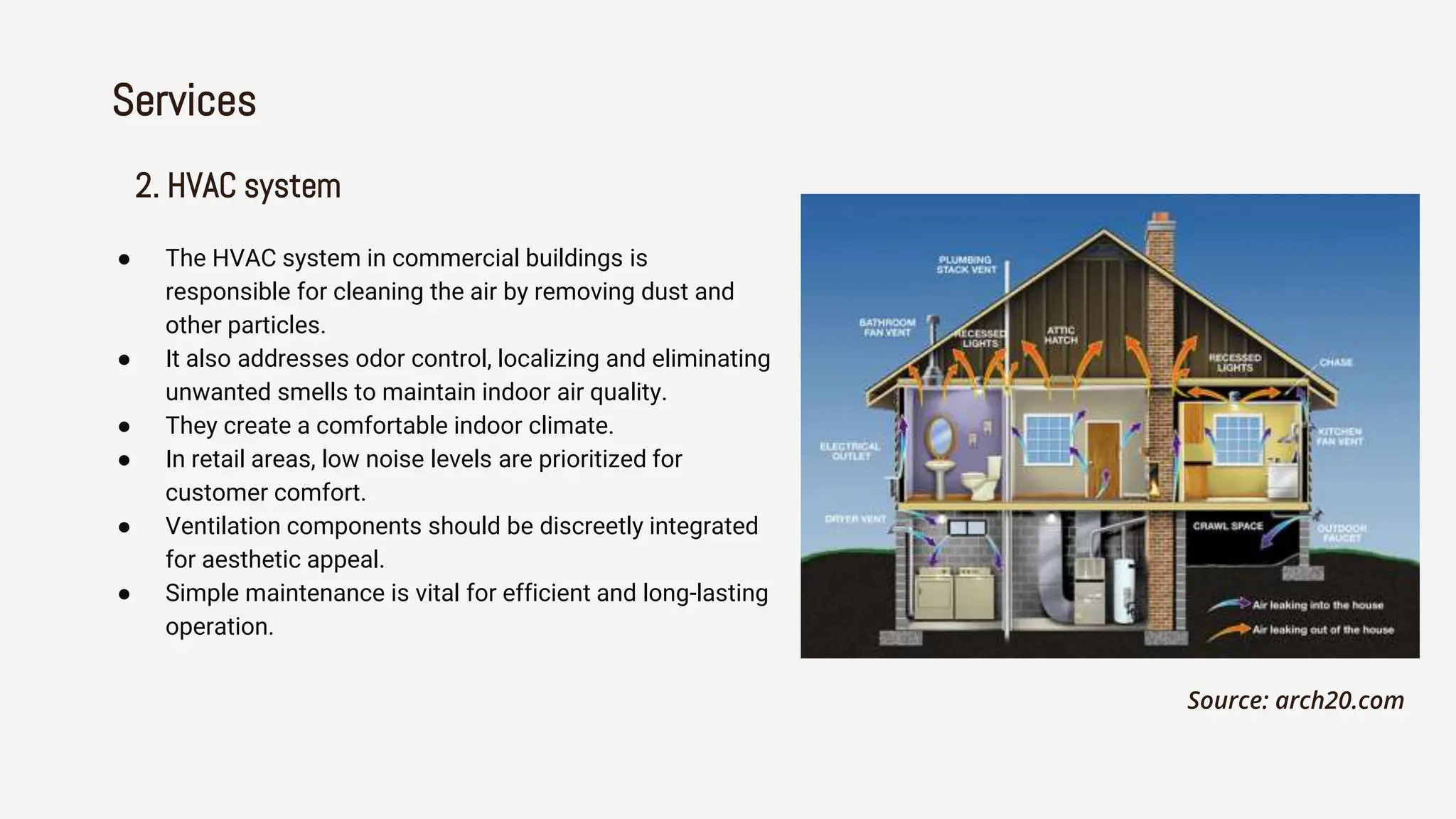
  • 139.
  • 140.
    Case study :International User Experience and Community Impact ● Passageways converge on a courtyard, mirroring urban layouts. ● Outdoor areas of restaurants, bars, and clubs seamlessly connect. ● Opting for outdoor spaces provides an authentic urban feel. ● Significant energy savings achieved by eliminating air-conditioning. Sketch: Manoj Thapa
  • 141.
    Case study :International Accessibility and Universal Design Reference: http://www.centralworld.co.th/ Groove Ground floor First floor
  • 142.
    Case study :International Parking Underground parking With drop off space at the site. 1. Level 1: This is where the Valet Parking service is available. 2. Level B2: This is where you can drop off your car for Valet Parking, and there's a waiting lounge provided for your convenience while the valet attendant parks your vehicle. . https://www.archdaily.com/
  • 143.
    COMPARATIVE ANALYSIS: 1. QUANTITATIVE 2.QUALITATIVE (Source: archdaily.com) , google .com
  • 145.
    Surrounding landscape Groove Lane189 ● Located in a dynamic urban environment with residential and commercial activity. ● The project prioritizes the seamless integration of plants and landscaping elements, enhancing the architectural composition with greenery. ● Harmonizes with surroundings while enhancing the well-being of occupants and visitors. ● Positioned adjacent to Changshou Park amidst greenery and open spaces. ● No specific mention of landscape integration, focus more on the building's facade. ● Serves as a prominent focal point in its dynamic surroundings. (Source: archdaily.com) , google .com
  • 146.
    Facade Contributes to thebuilding's prominence in the urban landscape Represents a sophisticated and innovative approach Groove Lane 189 ● Distinguishes the structure, making it a standout feature in the city. ● Minimalist, shades of grey and black, wooden finishes, greenery, hexagonal grid skylight. ● A gradient transition from bigger to smaller facade components regulates the exposure of the inside to the outside, and enhances the main entrance of the building. (Source: archdaily.com) , google .com
  • 147.
    Material Stainless steel, steel-reinforced concrete,stainless steel pin connectors, PVDF-coated aluminum panels, Acrylic boards. The World Trade Center in Tripureshwor, Kathmandu is constructed primarily using reinforced concrete, glass, and steel, which provide structural strength, durability, and a modern aesthetic. Lane 189, United World Trade Center (Source: archdaily.com) , google .com
  • 148.
    Layout and useof Spaces Groove ● The Groove is designed around a central open-air courtyard, enhancing horizontal flow and creating a communal dining and social space. ● Lane 189 is centered around a large atrium, promoting vertical interaction and maximizing natural light. Lane 189 (Source: archdaily.com) , google .com Sketch: Manoj Thapa
  • 149.
    Emergency exit National cases: Manbhawancomplex, UWTC Emergency exit are not placed appropriately. International cases : Groove, Lane 189 Design emphasises the placement of emergency exits as per literature review. (Source: archdaily.com) , google .com
  • 150.