
PALM VEIN TECHNOLOGY
SUBMITTEDBY:
Vibhor Varshney
Rishabh sharma
Rohit kumar
Introduction
BIOMETRICS
Palm Vein Technology
Principle Involved
WORKING
How secure is this technology?
Applications
 ADVANTAGES
DISADVANTAGES
CONCLUSION
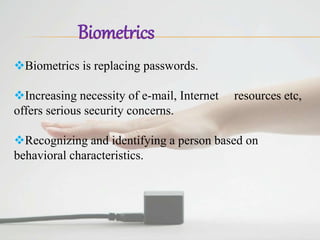
Biometrics
Biometrics is replacing passwords.
Increasing necessity of e-mail, Internet resources etc,
offers serious security concerns.
Recognizing and identifying a person based on
behavioral characteristics.
Palm Vein Technology
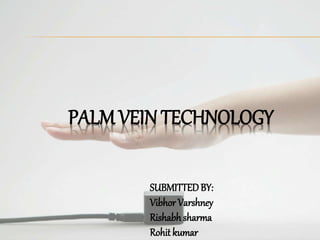
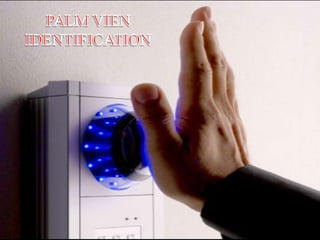
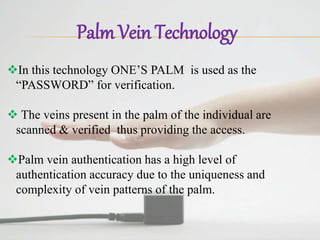
In this technology ONE’S PALM is used as the
“PASSWORD” for verification.
 The veins present in the palm of the individual are
scanned & verified thus providing the access.
Palm vein authentication has a high level of
authentication accuracy due to the uniqueness and
complexity of vein patterns of the palm.
Principle Involved
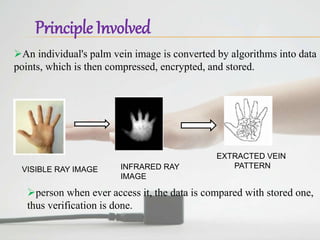
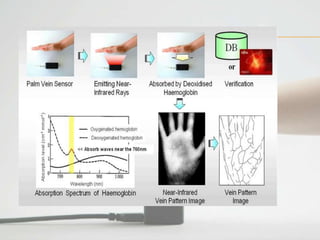
An individual's palm vein image is converted by algorithms into data
points, which is then compressed, encrypted, and stored.
VISIBLE RAY IMAGE INFRARED RAY
IMAGE
EXTRACTED VEIN
PATTERN
person when ever access it, the data is compared with stored one,
thus verification is done.
WORKING
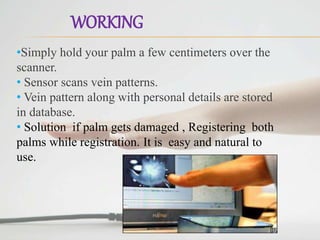
•Simply hold your palm a few centimeters over the
scanner.
• Sensor scans vein patterns.
• Vein pattern along with personal details are stored
in database.
• Solution if palm gets damaged , Registering both
palms while registration. It is easy and natural to
use.
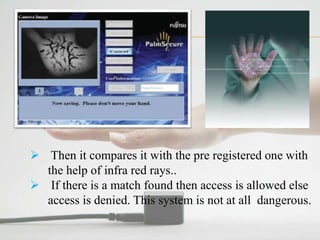
 Then it compares it with the pre registered one with
the help of infra red rays..
 If there is a match found then access is allowed else
access is denied. This system is not at all dangerous.
SECURITY PROVIDED
BY THIS SYSTEM
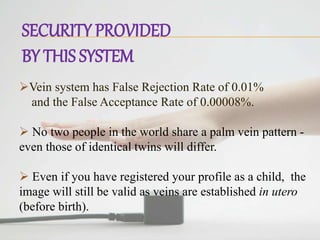
Vein system has False Rejection Rate of 0.01%
and the False Acceptance Rate of 0.00008%.
 No two people in the world share a palm vein pattern -
even those of identical twins will differ.
 Even if you have registered your profile as a child, the
image will still be valid as veins are established in utero
(before birth).
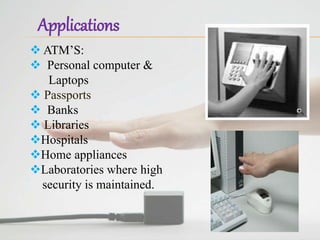
 ATM’S:
 Personal computer &
Laptops
 Passports
 Banks
 Libraries
Hospitals
Home appliances
Laboratories where high
security is maintained.
Applications
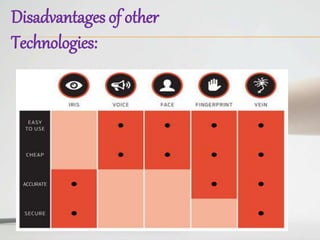
Disadvantages of other
Technologies:
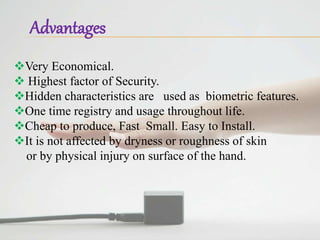
Advantages
Very Economical.
 Highest factor of Security.
Hidden characteristics are used as biometric features.
One time registry and usage throughout life.
Cheap to produce, Fast Small. Easy to Install.
It is not affected by dryness or roughness of skin
or by physical injury on surface of the hand.
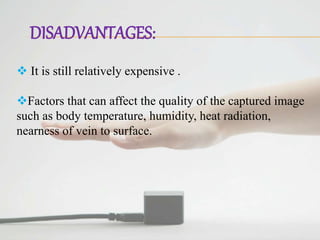
DISADVANTAGES:
 It is still relatively expensive .
Factors that can affect the quality of the captured image
such as body temperature, humidity, heat radiation,
nearness of vein to surface.
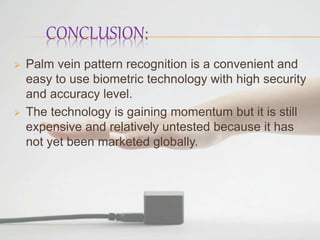
CONCLUSION:
 Palm vein pattern recognition is a convenient and
easy to use biometric technology with high security
and accuracy level.
 The technology is gaining momentum but it is still
expensive and relatively untested because it has
not yet been marketed globally.
Palm vein new

Palm vein new

  • 1.
    PALM VEIN TECHNOLOGY SUBMITTEDBY: VibhorVarshney Rishabh sharma Rohit kumar
  • 2.
    Introduction BIOMETRICS Palm Vein Technology PrincipleInvolved WORKING How secure is this technology? Applications  ADVANTAGES DISADVANTAGES CONCLUSION
  • 4.
    Biometrics Biometrics is replacingpasswords. Increasing necessity of e-mail, Internet resources etc, offers serious security concerns. Recognizing and identifying a person based on behavioral characteristics.
  • 5.
    Palm Vein Technology Inthis technology ONE’S PALM is used as the “PASSWORD” for verification.  The veins present in the palm of the individual are scanned & verified thus providing the access. Palm vein authentication has a high level of authentication accuracy due to the uniqueness and complexity of vein patterns of the palm.
  • 6.
    Principle Involved An individual'spalm vein image is converted by algorithms into data points, which is then compressed, encrypted, and stored. VISIBLE RAY IMAGE INFRARED RAY IMAGE EXTRACTED VEIN PATTERN person when ever access it, the data is compared with stored one, thus verification is done.
  • 7.
    WORKING •Simply hold yourpalm a few centimeters over the scanner. • Sensor scans vein patterns. • Vein pattern along with personal details are stored in database. • Solution if palm gets damaged , Registering both palms while registration. It is easy and natural to use.
  • 8.
     Then itcompares it with the pre registered one with the help of infra red rays..  If there is a match found then access is allowed else access is denied. This system is not at all dangerous.
  • 10.
    SECURITY PROVIDED BY THISSYSTEM Vein system has False Rejection Rate of 0.01% and the False Acceptance Rate of 0.00008%.  No two people in the world share a palm vein pattern - even those of identical twins will differ.  Even if you have registered your profile as a child, the image will still be valid as veins are established in utero (before birth).
  • 11.
     ATM’S:  Personalcomputer & Laptops  Passports  Banks  Libraries Hospitals Home appliances Laboratories where high security is maintained. Applications
  • 12.
  • 13.
    Advantages Very Economical.  Highestfactor of Security. Hidden characteristics are used as biometric features. One time registry and usage throughout life. Cheap to produce, Fast Small. Easy to Install. It is not affected by dryness or roughness of skin or by physical injury on surface of the hand.
  • 14.
    DISADVANTAGES:  It isstill relatively expensive . Factors that can affect the quality of the captured image such as body temperature, humidity, heat radiation, nearness of vein to surface.
  • 15.
    CONCLUSION:  Palm veinpattern recognition is a convenient and easy to use biometric technology with high security and accuracy level.  The technology is gaining momentum but it is still expensive and relatively untested because it has not yet been marketed globally.