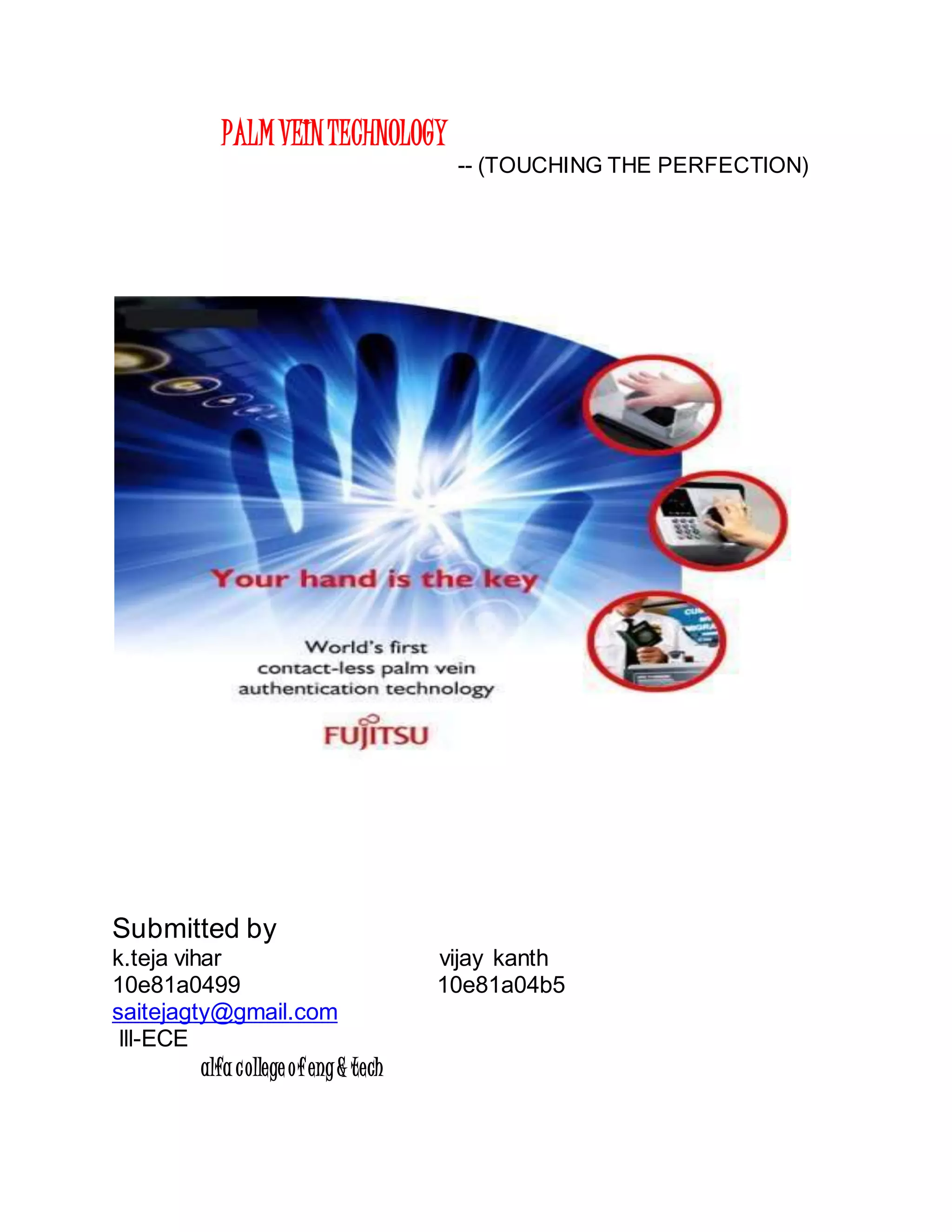
PALM VEINTECHNOLOGY
-- (TOUCHING THE PERFECTION)
Submitted by
k.teja vihar vijay kanth
10e81a0499 10e81a04b5
saitejagty@gmail.com
lll-ECE
alfa collegeofeng& tech
CONTENTS
1. ABSTRACT 1
2. INTRODUCTION2
3. PALM VIEW TECHNOLOGY
REVIEWS 2
i) Basis of Palm Vein Technology
ii) Palm Vein Registration
iii) Working of Palm Vein Systems
iv) How Secure is the Technology?
v) What happens if Registered Palm is
damaged?
vi) Contact less palm vein
authentication device
4. ADVANTAGES 6
5. APPLICATIONS 6
i) ATM
ii) Personal Computers
iii) Hospitals and Libraries
iv) Authentication
6. CONCLUSION 8
7. REFERENCES 8
ABSTRACT:
With the increase in technology threat to
personal data and national security had
also increased .The methods that were
developed to secure important information
from
outside intervention were not up to safe
mark .There was a need to introduce a
technology
that secures our data more efficiently from
unlawful intervention .
Fujitsu has developed a palm vein pattern
authentication technology that uses
vescular patterns as personal identification
data .Vein recognition technology is secure
because the authentication data exists inside
the body and is therefore very difficult to
forge. It is highly accurate. This technology
can be used in various fields like banking,
hospitals, government offices, in passport
issuing etc. Business growth will be
achieved
with these solutions by reducing the size of
the palm vein sensor and shortening the
authentication time. This paper is about the
palm vein technology, its applications, how
this technology is applied in real time
applications and the advantages of using this
technology.
2. Introduction:
Page | 4
In the ubiquitous network society, where
individuals can easily
access their information any time and
anywhere, people are also faced with the
risk that
others can easily access the same
information anytime and anywhere. Because
of this
risk, personal identification technology is
used which includes Passwords, personal
identification numbers and identification
cards. However, cards can be stolen and
passwords and numbers can be guessed or
forgotten. To solve these problems, Fujitsu
developed four methods: fingerprints, faces,
voice prints and palm veins. Among these,
because of its high accuracy, contact less
palm vein authentication technology is being
incorporated into various financial solution
products for use in public places. This paper
palm vein authentication technologies and
some examples of its application to financial
solutions.
3. Palm Vein TechnologyReviews:
3.1 The Basis of Palm Vein Technology
An individual first rests his wrist, and on
some
devices, the middle of his fingers, on the
sensor's supports
such that the palm is held centimeters above
the device's
scanner, which flashes a near-infrared ray on
the palm.
Unlike the skin, through which near-infrared
light passes,
deoxygenated hemoglobin in the blood
flowing through the veins absorbs near-
infrared
rays, illuminating the hemoglobin, causing it
to be visible to the scanner. Arteries and
capillaries, whose blood contains
oxygenated hemoglobin, which does not
absorb nearinfrared
light, are invisible to the sensor. The still
image captured by the camera, which
photographs in the near-infrared range,
appears as a black network, reflecting the
palm's
vein pattern against the lighter background
of the palm.
An individual's palm vein image is
converted by algorithms into data points,
which is then compressed, encrypted, and
stored by the software and registered along
with the other details in his profile as a
reference for future comparison. Then, each
time a
person logs in attempting to gain access by a
palm scan to a particular bank account or
secured entryway, etc., the newly captured
image is likewise processed and compared
to
the registered one or to the bank of stored
files for verification, all in a period of
seconds.
Numbers and positions of veins and their
crossing points are all compared and,
depending
on verification, the person is either granted
or denied access.
3.2 REGISTERING THROUGH
PALM VEIN TECHNOLOGY:
Step 1:
Palm vein authentication technology
consists of a small
Palm vein scanner that's easy and natural to
use, fast and
Highly accurate. Simply hold your palm a
few centimeters
Over the scanner and within a second it
reads your unique
vein pattern. A vein picture is taken and
palm pattern is
registered.
Step 2:
The registered palm pattern is stored into the
database along with the personal details
of the client.
3.3 Working of palm vein security
systems
1. One should place his/her palm near to
scanner.
2. The scanner makes use of a special
characteristic of the reduced hemoglobin
coursing
through the palm veins — it absorbs near-
infrared light. This makes it possible to take
a snapshot of what's beneath the outer skin,
something very hard to read or steal.
3. The integrated optical system in the palm
vein sensor uses this phenomenon to
generate
an image of the palm vein pattern and the
generated image is digitized, encrypted and
finally stored as a registered template in the
database.
3.4 How Secure is the Technology?
On the basis of testing the technology on
more than 70,000 individuals ,
Fujitsu declared that the new system had a
false rejection rate of 0.01% (i.e., only one
out of 10,000 scans were incorrect denials
for access), and a false acceptance rate of
less
than 0.00008% (i.e., incorrect approval for
access in one in over a million scans).
Also, if your profile is registered with your
right hand, don't log in with your left - the
patterns of an individual's two hands differ.
And if you registered your profile as a child
, it'll still be recognized as you grow, as an
individual's patterns of veins are
established in utero (before birth). No two
people in the world share a palm vein
pattern - even those of identical twins differ.
In addition the devices ability to perform
personal authentication was verified using
the following:
1. Data from people ranging from 6 to 85
years old including people in various
occupations in accordance with the
demographics realized by the Statistics
Center of the
Statistics Bureau.
2. Data about foreigners living in Japan in
accordance with the world demographics
released by the United Nations.
3. Data taken in various situations in daily
life including after drinking alcohol, taking a
bath, going outside and waking up.
3.5. What happens if the registered
palm gets damaged?
There may be a chance that the palm we had
registered may get
damaged then we cannot use this
technology, so during the time of
registration we take
the veins of both the hands so that if one
gets damaged we can access through the
second
hand. When hand get damaged up to large
extent we can get veins because deeper into
the
hand veins are obtained.
When we apply this method we can
maintain complete privacy .
3.6. Contactless palm vein
authentication device
(HYGIENE CONCERN):
The completely contactless feature of this
Device makes it suitable for use where high
levels of
hygiene are required .It also eliminates any
hesitation people
might have about coming into contact with
something that
other people have already touched. Fig:3.6
Contact less
Sensor
In addition to being contactless and thereby
hygienic and user-friendly in
that the user does not need to physically
touch a surface and is free of such hygiene
concerns, palm vein authentication is highly
secure in that the veins are internal to the
body and carry a wealth of information,
thereby being extremely difficult to forge.
4. ADVANTAGES:
In addition to the palm, vein authentication
can be done using the
vascular pattern on the back of a hand or a
finger. However, the palm vein pattern is the
most complex and covers the widest area,
because the palm has no hair, it is easier to
photograph its vascular pattern. The palm
also has no significant variations in skin
color compared with fingers or back of the
hand, where the color can darken in certain
areas.
5. APPLICATIONS:
This palm vein authentication technology is
used in various areas for
more security. The following are some of
the important areas where it is used:
5.1. ATM:
In July 2004, to ensure customer security,
Suruga bank launched its“Bio
Security Deposit” the world’s first financial
service to use Palm Secure . This service
features high security for customers using
vein authentication , does not require a
bank card or pass book and prevents
withdrawals from branches other than the
registered branch and ATMs thereby
minimizing the risk of fraudulent
withdrawals.
To open a Bio-Security Deposit account,
customers go to a bank and have their palm
veins photographed at the counter in order to
guarantee secure data management, the
palm vein data is stored only on the vein
data base server at the branch office where
the
account is opened..
In October 2004, The Bank of Tokyo
launched its “Super –IC Card”. This card
combines the functions of a bankcard, credit
card, electronic money and palm vein
authentication. This Super –IC Card
contains the customer’s palm
Vein data and vein authentication algorithms
and performs vein
authentication by itself . This system is
advantageous because
the customers information is not stored at
the bank. When a
Customer applies for a Super –IC Card, the
bank sends the card
to the customers home . To activate the palm
vein authentication function, the
customer brings the card and his passbook
and seal to the bank
counter where the customers vein
information is registered on
the card . After registration the customer can
make transactions at that branch counter
and ATM using palm vein authentication
and a matching PIN number
5.2. PERSONAL COMPUTERS:
In personal computers palm vein technology
can applied by inserting the vein sensor
inside mouse.
when power is supplied to system the mouse
also gets
power and the sensor in the mouse will be
ready to sense
palm veins. When one place his/her palm the
sensor sense
the veins and if they are matched with the
registered ones Fig:5.2 PC Sensor
the system allows the person to use it.
One can use this technology even to lock
folders , that should be
maintained as private information.
5.3. IN HOSPITALS AND LIBRARYS:
A public library in Japan is set to
become the first in the world to use palm-
vein biometrics
as a substitute for conventional library cards.
The University of Tokyo hospital has taken
delivery of a
contactless palm vein authentication system
to secure physical access to its
Department of Planning, Information and
Management.
5.4 Authentication:
In front of our homes we can apply
this Palm vein techonolgy so that by
registering the veins
of our family members and relatives we can
maintain high
range security which is not possible through
other
technologies . Japanese recently used this
technologies
before front doors and getting high range
security.
Fig:5.4 Near Front Doors
6. Conclusion:
Palm vein pattern authentication technology
developed by Fujitsu
was being used in a wide range in japan . If
this technology is introduced in our country
we can solve many problems such as
password protection in ATM ,
security in various fields and if we
implement this technology in government
offices
we can make the employees to work
according the government timings.surely
this
technology will bring a revolution in the
field of science and technology in the near
future.
7. REFERENCES:
1.
WWW.ZENGINKYO.OR.JP/EN/NEWS/IN
DEX
2. www.btm.co.jp/english/index.html
3. WWW.networkworld.COM

Palm vein technology

  • 1.
    PALM VEINTECHNOLOGY -- (TOUCHINGTHE PERFECTION) Submitted by k.teja vihar vijay kanth 10e81a0499 10e81a04b5 saitejagty@gmail.com lll-ECE alfa collegeofeng& tech
  • 2.
    CONTENTS 1. ABSTRACT 1 2.INTRODUCTION2 3. PALM VIEW TECHNOLOGY REVIEWS 2 i) Basis of Palm Vein Technology ii) Palm Vein Registration iii) Working of Palm Vein Systems iv) How Secure is the Technology? v) What happens if Registered Palm is damaged? vi) Contact less palm vein authentication device 4. ADVANTAGES 6 5. APPLICATIONS 6 i) ATM ii) Personal Computers iii) Hospitals and Libraries iv) Authentication 6. CONCLUSION 8 7. REFERENCES 8 ABSTRACT: With the increase in technology threat to personal data and national security had also increased .The methods that were developed to secure important information from outside intervention were not up to safe mark .There was a need to introduce a technology that secures our data more efficiently from unlawful intervention . Fujitsu has developed a palm vein pattern authentication technology that uses vescular patterns as personal identification data .Vein recognition technology is secure because the authentication data exists inside the body and is therefore very difficult to forge. It is highly accurate. This technology can be used in various fields like banking, hospitals, government offices, in passport issuing etc. Business growth will be achieved with these solutions by reducing the size of the palm vein sensor and shortening the authentication time. This paper is about the palm vein technology, its applications, how this technology is applied in real time applications and the advantages of using this technology. 2. Introduction: Page | 4 In the ubiquitous network society, where individuals can easily access their information any time and anywhere, people are also faced with the risk that others can easily access the same information anytime and anywhere. Because of this risk, personal identification technology is used which includes Passwords, personal identification numbers and identification cards. However, cards can be stolen and
  • 3.
    passwords and numberscan be guessed or forgotten. To solve these problems, Fujitsu developed four methods: fingerprints, faces, voice prints and palm veins. Among these, because of its high accuracy, contact less palm vein authentication technology is being incorporated into various financial solution products for use in public places. This paper palm vein authentication technologies and some examples of its application to financial solutions. 3. Palm Vein TechnologyReviews: 3.1 The Basis of Palm Vein Technology An individual first rests his wrist, and on some devices, the middle of his fingers, on the sensor's supports such that the palm is held centimeters above the device's scanner, which flashes a near-infrared ray on the palm. Unlike the skin, through which near-infrared light passes, deoxygenated hemoglobin in the blood flowing through the veins absorbs near- infrared rays, illuminating the hemoglobin, causing it to be visible to the scanner. Arteries and capillaries, whose blood contains oxygenated hemoglobin, which does not absorb nearinfrared light, are invisible to the sensor. The still image captured by the camera, which photographs in the near-infrared range, appears as a black network, reflecting the palm's vein pattern against the lighter background of the palm. An individual's palm vein image is converted by algorithms into data points, which is then compressed, encrypted, and stored by the software and registered along with the other details in his profile as a reference for future comparison. Then, each time a person logs in attempting to gain access by a palm scan to a particular bank account or secured entryway, etc., the newly captured image is likewise processed and compared to the registered one or to the bank of stored files for verification, all in a period of seconds. Numbers and positions of veins and their crossing points are all compared and, depending on verification, the person is either granted or denied access. 3.2 REGISTERING THROUGH PALM VEIN TECHNOLOGY: Step 1: Palm vein authentication technology consists of a small Palm vein scanner that's easy and natural to use, fast and Highly accurate. Simply hold your palm a few centimeters Over the scanner and within a second it reads your unique vein pattern. A vein picture is taken and palm pattern is registered. Step 2: The registered palm pattern is stored into the database along with the personal details of the client. 3.3 Working of palm vein security systems 1. One should place his/her palm near to scanner. 2. The scanner makes use of a special characteristic of the reduced hemoglobin coursing
  • 4.
    through the palmveins — it absorbs near- infrared light. This makes it possible to take a snapshot of what's beneath the outer skin, something very hard to read or steal. 3. The integrated optical system in the palm vein sensor uses this phenomenon to generate an image of the palm vein pattern and the generated image is digitized, encrypted and finally stored as a registered template in the database. 3.4 How Secure is the Technology? On the basis of testing the technology on more than 70,000 individuals , Fujitsu declared that the new system had a false rejection rate of 0.01% (i.e., only one out of 10,000 scans were incorrect denials for access), and a false acceptance rate of less than 0.00008% (i.e., incorrect approval for access in one in over a million scans). Also, if your profile is registered with your right hand, don't log in with your left - the patterns of an individual's two hands differ. And if you registered your profile as a child , it'll still be recognized as you grow, as an individual's patterns of veins are established in utero (before birth). No two people in the world share a palm vein pattern - even those of identical twins differ. In addition the devices ability to perform personal authentication was verified using the following: 1. Data from people ranging from 6 to 85 years old including people in various occupations in accordance with the demographics realized by the Statistics Center of the Statistics Bureau. 2. Data about foreigners living in Japan in accordance with the world demographics released by the United Nations. 3. Data taken in various situations in daily life including after drinking alcohol, taking a bath, going outside and waking up. 3.5. What happens if the registered palm gets damaged? There may be a chance that the palm we had registered may get damaged then we cannot use this technology, so during the time of registration we take the veins of both the hands so that if one gets damaged we can access through the second hand. When hand get damaged up to large extent we can get veins because deeper into the hand veins are obtained. When we apply this method we can maintain complete privacy . 3.6. Contactless palm vein authentication device (HYGIENE CONCERN): The completely contactless feature of this Device makes it suitable for use where high levels of hygiene are required .It also eliminates any hesitation people might have about coming into contact with something that other people have already touched. Fig:3.6 Contact less Sensor In addition to being contactless and thereby hygienic and user-friendly in that the user does not need to physically touch a surface and is free of such hygiene concerns, palm vein authentication is highly secure in that the veins are internal to the body and carry a wealth of information, thereby being extremely difficult to forge.
  • 5.
    4. ADVANTAGES: In additionto the palm, vein authentication can be done using the vascular pattern on the back of a hand or a finger. However, the palm vein pattern is the most complex and covers the widest area, because the palm has no hair, it is easier to photograph its vascular pattern. The palm also has no significant variations in skin color compared with fingers or back of the hand, where the color can darken in certain areas. 5. APPLICATIONS: This palm vein authentication technology is used in various areas for more security. The following are some of the important areas where it is used: 5.1. ATM: In July 2004, to ensure customer security, Suruga bank launched its“Bio Security Deposit” the world’s first financial service to use Palm Secure . This service features high security for customers using vein authentication , does not require a bank card or pass book and prevents withdrawals from branches other than the registered branch and ATMs thereby minimizing the risk of fraudulent withdrawals. To open a Bio-Security Deposit account, customers go to a bank and have their palm veins photographed at the counter in order to guarantee secure data management, the palm vein data is stored only on the vein data base server at the branch office where the account is opened.. In October 2004, The Bank of Tokyo launched its “Super –IC Card”. This card combines the functions of a bankcard, credit card, electronic money and palm vein authentication. This Super –IC Card contains the customer’s palm Vein data and vein authentication algorithms and performs vein authentication by itself . This system is advantageous because the customers information is not stored at the bank. When a Customer applies for a Super –IC Card, the bank sends the card to the customers home . To activate the palm vein authentication function, the customer brings the card and his passbook and seal to the bank counter where the customers vein information is registered on the card . After registration the customer can make transactions at that branch counter and ATM using palm vein authentication and a matching PIN number 5.2. PERSONAL COMPUTERS: In personal computers palm vein technology can applied by inserting the vein sensor inside mouse. when power is supplied to system the mouse also gets power and the sensor in the mouse will be ready to sense palm veins. When one place his/her palm the sensor sense the veins and if they are matched with the registered ones Fig:5.2 PC Sensor the system allows the person to use it. One can use this technology even to lock folders , that should be maintained as private information. 5.3. IN HOSPITALS AND LIBRARYS: A public library in Japan is set to become the first in the world to use palm- vein biometrics as a substitute for conventional library cards. The University of Tokyo hospital has taken delivery of a
  • 6.
    contactless palm veinauthentication system to secure physical access to its Department of Planning, Information and Management. 5.4 Authentication: In front of our homes we can apply this Palm vein techonolgy so that by registering the veins of our family members and relatives we can maintain high range security which is not possible through other technologies . Japanese recently used this technologies before front doors and getting high range security. Fig:5.4 Near Front Doors 6. Conclusion: Palm vein pattern authentication technology developed by Fujitsu was being used in a wide range in japan . If this technology is introduced in our country we can solve many problems such as password protection in ATM , security in various fields and if we implement this technology in government offices we can make the employees to work according the government timings.surely this technology will bring a revolution in the field of science and technology in the near future. 7. REFERENCES: 1. WWW.ZENGINKYO.OR.JP/EN/NEWS/IN DEX 2. www.btm.co.jp/english/index.html 3. WWW.networkworld.COM