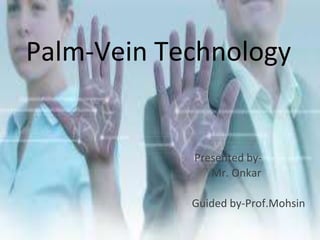
Palm-Vein Technology 
Presented by- 
Mr. Onkar 
Guided by-Prof.Mohsin
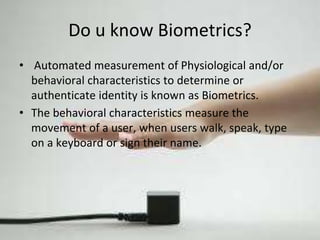
Do u know Biometrics? 
• Automated measurement of Physiological and/or 
behavioral characteristics to determine or 
authenticate identity is known as Biometrics. 
• The behavioral characteristics measure the 
movement of a user, when users walk, speak, type 
on a keyboard or sign their name.
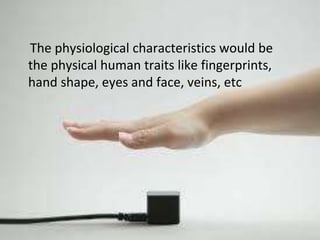
The physiological characteristics would be 
the physical human traits like fingerprints, 
hand shape, eyes and face, veins, etc
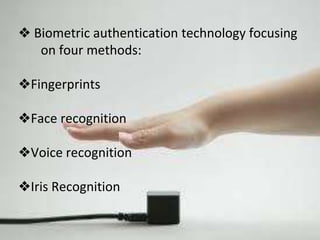
❖ Biometric authentication technology focusing 
on four methods: 
❖Fingerprints 
❖Face recognition 
❖Voice recognition 
❖Iris Recognition
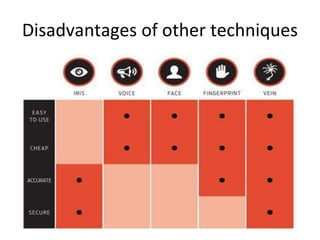
Disadvantages of other techniques
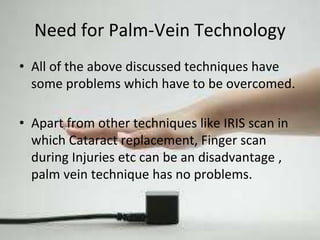
Need for Palm-Vein Technology 
• All of the above discussed techniques have 
some problems which have to be overcomed. 
• Apart from other techniques like IRIS scan in 
which Cataract replacement, Finger scan 
during Injuries etc can be an disadvantage , 
palm vein technique has no problems.
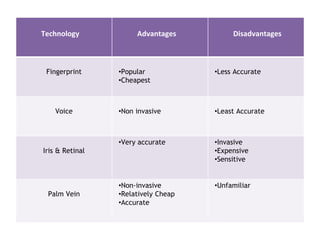
Technology Advantages Disadvantages 
Fingerprint •Popular 
•Cheapest 
•Less Accurate 
Voice •Non invasive •Least Accurate 
Iris & Retinal 
•Very accurate •Invasive 
•Expensive 
•Sensitive 
Palm Vein 
•Non-invasive 
•Relatively Cheap 
•Accurate 
•Unfamiliar
What is Palm-Vein technology? 
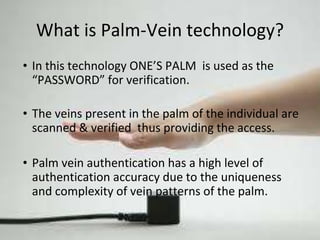
• In this technology ONE’S PALM is used as the 
“PASSWORD” for verification. 
• The veins present in the palm of the individual are 
scanned & verified thus providing the access. 
• Palm vein authentication has a high level of 
authentication accuracy due to the uniqueness 
and complexity of vein patterns of the palm.
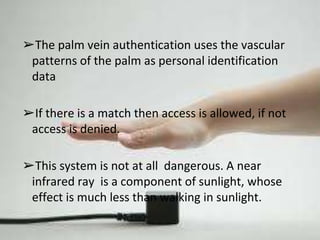
➢The palm vein authentication uses the vascular 
patterns of the palm as personal identification 
data 
➢If there is a match then access is allowed, if not 
access is denied. 
➢This system is not at all dangerous. A near 
infrared ray is a component of sunlight, whose 
effect is much less than walking in sunlight.
Principle 
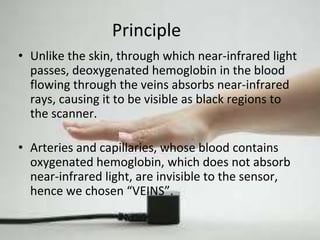
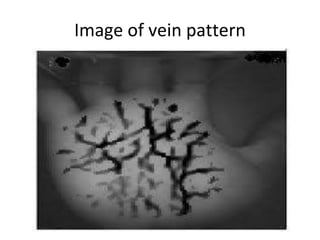
• Unlike the skin, through which near-infrared light 
passes, deoxygenated hemoglobin in the blood 
flowing through the veins absorbs near-infrared 
rays, causing it to be visible as black regions to 
the scanner. 
• Arteries and capillaries, whose blood contains 
oxygenated hemoglobin, which does not absorb 
near-infrared light, are invisible to the sensor, 
hence we chosen “VEINS”.
Image of vein pattern
Basis of the Palm-Vein Technology 
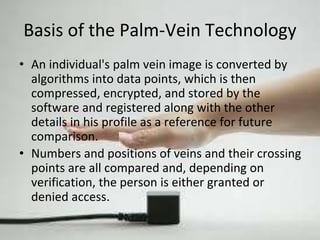
• An individual's palm vein image is converted by 
algorithms into data points, which is then 
compressed, encrypted, and stored by the 
software and registered along with the other 
details in his profile as a reference for future 
comparison. 
• Numbers and positions of veins and their crossing 
points are all compared and, depending on 
verification, the person is either granted or 
denied access.
Working 
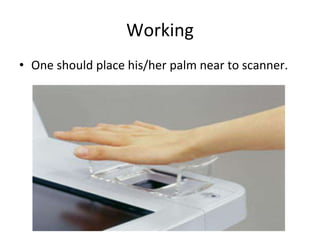
• One should place his/her palm near to scanner.
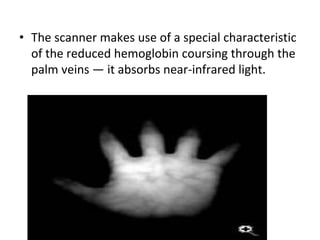
• The scanner makes use of a special characteristic 
of the reduced hemoglobin coursing through the 
palm veins — it absorbs near-infrared light.
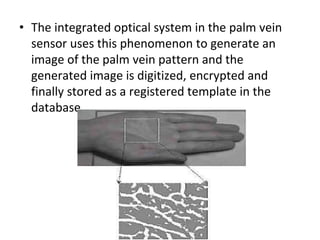
• The integrated optical system in the palm vein 
sensor uses this phenomenon to generate an 
image of the palm vein pattern and the 
generated image is digitized, encrypted and 
finally stored as a registered template in the 
database.
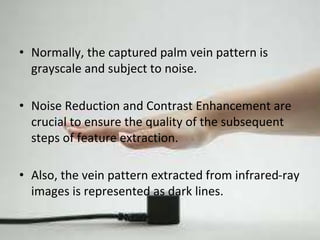
• Normally, the captured palm vein pattern is 
grayscale and subject to noise. 
• Noise Reduction and Contrast Enhancement are 
crucial to ensure the quality of the subsequent 
steps of feature extraction. 
• Also, the vein pattern extracted from infrared-ray 
images is represented as dark lines.
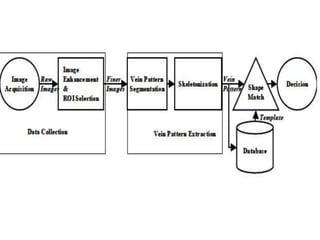
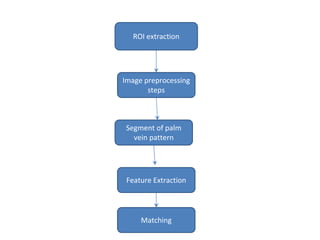
ROI extraction 
Image preprocessing 
steps 
Segment of palm 
vein pattern 
Feature Extraction 
Matching
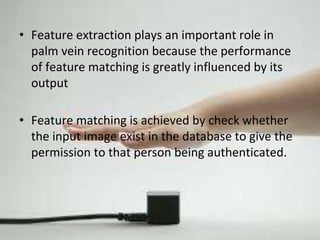
• Feature extraction plays an important role in 
palm vein recognition because the performance 
of feature matching is greatly influenced by its 
output 
• Feature matching is achieved by check whether 
the input image exist in the database to give the 
permission to that person being authenticated.
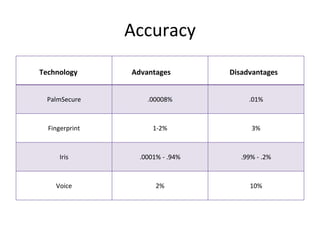
Accuracy 
Technology Advantages Disadvantages 
PalmSecure .00008% .01% 
Fingerprint 1-2% 3% 
Iris .0001% - .94% .99% - .2% 
Voice 2% 10%
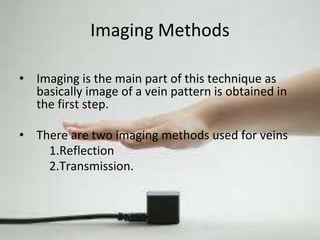
Imaging Methods 
• Imaging is the main part of this technique as 
basically image of a vein pattern is obtained in 
the first step. 
• There are two imaging methods used for veins 
1.Reflection 
2.Transmission.
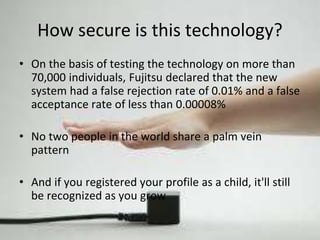
How secure is this technology? 
• On the basis of testing the technology on more than 
70,000 individuals, Fujitsu declared that the new 
system had a false rejection rate of 0.01% and a false 
acceptance rate of less than 0.00008% 
• No two people in the world share a palm vein 
pattern 
• And if you registered your profile as a child, it'll still 
be recognized as you grow
• It is difficult to forge for intruders. 
• It is not affected by dryness or roughness of skin 
or by physical injury on surface of the hand.
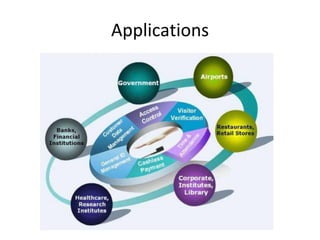
Applications
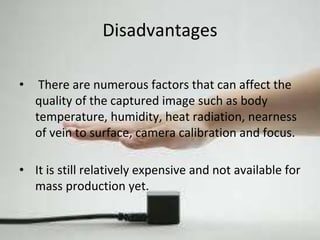
Disadvantages 
• There are numerous factors that can affect the 
quality of the captured image such as body 
temperature, humidity, heat radiation, nearness 
of vein to surface, camera calibration and focus. 
• It is still relatively expensive and not available for 
mass production yet.
Conclusion 
• If this technology is introduced in our country we 
can solve many problems such as password 
protection in ATM. 
• security in various fields and if we implement this 
technology in government offices we can make 
the employees to work according the government 
timings. 
• surely this technology will bring a revolution in the 
field of science and technology in the near future.
QUERIES??
THANK YOU..!!

Palm vein technology.pptx

  • 1.
    Palm-Vein Technology Presentedby- Mr. Onkar Guided by-Prof.Mohsin
  • 2.
    Do u knowBiometrics? • Automated measurement of Physiological and/or behavioral characteristics to determine or authenticate identity is known as Biometrics. • The behavioral characteristics measure the movement of a user, when users walk, speak, type on a keyboard or sign their name.
  • 3.
    The physiological characteristicswould be the physical human traits like fingerprints, hand shape, eyes and face, veins, etc
  • 4.
    ❖ Biometric authenticationtechnology focusing on four methods: ❖Fingerprints ❖Face recognition ❖Voice recognition ❖Iris Recognition
  • 5.
  • 6.
    Need for Palm-VeinTechnology • All of the above discussed techniques have some problems which have to be overcomed. • Apart from other techniques like IRIS scan in which Cataract replacement, Finger scan during Injuries etc can be an disadvantage , palm vein technique has no problems.
  • 7.
    Technology Advantages Disadvantages Fingerprint •Popular •Cheapest •Less Accurate Voice •Non invasive •Least Accurate Iris & Retinal •Very accurate •Invasive •Expensive •Sensitive Palm Vein •Non-invasive •Relatively Cheap •Accurate •Unfamiliar
  • 8.
    What is Palm-Veintechnology? • In this technology ONE’S PALM is used as the “PASSWORD” for verification. • The veins present in the palm of the individual are scanned & verified thus providing the access. • Palm vein authentication has a high level of authentication accuracy due to the uniqueness and complexity of vein patterns of the palm.
  • 9.
    ➢The palm veinauthentication uses the vascular patterns of the palm as personal identification data ➢If there is a match then access is allowed, if not access is denied. ➢This system is not at all dangerous. A near infrared ray is a component of sunlight, whose effect is much less than walking in sunlight.
  • 10.
    Principle • Unlikethe skin, through which near-infrared light passes, deoxygenated hemoglobin in the blood flowing through the veins absorbs near-infrared rays, causing it to be visible as black regions to the scanner. • Arteries and capillaries, whose blood contains oxygenated hemoglobin, which does not absorb near-infrared light, are invisible to the sensor, hence we chosen “VEINS”.
  • 11.
  • 12.
    Basis of thePalm-Vein Technology • An individual's palm vein image is converted by algorithms into data points, which is then compressed, encrypted, and stored by the software and registered along with the other details in his profile as a reference for future comparison. • Numbers and positions of veins and their crossing points are all compared and, depending on verification, the person is either granted or denied access.
  • 13.
    Working • Oneshould place his/her palm near to scanner.
  • 14.
    • The scannermakes use of a special characteristic of the reduced hemoglobin coursing through the palm veins — it absorbs near-infrared light.
  • 15.
    • The integratedoptical system in the palm vein sensor uses this phenomenon to generate an image of the palm vein pattern and the generated image is digitized, encrypted and finally stored as a registered template in the database.
  • 17.
    • Normally, thecaptured palm vein pattern is grayscale and subject to noise. • Noise Reduction and Contrast Enhancement are crucial to ensure the quality of the subsequent steps of feature extraction. • Also, the vein pattern extracted from infrared-ray images is represented as dark lines.
  • 18.
    ROI extraction Imagepreprocessing steps Segment of palm vein pattern Feature Extraction Matching
  • 19.
    • Feature extractionplays an important role in palm vein recognition because the performance of feature matching is greatly influenced by its output • Feature matching is achieved by check whether the input image exist in the database to give the permission to that person being authenticated.
  • 20.
    Accuracy Technology AdvantagesDisadvantages PalmSecure .00008% .01% Fingerprint 1-2% 3% Iris .0001% - .94% .99% - .2% Voice 2% 10%
  • 21.
    Imaging Methods •Imaging is the main part of this technique as basically image of a vein pattern is obtained in the first step. • There are two imaging methods used for veins 1.Reflection 2.Transmission.
  • 22.
    How secure isthis technology? • On the basis of testing the technology on more than 70,000 individuals, Fujitsu declared that the new system had a false rejection rate of 0.01% and a false acceptance rate of less than 0.00008% • No two people in the world share a palm vein pattern • And if you registered your profile as a child, it'll still be recognized as you grow
  • 23.
    • It isdifficult to forge for intruders. • It is not affected by dryness or roughness of skin or by physical injury on surface of the hand.
  • 24.
  • 25.
    Disadvantages • Thereare numerous factors that can affect the quality of the captured image such as body temperature, humidity, heat radiation, nearness of vein to surface, camera calibration and focus. • It is still relatively expensive and not available for mass production yet.
  • 26.
    Conclusion • Ifthis technology is introduced in our country we can solve many problems such as password protection in ATM. • security in various fields and if we implement this technology in government offices we can make the employees to work according the government timings. • surely this technology will bring a revolution in the field of science and technology in the near future.
  • 27.
  • 28.