Ancient African Art (8000 BCE - 2000 CE)
By: Kavita Sinha, Jason Seidman, and Phil Hochman
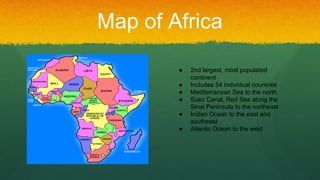
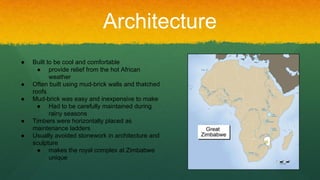
Map of Africa
● 2nd largest, most populated
continent
● Includes 54 individual countries
● Mediterranean Sea to the north
● Suez Canal, Red Sea along the
Sinai Peninsula to the northeast
● Indian Ocean to the east and
southeast
● Atlantic Ocean to the west
Key Ideas
● Much African art is created around spirituality, the spirit world, and the role of ancestors
in our lives
● African artists prefer wood, but notable works are also done in ivory and metal
● African art is rarely decorative, but made for a purpose, often for ceremonies
● African architecture is predominantly made of mud-brick; stone is rare, but can be seen
in Zimbabwe and in Ethiopian churches
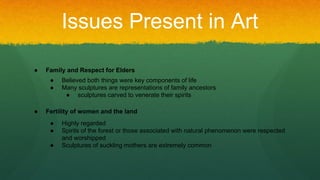
Issues Present in Art
● Family and Respect for Elders
● Believed both things were key components of life
● Many sculptures are representations of family ancestors
● sculptures carved to venerate their spirits
● Fertility of women and the land
● Highly regarded
● Spirits of the forest or those associated with natural phenomenon were respected
and worshipped
● Sculptures of suckling mothers are extremely common
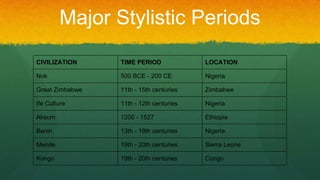
Major Stylistic Periods
CIVILIZATION TIME PERIOD LOCATION
Nok 500 BCE - 200 CE Nigeria
Great Zimbabwe 11th - 15th centuries Zimbabwe
Ife Culture 11th - 12th centuries Nigeria
Aksum 1200 - 1527 Ethiopia
Benin 13th - 19th centuries Nigeria
Mende 19th - 20th centuries Sierra Leone
Kongo 19th - 20th centuries Congo
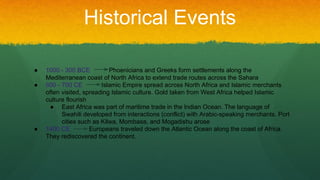
Historical Events
● 1000 - 300 BCE Phoenicians and Greeks form settlements along the
Mediterranean coast of North Africa to extend trade routes across the Sahara
● 600 - 700 CE Islamic Empire spread across North Africa and Islamic merchants
often visited, spreading Islamic culture. Gold taken from West Africa helped Islamic
culture flourish
● East Africa was part of maritime trade in the Indian Ocean. The language of
Swahili developed from interactions (conflict) with Arabic-speaking merchants. Port
cities such as Kilwa, Mombasa, and Mogadishu arose
● 1400 CE Europeans traveled down the Atlantic Ocean along the coast of Africa.
They rediscovered the continent.
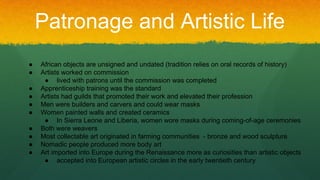
Patronage and Artistic Life
● African objects are unsigned and undated (tradition relies on oral records of history)
● Artists worked on commission
● lived with patrons until the commission was completed
● Apprenticeship training was the standard
● Artists had guilds that promoted their work and elevated their profession
● Men were builders and carvers and could wear masks
● Women painted walls and created ceramics
● In Sierra Leone and Liberia, women wore masks during coming-of-age ceremonies
● Both were weavers
● Most collectable art originated in farming communities - bronze and wood sculpture
● Nomadic people produced more body art
● Art imported into Europe during the Renaissance more as curiosities than artistic objects
● accepted into European artistic circles in the early twentieth century
Architecture
● Built to be cool and comfortable
● provide relief from the hot African
weather
● Often built using mud-brick walls and thatched
roofs
● Mud-brick was easy and inexpensive to make
● Had to be carefully maintained during
rainy seasons
● Timbers were horizontally placed as
maintenance ladders
● Usually avoided stonework in architecture and
sculpture
● makes the royal complex at Zimbabwe
unique
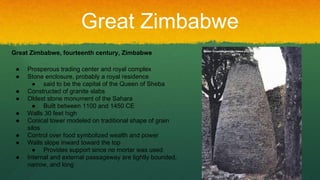
Great Zimbabwe
Great Zimbabwe, fourteenth century, Zimbabwe
● Prosperous trading center and royal complex
● Stone enclosure, probably a royal residence
● said to be the capital of the Queen of Sheba
● Constructed of granite slabs
● Oldest stone monument of the Sahara
● Built between 1100 and 1450 CE
● Walls 30 feet high
● Conical tower modeled on traditional shape of grain
silos
● Control over food symbolized wealth and power
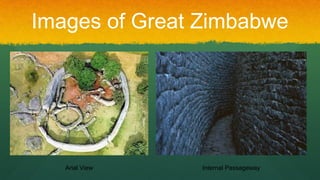
● Walls slope inward toward the top
● Provides support since no mortar was used
● Internal and external passageway are tightly bounded,
narrow, and long
Images of Great Zimbabwe
Arial View Internal Passageway
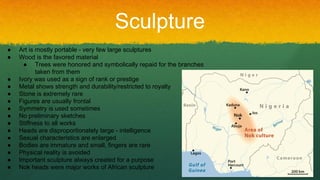
Sculpture
● Art is mostly portable - very few large sculptures
● Wood is the favored material
● Trees were honored and symbolically repaid for the branches
taken from them
● Ivory was used as a sign of rank or prestige
● Metal shows strength and durability/restricted to royalty
● Stone is extremely rare
● Figures are usually frontal
● Symmetry is used sometimes
● No preliminary sketches
● Stiffness to all works
● Heads are disproportionately large - intelligence
● Sexual characteristics are enlarged
● Bodies are immature and small, fingers are rare
● Physical reality is avoided
● Important sculpture always created for a purpose
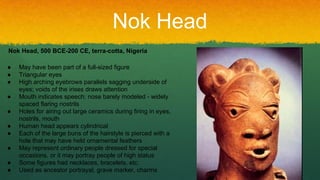
● Nok heads were major works of African sculpture
Nok Head
Nok Head, 500 BCE-200 CE, terra-cotta, Nigeria
● May have been part of a full-sized figure
● Triangular eyes
● High arching eyebrows parallels sagging underside of
eyes; voids of the irises draws attention
● Mouth indicates speech; nose barely modeled - widely
spaced flaring nostrils
● Holes for airing out large ceramics during firing in eyes,
nostrils, mouth
● Human head appears cylindrical
● Each of the large buns of the hairstyle is pierced with a
hole that may have held ornamental feathers
● May represent ordinary people dressed for special
occasions, or it may portray people of high status
● Some figures had necklaces, bracelets, etc.
● Used as ancestor portrayal, grave marker, charms
Contemporary Art
● Pioneered in 1950s and 1960s
● Colonial period & Years after World War II
● African artists trained in the
techniques of European art
● Most contemporary works have ties to
traditional African folklore, belief systems,
and imagery
● Use of new mediums such as oils and silk
screening
● Break from the traditional wooden
masks/sculptures, cloths, and body
painting
● Contemporary artists borrow from traditional
predecessors of the Western world
● Ex. Pablo Picasso
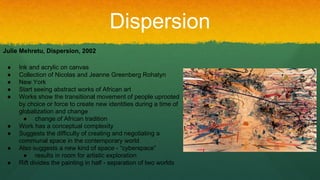
● Julie Mehretu
Julie Mehretu
RENEGADE DELIRIUM
2002
Dispersion
Julie Mehretu, Dispersion, 2002
● Ink and acrylic on canvas
● Collection of Nicolas and Jeanne Greenberg Rohatyn
● New York
● Start seeing abstract works of African art
● Works show the transitional movement of people uprooted
by choice or force to create new identities during a time of
globalization and change
● change of African tradition
● Work has a conceptual complexity
● Suggests the difficulty of creating and negotiating a
communal space in the contemporary world
● Also suggests a new kind of space - “cyberspace”
● results in room for artistic exploration
● Rift divides the painting in half - separation of two worlds
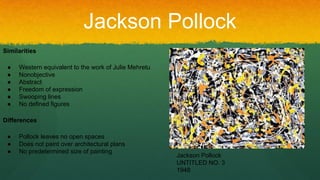
Jackson Pollock
Similarities
● Western equivalent to the work of Julie Mehretu
● Nonobjective
● Abstract
● Freedom of expression
● Swooping lines
● No defined figures
Differences
● Pollock leaves no open spaces
● Does not paint over architectural plans
● No predetermined size of painting
Jackson Pollock
UNTITLED NO. 3
1948
Textiles
● Made from cotton, animal fibers, grass fibers
● Woven cloth made on narrow and horizontal
looms
● Motifs and patterns of cloth produced by a
variety of techniques
● resist dyeing, tie dyeing, direct painting
on the fabric
● Cloth indicates status, personal, and group
identity
● Often worn to beautify, complement, and
enhance the body
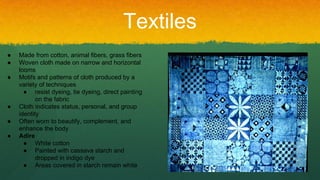
● Adire
● White cotton
● Painted with cassava starch and
dropped in indigo dye
● Areas covered in starch remain white
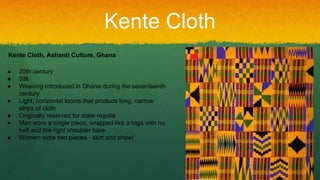
Kente Cloth
Kente Cloth, Ashanti Culture, Ghana
● 20th century
● Silk
● Weaving introduced in Ghana during the seventeenth
century
● Light, horizontal looms that produce long, narrow
strips of cloth
● Originally reserved for state regalia
● Man wore a single piece, wrapped like a toga with no
belt and the right shoulder bare
● Women wore two pieces - skirt and shawl
Masks
● Masks carved in wood and metal
● Costumed dancers don masks and assume the power of the
spirit it represents
● Role of the mask is never decorative, but functional and
spiritual
● Works have powers that are symbolically greater than their
visual representation
Mende Mask of Sierra Leone (Nowo), twentieth century, wood
● Female ancestor spirits
● High forehead = wisdom
● Used for initiation rites to adulthood
● Symbolic of the chrysalis of a butterfly
● Shiny black surface
● Small horizontal features
● Elaborate hairstyle decorated with combs
Glossary
1. Ciré perdue: the lost wax process; a bronze casting method in which a figure is modeled
in clay and covered with wax and then recovered with clay; when fired in a kiln, the wax
melts away, leaving a channel between the two layers of clay which can be used as a
mold for liquid metal
2. Fetish: an object believed to possess magical powers
3. Finials: knoblike architectural decorations usually found at the top point of a spire,
pinnacle, canopy, or gable; also found on furniture or the top of a staff
4. Jijora: the idea of floating between the concrete and the abstract; not too realistic
5. Kente: Ashanti woven textiles
6. Nowo: black masks worn by the Mende women to initiate young girls into adulthood
7. Scarification: scarring of the skin in patterns by cutting with a knife; when the cut heals,
a raised pattern is created, which is painted
8. Shaman: keeper of the power figure

African art powerpoint 1

  • 1.
    Ancient African Art(8000 BCE - 2000 CE) By: Kavita Sinha, Jason Seidman, and Phil Hochman
  • 2.
    Map of Africa ●2nd largest, most populated continent ● Includes 54 individual countries ● Mediterranean Sea to the north ● Suez Canal, Red Sea along the Sinai Peninsula to the northeast ● Indian Ocean to the east and southeast ● Atlantic Ocean to the west
  • 3.
    Key Ideas ● MuchAfrican art is created around spirituality, the spirit world, and the role of ancestors in our lives ● African artists prefer wood, but notable works are also done in ivory and metal ● African art is rarely decorative, but made for a purpose, often for ceremonies ● African architecture is predominantly made of mud-brick; stone is rare, but can be seen in Zimbabwe and in Ethiopian churches
  • 4.
    Issues Present inArt ● Family and Respect for Elders ● Believed both things were key components of life ● Many sculptures are representations of family ancestors ● sculptures carved to venerate their spirits ● Fertility of women and the land ● Highly regarded ● Spirits of the forest or those associated with natural phenomenon were respected and worshipped ● Sculptures of suckling mothers are extremely common
  • 5.
    Major Stylistic Periods CIVILIZATIONTIME PERIOD LOCATION Nok 500 BCE - 200 CE Nigeria Great Zimbabwe 11th - 15th centuries Zimbabwe Ife Culture 11th - 12th centuries Nigeria Aksum 1200 - 1527 Ethiopia Benin 13th - 19th centuries Nigeria Mende 19th - 20th centuries Sierra Leone Kongo 19th - 20th centuries Congo
  • 6.
    Historical Events ● 1000- 300 BCE Phoenicians and Greeks form settlements along the Mediterranean coast of North Africa to extend trade routes across the Sahara ● 600 - 700 CE Islamic Empire spread across North Africa and Islamic merchants often visited, spreading Islamic culture. Gold taken from West Africa helped Islamic culture flourish ● East Africa was part of maritime trade in the Indian Ocean. The language of Swahili developed from interactions (conflict) with Arabic-speaking merchants. Port cities such as Kilwa, Mombasa, and Mogadishu arose ● 1400 CE Europeans traveled down the Atlantic Ocean along the coast of Africa. They rediscovered the continent.
  • 7.
    Patronage and ArtisticLife ● African objects are unsigned and undated (tradition relies on oral records of history) ● Artists worked on commission ● lived with patrons until the commission was completed ● Apprenticeship training was the standard ● Artists had guilds that promoted their work and elevated their profession ● Men were builders and carvers and could wear masks ● Women painted walls and created ceramics ● In Sierra Leone and Liberia, women wore masks during coming-of-age ceremonies ● Both were weavers ● Most collectable art originated in farming communities - bronze and wood sculpture ● Nomadic people produced more body art ● Art imported into Europe during the Renaissance more as curiosities than artistic objects ● accepted into European artistic circles in the early twentieth century
  • 8.
    Architecture ● Built tobe cool and comfortable ● provide relief from the hot African weather ● Often built using mud-brick walls and thatched roofs ● Mud-brick was easy and inexpensive to make ● Had to be carefully maintained during rainy seasons ● Timbers were horizontally placed as maintenance ladders ● Usually avoided stonework in architecture and sculpture ● makes the royal complex at Zimbabwe unique
  • 9.
    Great Zimbabwe Great Zimbabwe,fourteenth century, Zimbabwe ● Prosperous trading center and royal complex ● Stone enclosure, probably a royal residence ● said to be the capital of the Queen of Sheba ● Constructed of granite slabs ● Oldest stone monument of the Sahara ● Built between 1100 and 1450 CE ● Walls 30 feet high ● Conical tower modeled on traditional shape of grain silos ● Control over food symbolized wealth and power ● Walls slope inward toward the top ● Provides support since no mortar was used ● Internal and external passageway are tightly bounded, narrow, and long
  • 10.
    Images of GreatZimbabwe Arial View Internal Passageway
  • 11.
    Sculpture ● Art ismostly portable - very few large sculptures ● Wood is the favored material ● Trees were honored and symbolically repaid for the branches taken from them ● Ivory was used as a sign of rank or prestige ● Metal shows strength and durability/restricted to royalty ● Stone is extremely rare ● Figures are usually frontal ● Symmetry is used sometimes ● No preliminary sketches ● Stiffness to all works ● Heads are disproportionately large - intelligence ● Sexual characteristics are enlarged ● Bodies are immature and small, fingers are rare ● Physical reality is avoided ● Important sculpture always created for a purpose ● Nok heads were major works of African sculpture
  • 12.
    Nok Head Nok Head,500 BCE-200 CE, terra-cotta, Nigeria ● May have been part of a full-sized figure ● Triangular eyes ● High arching eyebrows parallels sagging underside of eyes; voids of the irises draws attention ● Mouth indicates speech; nose barely modeled - widely spaced flaring nostrils ● Holes for airing out large ceramics during firing in eyes, nostrils, mouth ● Human head appears cylindrical ● Each of the large buns of the hairstyle is pierced with a hole that may have held ornamental feathers ● May represent ordinary people dressed for special occasions, or it may portray people of high status ● Some figures had necklaces, bracelets, etc. ● Used as ancestor portrayal, grave marker, charms
  • 13.
    Contemporary Art ● Pioneeredin 1950s and 1960s ● Colonial period & Years after World War II ● African artists trained in the techniques of European art ● Most contemporary works have ties to traditional African folklore, belief systems, and imagery ● Use of new mediums such as oils and silk screening ● Break from the traditional wooden masks/sculptures, cloths, and body painting ● Contemporary artists borrow from traditional predecessors of the Western world ● Ex. Pablo Picasso ● Julie Mehretu Julie Mehretu RENEGADE DELIRIUM 2002
  • 14.
    Dispersion Julie Mehretu, Dispersion,2002 ● Ink and acrylic on canvas ● Collection of Nicolas and Jeanne Greenberg Rohatyn ● New York ● Start seeing abstract works of African art ● Works show the transitional movement of people uprooted by choice or force to create new identities during a time of globalization and change ● change of African tradition ● Work has a conceptual complexity ● Suggests the difficulty of creating and negotiating a communal space in the contemporary world ● Also suggests a new kind of space - “cyberspace” ● results in room for artistic exploration ● Rift divides the painting in half - separation of two worlds
  • 15.
    Jackson Pollock Similarities ● Westernequivalent to the work of Julie Mehretu ● Nonobjective ● Abstract ● Freedom of expression ● Swooping lines ● No defined figures Differences ● Pollock leaves no open spaces ● Does not paint over architectural plans ● No predetermined size of painting Jackson Pollock UNTITLED NO. 3 1948
  • 16.
    Textiles ● Made fromcotton, animal fibers, grass fibers ● Woven cloth made on narrow and horizontal looms ● Motifs and patterns of cloth produced by a variety of techniques ● resist dyeing, tie dyeing, direct painting on the fabric ● Cloth indicates status, personal, and group identity ● Often worn to beautify, complement, and enhance the body ● Adire ● White cotton ● Painted with cassava starch and dropped in indigo dye ● Areas covered in starch remain white
  • 17.
    Kente Cloth Kente Cloth,Ashanti Culture, Ghana ● 20th century ● Silk ● Weaving introduced in Ghana during the seventeenth century ● Light, horizontal looms that produce long, narrow strips of cloth ● Originally reserved for state regalia ● Man wore a single piece, wrapped like a toga with no belt and the right shoulder bare ● Women wore two pieces - skirt and shawl
  • 18.
    Masks ● Masks carvedin wood and metal ● Costumed dancers don masks and assume the power of the spirit it represents ● Role of the mask is never decorative, but functional and spiritual ● Works have powers that are symbolically greater than their visual representation Mende Mask of Sierra Leone (Nowo), twentieth century, wood ● Female ancestor spirits ● High forehead = wisdom ● Used for initiation rites to adulthood ● Symbolic of the chrysalis of a butterfly ● Shiny black surface ● Small horizontal features ● Elaborate hairstyle decorated with combs
  • 19.
    Glossary 1. Ciré perdue:the lost wax process; a bronze casting method in which a figure is modeled in clay and covered with wax and then recovered with clay; when fired in a kiln, the wax melts away, leaving a channel between the two layers of clay which can be used as a mold for liquid metal 2. Fetish: an object believed to possess magical powers 3. Finials: knoblike architectural decorations usually found at the top point of a spire, pinnacle, canopy, or gable; also found on furniture or the top of a staff 4. Jijora: the idea of floating between the concrete and the abstract; not too realistic 5. Kente: Ashanti woven textiles 6. Nowo: black masks worn by the Mende women to initiate young girls into adulthood 7. Scarification: scarring of the skin in patterns by cutting with a knife; when the cut heals, a raised pattern is created, which is painted 8. Shaman: keeper of the power figure