PALEOBIOGEOGRAPHICAL PROVINCES
Name :- Darji Darshan. R
Geologypaperno: 404
RollNo: 03
Supervision: Dr. N. Y. Bhatt
M. G. Science institute
(geology department)
Navrangpura, Ahmedabad, Gujarat 380009
CONTENT
 What is paleobiogeography ?
 Type of palaeobiogeography
 Vertebrate life
 Invertebrate life
 plant life
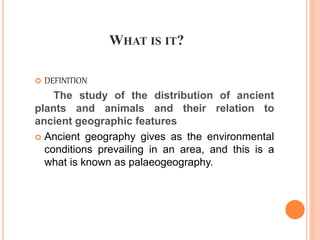
WHAT IS IT?
 DEFINITION
The study of the distribution of ancient
plants and animals and their relation to
ancient geographic features
 Ancient geography gives as the environmental
conditions prevailing in an area, and this is a
what is known as palaeogeography.
Continue…
 Environmental conditions Did not remain constant
throughout the earth history
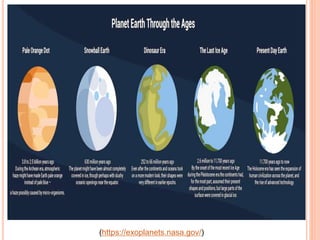
 Earth’s climate has changed throughout history.
Just in the last 605000 years there have been
seven cycles of glacial advance and Retreat,with
the abrupt end of the last ice age about 11700
years ago making the beginning of the modern
climate Era-and of human civilization.
(https://exoplanets.nasa.gov/)
TYPE OF PALAEOGEOGRAPHY
 Geographically instances considering The three
major life division
1. Vertebrate life
2. Invertebrate life
3. Plants life
VERTEBRATE LIFE
 Vertebrates give us the best illustrations.
 The earliest vertebrates resembled hagfish and
lived more than 500 million years ago. As other
classes of fish appeared, they evolved traits such
as a complete vertebral column, jaws, and a
bony endoskeleton. Amphibians were the first
tetrapod vertebrates as well as the first vertebrates
to live on land.
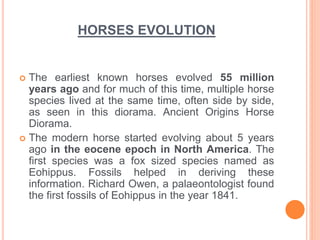
HORSES EVOLUTION
 The earliest known horses evolved 55 million
years ago and for much of this time, multiple horse
species lived at the same time, often side by side,
as seen in this diorama. Ancient Origins Horse
Diorama.
 The modern horse started evolving about 5 years
ago in the eocene epoch in North America. The
first species was a fox sized species named as
Eohippus. Fossils helped in deriving these
information. Richard Owen, a palaeontologist found
the first fossils of Eohippus in the year 1841.
VERTEBRATE LIFE
https://www.tes.com/teaching-resource/
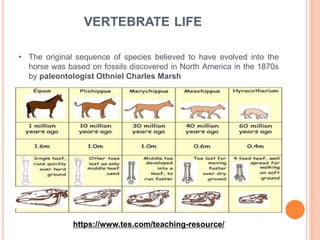
• The original sequence of species believed to have evolved into the
horse was based on fossils discovered in North America in the 1870s
by paleontologist Othniel Charles Marsh
https://www.britannica.com/
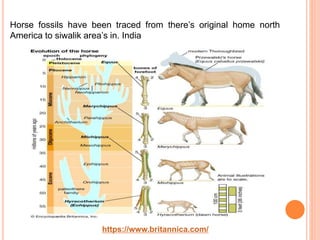
Horse fossils have been traced from there’s original home north
America to siwalik area’s in. India
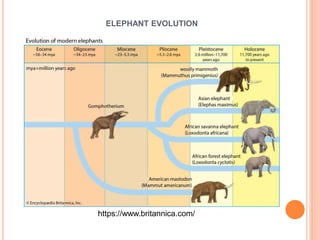
ELEPHANT EVOLUTION
 56 million years ago, elephant species originated
in Africa and remained there for the next 33 million
years. 20 million years ago, elephant ancestors
spread across land bridges from Africa to Europe to
Asia. ... Today, only three species remain in Asia
and Africa. Many of them lived—and died—in
Nebraska.
https://www.britannica.com/
ELEPHANT EVOLUTION
INVERTEBRATE LIFE
 It was the first step in the evolution of organs and organ
systems. At first, invertebrates developed tissues from just
two embryonic cell layers. There was an outer cell layer
called ectoderm and an inner cell layer called endoderm. The
two cell layers allowed different types of tissues to form.
 Jean-Baptiste Lamarck, was first discovered invertebrates.
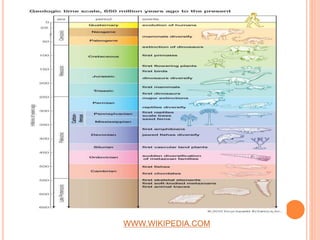
 About 3.5 billion years ago, the first microscopic
organisms appeared in the ocean. The first
invertebrates developed in the oceans. They were
soft-bodied animals with a shell or carapace, such
as these trilobites. Fish, like the agnathans,
appeared
 The Ordovician and Cambrian Periods are referred to
as the "age of invertebrates", with trilobites abundant. In
this period, brachiopods became more abundant that
the trilobites, but all but one species of them are extinct
today.
 After the Cambrian Period came the 45-million-year
Ordovician Period, which is marked in the fossil record
by an abundance of marine invertebrates. Perhaps the
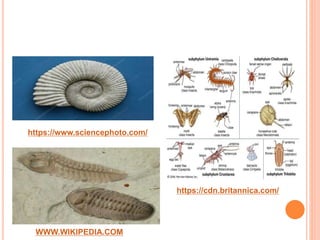
most famous of these invertebrates was the trilobite, an
armored arthropod that scuttled around the seafloor for
about 270 million years before going extinct
 In Gujarat Kachchh area provide various type of fossil .
https://www.sciencephoto.com/
WWW.WIKIPEDIA.COM
https://cdn.britannica.com/
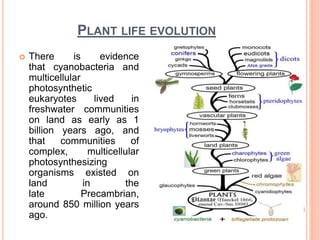
PLANT LIFE EVOLUTION
 There is evidence
that cyanobacteria and
multicellular
photosynthetic
eukaryotes lived in
freshwater communities
on land as early as 1
billion years ago, and
that communities of
complex, multicellular
photosynthesizing
organisms existed on
land in the
late Precambrian,
around 850 million years
ago.
PLANT LIFE EVOLUTION
 Plant Evaluation. Process of observing plants based on
characteristics related to general health, physiology and
reproduction. Chlorophyla. Chemical unique to the
chloroplasts inside plant cell, giving them their green color.
 New data and analysis show that plant life began colonising
land 500 million years ago, during the Cambrian Period,
around the same time as the emergence of the first land
animals. These studies are also improving our understanding
of how the plant family first evolved.
 Plants evolved from living in water to habiting land because
of genes they took up from bacteria, according to a new
study which establishes how the first step of large organisms
colonising the land took place.
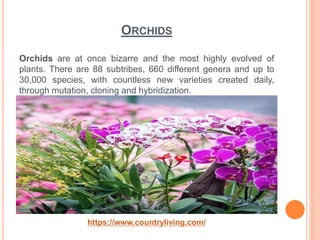
ORCHIDS
https://www.countryliving.com/
Orchids are at once bizarre and the most highly evolved of
plants. There are 88 subtribes, 660 different genera and up to
30,000 species, with countless new varieties created daily,
through mutation, cloning and hybridization.
WWW.WIKIPEDIA.COM
REFERENCE
 WWW.WIKIPEDIA.COM
 https://seaworld.org/
 https://quizlet.com/
 https://flexbooks.ck12.org/
 MSC SEM-1 PALAEOBIOGEOGRAPHY NOTE’S
Palaeobiogeographical  provinces

Palaeobiogeographical provinces

  • 1.
    PALEOBIOGEOGRAPHICAL PROVINCES Name :-Darji Darshan. R Geologypaperno: 404 RollNo: 03 Supervision: Dr. N. Y. Bhatt M. G. Science institute (geology department) Navrangpura, Ahmedabad, Gujarat 380009
  • 2.
    CONTENT  What ispaleobiogeography ?  Type of palaeobiogeography  Vertebrate life  Invertebrate life  plant life
  • 3.
    WHAT IS IT? DEFINITION The study of the distribution of ancient plants and animals and their relation to ancient geographic features  Ancient geography gives as the environmental conditions prevailing in an area, and this is a what is known as palaeogeography.
  • 4.
    Continue…  Environmental conditionsDid not remain constant throughout the earth history  Earth’s climate has changed throughout history. Just in the last 605000 years there have been seven cycles of glacial advance and Retreat,with the abrupt end of the last ice age about 11700 years ago making the beginning of the modern climate Era-and of human civilization.
  • 5.
  • 6.
    TYPE OF PALAEOGEOGRAPHY Geographically instances considering The three major life division 1. Vertebrate life 2. Invertebrate life 3. Plants life
  • 7.
    VERTEBRATE LIFE  Vertebratesgive us the best illustrations.  The earliest vertebrates resembled hagfish and lived more than 500 million years ago. As other classes of fish appeared, they evolved traits such as a complete vertebral column, jaws, and a bony endoskeleton. Amphibians were the first tetrapod vertebrates as well as the first vertebrates to live on land.
  • 8.
    HORSES EVOLUTION  Theearliest known horses evolved 55 million years ago and for much of this time, multiple horse species lived at the same time, often side by side, as seen in this diorama. Ancient Origins Horse Diorama.  The modern horse started evolving about 5 years ago in the eocene epoch in North America. The first species was a fox sized species named as Eohippus. Fossils helped in deriving these information. Richard Owen, a palaeontologist found the first fossils of Eohippus in the year 1841.
  • 9.
    VERTEBRATE LIFE https://www.tes.com/teaching-resource/ • Theoriginal sequence of species believed to have evolved into the horse was based on fossils discovered in North America in the 1870s by paleontologist Othniel Charles Marsh
  • 10.
    https://www.britannica.com/ Horse fossils havebeen traced from there’s original home north America to siwalik area’s in. India
  • 11.
    ELEPHANT EVOLUTION  56million years ago, elephant species originated in Africa and remained there for the next 33 million years. 20 million years ago, elephant ancestors spread across land bridges from Africa to Europe to Asia. ... Today, only three species remain in Asia and Africa. Many of them lived—and died—in Nebraska.
  • 12.
  • 13.
    INVERTEBRATE LIFE  Itwas the first step in the evolution of organs and organ systems. At first, invertebrates developed tissues from just two embryonic cell layers. There was an outer cell layer called ectoderm and an inner cell layer called endoderm. The two cell layers allowed different types of tissues to form.  Jean-Baptiste Lamarck, was first discovered invertebrates.  About 3.5 billion years ago, the first microscopic organisms appeared in the ocean. The first invertebrates developed in the oceans. They were soft-bodied animals with a shell or carapace, such as these trilobites. Fish, like the agnathans, appeared
  • 14.
     The Ordovicianand Cambrian Periods are referred to as the "age of invertebrates", with trilobites abundant. In this period, brachiopods became more abundant that the trilobites, but all but one species of them are extinct today.  After the Cambrian Period came the 45-million-year Ordovician Period, which is marked in the fossil record by an abundance of marine invertebrates. Perhaps the most famous of these invertebrates was the trilobite, an armored arthropod that scuttled around the seafloor for about 270 million years before going extinct  In Gujarat Kachchh area provide various type of fossil .
  • 15.
  • 16.
    PLANT LIFE EVOLUTION There is evidence that cyanobacteria and multicellular photosynthetic eukaryotes lived in freshwater communities on land as early as 1 billion years ago, and that communities of complex, multicellular photosynthesizing organisms existed on land in the late Precambrian, around 850 million years ago.
  • 17.
    PLANT LIFE EVOLUTION Plant Evaluation. Process of observing plants based on characteristics related to general health, physiology and reproduction. Chlorophyla. Chemical unique to the chloroplasts inside plant cell, giving them their green color.  New data and analysis show that plant life began colonising land 500 million years ago, during the Cambrian Period, around the same time as the emergence of the first land animals. These studies are also improving our understanding of how the plant family first evolved.  Plants evolved from living in water to habiting land because of genes they took up from bacteria, according to a new study which establishes how the first step of large organisms colonising the land took place.
  • 18.
    ORCHIDS https://www.countryliving.com/ Orchids are atonce bizarre and the most highly evolved of plants. There are 88 subtribes, 660 different genera and up to 30,000 species, with countless new varieties created daily, through mutation, cloning and hybridization.
  • 19.
  • 20.
    REFERENCE  WWW.WIKIPEDIA.COM  https://seaworld.org/ https://quizlet.com/  https://flexbooks.ck12.org/  MSC SEM-1 PALAEOBIOGEOGRAPHY NOTE’S