Paired t-Test
A Statistical Method for Comparing
Two Related Samples
Introduction
• The paired t-test is a statistical method used to
compare the means of two related groups.
• It is useful when the same subjects are
measured before and after a treatment.
When to Use a Paired t-Test
• • When data is collected from the same
subjects at two different time points.
• • When measuring a characteristic before and
after an intervention.
• • When using matched pairs, such as twins or
related individuals.
Assumptions
• • The data is continuous.
• • The samples are dependent (paired).
• • The differences between paired
observations are normally distributed.
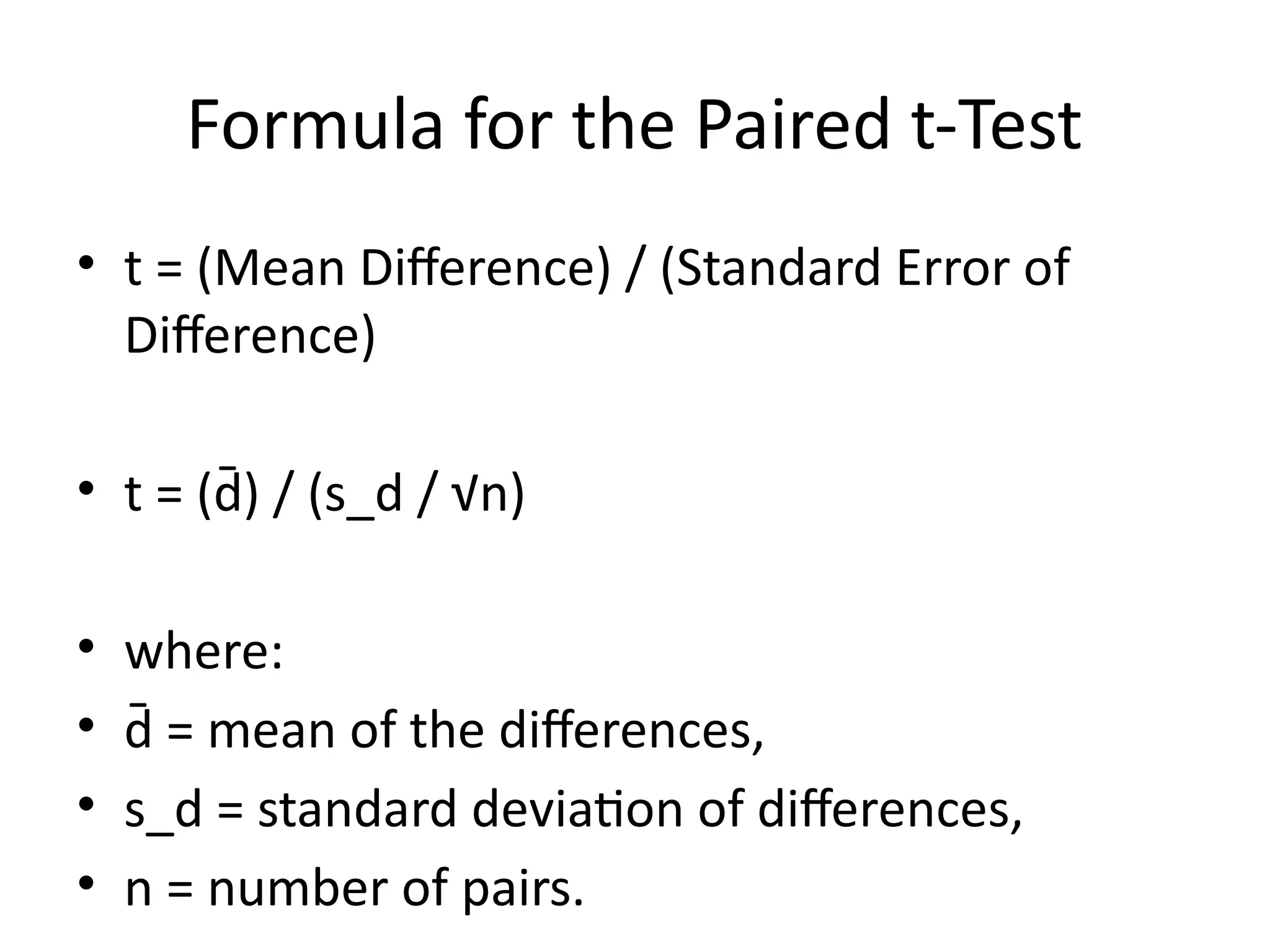
Formula for the Paired t-Test
• t = (Mean Difference) / (Standard Error of
Difference)
• t = (d̄) / (s_d / √n)
• where:
• d̄ = mean of the differences,
• s_d = standard deviation of differences,
• n = number of pairs.
Example Calculation
• Example: A group of students takes a test
before and after a training session.
• Their scores are compared using a paired t-
test.
• Steps:
• 1. Compute the differences.
• 2. Find the mean and standard deviation of
differences.
Interpreting the Results
• • If p-value < 0.05, reject the null hypothesis
(significant difference).
• • If p-value ≥ 0.05, fail to reject the null
hypothesis (no significant difference).
• • Consider confidence intervals to interpret
results further.
Paired_t_Test_PresentationNNNNNNNNN.pptx

  • 1.
    Paired t-Test A StatisticalMethod for Comparing Two Related Samples
  • 2.
    Introduction • The pairedt-test is a statistical method used to compare the means of two related groups. • It is useful when the same subjects are measured before and after a treatment.
  • 3.
    When to Usea Paired t-Test • • When data is collected from the same subjects at two different time points. • • When measuring a characteristic before and after an intervention. • • When using matched pairs, such as twins or related individuals.
  • 4.
    Assumptions • • Thedata is continuous. • • The samples are dependent (paired). • • The differences between paired observations are normally distributed.
  • 5.
    Formula for thePaired t-Test • t = (Mean Difference) / (Standard Error of Difference) • t = (d̄) / (s_d / √n) • where: • d̄ = mean of the differences, • s_d = standard deviation of differences, • n = number of pairs.
  • 6.
    Example Calculation • Example:A group of students takes a test before and after a training session. • Their scores are compared using a paired t- test. • Steps: • 1. Compute the differences. • 2. Find the mean and standard deviation of differences.
  • 7.
    Interpreting the Results •• If p-value < 0.05, reject the null hypothesis (significant difference). • • If p-value ≥ 0.05, fail to reject the null hypothesis (no significant difference). • • Consider confidence intervals to interpret results further.