Paints are used to protect metals, timber, or plastered
surfaces from the corrosive effects of weather, heat,
moisture or gases etc and to improve their appearance.
COMPOSITION OF PAINTS
Fundamental components of an oil-based paint are
A) BODY/bases
• Forming the main body of a paint
• Make the paint film harder and
more resistant to abrasion
• Reduce shrinkage cracks on drying
In white paint ; body is also the pigment
Commonly used bases are White lead,
Zinc oxide, Iron oxide, Metallic
powder such as Al, Cu, Br
Paints more often named after the base
as Lead paint, Zinc paint, and
Aluminum paint
B) VEHICLE
• Oily liquid in which the body and
pigment are soluble
• Facilitates the paint to be conveniently
spread over the surface
• Oil most commonly used as vehicle are
Linseed oil, Soya bean oil, Fish oil,
dehydrated castor oil
C) PIGMENT
Pigments are materials which gives the paint
its color
In white paint the body is the pigment
Natural pigments (natural iron oxides,
chrome oxides)
Synthetic pigments (phthalocynines ► coal
tar derivatives)
D) THINNER
Liquid thinner is added in the paint to
• Increase fluidity
• Making paint more smooth
• Help penetration of porous surfaces
Common thinner ► turpentine (made by
distilling gum from a number of pine
trees)
E) DRYERS
• Added to quicken the drying of vehicle
• Organic salts of Iron, zinc, lead,
manganese, Ca
to accelerate the oxidation and hardening of
vehicle
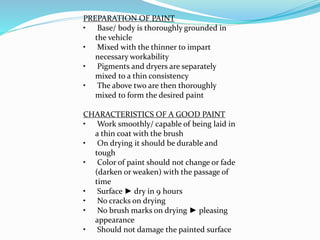
PREPARATION OF PAINT
• Base/ body is thoroughly grounded in
the vehicle
• Mixed with the thinner to impart
necessary workability
• Pigments and dryers are separately
mixed to a thin consistency
• The above two are then thoroughly
mixed to form the desired paint
CHARACTERISTICS OF A GOOD PAINT
• Work smoothly/ capable of being laid in
a thin coat with the brush
• On drying it should be durable and
tough
• Color of paint should not change or fade
(darken or weaken) with the passage of
time
• Surface ► dry in 9 hours
• No cracks on drying
• No brush marks on drying ► pleasing
appearance
• Should not damage the painted surface
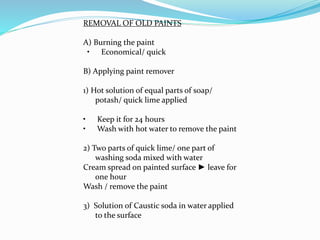
REMOVAL OF OLD PAINTS
A) Burning the paint
• Economical/ quick
B) Applying paint remover
1) Hot solution of equal parts of soap/
potash/ quick lime applied
• Keep it for 24 hours
• Wash with hot water to remove the paint
2) Two parts of quick lime/ one part of
washing soda mixed with water
Cream spread on painted surface ► leave for
one hour
Wash / remove the paint
3) Solution of Caustic soda in water applied
to the surface

Paints

  • 1.
    Paints are usedto protect metals, timber, or plastered surfaces from the corrosive effects of weather, heat, moisture or gases etc and to improve their appearance. COMPOSITION OF PAINTS Fundamental components of an oil-based paint are
  • 2.
    A) BODY/bases • Formingthe main body of a paint • Make the paint film harder and more resistant to abrasion • Reduce shrinkage cracks on drying In white paint ; body is also the pigment Commonly used bases are White lead, Zinc oxide, Iron oxide, Metallic powder such as Al, Cu, Br Paints more often named after the base as Lead paint, Zinc paint, and Aluminum paint
  • 3.
    B) VEHICLE • Oilyliquid in which the body and pigment are soluble • Facilitates the paint to be conveniently spread over the surface • Oil most commonly used as vehicle are Linseed oil, Soya bean oil, Fish oil, dehydrated castor oil C) PIGMENT Pigments are materials which gives the paint its color In white paint the body is the pigment Natural pigments (natural iron oxides, chrome oxides) Synthetic pigments (phthalocynines ► coal tar derivatives)
  • 4.
    D) THINNER Liquid thinneris added in the paint to • Increase fluidity • Making paint more smooth • Help penetration of porous surfaces Common thinner ► turpentine (made by distilling gum from a number of pine trees) E) DRYERS • Added to quicken the drying of vehicle • Organic salts of Iron, zinc, lead, manganese, Ca to accelerate the oxidation and hardening of vehicle
  • 5.
    PREPARATION OF PAINT •Base/ body is thoroughly grounded in the vehicle • Mixed with the thinner to impart necessary workability • Pigments and dryers are separately mixed to a thin consistency • The above two are then thoroughly mixed to form the desired paint CHARACTERISTICS OF A GOOD PAINT • Work smoothly/ capable of being laid in a thin coat with the brush • On drying it should be durable and tough • Color of paint should not change or fade (darken or weaken) with the passage of time • Surface ► dry in 9 hours • No cracks on drying • No brush marks on drying ► pleasing appearance • Should not damage the painted surface
  • 6.
    REMOVAL OF OLDPAINTS A) Burning the paint • Economical/ quick B) Applying paint remover 1) Hot solution of equal parts of soap/ potash/ quick lime applied • Keep it for 24 hours • Wash with hot water to remove the paint 2) Two parts of quick lime/ one part of washing soda mixed with water Cream spread on painted surface ► leave for one hour Wash / remove the paint 3) Solution of Caustic soda in water applied to the surface