I
NAME: SANGEEN KHAN
CLASS NO: 138
SECTION: E
TOPIC: BARRIERS IN
COMMUNICATION
SUBMITTED TO: GUL
ANDAM
MAM
SUBJECT: COMMUNICATION
AND PRESENTATION SKILLS
SEMESTER: 1ST (FALL)
II
SESSION: 2016-2020
III
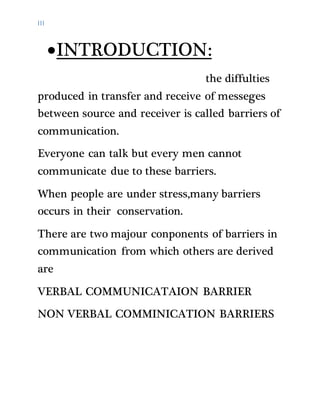
INTRODUCTION:
the diffulties
produced in transfer and receive of messeges
between source and receiver is called barriers of
communication.
Everyone can talk but every men cannot
communicate due to these barriers.
When people are under stress,many barriers
occurs in their conservation.
There are two majour conponents of barriers in
communication from which others are derived
are
VERBAL COMMUNICATAION BARRIER
NON VERBAL COMMINICATION BARRIERS
IV
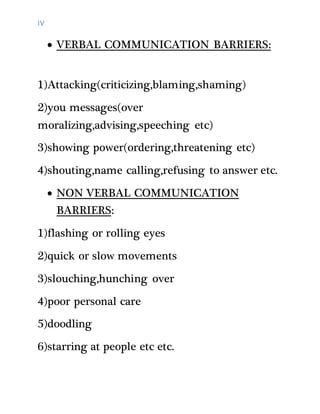
 VERBAL COMMUNICATION BARRIERS:
1)Attacking(criticizing,blaming,shaming)
2)you messages(over
moralizing,advising,speeching etc)
3)showing power(ordering,threatening etc)
4)shouting,name calling,refusing to answer etc.
 NON VERBAL COMMUNICATION
BARRIERS:
1)flashing or rolling eyes
2)quick or slow movements
3)slouching,hunching over
4)poor personal care
5)doodling
6)starring at people etc etc.
V
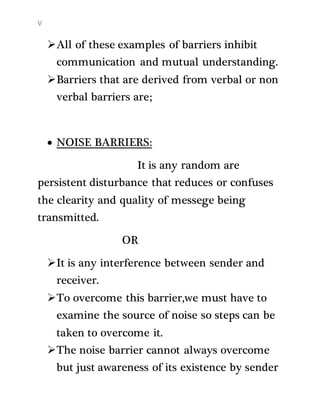
All of these examples of barriers inhibit
communication and mutual understanding.
Barriers that are derived from verbal or non
verbal barriers are;
 NOISE BARRIERS:
It is any random are
persistent disturbance that reduces or confuses
the clearity and quality of messege being
transmitted.
OR
It is any interference between sender and
receiver.
To overcome this barrier,we must have to
examine the source of noise so steps can be
taken to overcome it.
The noise barrier cannot always overcome
but just awareness of its existence by sender
VI
or receiver of messege can help to improve
the communication flow.
 FEEDBACK PROBLEM:
Feedback is reaction of reciver without which
sender cannot cannot know whether reciver
has recived the messege or not.
In face to face communication,this barrier
cannot occur brcause everything happens almost
simultaneously
Feedback not only regulates the communication
but stimuli it and actually act as hallmark of a
dialogue.
When there are feedback problems,no dialogue
is possible and communication will be one way
communication.
 MEDIA SELECTION PROBLEM:
VII
Media is the
channel through which communication flows
from sender to receiver.
For best communication,one thing should be
expressed in many forms and shapes(media).
Any project to develop one best medium of
communication will rather fruitless as
compared to the project which is expressed in
many ways of communication.
VIII
 THE MENTAL BARRIER:
It is one of principles barriers
in effective communication.It consist of noise in
mind of sender or reciver.Here are its 4 types.
1)ARROGANCE OF SENDER:
If sender belives that he
knows everything about which he speaks and
receiver disagree with sender,the sender will then
not accept the feedback and effective
communication is not possible.
2)SENDER ASSUMPTION ABOUT LOGICAL
FEEDBACK:
The priorities,problems or assumptions of receiver
may differ than the sender,the sender will judge the
receiver as incompetent and communication fails.
3)SENDER ASSUMES HIMSELF LOGICAL:
When
sender consider that he is completely logical and
IX
correct and his position must prevail,then
communication fails.
4)SELF INTRESTS OF SENDER:
If sender have strong
emotions and self interests then these traits may be
evident to receiver and he will think singer as
hypocritical and communications will fails.
 PROBLEM IN WORD SELECTION:
In verbal
environment,proper selection of words is very
important for good communication otherwise
communications fails.
Dr Rudolph Flesch gived ways to decrease the
word problems in communication.these are,
Use familier words in place of unfamiliar words.
Use concrete words in place of abstract words.
Use short words in place of long words.
Use single words in place of multiple words.
X
XI
XII

Barriers to communication

  • 1.
    I NAME: SANGEEN KHAN CLASSNO: 138 SECTION: E TOPIC: BARRIERS IN COMMUNICATION SUBMITTED TO: GUL ANDAM MAM SUBJECT: COMMUNICATION AND PRESENTATION SKILLS SEMESTER: 1ST (FALL)
  • 2.
  • 3.
    III INTRODUCTION: the diffulties produced intransfer and receive of messeges between source and receiver is called barriers of communication. Everyone can talk but every men cannot communicate due to these barriers. When people are under stress,many barriers occurs in their conservation. There are two majour conponents of barriers in communication from which others are derived are VERBAL COMMUNICATAION BARRIER NON VERBAL COMMINICATION BARRIERS
  • 4.
    IV  VERBAL COMMUNICATIONBARRIERS: 1)Attacking(criticizing,blaming,shaming) 2)you messages(over moralizing,advising,speeching etc) 3)showing power(ordering,threatening etc) 4)shouting,name calling,refusing to answer etc.  NON VERBAL COMMUNICATION BARRIERS: 1)flashing or rolling eyes 2)quick or slow movements 3)slouching,hunching over 4)poor personal care 5)doodling 6)starring at people etc etc.
  • 5.
    V All of theseexamples of barriers inhibit communication and mutual understanding. Barriers that are derived from verbal or non verbal barriers are;  NOISE BARRIERS: It is any random are persistent disturbance that reduces or confuses the clearity and quality of messege being transmitted. OR It is any interference between sender and receiver. To overcome this barrier,we must have to examine the source of noise so steps can be taken to overcome it. The noise barrier cannot always overcome but just awareness of its existence by sender
  • 6.
    VI or receiver ofmessege can help to improve the communication flow.  FEEDBACK PROBLEM: Feedback is reaction of reciver without which sender cannot cannot know whether reciver has recived the messege or not. In face to face communication,this barrier cannot occur brcause everything happens almost simultaneously Feedback not only regulates the communication but stimuli it and actually act as hallmark of a dialogue. When there are feedback problems,no dialogue is possible and communication will be one way communication.  MEDIA SELECTION PROBLEM:
  • 7.
    VII Media is the channelthrough which communication flows from sender to receiver. For best communication,one thing should be expressed in many forms and shapes(media). Any project to develop one best medium of communication will rather fruitless as compared to the project which is expressed in many ways of communication.
  • 8.
    VIII  THE MENTALBARRIER: It is one of principles barriers in effective communication.It consist of noise in mind of sender or reciver.Here are its 4 types. 1)ARROGANCE OF SENDER: If sender belives that he knows everything about which he speaks and receiver disagree with sender,the sender will then not accept the feedback and effective communication is not possible. 2)SENDER ASSUMPTION ABOUT LOGICAL FEEDBACK: The priorities,problems or assumptions of receiver may differ than the sender,the sender will judge the receiver as incompetent and communication fails. 3)SENDER ASSUMES HIMSELF LOGICAL: When sender consider that he is completely logical and
  • 9.
    IX correct and hisposition must prevail,then communication fails. 4)SELF INTRESTS OF SENDER: If sender have strong emotions and self interests then these traits may be evident to receiver and he will think singer as hypocritical and communications will fails.  PROBLEM IN WORD SELECTION: In verbal environment,proper selection of words is very important for good communication otherwise communications fails. Dr Rudolph Flesch gived ways to decrease the word problems in communication.these are, Use familier words in place of unfamiliar words. Use concrete words in place of abstract words. Use short words in place of long words. Use single words in place of multiple words.
  • 10.
  • 11.
  • 12.