The Institute of Science
Topic : Paints
Presented by : Shweta Prakash Rahate
M.Sc. Part II Sem IV
Contents
Paints
Purpose
Basic Components
Manufacturing
Requirements of good paint
Paints
Paint is essentially a coating or covering material
applied on a metallic surface.
Paint is a liquid solution that after application to a
substrate converts to a solid film.
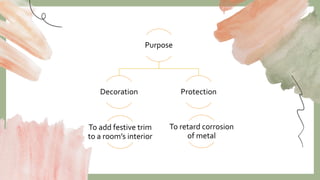
To retard corrosion
of metal
Purpose
Decoration Protection
To add festive trim
to a room’s interior
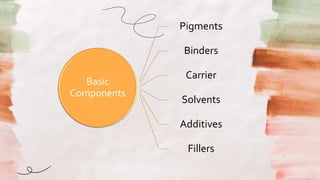
Basic
Components
Pigments
Binders
Carrier
Solvents
Additives
Fillers
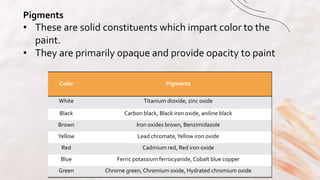
Pigments
• These are solid constituents which impart color to the
paint.
• They are primarily opaque and provide opacity to paint
Color Pigments
White Titanium dioxide, zinc oxide
Black Carbon black, Black iron oxide, aniline black
Brown Iron oxides brown, Benzimidazole
Yellow Lead chromate,Yellow iron oxide
Red Cadmium red, Red iron oxide
Blue Ferric potassium ferrocyanide, Cobalt blue copper
Green Chrome green, Chromium oxide, Hydrated chromium oxide
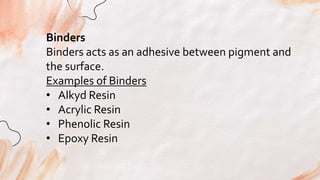
Binders
Binders acts as an adhesive between pigment and
the surface.
Examples of Binders
• Alkyd Resin
• Acrylic Resin
• Phenolic Resin
• Epoxy Resin
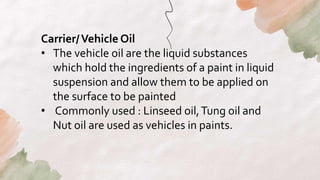
Carrier/Vehicle Oil
• The vehicle oil are the liquid substances
which hold the ingredients of a paint in liquid
suspension and allow them to be applied on
the surface to be painted
• Commonly used : Linseed oil,Tung oil and
Nut oil are used as vehicles in paints.
Solvent (Thinner)
It is used to reduce the viscosity of the paint for better
application. It is volatile and does not become part of
the paint film.
Most common solvent is Spirit ofTurpentine.
Additives
Additives are small amount of substance that
enhances the effectiveness of paint.
• Driers
It accelerates the paint drying by catalyzing the
oxidation of binder.
Eg: Manganese oxide, Manganese acetate, cobalt
tungstate etc.
• Plasticizers
It increases the paint fluidity.
Filler/Extender
• Fillers are a special type of pigment that
serve to thicken the film, support its
structure and simply increase the volume
of the paint
• Fillers are usually comprised of cheap and
inert materials.
Eg: China clay, talc, asbestos, barium
sulphate etc.
Types of Paints
•Oil Paint
•Emulsion Paint
•Enamel Paint
•Bituminous Paint
•Aluminum Paint
•Anti-corrosive Paint
Oil Paints
• Oil Paint stand for a rich finish, water-resistant properties and long
lasting abilites.
• Use in non-humid areas since drying time takes longer than 24 hours.
• Use on metals, walls, doors, windows and stained surfaces for
durability.
Emulsion Paints
• These are water based paints with fast drying characteristics.
• Emulsion painted walls are easy to clean.
• Easy to apply on exterior walls and interior walls too.
Enamel Paint
• Enamel Paint renders high durability, strong adhesion, provide
glossy finish and are water and stain resistant.
• Perfect for humid and wet spaces like bathrooms and kitchen
metals.
• Offers good coverage, hardness and color retention.
Bituminous Paint
• It is a black, tar-like paint ideal for exteriors such as ladders,
shafts, and other iron work.
• Helps in providing rust resistance for metal application.
Aluminum Paint
• It is resistant to electricity, weather, corrosion and is waterproof.
• Aluminum paints give a silvery finish and are strong and durable
paints due to the resin in it.
• Used for hot water tanks, hot pipes, oil storage tanks etc.
• Used for metals and woods too.
Anti-Corrosive Paint
• It is made from elements like linseed oil, zinc chrome and fine
sand.
• Mainly used for pipes, external structures and metallic work.
• It is cost-effective, black in colour and a strong, long-lasting
choice.
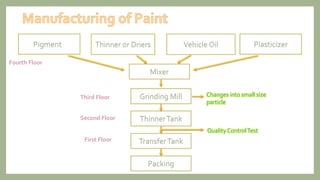
Pigment Thinner or Driers Vehicle Oil Plasticizer
Mixer
ThinnerTank
Grinding Mill
TransferTank
Packing
Changes into small size
particle
Quality ControlTest
Third Floor
Fourth Floor
Second Floor
First Floor
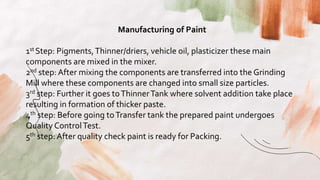
Manufacturing of Paint
1st Step: Pigments,Thinner/driers, vehicle oil, plasticizer these main
components are mixed in the mixer.
2nd step: After mixing the components are transferred into the Grinding
Mill where these components are changed into small size particles.
3rd step: Further it goes toThinnerTank where solvent addition take place
resulting in formation of thicker paste.
4th step: Before going toTransfer tank the prepared paint undergoes
Quality ControlTest.
5th step: After quality check paint is ready for Packing.
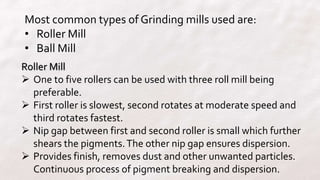
Most common types of Grinding mills used are:
• Roller Mill
• Ball Mill
Roller Mill
 One to five rollers can be used with three roll mill being
preferable.
 First roller is slowest, second rotates at moderate speed and
third rotates fastest.
 Nip gap between first and second roller is small which further
shears the pigments.The other nip gap ensures dispersion.
 Provides finish, removes dust and other unwanted particles.
Continuous process of pigment breaking and dispersion.
Ball Mill
 Has a steel cylinder and filled with 1/3 of its
volume with steel balls which are responsible
for the grinding action.
 Up to 40% volume should be of pigments, no
solvent loss, low maintenance, easy handling.
Requirement of Good Paint:
• The pigment which is used in paint should be
opaque.
• It should have good covering power.
• It should be chemically inert.
• It should have good hiding power.
• It should be weather resistant.
• It should have good washability.
• It should have anti corrosive property.
References:
 MJD Chemistry
 SlideShare.net
 Learnpick.in
 Edurev.in
 Unacademy
ThankYou

Paints.pptx

  • 1.
    The Institute ofScience Topic : Paints Presented by : Shweta Prakash Rahate M.Sc. Part II Sem IV
  • 2.
  • 3.
    Paints Paint is essentiallya coating or covering material applied on a metallic surface. Paint is a liquid solution that after application to a substrate converts to a solid film.
  • 4.
    To retard corrosion ofmetal Purpose Decoration Protection To add festive trim to a room’s interior
  • 5.
  • 6.
    Pigments • These aresolid constituents which impart color to the paint. • They are primarily opaque and provide opacity to paint Color Pigments White Titanium dioxide, zinc oxide Black Carbon black, Black iron oxide, aniline black Brown Iron oxides brown, Benzimidazole Yellow Lead chromate,Yellow iron oxide Red Cadmium red, Red iron oxide Blue Ferric potassium ferrocyanide, Cobalt blue copper Green Chrome green, Chromium oxide, Hydrated chromium oxide
  • 7.
    Binders Binders acts asan adhesive between pigment and the surface. Examples of Binders • Alkyd Resin • Acrylic Resin • Phenolic Resin • Epoxy Resin
  • 8.
    Carrier/Vehicle Oil • Thevehicle oil are the liquid substances which hold the ingredients of a paint in liquid suspension and allow them to be applied on the surface to be painted • Commonly used : Linseed oil,Tung oil and Nut oil are used as vehicles in paints.
  • 9.
    Solvent (Thinner) It isused to reduce the viscosity of the paint for better application. It is volatile and does not become part of the paint film. Most common solvent is Spirit ofTurpentine.
  • 10.
    Additives Additives are smallamount of substance that enhances the effectiveness of paint. • Driers It accelerates the paint drying by catalyzing the oxidation of binder. Eg: Manganese oxide, Manganese acetate, cobalt tungstate etc. • Plasticizers It increases the paint fluidity.
  • 11.
    Filler/Extender • Fillers area special type of pigment that serve to thicken the film, support its structure and simply increase the volume of the paint • Fillers are usually comprised of cheap and inert materials. Eg: China clay, talc, asbestos, barium sulphate etc.
  • 12.
    Types of Paints •OilPaint •Emulsion Paint •Enamel Paint •Bituminous Paint •Aluminum Paint •Anti-corrosive Paint
  • 13.
    Oil Paints • OilPaint stand for a rich finish, water-resistant properties and long lasting abilites. • Use in non-humid areas since drying time takes longer than 24 hours. • Use on metals, walls, doors, windows and stained surfaces for durability. Emulsion Paints • These are water based paints with fast drying characteristics. • Emulsion painted walls are easy to clean. • Easy to apply on exterior walls and interior walls too.
  • 14.
    Enamel Paint • EnamelPaint renders high durability, strong adhesion, provide glossy finish and are water and stain resistant. • Perfect for humid and wet spaces like bathrooms and kitchen metals. • Offers good coverage, hardness and color retention. Bituminous Paint • It is a black, tar-like paint ideal for exteriors such as ladders, shafts, and other iron work. • Helps in providing rust resistance for metal application.
  • 15.
    Aluminum Paint • Itis resistant to electricity, weather, corrosion and is waterproof. • Aluminum paints give a silvery finish and are strong and durable paints due to the resin in it. • Used for hot water tanks, hot pipes, oil storage tanks etc. • Used for metals and woods too. Anti-Corrosive Paint • It is made from elements like linseed oil, zinc chrome and fine sand. • Mainly used for pipes, external structures and metallic work. • It is cost-effective, black in colour and a strong, long-lasting choice.
  • 16.
    Pigment Thinner orDriers Vehicle Oil Plasticizer Mixer ThinnerTank Grinding Mill TransferTank Packing Changes into small size particle Quality ControlTest Third Floor Fourth Floor Second Floor First Floor
  • 17.
    Manufacturing of Paint 1stStep: Pigments,Thinner/driers, vehicle oil, plasticizer these main components are mixed in the mixer. 2nd step: After mixing the components are transferred into the Grinding Mill where these components are changed into small size particles. 3rd step: Further it goes toThinnerTank where solvent addition take place resulting in formation of thicker paste. 4th step: Before going toTransfer tank the prepared paint undergoes Quality ControlTest. 5th step: After quality check paint is ready for Packing.
  • 18.
    Most common typesof Grinding mills used are: • Roller Mill • Ball Mill Roller Mill  One to five rollers can be used with three roll mill being preferable.  First roller is slowest, second rotates at moderate speed and third rotates fastest.  Nip gap between first and second roller is small which further shears the pigments.The other nip gap ensures dispersion.  Provides finish, removes dust and other unwanted particles. Continuous process of pigment breaking and dispersion.
  • 19.
    Ball Mill  Hasa steel cylinder and filled with 1/3 of its volume with steel balls which are responsible for the grinding action.  Up to 40% volume should be of pigments, no solvent loss, low maintenance, easy handling.
  • 20.
    Requirement of GoodPaint: • The pigment which is used in paint should be opaque. • It should have good covering power. • It should be chemically inert. • It should have good hiding power. • It should be weather resistant. • It should have good washability. • It should have anti corrosive property.
  • 21.
    References:  MJD Chemistry SlideShare.net  Learnpick.in  Edurev.in  Unacademy
  • 22.