PAINTS AND VARNISHES
Paints
Paint is a liquid substance composed of pigments suspended in
a medium that dries to form a coloured layer when applied to a
surface.
So, paint is a mixture of pigment and a suitable liquid to form
closely adherent coating when spread into a surface in a thin
coat. It serves both decorative and protective purposes.
 In paint, pigments are finely ground and suspended in a liquid medium
(such as water or oil). This ensures that the pigments remain evenly
distributed throughout the paint, preventing settling and clumping,
which can affect the paint's performance and appearance.
Characteristics of Paints
Here are the characteristics of paints summarized in concise
points:
1. Wearability: Resistant to wear and tear, maintaining color and
finish over time.
2. Covering Ability: Provides uniform and smooth coverage on
surfaces.
3. Ease of Cleaning: Should allow for easy cleaning without
damaging the paint.
4. Environmentally Friendly: Low or zero VOCs, minimizing
environmental impact.
5. Aesthetic Appeal: Offers a pleasing appearance and can
enhance the ambiance of a space.
6. Durability: Forms a tough, elastic, and long-lasting film when
dry.
7. Moisture Resistance: Protects against moisture and prevents
mildew growth.
8. Color Retention: Maintains color without fading over time.
9. Quick Drying: Dries quickly to reduce downtime during
application.
10. Non-Toxic: Safe for indoor use, especially in residential
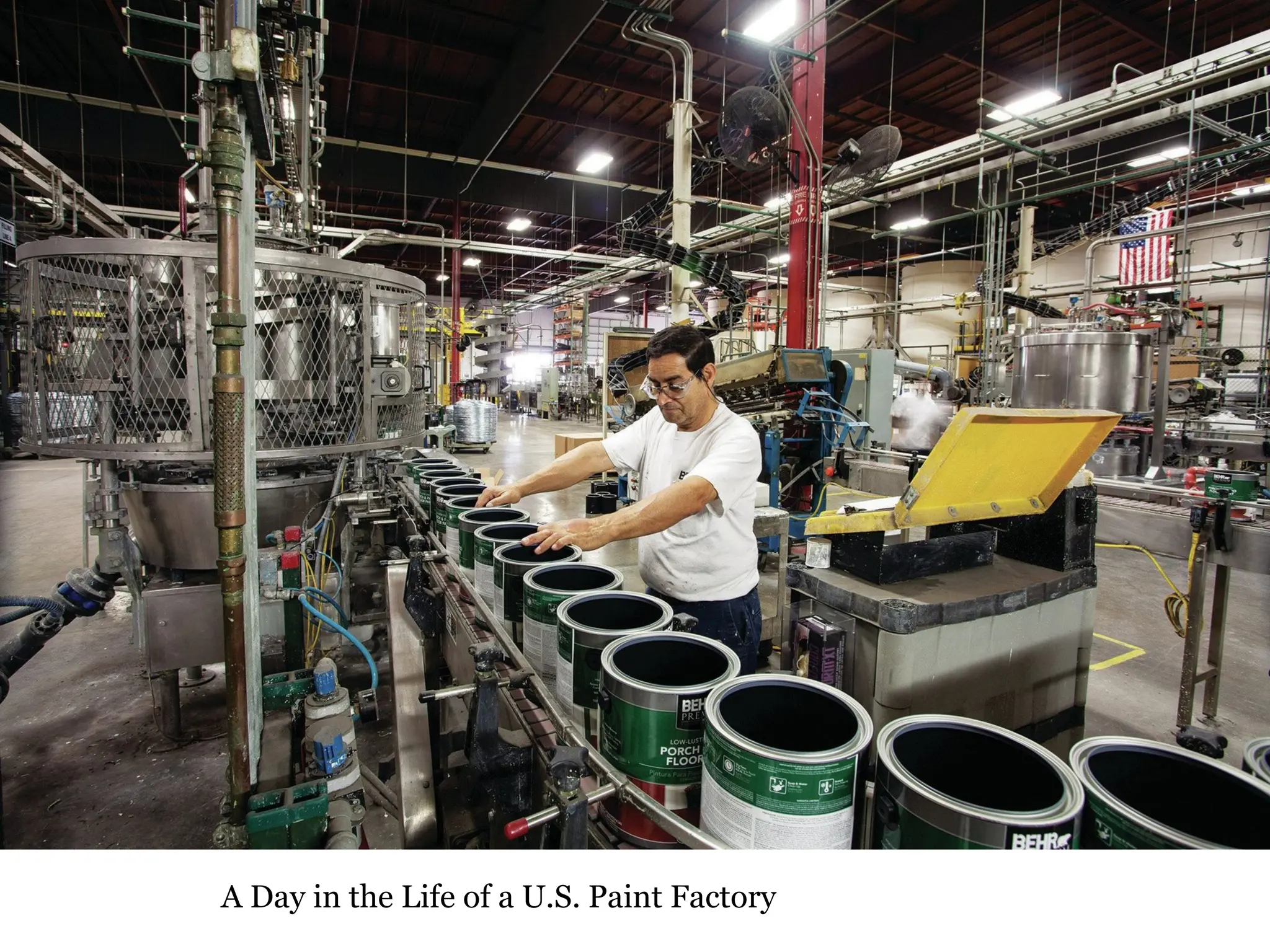
A Day in the Life of a U.S. Paint Factory
Classification of Paints:
Oil-based
paint
Aluminium
paint
Anti-
corrosive
paint
Bitumen
paint
Cellulose
paint
Synthetic
Paint
Chemical
resistant
paint
Fire
resistant
paint
Latex paint
Luminous
paint
Emulsion
paint
Cement
paint
Metal
paints
Oil-based Paints:
1. Oil-based paint is a type of paint that uses a drying
oil as its primary binder.
2. Oil-based paints are known for their slow drying
properties, which allow artists and painters to work
with the paint for extended periods, making it easier
to blend colours and make corrections.
3. Once dried, oil-based paint forms a tough, water-
resistant coating makes it ideal for surfaces that
require longevity and protection from the elements.
4. Oil-based paints typically provide a matte, smooth,
glossy finish and can be easily cleaned.
5. They are commonly used for painting walls, trim,
and furniture due to their durability and aesthetic
appeal.
Aluminium paint :
1. Made from a mixture of oil varnish and aluminium
pigment in the form of thin flakes.
2. Highly resistant to rust and corrosion, making it
suitable for outdoor applications. Good heat resistance
and thermal insulation properties, effective for hot-
water pipes and tanks.
3. Commonly used for metal, wood and masonry and
dries quickly.
Anti-corrosive Paints:
1. Typically contains rust-inhibiting pigments and is
designed specifically to protect metal surfaces from
corrosion.
2. Suitable for industrial applications, including pipelines,
machinery, and marine environments. It can be applied
directly to metal surfaces or over primers for added
protection.
Bitumen Paints:
1. Made from bitumen (a viscous, black material derived
from petroleum) mixed with solvents and pigments.
2. Excellent waterproofing properties and strong
adhesion to various substrates making it ideal for roofs,
foundations, concrete, iron and other surfaces exposed
to moisture and can be used in both residential and
industrial settings.
3. Resistant to chemicals and UV light, providing
protection against environmental degradation.
Cellulose Paint:
1. Made from cellulose nitrate or cellulose acetate, mixed
with solvents and pigments.
2. Offer excellent hiding power, high opacity covering
surfaces effectively with fewer coats.
3. They provide a bright, glossy, and long-lasting topcoat.
4. Cellulose paints dry rapidly.
5. Historically used extensively in the automotive
industry for its durability and fast drying time and not
suitable for indoor use as this paint having strong
odours.
Synthetic Paint
 Synthetic paint refers to paint formulations that utilize synthetic polymers as
the primary binder. These paints are known for their versatility, durability,
and various application properties.
Here are the key characteristics and details about synthetic paint:
 Composition:
• Synthetic Polymers: The main component of synthetic paint, which acts as a
binder. Common types include:
• Acrylics: Provide excellent adhesion, flexibility, and resistance to fading and
yellowing
• Polyurethanes: Known for their toughness and chemical resistance, often used
in high-performance coatings.
• Vinyls: Used in water-based paints, offering good adhesion and durability.
Latex Paint
1. Latex paint is a water-based paint that uses
synthetic polymers as binders. It is known for its
ease of use, quick drying time, and low odor.
2. Latex paint is ideal for residential and commercial
projects due to its durability and versatility.
Luminescent Paint
Luminescent paint contains phosphorescent materials
that absorb light and then emit it in the dark. This
type of paint glows after being exposed to light.
Fire-retardant paint
1. Fire-retardant paint is designed to slow down the
spread of fire and reduce smoke emissions. It
works by forming a protective char layer when
exposed to high temperatures.
2. Commonly applied to wood, drywall, and steel
structures in commercial and industrial settings to
enhance fire safety and compliance with building
codes.
Heat-resistant Paint
1. Heat-resistant paint can withstand high
temperatures without degrading or losing its
protective qualities. It is formulated to resist
chipping, peeling, and discoloration.
2. Ideal for surfaces exposed to high heat, such as
engines, exhaust systems, and grills. It is commonly
used in automotive, industrial, and home
applications.
Emulsion Paint
 Any paint consisting of an emulsion of oil in water
solvent is know as emulsion paint.
 Emulsion paint is water-based paint and contains acrylic
or vinyl as binders which provides adhesion and
durability once the paint dries. These results various
degrees of sheen in the finish; as the shine increases, the
paint tends to be more hard wearing. The ranges usually
offer matte, eggshell, silk, satin and full.
 Its called emulsion the pigments are dispersed in water
emulsified with an emulsifying agent.
Enamel Paint
1. Enamel paint is an oil-based or water-based paint
that dries to a hard, glossy finish. It is known for its
durability and resistance to wear and tear.
2. Often used for surfaces that require a tough finish,
such as furniture, cabinets, and metal surfaces.
Enamel paint is suitable for both interior and
exterior applications
Interior and Exterior Paints
 Interior Paint: Specifically formulated for indoor use, interior
paints are designed to withstand cleaning and resist stains. They
typically have lower VOC (volatile organic compound) levels and
are available in various finishes (matte, satin, gloss). These paints
are prepared by mixing pigments (white and coloured
pigments), vehicle (varnish or boiled linseed oil) and resins
(emulsified phenol formaldehyde, casein).
 Exterior Paint: Formulated to endure outdoor elements, exterior
paints are more durable and resistant to fading, moisture, and
mildew. They are designed to adhere well to surfaces like wood,
metal, and masonry. These paints generally have constituents such
as pigments (ZnO, TiO2, white lead), extenders (talc), vehicle
(boiled linseed oil) and thinners (mineral spirit, napthas).
Constituents
of Paints
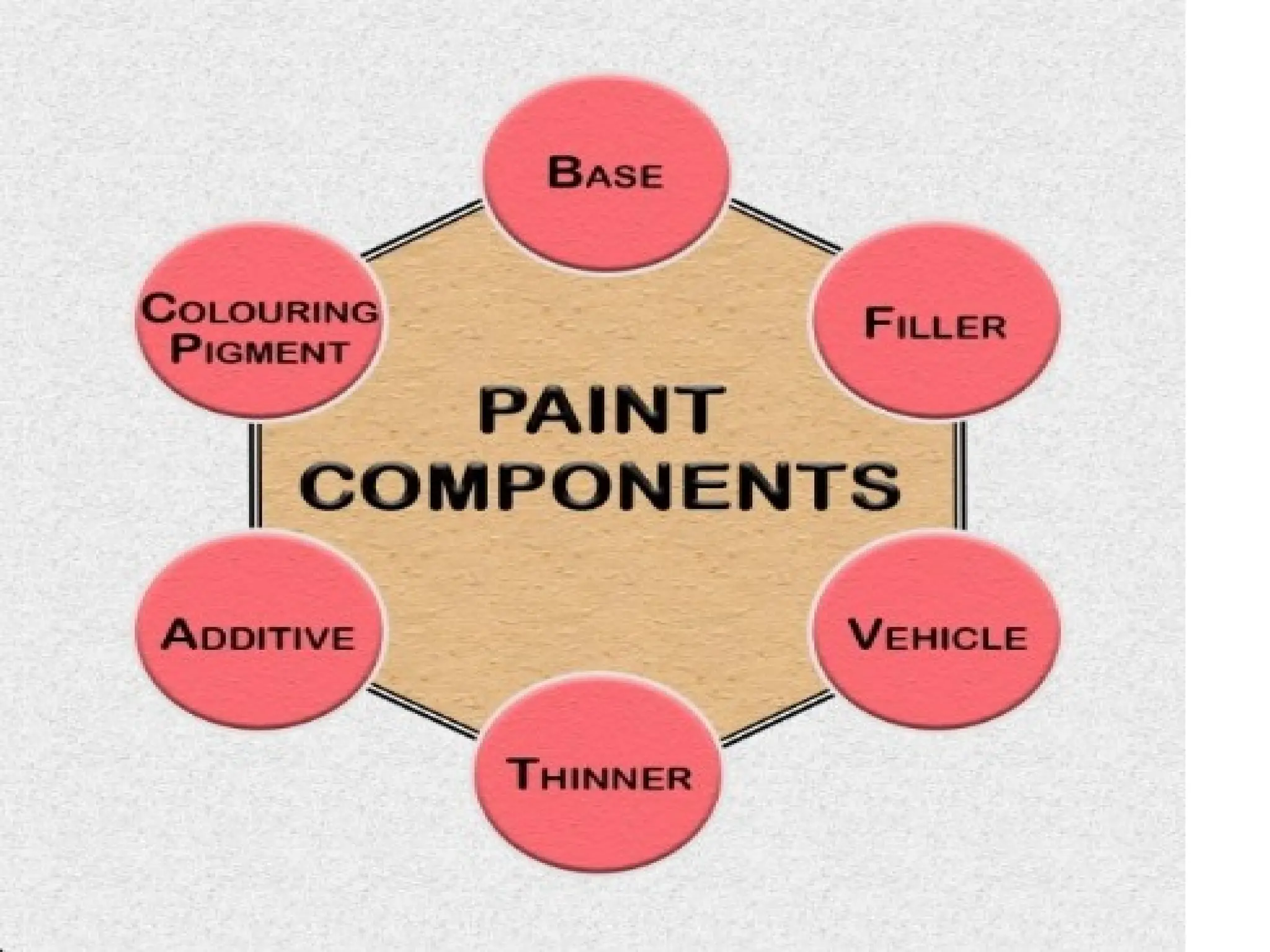
1. Base
The base is a solid substance that forms the bulk of the
paint. It also possesses the binding properties. It forms an
opaque coating, making it harder and elastic. Commonly
used bases for paints are white lead, red lead, zinc oxide,
iron oxide, titanium white, aluminium powder and
lithophone.
2. Vehicles/Drying oil/Binder/Resins/Film-
forming agent/carrier:
The vehicles are the liquid substances which hold the
ingredients of paints in liquid suspension and allow
them to be applied on the surface to be painted.
Linseed oil, Tung oil and Nut oil are used as vehicles
in paints. Of the above four oils, linseed oil is very
commonly used vehicles. It acts as binder for the base
and helps to stick to the surface. It facilitates the paint
to be conveniently spread.
Natural Binders: Such as linseed oil and casein.
Synthetic Binders: Include acrylics, polyurethanes, and vinyls.
3. The Drier
These are the compounds of metal like lead, manganese,
cobalt. The function of a drier is to absorb oxygen from
the air and supply it to the vehicle for hardening. The
drier should not be added until the paint is about to be
used. The excess drier is harmful because it destroys
elasticity and causes flaking.
4. Pigments
Pigments give required colour for paints. They are fine
particles and have a reinforcing effect on thin film of
the paint. The common pigments for different colours
are:
 Black -Lamp black, suit and charcoal black.
 Red– Venetian red, red lead and indian red.
 Brown—Burned timber, raw and burned sienna
 Green - Chrome green, copper sulphate.
 Blue—Prussian blue and ultra marine

Yellow—Ochre and chrome yellow.
5. Thinner/Solvent
It is known as solvent also. It makes paint thinner and
hence increases the coverage. It helps in spreading paint
uniformly over the surface. Terpentine and neptha are
commonly used thinners. After paint applied, thinner
evaporates and paint dries.
###
Fillers act as pigment extenders. It controls paint cost and
viscosity of paint
Why pigment volume concentration is the most
important concept of modern paint formulation?
Pigment Volume Concentration (PVC) is a crucial concept in
modern paint formulation because it directly influences the
performance, appearance, and durability of the paint. Here are
the key reasons why PVC is considered the most important aspect:
PVC is defined as the ratio of the volume of pigment to the total
volume of the paint film, including both pigment and binder, after
the paint has dried. It is calculated using the formula:
​
For example, a higher PVC can lead to a more opaque and less
glossy finish, while a lower PVC can result in a more transparent
and glossy appearance.
1. Impact on Colour and Opacity
Colour Intensity: A higher PVC generally results in more vibrant
colours and better opacity, as there is a greater concentration
of pigment particles that can scatter and absorb light. This leads
to a more intense colour appearance.
Hiding Power: The ability of paint to hide the surface
underneath (hiding power) is directly related to its PVC. Higher
PVC levels usually enhance hiding power, making the paint more
effective in covering previous colours or imperfections.
2. Influence on Finish and Gloss
Gloss Levels: The PVC affects the glossiness of the paint. Lower
PVC values typically result in glossier finishes, as there is less
pigment to scatter light. Conversely, higher PVC often leads to a
more matte finish due to increased light scattering by the
pigment particles.
3. Formulation Flexibility
Customization: Understanding PVC allows formulators to adjust the
pigment load to meet specific requirements for different
applications, such as primers, topcoats, or specialty paints. This
flexibility is vital for creating paints tailored to various performance
criteria.
4. Durability and Performance
Exterior Durability: Paints with lower PVC tend to exhibit better
durability when exposed to outdoor elements. This is because a
lower pigment load means more binder, which can better protect
against moisture and UV degradation.
Film Formation: The balance between pigment and binder at the
Critical Pigment Volume Concentration (CPVC) is essential for optimal
film formation. At CPVC, the binder sufficiently fills the spaces
between pigment particles, ensuring a strong and cohesive paint film.
Wall Finishes
 Matte
 Egg-shell/Satin
 Semi gloss
 Gloss
Mattefinish
Eggshell Finish
Semi glossy finish
Glossy finish
Toners, Lakes, Distempers
 Toner in paint refers to a substance used to adjust or modify
the color of the paint. It is typically pigment-based and is
added to the paint in specific quantities to achieve the desired
color effect. Toner allows for customization and fine-tuning of
the paint color to meet specific requirements.
 Lakes are a type of pigment used in paints. They are formed
by combining a dye with an insoluble material, such as alumina
hydrate or calcium carbonate. Lakes are often used in the form
of translucent glazes to portray the colors of rich fabrics and
draperies in paintings. Red lakes, in particular, were widely
used in Renaissance and Baroque paintings to create deep,
rich red colors.
Distempers are a type of water-based paint that was
historically used for interior walls and ceilings.
They are made from pigments, a binder (usually casein or
glue), and water.
Distempers provide a matte, flat finish and are known for
their low cost and ease of application. Distemper typically
dries to a matte finish and is not wash-resistant, making it
best suited for indoor applications where durability is less
of a concern.
It can be applied directly to cemented surfaces without the
need for a primer, and it is relatively affordable
compared to other paint types.
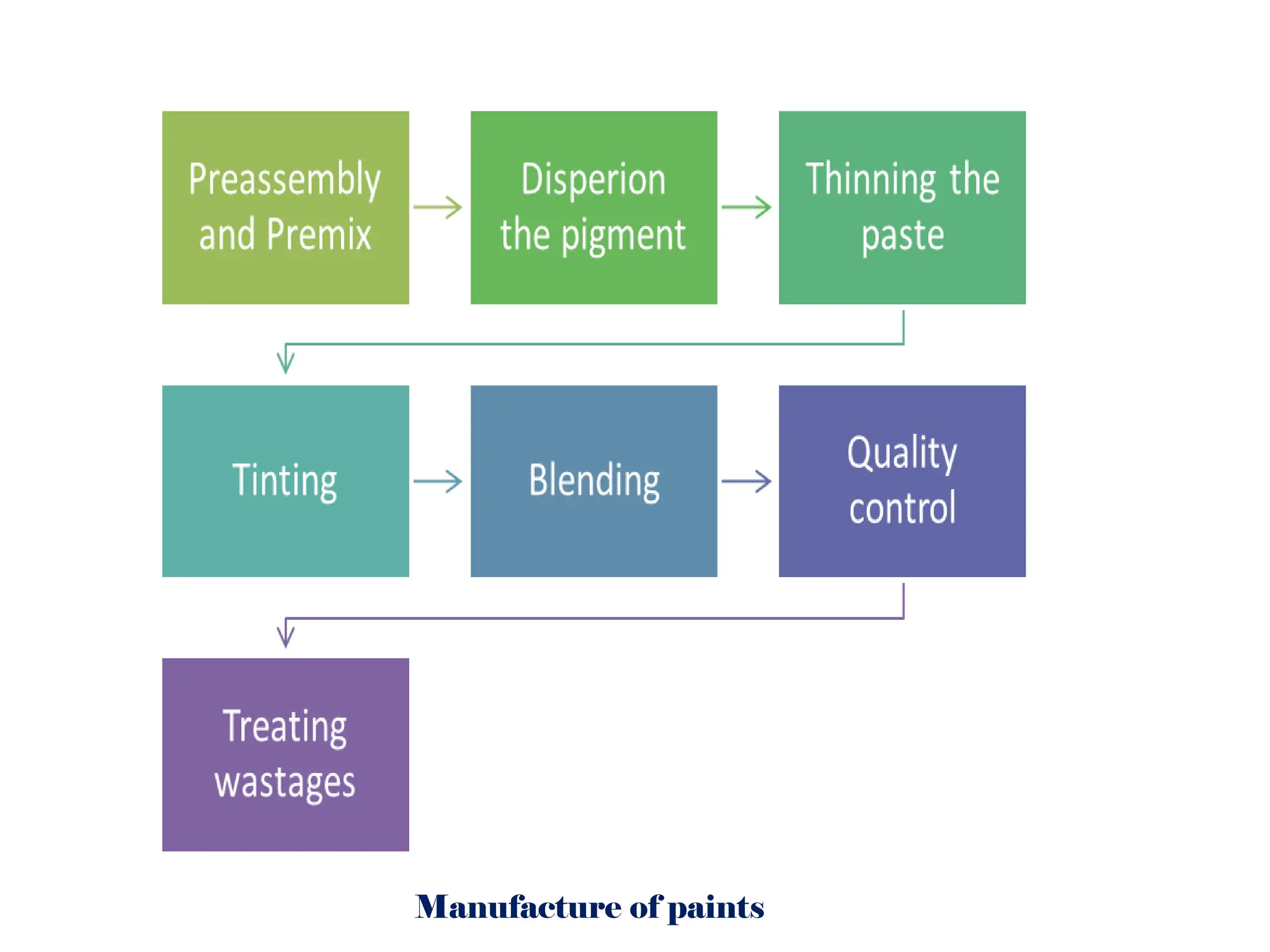
Manufacture of paints
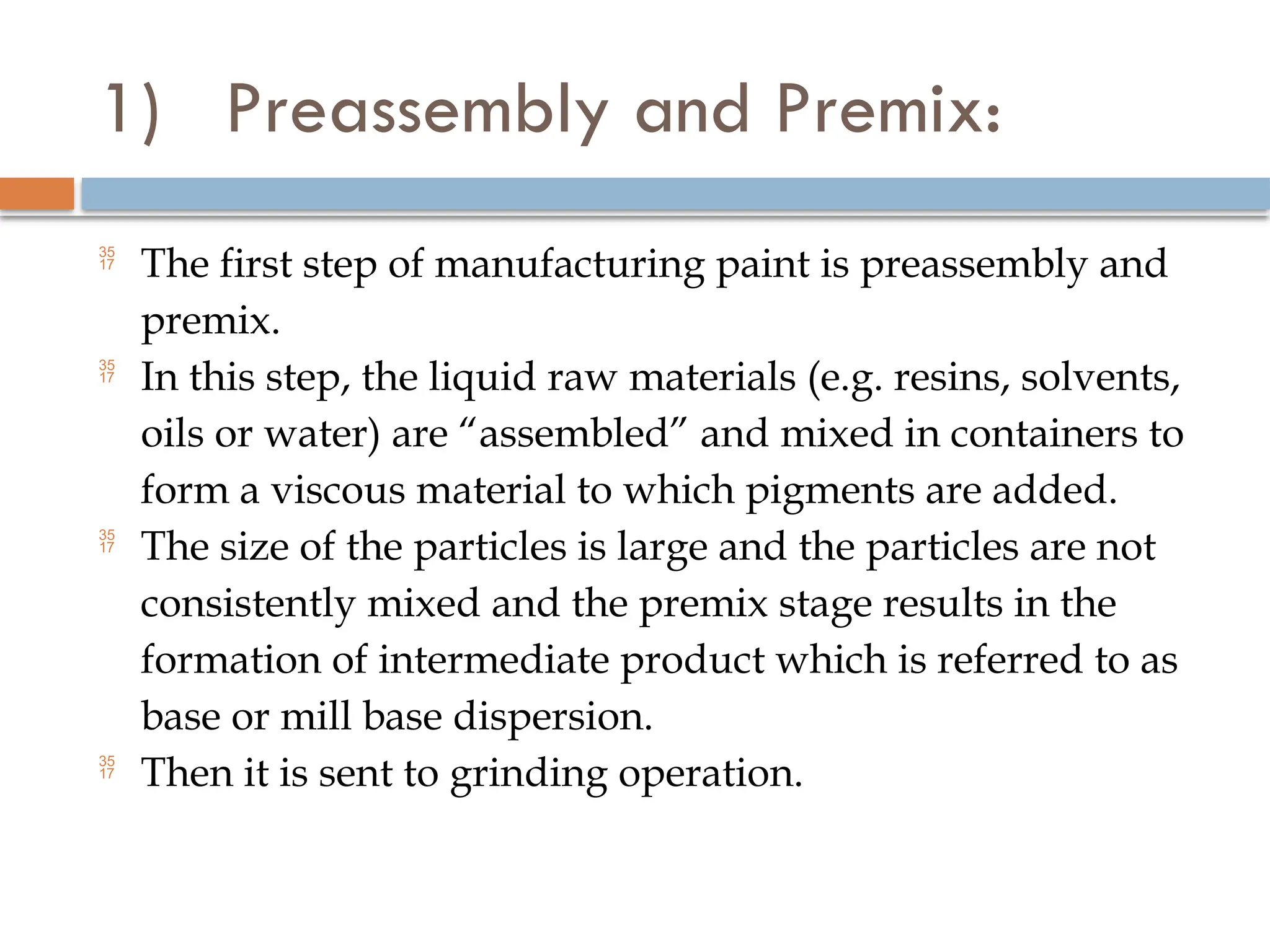
1) Preassembly and Premix:
 The first step of manufacturing paint is preassembly and
premix.
 In this step, the liquid raw materials (e.g. resins, solvents,
oils or water) are “assembled” and mixed in containers to
form a viscous material to which pigments are added.
 The size of the particles is large and the particles are not
consistently mixed and the premix stage results in the
formation of intermediate product which is referred to as
base or mill base dispersion.
 Then it is sent to grinding operation.
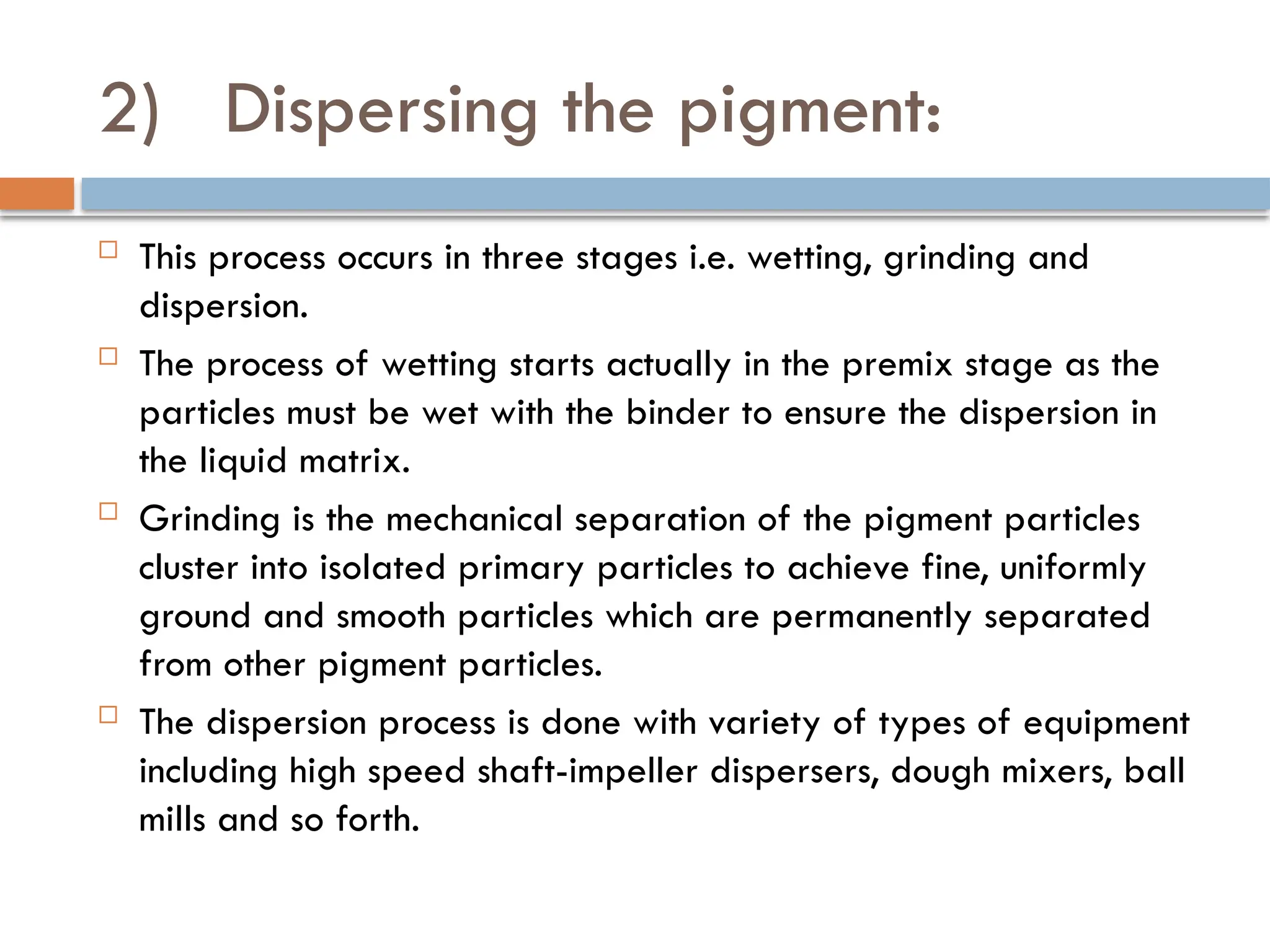
2) Dispersing the pigment:
 This process occurs in three stages i.e. wetting, grinding and
dispersion.
 The process of wetting starts actually in the premix stage as the
particles must be wet with the binder to ensure the dispersion in
the liquid matrix.
 Grinding is the mechanical separation of the pigment particles
cluster into isolated primary particles to achieve fine, uniformly
ground and smooth particles which are permanently separated
from other pigment particles.
 The dispersion process is done with variety of types of equipment
including high speed shaft-impeller dispersers, dough mixers, ball
mills and so forth.
2) Dispersing the pigment:
3) Thinning the Paste:
 Material let-down or thinning, which might
take as long as 48 hours, is the process by which
a completed mill base dispersion is let down or
reduced with solvent and binder to give a
coating which is designed to provide a durable
and serviceable film that is applied to the
surface.
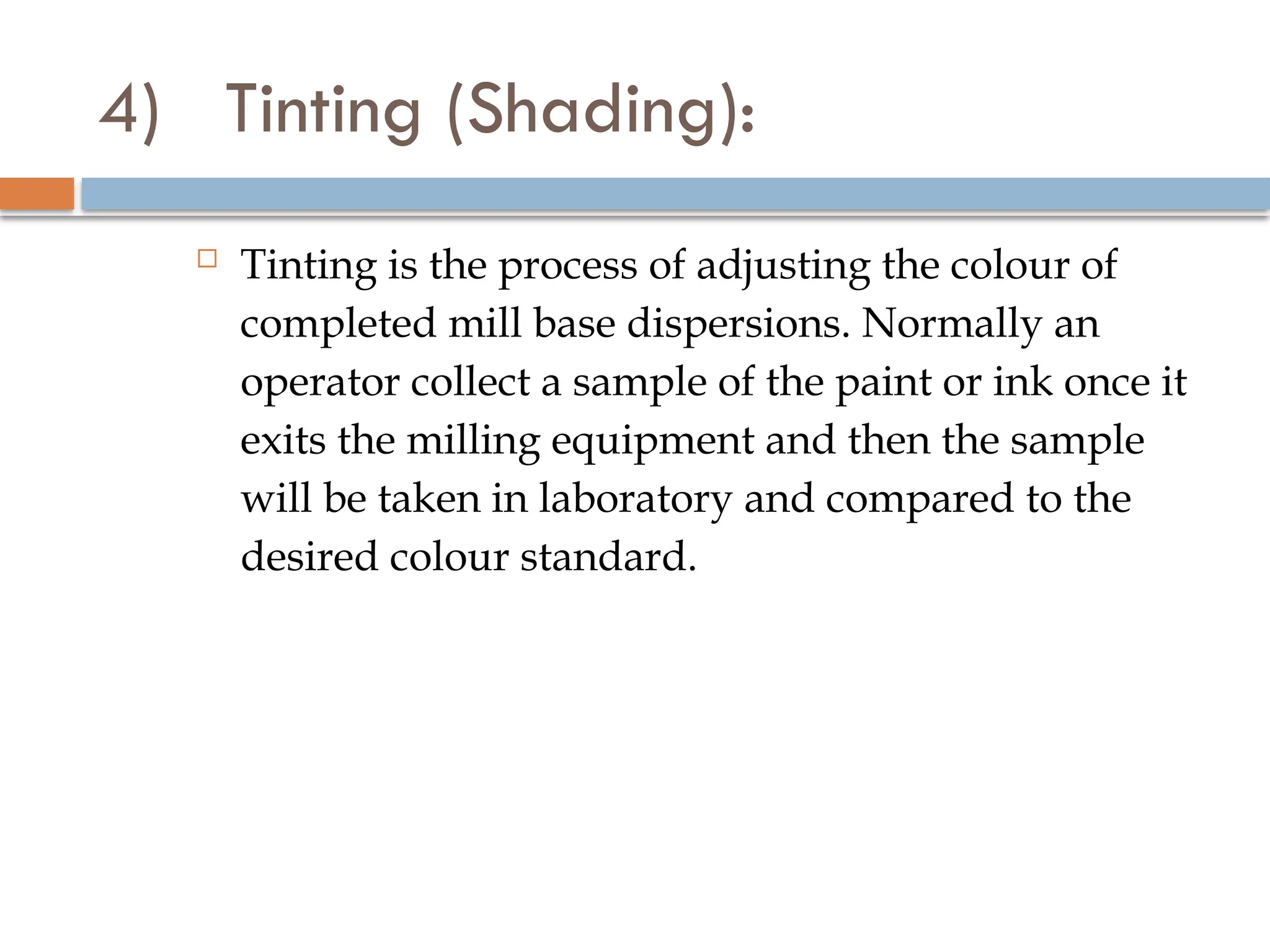
4) Tinting (Shading):
 Tinting is the process of adjusting the colour of
completed mill base dispersions. Normally an
operator collect a sample of the paint or ink once it
exits the milling equipment and then the sample
will be taken in laboratory and compared to the
desired colour standard.
5) Blending (Mixing):
 Blending is the process of incorporating the
additions into the material in order to meet the
desired product specifications.
6) Quality Control:
 Quality control measures are implemented to ensure the
paint meets specifications for colour and appearance,
viscosity and flow properties, drying time and film
formation, hiding power and opacity, shelf life and
stability.
7) Treating Wastages:
 A manufacturer has an in-house waste water
treatment facility that treats all liquids generated
on-site and monitored 24 hours a day to ensure
modern environmental considerations.
Paint Failure & Causes
Paint failure refers to the loss of adhesion,
durability, or aesthetic quality of a paint coating,
which can occur due to various factors.
Common Causes of paint failure
• Inadequate Surface Preparation: Poorly prepared surfaces can lead
to weak adhesion, resulting in various types of paint failure.
Cleaning, sanding, and priming are essential steps.
• Moisture: Water infiltration from leaks or high humidity can cause
blistering, peeling, and other failures.
• Improper Application: Using the wrong type of paint, applying it in
unsuitable conditions, or not following manufacturer instructions
can lead to failure.
• Environmental Factors: Exposure to extreme temperatures, UV
light, and weathering can accelerate paint degradation.
• Contamination: Dirt, grease, or residues on the surface can prevent
proper adhesion, leading to issues like cissing and flaking.
• Quality of Materials: Using low-quality paints or incompatible
materials can result in poor performance and early failure.
Blistering Crazing/
cracking
Peeling
Chalking Flaking Blooming
Mildew Cissing Sagging
Blistering, Cissing, Peeling, Chalking
1. Blistering: Formation of bubbles or blisters in the paint
film, often caused by trapped moisture or painting
over damp surfaces.
2. Cissing: Occurs when paint fails to spread evenly over
a surface, leading to uncoated spots. This is usually due
to surface contamination.
3. Peeling: Large sections of paint lift away from the
substrate, often resulting from moisture infiltration or
inadequate surface preparation.
4. Chalking: The formation of a powdery residue on the
paint surface due to weathering, which can affect
adhesion and appearance.
Cracking, Flaking, Blooming, Alligatoring
1. Cracking: Fine cracks appear in the paint film, often
due to aging, excessive heat, or applying too many
layers of paint.
2. Flaking: Paint lifts off in thin layers, typically due to poor
adhesion from painting over dirty or damp surfaces.
3. Blooming: A milky haze that forms on the surface of
varnish or lacquer, often due to moisture exposure.
4. Alligatoring: Alligatoring is a form of paint failure
characterized by the formation of large, irregular
cracks in the surface layer of the paint, resembling the
skin of an alligator.
Wrinkling, Sagging, Mildew, Flashing, Grinning
1. Wrinkling: Wrinkling occurs when the paint film develops
small wrinkles or ridges on the surface as it dries.
2. Sagging: Sagging refers to the downward movement of
the paint film, resulting in drips or runs on vertical surfaces.
3. Mildew: Mildew is a fungal growth that appears as dark
spots or patches on the paint surface, usually in damp or
humid conditions.
4. Flashing: Flashing is the uneven sheen or glossiness that
appears on a painted surface after it dries.
5. Grinning: Grinning occurs when the underlying surface or
previous paint layer shows through the topcoat, creating
a mottled appearance.
Varnishes
Varnish is a liquid coating material composed of a
mixture of resins, oils, and solvents that dries to form a
hard, transparent film. It is primarily used to protect
and enhance the appearance of wooden surfaces.
Types of Varnishes
The type of varnish mainly depends on the types of
solvents used and they are as follows :
 Oil varnishes
 Spirit varnishes
 Turpentine varnishes
 Asphalt varnishes
 Water varnishes
 Flat varnishes
 Spar varnishes
Manufacture of Varnishes
The manufacturing process of varnish involves several steps:
Preparation of Ingredients: raw materials, including resins, oils, solvents, and
driers, are measured and prepared for mixing.
Mixing: The resins and oils are blended together in a controlled environment.
This may involve heating to ensure complete dissolution and uniformity.
Addition of Solvents: Solvents are added to the mixture to achieve the desired
viscosity and application properties.
Incorporation of Driers: Driers are mixed in to enhance the drying process of
the varnish.
Filtration: The varnish is filtered to remove any impurities or undissolved
particles, ensuring a smooth final product.
Packaging: The finished varnish is packaged in appropriate containers for
distribution and sale.
Packaging: The finished varnish is packaged in appropriate containers for
distribution and sale.
How could you apply paint 5
Paint is applied onto a surface which has been previously treated by the
methods of Enhancement of adhesion : Cleaning, surface roughening,
primers, adhesion promoters, plasma treatment.
Air Spray:
Air spraying is fantastic in industrial paint jobs. An air sprayer uses air to
atomise the paint into a mist or fine spray. You can choose an air sprayer
that offers you different level of pressure or pattern and so on. This kind
method leaves you wit a professional smooth finish on any surface.
Roller:
If you plan on painting a flat surface or wall, a roller can come as handy.
Using a roller to apply paint allows you transfer paint efficiently and
quickly. Rollers come in various forms to produce different results.
Dip Coating:
On industrial projects, you may have certain elements that need covering
entirely in paint quickly and efficiently. If you use a dip coating method,
you can dip the element into the paint directly and allow it to dry. This
kind of method works best with thick paints with a strong adhesive
quality.
Roller:
If you plan on painting a flat surface or wall, a roller can come as handy.
Using a roller to apply paint allows you transfer paint efficiently and
quickly. Rollers come in various forms to produce different results.
Dip Coating:
On industrial projects, you may have certain elements that need covering
entirely in paint quickly and efficiently. If you use a dip coating method,
you can dip the element into the paint directly and allow it to dry. This
kind of method works best with thick paints with a strong adhesive
quality.
Paint Brush :
Paint brushes come in such a wide variety of styles, shapes, angles and even
bristles, that there is one for every task
Airless Sprayer:
An airless sprayer atomises the paint at a much higher pressure than an air
sprayer. Its great for spraying large industrial areas quickly and more
efficiently than an air sprayer and can handle much thicker coatings
Paint Brush :
Paint brushes come in such a wide variety of styles, shapes, angles and even
bristles, that there is one for every task
The END

Paints and Varnishes, Chemical Process Technology.pptx

  • 1.
  • 2.
    Paints Paint is aliquid substance composed of pigments suspended in a medium that dries to form a coloured layer when applied to a surface. So, paint is a mixture of pigment and a suitable liquid to form closely adherent coating when spread into a surface in a thin coat. It serves both decorative and protective purposes.  In paint, pigments are finely ground and suspended in a liquid medium (such as water or oil). This ensures that the pigments remain evenly distributed throughout the paint, preventing settling and clumping, which can affect the paint's performance and appearance.
  • 3.
  • 4.
    Here are thecharacteristics of paints summarized in concise points: 1. Wearability: Resistant to wear and tear, maintaining color and finish over time. 2. Covering Ability: Provides uniform and smooth coverage on surfaces. 3. Ease of Cleaning: Should allow for easy cleaning without damaging the paint. 4. Environmentally Friendly: Low or zero VOCs, minimizing environmental impact. 5. Aesthetic Appeal: Offers a pleasing appearance and can enhance the ambiance of a space. 6. Durability: Forms a tough, elastic, and long-lasting film when dry. 7. Moisture Resistance: Protects against moisture and prevents mildew growth. 8. Color Retention: Maintains color without fading over time. 9. Quick Drying: Dries quickly to reduce downtime during application. 10. Non-Toxic: Safe for indoor use, especially in residential
  • 5.
    A Day inthe Life of a U.S. Paint Factory
  • 7.
  • 8.
    Oil-based Paints: 1. Oil-basedpaint is a type of paint that uses a drying oil as its primary binder. 2. Oil-based paints are known for their slow drying properties, which allow artists and painters to work with the paint for extended periods, making it easier to blend colours and make corrections. 3. Once dried, oil-based paint forms a tough, water- resistant coating makes it ideal for surfaces that require longevity and protection from the elements. 4. Oil-based paints typically provide a matte, smooth, glossy finish and can be easily cleaned. 5. They are commonly used for painting walls, trim, and furniture due to their durability and aesthetic appeal.
  • 9.
    Aluminium paint : 1.Made from a mixture of oil varnish and aluminium pigment in the form of thin flakes. 2. Highly resistant to rust and corrosion, making it suitable for outdoor applications. Good heat resistance and thermal insulation properties, effective for hot- water pipes and tanks. 3. Commonly used for metal, wood and masonry and dries quickly.
  • 10.
    Anti-corrosive Paints: 1. Typicallycontains rust-inhibiting pigments and is designed specifically to protect metal surfaces from corrosion. 2. Suitable for industrial applications, including pipelines, machinery, and marine environments. It can be applied directly to metal surfaces or over primers for added protection.
  • 11.
    Bitumen Paints: 1. Madefrom bitumen (a viscous, black material derived from petroleum) mixed with solvents and pigments. 2. Excellent waterproofing properties and strong adhesion to various substrates making it ideal for roofs, foundations, concrete, iron and other surfaces exposed to moisture and can be used in both residential and industrial settings. 3. Resistant to chemicals and UV light, providing protection against environmental degradation.
  • 12.
    Cellulose Paint: 1. Madefrom cellulose nitrate or cellulose acetate, mixed with solvents and pigments. 2. Offer excellent hiding power, high opacity covering surfaces effectively with fewer coats. 3. They provide a bright, glossy, and long-lasting topcoat. 4. Cellulose paints dry rapidly. 5. Historically used extensively in the automotive industry for its durability and fast drying time and not suitable for indoor use as this paint having strong odours.
  • 13.
    Synthetic Paint  Syntheticpaint refers to paint formulations that utilize synthetic polymers as the primary binder. These paints are known for their versatility, durability, and various application properties. Here are the key characteristics and details about synthetic paint:  Composition: • Synthetic Polymers: The main component of synthetic paint, which acts as a binder. Common types include: • Acrylics: Provide excellent adhesion, flexibility, and resistance to fading and yellowing • Polyurethanes: Known for their toughness and chemical resistance, often used in high-performance coatings. • Vinyls: Used in water-based paints, offering good adhesion and durability.
  • 14.
    Latex Paint 1. Latexpaint is a water-based paint that uses synthetic polymers as binders. It is known for its ease of use, quick drying time, and low odor. 2. Latex paint is ideal for residential and commercial projects due to its durability and versatility.
  • 15.
    Luminescent Paint Luminescent paintcontains phosphorescent materials that absorb light and then emit it in the dark. This type of paint glows after being exposed to light.
  • 16.
    Fire-retardant paint 1. Fire-retardantpaint is designed to slow down the spread of fire and reduce smoke emissions. It works by forming a protective char layer when exposed to high temperatures. 2. Commonly applied to wood, drywall, and steel structures in commercial and industrial settings to enhance fire safety and compliance with building codes.
  • 17.
    Heat-resistant Paint 1. Heat-resistantpaint can withstand high temperatures without degrading or losing its protective qualities. It is formulated to resist chipping, peeling, and discoloration. 2. Ideal for surfaces exposed to high heat, such as engines, exhaust systems, and grills. It is commonly used in automotive, industrial, and home applications.
  • 18.
    Emulsion Paint  Anypaint consisting of an emulsion of oil in water solvent is know as emulsion paint.  Emulsion paint is water-based paint and contains acrylic or vinyl as binders which provides adhesion and durability once the paint dries. These results various degrees of sheen in the finish; as the shine increases, the paint tends to be more hard wearing. The ranges usually offer matte, eggshell, silk, satin and full.  Its called emulsion the pigments are dispersed in water emulsified with an emulsifying agent.
  • 19.
    Enamel Paint 1. Enamelpaint is an oil-based or water-based paint that dries to a hard, glossy finish. It is known for its durability and resistance to wear and tear. 2. Often used for surfaces that require a tough finish, such as furniture, cabinets, and metal surfaces. Enamel paint is suitable for both interior and exterior applications
  • 20.
    Interior and ExteriorPaints  Interior Paint: Specifically formulated for indoor use, interior paints are designed to withstand cleaning and resist stains. They typically have lower VOC (volatile organic compound) levels and are available in various finishes (matte, satin, gloss). These paints are prepared by mixing pigments (white and coloured pigments), vehicle (varnish or boiled linseed oil) and resins (emulsified phenol formaldehyde, casein).  Exterior Paint: Formulated to endure outdoor elements, exterior paints are more durable and resistant to fading, moisture, and mildew. They are designed to adhere well to surfaces like wood, metal, and masonry. These paints generally have constituents such as pigments (ZnO, TiO2, white lead), extenders (talc), vehicle (boiled linseed oil) and thinners (mineral spirit, napthas).
  • 21.
  • 24.
    1. Base The baseis a solid substance that forms the bulk of the paint. It also possesses the binding properties. It forms an opaque coating, making it harder and elastic. Commonly used bases for paints are white lead, red lead, zinc oxide, iron oxide, titanium white, aluminium powder and lithophone.
  • 25.
    2. Vehicles/Drying oil/Binder/Resins/Film- formingagent/carrier: The vehicles are the liquid substances which hold the ingredients of paints in liquid suspension and allow them to be applied on the surface to be painted. Linseed oil, Tung oil and Nut oil are used as vehicles in paints. Of the above four oils, linseed oil is very commonly used vehicles. It acts as binder for the base and helps to stick to the surface. It facilitates the paint to be conveniently spread.
  • 26.
    Natural Binders: Suchas linseed oil and casein. Synthetic Binders: Include acrylics, polyurethanes, and vinyls.
  • 27.
    3. The Drier Theseare the compounds of metal like lead, manganese, cobalt. The function of a drier is to absorb oxygen from the air and supply it to the vehicle for hardening. The drier should not be added until the paint is about to be used. The excess drier is harmful because it destroys elasticity and causes flaking.
  • 28.
    4. Pigments Pigments giverequired colour for paints. They are fine particles and have a reinforcing effect on thin film of the paint. The common pigments for different colours are:  Black -Lamp black, suit and charcoal black.  Red– Venetian red, red lead and indian red.  Brown—Burned timber, raw and burned sienna  Green - Chrome green, copper sulphate.  Blue—Prussian blue and ultra marine  Yellow—Ochre and chrome yellow.
  • 29.
    5. Thinner/Solvent It isknown as solvent also. It makes paint thinner and hence increases the coverage. It helps in spreading paint uniformly over the surface. Terpentine and neptha are commonly used thinners. After paint applied, thinner evaporates and paint dries. ### Fillers act as pigment extenders. It controls paint cost and viscosity of paint
  • 30.
    Why pigment volumeconcentration is the most important concept of modern paint formulation? Pigment Volume Concentration (PVC) is a crucial concept in modern paint formulation because it directly influences the performance, appearance, and durability of the paint. Here are the key reasons why PVC is considered the most important aspect: PVC is defined as the ratio of the volume of pigment to the total volume of the paint film, including both pigment and binder, after the paint has dried. It is calculated using the formula: ​ For example, a higher PVC can lead to a more opaque and less glossy finish, while a lower PVC can result in a more transparent and glossy appearance.
  • 31.
    1. Impact onColour and Opacity Colour Intensity: A higher PVC generally results in more vibrant colours and better opacity, as there is a greater concentration of pigment particles that can scatter and absorb light. This leads to a more intense colour appearance. Hiding Power: The ability of paint to hide the surface underneath (hiding power) is directly related to its PVC. Higher PVC levels usually enhance hiding power, making the paint more effective in covering previous colours or imperfections. 2. Influence on Finish and Gloss Gloss Levels: The PVC affects the glossiness of the paint. Lower PVC values typically result in glossier finishes, as there is less pigment to scatter light. Conversely, higher PVC often leads to a more matte finish due to increased light scattering by the pigment particles.
  • 32.
    3. Formulation Flexibility Customization:Understanding PVC allows formulators to adjust the pigment load to meet specific requirements for different applications, such as primers, topcoats, or specialty paints. This flexibility is vital for creating paints tailored to various performance criteria. 4. Durability and Performance Exterior Durability: Paints with lower PVC tend to exhibit better durability when exposed to outdoor elements. This is because a lower pigment load means more binder, which can better protect against moisture and UV degradation. Film Formation: The balance between pigment and binder at the Critical Pigment Volume Concentration (CPVC) is essential for optimal film formation. At CPVC, the binder sufficiently fills the spaces between pigment particles, ensuring a strong and cohesive paint film.
  • 33.
    Wall Finishes  Matte Egg-shell/Satin  Semi gloss  Gloss
  • 34.
  • 35.
  • 36.
  • 37.
  • 38.
    Toners, Lakes, Distempers Toner in paint refers to a substance used to adjust or modify the color of the paint. It is typically pigment-based and is added to the paint in specific quantities to achieve the desired color effect. Toner allows for customization and fine-tuning of the paint color to meet specific requirements.  Lakes are a type of pigment used in paints. They are formed by combining a dye with an insoluble material, such as alumina hydrate or calcium carbonate. Lakes are often used in the form of translucent glazes to portray the colors of rich fabrics and draperies in paintings. Red lakes, in particular, were widely used in Renaissance and Baroque paintings to create deep, rich red colors.
  • 39.
    Distempers are atype of water-based paint that was historically used for interior walls and ceilings. They are made from pigments, a binder (usually casein or glue), and water. Distempers provide a matte, flat finish and are known for their low cost and ease of application. Distemper typically dries to a matte finish and is not wash-resistant, making it best suited for indoor applications where durability is less of a concern. It can be applied directly to cemented surfaces without the need for a primer, and it is relatively affordable compared to other paint types.
  • 40.
  • 41.
  • 42.
    1) Preassembly andPremix:  The first step of manufacturing paint is preassembly and premix.  In this step, the liquid raw materials (e.g. resins, solvents, oils or water) are “assembled” and mixed in containers to form a viscous material to which pigments are added.  The size of the particles is large and the particles are not consistently mixed and the premix stage results in the formation of intermediate product which is referred to as base or mill base dispersion.  Then it is sent to grinding operation.
  • 43.
    2) Dispersing thepigment:  This process occurs in three stages i.e. wetting, grinding and dispersion.  The process of wetting starts actually in the premix stage as the particles must be wet with the binder to ensure the dispersion in the liquid matrix.  Grinding is the mechanical separation of the pigment particles cluster into isolated primary particles to achieve fine, uniformly ground and smooth particles which are permanently separated from other pigment particles.  The dispersion process is done with variety of types of equipment including high speed shaft-impeller dispersers, dough mixers, ball mills and so forth. 2) Dispersing the pigment:
  • 44.
    3) Thinning thePaste:  Material let-down or thinning, which might take as long as 48 hours, is the process by which a completed mill base dispersion is let down or reduced with solvent and binder to give a coating which is designed to provide a durable and serviceable film that is applied to the surface.
  • 45.
    4) Tinting (Shading): Tinting is the process of adjusting the colour of completed mill base dispersions. Normally an operator collect a sample of the paint or ink once it exits the milling equipment and then the sample will be taken in laboratory and compared to the desired colour standard.
  • 46.
    5) Blending (Mixing): Blending is the process of incorporating the additions into the material in order to meet the desired product specifications.
  • 47.
    6) Quality Control: Quality control measures are implemented to ensure the paint meets specifications for colour and appearance, viscosity and flow properties, drying time and film formation, hiding power and opacity, shelf life and stability.
  • 48.
    7) Treating Wastages: A manufacturer has an in-house waste water treatment facility that treats all liquids generated on-site and monitored 24 hours a day to ensure modern environmental considerations.
  • 49.
    Paint Failure &Causes Paint failure refers to the loss of adhesion, durability, or aesthetic quality of a paint coating, which can occur due to various factors.
  • 50.
    Common Causes ofpaint failure • Inadequate Surface Preparation: Poorly prepared surfaces can lead to weak adhesion, resulting in various types of paint failure. Cleaning, sanding, and priming are essential steps. • Moisture: Water infiltration from leaks or high humidity can cause blistering, peeling, and other failures. • Improper Application: Using the wrong type of paint, applying it in unsuitable conditions, or not following manufacturer instructions can lead to failure. • Environmental Factors: Exposure to extreme temperatures, UV light, and weathering can accelerate paint degradation. • Contamination: Dirt, grease, or residues on the surface can prevent proper adhesion, leading to issues like cissing and flaking. • Quality of Materials: Using low-quality paints or incompatible materials can result in poor performance and early failure.
  • 51.
  • 52.
    Blistering, Cissing, Peeling,Chalking 1. Blistering: Formation of bubbles or blisters in the paint film, often caused by trapped moisture or painting over damp surfaces. 2. Cissing: Occurs when paint fails to spread evenly over a surface, leading to uncoated spots. This is usually due to surface contamination. 3. Peeling: Large sections of paint lift away from the substrate, often resulting from moisture infiltration or inadequate surface preparation. 4. Chalking: The formation of a powdery residue on the paint surface due to weathering, which can affect adhesion and appearance.
  • 53.
    Cracking, Flaking, Blooming,Alligatoring 1. Cracking: Fine cracks appear in the paint film, often due to aging, excessive heat, or applying too many layers of paint. 2. Flaking: Paint lifts off in thin layers, typically due to poor adhesion from painting over dirty or damp surfaces. 3. Blooming: A milky haze that forms on the surface of varnish or lacquer, often due to moisture exposure. 4. Alligatoring: Alligatoring is a form of paint failure characterized by the formation of large, irregular cracks in the surface layer of the paint, resembling the skin of an alligator.
  • 54.
    Wrinkling, Sagging, Mildew,Flashing, Grinning 1. Wrinkling: Wrinkling occurs when the paint film develops small wrinkles or ridges on the surface as it dries. 2. Sagging: Sagging refers to the downward movement of the paint film, resulting in drips or runs on vertical surfaces. 3. Mildew: Mildew is a fungal growth that appears as dark spots or patches on the paint surface, usually in damp or humid conditions. 4. Flashing: Flashing is the uneven sheen or glossiness that appears on a painted surface after it dries. 5. Grinning: Grinning occurs when the underlying surface or previous paint layer shows through the topcoat, creating a mottled appearance.
  • 55.
    Varnishes Varnish is aliquid coating material composed of a mixture of resins, oils, and solvents that dries to form a hard, transparent film. It is primarily used to protect and enhance the appearance of wooden surfaces.
  • 56.
    Types of Varnishes Thetype of varnish mainly depends on the types of solvents used and they are as follows :  Oil varnishes  Spirit varnishes  Turpentine varnishes  Asphalt varnishes  Water varnishes  Flat varnishes  Spar varnishes
  • 57.
  • 58.
    The manufacturing processof varnish involves several steps: Preparation of Ingredients: raw materials, including resins, oils, solvents, and driers, are measured and prepared for mixing. Mixing: The resins and oils are blended together in a controlled environment. This may involve heating to ensure complete dissolution and uniformity. Addition of Solvents: Solvents are added to the mixture to achieve the desired viscosity and application properties. Incorporation of Driers: Driers are mixed in to enhance the drying process of the varnish. Filtration: The varnish is filtered to remove any impurities or undissolved particles, ensuring a smooth final product. Packaging: The finished varnish is packaged in appropriate containers for distribution and sale. Packaging: The finished varnish is packaged in appropriate containers for distribution and sale.
  • 59.
    How could youapply paint 5
  • 60.
    Paint is appliedonto a surface which has been previously treated by the methods of Enhancement of adhesion : Cleaning, surface roughening, primers, adhesion promoters, plasma treatment. Air Spray: Air spraying is fantastic in industrial paint jobs. An air sprayer uses air to atomise the paint into a mist or fine spray. You can choose an air sprayer that offers you different level of pressure or pattern and so on. This kind method leaves you wit a professional smooth finish on any surface. Roller: If you plan on painting a flat surface or wall, a roller can come as handy. Using a roller to apply paint allows you transfer paint efficiently and quickly. Rollers come in various forms to produce different results. Dip Coating: On industrial projects, you may have certain elements that need covering entirely in paint quickly and efficiently. If you use a dip coating method, you can dip the element into the paint directly and allow it to dry. This kind of method works best with thick paints with a strong adhesive quality. Roller: If you plan on painting a flat surface or wall, a roller can come as handy. Using a roller to apply paint allows you transfer paint efficiently and quickly. Rollers come in various forms to produce different results. Dip Coating: On industrial projects, you may have certain elements that need covering entirely in paint quickly and efficiently. If you use a dip coating method, you can dip the element into the paint directly and allow it to dry. This kind of method works best with thick paints with a strong adhesive quality.
  • 61.
    Paint Brush : Paintbrushes come in such a wide variety of styles, shapes, angles and even bristles, that there is one for every task Airless Sprayer: An airless sprayer atomises the paint at a much higher pressure than an air sprayer. Its great for spraying large industrial areas quickly and more efficiently than an air sprayer and can handle much thicker coatings Paint Brush : Paint brushes come in such a wide variety of styles, shapes, angles and even bristles, that there is one for every task The END