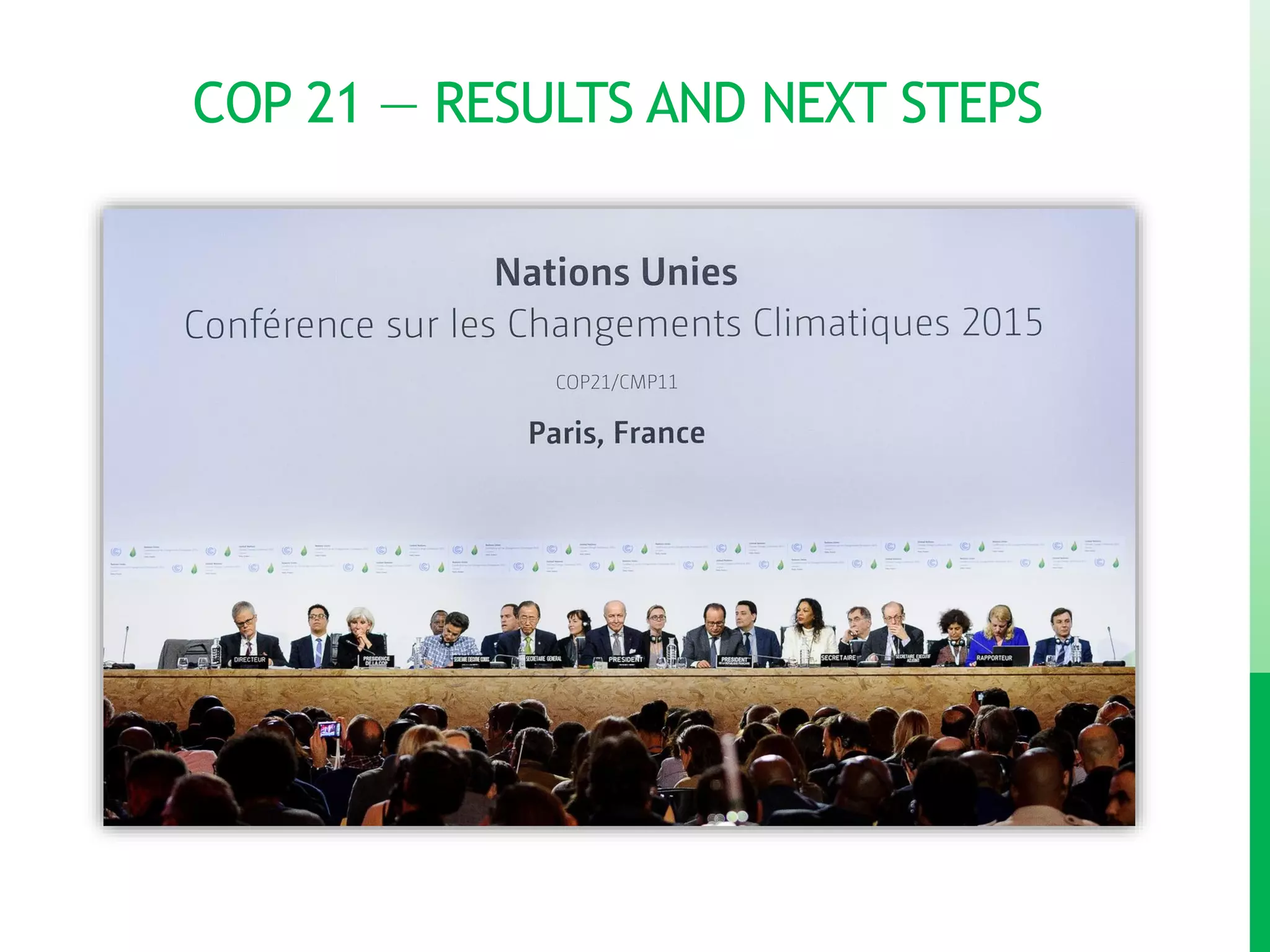
COP 21 — RESULTS AND NEXT STEPS
An unprecedented momentum
transitionned into a
universal agreement
An unprecedented momentum
3
A universal will to reach an agreement: more than 180 national contributions, the
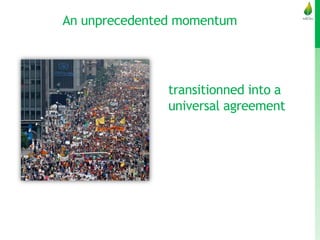
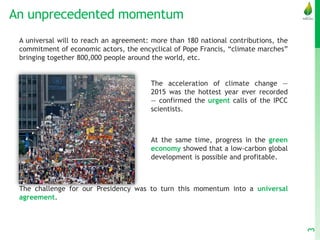
commitment of economic actors, the encyclical of Pope Francis, “climate marches”
bringing together 800,000 people around the world, etc.
The acceleration of climate change —
2015 was the hottest year ever recorded
— confirmed the urgent calls of the IPCC
scientists.
At the same time, progress in the green
economy showed that a low-carbon global
development is possible and profitable.
The challenge for our Presidency was to turn this momentum into a universal
agreement.
360-degree diplomacy
4
Our diplomatic network has been in the forefront through dialogue with all
countries, mobilization of civil society actors and public awareness-raising.
France and Peru organized several informal consultations in small but open
format, to explore possible political compromises.
Involvement of non-state actors fostered by the Lima-Paris Action Agenda
(cooperative initiatives) and the NAZCA platform (individual commitments).
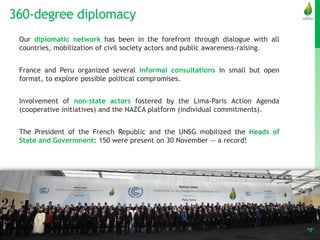
The President of the French Republic and the UNSG mobilized the Heads of
State and Government: 150 were present on 30 November — a record!
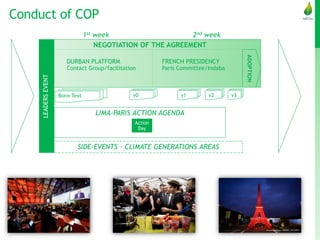
Conduct of COP
1st week 2nd week
NEGOTIATION OF THE AGREEMENT
LIMA-PARIS ACTION AGENDA
DURBAN PLATFORM
Contact Group/facilitation
FRENCH PRESIDENCY
Paris Committee/Indaba
Action
Day
ADOPTION
SIDE-EVENTS – CLIMATE GENERATIONS AREAS
v1 v2 v3
LEADERS
EVENT
v0
Bonn Text
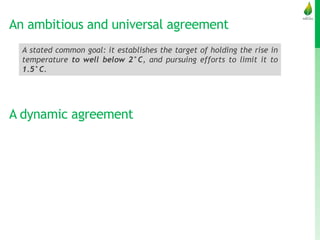
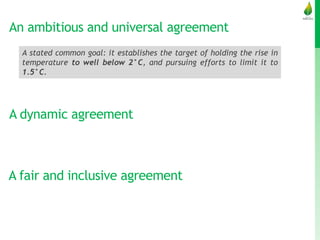
An ambitious and universal agreement
A stated common goal: it establishes the target of holding the rise in
temperature to well below 2°C, and pursuing efforts to limit it to
1.5°C.
A dynamic agreement
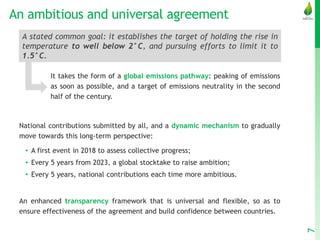
An ambitious and universal agreement
It takes the form of a global emissions pathway: peaking of emissions
as soon as possible, and a target of emissions neutrality in the second
half of the century.
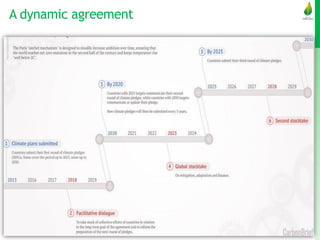
National contributions submitted by all, and a dynamic mechanism to gradually
move towards this long-term perspective:
• A first event in 2018 to assess collective progress;
• Every 5 years from 2023, a global stocktake to raise ambition;
• Every 5 years, national contributions each time more ambitious.
An enhanced transparency framework that is universal and flexible, so as to
ensure effectiveness of the agreement and build confidence between countries.
7
A stated common goal: it establishes the target of holding the rise in
temperature to well below 2°C, and pursuing efforts to limit it to
1.5°C.
A dynamic agreement
An ambitious and universal agreement
A stated common goal: it establishes the target of holding the rise in
temperature to well below 2°C, and pursuing efforts to limit it to
1.5°C.
A dynamic agreement
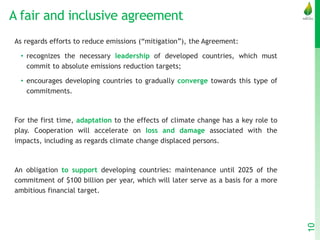
A fair and inclusive agreement
As regards efforts to reduce emissions (“mitigation”), the Agreement:
• recognizes the necessary leadership of developed countries, which must
commit to absolute emissions reduction targets;
• encourages developing countries to gradually converge towards this type of
commitments.
For the first time, adaptation to the effects of climate change has a key role to
play. Cooperation will accelerate on loss and damage associated with the
impacts, including as regards climate change displaced persons.
An obligation to support developing countries: maintenance until 2025 of the
commitment of $100 billion per year, which will later serve as a basis for a more
ambitious financial target.
10
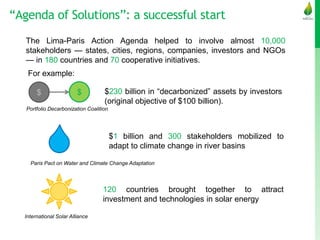
“Agenda of Solutions”: a successful start
The Lima-Paris Action Agenda helped to involve almost 10,000
stakeholders — states, cities, regions, companies, investors and NGOs
— in 180 countries and 70 cooperative initiatives.
$230 billion in “decarbonized” assets by investors
(original objective of $100 billion).
Portfolio Decarbonization Coalition
$ $
$1 billion and 300 stakeholders mobilized to
adapt to climate change in river basins
Paris Pact on Water and Climate Change Adaptation
120 countries brought together to attract
investment and technologies in solar energy
International Solar Alliance
For example:
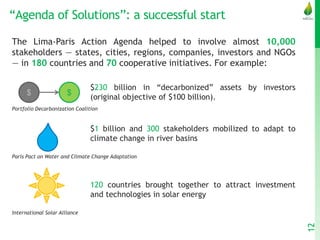
“Agenda of Solutions”: a successful start
The Lima-Paris Action Agenda helped to involve almost 10,000
stakeholders — states, cities, regions, companies, investors and NGOs
— in 180 countries and 70 cooperative initiatives. For example:
$230 billion in “decarbonized” assets by investors
(original objective of $100 billion).
Portfolio Decarbonization Coalition
$1 billion and 300 stakeholders mobilized to adapt to
climate change in river basins
Paris Pact on Water and Climate Change Adaptation
120 countries brought together to attract investment
and technologies in solar energy
International Solar Alliance
12
$ $
A world-renowned success
“The Paris deal has charted a clear course for global cooperation on
coping with climate change.”
Xi Jinping
“Paris will forever be remembered for this historic turning point in
global climate policy.”
Angela Merkel
“Climate justice has won and we are all working towards a greener
future.”
Narendra Modi
“The Paris Agreement establishes the enduring framework the world
needs to solve the climate crisis.”
Barack Obama
“The very positive results of COP 21 [...] have restored our faith in the
global community.”
Anote Tong (Kiribati Islands)
13
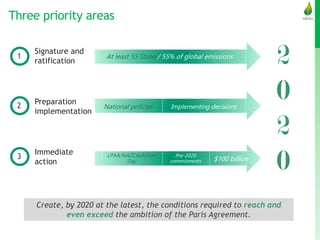
Three priority areas
Maritime sector
(IMO)
Civil Aviation
(ICAO)
Habitat III
1
2
3
Signature and
ratification
Preparation
implementation
Immediate
action
At least 55 States/ 55% of global emissions
2
0
2
0
LPAA/NAZCA/Action
Day $100 billion
Create, by 2020 at the latest, the conditions required to reach and
even exceed the ambition of the Paris Agreement.
National policies Implementing decisions
Pre-2020
commitments
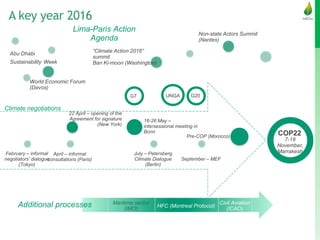
16-26 May –
intersessional meeting in
Bonn
Lima-Paris Action
Agenda
7-18
November,
Marrakesh
Abu Dhabi
Sustainability Week
“Climate Action 2016”
summit
Ban Ki-moon (Washington)
A key year 2016
Maritime sector
(IMO)
G20
Civil Aviation
(ICAO)
HFC (Montreal Protocol)
February – informal
negotiators' dialogue
(Tokyo)
22 April – opening of the
Agreement for signature
(New York)
G7 UNGA
COP22
World Economic Forum
(Davos)
Non-state Actors Summit
(Nantes)
Additional processes
July – Petersberg
Climate Dialogue
(Berlin)
September – MEF
April – informal
consultations (Paris)
Pre-COP (Morocco)
Climate negotiations
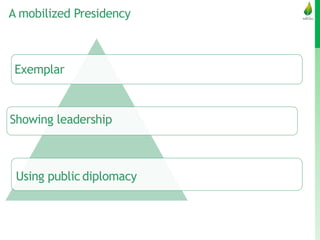
A mobilized Presidency
Exemplar
Showing leadership
Using public diplomacy
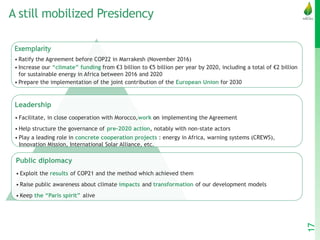
A still mobilized Presidency
Exemplarity
• Ratify the Agreement before COP22 in Marrakesh (November 2016)
• Increase our “climate” funding from €3 billion to €5 billion per year by 2020, including a total of €2 billion
for sustainable energy in Africa between 2016 and 2020
• Prepare the implementation of the joint contribution of the European Union for 2030
Leadership
• Facilitate, in close cooperation with Morocco,work on implementing the Agreement
• Help structure the governance of pre-2020 action, notably with non-state actors
• Play a leading role in concrete cooperation projects : energy in Africa, warning systems (CREWS),
Innovation Mission, International Solar Alliance, etc.
Public diplomacy
• Exploit the results of COP21 and the method which achieved them
• Raise public awareness about climate impacts and transformation of our development models
• Keep the “Paris spirit” alive
17
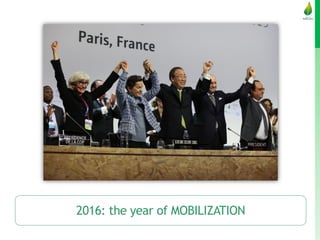
2016: the year of MOBILIZATION

Bruno_Fulda_021016-PRINT.pdf

  • 1.
    COP 21 —RESULTS AND NEXT STEPS
  • 2.
    An unprecedented momentum transitionnedinto a universal agreement
  • 3.
    An unprecedented momentum 3 Auniversal will to reach an agreement: more than 180 national contributions, the commitment of economic actors, the encyclical of Pope Francis, “climate marches” bringing together 800,000 people around the world, etc. The acceleration of climate change — 2015 was the hottest year ever recorded — confirmed the urgent calls of the IPCC scientists. At the same time, progress in the green economy showed that a low-carbon global development is possible and profitable. The challenge for our Presidency was to turn this momentum into a universal agreement.
  • 4.
    360-degree diplomacy 4 Our diplomaticnetwork has been in the forefront through dialogue with all countries, mobilization of civil society actors and public awareness-raising. France and Peru organized several informal consultations in small but open format, to explore possible political compromises. Involvement of non-state actors fostered by the Lima-Paris Action Agenda (cooperative initiatives) and the NAZCA platform (individual commitments). The President of the French Republic and the UNSG mobilized the Heads of State and Government: 150 were present on 30 November — a record!
  • 5.
    Conduct of COP 1stweek 2nd week NEGOTIATION OF THE AGREEMENT LIMA-PARIS ACTION AGENDA DURBAN PLATFORM Contact Group/facilitation FRENCH PRESIDENCY Paris Committee/Indaba Action Day ADOPTION SIDE-EVENTS – CLIMATE GENERATIONS AREAS v1 v2 v3 LEADERS EVENT v0 Bonn Text
  • 6.
    An ambitious anduniversal agreement A stated common goal: it establishes the target of holding the rise in temperature to well below 2°C, and pursuing efforts to limit it to 1.5°C. A dynamic agreement
  • 7.
    An ambitious anduniversal agreement It takes the form of a global emissions pathway: peaking of emissions as soon as possible, and a target of emissions neutrality in the second half of the century. National contributions submitted by all, and a dynamic mechanism to gradually move towards this long-term perspective: • A first event in 2018 to assess collective progress; • Every 5 years from 2023, a global stocktake to raise ambition; • Every 5 years, national contributions each time more ambitious. An enhanced transparency framework that is universal and flexible, so as to ensure effectiveness of the agreement and build confidence between countries. 7 A stated common goal: it establishes the target of holding the rise in temperature to well below 2°C, and pursuing efforts to limit it to 1.5°C.
  • 8.
  • 9.
    An ambitious anduniversal agreement A stated common goal: it establishes the target of holding the rise in temperature to well below 2°C, and pursuing efforts to limit it to 1.5°C. A dynamic agreement A fair and inclusive agreement
  • 10.
    A fair andinclusive agreement As regards efforts to reduce emissions (“mitigation”), the Agreement: • recognizes the necessary leadership of developed countries, which must commit to absolute emissions reduction targets; • encourages developing countries to gradually converge towards this type of commitments. For the first time, adaptation to the effects of climate change has a key role to play. Cooperation will accelerate on loss and damage associated with the impacts, including as regards climate change displaced persons. An obligation to support developing countries: maintenance until 2025 of the commitment of $100 billion per year, which will later serve as a basis for a more ambitious financial target. 10
  • 11.
    “Agenda of Solutions”:a successful start The Lima-Paris Action Agenda helped to involve almost 10,000 stakeholders — states, cities, regions, companies, investors and NGOs — in 180 countries and 70 cooperative initiatives. $230 billion in “decarbonized” assets by investors (original objective of $100 billion). Portfolio Decarbonization Coalition $ $ $1 billion and 300 stakeholders mobilized to adapt to climate change in river basins Paris Pact on Water and Climate Change Adaptation 120 countries brought together to attract investment and technologies in solar energy International Solar Alliance For example:
  • 12.
    “Agenda of Solutions”:a successful start The Lima-Paris Action Agenda helped to involve almost 10,000 stakeholders — states, cities, regions, companies, investors and NGOs — in 180 countries and 70 cooperative initiatives. For example: $230 billion in “decarbonized” assets by investors (original objective of $100 billion). Portfolio Decarbonization Coalition $1 billion and 300 stakeholders mobilized to adapt to climate change in river basins Paris Pact on Water and Climate Change Adaptation 120 countries brought together to attract investment and technologies in solar energy International Solar Alliance 12 $ $
  • 13.
    A world-renowned success “TheParis deal has charted a clear course for global cooperation on coping with climate change.” Xi Jinping “Paris will forever be remembered for this historic turning point in global climate policy.” Angela Merkel “Climate justice has won and we are all working towards a greener future.” Narendra Modi “The Paris Agreement establishes the enduring framework the world needs to solve the climate crisis.” Barack Obama “The very positive results of COP 21 [...] have restored our faith in the global community.” Anote Tong (Kiribati Islands) 13
  • 14.
    Three priority areas Maritimesector (IMO) Civil Aviation (ICAO) Habitat III 1 2 3 Signature and ratification Preparation implementation Immediate action At least 55 States/ 55% of global emissions 2 0 2 0 LPAA/NAZCA/Action Day $100 billion Create, by 2020 at the latest, the conditions required to reach and even exceed the ambition of the Paris Agreement. National policies Implementing decisions Pre-2020 commitments
  • 15.
    16-26 May – intersessionalmeeting in Bonn Lima-Paris Action Agenda 7-18 November, Marrakesh Abu Dhabi Sustainability Week “Climate Action 2016” summit Ban Ki-moon (Washington) A key year 2016 Maritime sector (IMO) G20 Civil Aviation (ICAO) HFC (Montreal Protocol) February – informal negotiators' dialogue (Tokyo) 22 April – opening of the Agreement for signature (New York) G7 UNGA COP22 World Economic Forum (Davos) Non-state Actors Summit (Nantes) Additional processes July – Petersberg Climate Dialogue (Berlin) September – MEF April – informal consultations (Paris) Pre-COP (Morocco) Climate negotiations
  • 16.
    A mobilized Presidency Exemplar Showingleadership Using public diplomacy
  • 17.
    A still mobilizedPresidency Exemplarity • Ratify the Agreement before COP22 in Marrakesh (November 2016) • Increase our “climate” funding from €3 billion to €5 billion per year by 2020, including a total of €2 billion for sustainable energy in Africa between 2016 and 2020 • Prepare the implementation of the joint contribution of the European Union for 2030 Leadership • Facilitate, in close cooperation with Morocco,work on implementing the Agreement • Help structure the governance of pre-2020 action, notably with non-state actors • Play a leading role in concrete cooperation projects : energy in Africa, warning systems (CREWS), Innovation Mission, International Solar Alliance, etc. Public diplomacy • Exploit the results of COP21 and the method which achieved them • Raise public awareness about climate impacts and transformation of our development models • Keep the “Paris spirit” alive 17
  • 18.
    2016: the yearof MOBILIZATION