Development
Management for bedwetting in 4-yo – reassurance; if after 5, 1st line: night-time fluid
restriction, timed voiding, positive reinforcement, 2nd line: desmopressin, imipramine, urine
alarm.
Umbilical hernia repair recommended after age 5.
Organic vs. non-organic causes of failure to thrive
Turner’s baby – lymphedema (puffy hands & feet) + neck webbing (most likely seen in
neonate), underlying cardiac defects 44%
Synacthen test for precocious puberty
Bone age – XR of left wrist & hand is compared with biological age, if low = constitutional
delay (they’ll take longer to grow)
Keys from online quizzes:
Tetralogy is not assc. w/ turner’s but PVAL is
What is the average weight gain per week for infants aged 3-6
months? – 100-150g
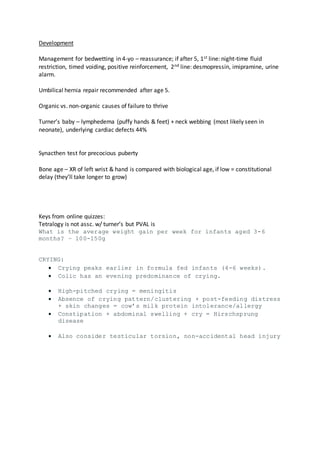
CRYING:
 Crying peaks earlier in formula fed infants (4-6 weeks).
 Colic has an evening predominance of crying.
 High-pitched crying = meningitis
 Absence of crying pattern/clustering + post-feeding distress
+ skin changes = cow’s milk protein intolerance/allergy
 Constipation + abdominal swelling + cry = Hirschsprung
disease
 Also consider testicular torsion, non-accidental head injury
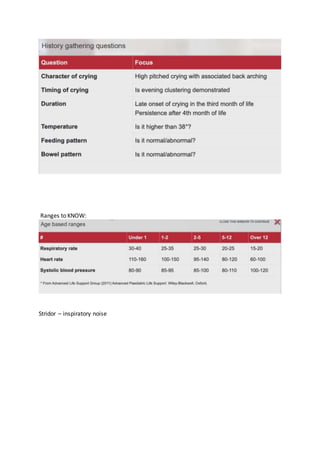
Ranges to KNOW:
Stridor – inspiratory noise

Paeds general notes

  • 1.
    Development Management for bedwettingin 4-yo – reassurance; if after 5, 1st line: night-time fluid restriction, timed voiding, positive reinforcement, 2nd line: desmopressin, imipramine, urine alarm. Umbilical hernia repair recommended after age 5. Organic vs. non-organic causes of failure to thrive Turner’s baby – lymphedema (puffy hands & feet) + neck webbing (most likely seen in neonate), underlying cardiac defects 44% Synacthen test for precocious puberty Bone age – XR of left wrist & hand is compared with biological age, if low = constitutional delay (they’ll take longer to grow) Keys from online quizzes: Tetralogy is not assc. w/ turner’s but PVAL is What is the average weight gain per week for infants aged 3-6 months? – 100-150g CRYING:  Crying peaks earlier in formula fed infants (4-6 weeks).  Colic has an evening predominance of crying.  High-pitched crying = meningitis  Absence of crying pattern/clustering + post-feeding distress + skin changes = cow’s milk protein intolerance/allergy  Constipation + abdominal swelling + cry = Hirschsprung disease  Also consider testicular torsion, non-accidental head injury
  • 2.
    Ranges to KNOW: Stridor– inspiratory noise