MANDEEP KAUR
Associate Professor
OBG
MATERNALASSESSMENT MEASURES
Definition:- Antenatal care refers to
the care that is given to an expectant
mother from the time that
conception is confirmed until the
beginning of labor. In addition to
monitoring the progress of the
pregnancy.
AIM: -
It aims to provide appropriate
support for the woman and her
family whatever the outcome of
the pregnancy and information
which will allow them to make
sensible and informed choices.
OBJECTIVES: -
1. To assess the health status of the mother
and fetus.
2. To screen out the ‘at risk’ pregnancy.
3. To formulate the plan of subsequent
management.
4. To obtain base line information against
which the subsequent changes are
assessed and which are of importance in
the determination of the
gestational age.
HISTORY TAKING:
Identifying information
Age
Duration of marriage
Chief complaints
Family history
Menstrual history
Obstetrical history- GPAL, GPA-B-C-D
Cont….
Terminology:
 Nulligravida
 Primigravida
 Multigravida
Multipara
Grand Multipara
Cont…
Present Obstetrical history-
1. First trimester (till12 weeks of
gestation)
2. Second trimester(12wk-28wk of
gestation)
3. Third trimester (>28wk)
Cont…
Past obstetrical history: 4 P’s
1. Pregnancy
2. Parturition
3. Puerperium
4. Product
•Personal history
OBSTETRICAL EXAMINATION
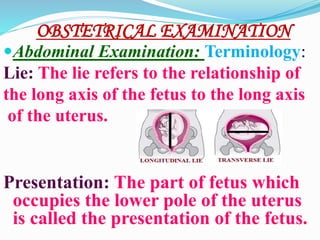
Abdominal Examination: Terminology:
Lie: The lie refers to the relationship of
the long axis of the fetus to the long axis
of the uterus.
Presentation: The part of fetus which
occupies the lower pole of the uterus
is called the presentation of the fetus.
CONT…
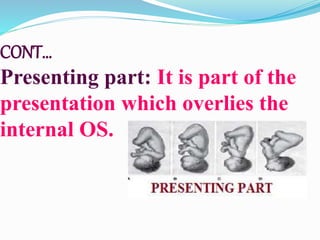
Presenting part: It is part of the
presentation which overlies the
internal OS.
CONT….
• ATTITUDE: The relation of the
different part of the fetus to one
another is called attitude.
• Denominator: The denominator is
the name of the part of the
presentation that is used to when
referring to fetal position.
• Position: It is the relation of the
denominator of the different
quadrants of the pelvis.
Cont…
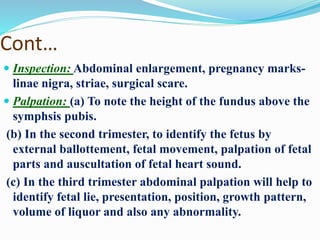
 Inspection: Abdominal enlargement, pregnancy marks-
linae nigra, striae, surgical scare.
 Palpation: (a) To note the height of the fundus above the
symphsis pubis.
(b) In the second trimester, to identify the fetus by
external ballottement, fetal movement, palpation of fetal
parts and auscultation of fetal heart sound.
(c) In the third trimester abdominal palpation will help to
identify fetal lie, presentation, position, growth pattern,
volume of liquor and also any abnormality.
Cont…
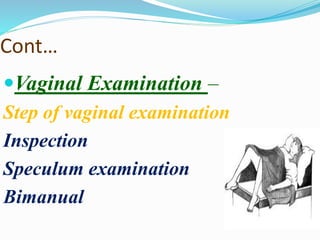
Vaginal Examination –
Step of vaginal examination
Inspection
Speculum examination
Bimanual
Cont…
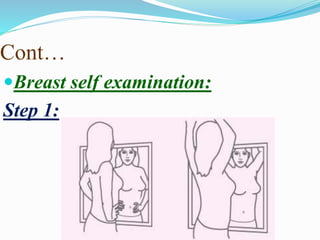
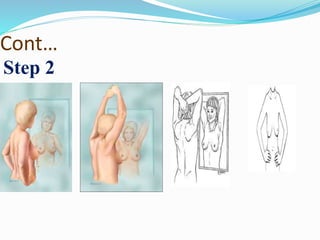
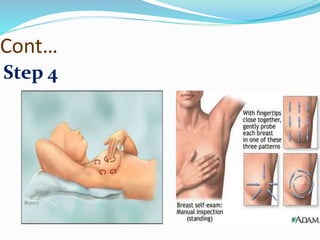
Breast self examination:
Step 1:
Cont…
Step 2
Cont…
Step 3
Cont…
Step 4
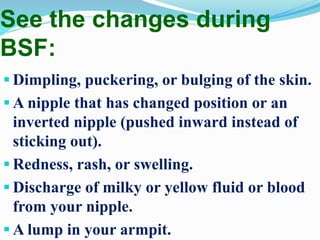
See the changes during
BSF:
 Dimpling, puckering, or bulging of the skin.
 A nipple that has changed position or an
inverted nipple (pushed inward instead of
sticking out).
 Redness, rash, or swelling.
 Discharge of milky or yellow fluid or blood
from your nipple.
 A lump in your armpit.
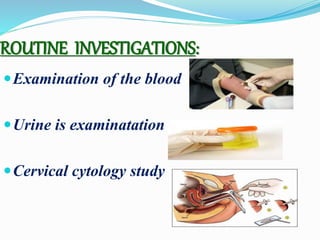
ROUTINE INVESTIGATIONS:
Examination of the blood
Urine is examinatation
Cervical cytology study
SPECIAL
INVESTIGATION
 Serological test for rubella and hepatitis B virus
 Maternal serum alpha feto protein (MSAFP)
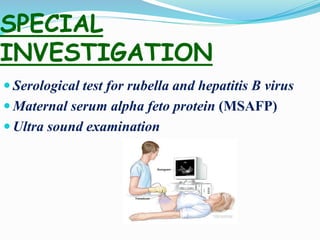
 Ultra sound examination
Maternal assessment measures

Maternal assessment measures