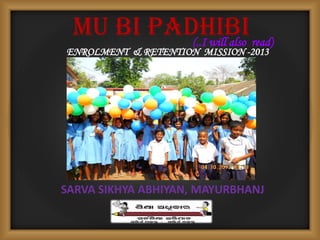
MU BI PADHIBI
ENROLMENT & RETENTION MISSION -2013
SARVA SIKHYA ABHIYAN, MAYURBHANJ
(..I will also read)
RATIONALE OF THE PROGRAMME
DISTRICT.- MAYURBHANJ
0
10
20
30
40
50
60
70
80
Literacy ST Literacy Women Literacy Rate
Mayurbhanj
Odisha
India
• Largest district in eastern India having dense forest & scattered habitation.
• Retention Rate- 68.38% which is 3rd lowest in the state.
• Drop out rate for Upper Primary is 8.33% in comparison to 7.57% in state.
• 56.59%age of Scheduled Tribe Population consisting of 30 schedule tribes
including 02 PTG having their own language.
• Prevalence of different languages used by the tribes makes Odia language, a
barrier in initiation of the learning process, in the very initial stages.
Keeping in view to comply with RTE, in hard to reach areas and disadvantages
groups, District Administration has launched the Massive Enrolment & Retention
Drive program “Mu Bi Padhibi” in convergence with ST/SC Dev. Dept., W&CD
Dept., Labor Dept., Health Dept. & Panchayati Raj Dept. on 1st April 2013 on the
eve of auspicious occasion of UTKAL DIVAS.
LITERACY RATE
 To identify & enrol each and every never enrolled and drop-
out child (6 - 14yrs.) in the District
 To rescue & mainstream the children working in
hotel/dhaba/garage and other hazardous places.
 To ensure 100% attendance of the student through community
participation and active involvement of stake holders as a
regular practice.
 Retention of children in school and reduction in drop-outs at
every stage.
 Capacity Building and sense of belongingness among
different stakeholders through stake holder
consultation, proper training and handholding.
 To ensure the teachers & students attendance through effective
monitoring.
AIMS AND OBJECTIVES
• Consultation with various field
functionaries,civil
society, teachers, NGOs, PRIs, et
c. for collection of views &
suggestions by organizing
workshop.
• Launch of the program.
• Organization of Head Masters’
conference at Sub-divisional
level to sensitize them.
PLAN OF ACTION
• Door to door survey for identification of target groups and collection of
data of “Drop-outs” and “Never enrolled” children.
• Organization of village level meeting & rally to create awareness among
the masses.
• Segregation of children for admission in appropriate school and class.
• Conduct parent counseling to
ensure admission of their
children.
• Collect socio-economic data of
parents of Out of School Children
to include them in different
livelihood support scheme.
• Publicity through mass media to
ensure enrolment.
Parent counseling program
• Physical verification of all enrolled students in school for de-duplication
of data and maintain data accuracy.
• Welcoming of all the students in the school by
tilak, chocolates, flowers, etc.
OUTCOME OF THE DRIVE
 Identification of 2871 never enrolled & 2654 drop out
children and their admission into different schools as per the
scheme given below -
 1419 children in Residential School of SC/ST Dept.
 647 children in Kasturba Gandhi Balika Vidyalaya.
 3322 children at Residential Special Training centre.
 67 of the rescued child labour enrolled in Residential Special
Training centre.
 28 PVTG Children enrolled in Special Schools.
 12 CWSN enrolled in Special Schools.
 42632 children enrolled in formal schools.
 Rescue of 104 child labor engaged in hotel / dhaba & other
hazardous sectors.
OUTCOME
Nos. of Children Identified & mainstreamed during “Mu Bi
Padhibi” is as below.-
No. of Children Identified
Children who
attend the age
6yrs.
Never Enrolled Drop Out
Child Labour
(below 14yrs.)
48521 2871 2654 104
No. children Mainstreamed
Formal
School
ST/SC (R/S) KGBV
Special
School
Provision
for RBC
Child
Labour
(below
14yrs.)
42632 1319 497 28 3322 104
RETENTION STRATEGY
This is the phase-II strategy of the
initiative – “MU BI PADHIBI”
 Development of Retention Plan
through stake holder
consultation, brain-storming and
organization of workshops and
sharing it with
CRCCs, BRCCs, S.I.s, BEOs, Headmast
ers, Teachers, etc.
 Organise Special child friendly
activities like story-telling festivals, art
and craft, traditional games, etc. in all
schools to attract children to schools
after re-opening and in the month of
August-September to keep them away
from fields, which is a major cause of
drop-outs.
 Tracking of Daily Attendance and
Initiation of specific steps for one
/two/ four days absentee children
& organisation of child friendly
activities during post-lunch session
at the school, led to improvement
in school attendance upto 84%.
 Engagement of 176 nos. of Local
Educated Tribal Youth as Siksha-
Sathi in remote & inaccessible
pockets.
Develop bi-lingual primers in tribal languages where more than one
tribal language prevail.
 Organization of workshops for Capacity Building and motivation of
field functionaries.
 Provision of special incentives like school bags, reading writing
materials, solar hurricane for RST centre.
MONITORING
 Formation of 3-Tier Monitoring
System---Gaon Siksha Parishad at
village level, Siksha Panchayat at G.P
level and Block Siksha Parishad at
block level followed by the District
level monthly review.
 Daily tracking on attendance of
children of nearly 350 schools of the
District through Education Cell.
Formation of Monitoring Teams
consisting of DIET Teacher Educator &
Educationist to provide on-site
pedagogical support to RST centre.
 Cross monitoring of education
districts through field functionaries
with support of DIET.
 Surprise checking for “attendance
in schools” located at
Municipalities & NAC areas in
regular interval.
 Exposure visit of teachers and
SMC members to other district to
ensure better involvement of
SMCs.
 RMS – Rapid Monitoring System
for random check and visits to
ensure action on Teacher and
Student attendance.
FUTURE STRATEGY
• Try and ensure that no child remains out of school in the age
group 6-14 by announcing award.
• Ensure more than 90% attendance in all schools through
proper monitoring, motivation of teachers and awareness
among parents.
• Ensure that all out off school and never enrolled children are
being tracked and their mainstreaming is ensured smoothly.
• Make the stake holders accountable for the education of
children.
• Focus on minimum quality as third phase of the mission.
Thank you

Enrollment & Retention Mission in Schools, Mayurbhanu, Odisha.

  • 1.
    MU BI PADHIBI ENROLMENT& RETENTION MISSION -2013 SARVA SIKHYA ABHIYAN, MAYURBHANJ (..I will also read)
  • 3.
    RATIONALE OF THEPROGRAMME DISTRICT.- MAYURBHANJ 0 10 20 30 40 50 60 70 80 Literacy ST Literacy Women Literacy Rate Mayurbhanj Odisha India • Largest district in eastern India having dense forest & scattered habitation. • Retention Rate- 68.38% which is 3rd lowest in the state. • Drop out rate for Upper Primary is 8.33% in comparison to 7.57% in state. • 56.59%age of Scheduled Tribe Population consisting of 30 schedule tribes including 02 PTG having their own language. • Prevalence of different languages used by the tribes makes Odia language, a barrier in initiation of the learning process, in the very initial stages. Keeping in view to comply with RTE, in hard to reach areas and disadvantages groups, District Administration has launched the Massive Enrolment & Retention Drive program “Mu Bi Padhibi” in convergence with ST/SC Dev. Dept., W&CD Dept., Labor Dept., Health Dept. & Panchayati Raj Dept. on 1st April 2013 on the eve of auspicious occasion of UTKAL DIVAS. LITERACY RATE
  • 4.
     To identify& enrol each and every never enrolled and drop- out child (6 - 14yrs.) in the District  To rescue & mainstream the children working in hotel/dhaba/garage and other hazardous places.  To ensure 100% attendance of the student through community participation and active involvement of stake holders as a regular practice.  Retention of children in school and reduction in drop-outs at every stage.  Capacity Building and sense of belongingness among different stakeholders through stake holder consultation, proper training and handholding.  To ensure the teachers & students attendance through effective monitoring. AIMS AND OBJECTIVES
  • 5.
    • Consultation withvarious field functionaries,civil society, teachers, NGOs, PRIs, et c. for collection of views & suggestions by organizing workshop. • Launch of the program. • Organization of Head Masters’ conference at Sub-divisional level to sensitize them. PLAN OF ACTION • Door to door survey for identification of target groups and collection of data of “Drop-outs” and “Never enrolled” children. • Organization of village level meeting & rally to create awareness among the masses. • Segregation of children for admission in appropriate school and class.
  • 6.
    • Conduct parentcounseling to ensure admission of their children. • Collect socio-economic data of parents of Out of School Children to include them in different livelihood support scheme. • Publicity through mass media to ensure enrolment. Parent counseling program • Physical verification of all enrolled students in school for de-duplication of data and maintain data accuracy. • Welcoming of all the students in the school by tilak, chocolates, flowers, etc.
  • 7.
    OUTCOME OF THEDRIVE  Identification of 2871 never enrolled & 2654 drop out children and their admission into different schools as per the scheme given below -  1419 children in Residential School of SC/ST Dept.  647 children in Kasturba Gandhi Balika Vidyalaya.  3322 children at Residential Special Training centre.  67 of the rescued child labour enrolled in Residential Special Training centre.  28 PVTG Children enrolled in Special Schools.  12 CWSN enrolled in Special Schools.  42632 children enrolled in formal schools.  Rescue of 104 child labor engaged in hotel / dhaba & other hazardous sectors.
  • 8.
    OUTCOME Nos. of ChildrenIdentified & mainstreamed during “Mu Bi Padhibi” is as below.- No. of Children Identified Children who attend the age 6yrs. Never Enrolled Drop Out Child Labour (below 14yrs.) 48521 2871 2654 104 No. children Mainstreamed Formal School ST/SC (R/S) KGBV Special School Provision for RBC Child Labour (below 14yrs.) 42632 1319 497 28 3322 104
  • 9.
    RETENTION STRATEGY This isthe phase-II strategy of the initiative – “MU BI PADHIBI”  Development of Retention Plan through stake holder consultation, brain-storming and organization of workshops and sharing it with CRCCs, BRCCs, S.I.s, BEOs, Headmast ers, Teachers, etc.  Organise Special child friendly activities like story-telling festivals, art and craft, traditional games, etc. in all schools to attract children to schools after re-opening and in the month of August-September to keep them away from fields, which is a major cause of drop-outs.
  • 10.
     Tracking ofDaily Attendance and Initiation of specific steps for one /two/ four days absentee children & organisation of child friendly activities during post-lunch session at the school, led to improvement in school attendance upto 84%.  Engagement of 176 nos. of Local Educated Tribal Youth as Siksha- Sathi in remote & inaccessible pockets. Develop bi-lingual primers in tribal languages where more than one tribal language prevail.  Organization of workshops for Capacity Building and motivation of field functionaries.  Provision of special incentives like school bags, reading writing materials, solar hurricane for RST centre.
  • 11.
    MONITORING  Formation of3-Tier Monitoring System---Gaon Siksha Parishad at village level, Siksha Panchayat at G.P level and Block Siksha Parishad at block level followed by the District level monthly review.  Daily tracking on attendance of children of nearly 350 schools of the District through Education Cell. Formation of Monitoring Teams consisting of DIET Teacher Educator & Educationist to provide on-site pedagogical support to RST centre.
  • 12.
     Cross monitoringof education districts through field functionaries with support of DIET.  Surprise checking for “attendance in schools” located at Municipalities & NAC areas in regular interval.  Exposure visit of teachers and SMC members to other district to ensure better involvement of SMCs.  RMS – Rapid Monitoring System for random check and visits to ensure action on Teacher and Student attendance.
  • 13.
    FUTURE STRATEGY • Tryand ensure that no child remains out of school in the age group 6-14 by announcing award. • Ensure more than 90% attendance in all schools through proper monitoring, motivation of teachers and awareness among parents. • Ensure that all out off school and never enrolled children are being tracked and their mainstreaming is ensured smoothly. • Make the stake holders accountable for the education of children. • Focus on minimum quality as third phase of the mission.
  • 15.