PacketEye 1.0
Java based packet sniffer application
Packet Sniffing by Ramakrishna is licensed under a Creative CommonsAttribution 4.0 International License.
Contents
▪ Introduction
▪ Technologies used
▪ How it works
▪ Features
▪ GUI
▪ User classes
▪ Benefits
Introduction
▪ The information running through networks is a valuable source
of evidence for network administrators to fish out intruders or
anomalous connections.
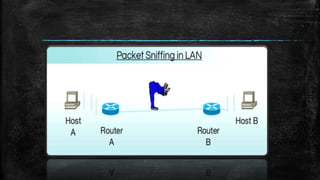
▪ A Packet Sniffer is a program that can monitor every packet that
crosses the network.
▪ Packet sniffers are network troubleshooting tools that provide a
detailed view of network traffic.
Introduction(cont…)
▪ This project’s intention is to develop a tool called PacketEye
(Packet Sniffer).
▪ Purpose of PacketEye project is to analyze ongoing traffic in a
network.
▪ It will help the administrator to examine network system for any
security breaches by observing the IP addresses.
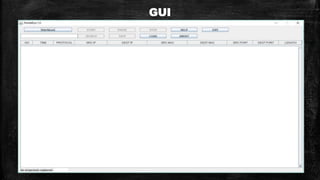
▪ The information that the user can capture includes protocol,
time of capture, source and destination IP, source and
destination MAC, port numbers and the data.
How it works
▪ A Packet Eye works by looking at every packet sent in the
network, including packets not intended for itself.
▪ To capture the packets using PacketEye we are setting NIC in
promiscuous mode.
▪ Promiscuous mode causes the controller to pass all the traffic it
receives to the CPU rather than passing only the frames that the
controller is intended to receive.
Technologies used
▪ For GUI design we used java awt & swings.
▪ For back-end we have used jpcap library developed in java.
▪ To develop java application using jpcap we have used a third-
party library called WinPcap.
Features
▪ Network monitoring for different networks
▪ Storing the captured packet for future references
▪ Retrieving the stored data
▪ Packet filtering
▪ Platform independent GUI
Features(cont…)
▪ Exploits information passed in clear text
▪ Protocols that pass information in clear text format are:
▪ Telnet
▪ FTP (File Transfer Protocol)
▪ SNMP (Simple Network Management Protocol)
▪ POP (Post Office Protocol)
GUI
User Classes
▪ These are the persons/devices that are part of sniffing process
Sender
Receiver
Intruder
Administrator
Benefits
▪ Platform independent
▪ It consumes less memory (RAM)
▪ It consumes less hard disk space
▪ Java based GUI for better user experience
▪ Conversion of Network traffic into human readable form
TEAM MEMBERS
▪ P. Ayyappa Swamy (N120170)
▪ P. Rama Krishna (N120382)
▪ D. VaraLakshmi (N120155)
▪ K. Mani (N120642)
Thank you

PacketEye

  • 1.
    PacketEye 1.0 Java basedpacket sniffer application Packet Sniffing by Ramakrishna is licensed under a Creative CommonsAttribution 4.0 International License.
  • 2.
    Contents ▪ Introduction ▪ Technologiesused ▪ How it works ▪ Features ▪ GUI ▪ User classes ▪ Benefits
  • 3.
    Introduction ▪ The informationrunning through networks is a valuable source of evidence for network administrators to fish out intruders or anomalous connections. ▪ A Packet Sniffer is a program that can monitor every packet that crosses the network. ▪ Packet sniffers are network troubleshooting tools that provide a detailed view of network traffic.
  • 5.
    Introduction(cont…) ▪ This project’sintention is to develop a tool called PacketEye (Packet Sniffer). ▪ Purpose of PacketEye project is to analyze ongoing traffic in a network. ▪ It will help the administrator to examine network system for any security breaches by observing the IP addresses. ▪ The information that the user can capture includes protocol, time of capture, source and destination IP, source and destination MAC, port numbers and the data.
  • 6.
    How it works ▪A Packet Eye works by looking at every packet sent in the network, including packets not intended for itself. ▪ To capture the packets using PacketEye we are setting NIC in promiscuous mode. ▪ Promiscuous mode causes the controller to pass all the traffic it receives to the CPU rather than passing only the frames that the controller is intended to receive.
  • 7.
    Technologies used ▪ ForGUI design we used java awt & swings. ▪ For back-end we have used jpcap library developed in java. ▪ To develop java application using jpcap we have used a third- party library called WinPcap.
  • 8.
    Features ▪ Network monitoringfor different networks ▪ Storing the captured packet for future references ▪ Retrieving the stored data ▪ Packet filtering ▪ Platform independent GUI
  • 9.
    Features(cont…) ▪ Exploits informationpassed in clear text ▪ Protocols that pass information in clear text format are: ▪ Telnet ▪ FTP (File Transfer Protocol) ▪ SNMP (Simple Network Management Protocol) ▪ POP (Post Office Protocol)
  • 10.
  • 11.
    User Classes ▪ Theseare the persons/devices that are part of sniffing process Sender Receiver Intruder Administrator
  • 12.
    Benefits ▪ Platform independent ▪It consumes less memory (RAM) ▪ It consumes less hard disk space ▪ Java based GUI for better user experience ▪ Conversion of Network traffic into human readable form
  • 13.
    TEAM MEMBERS ▪ P.Ayyappa Swamy (N120170) ▪ P. Rama Krishna (N120382) ▪ D. VaraLakshmi (N120155) ▪ K. Mani (N120642)
  • 14.