

The basics of
network cable
connections.
Page 2
Instructor, PACE-IT Program – Edmonds Community College
Areas of Expertise Industry Certifications
 PC Hardware
 Network Administration
 IT Project Management
 Network Design
 User Training
 IT Troubleshooting
Qualifications Summary
Education
 M.B.A., IT Management, Western Governor’s University
 B.S., IT Security, Western Governor’s University
Entrepreneur, executive leader, and proven manger
with 10+ years of experience turning complex issues
into efficient and effective solutions.
Strengths include developing and mentoring diverse
workforces, improving processes, analyzing
business needs and creating the solutions
required— with a focus on technology.
Page 3
PACE-IT.
– Fiber optic network connections.
– Coaxial network connections.
– Twisted pair wire network connections.
Page 4
The basics of network cable connections.
Page 5
The basics of network cable connections.
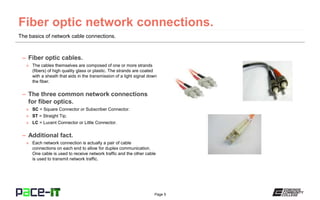
– Fiber optic cables.
» The cables themselves are composed of one or more strands
(fibers) of high quality glass or plastic. The strands are coated
with a sheath that aids in the transmission of a light signal down
the fiber.
– The three common network connections
for fiber optics.
» SC = Square Connector or Subscriber Connector.
» ST = Straight Tip.
» LC = Lucent Connector or Little Connector.
– Additional fact.
» Each network connection is actually a pair of cable
connections on each end to allow for duplex communication.
One cable is used to receive network traffic and the other cable
is used to transmit network traffic.
Page 6
The basics of network cable connections.
Page 7
The basics of network cable connections.
– Coaxial cable.
» A coaxial (coax) network cable is composed of a central
conductor (which may be solid copper, stranded copper, or
copper plated steel) that is surrounded by an insulating layer,
which is surrounded by a shield layer (that may be composed
of metal foil, braided metal strands, or metal mesh), which is
finally surrounded by an outer insulating layer. The ends of a
coax network cable are required to be terminated with a
resistor to eliminate signal bounce.
– The common network connector for coax
cable.
» F connector = a simple rugged connector. They are used with
RG-6 (radio grade) or RG-59 coaxial cable.
– Less common network connector for coax
cable.
» BNC = Bayonet Neill-Concelman connector or bayonet nut
connector. This is an older technology that really isn’t used in
the modern network.
Page 8
The basics of network cable connections.
Page 9
The basics of network cable connections.
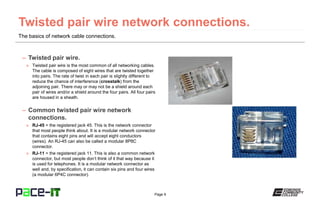
– Twisted pair wire.
» Twisted pair wire is the most common of all networking cables.
The cable is composed of eight wires that are twisted together
into pairs. The rate of twist in each pair is slightly different to
reduce the chance of interference (crosstalk) from the
adjoining pair. There may or may not be a shield around each
pair of wires and/or a shield around the four pairs. All four pairs
are housed in a sheath.
– Common twisted pair wire network
connections.
» RJ-45 = the registered jack 45. This is the network connector
that most people think about. It is a modular network connector
that contains eight pins and will accept eight conductors
(wires). An RJ-45 can also be called a modular 8P8C
connector.
» RJ-11 = the registered jack 11. This is also a common network
connector, but most people don’t think of it that way because it
is used for telephones. It is a modular network connector as
well and, by specification, it can contain six pins and four wires
(a modular 6P4C connector).
Page 10
The basics of network cable connections.
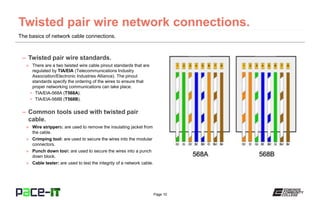
– Twisted pair wire standards.
» There are a two twisted wire cable pinout standards that are
regulated by TIA/EIA (Telecommunications Industry
Association/Electronic Industries Alliance). The pinout
standards specify the ordering of the wires to ensure that
proper networking communications can take place.
• TIA/EIA-568A (T568A).
• TIA/EIA-568B (T568B).
– Common tools used with twisted pair
cable.
» Wire strippers: are used to remove the insulating jacket from
the cable.
» Crimping tool: are used to secure the wires into the modular
connectors.
» Punch down tool: are used to secure the wires into a punch
down block.
» Cable tester: are used to test the integrity of a network cable.
Page 11
Fiber optic cables are composed of glass or plastic fibers that are coated in
a sheath to aid in signal transmission. There are three common types of
connectors: the SC, the ST, and the LC.
Topic
Fiber optic network
connections.
Summary
Coax cable is composed of a central conductor, surrounded by a insulating
sleeve, surrounded by a shield, which is all surrounded by an insulating
layer. The modern coax network connector is the F connector, which is
used with RG-6 and RG-59 coax cable. A less common coax network
connector is the BNC.
Coaxial network connections.
Twisted pair wire cables are composed of eight wires that are twisted
together in pairs. The most common network connectors are the RJ-45
(8P8C) modular connector and the RJ-11 (6P4C) modular connector. The
TIA/EIA has established a pair of wiring standards (T568A and T568B) for
network communications.
Twisted pair wire network
connections.
The basics of network cable connections.
Page 12
THANK YOU!
This workforce solution was 100 percent funded by a $3 million grant awarded by the
U.S. Department of Labor's Employment and Training Administration. The solution was
created by the grantee and does not necessarily reflect the official position of the U.S.
Department of Labor. The Department of Labor makes no guarantees, warranties, or
assurances of any kind, express or implied, with respect to such information, including
any information on linked sites and including, but not limited to, accuracy of the
information or its completeness, timeliness, usefulness, adequacy, continued availability
or ownership. Funded by the Department of Labor, Employment and Training
Administration, Grant #TC-23745-12-60-A-53.
PACE-IT is an equal opportunity employer/program and auxiliary aids and services are
available upon request to individuals with disabilities. For those that are hearing
impaired, a video phone is available at the Services for Students with Disabilities (SSD)
office in Mountlake Terrace Hall 159. Check www.edcc.edu/ssd for office hours. Call
425.354.3113 on a video phone for more information about the PACE-IT program. For
any additional special accommodations needed, call the SSD office at 425.640.1814.
Edmonds Community College does not discriminate on the basis of race; color; religion;
national origin; sex; disability; sexual orientation; age; citizenship, marital, or veteran
status; or genetic information in its programs and activities.

Pace IT - Basic Network Connections

  • 1.
    The basics of networkcable connections.
  • 2.
    Page 2 Instructor, PACE-ITProgram – Edmonds Community College Areas of Expertise Industry Certifications  PC Hardware  Network Administration  IT Project Management  Network Design  User Training  IT Troubleshooting Qualifications Summary Education  M.B.A., IT Management, Western Governor’s University  B.S., IT Security, Western Governor’s University Entrepreneur, executive leader, and proven manger with 10+ years of experience turning complex issues into efficient and effective solutions. Strengths include developing and mentoring diverse workforces, improving processes, analyzing business needs and creating the solutions required— with a focus on technology.
  • 3.
    Page 3 PACE-IT. – Fiberoptic network connections. – Coaxial network connections. – Twisted pair wire network connections.
  • 4.
    Page 4 The basicsof network cable connections.
  • 5.
    Page 5 The basicsof network cable connections. – Fiber optic cables. » The cables themselves are composed of one or more strands (fibers) of high quality glass or plastic. The strands are coated with a sheath that aids in the transmission of a light signal down the fiber. – The three common network connections for fiber optics. » SC = Square Connector or Subscriber Connector. » ST = Straight Tip. » LC = Lucent Connector or Little Connector. – Additional fact. » Each network connection is actually a pair of cable connections on each end to allow for duplex communication. One cable is used to receive network traffic and the other cable is used to transmit network traffic.
  • 6.
    Page 6 The basicsof network cable connections.
  • 7.
    Page 7 The basicsof network cable connections. – Coaxial cable. » A coaxial (coax) network cable is composed of a central conductor (which may be solid copper, stranded copper, or copper plated steel) that is surrounded by an insulating layer, which is surrounded by a shield layer (that may be composed of metal foil, braided metal strands, or metal mesh), which is finally surrounded by an outer insulating layer. The ends of a coax network cable are required to be terminated with a resistor to eliminate signal bounce. – The common network connector for coax cable. » F connector = a simple rugged connector. They are used with RG-6 (radio grade) or RG-59 coaxial cable. – Less common network connector for coax cable. » BNC = Bayonet Neill-Concelman connector or bayonet nut connector. This is an older technology that really isn’t used in the modern network.
  • 8.
    Page 8 The basicsof network cable connections.
  • 9.
    Page 9 The basicsof network cable connections. – Twisted pair wire. » Twisted pair wire is the most common of all networking cables. The cable is composed of eight wires that are twisted together into pairs. The rate of twist in each pair is slightly different to reduce the chance of interference (crosstalk) from the adjoining pair. There may or may not be a shield around each pair of wires and/or a shield around the four pairs. All four pairs are housed in a sheath. – Common twisted pair wire network connections. » RJ-45 = the registered jack 45. This is the network connector that most people think about. It is a modular network connector that contains eight pins and will accept eight conductors (wires). An RJ-45 can also be called a modular 8P8C connector. » RJ-11 = the registered jack 11. This is also a common network connector, but most people don’t think of it that way because it is used for telephones. It is a modular network connector as well and, by specification, it can contain six pins and four wires (a modular 6P4C connector).
  • 10.
    Page 10 The basicsof network cable connections. – Twisted pair wire standards. » There are a two twisted wire cable pinout standards that are regulated by TIA/EIA (Telecommunications Industry Association/Electronic Industries Alliance). The pinout standards specify the ordering of the wires to ensure that proper networking communications can take place. • TIA/EIA-568A (T568A). • TIA/EIA-568B (T568B). – Common tools used with twisted pair cable. » Wire strippers: are used to remove the insulating jacket from the cable. » Crimping tool: are used to secure the wires into the modular connectors. » Punch down tool: are used to secure the wires into a punch down block. » Cable tester: are used to test the integrity of a network cable.
  • 11.
    Page 11 Fiber opticcables are composed of glass or plastic fibers that are coated in a sheath to aid in signal transmission. There are three common types of connectors: the SC, the ST, and the LC. Topic Fiber optic network connections. Summary Coax cable is composed of a central conductor, surrounded by a insulating sleeve, surrounded by a shield, which is all surrounded by an insulating layer. The modern coax network connector is the F connector, which is used with RG-6 and RG-59 coax cable. A less common coax network connector is the BNC. Coaxial network connections. Twisted pair wire cables are composed of eight wires that are twisted together in pairs. The most common network connectors are the RJ-45 (8P8C) modular connector and the RJ-11 (6P4C) modular connector. The TIA/EIA has established a pair of wiring standards (T568A and T568B) for network communications. Twisted pair wire network connections. The basics of network cable connections.
  • 12.
  • 13.
    This workforce solutionwas 100 percent funded by a $3 million grant awarded by the U.S. Department of Labor's Employment and Training Administration. The solution was created by the grantee and does not necessarily reflect the official position of the U.S. Department of Labor. The Department of Labor makes no guarantees, warranties, or assurances of any kind, express or implied, with respect to such information, including any information on linked sites and including, but not limited to, accuracy of the information or its completeness, timeliness, usefulness, adequacy, continued availability or ownership. Funded by the Department of Labor, Employment and Training Administration, Grant #TC-23745-12-60-A-53. PACE-IT is an equal opportunity employer/program and auxiliary aids and services are available upon request to individuals with disabilities. For those that are hearing impaired, a video phone is available at the Services for Students with Disabilities (SSD) office in Mountlake Terrace Hall 159. Check www.edcc.edu/ssd for office hours. Call 425.354.3113 on a video phone for more information about the PACE-IT program. For any additional special accommodations needed, call the SSD office at 425.640.1814. Edmonds Community College does not discriminate on the basis of race; color; religion; national origin; sex; disability; sexual orientation; age; citizenship, marital, or veteran status; or genetic information in its programs and activities.