Waterwise Gardening:
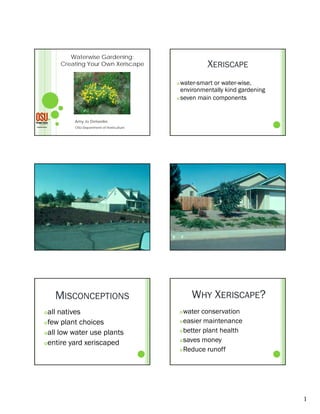
     Creating Your Own Xeriscape                       XERISCAPE
                                           water-smart or water-wise,
                                            environmentally kind g
                                                           y     gardening
                                                                         g
                                           seven main components


         Amy Jo Detweiler,
         OSU-Department of Horticulture


    MISCONCEPTIONS                                WHY XERISCAPE?
all natives                                   water conservation
few plant choices                             easier maintenance

                                               better plant health
all low water use plants
                                               saves money
entire yard xeriscaped
                                               Reduce runoff


                                                                             1
7 STEPS               1. PLANNING AND DESIGN
planning &     efficient        assess your site – taking note of
 design          irrigation        structures, topography, and
plant
                mulching          microclimates
 selection
                maintenance
soils

turf


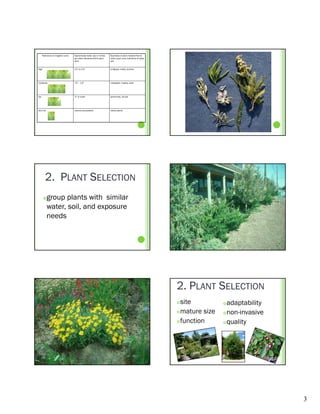
                               1. PLANNING & DESIGN
                                collect ideas
                                consider your

                                 budget
                                do it yourself or

                                 hire a
                                 landscape
                                 professional


1. PLANNING & DESIGN                     4 HYDROZONES
                                         (IRRIGATION ZONES)
 different hydrozones or              High
  adaptive irrigation                                              uses
 Xeriscape 30-70% of the
                                         Moderate
                                         M d t                 supplemental
                                                                   l    t l
                                                                  water
  landscape
                                              Low
 install in phases


                                                    Very low


                                                                              2
Hydrozone or Irrigation zone   Approximate water use in inches   Examples of plant material found
                                     per week delivered within each    within each zone indicative of water
                                     zone                              use


high                                 1.5 to 2.0”                       turfgrass, willow, birches


moderate                             .75 – 1.0”                        crabapple, maples, oaks


low                                  .5” or lower                      perennials, shrubs


very low                             natural precipitation             native plants


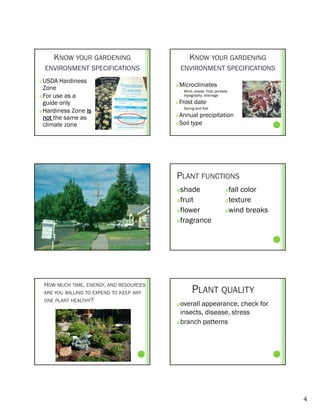
         2. PLANT SELECTION
          group plants with similar
           water, soil
           water soil, and exposure
           needs


                                                                                                              2. PLANT SELECTION
                                                                                                               site           adaptability
                                                                                                               mature size    non-invasive

                                                                                                               function       quality


                                                                                                                                               3
KNOW YOUR GARDENING                             KNOW YOUR GARDENING
    ENVIRONMENT SPECIFICATIONS                  ENVIRONMENT SPECIFICATIONS
 USDA Hardiness
  Zone                                         Microclimates
                                                   Wind, shade, frost pockets,
 For use as a                                      topography, drainage

  guide only                                   Frost date
                                                    Spring and Fall
 Hardiness Zone is
                                                


  not the same as                            Annual precipitation
                                             Soil type
  climate zone


                                            PLANT FUNCTIONS
                                            shade                           fall color
                                            fruit                           texture

                                            flower                          wind breaks

                                            fragrance


    HOW MUCH TIME, ENERGY, AND RESOURCES
    ARE YOU WILLING TO EXPEND TO KEEP ANY               PLANT QUALITY
    ONE PLANT HEALTHY?
                                             overall appearance, check for
                                              insects, disease, stress
                                             branch patterns


                                                                                            4
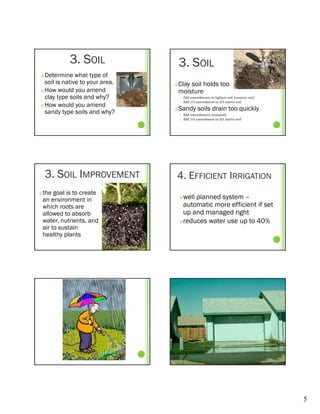
3. SOIL                3. SOIL
 Determine what type of
  soil is native to your area.      Clay soil holds too                        much
 How would you amend
               y                     moisture
  clay type soils and why?              Add amendments to lighten soil (coconut coir)
                                         Add 1/3 amendment to 2/3 native soil
 How would you amend
                                     


  sandy type soils and why?
                                    Sandy soils drain too quickly
                                        Add amendments (compost)
                                        Add 1/3 amendment to 2/3 native soil


    3. SOIL IMPROVEMENT          4. EFFICIENT IRRIGATION
   the goal is to create
    an environment in                 well planned system –
    which roots are                    automatic more efficient if set
    allowed to absorb                  up and managed right
    water, nutrients, and             reduces water use up to 40%
    air to sustain
    healthy plants


                                                                                         5
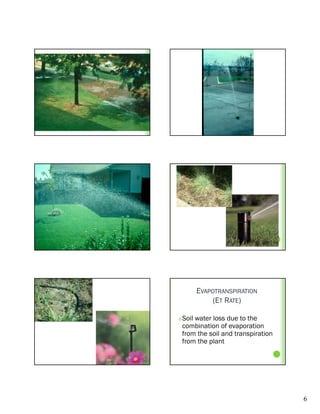
EVAPOTRANSPIRATION
             (ET RATE)

   Soil water loss due to the
    combination of evaporation
    from the soil and transpiration
    from the plant


                                      6
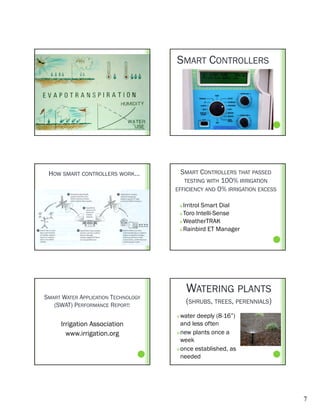
SMART CONTROLLERS


 HOW SMART CONTROLLERS WORK…           SMART CONTROLLERS THAT PASSED
                                        TESTING WITH 100% IRRIGATION
                                     EFFICIENCY AND 0% IRRIGATION EXCESS

                                          Irritrol Smart Dial
                                          Toro Intelli-Sense
                                          WeatherTRAK

                                          Rainbird ET Manager


                                             WATERING PLANTS
SMART WATER APPLICATION TECHNOLOGY
   (SWAT) PERFORMANCE REPORT:
                                             (SHRUBS, TREES, PERENNIALS)
                                      water deeply (8-16”)
     Irrigation Association
     I i i A         i i               and l
                                         d less often
                                                 ft
       www.irrigation.org             new plants once a

                                       week
                                      once established, as

                                       needed


                                                                           7
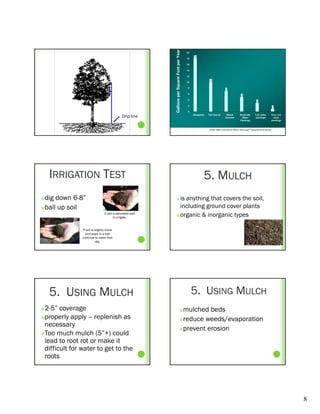
Gallons per Square Foot per Year
                                                                                                20
                                                                                                     18
                                                                                                18

                                                                                                16

                                                                                                14

                                                                                                12
                                                                                                                  10
                                                                                                10

                                                                                                 8
                                                                                                                                  7


                                                                       r
                                                                                                 6
                                                                                                                                                 5

                                                                                                 4                                                               3

                                                                                                 2                                                                                 1

                                                                                                 0

                                               Drip line                                             Bluegrass   Tall Fescue      Wheat
                                                                                                                                 Grasses
                                                                                                                                                Moderate
                                                                                                                                                  Water
                                                                                                                                                               Low water
                                                                                                                                                               plantings
                                                                                                                                                                               Very Low
                                                                                                                                                                                 water
                                                                                                                                                Plantings                      plantings


                                                                                                                  Values taken from Denver Water Xeriscape™ Demonstration Garden


    IRRIGATION TEST                                                                                          5. MULCH
 dig down 6-8”                                                 is anything that covers the soil,
 ball up soil                                                   including ground cover plants
                                                                organic & inorganic types
                                 If soil is saturated wait
                                         to irrigate.


               If soil is slightly moist
                 and stays in a ball
               continue to water that
                          day.


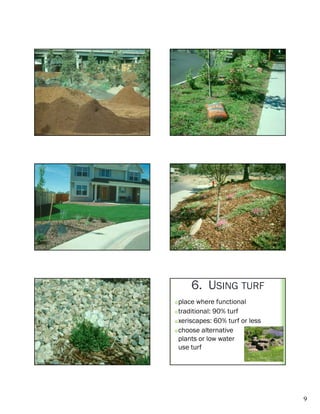
    5. USING MULCH                                                                                   5. USING MULCH
 2-5” coverage                                                                         mulched beds
 properly apply – replenish as
                                                                                        reduce weeds/evaporation
                                                                                                       / p
  necessary
                                                                                        prevent erosion
 Too much mulch (5”+) could

  lead to root rot or make it
  difficult for water to get to the
  roots


                                                                                                                                                                                           8
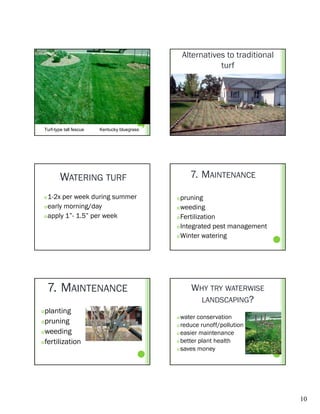
6. USING TURF
 place where functional
 traditional: 90% turf

 xeriscapes: 60% turf or less

 choose alternative

  plants or low water
  use turf


                                 9
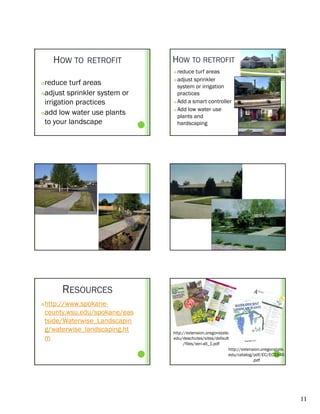
Alternatives to traditional
                                                             turf


 Turf-type tall fescue   Kentucky bluegrass


         WATERING TURF                              7. MAINTENANCE

  1-2x per week during summer                 pruning
  early morning/day                           weeding

  apply 1”- 1.5” per week                     Fertilization

                                               Integrated pest management

                                               Winter watering


     7. MAINTENANCE                                 WHY TRY WATERWISE
                                                      LANDSCAPING?
planting
                                               water conservation
pruning
                                               reduce runoff/pollution

weeding                                       easier maintenance

fertilization                                 better plant health

                                               saves money


                                                                                10
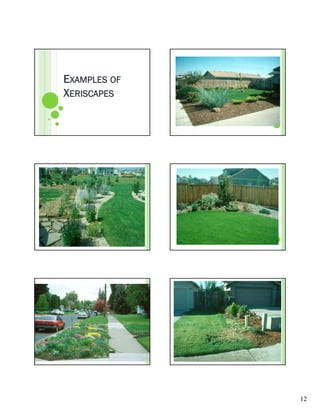
HOW TO    RETROFIT         HOW TO RETROFIT
                                  reduce turf areas
                                   adjust sprinkler
reduce turf areas               

                                   system or irrigation
adjust sprinkler system or        practices
                                       ti
 irrigation practices             Add a smart controller

                                  Add low water use
add low water use plants
                                   plants and
 to your landscape                 hardscaping


         RESOURCES
   http://www.spokane-
    county.wsu.edu/spokane/eas
    tside/Waterwise_Landscapin
    tside/Waterwise Landscapin
    g/waterwise_landscaping.ht   http://extension.oregonstate.
    m                            edu/deschutes/sites/default
                                       /files/xeri-all_1.pdf
                                                             http://extension.oregonstate.
                                                             edu/catalog/pdf/EC/EC1546
                                                                          .pdf


                                                                                             11
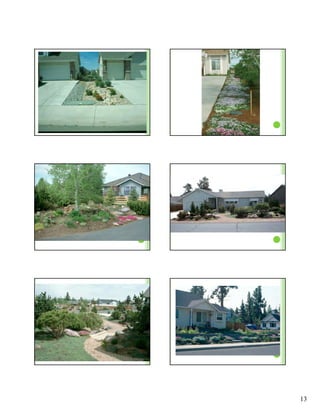
EXAMPLES OF
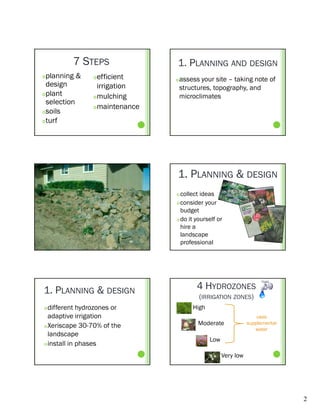
XERISCAPES


              12
13
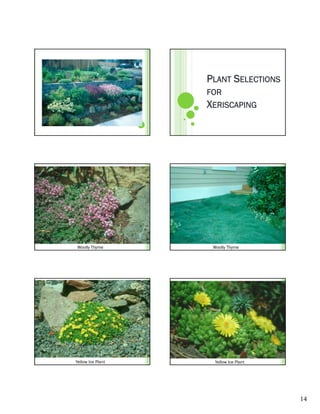
PLANT SELECTIONS
                   FOR
                   XERISCAPING


Woolly Thyme        Woolly Thyme


Yellow Ice Plant    Yellow Ice Plant


                                       14
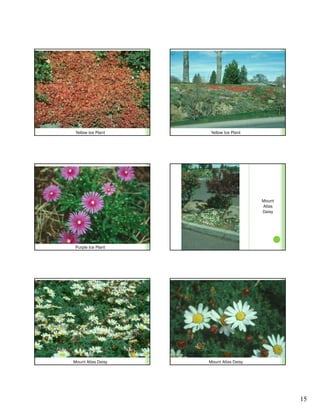
Yellow Ice Plant    Yellow Ice Plant


                                        Mount
                                        Atlas
                                        Daisy


 Purple Ice Plant


Mount Atlas Daisy   Mount Atlas Daisy


                                                15
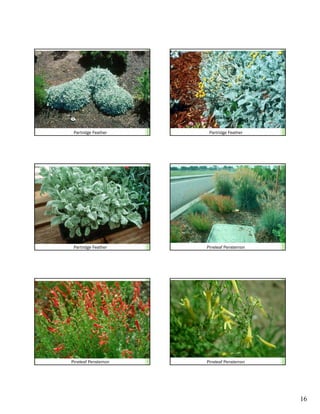
Partridge Feather    Partridge Feather


 Partridge Feather   Pineleaf Penstemon


Pineleaf Penstemon   Pineleaf Penstemon


                                          16
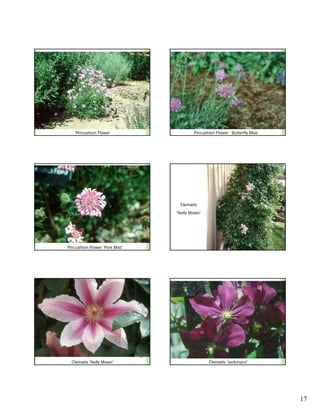
Pincushion Flower                    Pincushion Flower ‘ Butterfly Blue’


                                  Clematis
                                ‘Nelly Moser’


Pincushion Flower ‘Pink Mist’


  Clematis ‘Nelly Moser’                         Clematis ‘Jackmanii’


                                                                               17
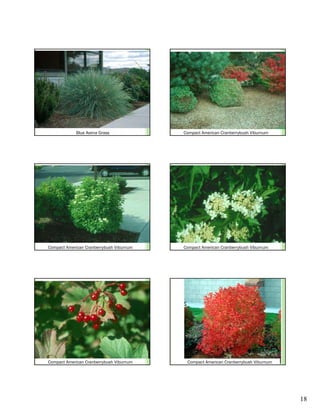
Blue Avena Grass              Compact American Cranberrybush Viburnum


Compact American Cranberrybush Viburnum   Compact American Cranberrybush Viburnum


Compact American Cranberrybush Viburnum    Compact American Cranberrybush Viburnum


                                                                                     18
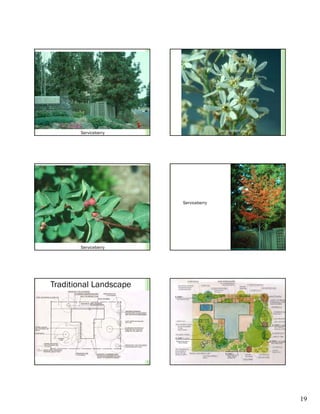
Serviceberry                              Serviceberry


                                  Serviceberry


       Serviceberry


Traditional Landscape


                        Blended Grass Mix or
                           Native Grasses


                                                                19
AMY JO DETWEILER
541-548-6088
Amyjo.detweiler@oregonstate.edu


                                  20

Waterwise Gardening: Creating Your Own Xeriscape - Oregon State University

  • 1.
    Waterwise Gardening: Creating Your Own Xeriscape XERISCAPE  water-smart or water-wise, environmentally kind g y gardening g  seven main components Amy Jo Detweiler, OSU-Department of Horticulture MISCONCEPTIONS WHY XERISCAPE? all natives  water conservation few plant choices  easier maintenance  better plant health all low water use plants  saves money entire yard xeriscaped  Reduce runoff 1
  • 2.
    7 STEPS 1. PLANNING AND DESIGN planning & efficient  assess your site – taking note of design irrigation structures, topography, and plant mulching microclimates selection maintenance soils turf 1. PLANNING & DESIGN  collect ideas  consider your budget  do it yourself or hire a landscape professional 1. PLANNING & DESIGN 4 HYDROZONES (IRRIGATION ZONES)  different hydrozones or High adaptive irrigation uses  Xeriscape 30-70% of the Moderate M d t supplemental l t l water landscape Low  install in phases Very low 2
  • 3.
    Hydrozone or Irrigationzone Approximate water use in inches Examples of plant material found per week delivered within each within each zone indicative of water zone use high 1.5 to 2.0” turfgrass, willow, birches moderate .75 – 1.0” crabapple, maples, oaks low .5” or lower perennials, shrubs very low natural precipitation native plants 2. PLANT SELECTION  group plants with similar water, soil water soil, and exposure needs 2. PLANT SELECTION  site  adaptability  mature size  non-invasive  function  quality 3
  • 4.
    KNOW YOUR GARDENING KNOW YOUR GARDENING ENVIRONMENT SPECIFICATIONS ENVIRONMENT SPECIFICATIONS  USDA Hardiness Zone  Microclimates  Wind, shade, frost pockets,  For use as a topography, drainage guide only  Frost date Spring and Fall  Hardiness Zone is  not the same as  Annual precipitation  Soil type climate zone PLANT FUNCTIONS shade fall color fruit texture flower wind breaks fragrance HOW MUCH TIME, ENERGY, AND RESOURCES ARE YOU WILLING TO EXPEND TO KEEP ANY PLANT QUALITY ONE PLANT HEALTHY?  overall appearance, check for insects, disease, stress  branch patterns 4
  • 5.
    3. SOIL 3. SOIL  Determine what type of soil is native to your area.  Clay soil holds too much  How would you amend y moisture clay type soils and why?  Add amendments to lighten soil (coconut coir) Add 1/3 amendment to 2/3 native soil  How would you amend  sandy type soils and why?  Sandy soils drain too quickly  Add amendments (compost)  Add 1/3 amendment to 2/3 native soil 3. SOIL IMPROVEMENT 4. EFFICIENT IRRIGATION  the goal is to create an environment in  well planned system – which roots are automatic more efficient if set allowed to absorb up and managed right water, nutrients, and  reduces water use up to 40% air to sustain healthy plants 5
  • 6.
    EVAPOTRANSPIRATION (ET RATE)  Soil water loss due to the combination of evaporation from the soil and transpiration from the plant 6
  • 7.
    SMART CONTROLLERS HOWSMART CONTROLLERS WORK… SMART CONTROLLERS THAT PASSED TESTING WITH 100% IRRIGATION EFFICIENCY AND 0% IRRIGATION EXCESS  Irritrol Smart Dial  Toro Intelli-Sense  WeatherTRAK  Rainbird ET Manager WATERING PLANTS SMART WATER APPLICATION TECHNOLOGY (SWAT) PERFORMANCE REPORT: (SHRUBS, TREES, PERENNIALS)  water deeply (8-16”) Irrigation Association I i i A i i and l d less often ft www.irrigation.org  new plants once a week  once established, as needed 7
  • 8.
    Gallons per SquareFoot per Year 20 18 18 16 14 12 10 10 8 7 r 6 5 4 3 2 1 0 Drip line Bluegrass Tall Fescue Wheat Grasses Moderate Water Low water plantings Very Low water Plantings plantings Values taken from Denver Water Xeriscape™ Demonstration Garden IRRIGATION TEST 5. MULCH  dig down 6-8”  is anything that covers the soil,  ball up soil including ground cover plants  organic & inorganic types If soil is saturated wait to irrigate. If soil is slightly moist and stays in a ball continue to water that day. 5. USING MULCH 5. USING MULCH  2-5” coverage  mulched beds  properly apply – replenish as  reduce weeds/evaporation / p necessary  prevent erosion  Too much mulch (5”+) could lead to root rot or make it difficult for water to get to the roots 8
  • 9.
    6. USING TURF place where functional  traditional: 90% turf  xeriscapes: 60% turf or less  choose alternative plants or low water use turf 9
  • 10.
    Alternatives to traditional turf Turf-type tall fescue Kentucky bluegrass WATERING TURF 7. MAINTENANCE  1-2x per week during summer  pruning  early morning/day  weeding  apply 1”- 1.5” per week  Fertilization  Integrated pest management  Winter watering 7. MAINTENANCE WHY TRY WATERWISE LANDSCAPING? planting  water conservation pruning  reduce runoff/pollution weeding  easier maintenance fertilization  better plant health  saves money 10
  • 11.
    HOW TO RETROFIT HOW TO RETROFIT  reduce turf areas adjust sprinkler reduce turf areas  system or irrigation adjust sprinkler system or practices ti irrigation practices  Add a smart controller  Add low water use add low water use plants plants and to your landscape hardscaping RESOURCES  http://www.spokane- county.wsu.edu/spokane/eas tside/Waterwise_Landscapin tside/Waterwise Landscapin g/waterwise_landscaping.ht http://extension.oregonstate. m edu/deschutes/sites/default /files/xeri-all_1.pdf http://extension.oregonstate. edu/catalog/pdf/EC/EC1546 .pdf 11
  • 12.
  • 13.
  • 14.
    PLANT SELECTIONS FOR XERISCAPING Woolly Thyme Woolly Thyme Yellow Ice Plant Yellow Ice Plant 14
  • 15.
    Yellow Ice Plant Yellow Ice Plant Mount Atlas Daisy Purple Ice Plant Mount Atlas Daisy Mount Atlas Daisy 15
  • 16.
    Partridge Feather Partridge Feather Partridge Feather Pineleaf Penstemon Pineleaf Penstemon Pineleaf Penstemon 16
  • 17.
    Pincushion Flower Pincushion Flower ‘ Butterfly Blue’ Clematis ‘Nelly Moser’ Pincushion Flower ‘Pink Mist’ Clematis ‘Nelly Moser’ Clematis ‘Jackmanii’ 17
  • 18.
    Blue Avena Grass Compact American Cranberrybush Viburnum Compact American Cranberrybush Viburnum Compact American Cranberrybush Viburnum Compact American Cranberrybush Viburnum Compact American Cranberrybush Viburnum 18
  • 19.
    Serviceberry Serviceberry Serviceberry Serviceberry Traditional Landscape Blended Grass Mix or Native Grasses 19
  • 20.