Environmentally Friendly Landscaping
Georgia's continuing drought has helped us all appreciate how important it is to
conserve our water resources.

While many of us understand the value of water we may not know how our
every-day activities can negatively impact our streams and reservoirs. Over the
last 30 years water consumption per
person has increased dramatically (see     Fig. 1. Water Consumption in Georgia
Fig. 1). As our population continues to
                                                    Avg. daily water use
grow, it becomes even more                    1965 50 gal/day
challenging to ensure our streams are         2000 200 gal/day
protected from pollution and over-use.

A large portion of our water is used outdoors for recreation, gardening and
landscaping. In the summer, some households may use 100 percent more water
for outdoor use than in the winter. Many homeowners over-water their
landscape and much of that water is lost to evaporation or run-off.

                                         When Etowah Water & Sewer Authority
Did you know….?
- For each 1000 sq. ft. of landscape no  in Dawsonville, GA moved into their
   longer irrigated you save as much     new building they wanted to use the
   as $200 per year on your water and    site as a demonstration for cutting
   sewer bill.                           edge environmental protection
More info at: www.georgiadrought.org     techniques. Choosing to landscape
                                         the site to promote water conservation
                                         and pollution reduction was an obvious
opportunity lead by example. For a list of plants we used in the project see the
following website!

Xeriscape™ -A Sensible Solution
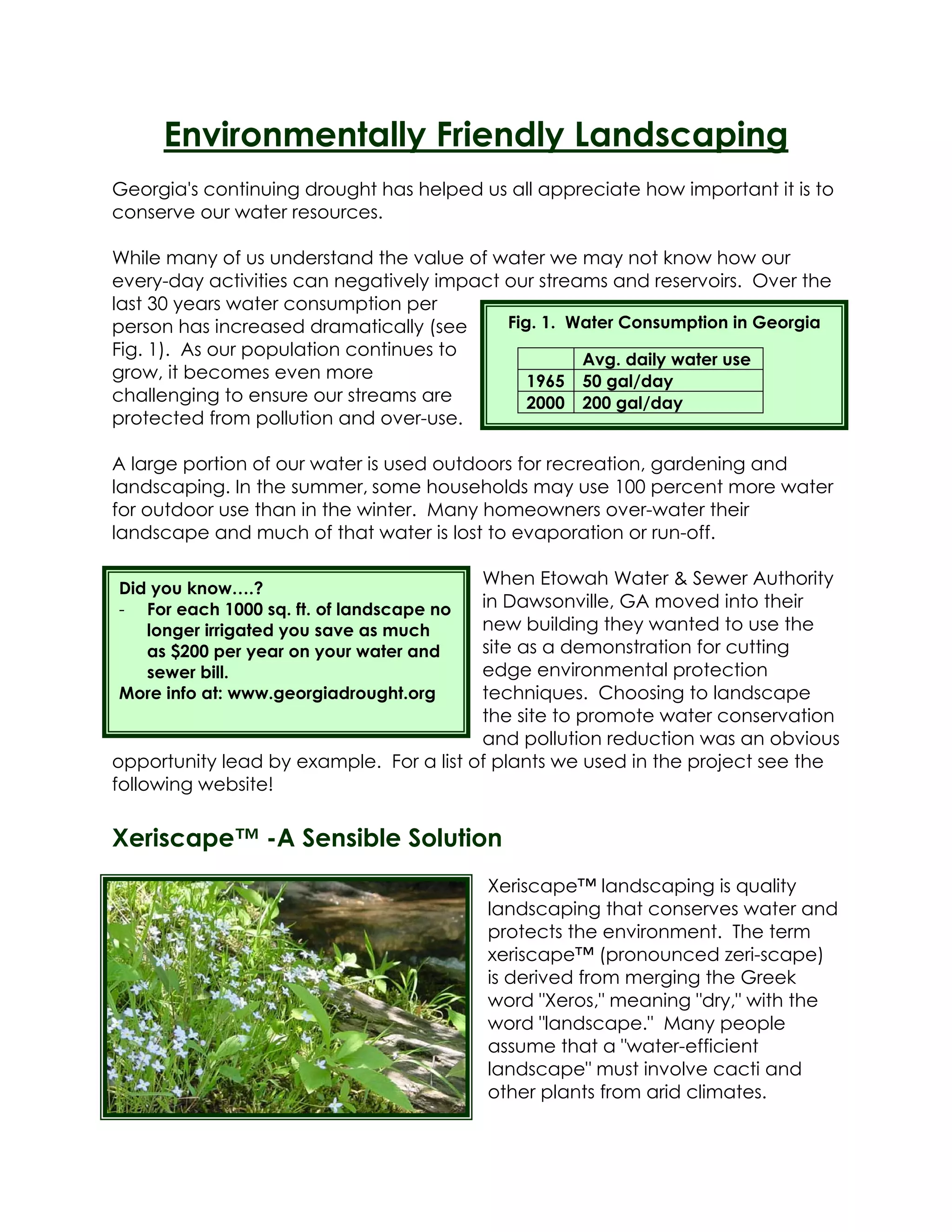
                                          Xeriscape™ landscaping is quality
                                          landscaping that conserves water and
                                          protects the environment. The term
                                          xeriscape™ (pronounced zeri-scape)
                                          is derived from merging the Greek
                                          word "Xeros," meaning "dry," with the
                                          word "landscape." Many people
                                          assume that a "water-efficient
                                          landscape" must involve cacti and
                                          other plants from arid climates.
Actually, all our native plants in Georgia are
                             adapted to the natural cyclical rainfall patterns
                             and can be included in landscaping with beautiful
                             results! If you choose to use plants that are not
                             native to Georgia in a water-efficient landscape it
                             is important to make sure you don't choose a plant
                             that is invasive (we certainly don't want another
                             "kudzu").

A Xeriscape can significantly reduce outdoor water consumption without
sacrificing beauty. Not only is Xeriscaping an environmentally sound landscape,
requiring less fertilizer and fewer chemicals, it is also low maintenance -- saving
you time, effort and money!

How Do I Get Started?                                  Xeriscape Basics
                                                       High water -use     -10% or less
Establish Water-use Zones                              Moderate water use -20% or less
A Xeriscape plan divides the landscape into three      Low water-use       -50% or more
water-use zones: high (regular watering),
moderate (occasional watering) and low (natural
rainfall).

High water-use zones-small, highly visible areas and highly maintained areas of
the landscape where plants are watered regularly in the absence of rainfall.
Ideally high water use zones should account for no more than 10 percent of the
landscape.

Moderate water-use zones-established plants are watered only when they turn a
gray-green color, wilt or show other symptoms of moisture stress. Ideally, 20
percent or less of the landscape should be moderate water-use zones.

Low water-use zones- Plants are watered by natural rainfall and would not be
irrigated. For greatest water conservation, design as much of your landscape as
possible into low water-use zones. Most people are surprised to learn that the
majority of our woody ornamental trees and shrubs, turf grasses, some
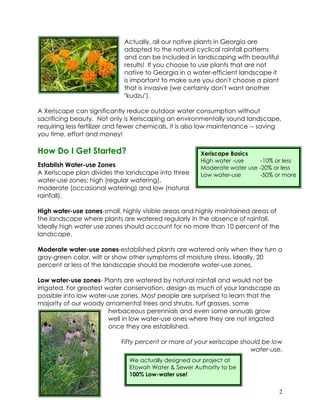
                         herbaceous perennials and even some annuals grow
                         well in low water-use ones where they are not irrigated
                         once they are established.

                            Fifty percent or more of your xeriscape should be low
                                                                       water-use.
                               We actually designed our project at
                               Etowah Water & Sewer Authority to be
                               100% Low-water use!


                                                                                   2
Environmentally Friendly Landscaping/Lawn Tips      Expect a slight loss of quality
     From www.cleanwatercampaign.com                during extended dry periods, but
                                                    don't be alarmed. Some plants
1. Plant natural vegetation to control erosion.     will literally shut down during
2. Test soil first before applying fertilizers.
                                                    drought and cease growing.
3. Identify the bugs in your yard. Most are
    beneficial.
                                                    Learning to accept this "less than
4. Direct rainwater from downspouts away            perfect" appearance during dry
    from pavement into your lawn.                   periods is one of the most difficult
5. Check the weather forecast for predicted         obstacles to overcome in a
    rain and don't apply fertilizer or pesticides   water-efficient landscape.
    before or directly after a rain. (You’ll wash
    pollutants and $ down the drain.)               One exception to the water zone
6. Sweep up dirt/debris rather than hosing          rule is newly planted ornamental
    away with water.                                plants and turf grasses. These
7. Compost/Recycle yard waste.                      plants require regular irrigation
8. Clean up pet waste.
                                                    during the establishment period
9. Leave native vegetation and trees along
    streams
                                                    (8 to 10 weeks after planting),
10. Plant native vegetation in yard.                regardless of their intended
                                                    water-use zone. For more info on
                                                    Xeriscapes, contact the Georgia
                                                    Water Wise Council (contact info
                                                    below).

Why Did We Use Plants Native To
North Georgia?
         Plants native to our soils and climate
in north Georgia generally require less
fertilizer and pesticides, less water, and
provide the best overall food sources for
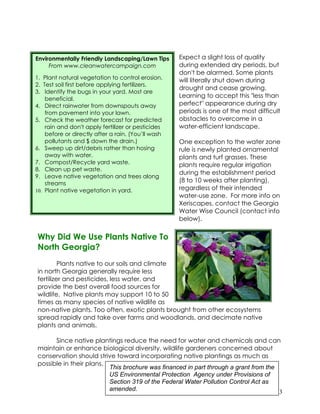
wildlife. Native plants may support 10 to 50
times as many species of native wildlife as
non-native plants. Too often, exotic plants brought from other ecosystems
spread rapidly and take over farms and woodlands, and decimate native
plants and animals.

      Since native plantings reduce the need for water and chemicals and can
maintain or enhance biological diversity, wildlife gardeners concerned about
conservation should strive toward incorporating native plantings as much as
possible in their plans.
                         This brochure was financed in part through a grant from the
                         US Environmental Protection Agency under Provisions of
                         Section 319 of the Federal Water Pollution Control Act as
                         amended.                                                    3
What You Can Do:
       Buy or grow your own native plants. Be absolutely sure your nursery
       guarantees its stock is not dug from the wild.
       Join and become active in a native plant group.
       Promote the use of native plants in roadside, school, and commercial
       landscaping.
       Save native plant communities in your area. It's much harder to restore
       wild areas than it is to preserve them.
   (From http://www.nwf.org/backyardwildlifehabitat/nativeplants.cfm)

         Help us make a difference in the Etowah watershed!
 Please look at your outdoor landscape and see what you can do to
          make it more water, wildlife and pollution friendly!

Other Resources:
Clean Water Campaign, 40 Courtland St., Atlanta, GA 30303, www.cleanwatercampaign.com,
email: kobrien@atlantaregional.com

Georgia Native Plant Society, P. O. Box 422085, Atlanta, GA 30342-2085 www.gnps.org
770-343-6000

Georgia Water Wise Council, 1033 Franklin Rd., Ste. 9-187, Marietta, GA 30067-8004 770-483-9474,
http://www.griffin.peachnet.edu/waterwise/wwc.htm

Gardening With Native Wild Flowers by Leonard E. Foote, Samuel B., Jr. Jones

Georgia Water Wise Council, 1033 Franklin Rd., Ste. 9-187, Marietta, GA 30067-8004 770-483-9474,
http://www.griffin.peachnet.edu/waterwise/wwc.htm

A Guide to Developing a Water-Wise Landscape- www.ces.uga.edu/pubcd/B1073.htm

Landscaping Revolution: Garden With Mother Nature, Not Against Her
By Andy Wasowski and Sally Wasowski

Landscaping with Native Plants of the South by Andy Wasowski

Native Plant Finder-National Wildlife Federation tool to locate information on plants native to the
Southeast. http://www.nwf.org/backyardwildlifehabitat/nativeplants.cfm

Trees of Georgia and Adjacent States by Claud L. Brown and L. Katherine Kirkman

Southeast Recommended Native Plant List (Lady Bird Johnson Wildflower Center)
http://wildflower.avatartech.com/Plants_Online/Clearinghouse/Factpacks/Southeast%20Book/S
E_Plants.PDF
Co-sponsors:
Etowah Water & Sewer
Authority


                                                                                                  4

Environmentally Friendly Landscaping - Upper Etowah River Alliance

  • 1.
    Environmentally Friendly Landscaping Georgia'scontinuing drought has helped us all appreciate how important it is to conserve our water resources. While many of us understand the value of water we may not know how our every-day activities can negatively impact our streams and reservoirs. Over the last 30 years water consumption per person has increased dramatically (see Fig. 1. Water Consumption in Georgia Fig. 1). As our population continues to Avg. daily water use grow, it becomes even more 1965 50 gal/day challenging to ensure our streams are 2000 200 gal/day protected from pollution and over-use. A large portion of our water is used outdoors for recreation, gardening and landscaping. In the summer, some households may use 100 percent more water for outdoor use than in the winter. Many homeowners over-water their landscape and much of that water is lost to evaporation or run-off. When Etowah Water & Sewer Authority Did you know….? - For each 1000 sq. ft. of landscape no in Dawsonville, GA moved into their longer irrigated you save as much new building they wanted to use the as $200 per year on your water and site as a demonstration for cutting sewer bill. edge environmental protection More info at: www.georgiadrought.org techniques. Choosing to landscape the site to promote water conservation and pollution reduction was an obvious opportunity lead by example. For a list of plants we used in the project see the following website! Xeriscape™ -A Sensible Solution Xeriscape™ landscaping is quality landscaping that conserves water and protects the environment. The term xeriscape™ (pronounced zeri-scape) is derived from merging the Greek word "Xeros," meaning "dry," with the word "landscape." Many people assume that a "water-efficient landscape" must involve cacti and other plants from arid climates.
  • 2.
    Actually, all ournative plants in Georgia are adapted to the natural cyclical rainfall patterns and can be included in landscaping with beautiful results! If you choose to use plants that are not native to Georgia in a water-efficient landscape it is important to make sure you don't choose a plant that is invasive (we certainly don't want another "kudzu"). A Xeriscape can significantly reduce outdoor water consumption without sacrificing beauty. Not only is Xeriscaping an environmentally sound landscape, requiring less fertilizer and fewer chemicals, it is also low maintenance -- saving you time, effort and money! How Do I Get Started? Xeriscape Basics High water -use -10% or less Establish Water-use Zones Moderate water use -20% or less A Xeriscape plan divides the landscape into three Low water-use -50% or more water-use zones: high (regular watering), moderate (occasional watering) and low (natural rainfall). High water-use zones-small, highly visible areas and highly maintained areas of the landscape where plants are watered regularly in the absence of rainfall. Ideally high water use zones should account for no more than 10 percent of the landscape. Moderate water-use zones-established plants are watered only when they turn a gray-green color, wilt or show other symptoms of moisture stress. Ideally, 20 percent or less of the landscape should be moderate water-use zones. Low water-use zones- Plants are watered by natural rainfall and would not be irrigated. For greatest water conservation, design as much of your landscape as possible into low water-use zones. Most people are surprised to learn that the majority of our woody ornamental trees and shrubs, turf grasses, some herbaceous perennials and even some annuals grow well in low water-use ones where they are not irrigated once they are established. Fifty percent or more of your xeriscape should be low water-use. We actually designed our project at Etowah Water & Sewer Authority to be 100% Low-water use! 2
  • 3.
    Environmentally Friendly Landscaping/LawnTips Expect a slight loss of quality From www.cleanwatercampaign.com during extended dry periods, but don't be alarmed. Some plants 1. Plant natural vegetation to control erosion. will literally shut down during 2. Test soil first before applying fertilizers. drought and cease growing. 3. Identify the bugs in your yard. Most are beneficial. Learning to accept this "less than 4. Direct rainwater from downspouts away perfect" appearance during dry from pavement into your lawn. periods is one of the most difficult 5. Check the weather forecast for predicted obstacles to overcome in a rain and don't apply fertilizer or pesticides water-efficient landscape. before or directly after a rain. (You’ll wash pollutants and $ down the drain.) One exception to the water zone 6. Sweep up dirt/debris rather than hosing rule is newly planted ornamental away with water. plants and turf grasses. These 7. Compost/Recycle yard waste. plants require regular irrigation 8. Clean up pet waste. during the establishment period 9. Leave native vegetation and trees along streams (8 to 10 weeks after planting), 10. Plant native vegetation in yard. regardless of their intended water-use zone. For more info on Xeriscapes, contact the Georgia Water Wise Council (contact info below). Why Did We Use Plants Native To North Georgia? Plants native to our soils and climate in north Georgia generally require less fertilizer and pesticides, less water, and provide the best overall food sources for wildlife. Native plants may support 10 to 50 times as many species of native wildlife as non-native plants. Too often, exotic plants brought from other ecosystems spread rapidly and take over farms and woodlands, and decimate native plants and animals. Since native plantings reduce the need for water and chemicals and can maintain or enhance biological diversity, wildlife gardeners concerned about conservation should strive toward incorporating native plantings as much as possible in their plans. This brochure was financed in part through a grant from the US Environmental Protection Agency under Provisions of Section 319 of the Federal Water Pollution Control Act as amended. 3
  • 4.
    What You CanDo: Buy or grow your own native plants. Be absolutely sure your nursery guarantees its stock is not dug from the wild. Join and become active in a native plant group. Promote the use of native plants in roadside, school, and commercial landscaping. Save native plant communities in your area. It's much harder to restore wild areas than it is to preserve them. (From http://www.nwf.org/backyardwildlifehabitat/nativeplants.cfm) Help us make a difference in the Etowah watershed! Please look at your outdoor landscape and see what you can do to make it more water, wildlife and pollution friendly! Other Resources: Clean Water Campaign, 40 Courtland St., Atlanta, GA 30303, www.cleanwatercampaign.com, email: kobrien@atlantaregional.com Georgia Native Plant Society, P. O. Box 422085, Atlanta, GA 30342-2085 www.gnps.org 770-343-6000 Georgia Water Wise Council, 1033 Franklin Rd., Ste. 9-187, Marietta, GA 30067-8004 770-483-9474, http://www.griffin.peachnet.edu/waterwise/wwc.htm Gardening With Native Wild Flowers by Leonard E. Foote, Samuel B., Jr. Jones Georgia Water Wise Council, 1033 Franklin Rd., Ste. 9-187, Marietta, GA 30067-8004 770-483-9474, http://www.griffin.peachnet.edu/waterwise/wwc.htm A Guide to Developing a Water-Wise Landscape- www.ces.uga.edu/pubcd/B1073.htm Landscaping Revolution: Garden With Mother Nature, Not Against Her By Andy Wasowski and Sally Wasowski Landscaping with Native Plants of the South by Andy Wasowski Native Plant Finder-National Wildlife Federation tool to locate information on plants native to the Southeast. http://www.nwf.org/backyardwildlifehabitat/nativeplants.cfm Trees of Georgia and Adjacent States by Claud L. Brown and L. Katherine Kirkman Southeast Recommended Native Plant List (Lady Bird Johnson Wildflower Center) http://wildflower.avatartech.com/Plants_Online/Clearinghouse/Factpacks/Southeast%20Book/S E_Plants.PDF Co-sponsors: Etowah Water & Sewer Authority 4