Promoting the wellbeing of children in
out of home care: involving children and
parents in care planning and review
Jonathan Dickens, Georgia Philip and Julie
Young
Centre for Research on Children and
Families, University of East Anglia
Workshop Structure1
The
review
process 2
The study
methodology
3
Key
messages
Care planning and review
 In England there is an elaborate system of planning and
review for looked after children, intended to avoid drift
and delay, achieve permanence and ensure good care
 Wishes and feelings of the child must be taken into
account (Children Act 1989). There is an expectation that
children should be involved in the review process
 Since 2004, ‘independent reviewing officers’ have chaired
the reviews, but there have been on-going questions
about their effectiveness and independence
 New regulations and statutory guidance came into force
in 2011, to improve care planning and strengthen the role
of the IRO
Care planning and review
How is
the
system
working?
Our
central
research
question
The research methodology: 2012-14
Case file
analysis in
four LAs
(122 cases)
In-depth
interviews on
half the case
file cases (61)
A multi-
professional
focus group in
each of four LAs
Two focus
groups with
young people
National
questionnaire
IROs (65)
Team
managers (46)
Children’s
guardians (39)
IROs (54)
SWs (54)
Parents (15)
Children (15)
Professional
Phone based
Structured
Parent
Home based
Very unstructured
Child
Home based
Activity based
Use of a ‘PASS’ card
The Interviews
Children’s Interviews
Key
questions
Poster
about me
Decision
cards
‘My review’
sheets
‘My SW /
IRO’ sheets
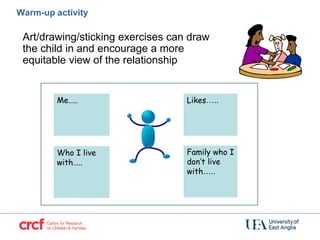
Warm-up activity
Art/drawing/sticking exercises can draw
the child in and encourage a more
equitable view of the relationship
Who I live
with…..
Family who I
don’t live
with…..
Likes…..Me…..
‘My Review’ sheets
Children were asked to draw where people sat in their
LAC review
Me
Teacher
IRO
SW
Mum
My
Review
‘Who makes decisions about…?’
Where I
live?
Whether I
can
sleepover
at friends
piercings
My hair
cut
How much
pocket
money I
get
Decision cards
• Risk assessment needed
• obtain info from referring person, have a ‘buddy system’ in
place, know your travel arrangements, leave valuables at
home, prepare for a smoky environment
• Risk of interference/influence from other people
in household – including small children
• emphasise that the interview needs
to be private and that answers from
key person needed
Home-based Interviews
Discussion of research
methodology
Involving children and parents in
care planning and review
Key findings & issues
Involvement
 The purposes of involvement
• Instrumental - achieving best outcomes for children
through better knowledge /communication/timely action
• Rights based– participation rights of children, parents and
professionals (NB foster carers as parents and
professionals)
 The experience of involvement
• If the review process, including the meeting, is positive,
clear, reassuring, affirming and enabling this can in itself
have a positive impact on all participants - and the
success of the care plan.
Involving children in reviews; findings:
 IROs were seen as having key role in ‘tailoring’ the review and
(along with SW) consulting children
 Survey of IROs showed that just under ¼ visited ‘most’ children
between reviews
 Attendance at reviews increased with age: File analysis showed
5-12, 43% , 13-15, 65%, 16 + 80% attended some or all of the
meeting
 Survey of IROs showed that just over half felt they were not
involving children appropriately; interviews showed that
consultation documents consistently seen as an area for
development
 Review venues are an expression of the dilemma over balancing
rights and needs of those involved – not simply the child’s ‘choice’
• For 2 LAs around 70% of reviews took place in the foster home
• Across all 4 LAs about 15% took place in schools
Key dilemmas for IROs and social workers:
 ‘Balancing’ rights and needs of children, birth family, carers and
professionals – in order to improve child outcomes
 Balancing the need for honesty and openness with need to
‘protect’ children’s privacy or feelings
 Balancing the requirement of a formal, transparent system, with
the need to be responsive and sensitive to the child
 Bearing in mind the child’s chronological age, emotional age
/stage and cognitive ability
 Taking account of the type of placement e.g. long-term foster
care and the DfE concept of a proportionate role for social
workers, IROs and review processes.
Involving children: the review meeting
‘The child’s meeting’ and/or a ‘planning meeting’?
“You know, and it’s a difficult thing to get that balance
right. Because if you just present a sort of rosy view
because the child’s there, actually you’re not going to get
a proper plan agreed because you’re discussing things
that aren’t correct. But equally, to destroy a child, you
know, that’s cruel” (SW interview)
“I am like the main person, which is right, because you
never want to feel in a review, your review, you don’t want
to feel like the black sheep do you? You don’t want to be,
you know, only listening, you want to be involved in it” (17
year old girl, LTFC)
Involving birth parents:
 Involved in plans?
 Involved in planning and the child’s life
They never left us out of any plans; they would tell us what
ideas they had and what was best for A and we just went
along with it. There is no point trying to fight social services.
(Mother, 3 children in care, 4th removed at birth)
You know, when we were talking about him coming home to
sleep, she (social worker) is asking my opinion and how I feel
it will be, and she is listening to me. She is really lovely.
(Mother)
The IRO role as bridge building for parents
I think the [IRO] is on everyone’s side; he was a little bit
for us and a little bit for the social worker, a big part for A
(child) of course, I think he is trying to do the best for A,
yeah. (Parent)
He treated us normal, he treated us like we were normal
people (parent with learning disabilities) (Parent)
She made me feel like the mother that I am, yeah.
(Parent)
Discussion…
 Multiple ‘parents’ in the lives / care plans of looked after
children: ‘biological parents’; ‘corporate parents’;
‘attachment figures’. A role for everyone?
 A need for an independent professional and oversight in
the lives of looked after children? How independent?
 A difficult balance - ensuring standards are met but
allowing for flexibility and tailoring to each individual
case?

Promoting the well being of children in out of home care:

  • 1.
    Promoting the wellbeingof children in out of home care: involving children and parents in care planning and review Jonathan Dickens, Georgia Philip and Julie Young Centre for Research on Children and Families, University of East Anglia
  • 2.
    Workshop Structure1 The review process 2 Thestudy methodology 3 Key messages
  • 3.
    Care planning andreview  In England there is an elaborate system of planning and review for looked after children, intended to avoid drift and delay, achieve permanence and ensure good care  Wishes and feelings of the child must be taken into account (Children Act 1989). There is an expectation that children should be involved in the review process  Since 2004, ‘independent reviewing officers’ have chaired the reviews, but there have been on-going questions about their effectiveness and independence  New regulations and statutory guidance came into force in 2011, to improve care planning and strengthen the role of the IRO
  • 4.
    Care planning andreview How is the system working? Our central research question
  • 5.
    The research methodology:2012-14 Case file analysis in four LAs (122 cases) In-depth interviews on half the case file cases (61) A multi- professional focus group in each of four LAs Two focus groups with young people National questionnaire IROs (65) Team managers (46) Children’s guardians (39) IROs (54) SWs (54) Parents (15) Children (15)
  • 6.
    Professional Phone based Structured Parent Home based Veryunstructured Child Home based Activity based Use of a ‘PASS’ card The Interviews
  • 7.
  • 8.
    Warm-up activity Art/drawing/sticking exercisescan draw the child in and encourage a more equitable view of the relationship Who I live with….. Family who I don’t live with….. Likes…..Me…..
  • 9.
    ‘My Review’ sheets Childrenwere asked to draw where people sat in their LAC review Me Teacher IRO SW Mum My Review
  • 10.
    ‘Who makes decisionsabout…?’ Where I live? Whether I can sleepover at friends piercings My hair cut How much pocket money I get Decision cards
  • 11.
    • Risk assessmentneeded • obtain info from referring person, have a ‘buddy system’ in place, know your travel arrangements, leave valuables at home, prepare for a smoky environment • Risk of interference/influence from other people in household – including small children • emphasise that the interview needs to be private and that answers from key person needed Home-based Interviews
  • 12.
  • 13.
    Involving children andparents in care planning and review Key findings & issues
  • 14.
    Involvement  The purposesof involvement • Instrumental - achieving best outcomes for children through better knowledge /communication/timely action • Rights based– participation rights of children, parents and professionals (NB foster carers as parents and professionals)  The experience of involvement • If the review process, including the meeting, is positive, clear, reassuring, affirming and enabling this can in itself have a positive impact on all participants - and the success of the care plan.
  • 15.
    Involving children inreviews; findings:  IROs were seen as having key role in ‘tailoring’ the review and (along with SW) consulting children  Survey of IROs showed that just under ¼ visited ‘most’ children between reviews  Attendance at reviews increased with age: File analysis showed 5-12, 43% , 13-15, 65%, 16 + 80% attended some or all of the meeting  Survey of IROs showed that just over half felt they were not involving children appropriately; interviews showed that consultation documents consistently seen as an area for development  Review venues are an expression of the dilemma over balancing rights and needs of those involved – not simply the child’s ‘choice’ • For 2 LAs around 70% of reviews took place in the foster home • Across all 4 LAs about 15% took place in schools
  • 16.
    Key dilemmas forIROs and social workers:  ‘Balancing’ rights and needs of children, birth family, carers and professionals – in order to improve child outcomes  Balancing the need for honesty and openness with need to ‘protect’ children’s privacy or feelings  Balancing the requirement of a formal, transparent system, with the need to be responsive and sensitive to the child  Bearing in mind the child’s chronological age, emotional age /stage and cognitive ability  Taking account of the type of placement e.g. long-term foster care and the DfE concept of a proportionate role for social workers, IROs and review processes.
  • 17.
    Involving children: thereview meeting ‘The child’s meeting’ and/or a ‘planning meeting’? “You know, and it’s a difficult thing to get that balance right. Because if you just present a sort of rosy view because the child’s there, actually you’re not going to get a proper plan agreed because you’re discussing things that aren’t correct. But equally, to destroy a child, you know, that’s cruel” (SW interview) “I am like the main person, which is right, because you never want to feel in a review, your review, you don’t want to feel like the black sheep do you? You don’t want to be, you know, only listening, you want to be involved in it” (17 year old girl, LTFC)
  • 18.
    Involving birth parents: Involved in plans?  Involved in planning and the child’s life They never left us out of any plans; they would tell us what ideas they had and what was best for A and we just went along with it. There is no point trying to fight social services. (Mother, 3 children in care, 4th removed at birth) You know, when we were talking about him coming home to sleep, she (social worker) is asking my opinion and how I feel it will be, and she is listening to me. She is really lovely. (Mother)
  • 19.
    The IRO roleas bridge building for parents I think the [IRO] is on everyone’s side; he was a little bit for us and a little bit for the social worker, a big part for A (child) of course, I think he is trying to do the best for A, yeah. (Parent) He treated us normal, he treated us like we were normal people (parent with learning disabilities) (Parent) She made me feel like the mother that I am, yeah. (Parent)
  • 20.
    Discussion…  Multiple ‘parents’in the lives / care plans of looked after children: ‘biological parents’; ‘corporate parents’; ‘attachment figures’. A role for everyone?  A need for an independent professional and oversight in the lives of looked after children? How independent?  A difficult balance - ensuring standards are met but allowing for flexibility and tailoring to each individual case?