04 Module Four Care Placement Roles & Responsibilities - Copy.ppt
1.
Training On AlternativeCare For Foster Care
Givers
JRS 2022
Module 3:
Care Placement Process, Roles &
Responsibilities
2.
By the endof this session, participants
will be able to:
• Understand the foster care placement process
• Comprehend how children and foster carers are supported
during their placement
• Know their role in the care placement process
3.
What is FosterCare?
• Foster care is a family-based child protection
procedure, where care is provided for a child in a
family other than their biological one, by a person
who has been selected and trained for this purpose.
• It is temporary and time-restricted.
Why do childrenbecome separated from their
primary caregivers?
Children get separated by accident:
• Many children were apart from their families when
the earthquake hit, and some were unable to find their
families afterwards
Children are sent away from their families:
• Children are ‘boarded out’ or sent to live in ‘restavek’
(sent to live with someone)
• Occasionally, children are abandoned by relatives who
cannot care for them
6.
Children leave theirfamilies:
• Some children run away from their families because of
abuse or neglect, or because they are looking for better
opportunities
• Children living in displacement sites may slowly separate
as they look for economic opportunities on the streets
Children are removed from their families:
• Sometimes children are removed from their families
because they are exposed to or at risk of abuse,
exploitation or neglect
7.
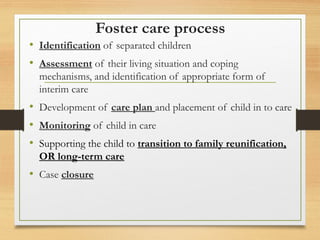
Foster care process
•Identification of separated children
• Assessment of their living situation and coping
mechanisms, and identification of appropriate form of
interim care
• Development of care plan and placement of child in to care
• Monitoring of child in care
• Supporting the child to transition to family reunification,
OR long-term care
• Case closure
8.
How are childrenidentified and
referred to foster care?
• Caseworkers are responsible for working with vulnerable
children in displacement sites and will identify children in need
of interim care.
• Community members, agencies and government representatives
may refer children in need of care to caseworkers
• Caseworkers also work with separated children and identify
children in need of interim care from a wider catchment area.
9.
Which children aremost in need of
foster care?
Consider:
• What other care options are available to children
• Which children are most in need of a safe environment
rather than being cared for in the community
• Which children are most in need of family based care
rather than residential care
• Whether it is within the capacity of a foster carer to
provide adequate care for the child
10.
How do wedecide which children should be
placed in foster care?
Caseworkers will undertake an assessment of the child’s living situation
and coping mechanism, to assess:
• Whether the child is in an appropriate, stable and protective care
environment,
• Child’s access to services and psychosocial wellbeing, the social
support systems around the child, as well as the child’s survival
strategies and whether these put the child at risk, alternative care
options available to the child
Based on this, Caseworkers may: try to support the child in their
present care arrangement, Identify alternative care within the
community and refer the child for residential care, and Identify
foster care for the child
11.
Developing a CarePlan
Done by caseworker, in consultation with the co-ordinator,
child, carer and foster carer.
It outlines:
• Objective of placement
• Specific care and service support needs of child and how
these will be met
• Anticipated length of stay
• Frequency and timing of monitoring visits
It is signed off by the caseworker, foster carer and child
12.
Monitoring the Placement
TheCaseworker will visit the child and foster carer on a
regular basis, as outlined in the care plan. The purpose of
the visits is to:
• Provide support and guidance to both the child and the
caregiver and mediate on any problems
• Ensure that the child and family are accessing services
and community resources as planned
• Update the child and caregiver on progress made
towards long-term care solutions
13.
Transitioning to family
reunification/long-termcare
• For children who will be reunified with their families,
caseworkers may need to mediate on any problems
arising.
• Children who cannot return home will undergo a
best interest determination process to decide what
long-term options are appropriate for the child.
• Both caseworkers and foster carers should help the
child prepare for return / transition
14.
A case isclosed when…
The child has been placed in long-term care
• A minimum of X months have gone by since the long-term
care placement
• Follow up has been conducted as a minimum every X weeks
• Any specified elements of the permanency plan have been
implemented
• The long-term caregiver is satisfied that they no longer need
support with the placement
• The child has fulfilled all necessary integration criteria