Seminar by:
Anand Babu
int82657@stud.uni-stuttgart.de
Institute for Parallel and Distributed
Systems (IPVS)
University of Stuttgart
05/01/13Peer to Peer Content Delivery Networks1
Peer-to-Peer
Content Delivery
Network
Outline
05/01/13Peer to Peer Content Delivery Networks2
Motivation
Traditional Approaches
P2P Architecture
Types of P2P
Centralized
Decentralized
 Unstructured
 Structured
Summary
References
Motivation
Millions of users want to download the same popular huge
files (for free)
E.g:
Film, Video and music
Media content from Broadcasters
Personal Content
Software
Institutions
05/01/13Peer to Peer Content Delivery Networks3
Router
“Interested”
End-host
Source
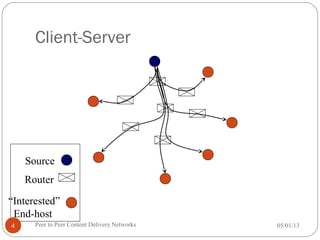
Client-Server
05/01/13Peer to Peer Content Delivery Networks4
Router
“Interested”
End-host
Source
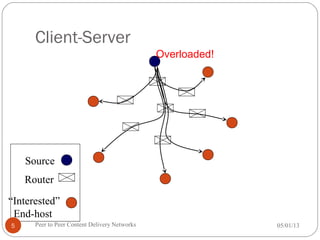
Client-Server
Overloaded!
05/01/13Peer to Peer Content Delivery Networks5
Router
“Interested”
End-host
Source
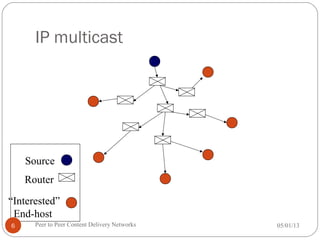
IP multicast
05/01/13Peer to Peer Content Delivery Networks6
Router
“Interested”
End-host
Source
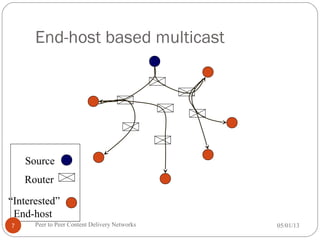
End-host based multicast
05/01/13Peer to Peer Content Delivery Networks7
End-host based multicast
“Single-uploader”  “Multiple-uploaders”
Node that has downloaded file will then upload it to other
nodes.
Uploading costs amortized across all nodes
Also called “Application-level Multicast”
Many protocols proposed early this decade
Yoid (2000), Narada (2000), Overcast (2000), ALMI (2001)
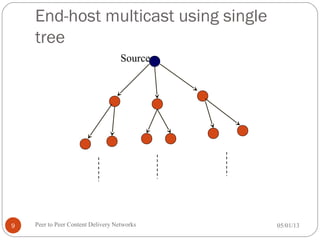
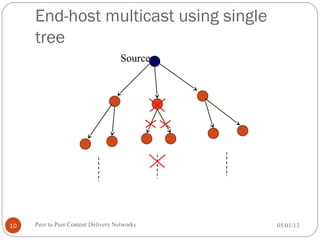
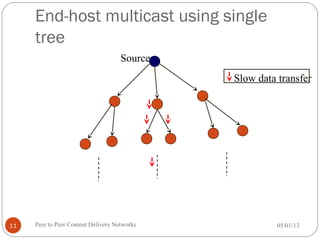
All use single trees
Problem with single trees?
05/01/13Peer to Peer Content Delivery Networks8
End-host multicast using single
tree
Source
05/01/13Peer to Peer Content Delivery Networks9
End-host multicast using single
tree
Source
05/01/13Peer to Peer Content Delivery Networks10
End-host multicast using single
tree
Source
Slow data transfer
05/01/13Peer to Peer Content Delivery Networks11
Why is P2P CDN important?
P2P consumes significant amount of internet traffic today
In 2004, Total P2P traffic was 60% (Source: Cachelogic)
Slightly lower share in 2005 (possibly because of legal action),
but still significant
BT is the most popular P2P Protocol(30% in 2004)
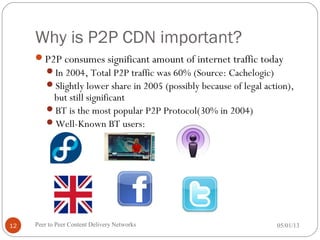
Well-Known BT users:
05/01/13Peer to Peer Content Delivery Networks12
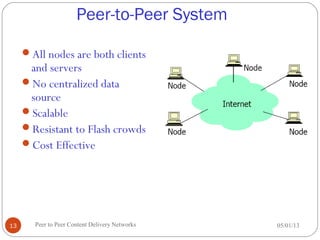
Peer-to-Peer System
05/01/13Peer to Peer Content Delivery Networks13
All nodes are both clients
and servers
No centralized data
source
Scalable
Resistant to Flash crowds
Cost Effective
Types of Peer-to-Peer Systems
Centralized
Napster
Decentralized
 Gnutella
 Fast-track
Structured
 Freenet
 Chord
 Pastry
05/01/13Peer to Peer Content Delivery Networks14
Napster
05/01/13Peer to Peer Content Delivery Networks15
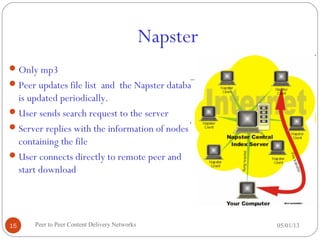
Only mp3
Peer updates file list and the Napster database
is updated periodically.
User sends search request to the server
Server replies with the information of nodes
containing the file
User connects directly to remote peer and
start download
Napster -- continued
05/01/13Peer to Peer Content Delivery Networks16
Search is centralized and dynamic.
File transfer is direct (Peer to Peer)
Pros and Cons:
Fast and Efficient and up-to-date(no stale links)
Single point of failure
Gnutella
05/01/13Peer to Peer Content Delivery Networks17
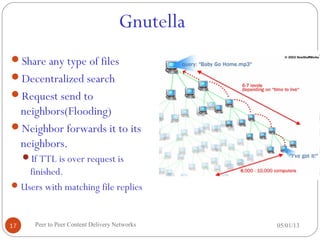
Share any type of files
Decentralized search
Request send to
neighbors(Flooding)
Neighbor forwards it to its
neighbors.
If TTL is over request is
finished.
Users with matching file replies
Gnutella -- continued
05/01/13Peer to Peer Content Delivery Networks18
Decentralized system
No Single point of failure
Less Prone to denial of service
Flooding queries
Increase network congestion
Search only reaches to a subset of peers due to
TTL.
Compromise in Privacy as peers are able to see
search queries.
Fast-track
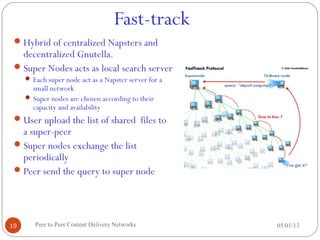
Hybrid of centralized Napsters and
decentralized Gnutella.
Super Nodes acts as local search server
 Each super node act as a Napster server for a
small network
 Super nodes are chosen according to their
capacity and availability
User upload the list of shared files to
a super-peer
Super nodes exchange the list
periodically
Peer send the query to super node
05/01/13Peer to Peer Content Delivery Networks19
BitTorrent
“Pull-based”
Each file split into smaller pieces
Nodes pull desired pieces
Pieces not downloaded in sequential order
Previous multicast schemes aimed to support “streaming”; Bit
Torrent does not
“swarming” approach
Encourages contribution by all nodes
05/01/13Peer to Peer Content Delivery Networks20
Basic Components
Seed
Peer that has the entire file
Leacher
Peer that has an incomplete copy of the file
A Torrent file
Passive component
Contains meta-data about the file to be downloaded and the peers
Typically hosted on a web server
A Tracker
Central component
Returns a random list of peers with state information(Completed or
Downloading)
05/01/13Peer to Peer Content Delivery Networks21
Data types
All the data used in Bit-torrent communication is Bencoded.
Integer: 2011  Bencoded: i2011e
String: “Something” Bencoded: 9: Something
List: List[0]=1337 List[1]=“DEF” List[2]=“CON” Bencoded:
li1337e:3DEF:3CONe
Dictionary:Dictionary[“uname”]=“hpcbabu”
Dictionary[“password”]=“default” Benocded form
d5:uname7:hpcbabu8:password7:defaulte
05/01/13Peer to Peer Content Delivery Networks22
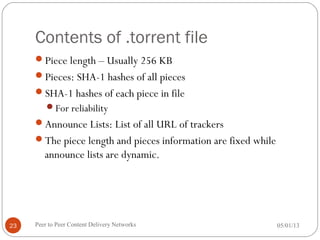
Contents of .torrent file
Piece length – Usually 256 KB
Pieces: SHA-1 hashes of all pieces
SHA-1 hashes of each piece in file
For reliability
Announce Lists: List of all URL of trackers
The piece length and pieces information are fixed while
announce lists are dynamic.
05/01/13Peer to Peer Content Delivery Networks23
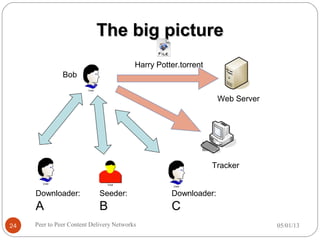
The big pictureThe big picture
Web Server
Bob
Tracker
Downloader:
A
Seeder:
B
Downloader:
C
Harry Potter.torrent
05/01/13Peer to Peer Content Delivery Networks24
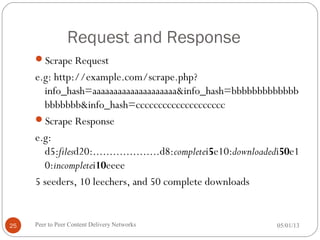
Request and Response
Scrape Request
e.g: http://example.com/scrape.php?
info_hash=aaaaaaaaaaaaaaaaaaaa&info_hash=bbbbbbbbbbbbb
bbbbbbb&info_hash=cccccccccccccccccccc
Scrape Response
e.g:
d5:filesd20:....................d8:completei5e10:downloadedi50e1
0:incompletei10eeee
5 seeders, 10 leechers, and 50 complete downloads
05/01/13Peer to Peer Content Delivery Networks25
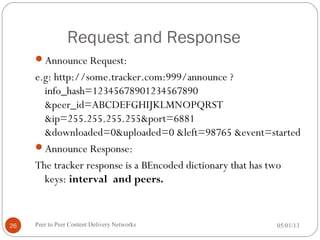
Request and Response
Announce Request:
e.g: http://some.tracker.com:999/announce ?
info_hash=12345678901234567890
&peer_id=ABCDEFGHIJKLMNOPQRST
&ip=255.255.255.255&port=6881
&downloaded=0&uploaded=0 &left=98765 &event=started
Announce Response:
The tracker response is a BEncoded dictionary that has two
keys: interval and peers.
05/01/13Peer to Peer Content Delivery Networks26
Peer wire Protocol(TCP)
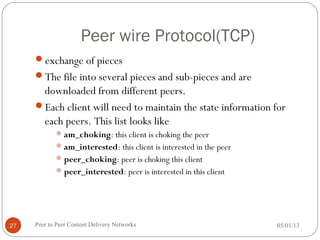
exchange of pieces
The file into several pieces and sub-pieces and are
downloaded from different peers.
Each client will need to maintain the state information for
each peers. This list looks like
am_choking: this client is choking the peer
am_interested: this client is interested in the peer
peer_choking: peer is choking this client
peer_interested: peer is interested in this client
05/01/13Peer to Peer Content Delivery Networks27
Steps in PWP:
Handshaking
Message Communication
 Pipelining
 Piece selection strategy
Peer selection strategy
Choking and optimistic unchoking
Anti-snubbing
Upload-Only Mode
End Game Mode
05/01/13Peer to Peer Content Delivery Networks28
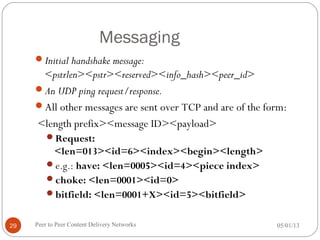
Messaging
Initial handshake message:
<pstrlen><pstr><reserved><info_hash><peer_id>
An UDP ping request/response.
All other messages are sent over TCP and are of the form:
 <length prefix><message ID><payload>
Request:
<len=013><id=6><index><begin><length>
e.g.: have: <len=0005><id=4><piece index>
choke: <len=0001><id=0>
bitfield: <len=0001+X><id=5><bitfield>
05/01/13Peer to Peer Content Delivery Networks29
Pipelining
Keep unfulfilled requests on each connection
To cut down the round-trip
This scheme has been found to saturate most connections in
practice
Extremely efficient over slow lines.
Default - 5
05/01/13Peer to Peer Content Delivery Networks30
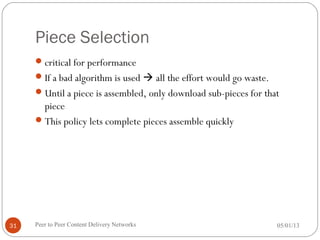
Piece Selection
critical for performance
If a bad algorithm is used  all the effort would go waste.
Until a piece is assembled, only download sub-pieces for that
piece
This policy lets complete pieces assemble quickly
05/01/13Peer to Peer Content Delivery Networks31
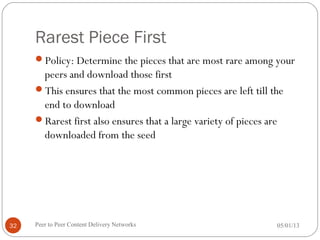
Rarest Piece First
Policy: Determine the pieces that are most rare among your
peers and download those first
This ensures that the most common pieces are left till the
end to download
Rarest first also ensures that a large variety of pieces are
downloaded from the seed
05/01/13Peer to Peer Content Delivery Networks32
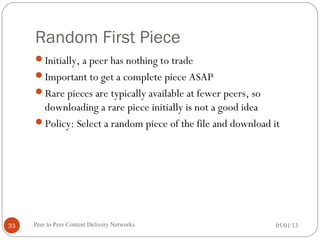
Random First Piece
Initially, a peer has nothing to trade
Important to get a complete piece ASAP
Rare pieces are typically available at fewer peers, so
downloading a rare piece initially is not a good idea
Policy: Select a random piece of the file and download it
05/01/13Peer to Peer Content Delivery Networks33
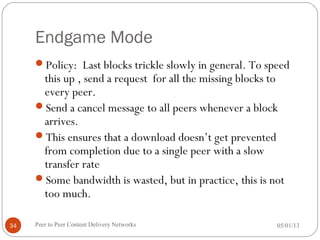
Endgame Mode
Policy: Last blocks trickle slowly in general. To speed
this up , send a request for all the missing blocks to
every peer.
Send a cancel message to all peers whenever a block
arrives.
This ensures that a download doesn’t get prevented
from completion due to a single peer with a slow
transfer rate
Some bandwidth is wasted, but in practice, this is not
too much.
05/01/13Peer to Peer Content Delivery Networks34
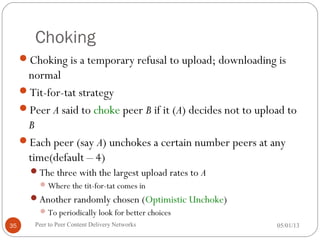
Choking
Choking is a temporary refusal to upload; downloading is
normal
Tit-for-tat strategy
Peer A said to choke peer B if it (A) decides not to upload to
B
Each peer (say A) unchokes a certain number peers at any
time(default – 4)
The three with the largest upload rates to A
Where the tit-for-tat comes in
Another randomly chosen (Optimistic Unchoke)
To periodically look for better choices
05/01/13Peer to Peer Content Delivery Networks35
Anti-snubbing
A peer is said to be snubbed if each of its peers chokes it
Poor download rates until the optimistic unchoke finds
better peers.
If No data download for over a minute, assume its snubbed.
Don’t upload to that peer unless as an optimistic unchoke.
More than one concurrent optimistic unchoke – fast
recovery.
05/01/13Peer to Peer Content Delivery Networks36
Upload-Only mode
Once download is complete, a peer has no download
rates to use for comparison nor has any need to use them
The question is, which nodes to upload to?
Policy: Upload to those with the best upload rate.
This ensures that pieces get replicated faster
05/01/13Peer to Peer Content Delivery Networks37
Pros and cons of BitTorrent
Pros
Proficient in utilizing partially downloaded files
Discourages “freeloading”
By rewarding fastest uploaders
No infrastructure costs
Better resource utilization
Works well for “hot content”
05/01/13Peer to Peer Content Delivery Networks38
Pros and cons of BitTorrent
Cons
Long tail doesn’t work
Even worse: no trackers for obscure content
Single point of failure: New nodes can’t enter swarm if tracker
goes down
Lack of a search feature
 Users need to resort to out-of-band search: well known torrent-
hosting sites / plain old web-search
05/01/13Peer to Peer Content Delivery Networks39
Analysis
Random neighbor selection  high cross-traffic
ISP Perspective: Different links have different costs
P2P Applications Perspective: No knowledge of underlying
ISP topology
No longer optimal if nodes should connect only to same ISP
nodes.
End result: Throttling
05/01/13Peer to Peer Content Delivery Networks40
Challenges/Open questions
Network-Friendly Bit torrent: ISPs informs Bit-torrent of its
link preferences.
Biased Neighbor selection
Rarest Piece First suffers
Move from TCP-UDP: take control of the internet ?
Legal Complexity
05/01/13Peer to Peer Content Delivery Networks41
Summary
P2P CDNs can be
cost-effective
Provide better resource utilization
Challenges:
Network Congestion
Network cost–Friendly Protocols
Handling copyright issues
05/01/13Peer to Peer Content Delivery Networks42
Thank You
05/01/13Peer to Peer Content Delivery Networks43

P2p cdn

  • 1.
    Seminar by: Anand Babu int82657@stud.uni-stuttgart.de Institutefor Parallel and Distributed Systems (IPVS) University of Stuttgart 05/01/13Peer to Peer Content Delivery Networks1 Peer-to-Peer Content Delivery Network
  • 2.
    Outline 05/01/13Peer to PeerContent Delivery Networks2 Motivation Traditional Approaches P2P Architecture Types of P2P Centralized Decentralized  Unstructured  Structured Summary References
  • 3.
    Motivation Millions of userswant to download the same popular huge files (for free) E.g: Film, Video and music Media content from Broadcasters Personal Content Software Institutions 05/01/13Peer to Peer Content Delivery Networks3
  • 4.
  • 5.
  • 6.
  • 7.
  • 8.
    End-host based multicast “Single-uploader” “Multiple-uploaders” Node that has downloaded file will then upload it to other nodes. Uploading costs amortized across all nodes Also called “Application-level Multicast” Many protocols proposed early this decade Yoid (2000), Narada (2000), Overcast (2000), ALMI (2001) All use single trees Problem with single trees? 05/01/13Peer to Peer Content Delivery Networks8
  • 9.
    End-host multicast usingsingle tree Source 05/01/13Peer to Peer Content Delivery Networks9
  • 10.
    End-host multicast usingsingle tree Source 05/01/13Peer to Peer Content Delivery Networks10
  • 11.
    End-host multicast usingsingle tree Source Slow data transfer 05/01/13Peer to Peer Content Delivery Networks11
  • 12.
    Why is P2PCDN important? P2P consumes significant amount of internet traffic today In 2004, Total P2P traffic was 60% (Source: Cachelogic) Slightly lower share in 2005 (possibly because of legal action), but still significant BT is the most popular P2P Protocol(30% in 2004) Well-Known BT users: 05/01/13Peer to Peer Content Delivery Networks12
  • 13.
    Peer-to-Peer System 05/01/13Peer toPeer Content Delivery Networks13 All nodes are both clients and servers No centralized data source Scalable Resistant to Flash crowds Cost Effective
  • 14.
    Types of Peer-to-PeerSystems Centralized Napster Decentralized  Gnutella  Fast-track Structured  Freenet  Chord  Pastry 05/01/13Peer to Peer Content Delivery Networks14
  • 15.
    Napster 05/01/13Peer to PeerContent Delivery Networks15 Only mp3 Peer updates file list and the Napster database is updated periodically. User sends search request to the server Server replies with the information of nodes containing the file User connects directly to remote peer and start download
  • 16.
    Napster -- continued 05/01/13Peerto Peer Content Delivery Networks16 Search is centralized and dynamic. File transfer is direct (Peer to Peer) Pros and Cons: Fast and Efficient and up-to-date(no stale links) Single point of failure
  • 17.
    Gnutella 05/01/13Peer to PeerContent Delivery Networks17 Share any type of files Decentralized search Request send to neighbors(Flooding) Neighbor forwards it to its neighbors. If TTL is over request is finished. Users with matching file replies
  • 18.
    Gnutella -- continued 05/01/13Peerto Peer Content Delivery Networks18 Decentralized system No Single point of failure Less Prone to denial of service Flooding queries Increase network congestion Search only reaches to a subset of peers due to TTL. Compromise in Privacy as peers are able to see search queries.
  • 19.
    Fast-track Hybrid of centralizedNapsters and decentralized Gnutella. Super Nodes acts as local search server  Each super node act as a Napster server for a small network  Super nodes are chosen according to their capacity and availability User upload the list of shared files to a super-peer Super nodes exchange the list periodically Peer send the query to super node 05/01/13Peer to Peer Content Delivery Networks19
  • 20.
    BitTorrent “Pull-based” Each file splitinto smaller pieces Nodes pull desired pieces Pieces not downloaded in sequential order Previous multicast schemes aimed to support “streaming”; Bit Torrent does not “swarming” approach Encourages contribution by all nodes 05/01/13Peer to Peer Content Delivery Networks20
  • 21.
    Basic Components Seed Peer thathas the entire file Leacher Peer that has an incomplete copy of the file A Torrent file Passive component Contains meta-data about the file to be downloaded and the peers Typically hosted on a web server A Tracker Central component Returns a random list of peers with state information(Completed or Downloading) 05/01/13Peer to Peer Content Delivery Networks21
  • 22.
    Data types All thedata used in Bit-torrent communication is Bencoded. Integer: 2011  Bencoded: i2011e String: “Something” Bencoded: 9: Something List: List[0]=1337 List[1]=“DEF” List[2]=“CON” Bencoded: li1337e:3DEF:3CONe Dictionary:Dictionary[“uname”]=“hpcbabu” Dictionary[“password”]=“default” Benocded form d5:uname7:hpcbabu8:password7:defaulte 05/01/13Peer to Peer Content Delivery Networks22
  • 23.
    Contents of .torrentfile Piece length – Usually 256 KB Pieces: SHA-1 hashes of all pieces SHA-1 hashes of each piece in file For reliability Announce Lists: List of all URL of trackers The piece length and pieces information are fixed while announce lists are dynamic. 05/01/13Peer to Peer Content Delivery Networks23
  • 24.
    The big pictureThebig picture Web Server Bob Tracker Downloader: A Seeder: B Downloader: C Harry Potter.torrent 05/01/13Peer to Peer Content Delivery Networks24
  • 25.
    Request and Response ScrapeRequest e.g: http://example.com/scrape.php? info_hash=aaaaaaaaaaaaaaaaaaaa&info_hash=bbbbbbbbbbbbb bbbbbbb&info_hash=cccccccccccccccccccc Scrape Response e.g: d5:filesd20:....................d8:completei5e10:downloadedi50e1 0:incompletei10eeee 5 seeders, 10 leechers, and 50 complete downloads 05/01/13Peer to Peer Content Delivery Networks25
  • 26.
    Request and Response AnnounceRequest: e.g: http://some.tracker.com:999/announce ? info_hash=12345678901234567890 &peer_id=ABCDEFGHIJKLMNOPQRST &ip=255.255.255.255&port=6881 &downloaded=0&uploaded=0 &left=98765 &event=started Announce Response: The tracker response is a BEncoded dictionary that has two keys: interval and peers. 05/01/13Peer to Peer Content Delivery Networks26
  • 27.
    Peer wire Protocol(TCP) exchangeof pieces The file into several pieces and sub-pieces and are downloaded from different peers. Each client will need to maintain the state information for each peers. This list looks like am_choking: this client is choking the peer am_interested: this client is interested in the peer peer_choking: peer is choking this client peer_interested: peer is interested in this client 05/01/13Peer to Peer Content Delivery Networks27
  • 28.
    Steps in PWP: Handshaking MessageCommunication  Pipelining  Piece selection strategy Peer selection strategy Choking and optimistic unchoking Anti-snubbing Upload-Only Mode End Game Mode 05/01/13Peer to Peer Content Delivery Networks28
  • 29.
    Messaging Initial handshake message: <pstrlen><pstr><reserved><info_hash><peer_id> AnUDP ping request/response. All other messages are sent over TCP and are of the form:  <length prefix><message ID><payload> Request: <len=013><id=6><index><begin><length> e.g.: have: <len=0005><id=4><piece index> choke: <len=0001><id=0> bitfield: <len=0001+X><id=5><bitfield> 05/01/13Peer to Peer Content Delivery Networks29
  • 30.
    Pipelining Keep unfulfilled requests oneach connection To cut down the round-trip This scheme has been found to saturate most connections in practice Extremely efficient over slow lines. Default - 5 05/01/13Peer to Peer Content Delivery Networks30
  • 31.
    Piece Selection critical forperformance If a bad algorithm is used  all the effort would go waste. Until a piece is assembled, only download sub-pieces for that piece This policy lets complete pieces assemble quickly 05/01/13Peer to Peer Content Delivery Networks31
  • 32.
    Rarest Piece First Policy:Determine the pieces that are most rare among your peers and download those first This ensures that the most common pieces are left till the end to download Rarest first also ensures that a large variety of pieces are downloaded from the seed 05/01/13Peer to Peer Content Delivery Networks32
  • 33.
    Random First Piece Initially,a peer has nothing to trade Important to get a complete piece ASAP Rare pieces are typically available at fewer peers, so downloading a rare piece initially is not a good idea Policy: Select a random piece of the file and download it 05/01/13Peer to Peer Content Delivery Networks33
  • 34.
    Endgame Mode Policy: Lastblocks trickle slowly in general. To speed this up , send a request for all the missing blocks to every peer. Send a cancel message to all peers whenever a block arrives. This ensures that a download doesn’t get prevented from completion due to a single peer with a slow transfer rate Some bandwidth is wasted, but in practice, this is not too much. 05/01/13Peer to Peer Content Delivery Networks34
  • 35.
    Choking Choking is atemporary refusal to upload; downloading is normal Tit-for-tat strategy Peer A said to choke peer B if it (A) decides not to upload to B Each peer (say A) unchokes a certain number peers at any time(default – 4) The three with the largest upload rates to A Where the tit-for-tat comes in Another randomly chosen (Optimistic Unchoke) To periodically look for better choices 05/01/13Peer to Peer Content Delivery Networks35
  • 36.
    Anti-snubbing A peer issaid to be snubbed if each of its peers chokes it Poor download rates until the optimistic unchoke finds better peers. If No data download for over a minute, assume its snubbed. Don’t upload to that peer unless as an optimistic unchoke. More than one concurrent optimistic unchoke – fast recovery. 05/01/13Peer to Peer Content Delivery Networks36
  • 37.
    Upload-Only mode Once downloadis complete, a peer has no download rates to use for comparison nor has any need to use them The question is, which nodes to upload to? Policy: Upload to those with the best upload rate. This ensures that pieces get replicated faster 05/01/13Peer to Peer Content Delivery Networks37
  • 38.
    Pros and consof BitTorrent Pros Proficient in utilizing partially downloaded files Discourages “freeloading” By rewarding fastest uploaders No infrastructure costs Better resource utilization Works well for “hot content” 05/01/13Peer to Peer Content Delivery Networks38
  • 39.
    Pros and consof BitTorrent Cons Long tail doesn’t work Even worse: no trackers for obscure content Single point of failure: New nodes can’t enter swarm if tracker goes down Lack of a search feature  Users need to resort to out-of-band search: well known torrent- hosting sites / plain old web-search 05/01/13Peer to Peer Content Delivery Networks39
  • 40.
    Analysis Random neighbor selection high cross-traffic ISP Perspective: Different links have different costs P2P Applications Perspective: No knowledge of underlying ISP topology No longer optimal if nodes should connect only to same ISP nodes. End result: Throttling 05/01/13Peer to Peer Content Delivery Networks40
  • 41.
    Challenges/Open questions Network-Friendly Bittorrent: ISPs informs Bit-torrent of its link preferences. Biased Neighbor selection Rarest Piece First suffers Move from TCP-UDP: take control of the internet ? Legal Complexity 05/01/13Peer to Peer Content Delivery Networks41
  • 42.
    Summary P2P CDNs canbe cost-effective Provide better resource utilization Challenges: Network Congestion Network cost–Friendly Protocols Handling copyright issues 05/01/13Peer to Peer Content Delivery Networks42
  • 43.
    Thank You 05/01/13Peer toPeer Content Delivery Networks43

Editor's Notes

  • #15 P2P systems are classified under two major categories centralized and decentralized. Example of centralized is Napster in which one server keeps the information of of all the other peers and decentralized is further divided into structured and unstructured. These are categorized under unstructured as they do not follow any structured way for file placement and do not optimize the search algorithm. Due to their unstructured way, they flood the queries in network and increase the network congestion…..whereas in structured they follow particular algorithms to search a file in the network.
  • #16 Napster was the start of P2P and it could share only music files with peers. Every node uploads the list of shared files onto the server and whenever any peer search for a file, the server replies back with the list of nodes containing the file. User connect directly to remote peer and start download. However if the remote peer is behind a firewall, the peer send this information to the server and server forwards this request to the remote peer and then our node waits for the remote peer to connect in order to download the file.
  • #17 Issues with Napster…Since it has a single server maintaining the list, the server is the single point of failure….Hence it is prone to denial of service…………However it ensures correct results till the time server is working properly…..as the list is uploaded directly to the server….. Search is centralized but the file transfer is peer to peer….
  • #18 Gnutella could share any type of files, in opposition to Napster…..The search is decentralized….
  • #19 Since the system is completely decentralized there is no single point of failure…………and this is less prone to denial of service….. However it cannot ensure correct results as one node may have the requested file but before the request reaches this node TTL is over and peer is refused about the file……. It increases network congestion as each time the query is broadcasted to all the neighbors…..
  • #20 It connect different networks together…..each network has a super node that keeps the information of all the shared file by the nodes in that network…….