Using realist evaluation with
vulnerable young people and the
services that support them:
examples from research
Not to be reproduced without permission from the authors
Dr Julie Harris, Dr Debi Roker, Dr Lucie Shuker
University of Bedfordshire
The International Centre
• Committed to increasing understanding of, and improving responses
to, child sexual exploitation, violence and trafficking in local, national
and international contexts
• Achieved through:
– academic rigour and research excellence
– collaborative and partnership based approaches to applied
social research
– meaningful and ethical engagement of children and young
people
– active dissemination and evidence-based engagement in theory,
policy and practice
Workshop outline
• Reflect on multiple ways evaluations are used
• Realist cycle of evaluation (including theory of change)
• Taking account of context
• Understanding how change happens –mechanisms
• Conclusions/reflections
To begin…
Think about an evaluation that you have participated in….
Discuss the following with a partner
1) What was the purpose of the evaluation?
2) How were the findings used?
Four uses of evaluation
• Symbolic use – providing the rationale for action or
inaction, reinforce a policy position or reassure
commissioners (Mark and Henry, 2004)
• Instrumental use - where action occurs directly as a
result of evaluation e.g. regarding continuation of a
programme, expansion, revision or termination (Preskill
& Caracelli, 1997)
Four uses of evaluation cont..
• Conceptual use – learning that emerges from a
programme e.g.… regarding its participants, its operation
or its outcomes (Weiss, 1977)
• Process use – the learning or activities that may occur
through the engagement of participants in the research
process (rather than from the findings per se) (Patton,
1997)
An example of process use
• Piloting a co-determined approach to outcomes for
young people leaving care:
- how did the process of involving young people in outcome
setting and reviewing improve their projection and planning skills?
- did the process in itself contribute to improved outcomes e.g.
by increasing their sense of control through the leaving care
journey?
An example of conceptual use
• What does this approach to measuring outcomes tell us
about the population of care leavers and the needs of
the different groups within it?
- young people who are ‘moving on’
- young people who are ‘surviving’
- young people who are ‘struggling’
(Stein, 2006)
Making evaluation meaningful
• Informing practice
• Being attentive to the experiences of those at the heart
of the system
“Use is the link between the day-to-day work of evaluation, on the
one hand and those activities that could actually improve the lives of
programme participants and society on the other.”
Mark and Henry, 2004. p.35.
The Realist Evaluation Cycle
… how does it work?
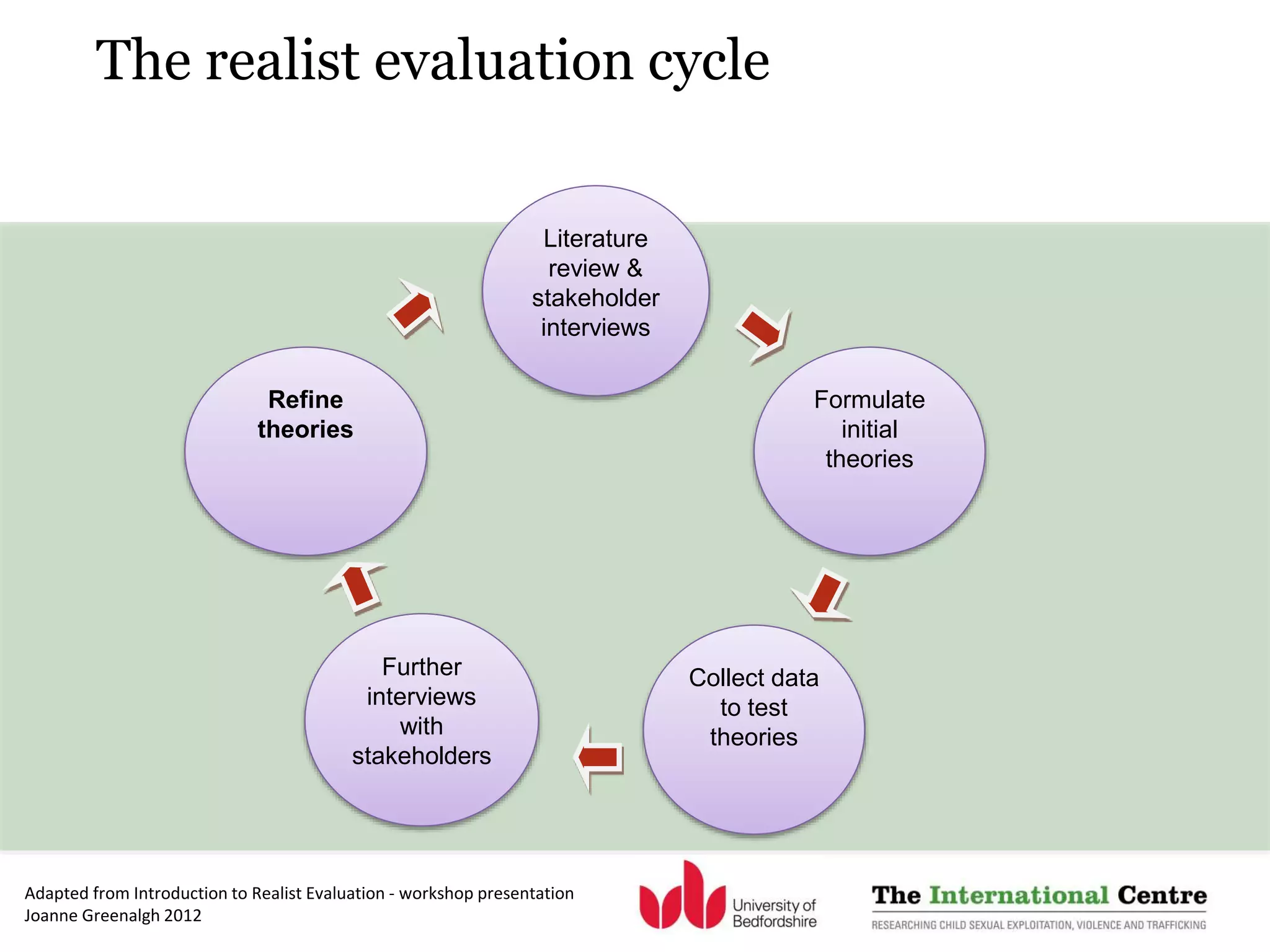
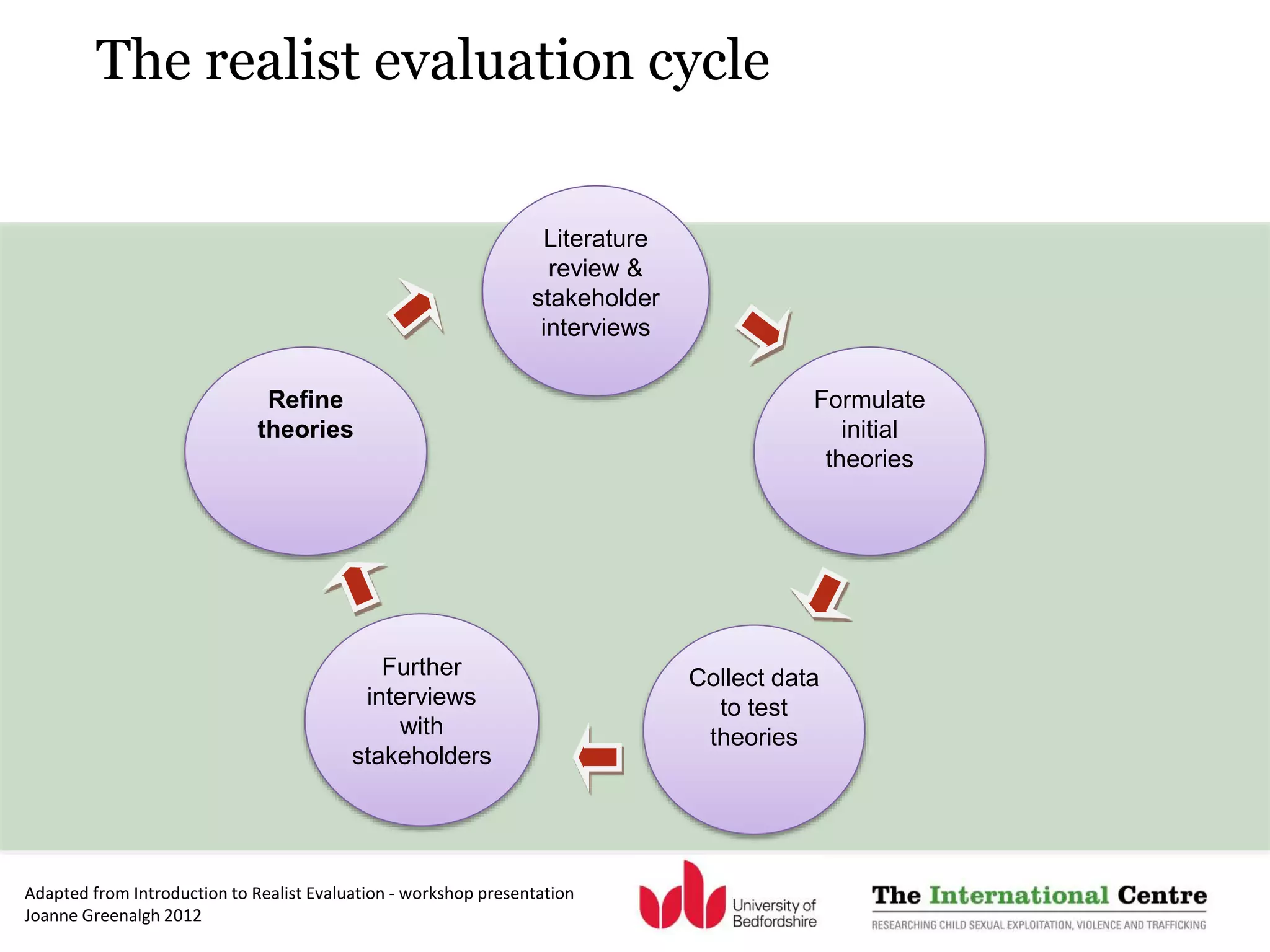
The realist evaluation cycle
Literature
review &
stakeholder
interviews
Formulate
initial
theories
Collect data
to test
theories
Further
interviews
with
stakeholders
Refine
theories
Adapted from Introduction to Realist Evaluation - workshop presentation
Joanne Greenalgh 2012
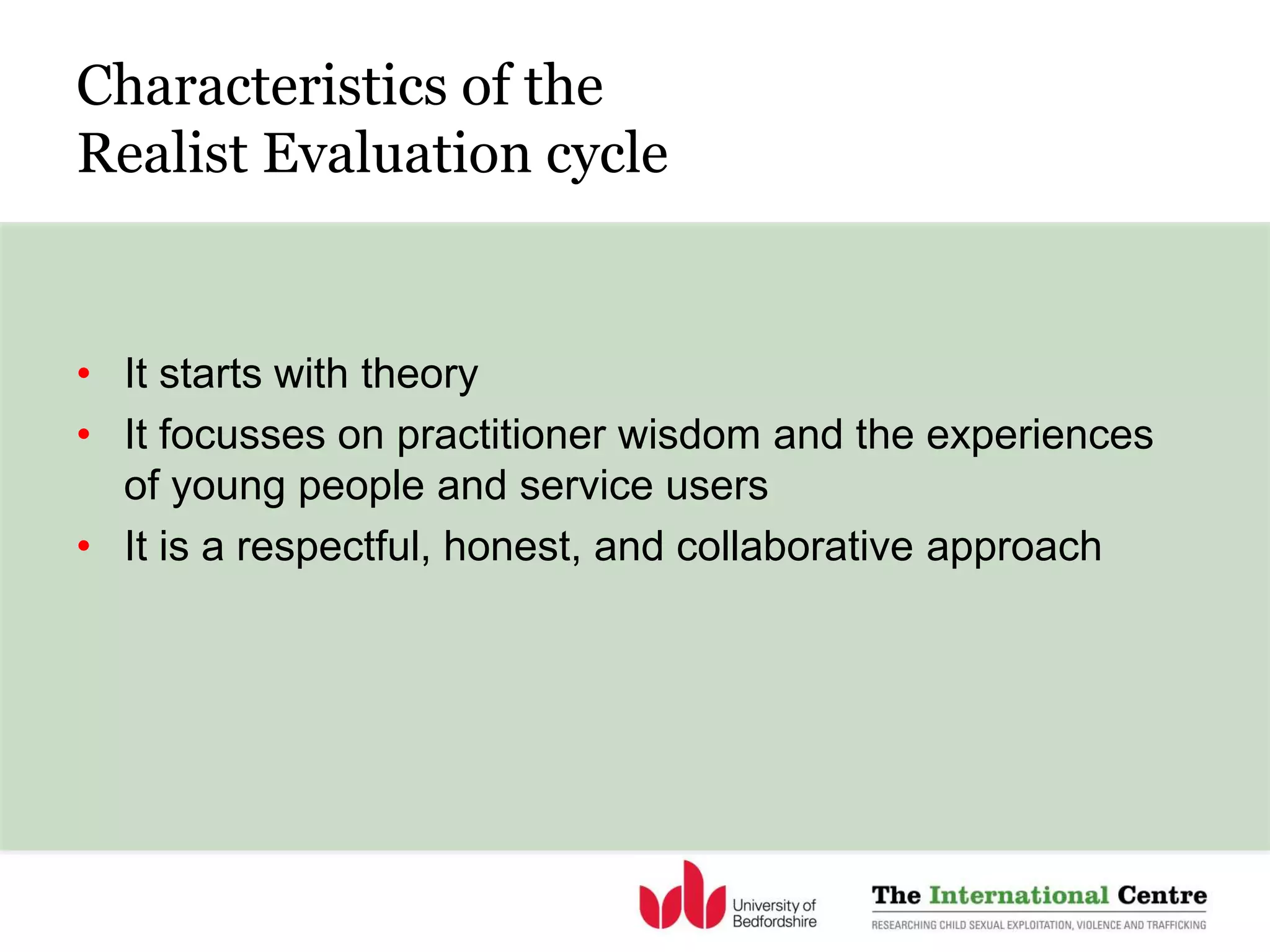
Characteristics of the
Realist Evaluation cycle
• It starts with theory
• It focusses on practitioner wisdom and the experiences
of young people and service users
• It is a respectful, honest, and collaborative approach
Realist evaluation
methods and approaches
• Mixed methods
• Triangulation of data
• Focus on testing and refining theories
• Aims to identify CMOs (contexts, mechanisms and
outcomes – more in a minute!)
• …. to identify what works, for whom, in what
circumstances, and why (Pawson and Tilley, 1997)
As an example ….
• Evaluation of the ‘Hub and Spoke’ model for addressing
CSE
• Different stages, reflecting the realist evaluation
approach
• Different sources of data collection, reflecting the realist
evaluation approach
… over to Julie and Lucie …
… for more detail on context, mechanisms and
outcomes (CMOs)
Context
Think about a new initiative that was introduced into your organization.
How did it play out? (e.g. Embraced? Resisted? Ignored?)
What kinds of contextual factors were influencing the way that
you/others responded to the change being introduced?
The importance of context
“Programmes or interventions are never
introduced into neutral spaces – context is key”
(Pawson and Tilley, 1997)
• All programmes have an idea about how change is meant to
happen, but whether programmes are successful in activating
‘change mechanisms’ depends on contexts (C)
• Pre-existing features of localities into which programmes are
introduced
• Some will support programme theory and others won’t – so there will
always be winners and losers
Contexts
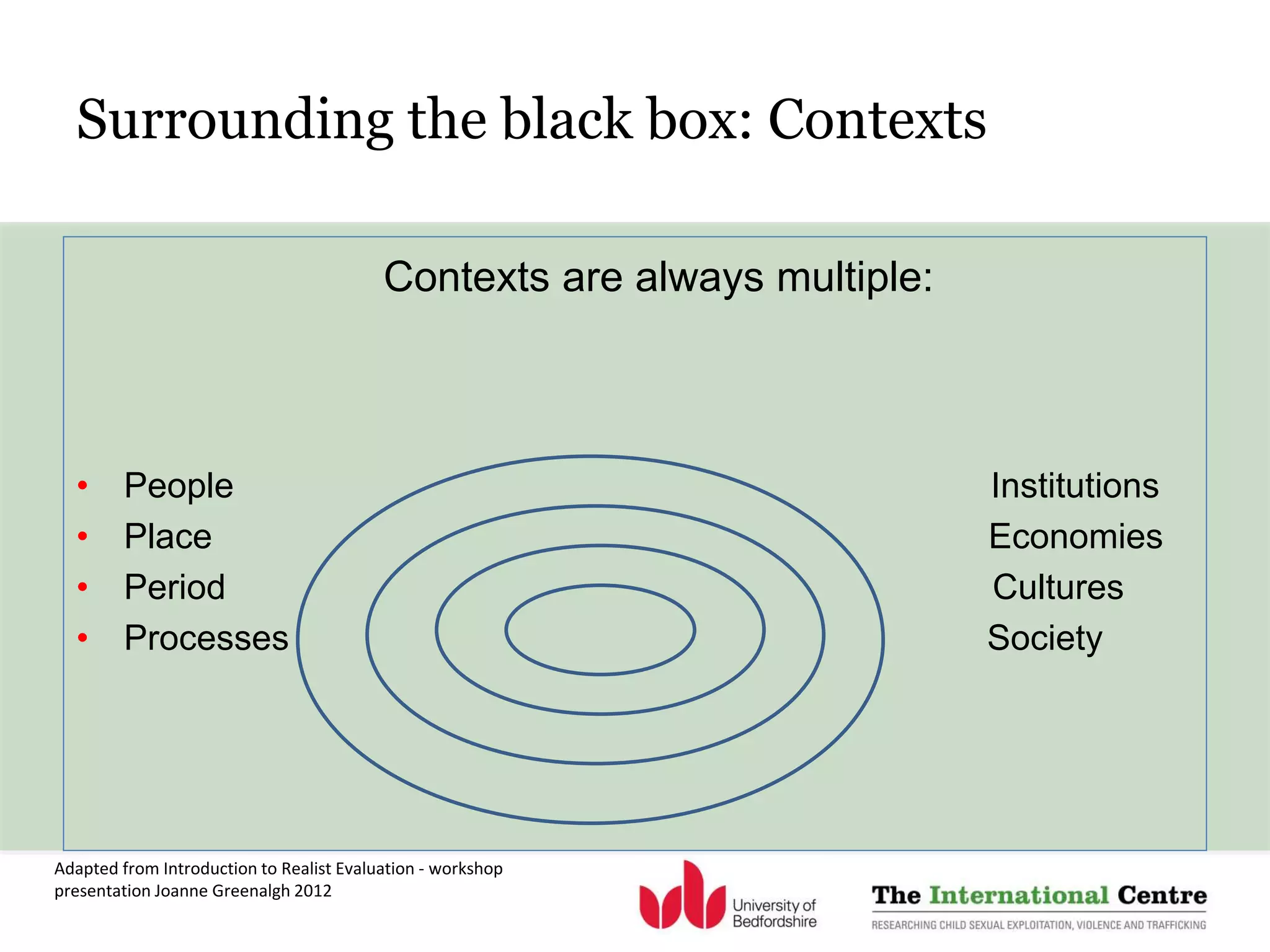
Surrounding the black box: Contexts
Contexts are always multiple:
• People Institutions
• Place Economies
• Period Cultures
• Processes Society
Adapted from Introduction to Realist Evaluation - workshop
presentation Joanne Greenalgh 2012
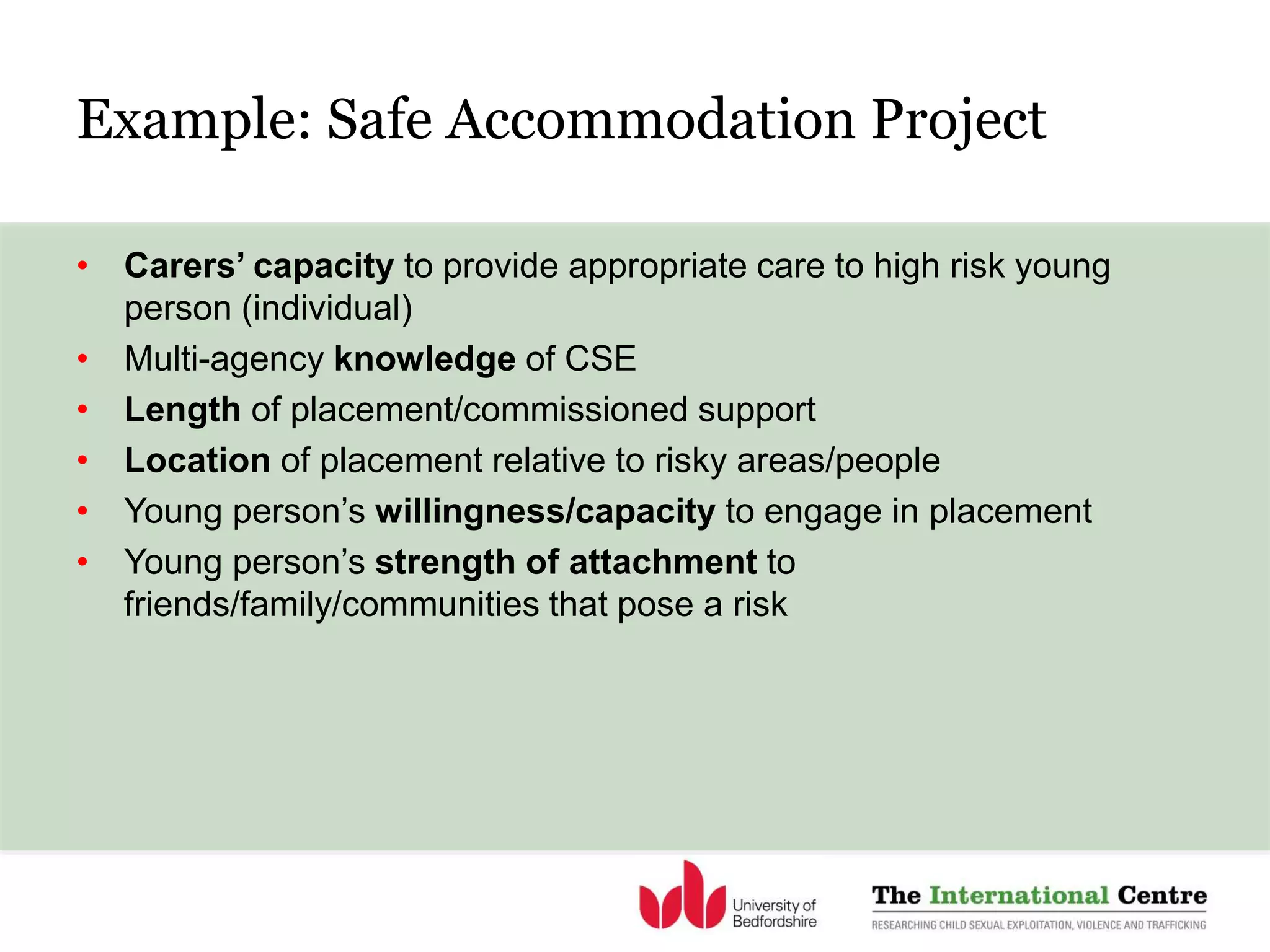
Example: Safe Accommodation Project
• Carers’ capacity to provide appropriate care to high risk young
person (individual)
• Multi-agency knowledge of CSE
• Length of placement/commissioned support
• Location of placement relative to risky areas/people
• Young person’s willingness/capacity to engage in placement
• Young person’s strength of attachment to
friends/family/communities that pose a risk
Context feeds into refined theories
• Placements most effective when YP ready/wiling to engage
– whatever risk level (YP capacity to engage)
• Placements have to counteract the ‘pull’ away by giving
reasons to stay (YP attachment to FFC)
• Trusting relationships underpin other interventions (carer
capacity to build relationship)
• Takes time to go from physical to relational to
psychological security (length of placement)
• Multi-agency shared understanding is key (MA knowledge
of CSE)
• Describe what it is about programmes and interventions
that bring about any effects.
• Programmes usually offer new resources – material,
social, emotional etc.
• How people act on these is known as the programme
‘mechanism’
• Mechanisms often work behind the scenes
• The concept of mechanism is the pivot around which
realist research revolves.
Mechanisms
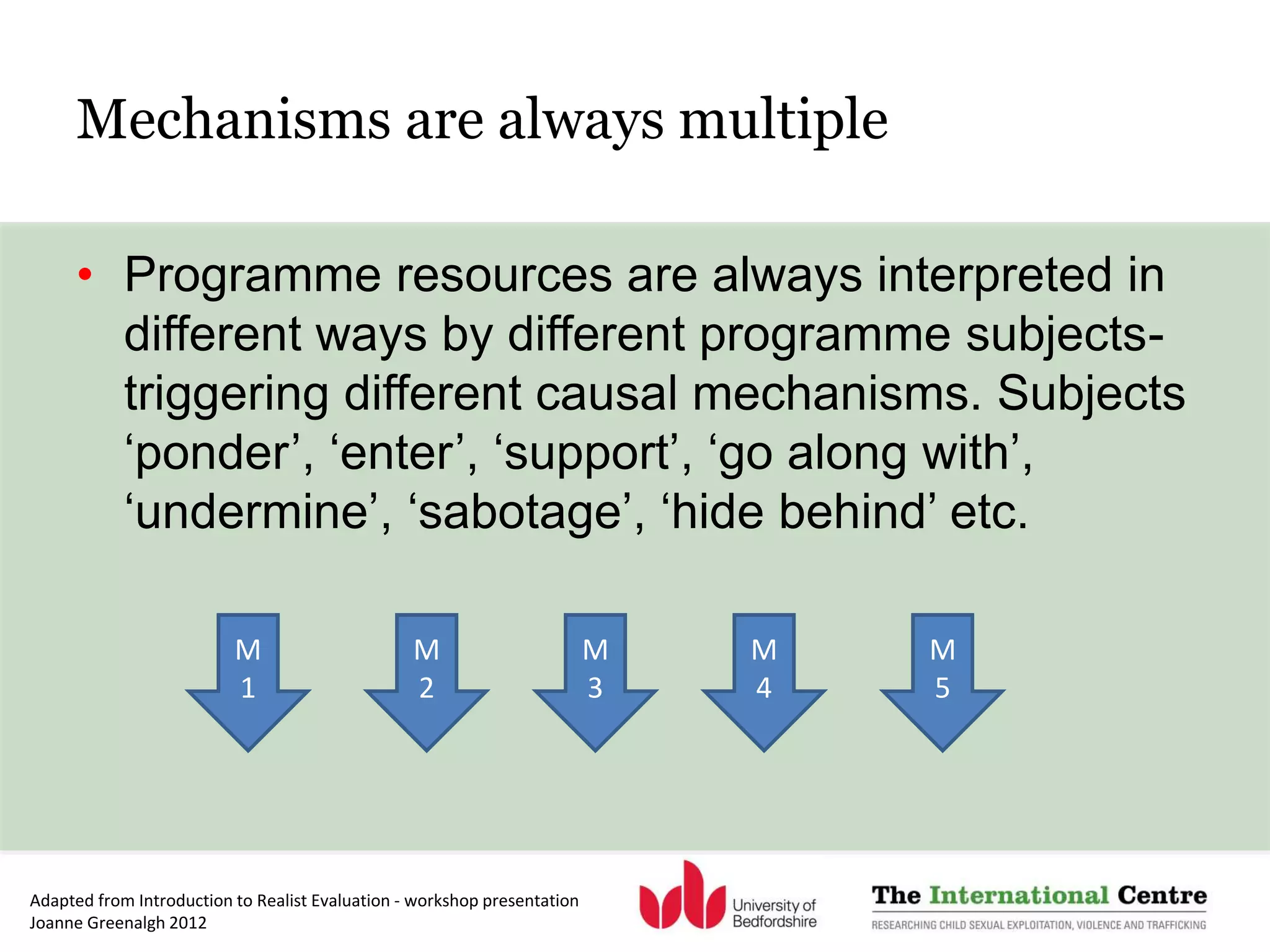
• Programme resources are always interpreted in
different ways by different programme subjects-
triggering different causal mechanisms. Subjects
‘ponder’, ‘enter’, ‘support’, ‘go along with’,
‘undermine’, ‘sabotage’, ‘hide behind’ etc.
Mechanisms are always multiple
M
1
M
2
M
3
M
4
M
5
Adapted from Introduction to Realist Evaluation - workshop presentation
Joanne Greenalgh 2012
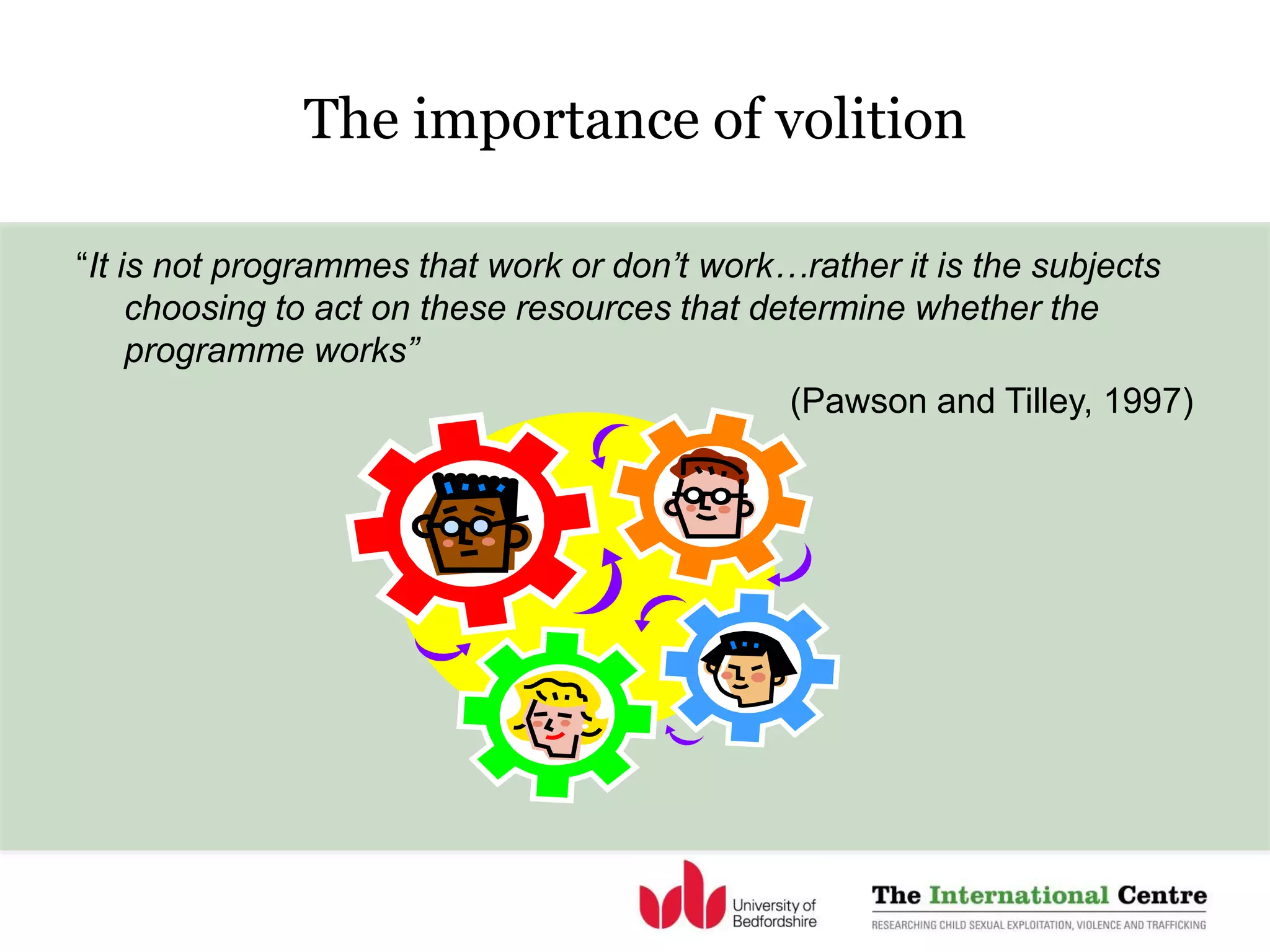
“It is not programmes that work or don’t work…rather it is the subjects
choosing to act on these resources that determine whether the
programme works”
(Pawson and Tilley, 1997)
The importance of volition
Understanding mechanisms in the context
of child protection
Examples:
• Reluctance of young people affected by CSE to engage
in support services, or
• Non recognition of abuse
Key mechanisms:
• Persistence of project workers (for example, through assertive
outreach) – eventually persuades young people that someone is
investing in them.
• The recognition of their peers as being exploited (for example,
through group work) – may help young people to better understand
their own situation.
Summary
• If ‘What works?’ is the wrong question, RE suggests we ask ‘What
works for whom, in what circumstances?’
• Assumes that because of context there will always be winners and
losers. Change mechanisms will only be activated for some people
• We need to look for a complex footprint of outcomes – some
intended, some not.
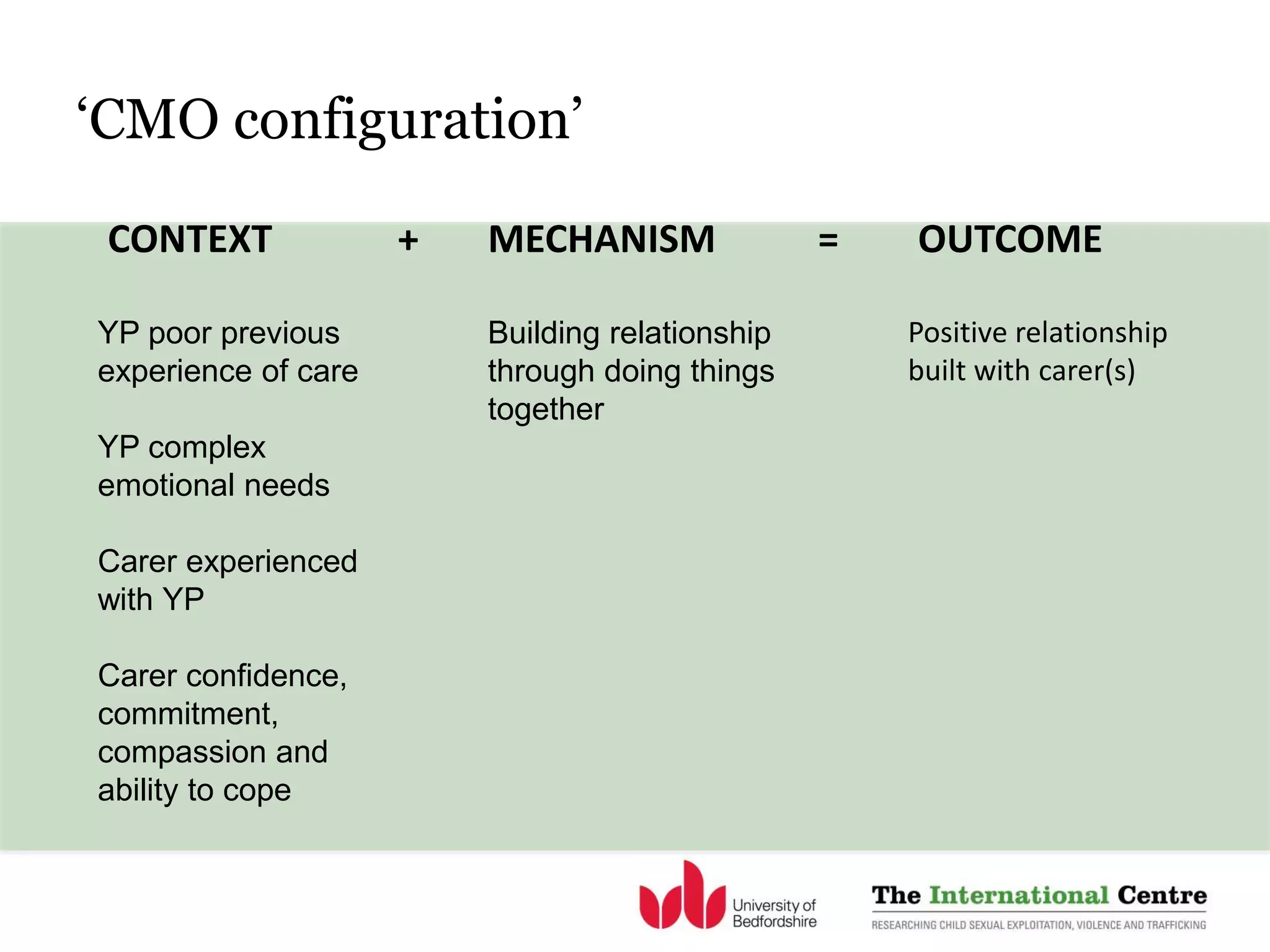
‘CMO configuration’
CONTEXT MECHANISM OUTCOME
YP poor previous
experience of care
YP complex
emotional needs
Carer experienced
with YP
Carer confidence,
commitment,
compassion and
ability to cope
Building relationship
through doing things
together
Positive relationship
built with carer(s)
+ =
The realist evaluation cycle
Literature
review &
stakeholder
interviews
Formulate
initial
theories
Collect data
to test
theories
Further
interviews
with
stakeholders
Refine
theories
Adapted from Introduction to Realist Evaluation - workshop presentation
Joanne Greenalgh 2012
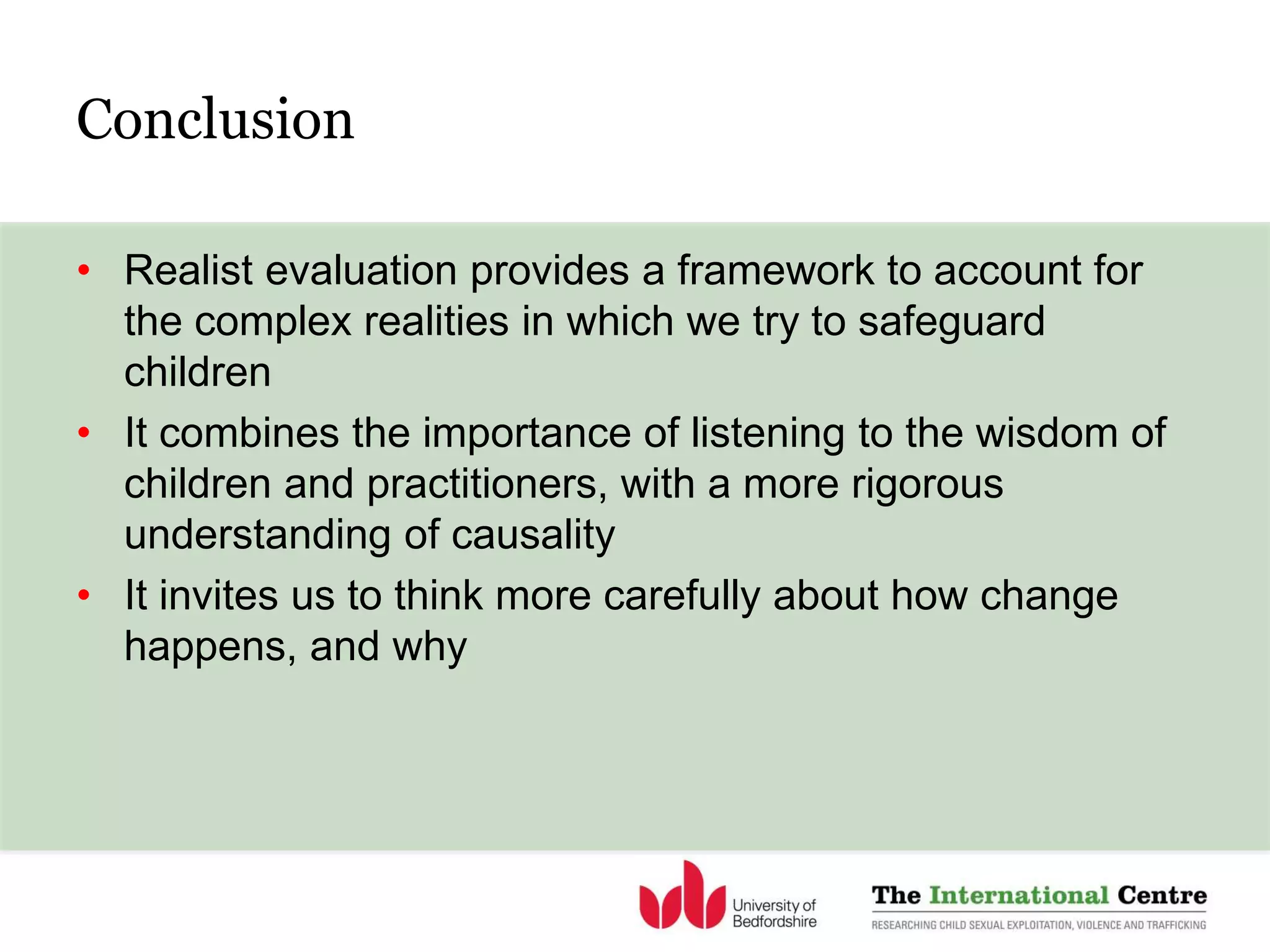
Conclusion
• Realist evaluation provides a framework to account for
the complex realities in which we try to safeguard
children
• It combines the importance of listening to the wisdom of
children and practitioners, with a more rigorous
understanding of causality
• It invites us to think more carefully about how change
happens, and why
Finally ….
• What does all this mean for you?
• How might a realist evaluation approach be useful for
you, in your work?
• Questions and discussion
References
• Mark M and Henry G (2004) The mechanisms and outcomes of
evaluation influence. Evaluation 10:35. Sage Publications
• Preskill H and Caracelli V J (1997) Current and developing
conceptions of use: Evaluation use topical interest group survey
results. Evaluation Practice, 18, 209-225
• Patton M Q (1997) Utilization-focussed Evaluation: The New
Century Text. Thousand Oaks, CA: Sage
• Pawson R and Tilley N (1997) Realistic Evaluation. London: Sage
Publications
• Stein M (2006) Research review: Young people leaving care. Child
and Family Social Work, 11, pp. 273-279
• Weiss C (1987) Using Social Research in Public Policy Making.
Lexington, MA: Lexington Books
Julie.harris@beds.ac.uk
For more information on our work including
research publications, short films and outputs from
young people please visit
www.beds.ac.uk/ic

Using realist evaluation with vulnerable young people and the services that support them:

  • 1.
    Using realist evaluationwith vulnerable young people and the services that support them: examples from research Not to be reproduced without permission from the authors Dr Julie Harris, Dr Debi Roker, Dr Lucie Shuker University of Bedfordshire
  • 2.
    The International Centre •Committed to increasing understanding of, and improving responses to, child sexual exploitation, violence and trafficking in local, national and international contexts • Achieved through: – academic rigour and research excellence – collaborative and partnership based approaches to applied social research – meaningful and ethical engagement of children and young people – active dissemination and evidence-based engagement in theory, policy and practice
  • 3.
    Workshop outline • Reflecton multiple ways evaluations are used • Realist cycle of evaluation (including theory of change) • Taking account of context • Understanding how change happens –mechanisms • Conclusions/reflections
  • 4.
    To begin… Think aboutan evaluation that you have participated in…. Discuss the following with a partner 1) What was the purpose of the evaluation? 2) How were the findings used?
  • 5.
    Four uses ofevaluation • Symbolic use – providing the rationale for action or inaction, reinforce a policy position or reassure commissioners (Mark and Henry, 2004) • Instrumental use - where action occurs directly as a result of evaluation e.g. regarding continuation of a programme, expansion, revision or termination (Preskill & Caracelli, 1997)
  • 6.
    Four uses ofevaluation cont.. • Conceptual use – learning that emerges from a programme e.g.… regarding its participants, its operation or its outcomes (Weiss, 1977) • Process use – the learning or activities that may occur through the engagement of participants in the research process (rather than from the findings per se) (Patton, 1997)
  • 7.
    An example ofprocess use • Piloting a co-determined approach to outcomes for young people leaving care: - how did the process of involving young people in outcome setting and reviewing improve their projection and planning skills? - did the process in itself contribute to improved outcomes e.g. by increasing their sense of control through the leaving care journey?
  • 8.
    An example ofconceptual use • What does this approach to measuring outcomes tell us about the population of care leavers and the needs of the different groups within it? - young people who are ‘moving on’ - young people who are ‘surviving’ - young people who are ‘struggling’ (Stein, 2006)
  • 9.
    Making evaluation meaningful •Informing practice • Being attentive to the experiences of those at the heart of the system “Use is the link between the day-to-day work of evaluation, on the one hand and those activities that could actually improve the lives of programme participants and society on the other.” Mark and Henry, 2004. p.35.
  • 10.
    The Realist EvaluationCycle … how does it work?
  • 11.
    The realist evaluationcycle Literature review & stakeholder interviews Formulate initial theories Collect data to test theories Further interviews with stakeholders Refine theories Adapted from Introduction to Realist Evaluation - workshop presentation Joanne Greenalgh 2012
  • 12.
    Characteristics of the RealistEvaluation cycle • It starts with theory • It focusses on practitioner wisdom and the experiences of young people and service users • It is a respectful, honest, and collaborative approach
  • 13.
    Realist evaluation methods andapproaches • Mixed methods • Triangulation of data • Focus on testing and refining theories • Aims to identify CMOs (contexts, mechanisms and outcomes – more in a minute!) • …. to identify what works, for whom, in what circumstances, and why (Pawson and Tilley, 1997)
  • 14.
    As an example…. • Evaluation of the ‘Hub and Spoke’ model for addressing CSE • Different stages, reflecting the realist evaluation approach • Different sources of data collection, reflecting the realist evaluation approach
  • 15.
    … over toJulie and Lucie … … for more detail on context, mechanisms and outcomes (CMOs)
  • 16.
    Context Think about anew initiative that was introduced into your organization. How did it play out? (e.g. Embraced? Resisted? Ignored?) What kinds of contextual factors were influencing the way that you/others responded to the change being introduced?
  • 17.
    The importance ofcontext “Programmes or interventions are never introduced into neutral spaces – context is key” (Pawson and Tilley, 1997)
  • 18.
    • All programmeshave an idea about how change is meant to happen, but whether programmes are successful in activating ‘change mechanisms’ depends on contexts (C) • Pre-existing features of localities into which programmes are introduced • Some will support programme theory and others won’t – so there will always be winners and losers Contexts
  • 19.
    Surrounding the blackbox: Contexts Contexts are always multiple: • People Institutions • Place Economies • Period Cultures • Processes Society Adapted from Introduction to Realist Evaluation - workshop presentation Joanne Greenalgh 2012
  • 20.
    Example: Safe AccommodationProject • Carers’ capacity to provide appropriate care to high risk young person (individual) • Multi-agency knowledge of CSE • Length of placement/commissioned support • Location of placement relative to risky areas/people • Young person’s willingness/capacity to engage in placement • Young person’s strength of attachment to friends/family/communities that pose a risk
  • 21.
    Context feeds intorefined theories • Placements most effective when YP ready/wiling to engage – whatever risk level (YP capacity to engage) • Placements have to counteract the ‘pull’ away by giving reasons to stay (YP attachment to FFC) • Trusting relationships underpin other interventions (carer capacity to build relationship) • Takes time to go from physical to relational to psychological security (length of placement) • Multi-agency shared understanding is key (MA knowledge of CSE)
  • 22.
    • Describe whatit is about programmes and interventions that bring about any effects. • Programmes usually offer new resources – material, social, emotional etc. • How people act on these is known as the programme ‘mechanism’ • Mechanisms often work behind the scenes • The concept of mechanism is the pivot around which realist research revolves. Mechanisms
  • 23.
    • Programme resourcesare always interpreted in different ways by different programme subjects- triggering different causal mechanisms. Subjects ‘ponder’, ‘enter’, ‘support’, ‘go along with’, ‘undermine’, ‘sabotage’, ‘hide behind’ etc. Mechanisms are always multiple M 1 M 2 M 3 M 4 M 5 Adapted from Introduction to Realist Evaluation - workshop presentation Joanne Greenalgh 2012
  • 24.
    “It is notprogrammes that work or don’t work…rather it is the subjects choosing to act on these resources that determine whether the programme works” (Pawson and Tilley, 1997) The importance of volition
  • 25.
    Understanding mechanisms inthe context of child protection Examples: • Reluctance of young people affected by CSE to engage in support services, or • Non recognition of abuse
  • 26.
    Key mechanisms: • Persistenceof project workers (for example, through assertive outreach) – eventually persuades young people that someone is investing in them. • The recognition of their peers as being exploited (for example, through group work) – may help young people to better understand their own situation.
  • 27.
    Summary • If ‘Whatworks?’ is the wrong question, RE suggests we ask ‘What works for whom, in what circumstances?’ • Assumes that because of context there will always be winners and losers. Change mechanisms will only be activated for some people • We need to look for a complex footprint of outcomes – some intended, some not.
  • 28.
    ‘CMO configuration’ CONTEXT MECHANISMOUTCOME YP poor previous experience of care YP complex emotional needs Carer experienced with YP Carer confidence, commitment, compassion and ability to cope Building relationship through doing things together Positive relationship built with carer(s) + =
  • 29.
    The realist evaluationcycle Literature review & stakeholder interviews Formulate initial theories Collect data to test theories Further interviews with stakeholders Refine theories Adapted from Introduction to Realist Evaluation - workshop presentation Joanne Greenalgh 2012
  • 30.
    Conclusion • Realist evaluationprovides a framework to account for the complex realities in which we try to safeguard children • It combines the importance of listening to the wisdom of children and practitioners, with a more rigorous understanding of causality • It invites us to think more carefully about how change happens, and why
  • 31.
    Finally …. • Whatdoes all this mean for you? • How might a realist evaluation approach be useful for you, in your work? • Questions and discussion
  • 32.
    References • Mark Mand Henry G (2004) The mechanisms and outcomes of evaluation influence. Evaluation 10:35. Sage Publications • Preskill H and Caracelli V J (1997) Current and developing conceptions of use: Evaluation use topical interest group survey results. Evaluation Practice, 18, 209-225 • Patton M Q (1997) Utilization-focussed Evaluation: The New Century Text. Thousand Oaks, CA: Sage • Pawson R and Tilley N (1997) Realistic Evaluation. London: Sage Publications • Stein M (2006) Research review: Young people leaving care. Child and Family Social Work, 11, pp. 273-279 • Weiss C (1987) Using Social Research in Public Policy Making. Lexington, MA: Lexington Books
  • 33.
    Julie.harris@beds.ac.uk For more informationon our work including research publications, short films and outputs from young people please visit www.beds.ac.uk/ic