Soil Fertility and Plant Nutrition
SSCA021
An introduction
What is Plant nutrition?
What is Soil Fertility?
How do they relate?
Plant nutrition
the study of the chemical elements and compounds
necessary for plant growth and plant metabolism.
Plant nutrition is one of the most influential
preharvest factors for the productivity and
nutritional quality of crops for human consumption 
(Wang et al., 2008).
“You've certainly heard the phrase 'an apple a day
keeps the doctor away.' And perhaps you've been
told to make sure your plate looks colorful with
veggies. Essential nutrients in our diet contribute
to a properly functioning and healthy body. Plants
follow a similar approach. In addition to needing
light and water to survive, they rely on a balance
of essential elements to sustain their growth…”
Study.com
What is soil fertility?
Definition:
Soil fertility refers to the ability of a soil to supply the nutrient elements in the amounts, forms and
proportions required for maximum plant growth.
 Managing your soil resource to make it productive, maximise yields and profit while reducing
negative impacts.
Soil productivity – Soil productivity is the capacity of a soil to sustain plant
growth.
Components of soil fertility include
• Soil physics
• Soil chemistry
• Soil biology
• Plant nutrition
Also considers
• Economics
• Environment
• Food security
Important concepts
• Soil productivity
• Soil potential
• Soil quality
• Soil health
• Soil conservation
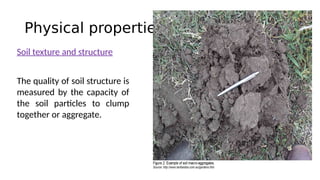
Physical properties
Soil texture and structure
The quality of soil structure is
measured by the capacity of
the soil particles to clump
together or aggregate.
Why is structure important in
soil fertility
• Soil structure affects plant growth by influencing root distribution
and the ability to take up water and nutrients.
• Soil structure facilitates oxygen and water infiltration and can
improve water storage.
• Disturbance of soil structure through compaction or tillage can
result in the rapid recycling of nutrients, crusting (the hardening of
the soil surface layer) reduced water and air availability to roots.
Chemical properties
• Soil chemistry is the interaction of various chemical constituents that
takes place among soil particles and in the soil solution, or the water
retained by soil.
• The chemical interactions that occur in soil are highly complex, but
understanding certain basic concepts will better help you manage
your soils.
• soil pH and soil/plant nutrients (Chapter 2)
Biological properties
Nutrient Cycling by Soil Microbes
• Soil microbes exert much influence in controlling the quantities and forms
of various chemical elements found in soil.
• Most notable are the cycles for carbon, nitrogen, sulfur and phosphorus,
all of which are elements important in soil fertility.
• The mineralization (i.e. the conversion of organic forms of the elements to
their inorganic forms) of organic materials by soil microbes liberates
carbon dioxide, ammonium (which is rapidly converted to nitrate by soil
microbes), sulfate, phosphate and inorganic forms of other elements.
• This is the basis of nutrient cycling in all major ecosystems of the world.
Important role of soils
• Anchor for roots
• Conductor of oxygen (air-filled pore space) and vents for other gases (e.g. CO2
and methane)
• Storage and supplier of water (sponge effect)
• Storage and supplier of plant nutrients (chemical sponge)
• Buffer (cushions nutrient supply)
• Moderates nutrient supply (supply of nutrients through biological transformation
– particularly N)
Historical perspective
Ancient records
• Man: wanderer settler
• Families, clans and villages began
• Development of agriculture
https://www.foodsystemprimer.org/food-production/history-of-agriculture/
• Mesopotamia – writings dating back to 2500 BC
• Greek historians in 500 BC commented on high production on the Tigris flood
plain
• Manures of animals and man used 300 – 800 BC
• Green manuring with legume crops 20 – 70 BC
• Liming recommended by Romans 60 – 100 AD
Historical perspective
The 18th
Century
• Initially concentrated on water as the main “nutrient”
• Suggestion that saltpetre (KNO3) was the “principle” of vegetation
• Recognition that earth (soil) rather than water was the principle of vegetation
• Many quaint (curious) ideas:
Jethro Tull (1674-1741)
• Believed soil particles were ingested by openings in plant roots – “lacteal
mouths of root”
Arthur Young (1741-1820)
• Grew barley in sand and added anything from charcoal, train oil wine, animal
manures, gun powder and many others – some worked others not
• Ideas were refined and basic concepts used today were developed through
many concepts still poorly understood
Historical perspective
1. Liebig (1803-1873)
• Most of the C in plants comes from CO2
• H and O come from water
• P is necessary for seed formation
• Plants absorb everything from soil but excretes non-essential materials
• Alkaline metals are needed for neutralization of acids formed in plants
Liebig proposed the “law of minimum”
• Identify the most limiting factor (e.g. lime, potash, nitrogen, phosphoric acid,
magnesia)
• Application of non limiting factors will not affect yields (nutrient essentiality)
He pioneered plant analysis and the manufacture of “artificial manure”
Historical perspective
2. Lawes and Gilbert (mid-1800’s)
• Established an agricultural experimental station at Rothamsted,
UK
• By 1855 they settled on the following points
1) Crops require both P and K
2) Non-legumes require N
3) Soil fertility application requires fertiliser application
4) Fallow is beneficial (increases available N)
Modern Knowledge
Most useful gains
• Understanding soil water storage and movement
• Valuation of reserves of plant nutrients
• Physical, biological conditions in the rhizosphere
• The role of cultivation in production systems
• Some current trends/ areas of interest
• Organic farming – various forms
• Conservation / no-till farming
• Indigenous farming versus scientific knowledge
• Biodynamic farming (create a diversified, balanced farm ecosystem that
generates health and fertility)
• Permaculture (simulating or directly utilizing the patterns and features
observed in natural ecosystem)
• Land application of waste
• Hydroponics (soilless agric)
Why soil fertility management?
Manage the soil resource so that:
• Crop yields are high and production is profitable
• Crop quality is at optimum level
• Environmental quality is maintained
• Surface and ground water quality is maintained
• Loss of soil into dams through erosion
• Atmospheric pollution
• Soil resource is maintained
SOIL POTENTIAL
• Soil potential only becomes a meaningful term if it is specified in
terms of a specific crop.
• A soil type which is not suitable for the production of dryland maize
can, for example, be ideal for pastures.
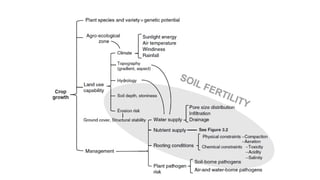
• FACTORS DETERMINING SOIL POTENTIAL.
Soil texture
Soil depth
Soil structure
Rainfall
Position and inclination
SOIL POTENTIAL
Introduction_soil_fertility_2022.pptx.pdf

Introduction_soil_fertility_2022.pptx.pdf

  • 1.
    Soil Fertility andPlant Nutrition SSCA021 An introduction
  • 2.
    What is Plantnutrition? What is Soil Fertility? How do they relate?
  • 3.
    Plant nutrition the studyof the chemical elements and compounds necessary for plant growth and plant metabolism. Plant nutrition is one of the most influential preharvest factors for the productivity and nutritional quality of crops for human consumption  (Wang et al., 2008).
  • 4.
    “You've certainly heardthe phrase 'an apple a day keeps the doctor away.' And perhaps you've been told to make sure your plate looks colorful with veggies. Essential nutrients in our diet contribute to a properly functioning and healthy body. Plants follow a similar approach. In addition to needing light and water to survive, they rely on a balance of essential elements to sustain their growth…” Study.com
  • 7.
    What is soilfertility? Definition: Soil fertility refers to the ability of a soil to supply the nutrient elements in the amounts, forms and proportions required for maximum plant growth.  Managing your soil resource to make it productive, maximise yields and profit while reducing negative impacts. Soil productivity – Soil productivity is the capacity of a soil to sustain plant growth. Components of soil fertility include • Soil physics • Soil chemistry • Soil biology • Plant nutrition Also considers • Economics • Environment • Food security
  • 8.
    Important concepts • Soilproductivity • Soil potential • Soil quality • Soil health • Soil conservation
  • 9.
    Physical properties Soil textureand structure The quality of soil structure is measured by the capacity of the soil particles to clump together or aggregate.
  • 11.
    Why is structureimportant in soil fertility • Soil structure affects plant growth by influencing root distribution and the ability to take up water and nutrients. • Soil structure facilitates oxygen and water infiltration and can improve water storage. • Disturbance of soil structure through compaction or tillage can result in the rapid recycling of nutrients, crusting (the hardening of the soil surface layer) reduced water and air availability to roots.
  • 12.
    Chemical properties • Soilchemistry is the interaction of various chemical constituents that takes place among soil particles and in the soil solution, or the water retained by soil. • The chemical interactions that occur in soil are highly complex, but understanding certain basic concepts will better help you manage your soils. • soil pH and soil/plant nutrients (Chapter 2)
  • 13.
    Biological properties Nutrient Cycling by Soil Microbes • Soilmicrobes exert much influence in controlling the quantities and forms of various chemical elements found in soil. • Most notable are the cycles for carbon, nitrogen, sulfur and phosphorus, all of which are elements important in soil fertility. • The mineralization (i.e. the conversion of organic forms of the elements to their inorganic forms) of organic materials by soil microbes liberates carbon dioxide, ammonium (which is rapidly converted to nitrate by soil microbes), sulfate, phosphate and inorganic forms of other elements. • This is the basis of nutrient cycling in all major ecosystems of the world.
  • 14.
    Important role ofsoils • Anchor for roots • Conductor of oxygen (air-filled pore space) and vents for other gases (e.g. CO2 and methane) • Storage and supplier of water (sponge effect) • Storage and supplier of plant nutrients (chemical sponge) • Buffer (cushions nutrient supply) • Moderates nutrient supply (supply of nutrients through biological transformation – particularly N)
  • 15.
    Historical perspective Ancient records •Man: wanderer settler • Families, clans and villages began • Development of agriculture https://www.foodsystemprimer.org/food-production/history-of-agriculture/ • Mesopotamia – writings dating back to 2500 BC • Greek historians in 500 BC commented on high production on the Tigris flood plain • Manures of animals and man used 300 – 800 BC • Green manuring with legume crops 20 – 70 BC • Liming recommended by Romans 60 – 100 AD
  • 16.
    Historical perspective The 18th Century •Initially concentrated on water as the main “nutrient” • Suggestion that saltpetre (KNO3) was the “principle” of vegetation • Recognition that earth (soil) rather than water was the principle of vegetation • Many quaint (curious) ideas: Jethro Tull (1674-1741) • Believed soil particles were ingested by openings in plant roots – “lacteal mouths of root” Arthur Young (1741-1820) • Grew barley in sand and added anything from charcoal, train oil wine, animal manures, gun powder and many others – some worked others not • Ideas were refined and basic concepts used today were developed through many concepts still poorly understood
  • 17.
    Historical perspective 1. Liebig(1803-1873) • Most of the C in plants comes from CO2 • H and O come from water • P is necessary for seed formation • Plants absorb everything from soil but excretes non-essential materials • Alkaline metals are needed for neutralization of acids formed in plants Liebig proposed the “law of minimum” • Identify the most limiting factor (e.g. lime, potash, nitrogen, phosphoric acid, magnesia) • Application of non limiting factors will not affect yields (nutrient essentiality) He pioneered plant analysis and the manufacture of “artificial manure”
  • 18.
    Historical perspective 2. Lawesand Gilbert (mid-1800’s) • Established an agricultural experimental station at Rothamsted, UK • By 1855 they settled on the following points 1) Crops require both P and K 2) Non-legumes require N 3) Soil fertility application requires fertiliser application 4) Fallow is beneficial (increases available N)
  • 19.
    Modern Knowledge Most usefulgains • Understanding soil water storage and movement • Valuation of reserves of plant nutrients • Physical, biological conditions in the rhizosphere • The role of cultivation in production systems • Some current trends/ areas of interest • Organic farming – various forms • Conservation / no-till farming • Indigenous farming versus scientific knowledge • Biodynamic farming (create a diversified, balanced farm ecosystem that generates health and fertility) • Permaculture (simulating or directly utilizing the patterns and features observed in natural ecosystem) • Land application of waste • Hydroponics (soilless agric)
  • 20.
    Why soil fertilitymanagement? Manage the soil resource so that: • Crop yields are high and production is profitable • Crop quality is at optimum level • Environmental quality is maintained • Surface and ground water quality is maintained • Loss of soil into dams through erosion • Atmospheric pollution • Soil resource is maintained
  • 21.
    SOIL POTENTIAL • Soilpotential only becomes a meaningful term if it is specified in terms of a specific crop. • A soil type which is not suitable for the production of dryland maize can, for example, be ideal for pastures. • FACTORS DETERMINING SOIL POTENTIAL. Soil texture Soil depth Soil structure Rainfall Position and inclination
  • 22.