BUILDING A PROOF OF CONCEPT FOR AN OPEN BADGE INFRASTRUCTURE
The open badge experiment in Dutch HE
27 October 2017
Frans Ward, Ronald Ham - SURFnet
#OpenRecognition – Bologna, Italy
Mainly you
• Questions?
Ronald
• What are some of the results up until now?
• What defines a functional ecosystem?
• What are the challenges we see and foresee?
Frans
• About SURFnet & our aim
• How do badges fit in?
• What questions are we asking ourselves?
• Why did we initiate a PoC?
What to Expect
10 mins
5 mins
15 mins
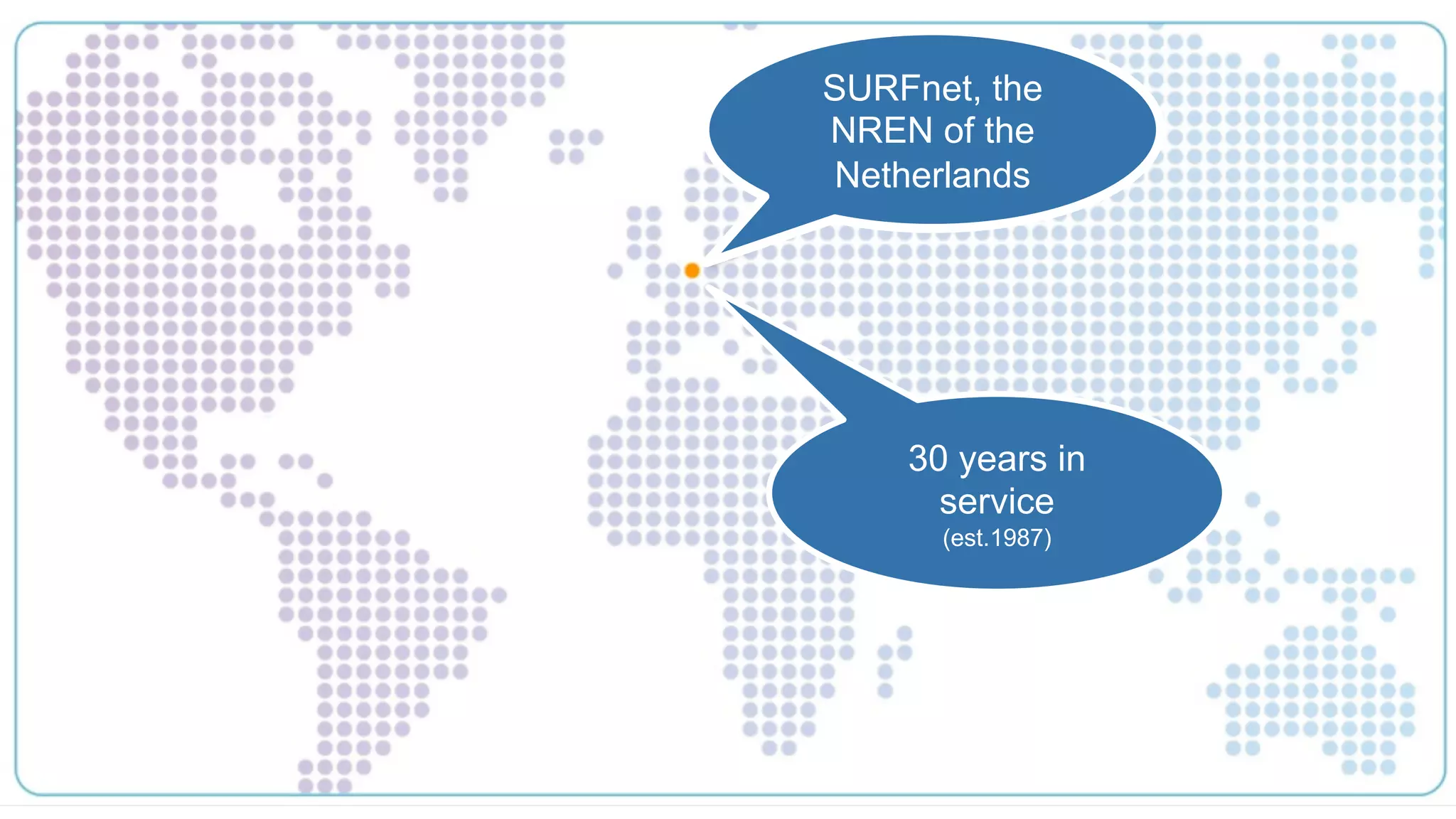
SURFnet
30 years in
service
(est.1987)
SURFnet, the
NREN of the
Netherlands
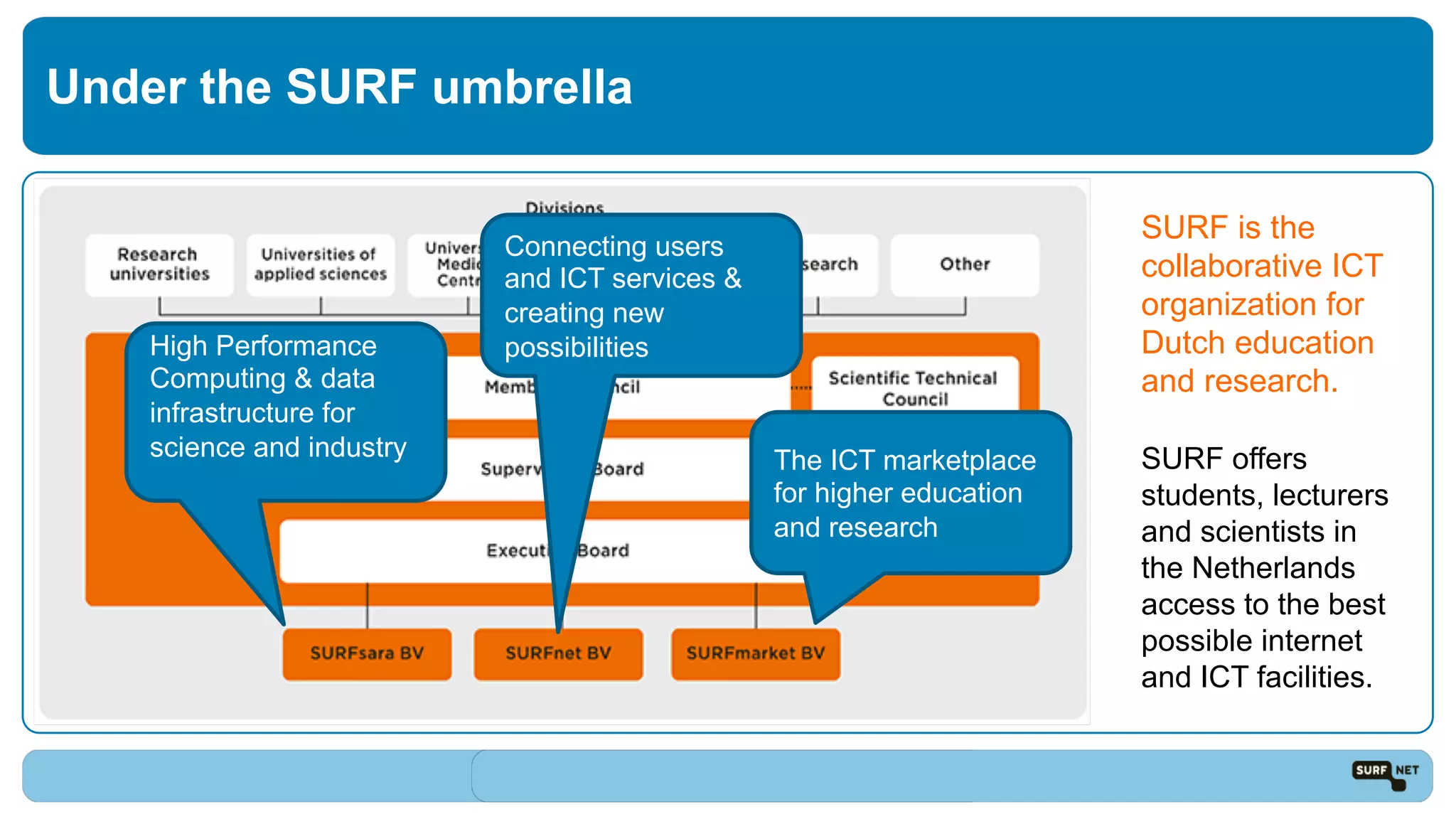
Under the SURF umbrella
SURF is the
collaborative ICT
organization for
Dutch education
and research.
SURF offers
students, lecturers
and scientists in
the Netherlands
access to the best
possible internet
and ICT facilities.
The ICT marketplace
for higher education
and research
High Performance
Computing & data
infrastructure for
science and industry
Connecting users
and ICT services &
creating new
possibilities
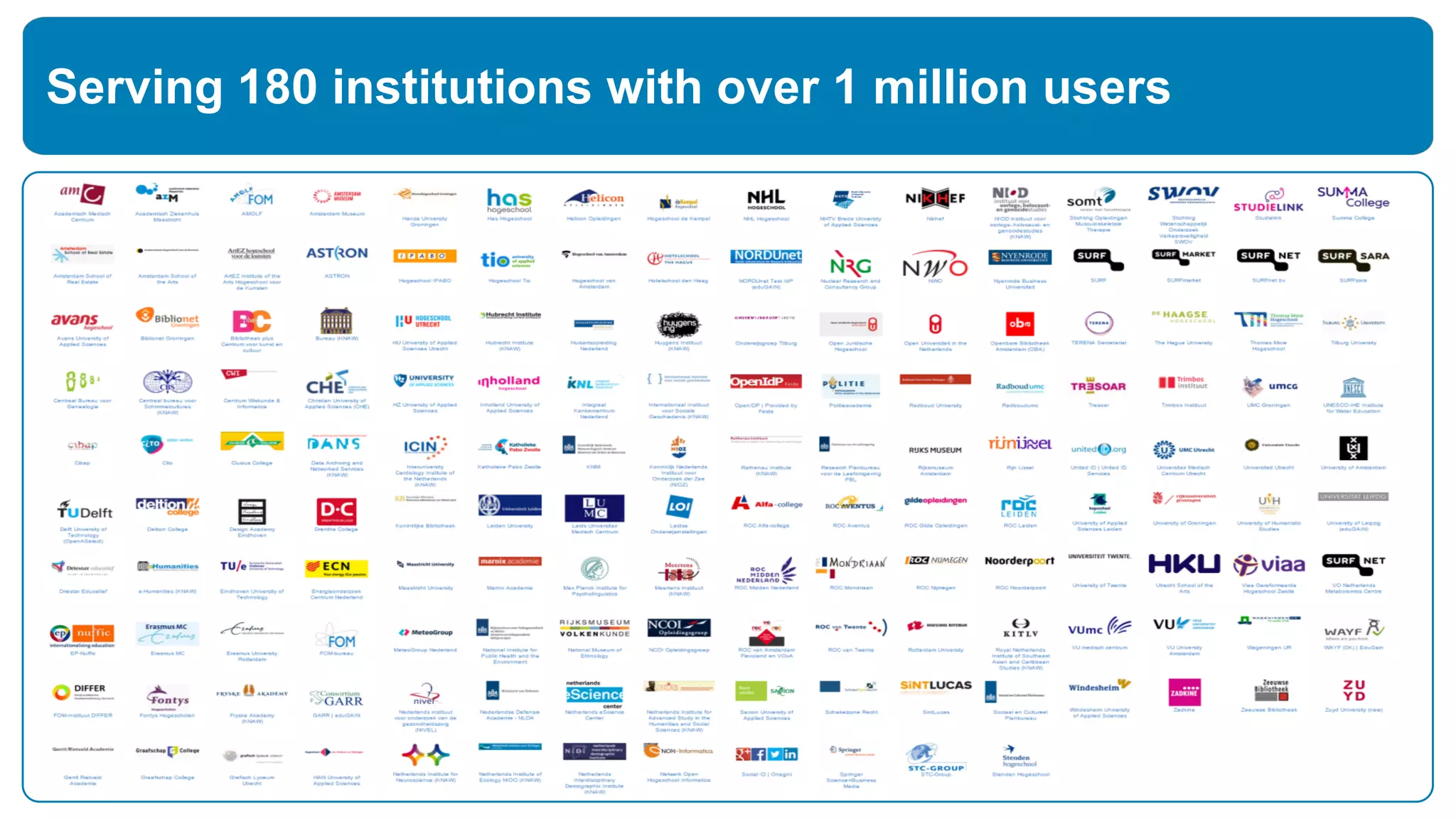
Serving 180 institutions with over 1 million users
SURFnet is setting the default to OPEN
DUt
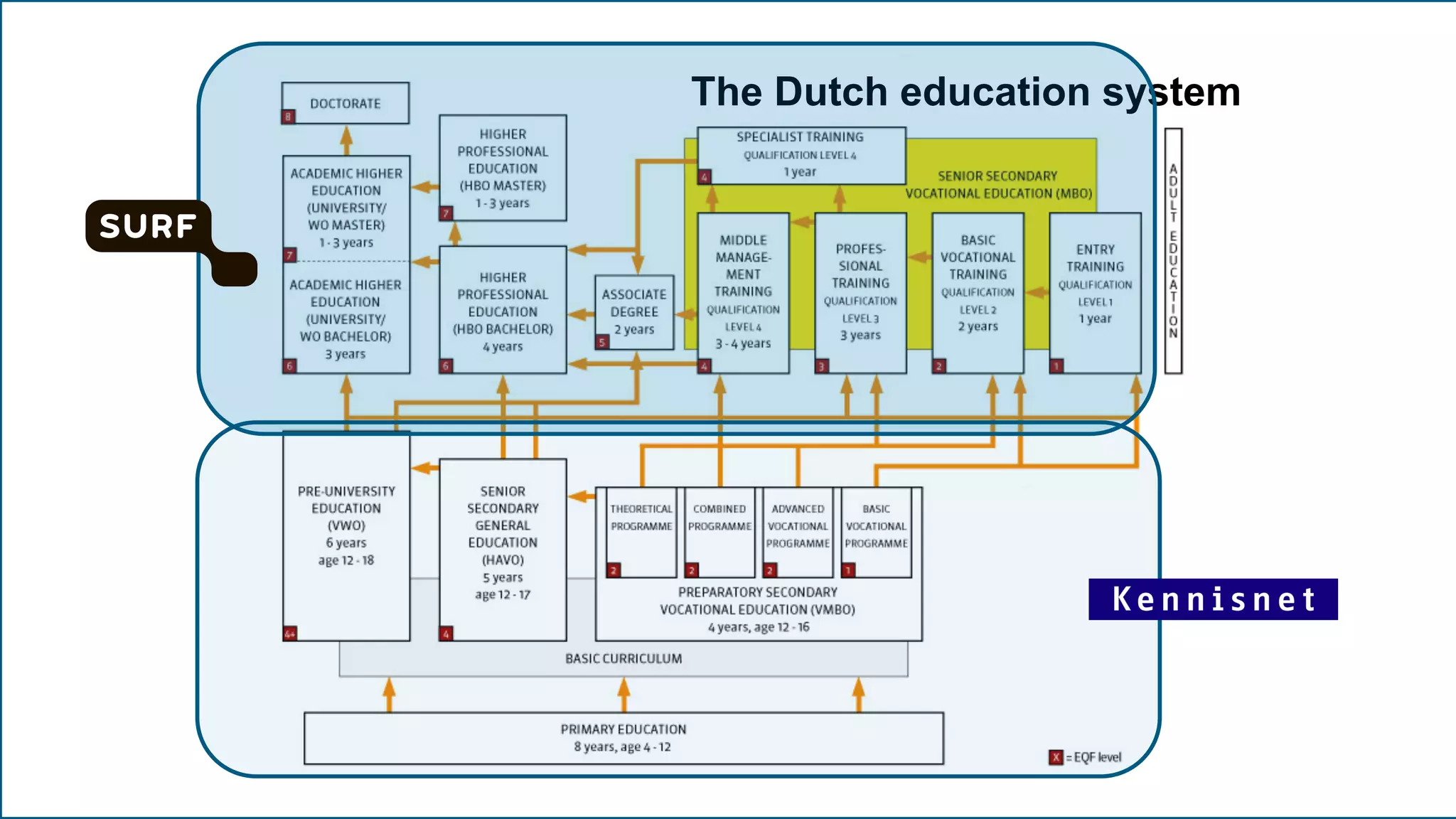
The Dutch education system
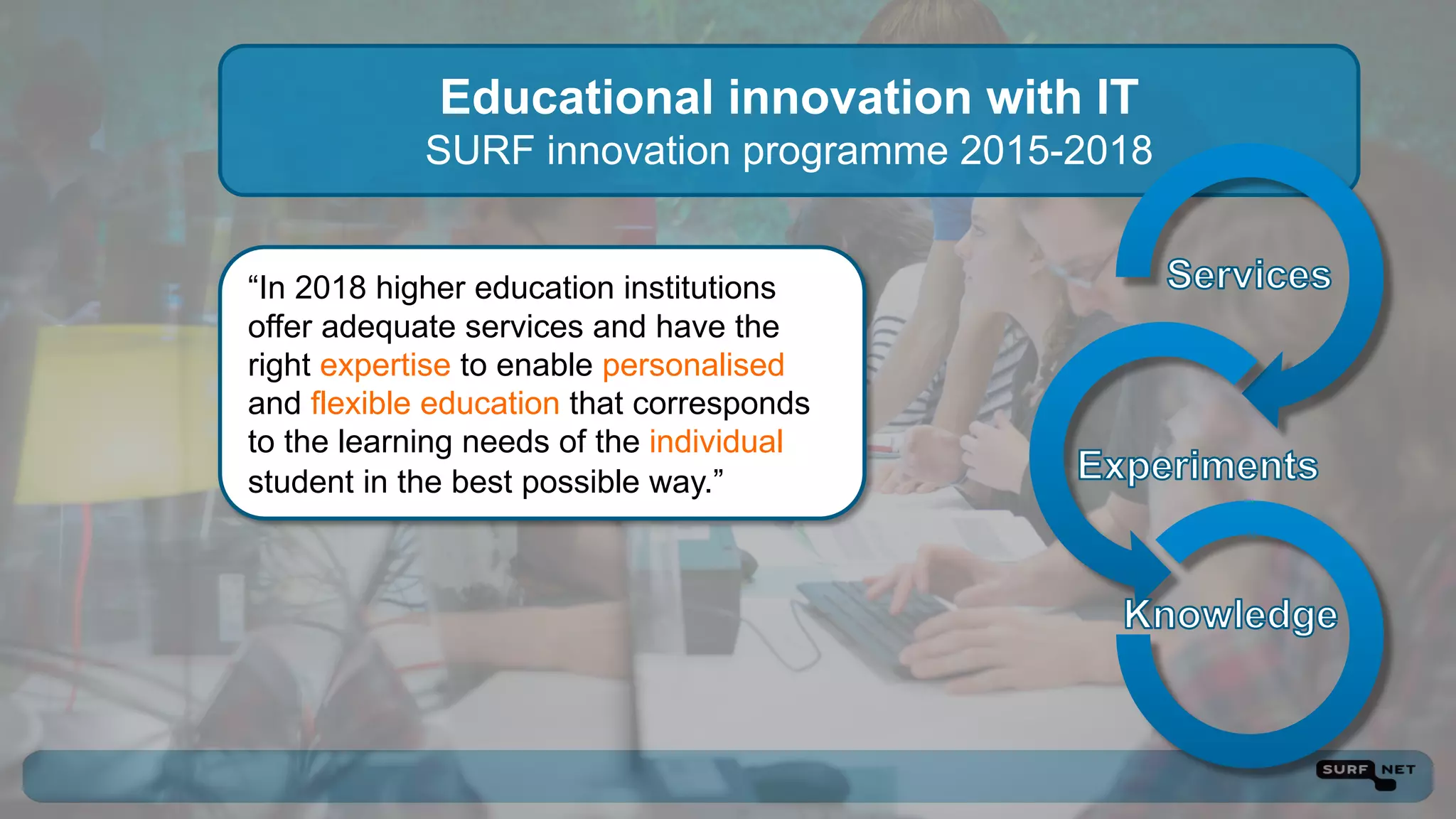
Educational innovation with IT
SURF innovation programme 2015-2018
“In 2018 higher education institutions
offer adequate services and have the
right expertise to enable personalised
and flexible education that corresponds
to the learning needs of the individual
student in the best possible way.”
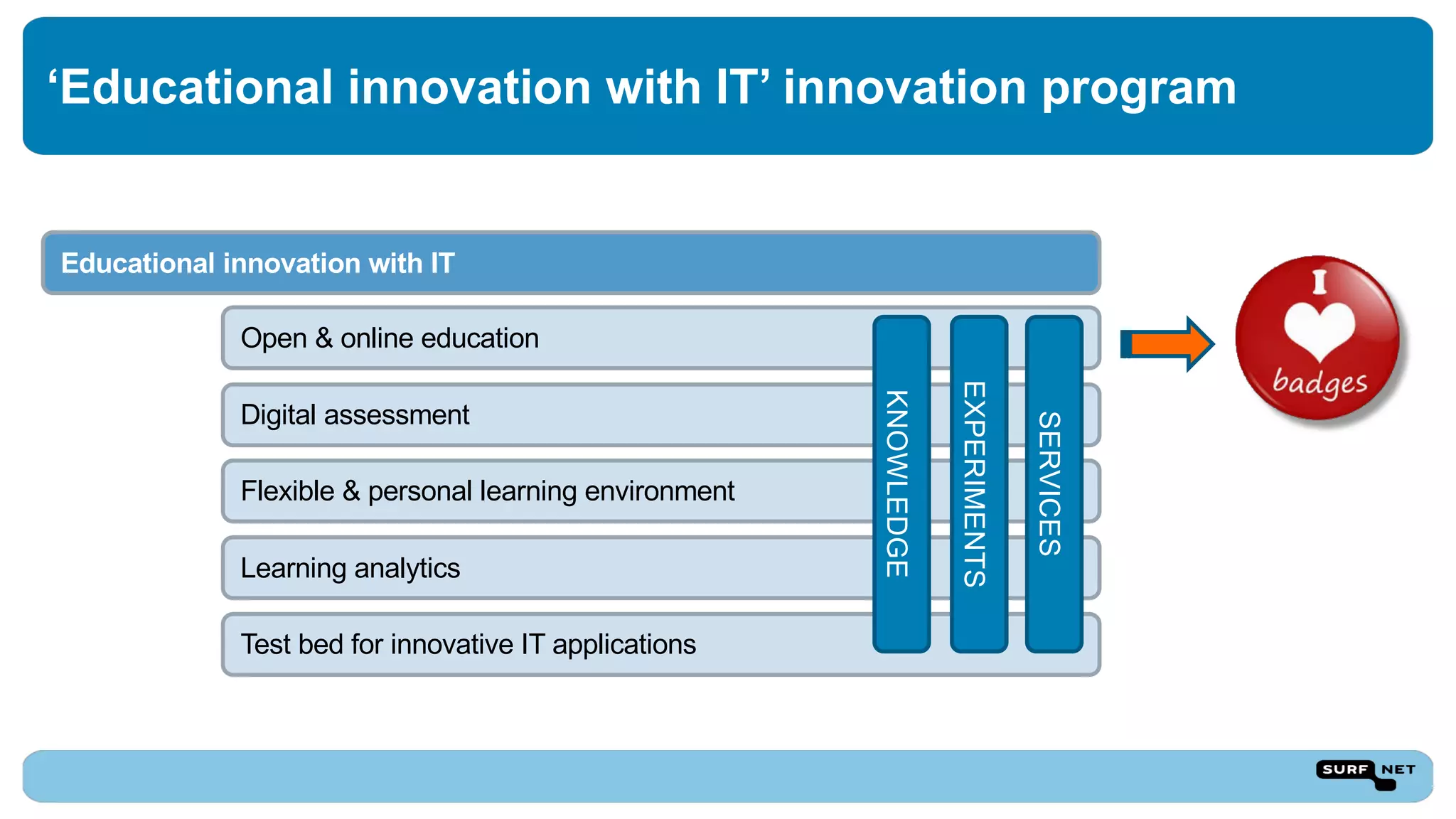
‘Educational innovation with IT’ innovation program
Educational innovation with IT
Open & online education
Digital assessment
Flexible & personal learning environment
Learning analytics
Test bed for innovative IT applications
KNOWLEDGE
EXPERIMENTS
SERVICES
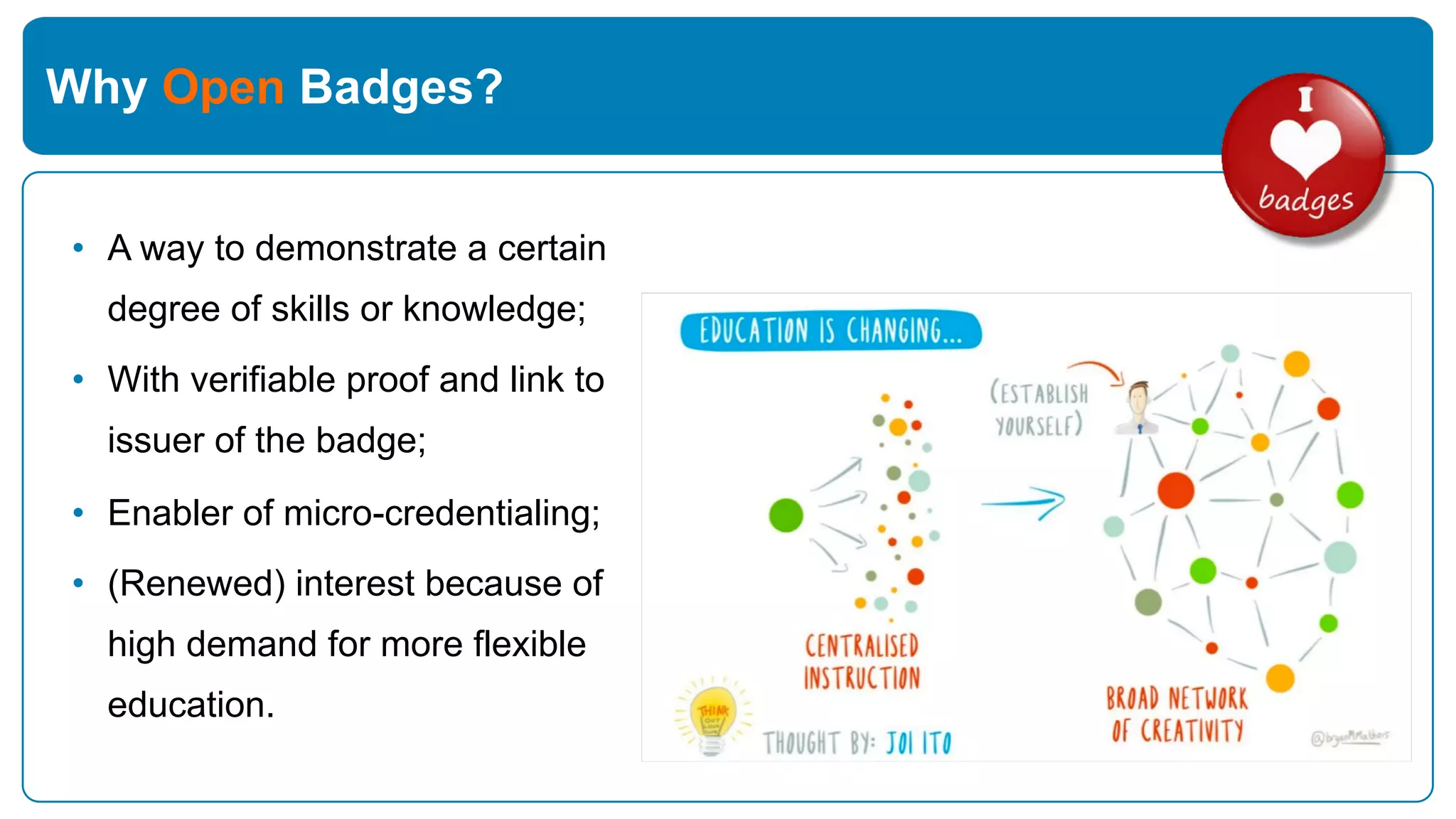
Why Open Badges?
• A way to demonstrate a certain
degree of skills or knowledge;
• With verifiable proof and link to
issuer of the badge;
• Enabler of micro-credentialing;
• (Renewed) interest because of
high demand for more flexible
education.
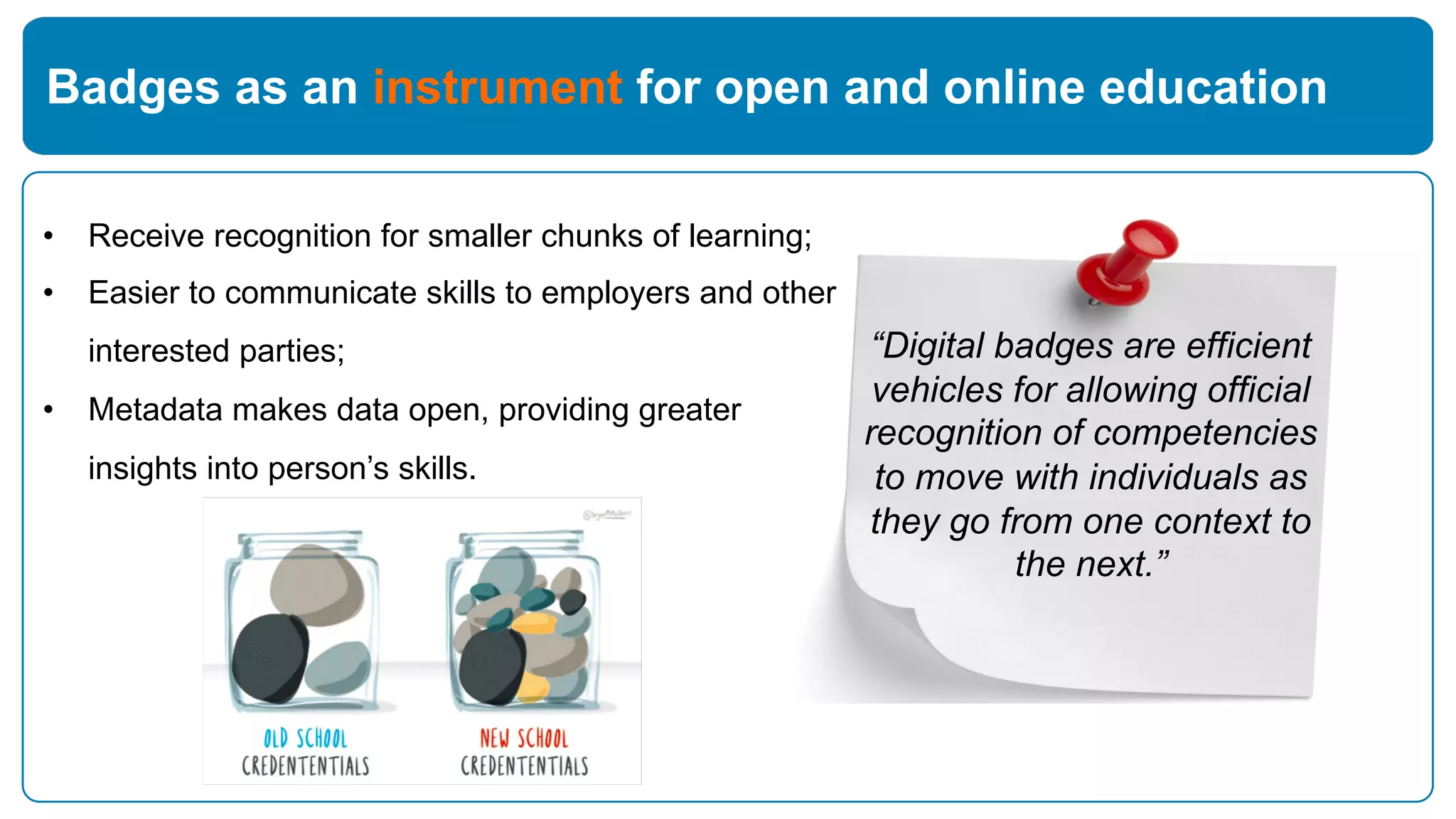
Badges as an instrument for open and online education
“Digital badges are efficient
vehicles for allowing official
recognition of competencies
to move with individuals as
they go from one context to
the next.”
• Receive recognition for smaller chunks of learning;
• Easier to communicate skills to employers and other
interested parties;
• Metadata makes data open, providing greater
insights into person’s skills.
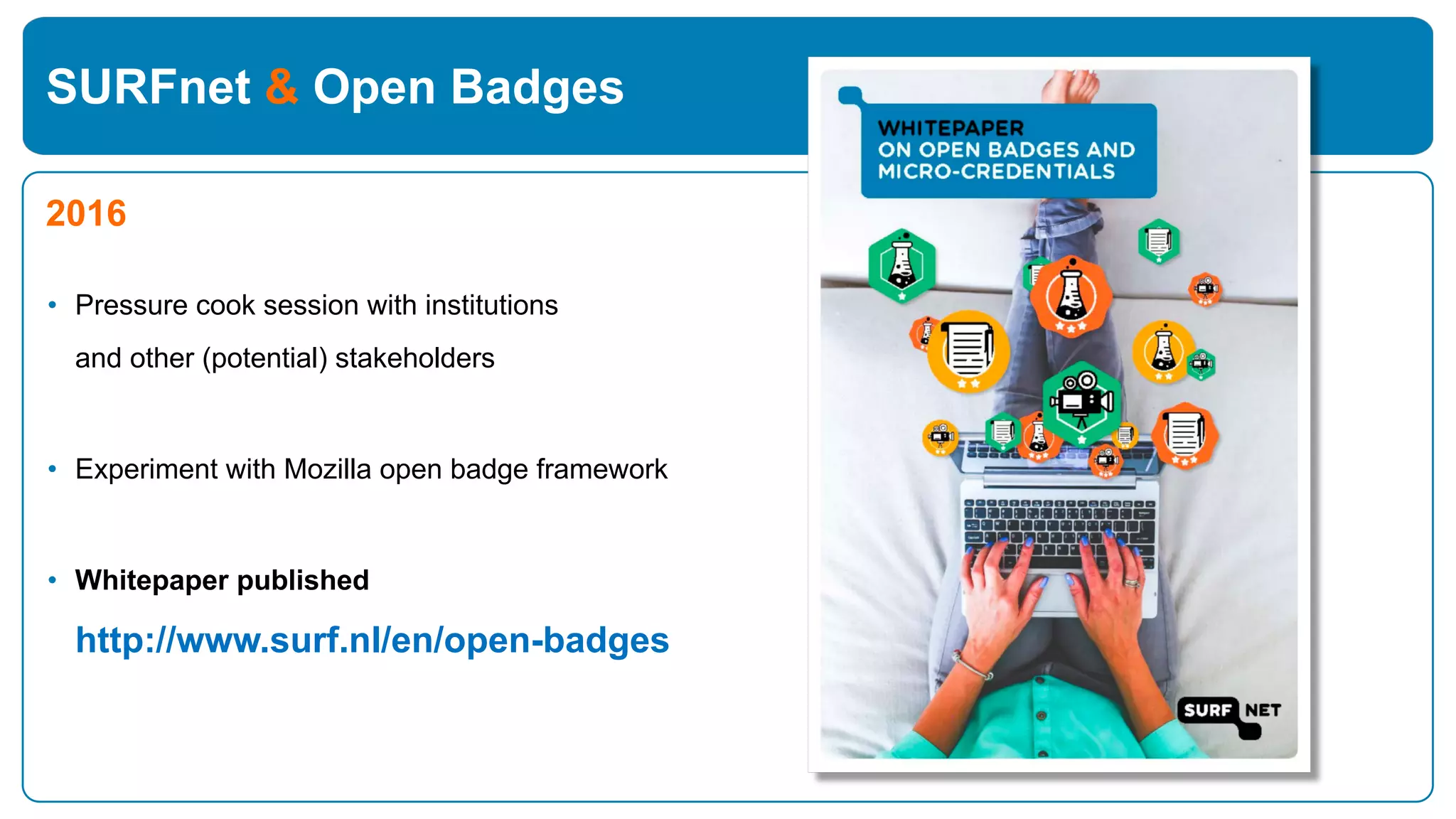
SURFnet & Open Badges
2016
• Pressure cook session with institutions
and other (potential) stakeholders
• Experiment with Mozilla open badge framework
• Whitepaper published
http://www.surf.nl/en/open-badges
SURFnet & Open Badges
2017 - Investigating service offering opportunities & Proof of Concepts
SURFacademy Seminar
• Which challenges and chances are
there for institutions?
• What is needed? (not just technical
but also standardization frameworks)
• Which role for SURF(net)?
Proof of Concept
• Building basic infra.
• Testing institutional usecases.
• Setting up business model.
• Interorganisational positioning of
micro-credentialing.
2018 – Pilot Edubadge service 2019 – SURF Edubadge service?
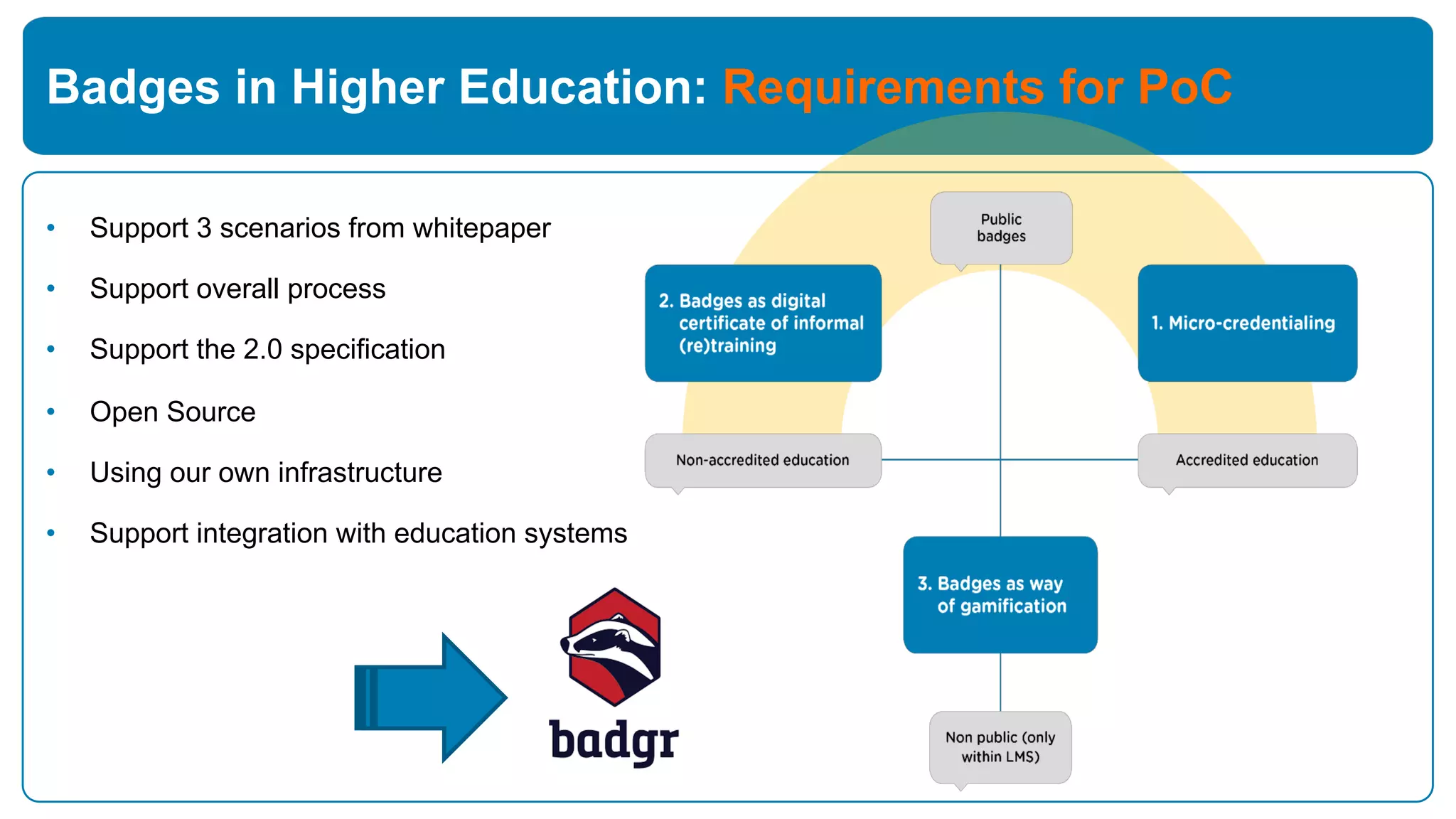
Badges in Higher Education: Requirements for PoC
• Support 3 scenarios from whitepaper
• Support overall process
• Support the 2.0 specification
• Open Source
• Using our own infrastructure
• Support integration with education systems
}
}
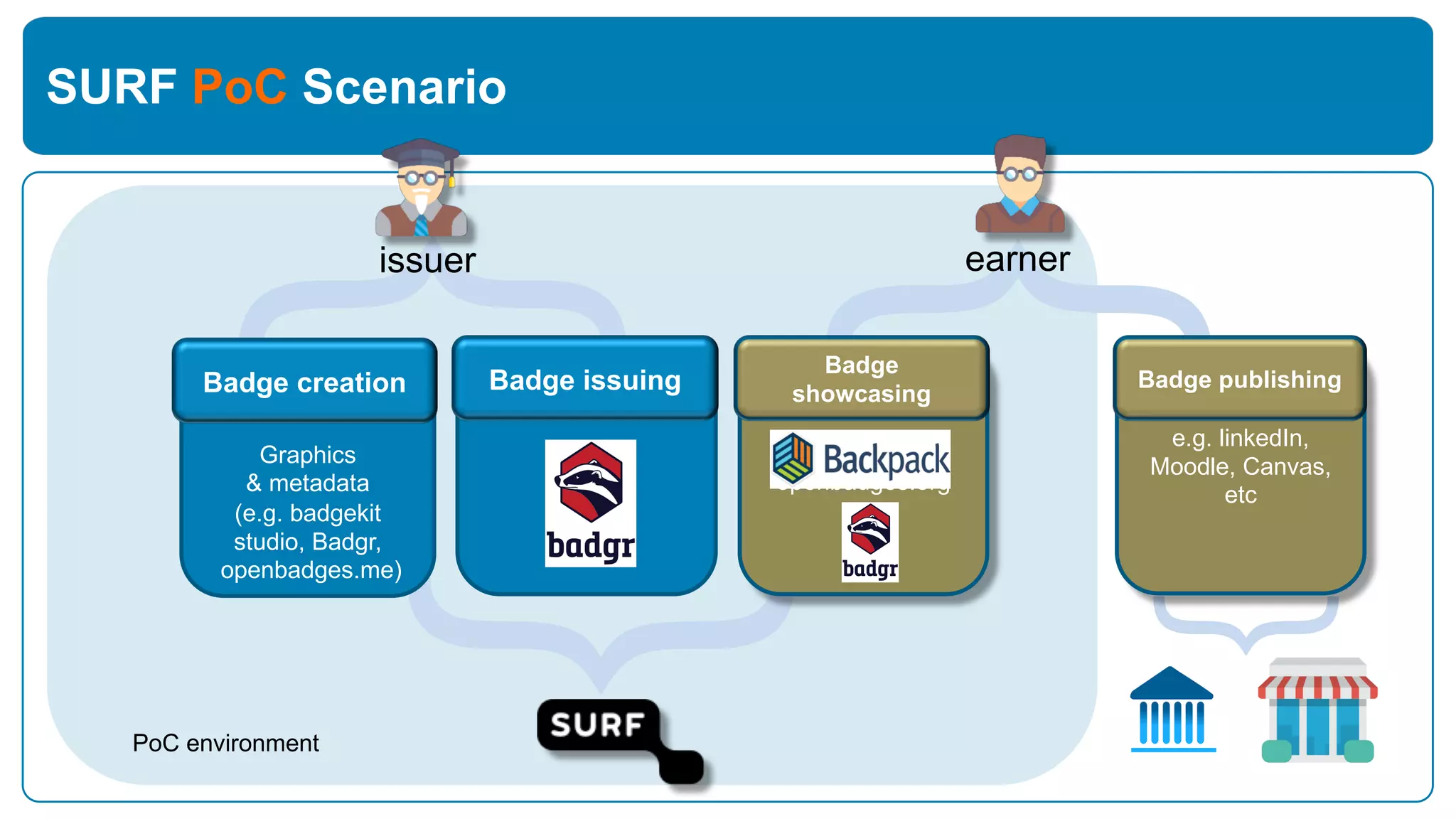
SURF PoC Scenario
}
}
PoC environment
e.g. linkedIn,
Moodle, Canvas,
etc
Badge publishingG
Graphics
& metadata
(e.g. badgekit
studio, Badgr,
openbadges.me)
Badge creation
issuer earner
e.g. backpack.
openbadges.org
Badge
showcasing
Badgr
Badge issuing
Participating institutions
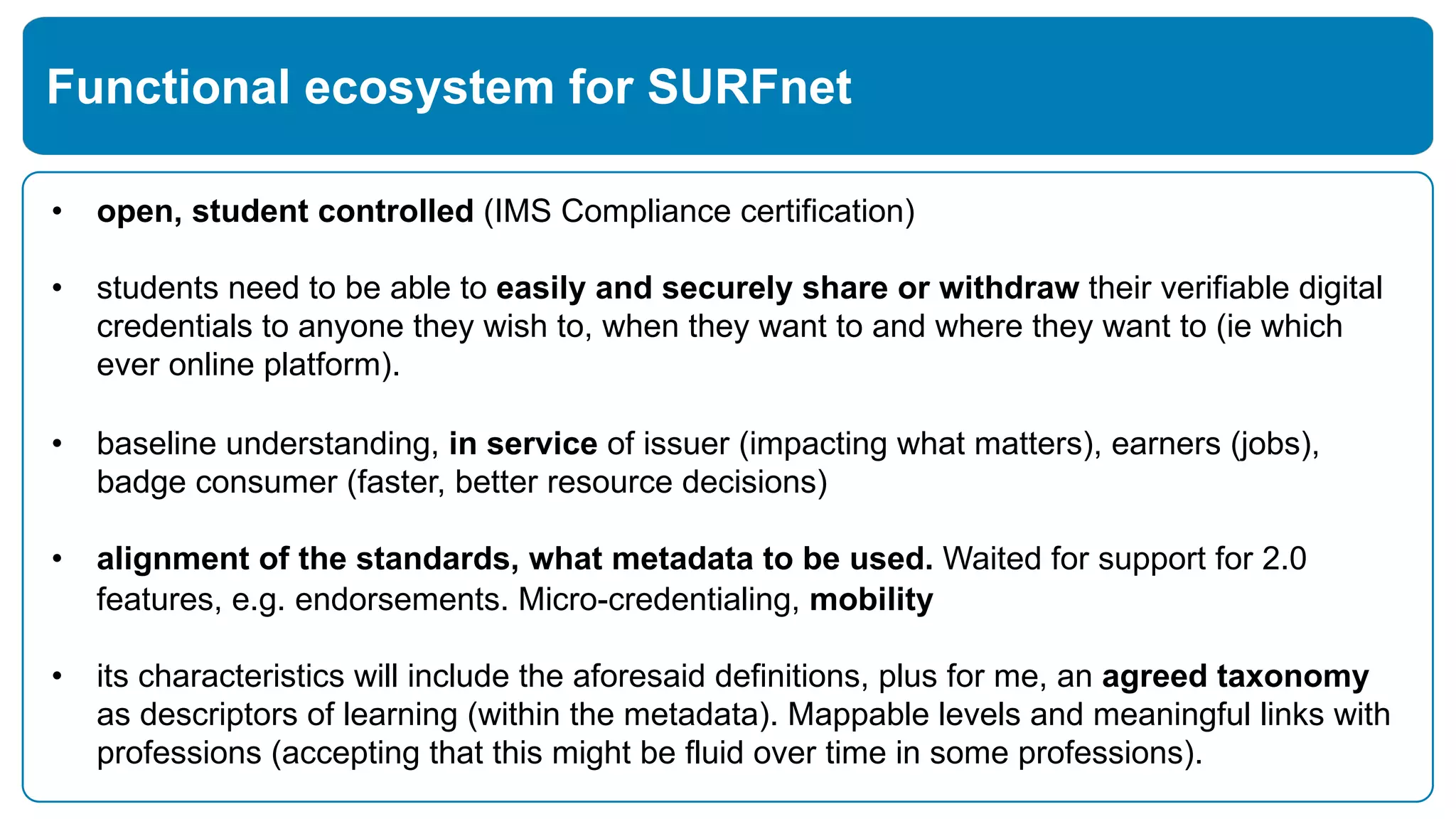
• open, student controlled (IMS Compliance certification)
• students need to be able to easily and securely share or withdraw their verifiable digital
credentials to anyone they wish to, when they want to and where they want to (ie which
ever online platform).
• baseline understanding, in service of issuer (impacting what matters), earners (jobs),
badge consumer (faster, better resource decisions)
• alignment of the standards, what metadata to be used. Waited for support for 2.0
features, e.g. endorsements. Micro-credentialing, mobility
• its characteristics will include the aforesaid definitions, plus for me, an agreed taxonomy
as descriptors of learning (within the metadata). Mappable levels and meaningful links with
professions (accepting that this might be fluid over time in some professions).
Functional ecosystem for SURFnet
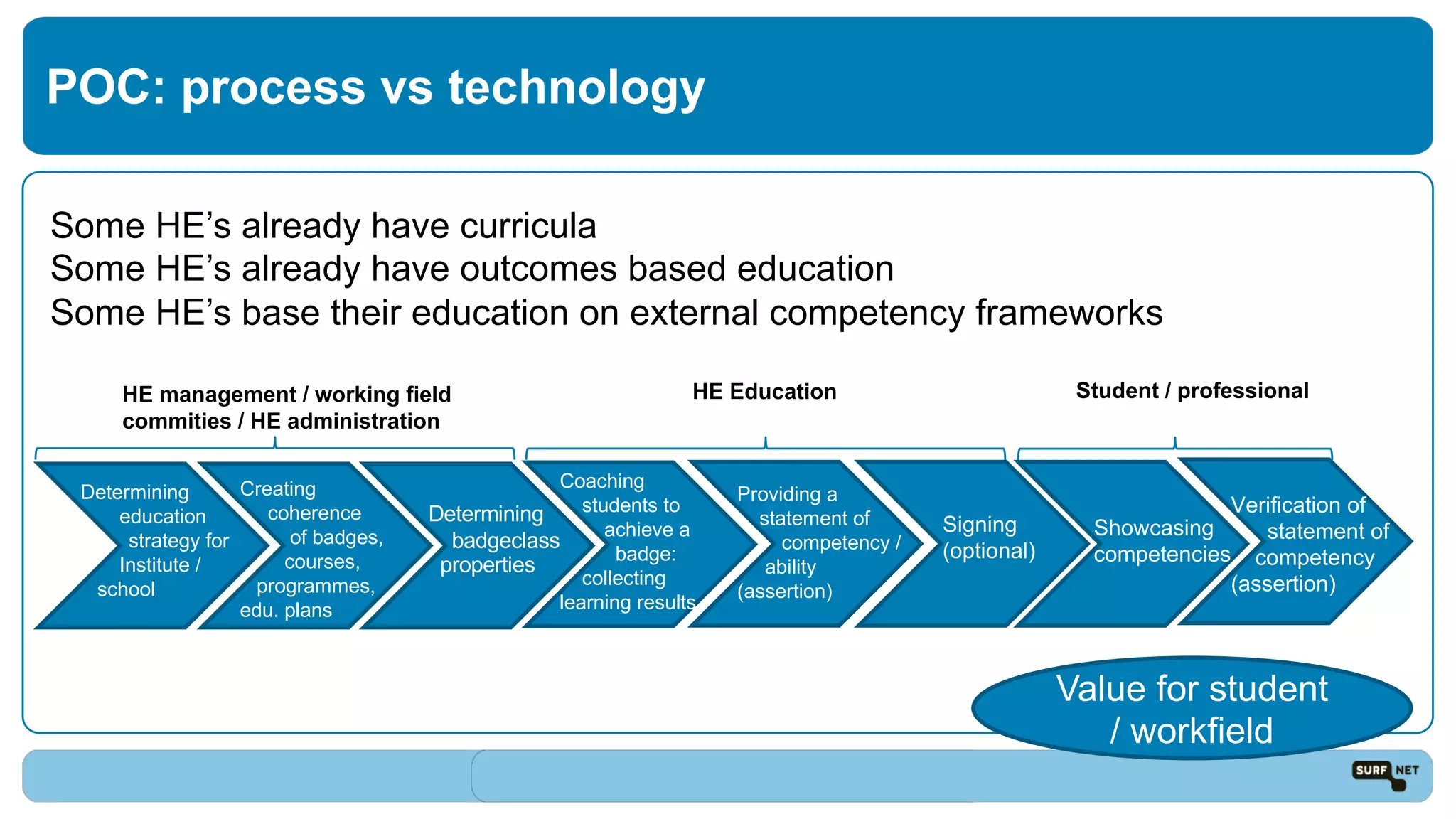
POC: process vs technology
Some HE’s already have curricula
Some HE’s already have outcomes based education
Some HE’s base their education on external competency frameworks
Determining
.. education
….. strategy for
.. Institute /
school
Creating
coherence
of badges,
courses,
programmes,
edu. plans
Determining
badgeclass
properties
Coaching
students to
achieve a
badge:
collecting
learning results
Providing a
statement of
competency /
ability
(assertion)
Signing
(optional)
Showcasing
competencies
Verification of
statement of
competency
(assertion)
HE management / working field
commities / HE administration
HE Education Student / professional
Value for student
/ workfield
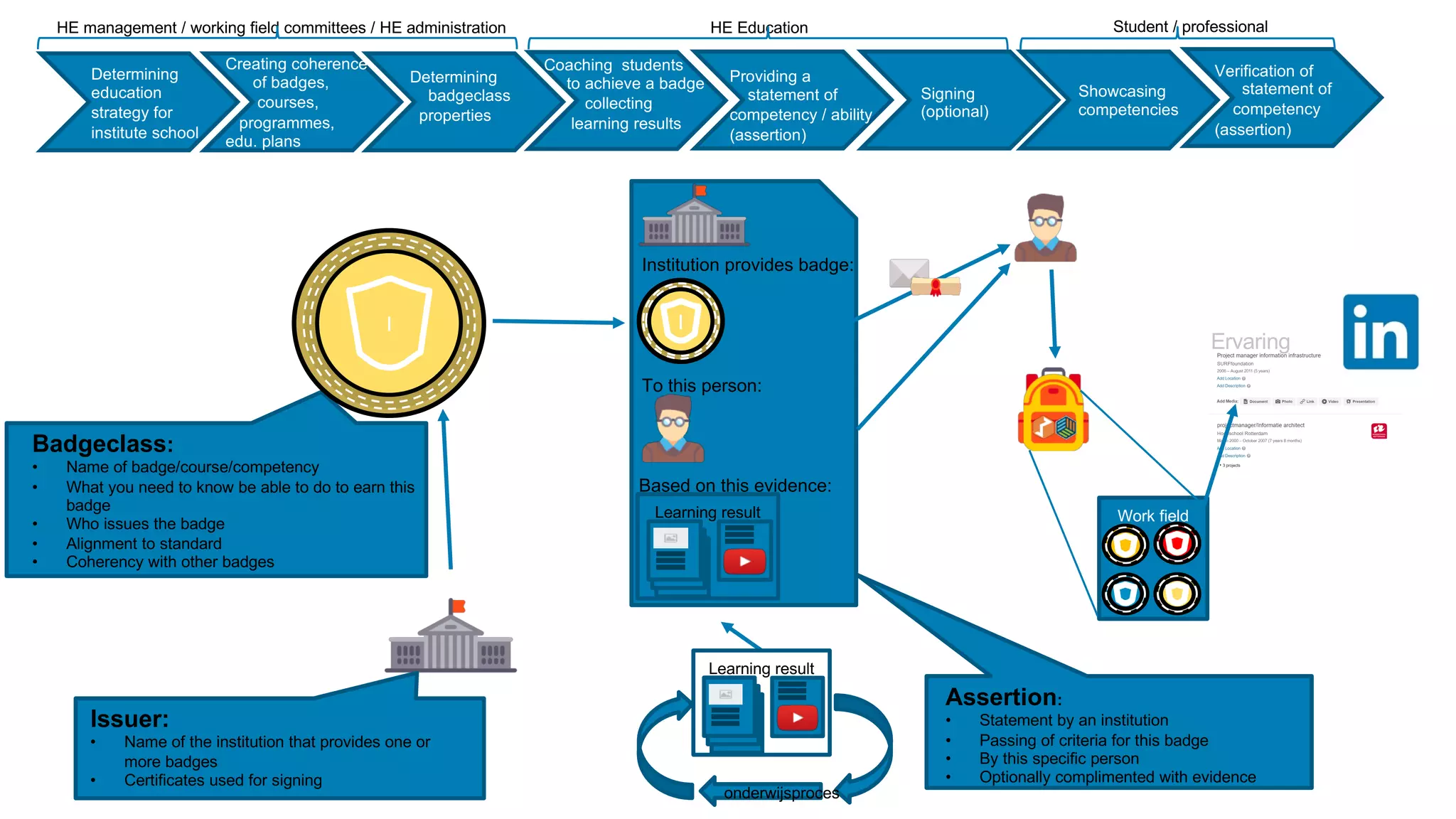
I
Badgeclass:
• Name of badge/course/competency
• What you need to know be able to do to earn this
badge
• Who issues the badge
• Alignment to standard
• Coherency with other badges
Issuer:
• Name of the institution that provides one or
more badges
• Certificates used for signing
I
Institution provides badge:
To this person:
Based on this evidence:
Learning result
onderwijsproces
Determining
education
strategy for
institute school
Creating coherence
of badges,
courses,
programmes,
edu. plans
Determining
badgeclass
properties
Coaching students
to achieve a badge
collecting
learning results
Providing a
statement of
competency / ability
(assertion)
Assertion:
• Statement by an institution
• Passing of criteria for this badge
• By this specific person
• Optionally complimented with evidence
Signing
(optional)
Showcasing
competencies
Verification of
statement of
competency
(assertion)
HE management / working field committees / HE administration HE Education Student / professional
Work field
Ervaring
Learning result
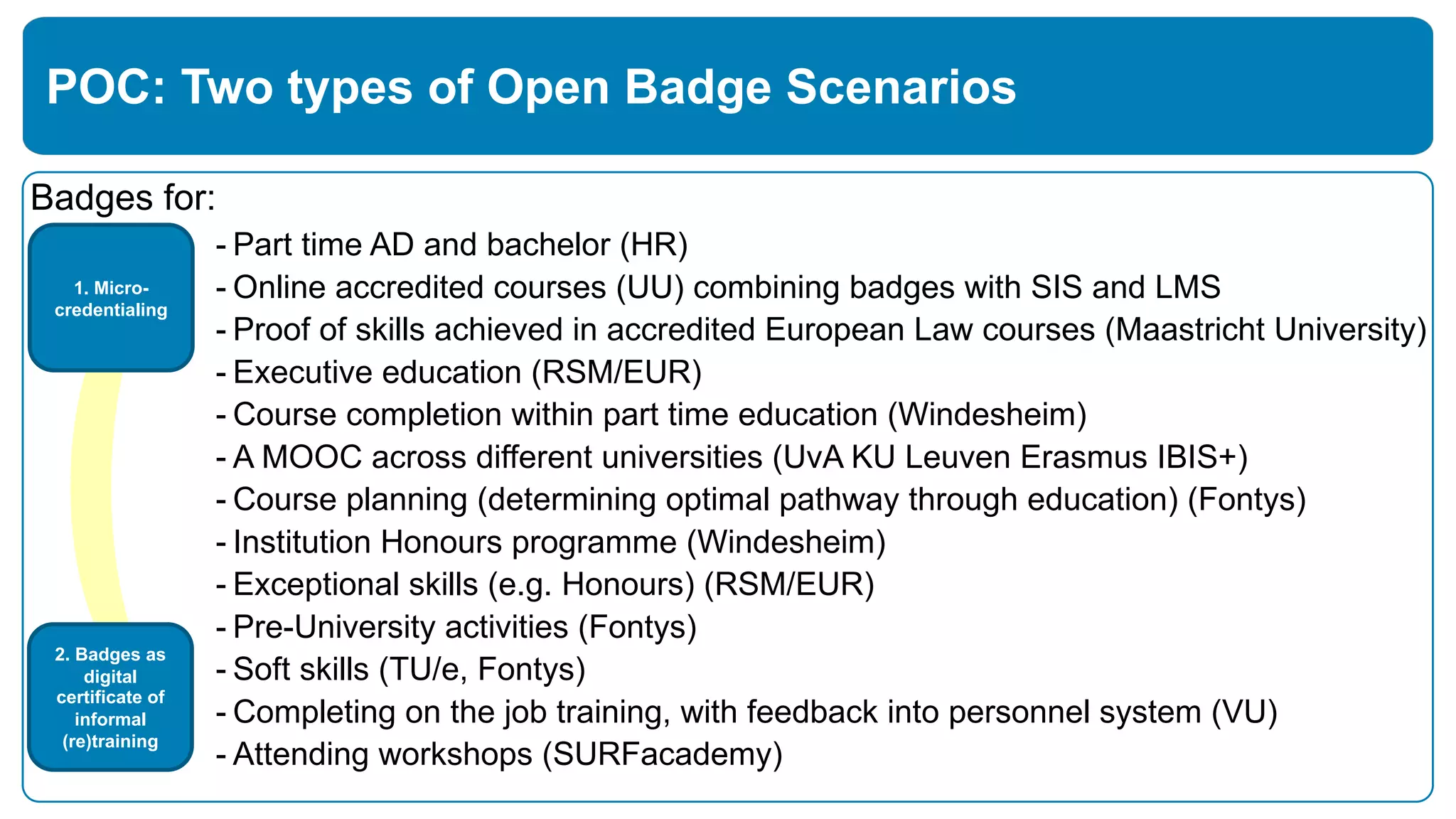
- Part time AD and bachelor (HR)
- Online accredited courses (UU) combining badges with SIS and LMS
- Proof of skills achieved in accredited European Law courses (Maastricht University)
- Executive education (RSM/EUR)
- Course completion within part time education (Windesheim)
- A MOOC across different universities (UvA KU Leuven Erasmus IBIS+)
- Course planning (determining optimal pathway through education) (Fontys)
- Institution Honours programme (Windesheim)
- Exceptional skills (e.g. Honours) (RSM/EUR)
- Pre-University activities (Fontys)
- Soft skills (TU/e, Fontys)
- Completing on the job training, with feedback into personnel system (VU)
- Attending workshops (SURFacademy)
POC: Two types of Open Badge Scenarios
2. Badges as
digital
certificate of
informal
(re)training
1. Micro-
credentialing
Badges for:
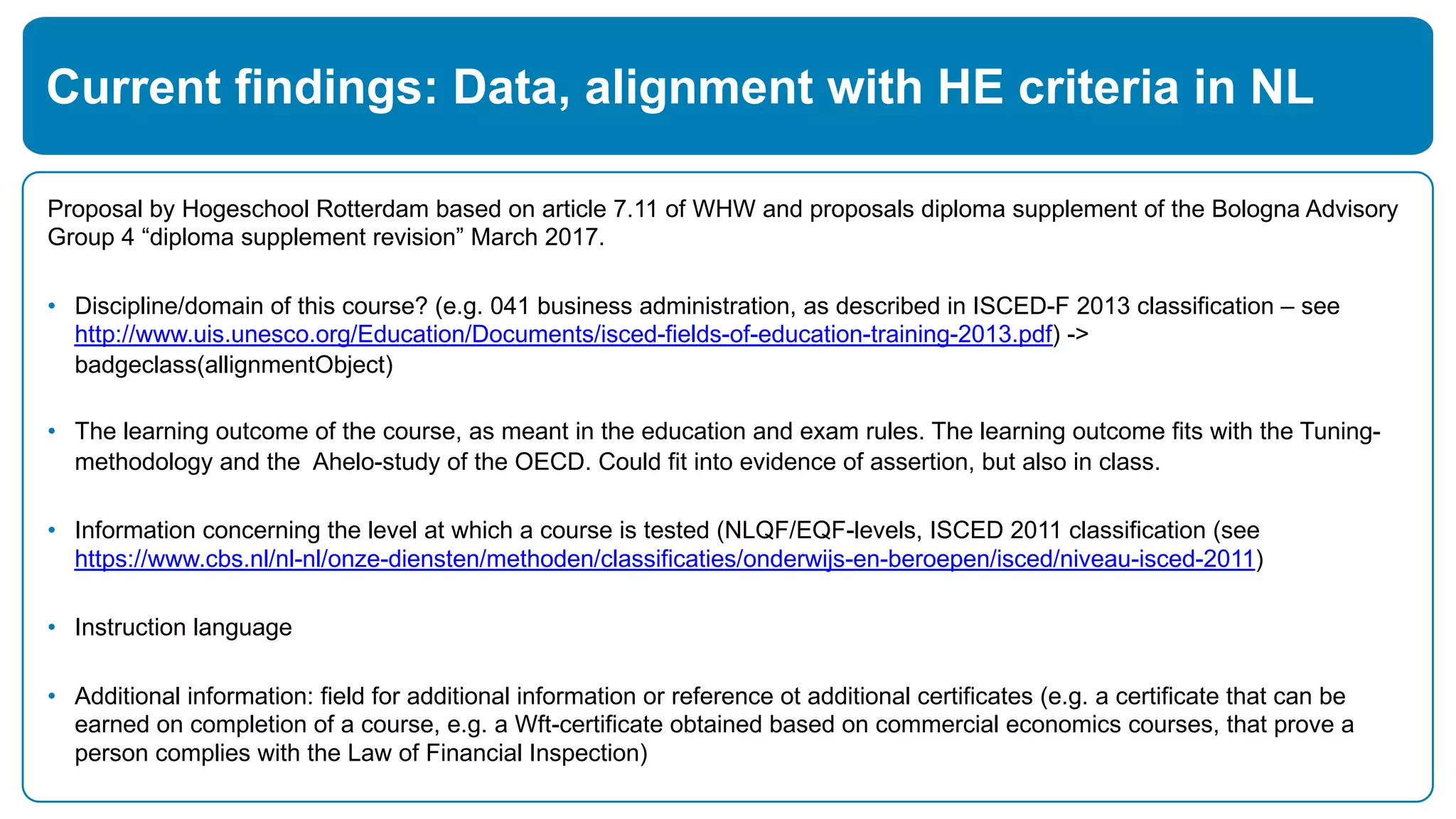
Proposal by Hogeschool Rotterdam based on article 7.11 of WHW and proposals diploma supplement of the Bologna Advisory
Group 4 “diploma supplement revision” March 2017.
• Discipline/domain of this course? (e.g. 041 business administration, as described in ISCED-F 2013 classification – see
http://www.uis.unesco.org/Education/Documents/isced-fields-of-education-training-2013.pdf) ->
badgeclass(allignmentObject)
• The learning outcome of the course, as meant in the education and exam rules. The learning outcome fits with the Tuning-
methodology and the Ahelo-study of the OECD. Could fit into evidence of assertion, but also in class.
• Information concerning the level at which a course is tested (NLQF/EQF-levels, ISCED 2011 classification (see
https://www.cbs.nl/nl-nl/onze-diensten/methoden/classificaties/onderwijs-en-beroepen/isced/niveau-isced-2011)
• Instruction language
• Additional information: field for additional information or reference ot additional certificates (e.g. a certificate that can be
earned on completion of a course, e.g. a Wft-certificate obtained based on commercial economics courses, that prove a
person complies with the Law of Financial Inspection)
Current findings: Data, alignment with HE criteria in NL
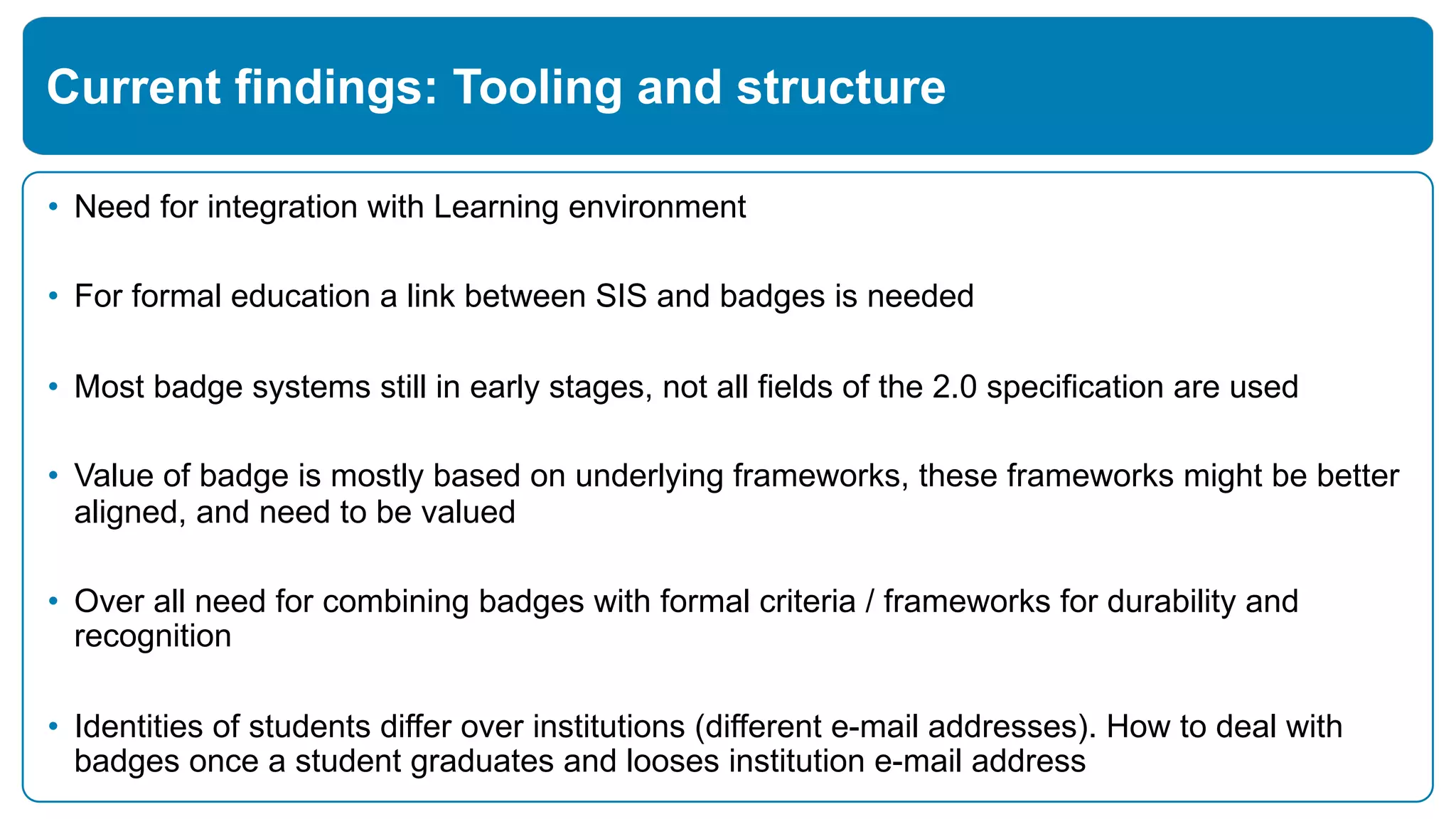
• Need for integration with Learning environment
• For formal education a link between SIS and badges is needed
• Most badge systems still in early stages, not all fields of the 2.0 specification are used
• Value of badge is mostly based on underlying frameworks, these frameworks might be better
aligned, and need to be valued
• Over all need for combining badges with formal criteria / frameworks for durability and
recognition
• Identities of students differ over institutions (different e-mail addresses). How to deal with
badges once a student graduates and looses institution e-mail address
Current findings: Tooling and structure
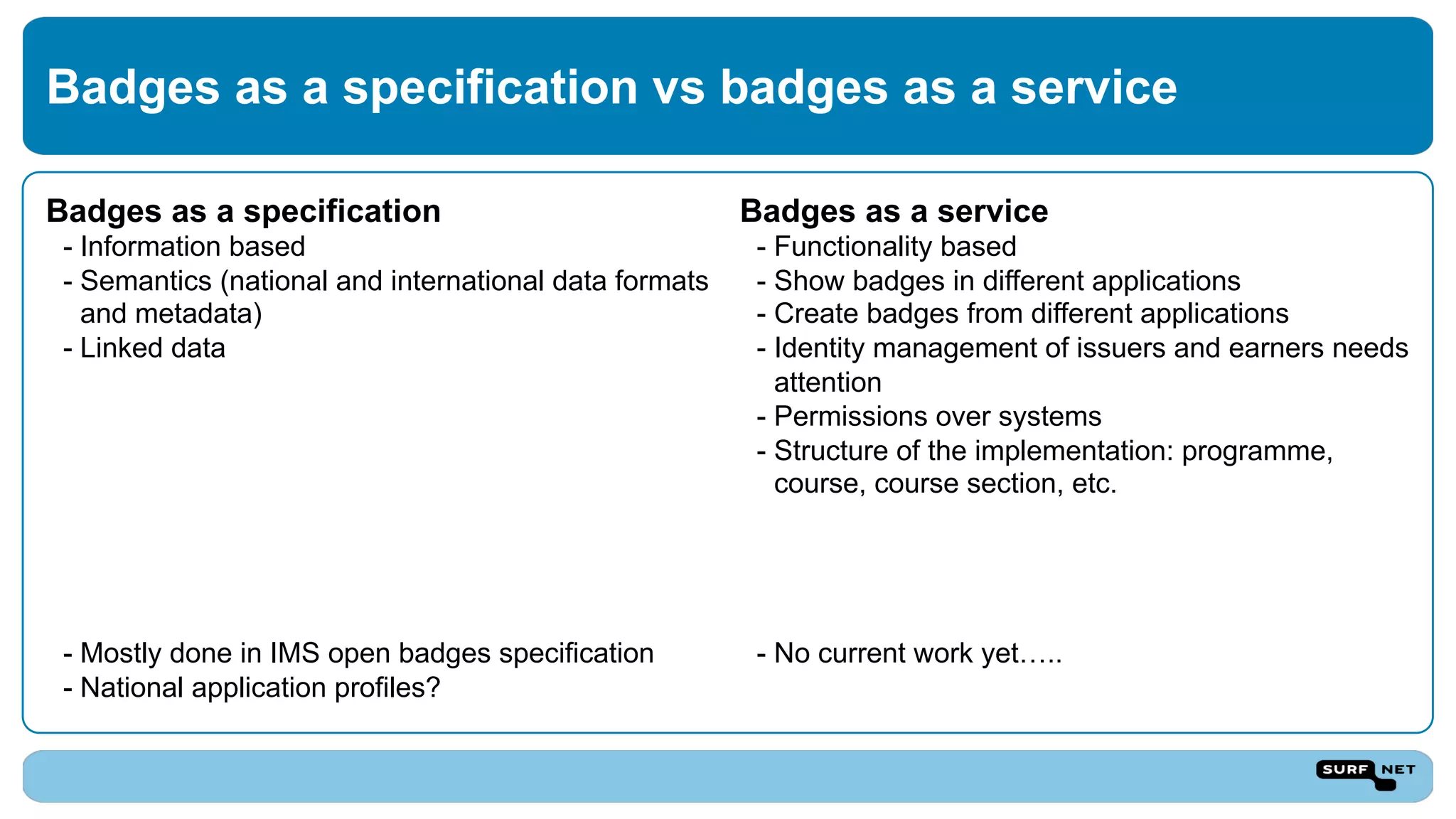
Badges as a specification
- Information based
- Semantics (national and international data formats
and metadata)
- Linked data
- Mostly done in IMS open badges specification
- National application profiles?
Badges as a service
- Functionality based
- Show badges in different applications
- Create badges from different applications
- Identity management of issuers and earners needs
attention
- Permissions over systems
- Structure of the implementation: programme,
course, course section, etc.
- No current work yet…..
Badges as a specification vs badges as a service
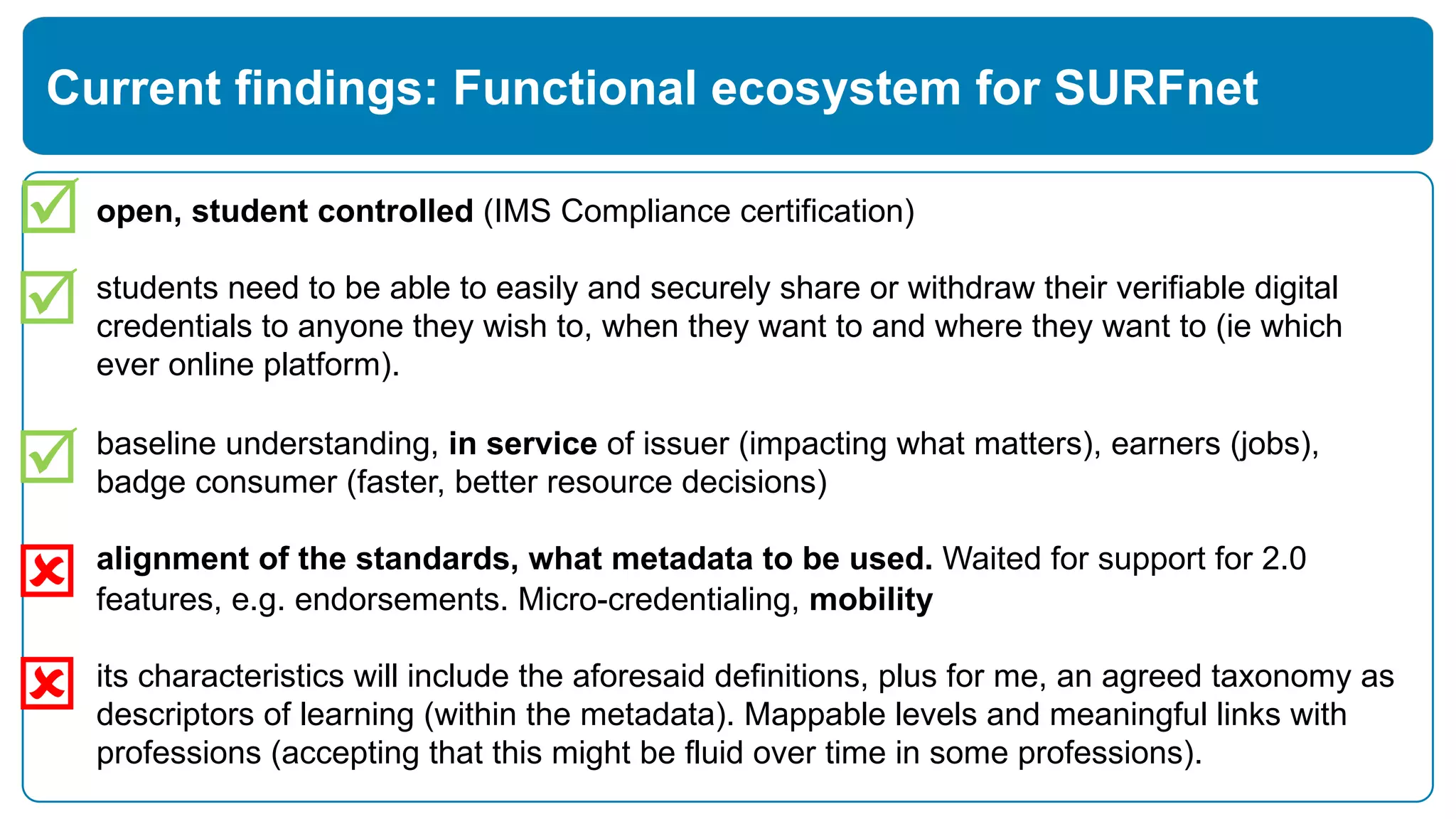
open, student controlled (IMS Compliance certification)
students need to be able to easily and securely share or withdraw their verifiable digital
credentials to anyone they wish to, when they want to and where they want to (ie which
ever online platform).
baseline understanding, in service of issuer (impacting what matters), earners (jobs),
badge consumer (faster, better resource decisions)
alignment of the standards, what metadata to be used. Waited for support for 2.0
features, e.g. endorsements. Micro-credentialing, mobility
its characteristics will include the aforesaid definitions, plus for me, an agreed taxonomy as
descriptors of learning (within the metadata). Mappable levels and meaningful links with
professions (accepting that this might be fluid over time in some professions).
Current findings: Functional ecosystem for SURFnet
þ
ý
þ
þ
ý
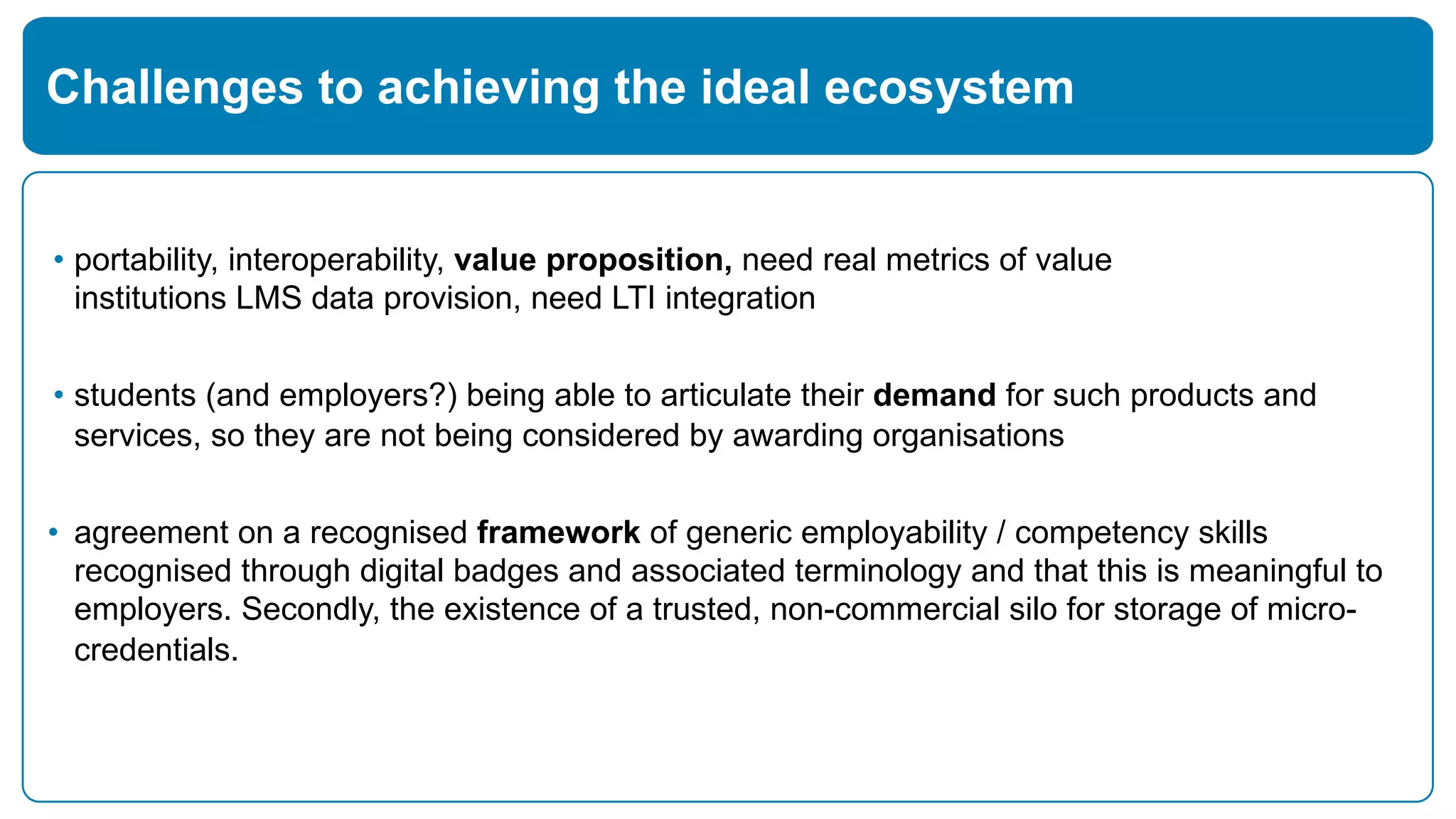
• portability, interoperability, value proposition, need real metrics of value
institutions LMS data provision, need LTI integration
• students (and employers?) being able to articulate their demand for such products and
services, so they are not being considered by awarding organisations
• agreement on a recognised framework of generic employability / competency skills
recognised through digital badges and associated terminology and that this is meaningful to
employers. Secondly, the existence of a trusted, non-commercial silo for storage of micro-
credentials.
Challenges to achieving the ideal ecosystem
Ø Continuation of POC
Ø LTI integration of Badgr platform (to improve LMS – badge system communication)
Ø Research for open badge and SIS integration
Ø Research into persistent identifiers for persons that are privacy aware
Ø Alignment of Open Badge to Dutch HE metadata
Activities we are planning for the future
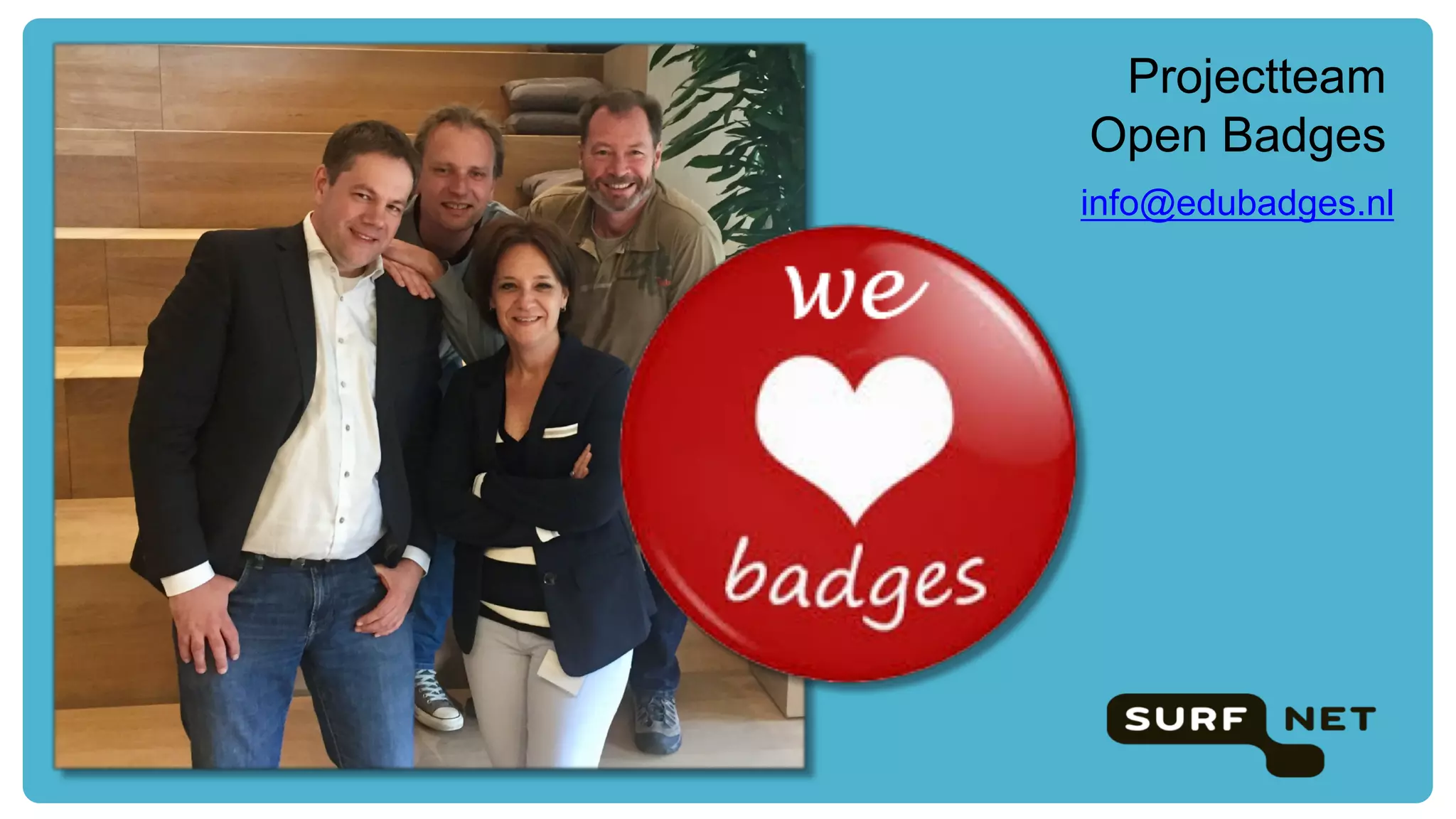
info@edubadges.nl
Projectteam
Open Badges
Questions?
Frans Ward: frans.ward@surfnet.nl
Ronald Ham: ronald.ham@surfnet.nl

ePIC 2017 - The open badge experiment in Dutch HE

  • 1.
    BUILDING A PROOFOF CONCEPT FOR AN OPEN BADGE INFRASTRUCTURE The open badge experiment in Dutch HE 27 October 2017 Frans Ward, Ronald Ham - SURFnet #OpenRecognition – Bologna, Italy
  • 2.
    Mainly you • Questions? Ronald •What are some of the results up until now? • What defines a functional ecosystem? • What are the challenges we see and foresee? Frans • About SURFnet & our aim • How do badges fit in? • What questions are we asking ourselves? • Why did we initiate a PoC? What to Expect 10 mins 5 mins 15 mins
  • 3.
  • 4.
    Under the SURFumbrella SURF is the collaborative ICT organization for Dutch education and research. SURF offers students, lecturers and scientists in the Netherlands access to the best possible internet and ICT facilities. The ICT marketplace for higher education and research High Performance Computing & data infrastructure for science and industry Connecting users and ICT services & creating new possibilities
  • 5.
    Serving 180 institutionswith over 1 million users
  • 6.
    SURFnet is settingthe default to OPEN DUt The Dutch education system
  • 7.
    Educational innovation withIT SURF innovation programme 2015-2018 “In 2018 higher education institutions offer adequate services and have the right expertise to enable personalised and flexible education that corresponds to the learning needs of the individual student in the best possible way.”
  • 8.
    ‘Educational innovation withIT’ innovation program Educational innovation with IT Open & online education Digital assessment Flexible & personal learning environment Learning analytics Test bed for innovative IT applications KNOWLEDGE EXPERIMENTS SERVICES
  • 9.
    Why Open Badges? •A way to demonstrate a certain degree of skills or knowledge; • With verifiable proof and link to issuer of the badge; • Enabler of micro-credentialing; • (Renewed) interest because of high demand for more flexible education.
  • 10.
    Badges as aninstrument for open and online education “Digital badges are efficient vehicles for allowing official recognition of competencies to move with individuals as they go from one context to the next.” • Receive recognition for smaller chunks of learning; • Easier to communicate skills to employers and other interested parties; • Metadata makes data open, providing greater insights into person’s skills.
  • 11.
    SURFnet & OpenBadges 2016 • Pressure cook session with institutions and other (potential) stakeholders • Experiment with Mozilla open badge framework • Whitepaper published http://www.surf.nl/en/open-badges
  • 12.
    SURFnet & OpenBadges 2017 - Investigating service offering opportunities & Proof of Concepts SURFacademy Seminar • Which challenges and chances are there for institutions? • What is needed? (not just technical but also standardization frameworks) • Which role for SURF(net)? Proof of Concept • Building basic infra. • Testing institutional usecases. • Setting up business model. • Interorganisational positioning of micro-credentialing. 2018 – Pilot Edubadge service 2019 – SURF Edubadge service?
  • 13.
    Badges in HigherEducation: Requirements for PoC • Support 3 scenarios from whitepaper • Support overall process • Support the 2.0 specification • Open Source • Using our own infrastructure • Support integration with education systems
  • 14.
    } } SURF PoC Scenario } } PoCenvironment e.g. linkedIn, Moodle, Canvas, etc Badge publishingG Graphics & metadata (e.g. badgekit studio, Badgr, openbadges.me) Badge creation issuer earner e.g. backpack. openbadges.org Badge showcasing Badgr Badge issuing
  • 15.
  • 16.
    • open, studentcontrolled (IMS Compliance certification) • students need to be able to easily and securely share or withdraw their verifiable digital credentials to anyone they wish to, when they want to and where they want to (ie which ever online platform). • baseline understanding, in service of issuer (impacting what matters), earners (jobs), badge consumer (faster, better resource decisions) • alignment of the standards, what metadata to be used. Waited for support for 2.0 features, e.g. endorsements. Micro-credentialing, mobility • its characteristics will include the aforesaid definitions, plus for me, an agreed taxonomy as descriptors of learning (within the metadata). Mappable levels and meaningful links with professions (accepting that this might be fluid over time in some professions). Functional ecosystem for SURFnet
  • 17.
    POC: process vstechnology Some HE’s already have curricula Some HE’s already have outcomes based education Some HE’s base their education on external competency frameworks Determining .. education ….. strategy for .. Institute / school Creating coherence of badges, courses, programmes, edu. plans Determining badgeclass properties Coaching students to achieve a badge: collecting learning results Providing a statement of competency / ability (assertion) Signing (optional) Showcasing competencies Verification of statement of competency (assertion) HE management / working field commities / HE administration HE Education Student / professional Value for student / workfield
  • 18.
    I Badgeclass: • Name ofbadge/course/competency • What you need to know be able to do to earn this badge • Who issues the badge • Alignment to standard • Coherency with other badges Issuer: • Name of the institution that provides one or more badges • Certificates used for signing I Institution provides badge: To this person: Based on this evidence: Learning result onderwijsproces Determining education strategy for institute school Creating coherence of badges, courses, programmes, edu. plans Determining badgeclass properties Coaching students to achieve a badge collecting learning results Providing a statement of competency / ability (assertion) Assertion: • Statement by an institution • Passing of criteria for this badge • By this specific person • Optionally complimented with evidence Signing (optional) Showcasing competencies Verification of statement of competency (assertion) HE management / working field committees / HE administration HE Education Student / professional Work field Ervaring Learning result
  • 19.
    - Part timeAD and bachelor (HR) - Online accredited courses (UU) combining badges with SIS and LMS - Proof of skills achieved in accredited European Law courses (Maastricht University) - Executive education (RSM/EUR) - Course completion within part time education (Windesheim) - A MOOC across different universities (UvA KU Leuven Erasmus IBIS+) - Course planning (determining optimal pathway through education) (Fontys) - Institution Honours programme (Windesheim) - Exceptional skills (e.g. Honours) (RSM/EUR) - Pre-University activities (Fontys) - Soft skills (TU/e, Fontys) - Completing on the job training, with feedback into personnel system (VU) - Attending workshops (SURFacademy) POC: Two types of Open Badge Scenarios 2. Badges as digital certificate of informal (re)training 1. Micro- credentialing Badges for:
  • 20.
    Proposal by HogeschoolRotterdam based on article 7.11 of WHW and proposals diploma supplement of the Bologna Advisory Group 4 “diploma supplement revision” March 2017. • Discipline/domain of this course? (e.g. 041 business administration, as described in ISCED-F 2013 classification – see http://www.uis.unesco.org/Education/Documents/isced-fields-of-education-training-2013.pdf) -> badgeclass(allignmentObject) • The learning outcome of the course, as meant in the education and exam rules. The learning outcome fits with the Tuning- methodology and the Ahelo-study of the OECD. Could fit into evidence of assertion, but also in class. • Information concerning the level at which a course is tested (NLQF/EQF-levels, ISCED 2011 classification (see https://www.cbs.nl/nl-nl/onze-diensten/methoden/classificaties/onderwijs-en-beroepen/isced/niveau-isced-2011) • Instruction language • Additional information: field for additional information or reference ot additional certificates (e.g. a certificate that can be earned on completion of a course, e.g. a Wft-certificate obtained based on commercial economics courses, that prove a person complies with the Law of Financial Inspection) Current findings: Data, alignment with HE criteria in NL
  • 21.
    • Need forintegration with Learning environment • For formal education a link between SIS and badges is needed • Most badge systems still in early stages, not all fields of the 2.0 specification are used • Value of badge is mostly based on underlying frameworks, these frameworks might be better aligned, and need to be valued • Over all need for combining badges with formal criteria / frameworks for durability and recognition • Identities of students differ over institutions (different e-mail addresses). How to deal with badges once a student graduates and looses institution e-mail address Current findings: Tooling and structure
  • 22.
    Badges as aspecification - Information based - Semantics (national and international data formats and metadata) - Linked data - Mostly done in IMS open badges specification - National application profiles? Badges as a service - Functionality based - Show badges in different applications - Create badges from different applications - Identity management of issuers and earners needs attention - Permissions over systems - Structure of the implementation: programme, course, course section, etc. - No current work yet….. Badges as a specification vs badges as a service
  • 23.
    open, student controlled(IMS Compliance certification) students need to be able to easily and securely share or withdraw their verifiable digital credentials to anyone they wish to, when they want to and where they want to (ie which ever online platform). baseline understanding, in service of issuer (impacting what matters), earners (jobs), badge consumer (faster, better resource decisions) alignment of the standards, what metadata to be used. Waited for support for 2.0 features, e.g. endorsements. Micro-credentialing, mobility its characteristics will include the aforesaid definitions, plus for me, an agreed taxonomy as descriptors of learning (within the metadata). Mappable levels and meaningful links with professions (accepting that this might be fluid over time in some professions). Current findings: Functional ecosystem for SURFnet þ ý þ þ ý
  • 24.
    • portability, interoperability,value proposition, need real metrics of value institutions LMS data provision, need LTI integration • students (and employers?) being able to articulate their demand for such products and services, so they are not being considered by awarding organisations • agreement on a recognised framework of generic employability / competency skills recognised through digital badges and associated terminology and that this is meaningful to employers. Secondly, the existence of a trusted, non-commercial silo for storage of micro- credentials. Challenges to achieving the ideal ecosystem
  • 25.
    Ø Continuation ofPOC Ø LTI integration of Badgr platform (to improve LMS – badge system communication) Ø Research for open badge and SIS integration Ø Research into persistent identifiers for persons that are privacy aware Ø Alignment of Open Badge to Dutch HE metadata Activities we are planning for the future
  • 26.
  • 27.