Apprenticeships 
Gathering Information
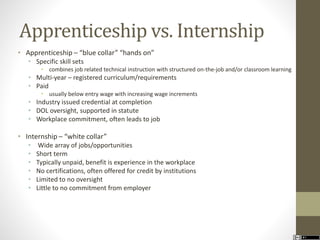
Apprenticeship vs. Internship 
• Apprenticeship – “blue collar” “hands on” 
• Specific skill sets 
• combines job related technical instruction with structured on-the-job and/or classroom learning 
• Multi-year – registered curriculum/requirements 
• Paid 
• usually below entry wage with increasing wage increments 
• Industry issued credential at completion 
• DOL oversight, supported in statute 
• Workplace commitment, often leads to job 
• Internship – “white collar” 
• Wide array of jobs/opportunities 
• Short term 
• Typically unpaid, benefit is experience in the workplace 
• No certifications, often offered for credit by institutions 
• Limited to no oversight 
• Little to no commitment from employer
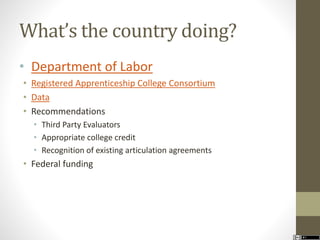
What’s the country doing? 
• Department of Labor 
• Registered Apprenticeship College Consortium 
• Data 
• Recommendations 
• Third Party Evaluators 
• Appropriate college credit 
• Recognition of existing articulation agreements 
• Federal funding
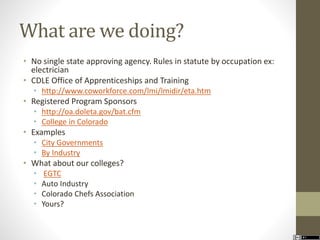
What are we doing? 
• No single state approving agency. Rules in statute by occupation ex: 
electrician 
• CDLE Office of Apprenticeships and Training 
• http://www.coworkforce.com/lmi/lmidir/eta.htm 
• Registered Program Sponsors 
• http://oa.doleta.gov/bat.cfm 
• College in Colorado 
• Examples 
• City Governments 
• By Industry 
• What about our colleges? 
• EGTC 
• Auto Industry 
• Colorado Chefs Association 
• Yours?
What are we looking at now? 
• RACC membership and ACE partnership 
• CPL For Industry Certifications 
• ACE Crosswalk with IEC-RM https://www.iecrm.org/ 
• Other existing industry apprenticeship programs 
• Who, what, when, how???
CC BY Attribution 
• This Workforce Solution, ”Apprenticeship” presentation by 
Bitsy Cohn is licensed under a Creative Commons Attribution 
4.0 International License. Based on a work created under the 
Department of Labor, TAACCCT3 grant, permissions beyond 
the scope of this license may be available 
at www.cccs.edu/CHAMP.

CHAMP Advisory Meeting October 2014 presentation on Apprenticeships

  • 1.
  • 2.
    Apprenticeship vs. Internship • Apprenticeship – “blue collar” “hands on” • Specific skill sets • combines job related technical instruction with structured on-the-job and/or classroom learning • Multi-year – registered curriculum/requirements • Paid • usually below entry wage with increasing wage increments • Industry issued credential at completion • DOL oversight, supported in statute • Workplace commitment, often leads to job • Internship – “white collar” • Wide array of jobs/opportunities • Short term • Typically unpaid, benefit is experience in the workplace • No certifications, often offered for credit by institutions • Limited to no oversight • Little to no commitment from employer
  • 3.
    What’s the countrydoing? • Department of Labor • Registered Apprenticeship College Consortium • Data • Recommendations • Third Party Evaluators • Appropriate college credit • Recognition of existing articulation agreements • Federal funding
  • 4.
    What are wedoing? • No single state approving agency. Rules in statute by occupation ex: electrician • CDLE Office of Apprenticeships and Training • http://www.coworkforce.com/lmi/lmidir/eta.htm • Registered Program Sponsors • http://oa.doleta.gov/bat.cfm • College in Colorado • Examples • City Governments • By Industry • What about our colleges? • EGTC • Auto Industry • Colorado Chefs Association • Yours?
  • 5.
    What are welooking at now? • RACC membership and ACE partnership • CPL For Industry Certifications • ACE Crosswalk with IEC-RM https://www.iecrm.org/ • Other existing industry apprenticeship programs • Who, what, when, how???
  • 6.
    CC BY Attribution • This Workforce Solution, ”Apprenticeship” presentation by Bitsy Cohn is licensed under a Creative Commons Attribution 4.0 International License. Based on a work created under the Department of Labor, TAACCCT3 grant, permissions beyond the scope of this license may be available at www.cccs.edu/CHAMP.

Editor's Notes

  • #2 Apprenticeships Gathering information
  • #3 Apprenticeship vs. Internship Apprenticeship – “blue collar” “hands on” Specific skill sets combines job related technical instruction with structured on-the-job and/or classroom learning Multi-year – registered curriculum/requirements Paid usually below entry wage with increasing wage increments Industry issued credential at completion DOL oversight, supported in statute Workplace commitment, often leads to job Internship – “white collar” Wide array of jobs/opportunities Short term Typically unpaid, benefit is experience in the workplace No certifications, often offered for credit by institutions Limited to no oversight Little to no commitment from employer
  • #4 What is the country doing? Department of Labor Registered Apprenticeship College Consortium Data Recommendations Third Party Evaluators Appropriate college credit Recognition of existing articulation agreements Federal funding
  • #5 What are we doing? No single state approving agency. Rules in statute by occupation ex: electrician CDLE Office of Apprenticeships and Training http://www.coworkforce.com/lmi/lmidir/eta.htm Registered Program Sponsors http://oa.doleta.gov/bat.cfm College in Colorado Examples City Governments By Industry What about our colleges? EGTC Auto Industry Colorado Chefs Association Yours?
  • #6 What are we looking at now? RACC membership and ACE partnership CPL For Industry Certifications ACE Crosswalk with IEC-RM https://www.iecrm.org/ Other existing industry apprenticeship programs Who, what, when, how???
  • #7 CC BY Attribution This Workforce Solution, ”Apprenticeship” presentation by Bitsy Cohn is licensed under a Creative Commons Attribution 4.0 International License. Based on a work created under the Department of Labor, TAACCCT3 grant, permissions beyond the scope of this license may