COLLEGE OF AGRICULTURAL TECHNOLOGY
( (Affiliated to Tamil Nadu Agricultural University, Coimbatore-3)
Kullapuram (Po),ViaVaigai Dam, Theni-625 562
PAPAYA FRUIT ROT
SUBMITTED BY, COURSE TEACHER
KEERTHANA.R Dr. PARTHASARATHY.S
2015021062. Asst. Prof., PLANT PATHOLOGY
CAUSAL ORGANISM
• Rhizopus stolonifer – Rhizopus fruit rot
• Ascochyta caricae – Phomopsis fruit rot
• Lasiodiplodia theobromae – Stem end rot or surface fruit rot
• Colletotrichum gleosporioides - Anthracnose
OCCURENCE
• Papaya fruit rot is a serious and widespread in almost all the
chief Papaya growing parts of Assam.
• It was observed at the Burnihat Fruit Research Station in July,
1944 and has since recurred every year in a severe form during
rains.
DISTRIBUTION
• It is world wide in distribution. It is distributed in Malaysia,
Hawaii, Australia, Brazil, Spain, Taiwan, Fiji, Samoa and
Tonga.
• In India, it is distributed in Assam, Maharastra, Karnataka,
Tamil Nadu, Bihar, U. P, Kerala.
LOSSES
A survey of the Cachar district and in the North Cachar hills
showed 10 – 15% of the fruits to be affected on the trees.
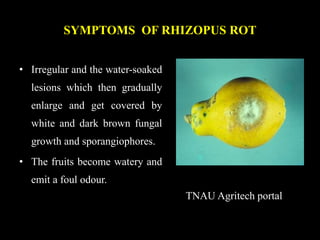
SYMPTOMS OF RHIZOPUS ROT
• Irregular and the water-soaked
lesions which then gradually
enlarge and get covered by
white and dark brown fungal
growth and sporangiophores.
• The fruits become watery and
emit a foul odour.
TNAU Agritech portal
SYMPTOMS OF PHOMOPSIS ROT
• Affected fruit develops a water-
soaked spot which increases and
skin becomes soft .
• The rotten area turns dark brown to
black and get depressed and cracks
at a later stage.
TNAU Agritech portal
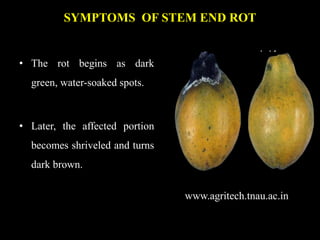
SYMPTOMS OF STEM END ROT
• The rot begins as dark
green, water-soaked spots.
• Later, the affected portion
becomes shriveled and turns
dark brown.
www.agritech.tnau.ac.in
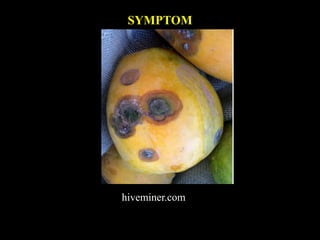
SYMPTOMS OF ANTHRACNOSE
• Brownish superficial discolouration on skin of the fruit,
which develops circular, slightly sunken areas.
• Lesions gradually coalesce and sparse mycelia growth appears
on the margin of the spots.
• Finally results in mummification and deformation.
SYMPTOM
hiveminer.com
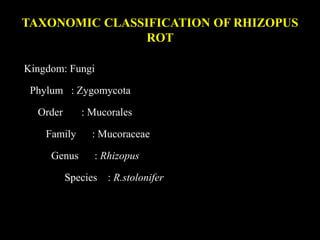
TAXONOMIC CLASSIFICATION OF RHIZOPUS
ROT
Kingdom: Fungi
Phylum : Zygomycota
Order : Mucorales
Family : Mucoraceae
Genus : Rhizopus
Species : R.stolonifer
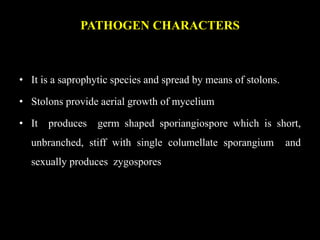
PATHOGEN CHARACTERS
• It is a saprophytic species and spread by means of stolons.
• Stolons provide aerial growth of mycelium
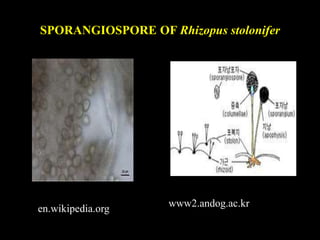
• It produces germ shaped sporiangiospore which is short,
unbranched, stiff with single columellate sporangium and
sexually produces zygospores
SPORANGIOSPORE OF Rhizopus stolonifer
www2.andog.ac.kr
en.wikipedia.org
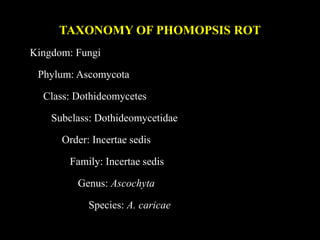
TAXONOMY OF PHOMOPSIS ROT
Kingdom: Fungi
Phylum: Ascomycota
Class: Dothideomycetes
Subclass: Dothideomycetidae
Order: Incertae sedis
Family: Incertae sedis
Genus: Ascochyta
Species: A. caricae
PATHOGEN CHARACTERS
• Mycelium is white, branched and septate which then produces
pycnidia
• Conidia are hyaline, fusiform, unicellular produced in
pycnidia
TAXONOMY OF STEM END ROT
Kingdom: Fungi
Division: Ascomycota
Class: Dothideomycetes
Order: Botryosphaeriales
Family: Botryosphaeriaceae
Genus: Lasiodiplodia
Species: L. theobromae
PATHOGEN CHARACTERS
• Erumpent pycnidia formed in stromata
• Conidia are initially hyaline and unicellular, subovoid to
ellipsoidal.
• Mature conidia are two celled, cinnamon to light brown in
colour with striations.
TAXONOMY OF PAPAYA ANTHRACNOSE
Kingdom: Fungi
Division: Ascomycota
Class: Sordariomycetes
Order: Glomerellales
Family: Glomerellaceae
Genus: Colletotrichum
Species: C. gloeosporioides
PATHOGEN CHARACTERS
• Pathogen is hemibiotroph, survives in soil without host and
when lands upon the host produces appresorium.
• Fungus produces hyaline, one celled, ovoid to oblong, slightly
curved or dumbbell shaped conidia.
• Waxy acervuli that are produced in infected tissues are
subepidermal, typically with setae, simple, short, erect
conidiophores.
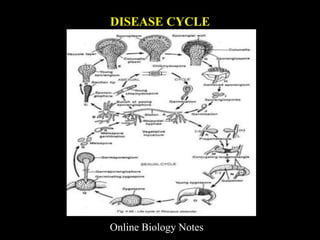
DISEASE CYCLE
Online Biology Notes
FAVOURABLE CONDITIONS
 High humidity
 Temperature of 25°C during storage.
 Frequent rains.
 Moist conditions favours the development of the disease .
MODE OF SPREAD
 Primary spread
Primarily spreads through air borne conidia and by the
rain splashes.
 Secondary spread
Secondary spead by means of wounds and injuries in the
fruit .
INTEGRATED DISEASE MANAGEMENT
• Cuts should be made at an angle to allow water to drain from
the wood surfaces.
• Avoid injuries during the harvesting of fruits.
• Prune early in the season when spore production is low or late
in the season when wounds are less susceptible and heal more
rapidly.
• Hot water treatment 49°C for 20 minutes for effective control.
• Post harvest treatment with Benzimidazole may reduce fruit
loss.
• Borax, captan, difolatan and dithane M-45 are effective.
• The disease can be controlled by dipping the fruits with DCNA
(2,6 – dichloro – 4 nitroaniline) at 1000-2000 ppm.
• Spray the fruits with Bordeaux mixture @ 5g in 1 litre of
water at an intervals.
REFERENCES
• https://www.appsnet.org/Publications/potm/pdf/Oct08.pdf
• http://agritech.tnau.ac.in/crop protection/crop pdf/papaya.pdf
• Thind T.S, Disease of fruits and vegetables and their
management, 2016, Kalyani publishers, New Delhi, pg.no 136
– 137.
• Chaube H.S, Crop disease and their management, 2015, PHL
learning publishers, New Delhi, pg.no 636 – 637.

Papaya Fruit Rot

  • 1.
    COLLEGE OF AGRICULTURALTECHNOLOGY ( (Affiliated to Tamil Nadu Agricultural University, Coimbatore-3) Kullapuram (Po),ViaVaigai Dam, Theni-625 562 PAPAYA FRUIT ROT SUBMITTED BY, COURSE TEACHER KEERTHANA.R Dr. PARTHASARATHY.S 2015021062. Asst. Prof., PLANT PATHOLOGY
  • 2.
    CAUSAL ORGANISM • Rhizopusstolonifer – Rhizopus fruit rot • Ascochyta caricae – Phomopsis fruit rot • Lasiodiplodia theobromae – Stem end rot or surface fruit rot • Colletotrichum gleosporioides - Anthracnose
  • 3.
    OCCURENCE • Papaya fruitrot is a serious and widespread in almost all the chief Papaya growing parts of Assam. • It was observed at the Burnihat Fruit Research Station in July, 1944 and has since recurred every year in a severe form during rains.
  • 4.
    DISTRIBUTION • It isworld wide in distribution. It is distributed in Malaysia, Hawaii, Australia, Brazil, Spain, Taiwan, Fiji, Samoa and Tonga. • In India, it is distributed in Assam, Maharastra, Karnataka, Tamil Nadu, Bihar, U. P, Kerala. LOSSES A survey of the Cachar district and in the North Cachar hills showed 10 – 15% of the fruits to be affected on the trees.
  • 5.
    SYMPTOMS OF RHIZOPUSROT • Irregular and the water-soaked lesions which then gradually enlarge and get covered by white and dark brown fungal growth and sporangiophores. • The fruits become watery and emit a foul odour. TNAU Agritech portal
  • 6.
    SYMPTOMS OF PHOMOPSISROT • Affected fruit develops a water- soaked spot which increases and skin becomes soft . • The rotten area turns dark brown to black and get depressed and cracks at a later stage. TNAU Agritech portal
  • 7.
    SYMPTOMS OF STEMEND ROT • The rot begins as dark green, water-soaked spots. • Later, the affected portion becomes shriveled and turns dark brown. www.agritech.tnau.ac.in
  • 8.
    SYMPTOMS OF ANTHRACNOSE •Brownish superficial discolouration on skin of the fruit, which develops circular, slightly sunken areas. • Lesions gradually coalesce and sparse mycelia growth appears on the margin of the spots. • Finally results in mummification and deformation.
  • 9.
  • 10.
    TAXONOMIC CLASSIFICATION OFRHIZOPUS ROT Kingdom: Fungi Phylum : Zygomycota Order : Mucorales Family : Mucoraceae Genus : Rhizopus Species : R.stolonifer
  • 11.
    PATHOGEN CHARACTERS • Itis a saprophytic species and spread by means of stolons. • Stolons provide aerial growth of mycelium • It produces germ shaped sporiangiospore which is short, unbranched, stiff with single columellate sporangium and sexually produces zygospores
  • 12.
    SPORANGIOSPORE OF Rhizopusstolonifer www2.andog.ac.kr en.wikipedia.org
  • 13.
    TAXONOMY OF PHOMOPSISROT Kingdom: Fungi Phylum: Ascomycota Class: Dothideomycetes Subclass: Dothideomycetidae Order: Incertae sedis Family: Incertae sedis Genus: Ascochyta Species: A. caricae
  • 14.
    PATHOGEN CHARACTERS • Myceliumis white, branched and septate which then produces pycnidia • Conidia are hyaline, fusiform, unicellular produced in pycnidia
  • 15.
    TAXONOMY OF STEMEND ROT Kingdom: Fungi Division: Ascomycota Class: Dothideomycetes Order: Botryosphaeriales Family: Botryosphaeriaceae Genus: Lasiodiplodia Species: L. theobromae
  • 16.
    PATHOGEN CHARACTERS • Erumpentpycnidia formed in stromata • Conidia are initially hyaline and unicellular, subovoid to ellipsoidal. • Mature conidia are two celled, cinnamon to light brown in colour with striations.
  • 17.
    TAXONOMY OF PAPAYAANTHRACNOSE Kingdom: Fungi Division: Ascomycota Class: Sordariomycetes Order: Glomerellales Family: Glomerellaceae Genus: Colletotrichum Species: C. gloeosporioides
  • 18.
    PATHOGEN CHARACTERS • Pathogenis hemibiotroph, survives in soil without host and when lands upon the host produces appresorium. • Fungus produces hyaline, one celled, ovoid to oblong, slightly curved or dumbbell shaped conidia. • Waxy acervuli that are produced in infected tissues are subepidermal, typically with setae, simple, short, erect conidiophores.
  • 19.
  • 20.
    FAVOURABLE CONDITIONS  Highhumidity  Temperature of 25°C during storage.  Frequent rains.  Moist conditions favours the development of the disease .
  • 21.
    MODE OF SPREAD Primary spread Primarily spreads through air borne conidia and by the rain splashes.  Secondary spread Secondary spead by means of wounds and injuries in the fruit .
  • 22.
    INTEGRATED DISEASE MANAGEMENT •Cuts should be made at an angle to allow water to drain from the wood surfaces. • Avoid injuries during the harvesting of fruits. • Prune early in the season when spore production is low or late in the season when wounds are less susceptible and heal more rapidly. • Hot water treatment 49°C for 20 minutes for effective control.
  • 23.
    • Post harvesttreatment with Benzimidazole may reduce fruit loss. • Borax, captan, difolatan and dithane M-45 are effective. • The disease can be controlled by dipping the fruits with DCNA (2,6 – dichloro – 4 nitroaniline) at 1000-2000 ppm. • Spray the fruits with Bordeaux mixture @ 5g in 1 litre of water at an intervals.
  • 24.
    REFERENCES • https://www.appsnet.org/Publications/potm/pdf/Oct08.pdf • http://agritech.tnau.ac.in/cropprotection/crop pdf/papaya.pdf • Thind T.S, Disease of fruits and vegetables and their management, 2016, Kalyani publishers, New Delhi, pg.no 136 – 137. • Chaube H.S, Crop disease and their management, 2015, PHL learning publishers, New Delhi, pg.no 636 – 637.