

Introduction
• Ozone is known to us as a molecule
present in the atmosphere which protects
us from radiation. It also binds to the
pollutants presents, hence used to
measure pollution levels.
• This is the job of ozone, to be nature’s
filter of “bad” particles.
WHAT IS OZONE ?

•
•
•
•
•

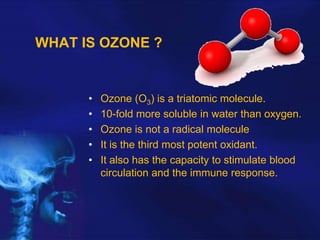
Ozone (O3) is a triatomic molecule.
10-fold more soluble in water than oxygen.
Ozone is not a radical molecule
It is the third most potent oxidant.
It also has the capacity to stimulate blood
circulation and the immune response.
How is ozone produced ?
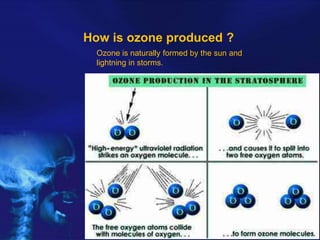
Ozone is naturally formed by the sun and
lightning in storms.
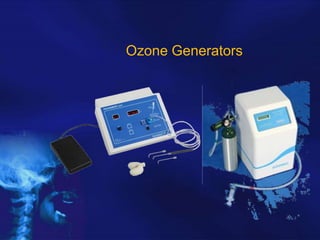
Ozone Generators
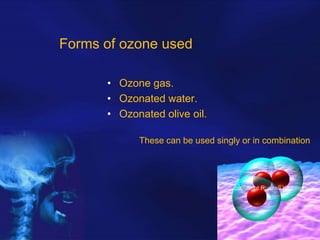
Forms of ozone used
• Ozone gas.
• Ozonated water.
• Ozonated olive oil.
These can be used singly or in combination
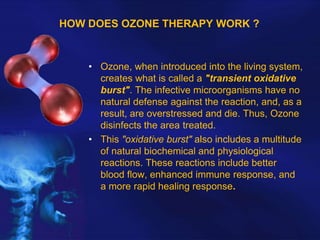
HOW DOES OZONE THERAPY WORK ?

• Ozone, when introduced into the living system,
creates what is called a "transient oxidative
burst". The infective microorganisms have no
natural defense against the reaction, and, as a
result, are overstressed and die. Thus, Ozone
disinfects the area treated.
• This "oxidative burst" also includes a multitude
of natural biochemical and physiological
reactions. These reactions include better
blood flow, enhanced immune response, and
a more rapid healing response.
CAN YOU BE ALLERGIC TO OZONE ?

• No, Ozone is just an energized form of
oxygen.
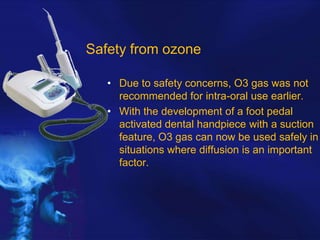
Safety from ozone
• Due to safety concerns, O3 gas was not
recommended for intra-oral use earlier.
• With the development of a foot pedal
activated dental handpiece with a suction
feature, O3 gas can now be used safely in
situations where diffusion is an important
factor.
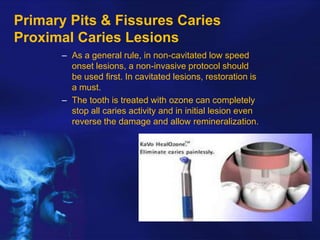
Primary Pits & Fissures Caries
Proximal Caries Lesions
– As a general rule, in non-cavitated low speed
onset lesions, a non-invasive protocol should
be used first. In cavitated lesions, restoration is
a must.
– The tooth is treated with ozone can completely
stop all caries activity and in initial lesion even
reverse the damage and allow remineralization.
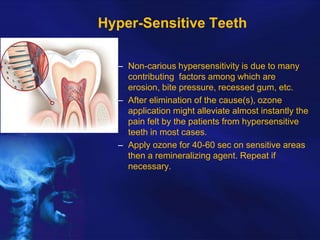
Hyper-Sensitive Teeth
– Non-carious hypersensitivity is due to many
contributing factors among which are
erosion, bite pressure, recessed gum, etc.
– After elimination of the cause(s), ozone
application might alleviate almost instantly the
pain felt by the patients from hypersensitive
teeth in most cases.
– Apply ozone for 40-60 sec on sensitive areas
then a remineralizing agent. Repeat if
necessary.
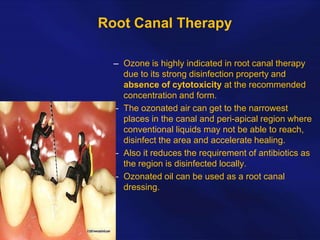
Root Canal Therapy
– Ozone is highly indicated in root canal therapy
due to its strong disinfection property and
absence of cytotoxicity at the recommended
concentration and form.
– The ozonated air can get to the narrowest
places in the canal and peri-apical region where
conventional liquids may not be able to reach,
disinfect the area and accelerate healing.
– Also it reduces the requirement of antibiotics as
the region is disinfected locally.
– Ozonated oil can be used as a root canal
dressing.
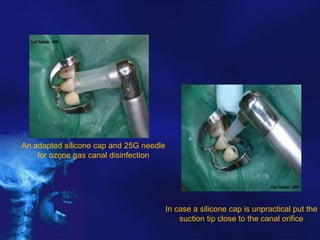
An adapted silicone cap and 25G needle
for ozone gas canal disinfection

In case a silicone cap is unpractical put the
suction tip close to the canal orifice
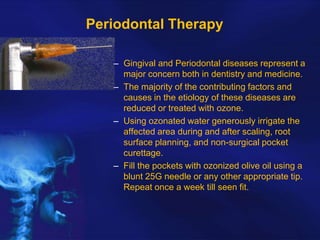
Periodontal Therapy
– Gingival and Periodontal diseases represent a
major concern both in dentistry and medicine.
– The majority of the contributing factors and
causes in the etiology of these diseases are
reduced or treated with ozone.
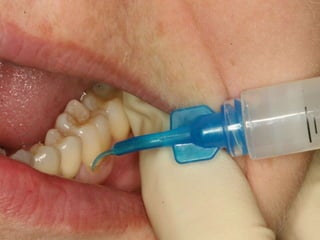
– Using ozonated water generously irrigate the
affected area during and after scaling, root
surface planning, and non-surgical pocket
curettage.
– Fill the pockets with ozonized olive oil using a
blunt 25G needle or any other appropriate tip.
Repeat once a week till seen fit.
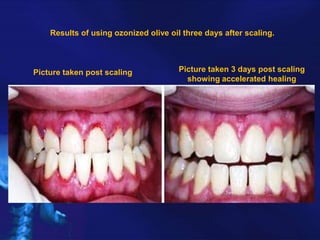
Results of using ozonized olive oil three days after scaling.

Picture taken post scaling

Picture taken 3 days post scaling
showing accelerated healing
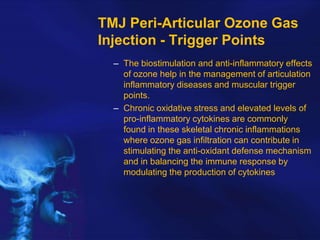
TMJ Peri-Articular Ozone Gas
Injection - Trigger Points
– The biostimulation and anti-inflammatory effects
of ozone help in the management of articulation
inflammatory diseases and muscular trigger
points.
– Chronic oxidative stress and elevated levels of
pro-inflammatory cytokines are commonly
found in these skeletal chronic inflammations
where ozone gas infiltration can contribute in
stimulating the anti-oxidant defense mechanism
and in balancing the immune response by
modulating the production of cytokines
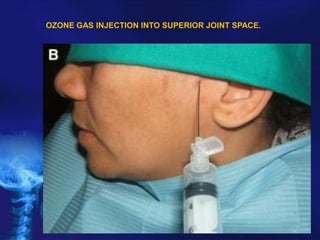
OZONE GAS INJECTION INTO SUPERIOR JOINT SPACE.
Post-Extraction
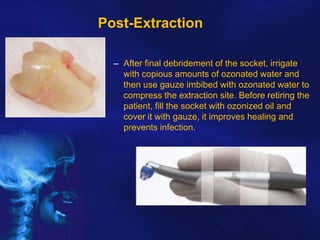
– After final debridement of the socket, irrigate
with copious amounts of ozonated water and
then use gauze imbibed with ozonated water to
compress the extraction site. Before retiring the
patient, fill the socket with ozonized oil and
cover it with gauze, it improves healing and
prevents infection.
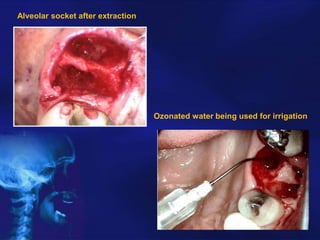
Alveolar socket after extraction

Ozonated water being used for irrigation
Peri-Implantitis
– Peri-implantitis is very bothering to both the
dentist and the patient.
– Ozone can play an important role and be used
as gas or in aqueous form.
– Ozonated water can also be used as an irrigant
during debridement and curettage.
– Also advise the patient to apply ozonized oil on
the affected area 3-4 times/day.
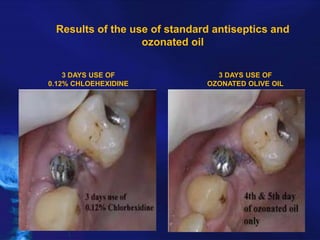
Results of the use of standard antiseptics and
ozonated oil
3 DAYS USE OF
0.12% CHLOEHEXIDINE

3 DAYS USE OF
OZONATED OLIVE OIL
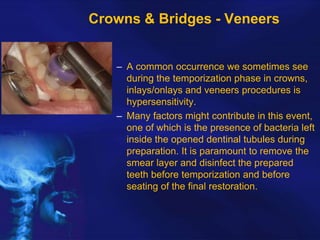
Crowns & Bridges - Veneers
– A common occurrence we sometimes see
during the temporization phase in crowns,
inlays/onlays and veneers procedures is
hypersensitivity.
– Many factors might contribute in this event,
one of which is the presence of bacteria left
inside the opened dentinal tubules during
preparation. It is paramount to remove the
smear layer and disinfect the prepared
teeth before temporization and before
seating of the final restoration.
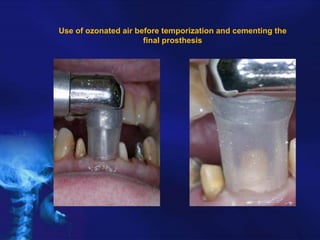
Use of ozonated air before temporization and cementing the
final prosthesis
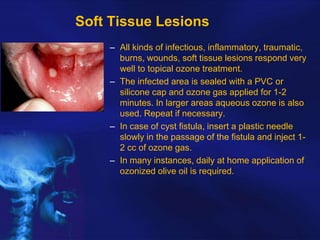
Soft Tissue Lesions
– All kinds of infectious, inflammatory, traumatic,
burns, wounds, soft tissue lesions respond very
well to topical ozone treatment.
– The infected area is sealed with a PVC or
silicone cap and ozone gas applied for 1-2
minutes. In larger areas aqueous ozone is also
used. Repeat if necessary.
– In case of cyst fistula, insert a plastic needle
slowly in the passage of the fistula and inject 12 cc of ozone gas.
– In many instances, daily at home application of
ozonized olive oil is required.
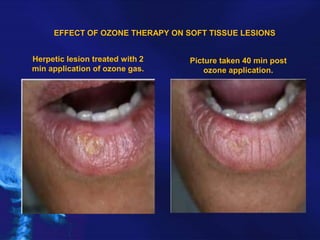
EFFECT OF OZONE THERAPY ON SOFT TISSUE LESIONS
Herpetic lesion treated with 2
min application of ozone gas.

Picture taken 40 min post
ozone application.
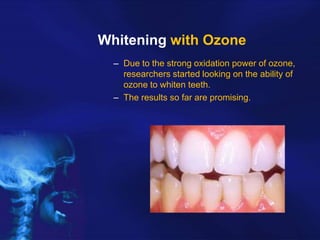
Whitening with Ozone
– Due to the strong oxidation power of ozone,
researchers started looking on the ability of
ozone to whiten teeth.
– The results so far are promising.
Conclusion
• Modern dentistry is all about non/minimal
invasive dentistry. Ozone therapy in the
present stage is reducing caries activity,
improving periodontal health, and also
improving the healing time of oral lesions
and wounds.
Ozone therapy is bound to
revolutionize the way dentistry is
going to be practiced in the future.
Ozone Therapy in Dentistry

Ozone Therapy in Dentistry

  • 2.
    Introduction • Ozone isknown to us as a molecule present in the atmosphere which protects us from radiation. It also binds to the pollutants presents, hence used to measure pollution levels. • This is the job of ozone, to be nature’s filter of “bad” particles.
  • 3.
    WHAT IS OZONE? • • • • • Ozone (O3) is a triatomic molecule. 10-fold more soluble in water than oxygen. Ozone is not a radical molecule It is the third most potent oxidant. It also has the capacity to stimulate blood circulation and the immune response.
  • 4.
    How is ozoneproduced ? Ozone is naturally formed by the sun and lightning in storms.
  • 5.
  • 6.
    Forms of ozoneused • Ozone gas. • Ozonated water. • Ozonated olive oil. These can be used singly or in combination
  • 7.
    HOW DOES OZONETHERAPY WORK ? • Ozone, when introduced into the living system, creates what is called a "transient oxidative burst". The infective microorganisms have no natural defense against the reaction, and, as a result, are overstressed and die. Thus, Ozone disinfects the area treated. • This "oxidative burst" also includes a multitude of natural biochemical and physiological reactions. These reactions include better blood flow, enhanced immune response, and a more rapid healing response.
  • 8.
    CAN YOU BEALLERGIC TO OZONE ? • No, Ozone is just an energized form of oxygen.
  • 9.
    Safety from ozone •Due to safety concerns, O3 gas was not recommended for intra-oral use earlier. • With the development of a foot pedal activated dental handpiece with a suction feature, O3 gas can now be used safely in situations where diffusion is an important factor.
  • 10.
    Primary Pits &Fissures Caries Proximal Caries Lesions – As a general rule, in non-cavitated low speed onset lesions, a non-invasive protocol should be used first. In cavitated lesions, restoration is a must. – The tooth is treated with ozone can completely stop all caries activity and in initial lesion even reverse the damage and allow remineralization.
  • 11.
    Hyper-Sensitive Teeth – Non-carioushypersensitivity is due to many contributing factors among which are erosion, bite pressure, recessed gum, etc. – After elimination of the cause(s), ozone application might alleviate almost instantly the pain felt by the patients from hypersensitive teeth in most cases. – Apply ozone for 40-60 sec on sensitive areas then a remineralizing agent. Repeat if necessary.
  • 12.
    Root Canal Therapy –Ozone is highly indicated in root canal therapy due to its strong disinfection property and absence of cytotoxicity at the recommended concentration and form. – The ozonated air can get to the narrowest places in the canal and peri-apical region where conventional liquids may not be able to reach, disinfect the area and accelerate healing. – Also it reduces the requirement of antibiotics as the region is disinfected locally. – Ozonated oil can be used as a root canal dressing.
  • 13.
    An adapted siliconecap and 25G needle for ozone gas canal disinfection In case a silicone cap is unpractical put the suction tip close to the canal orifice
  • 14.
    Periodontal Therapy – Gingivaland Periodontal diseases represent a major concern both in dentistry and medicine. – The majority of the contributing factors and causes in the etiology of these diseases are reduced or treated with ozone. – Using ozonated water generously irrigate the affected area during and after scaling, root surface planning, and non-surgical pocket curettage. – Fill the pockets with ozonized olive oil using a blunt 25G needle or any other appropriate tip. Repeat once a week till seen fit.
  • 16.
    Results of usingozonized olive oil three days after scaling. Picture taken post scaling Picture taken 3 days post scaling showing accelerated healing
  • 17.
    TMJ Peri-Articular OzoneGas Injection - Trigger Points – The biostimulation and anti-inflammatory effects of ozone help in the management of articulation inflammatory diseases and muscular trigger points. – Chronic oxidative stress and elevated levels of pro-inflammatory cytokines are commonly found in these skeletal chronic inflammations where ozone gas infiltration can contribute in stimulating the anti-oxidant defense mechanism and in balancing the immune response by modulating the production of cytokines
  • 18.
    OZONE GAS INJECTIONINTO SUPERIOR JOINT SPACE.
  • 19.
    Post-Extraction – After finaldebridement of the socket, irrigate with copious amounts of ozonated water and then use gauze imbibed with ozonated water to compress the extraction site. Before retiring the patient, fill the socket with ozonized oil and cover it with gauze, it improves healing and prevents infection.
  • 20.
    Alveolar socket afterextraction Ozonated water being used for irrigation
  • 21.
    Peri-Implantitis – Peri-implantitis isvery bothering to both the dentist and the patient. – Ozone can play an important role and be used as gas or in aqueous form. – Ozonated water can also be used as an irrigant during debridement and curettage. – Also advise the patient to apply ozonized oil on the affected area 3-4 times/day.
  • 22.
    Results of theuse of standard antiseptics and ozonated oil 3 DAYS USE OF 0.12% CHLOEHEXIDINE 3 DAYS USE OF OZONATED OLIVE OIL
  • 23.
    Crowns & Bridges- Veneers – A common occurrence we sometimes see during the temporization phase in crowns, inlays/onlays and veneers procedures is hypersensitivity. – Many factors might contribute in this event, one of which is the presence of bacteria left inside the opened dentinal tubules during preparation. It is paramount to remove the smear layer and disinfect the prepared teeth before temporization and before seating of the final restoration.
  • 24.
    Use of ozonatedair before temporization and cementing the final prosthesis
  • 25.
    Soft Tissue Lesions –All kinds of infectious, inflammatory, traumatic, burns, wounds, soft tissue lesions respond very well to topical ozone treatment. – The infected area is sealed with a PVC or silicone cap and ozone gas applied for 1-2 minutes. In larger areas aqueous ozone is also used. Repeat if necessary. – In case of cyst fistula, insert a plastic needle slowly in the passage of the fistula and inject 12 cc of ozone gas. – In many instances, daily at home application of ozonized olive oil is required.
  • 26.
    EFFECT OF OZONETHERAPY ON SOFT TISSUE LESIONS Herpetic lesion treated with 2 min application of ozone gas. Picture taken 40 min post ozone application.
  • 27.
    Whitening with Ozone –Due to the strong oxidation power of ozone, researchers started looking on the ability of ozone to whiten teeth. – The results so far are promising.
  • 28.
    Conclusion • Modern dentistryis all about non/minimal invasive dentistry. Ozone therapy in the present stage is reducing caries activity, improving periodontal health, and also improving the healing time of oral lesions and wounds. Ozone therapy is bound to revolutionize the way dentistry is going to be practiced in the future.