Cariosolve
DR.Junait Othman
Mosul university- College of
dentistry
Defenition
 Chemomechanical caries removal
(CMCR)
 is a non-invasive technique eliminating
infected dentine via a chemical agent.
This is a method of caries removal based
on dissolution.
History
 The idea developed in 1970 while using
NaOCl in endodontic treatment.
 NaOcl is able to remove the organic
materials in the root canals and dissolve
the carious dentine tissues.
 (Goldman and Kronman1976)
GK101only attack the degenerated
collagen fibers and soften the inner layer
of carious dentine then instrument is used.
 Caridex 1984 two bottle system
1. NaoCl
2. glycine, aminobutyric acid, sodium
chloride and sodium hydroxide.
3. Disadvantage
the large volumes of liquid used per cavity
preparation and the increased time
equired
Cariosolve 2009
 It makes use of three naturally occurring
amino acids (glutamic acid, leucin and
lycine) .
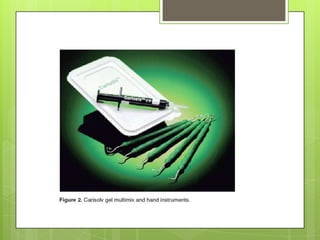
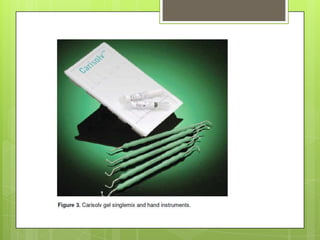
 Composed of two syringe
1. sodium hypochlorite (0.5%)
2. glutamic
acid, lysine, leucine, carboxymethylcellul
ose, sodium chloride, sodium hydroxide
and a red dye.
Mechanism of action
 causes proteolytic degradation of the
already partially broken-down collagen in
the outer carious dentine.
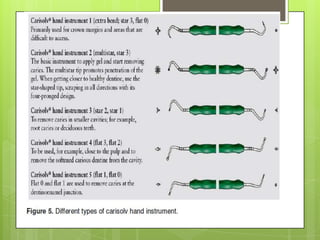
 followed by the removal of lesion using
specially designed non-invasive
instrument. This procedure is repeated
until all carious tissues are removed.
advantages
1. ability of selectively removing the outer layer of dentin
caries.
2. it does not attack the sound dentin as it is alkaline
3. Over-excavation of the cavity, thereby, is prevented.
4. Less perception of pain and more comfortable for
patient.
5. Less fear and anxiety to method, leads to less
discomfort to patients especially in children.
6. Removes only infected layer and leads to more tissue
preservation.
7. No pulpal irritation.
8. Well suited to the treatment of deciduous teeth, dental
phobic’s and medically compromised patients.
9. Better removal of caries in uncooperative patients.
10. Useful in physically handicapped patients.
11. Useful in patients with T.B like infectious diseases
(prevent droplet infection).
Disadvantages
1. Rotary and/or hand instruments may still be
needed for the removal of tissue Large volumes
of solution were needed (200 to 500 ml) and the
procedure was slow and also costly.
2. Only certain cavities were suitable for treatment
by the technique and because of the time
involved (10 to 15 min) and limited use, its
popularity waned.
3. Although there were studies on the efficacy of
caries removal by the procedure, studies on the
long term success of cavities restored after
CMCR treatment were lacking.

How to use it in clinic
1. Apply the gel with one of the hand
instruments.
2. Wait 30sec
3. Remove carious dentine with hand
instrument.
4. Reapt the procedure until no more
carios dentine is left.
Cariosolve
Cariosolve
Cariosolve
Cariosolve

Cariosolve

  • 1.
  • 2.
    Defenition  Chemomechanical cariesremoval (CMCR)  is a non-invasive technique eliminating infected dentine via a chemical agent. This is a method of caries removal based on dissolution.
  • 3.
    History  The ideadeveloped in 1970 while using NaOCl in endodontic treatment.  NaOcl is able to remove the organic materials in the root canals and dissolve the carious dentine tissues.  (Goldman and Kronman1976) GK101only attack the degenerated collagen fibers and soften the inner layer of carious dentine then instrument is used.
  • 4.
     Caridex 1984two bottle system 1. NaoCl 2. glycine, aminobutyric acid, sodium chloride and sodium hydroxide. 3. Disadvantage the large volumes of liquid used per cavity preparation and the increased time equired
  • 5.
    Cariosolve 2009  Itmakes use of three naturally occurring amino acids (glutamic acid, leucin and lycine) .  Composed of two syringe 1. sodium hypochlorite (0.5%) 2. glutamic acid, lysine, leucine, carboxymethylcellul ose, sodium chloride, sodium hydroxide and a red dye.
  • 6.
    Mechanism of action causes proteolytic degradation of the already partially broken-down collagen in the outer carious dentine.  followed by the removal of lesion using specially designed non-invasive instrument. This procedure is repeated until all carious tissues are removed.
  • 7.
  • 8.
    1. ability ofselectively removing the outer layer of dentin caries. 2. it does not attack the sound dentin as it is alkaline 3. Over-excavation of the cavity, thereby, is prevented. 4. Less perception of pain and more comfortable for patient. 5. Less fear and anxiety to method, leads to less discomfort to patients especially in children. 6. Removes only infected layer and leads to more tissue preservation. 7. No pulpal irritation. 8. Well suited to the treatment of deciduous teeth, dental phobic’s and medically compromised patients. 9. Better removal of caries in uncooperative patients. 10. Useful in physically handicapped patients. 11. Useful in patients with T.B like infectious diseases (prevent droplet infection).
  • 9.
    Disadvantages 1. Rotary and/orhand instruments may still be needed for the removal of tissue Large volumes of solution were needed (200 to 500 ml) and the procedure was slow and also costly. 2. Only certain cavities were suitable for treatment by the technique and because of the time involved (10 to 15 min) and limited use, its popularity waned. 3. Although there were studies on the efficacy of caries removal by the procedure, studies on the long term success of cavities restored after CMCR treatment were lacking. 
  • 10.
    How to useit in clinic 1. Apply the gel with one of the hand instruments. 2. Wait 30sec 3. Remove carious dentine with hand instrument. 4. Reapt the procedure until no more carios dentine is left.