OZONE
WATER
Dental Treatment
THE REPORTERS
Leanne Janasea Burla Patricia Joy Cordero Mary Noelyn Degoma
Aje Marie Delfin Sydney Jill Magbanua Jaymari Sualog
OZONE (O3
)
● A highly reactive compound composed of three oxygen
atoms that acts as an oxidant and oxidizer.
● First identified by Christian Friedrich Schönbein in
1840
● Exists at the ground level as an air pollutant and a
constituent of urban smog, as well as in the Earth’s upper
atmosphere as a protective layer from ultraviolet rays.
OZONE (O3
)
● Ozone gas has a high oxidation potential and is
effective against bacteria, viruses, fungi, and
protozoa.
● It also has the capacity to stimulate blood
circulation, platelets, and immune response.
● This strong oxidant property has led to use of
ozone in medical and dental fields.
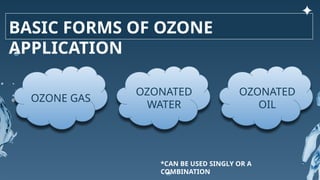
BASIC FORMS OF OZONE
APPLICATION
*CAN BE USED SINGLY OR A
COMBINATION
OZONE GAS
OZONATED
WATER
OZONATED
OIL
CAN YOU BE
ALLERGIC TO
OZONE?
Since ozone is just Oxygen in
energized form ;)
Ozone Water
– essentially water that is free from all impurities
● Able to kill viruses, bacteria, and any pesticides that
are situated in the substance.
● Can be an alternative to saline to wash the mouth
after implant placement
● Best irrigating solution compared to normal saline
and povidone-iodine in terms of reduction in pain
and dry socket
Ozone Water
● An antimicrobial agent that is able to modulate
pain and inflammation
● Causes less cytotoxic effect than chlorhexidine
(0.2% and 2%), sodium hypochlorite (2.5% and
5.25%), and hydrogen peroxide.
● In vitro studies have shown that ozonated water
can effectively destroy Staphylococcus aureus,
Enterococcus faecalis, and Pseudomonas aeruginosa
– A minimally invasive approach that utilizes a medical-
grade ozone gas to disinfect, sterilize, and promote
healing in dental procedures
● Reduces the need for traditional disinfectants and
antibiotics
● Effective against bacteria, viruses, and fungi, aiding in
preventing and treating conditions like tooth decay and
gum disease.
● Can be used to treat gum disease, root sensitivity and
OZONE DENTAL TREATMENT
● Works by using ozone gas or infused
substances to destroy bacteria, viruses,
and fungi, while also stimulating tissue
repair, resulting in effective disinfection
and promotion of healing in dental
procedures.
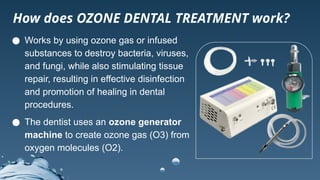
● The dentist uses an ozone generator
machine to create ozone gas (O3) from
oxygen molecules (O2).
How does OZONE DENTAL TREATMENT work?
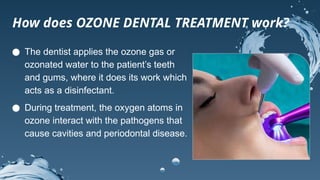
● The dentist applies the ozone gas or
ozonated water to the patient’s teeth
and gums, where it does its work which
acts as a disinfectant.
● During treatment, the oxygen atoms in
ozone interact with the pathogens that
cause cavities and periodontal disease.
How does OZONE DENTAL TREATMENT work?
● The dentist applies the ozone gas or
ozonated water to the patient’s teeth
and gums, where it does its work which
acts as a disinfectant.
● During treatment, the oxygen atoms in
ozone interact with the pathogens that
cause cavities and periodontal disease.
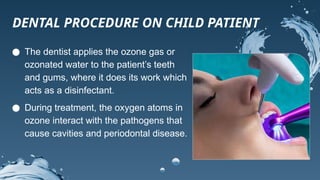
DENTAL PROCEDURE ON CHILD PATIENT
BENEFITS OF OZONE DENTAL
TREATMENT
1. Elimination of Tooth Decay
2. Effective remineralization
3. Minimally invasive
4. Reduction of tooth
sensitivity
5. Canker sore treatment
6. Safe, effective, and natural
● Effective disinfection, killing
bacteria, viruses, and fungi
● Reduction of chemical
usage compared to other
treatments
● No harmful byproducts
formed during treatment
● Oxidizes and removes
organic contaminants
● Shorter treatment times
compared to some
ADVANTAGES
● Higher cost compared to
other methods
● Requirement for skilled
professionals for
maintenance
● Lack of residual
disinfection to prevent
regrowth
● Special mixing techniques
needed due to low
solubility
DISADVANTAGE
S
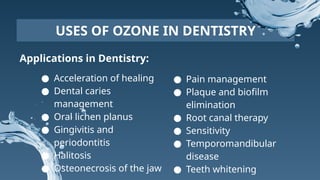
Applications in Dentistry:
USES OF OZONE IN DENTISTRY
● Acceleration of healing
● Dental caries
management
● Oral lichen planus
● Gingivitis and
periodontitis
● Halitosis
● Osteonecrosis of the jaw
● Pain management
● Plaque and biofilm
elimination
● Root canal therapy
● Sensitivity
● Temporomandibular
disease
● Teeth whitening
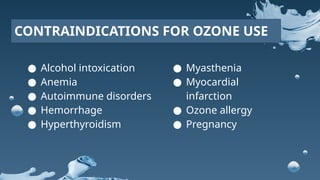
● Alcohol intoxication
● Anemia
● Autoimmune disorders
● Hemorrhage
● Hyperthyroidism
CONTRAINDICATIONS FOR OZONE USE
● Myasthenia
● Myocardial
infarction
● Ozone allergy
● Pregnancy
CONCLUSION

OZONE WATER powerpoint presentation by a

  • 2.
  • 3.
    THE REPORTERS Leanne JanaseaBurla Patricia Joy Cordero Mary Noelyn Degoma Aje Marie Delfin Sydney Jill Magbanua Jaymari Sualog
  • 4.
    OZONE (O3 ) ● Ahighly reactive compound composed of three oxygen atoms that acts as an oxidant and oxidizer. ● First identified by Christian Friedrich Schönbein in 1840 ● Exists at the ground level as an air pollutant and a constituent of urban smog, as well as in the Earth’s upper atmosphere as a protective layer from ultraviolet rays.
  • 5.
    OZONE (O3 ) ● Ozonegas has a high oxidation potential and is effective against bacteria, viruses, fungi, and protozoa. ● It also has the capacity to stimulate blood circulation, platelets, and immune response. ● This strong oxidant property has led to use of ozone in medical and dental fields.
  • 6.
    BASIC FORMS OFOZONE APPLICATION *CAN BE USED SINGLY OR A COMBINATION OZONE GAS OZONATED WATER OZONATED OIL
  • 7.
  • 8.
    Since ozone isjust Oxygen in energized form ;)
  • 9.
    Ozone Water – essentiallywater that is free from all impurities ● Able to kill viruses, bacteria, and any pesticides that are situated in the substance. ● Can be an alternative to saline to wash the mouth after implant placement ● Best irrigating solution compared to normal saline and povidone-iodine in terms of reduction in pain and dry socket
  • 10.
    Ozone Water ● Anantimicrobial agent that is able to modulate pain and inflammation ● Causes less cytotoxic effect than chlorhexidine (0.2% and 2%), sodium hypochlorite (2.5% and 5.25%), and hydrogen peroxide. ● In vitro studies have shown that ozonated water can effectively destroy Staphylococcus aureus, Enterococcus faecalis, and Pseudomonas aeruginosa
  • 11.
    – A minimallyinvasive approach that utilizes a medical- grade ozone gas to disinfect, sterilize, and promote healing in dental procedures ● Reduces the need for traditional disinfectants and antibiotics ● Effective against bacteria, viruses, and fungi, aiding in preventing and treating conditions like tooth decay and gum disease. ● Can be used to treat gum disease, root sensitivity and OZONE DENTAL TREATMENT
  • 12.
    ● Works byusing ozone gas or infused substances to destroy bacteria, viruses, and fungi, while also stimulating tissue repair, resulting in effective disinfection and promotion of healing in dental procedures. ● The dentist uses an ozone generator machine to create ozone gas (O3) from oxygen molecules (O2). How does OZONE DENTAL TREATMENT work?
  • 13.
    ● The dentistapplies the ozone gas or ozonated water to the patient’s teeth and gums, where it does its work which acts as a disinfectant. ● During treatment, the oxygen atoms in ozone interact with the pathogens that cause cavities and periodontal disease. How does OZONE DENTAL TREATMENT work?
  • 14.
    ● The dentistapplies the ozone gas or ozonated water to the patient’s teeth and gums, where it does its work which acts as a disinfectant. ● During treatment, the oxygen atoms in ozone interact with the pathogens that cause cavities and periodontal disease. DENTAL PROCEDURE ON CHILD PATIENT
  • 15.
    BENEFITS OF OZONEDENTAL TREATMENT 1. Elimination of Tooth Decay 2. Effective remineralization 3. Minimally invasive 4. Reduction of tooth sensitivity 5. Canker sore treatment 6. Safe, effective, and natural
  • 16.
    ● Effective disinfection,killing bacteria, viruses, and fungi ● Reduction of chemical usage compared to other treatments ● No harmful byproducts formed during treatment ● Oxidizes and removes organic contaminants ● Shorter treatment times compared to some ADVANTAGES ● Higher cost compared to other methods ● Requirement for skilled professionals for maintenance ● Lack of residual disinfection to prevent regrowth ● Special mixing techniques needed due to low solubility DISADVANTAGE S
  • 17.
    Applications in Dentistry: USESOF OZONE IN DENTISTRY ● Acceleration of healing ● Dental caries management ● Oral lichen planus ● Gingivitis and periodontitis ● Halitosis ● Osteonecrosis of the jaw ● Pain management ● Plaque and biofilm elimination ● Root canal therapy ● Sensitivity ● Temporomandibular disease ● Teeth whitening
  • 18.
    ● Alcohol intoxication ●Anemia ● Autoimmune disorders ● Hemorrhage ● Hyperthyroidism CONTRAINDICATIONS FOR OZONE USE ● Myasthenia ● Myocardial infarction ● Ozone allergy ● Pregnancy
  • 19.

Editor's Notes

  • #4 It cleanses the air and combines with any pollutant that it comes. Ozone exists as colorless gas, with a pungent odor at room temperature. It is an unstable gas that cannot be stored and should be used at once because it has a half-life of 40 min at 20 °C.
  • #5 Ozone is known to us as a molecule present in the atmosphere which protects us from radiation. It also binds to the pollutants presents, hence used to measure pollution levels. • This is the job of ozone, to be nature’s filter of “bad” particles.
  • #9 when ozone is placed into water, it’s able to kill a study where ozone water was used as an alternative to saline to wash the mouth after implant placement, the study demonstrated that using ozonated water decreased pain and inflammation and accelerated wound healing.
  • #10 How does it work? As well as being an antimicrobial agent, ozone dissolved in water has been found to be able to modulate pain and inflammation. Its antimicrobial and anti-inflammatory actions can prevent infections and promote healing. Therefore using ozonated water rather than regular water for dental treatments can be beneficial.
  • #11 Ozone therapy can be used to treat gum disease, root sensitivity, deep decay. Removal of harmful bacteria with ozone on deep decay is the natural way to keep the tooth alive and pain-free! Ozone therapy enhances the healing process in diseased tissues and deep decay, often preventing the need for root canal therapy. It can be used alone or with other treatments.
  • #12 During treatment, the oxygen atoms in ozone interact with the pathogens that cause cavities and periodontal disease. The oxygen oxidizes and kills the harmful microbes in the mouth and helps break down the plaque biofilms that lead to tooth decay. One strength of ozone treatment is that it doesn’t damage healthy tissues. Our cells have antioxidants and free radical scavengers that fight the oxidative effects of ozone. Bacteria and other pathogens don’t have enough of these molecules, so the ozone kills them.
  • #13 During treatment, the oxygen atoms in ozone interact with the pathogens that cause cavities and periodontal disease. The oxygen oxidizes and kills the harmful microbes in the mouth and helps break down the plaque biofilms that lead to tooth decay.
  • #14 During treatment, the oxygen atoms in ozone interact with the pathogens that cause cavities and periodontal disease. The oxygen oxidizes and kills the harmful microbes in the mouth and helps break down the plaque biofilms that lead to tooth decay.
  • #15 The most significant benefit of ozone therapy is that it does not harm healthy tissues. Since our cells include antioxidants and free radical scavengers to fight the oxidative effects of ozone, and bacteria and other diseases do not contain enough of these molecules, so therefore ozone eliminates them.