Redox Indicators
INDICATORS
Oxidation/reduction (redox) indicators are colorimetric
reagents which show a distinct color change at a specific
electrode potential.
Examples: Anilinic acid, Diphenylamine, m-cresol-indophenol,
Methylene blue & Nile blue
There are 3 types of indicators
Internal or Redox Indicator
Self Indicators
External Indicators
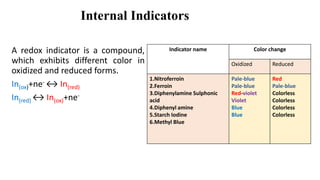
Internal Indicators
A redox indicator is a compound,
which exhibits different color in
oxidized and reduced forms.
In(ox)+ne- ↔ In(red)
In(red) ↔ In(ox)+ne-
Indicator name Color change
Oxidized Reduced
1.Nitroferroin
2.Ferroin
3.Diphenylamine Sulphonic
acid
4.Diphenyl amine
5.Starch Iodine
6.Methyl Blue
Pale-blue
Pale-blue
Red-violet
Violet
Blue
Blue
Red
Pale-blue
Colorless
Colorless
Colorless
Colorless
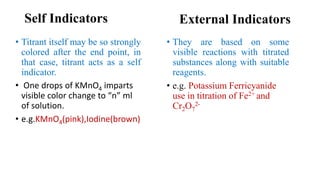
Self Indicators
• Titrant itself may be so strongly
colored after the end point, in
that case, titrant acts as a self
indicator.
• One drops of KMnO4 imparts
visible color change to “n” ml
of solution.
• e.g.KMnO4(pink),Iodine(brown)
External Indicators
• They are based on some
visible reactions with titrated
substances along with suitable
reagents.
• e.g. Potassium Ferricyanide
use in titration of Fe2+ and
Cr2O7
2-
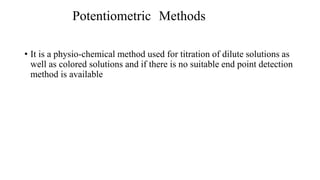
Potentiometric Methods
• It is a physio-chemical method used for titration of dilute solutions as
well as colored solutions and if there is no suitable end point detection
method is available
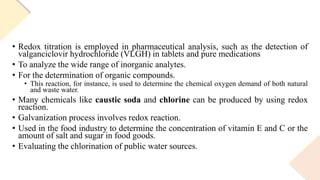
APPLICATIONS
• Redox titration is employed in pharmaceutical analysis, such as the detection of
valganciclovir hydrochloride (VLGH) in tablets and pure medications
• To analyze the wide range of inorganic analytes.
• For the determination of organic compounds.
• This reaction, for instance, is used to determine the chemical oxygen demand of both natural
and waste water.
• Many chemicals like caustic soda and chlorine can be produced by using redox
reaction.
• Galvanization process involves redox reaction.
• Used in the food industry to determine the concentration of vitamin E and C or the
amount of salt and sugar in food goods.
• Evaluating the chlorination of public water sources.

Redox Titration Indicators.pptx

  • 1.
  • 2.
  • 3.
    Oxidation/reduction (redox) indicatorsare colorimetric reagents which show a distinct color change at a specific electrode potential. Examples: Anilinic acid, Diphenylamine, m-cresol-indophenol, Methylene blue & Nile blue
  • 4.
    There are 3types of indicators Internal or Redox Indicator Self Indicators External Indicators
  • 5.
    Internal Indicators A redoxindicator is a compound, which exhibits different color in oxidized and reduced forms. In(ox)+ne- ↔ In(red) In(red) ↔ In(ox)+ne- Indicator name Color change Oxidized Reduced 1.Nitroferroin 2.Ferroin 3.Diphenylamine Sulphonic acid 4.Diphenyl amine 5.Starch Iodine 6.Methyl Blue Pale-blue Pale-blue Red-violet Violet Blue Blue Red Pale-blue Colorless Colorless Colorless Colorless
  • 6.
    Self Indicators • Titrantitself may be so strongly colored after the end point, in that case, titrant acts as a self indicator. • One drops of KMnO4 imparts visible color change to “n” ml of solution. • e.g.KMnO4(pink),Iodine(brown) External Indicators • They are based on some visible reactions with titrated substances along with suitable reagents. • e.g. Potassium Ferricyanide use in titration of Fe2+ and Cr2O7 2-
  • 7.
    Potentiometric Methods • Itis a physio-chemical method used for titration of dilute solutions as well as colored solutions and if there is no suitable end point detection method is available
  • 8.
  • 9.
    • Redox titrationis employed in pharmaceutical analysis, such as the detection of valganciclovir hydrochloride (VLGH) in tablets and pure medications • To analyze the wide range of inorganic analytes. • For the determination of organic compounds. • This reaction, for instance, is used to determine the chemical oxygen demand of both natural and waste water. • Many chemicals like caustic soda and chlorine can be produced by using redox reaction. • Galvanization process involves redox reaction. • Used in the food industry to determine the concentration of vitamin E and C or the amount of salt and sugar in food goods. • Evaluating the chlorination of public water sources.