Oxford basic lesson – Lesson 10 page 36-38
another Would you like  another  potato? Would you like  some more  meat? {NOT ... another meat?) Would you like  some more  peas?'(NOT . . . another peas?). another + singular noun another + few/number + plural noun note  Another  is one word.   Normally, we only use another with singular countable nouns.  I'm staying for  another few weeks.  We need  another three chairs. 'Nice day.' 'Yes. Bit cold,  though.' But we can use  another  before a plural noun in expressions with  few  or a number. He's bought  another  car. {NOT . . . an other car.)
Another Some more Another few Another two  Another three SARAH WANTS TO OFFER SOME PIZZA SLICE TO JENNY . SARAH WANTS TO OFFER SOME CUSTARD  TO JENNY  SARAH WANTS TO OFFER SOME NUTS  TO JENNY . Sarah Jenny Would you like to ………… Please have …. Why don’t you ………. speaking task Use the words on the right to create the sentences.
Any  can mean 'it doesn't matter which'; 'whichever you like'.  any ( = 'it doesn't matter which')   We can use anybody, anyone, anything and anywhere in the same way   'When shall I come?'  Any  time.' 'Could you pass me a knife?' 'Which one?' 'It doesn't matter.  Any  one.'. note  She goes out with  anybody  who asks her. 'What would you like to eat?' 'It doesn't matter.  Anything  will do.' 'Where can we sit?'  Anywhere  you like.'
Can I come to your place  to watch that movie? Oh sure ! You can ………….. Who can help me with this report ? Does ……………………( notebook) When  did  you finish the work , I though you had left ? Did you find the t-shirt you were looking for  in the market ? I guess ………………… You can ask john . No, thanks . I am ok Oh no !! ……………………….. give answers by using the vocabulary below Anytime  Anyone Anybody Anything Anywhere  …
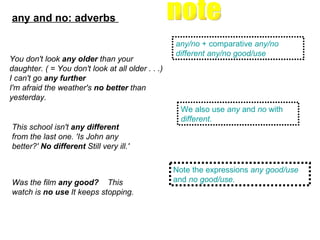
any/no  + comparative  any/no different any/no good/use any and no: adverbs   We also use  any  and  no  with  different.   You don't look  any older  than your daughter. ( = You don't look at all older . . .) I can't go  any further I'm afraid the weather's  no better  than yesterday. note  This school isn't  any different  from the last one. 'Is John any better?'  No different  Still very ill.' Note the expressions  any good/use  and  no good/use. Was the film  any good?  This watch is  no use  It keeps stopping.
Any better  Any older Any good Any bigger Any faster Any happier Any different  No different  Any use No good  No use  His car  You look Your dress Your son  Your bike  Your friend Your shirt  The washing machine  The boyfriend  Sarah Jenny  Sarah has some comments about jenny’s matters . She is commenting  on them, you have to form the comments  in the same way as the example . Example  You don't look  any older  than your daughter. speaking task
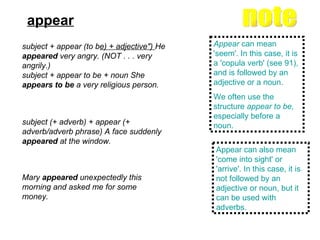
appear   subject (+ adverb) + appear (+ adverb/adverb phrase) A face suddenly  appeared  at the window. note  Appear  can mean 'seem'. In this case, it is a 'copula verb' (see 91), and is followed by an adjective or a noun. We often use the structure  appear to be,  especially before a noun. subject + appear (to b e) + adjective")  He  appeared  very angry. (NOT . . . very angrily.) subject + appear to be + noun She  appears to be  a very religious person. Appear can also mean 'come into sight' or 'arrive'. In this case, it is not followed by an adjective or noun, but it can be used with adverbs. Mary  appeared  unexpectedly this morning and asked me for some money.
How  did  Jenny feel when she found the house dirty ?  How did john feel after coming back from the business trip ? How did you meet with the car accident, even though You drive carefully ? Why was everyone surprised to see Jenny at the Party ? John’s co-workers were astonished to see him at the Meeting at 9 o clock , what happened ? speaking task Try to imagine the situations  and give answers by using the pictures on the right
Possible answers  She appeared to be angry  when she found that the house was dirty . He appeared to be relaxed  after he came back from his  business trip . My car hit the  tree as a dog suddenly appeared on the road . We had not seen her for long , we  were all surprised when she appeared at the party , We were not expecting john to come to office , however he appeared suddenly at 9 oclock and we were all astonished .
(a) round and about We walked  round  the old part of the town. Can I look  round? Could you pass the cups  round,  please? note  We usually use  round to  movement or position in a circle, or in a curve. We all sat  round  the table. I walked  round  the car and looked at the wheels. 'Where do you live?' 'Just  round  the corner.' We also use  round  when we talk about going to all (or most) parts of a place, or giving things to everybody in a group.
(a) round and about Stop  fooling around/about  We're late.   note  We use  around or aboutio  express movements or positions that are not very clear or definite: 'here and there', 'in lots of places', 'in different parts of'/somewhere near' and similar ideas.   The children were running  around/about  everywhere. Stop standing  around/about  and do some work. 'Where's John?' 'Somewhere  around/about' We also use  round  when we talk about going to all (or most) parts of a place, or giving things to everybody in a group. And  around/about  can mean 'approximately', 'not exactly'. There were  around/about  fifty people there. 'What time shall I come?'  Around/about  eight.'
The family sat round the table to eat their dinner . She kept standing around and wasted her time . He walked round the room to look for his lost keys . Read the following  sentences
There was mess all around the place . He walked round the children, distributing them sweets . He fooled around the house and  broke many precious things .
summary In this lesson we discussed about some grammar forms . We tried  to use the same forms for the speaking tasks .

Oxford sample

  • 1.
    Oxford basic lesson– Lesson 10 page 36-38
  • 2.
    another Would youlike another potato? Would you like some more meat? {NOT ... another meat?) Would you like some more peas?'(NOT . . . another peas?). another + singular noun another + few/number + plural noun note Another is one word. Normally, we only use another with singular countable nouns. I'm staying for another few weeks. We need another three chairs. 'Nice day.' 'Yes. Bit cold, though.' But we can use another before a plural noun in expressions with few or a number. He's bought another car. {NOT . . . an other car.)
  • 3.
    Another Some moreAnother few Another two Another three SARAH WANTS TO OFFER SOME PIZZA SLICE TO JENNY . SARAH WANTS TO OFFER SOME CUSTARD TO JENNY SARAH WANTS TO OFFER SOME NUTS TO JENNY . Sarah Jenny Would you like to ………… Please have …. Why don’t you ………. speaking task Use the words on the right to create the sentences.
  • 4.
    Any canmean 'it doesn't matter which'; 'whichever you like'. any ( = 'it doesn't matter which') We can use anybody, anyone, anything and anywhere in the same way 'When shall I come?' Any time.' 'Could you pass me a knife?' 'Which one?' 'It doesn't matter. Any one.'. note She goes out with anybody who asks her. 'What would you like to eat?' 'It doesn't matter. Anything will do.' 'Where can we sit?' Anywhere you like.'
  • 5.
    Can I cometo your place to watch that movie? Oh sure ! You can ………….. Who can help me with this report ? Does ……………………( notebook) When did you finish the work , I though you had left ? Did you find the t-shirt you were looking for in the market ? I guess ………………… You can ask john . No, thanks . I am ok Oh no !! ……………………….. give answers by using the vocabulary below Anytime Anyone Anybody Anything Anywhere …
  • 6.
    any/no +comparative any/no different any/no good/use any and no: adverbs We also use any and no with different. You don't look any older than your daughter. ( = You don't look at all older . . .) I can't go any further I'm afraid the weather's no better than yesterday. note This school isn't any different from the last one. 'Is John any better?' No different Still very ill.' Note the expressions any good/use and no good/use. Was the film any good? This watch is no use It keeps stopping.
  • 7.
    Any better Any older Any good Any bigger Any faster Any happier Any different No different Any use No good No use His car You look Your dress Your son Your bike Your friend Your shirt The washing machine The boyfriend Sarah Jenny Sarah has some comments about jenny’s matters . She is commenting on them, you have to form the comments in the same way as the example . Example You don't look any older than your daughter. speaking task
  • 8.
    appear subject (+ adverb) + appear (+ adverb/adverb phrase) A face suddenly appeared at the window. note Appear can mean 'seem'. In this case, it is a 'copula verb' (see 91), and is followed by an adjective or a noun. We often use the structure appear to be, especially before a noun. subject + appear (to b e) + adjective") He appeared very angry. (NOT . . . very angrily.) subject + appear to be + noun She appears to be a very religious person. Appear can also mean 'come into sight' or 'arrive'. In this case, it is not followed by an adjective or noun, but it can be used with adverbs. Mary appeared unexpectedly this morning and asked me for some money.
  • 9.
    How did Jenny feel when she found the house dirty ? How did john feel after coming back from the business trip ? How did you meet with the car accident, even though You drive carefully ? Why was everyone surprised to see Jenny at the Party ? John’s co-workers were astonished to see him at the Meeting at 9 o clock , what happened ? speaking task Try to imagine the situations and give answers by using the pictures on the right
  • 10.
    Possible answers She appeared to be angry when she found that the house was dirty . He appeared to be relaxed after he came back from his business trip . My car hit the tree as a dog suddenly appeared on the road . We had not seen her for long , we were all surprised when she appeared at the party , We were not expecting john to come to office , however he appeared suddenly at 9 oclock and we were all astonished .
  • 11.
    (a) round andabout We walked round the old part of the town. Can I look round? Could you pass the cups round, please? note We usually use round to movement or position in a circle, or in a curve. We all sat round the table. I walked round the car and looked at the wheels. 'Where do you live?' 'Just round the corner.' We also use round when we talk about going to all (or most) parts of a place, or giving things to everybody in a group.
  • 12.
    (a) round andabout Stop fooling around/about We're late. note We use around or aboutio express movements or positions that are not very clear or definite: 'here and there', 'in lots of places', 'in different parts of'/somewhere near' and similar ideas. The children were running around/about everywhere. Stop standing around/about and do some work. 'Where's John?' 'Somewhere around/about' We also use round when we talk about going to all (or most) parts of a place, or giving things to everybody in a group. And around/about can mean 'approximately', 'not exactly'. There were around/about fifty people there. 'What time shall I come?' Around/about eight.'
  • 13.
    The family satround the table to eat their dinner . She kept standing around and wasted her time . He walked round the room to look for his lost keys . Read the following sentences
  • 14.
    There was messall around the place . He walked round the children, distributing them sweets . He fooled around the house and broke many precious things .
  • 15.
    summary In thislesson we discussed about some grammar forms . We tried to use the same forms for the speaking tasks .