Essential Question : What was the role of the U.S.  during World War I? Warm-Up Question : Brainstorm & list the various reasons for the outbreak of World War I in Europe
Quick Class Discussion:  What Caused the  “Great War”?
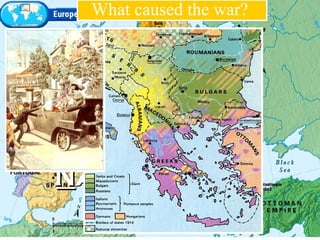
M ILITARISM A LLIANCES I MPERIALISM N ATIONALISM  Europe  before  the war What caused the war?
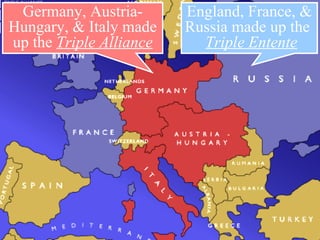
Germany, Austria-Hungary, & Italy made up the  Triple Alliance England, France, & Russia made up the  Triple Entente
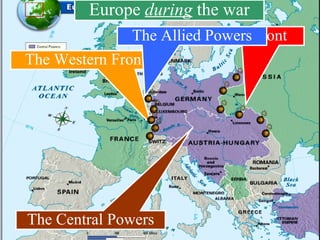
Europe  during  the war The Western Front The Eastern Front The Allied Powers The Central Powers
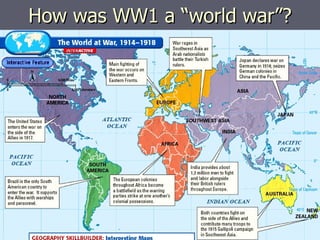
How was WW1 a “world war”?
Essential Question : What was the role of the U.S. in World War I? Warm-Up Question : Which foreign policy would have been most appropriate for the U.S. from 1914 to 1917 given the outbreak of war in Europe?:  TR’s “Big Stick Diplomacy,”  Taft’s “Dollar Diplomacy,” or Wilson’s “Moral Diplomacy”
American Neutrality When war was declared in Europe in July 1914, Wilson proclaimed American neutrality due to:  Tradition of non-involvement  Progressives & women organized against war America as a land of immigrants should not take sides in Europe The majority of the U.S. supported the Allies but wanted to avoid war
Threats to American Neutrality U.S. neutrality was threatened from the very beginning: England & Germany appealed to the U.S. to enter on their side  U.S. trade with England & France provided a strong bond  The most serious threat proved to be Germany’s violation of the right to “freedom of the seas” England appealed to cultural ties & propaganda of Germans atrocities  Germany blamed the war on Russian expansion & French revenge
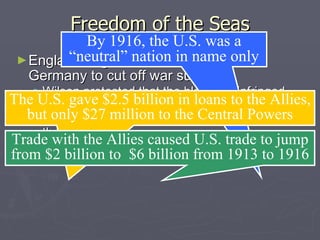
Freedom of the Seas England began a blockade around Germany to cut off war supplies: Wilson protested that the blockade infringed on America’s right to trade as a neutral nation  But the flood of Allied war orders helped fuel the U.S. economy Loans & trade drew the U.S. closer to the Allies while trade with Germany all but ended By 1916, the U.S. was a “neutral” nation in name only The U.S. gave $2.5 billion in loans to the Allies, but only $27 million to the Central Powers Trade with the Allies caused U.S. trade to jump from $2 billion to  $6 billion from 1913 to 1916
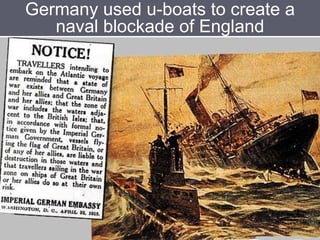
The U-Boat Threat Germany’s response to the British blockade was  unrestricted submarine warfare  in 1915: Americans died during u-boat attacks on the  Lusitania ,  Arabic, & Sussex  from   1915 to 1916 In the  Sussex Pledge , Germany agreed to limit attacks if the U.S. helped end England’s blockade Despite the  Sussex Pledge , Congress passed the National Defense Act in 1916 that increased the size of the U.S. army & navy
Germany used u-boats to create a naval blockade of England
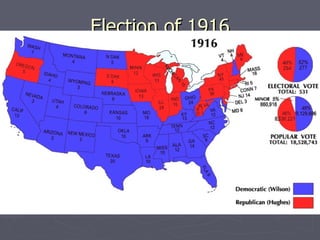
Election of 1916 In the 1916 election, Wilson balanced contrasting stances: He appealed to progressives & anti-war voters with the slogan “ He kept us out of war ” But argued for “preparedness” by building up the military in case the U.S. joins the war Wilson won by affirming 2 goals: freedom of the seas & neutrality
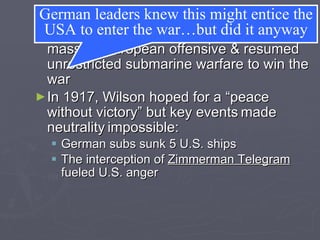
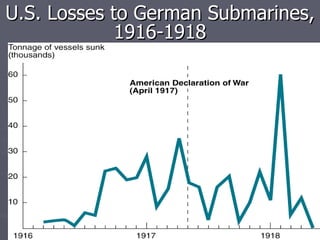
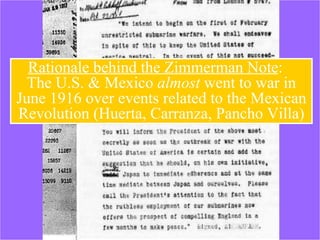
America Joins the Allies In December 1916, Germany led a massive European offensive & resumed unrestricted submarine warfare to win the war In 1917, Wilson hoped for a “peace without victory” but key events   made   neutrality   impossible:  German subs sunk 5 U.S. ships The interception of  Zimmerman Telegram  fueled U.S. anger  German leaders knew this might entice the USA to enter the war…but did it anyway
U.S. Losses to German Submarines, 1916-1918
Rationale behind the Zimmerman Note :  The U.S. & Mexico  almost  went to war in June 1916 over events related to the Mexican Revolution (Huerta, Carranza, Pancho Villa)
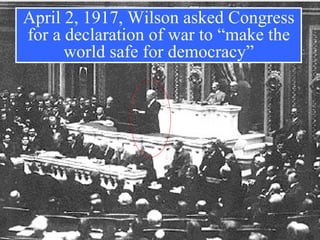
April 2, 1917, Wilson asked Congress for a declaration of war to “make the world safe for democracy”
What really brought  the U.S. into WWI?
“ Over There ”  American Military Participation in WWI
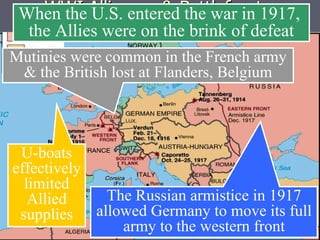
WWI Alliances & Battlefronts, 1914-1917 When the U.S. entered the war in 1917,  the Allies were on the brink of defeat U-boats effectively limited Allied supplies The Russian armistice in 1917 allowed Germany to move its full army to the western front Mutinies were common in the French army & the British lost at Flanders, Belgium
Mobilization Wilson named  John Pershing  to head the  American Expeditionary Force  (AEF), but despite Wilson’s  preparedness campaign, the U.S. was not prepared for full scale war Many wanted a volunteer army, but Wilson pressed Congress to pass a  Selective Service Act   (24 million registered & 2.8 million were drafted to fight in Europe) The army & navy increased in size but military leaders had not prepared a plan for war (“ To plan for war is to violate the terms of neutrality ”)
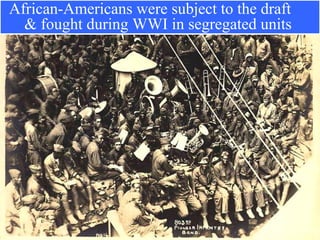
African-Americans were subject to the draft  & fought during WWI in segregated units
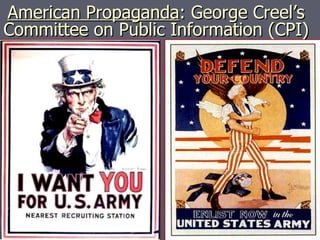
American Propaganda : George Creel’s Committee on Public Information (CPI)
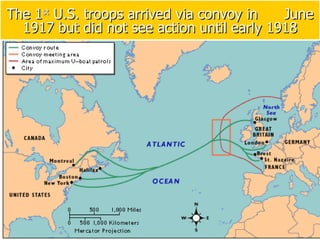
The 1 st  U.S. troops arrived via convoy in  June 1917 but did not see action until early 1918
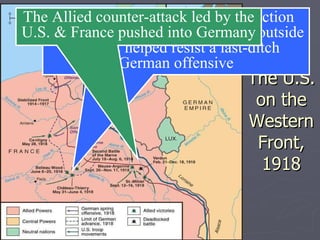
The U.S. on the Western Front, 1918 American soldiers saw their 1 st  action  in May 1918 at Chateau Thierry outside Paris & helped resist a last-ditch German offensive The Allied counter-attack led by the U.S. & France pushed into Germany
War in the Trenches The   arrival of fresh American soldiers & war supplies raised Allied morale at a crucial time: By October 1918, the German gov’t knew the war was over Turkey, Austria-Hungary, & Bulgaria were all out of the war Nov 11, 1918 Germany signed an armistice with the Allies
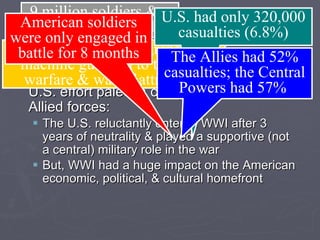
Conclusions The “Great War” was a  total war  but the U.S. effort paled in comparison to other Allied forces: The U.S. reluctantly entered WWI after 3 years of neutrality & played a supportive (not a central) military role in the war But, WWI had a huge impact on the American economic, political, & cultural homefront 9 million soldiers &  5 million civilians died Artillery, poison gas, grenades, machine guns led to trench warfare & war of attrition American soldiers were only engaged in battle for 8 months U.S. had only 320,000 casualties (6.8%) The Allies had 52% casualties; the Central Powers had 57%
Why Did We Go “Over There”?  Wilson was re-elected in 1916 largely due to his campaign rhetoric “ He   kept   us   out   of   the   war .”   By   1917,   the   U.S.   joined   the   Allies.   Why? Examine the reasons for U.S. entry into WWI & rank each as to which were the most powerful forces in causing the USA to join the Allied cause.

Over there4 1

  • 1.
    Essential Question :What was the role of the U.S. during World War I? Warm-Up Question : Brainstorm & list the various reasons for the outbreak of World War I in Europe
  • 2.
    Quick Class Discussion: What Caused the “Great War”?
  • 3.
    M ILITARISM ALLIANCES I MPERIALISM N ATIONALISM Europe before the war What caused the war?
  • 4.
    Germany, Austria-Hungary, &Italy made up the Triple Alliance England, France, & Russia made up the Triple Entente
  • 5.
    Europe during the war The Western Front The Eastern Front The Allied Powers The Central Powers
  • 6.
    How was WW1a “world war”?
  • 7.
    Essential Question :What was the role of the U.S. in World War I? Warm-Up Question : Which foreign policy would have been most appropriate for the U.S. from 1914 to 1917 given the outbreak of war in Europe?: TR’s “Big Stick Diplomacy,” Taft’s “Dollar Diplomacy,” or Wilson’s “Moral Diplomacy”
  • 8.
    American Neutrality Whenwar was declared in Europe in July 1914, Wilson proclaimed American neutrality due to: Tradition of non-involvement Progressives & women organized against war America as a land of immigrants should not take sides in Europe The majority of the U.S. supported the Allies but wanted to avoid war
  • 9.
    Threats to AmericanNeutrality U.S. neutrality was threatened from the very beginning: England & Germany appealed to the U.S. to enter on their side U.S. trade with England & France provided a strong bond The most serious threat proved to be Germany’s violation of the right to “freedom of the seas” England appealed to cultural ties & propaganda of Germans atrocities Germany blamed the war on Russian expansion & French revenge
  • 10.
    Freedom of theSeas England began a blockade around Germany to cut off war supplies: Wilson protested that the blockade infringed on America’s right to trade as a neutral nation But the flood of Allied war orders helped fuel the U.S. economy Loans & trade drew the U.S. closer to the Allies while trade with Germany all but ended By 1916, the U.S. was a “neutral” nation in name only The U.S. gave $2.5 billion in loans to the Allies, but only $27 million to the Central Powers Trade with the Allies caused U.S. trade to jump from $2 billion to $6 billion from 1913 to 1916
  • 11.
    The U-Boat ThreatGermany’s response to the British blockade was unrestricted submarine warfare in 1915: Americans died during u-boat attacks on the Lusitania , Arabic, & Sussex from 1915 to 1916 In the Sussex Pledge , Germany agreed to limit attacks if the U.S. helped end England’s blockade Despite the Sussex Pledge , Congress passed the National Defense Act in 1916 that increased the size of the U.S. army & navy
  • 12.
    Germany used u-boatsto create a naval blockade of England
  • 13.
    Election of 1916In the 1916 election, Wilson balanced contrasting stances: He appealed to progressives & anti-war voters with the slogan “ He kept us out of war ” But argued for “preparedness” by building up the military in case the U.S. joins the war Wilson won by affirming 2 goals: freedom of the seas & neutrality
  • 14.
    America Joins theAllies In December 1916, Germany led a massive European offensive & resumed unrestricted submarine warfare to win the war In 1917, Wilson hoped for a “peace without victory” but key events made neutrality impossible: German subs sunk 5 U.S. ships The interception of Zimmerman Telegram fueled U.S. anger German leaders knew this might entice the USA to enter the war…but did it anyway
  • 15.
    U.S. Losses toGerman Submarines, 1916-1918
  • 16.
    Rationale behind theZimmerman Note : The U.S. & Mexico almost went to war in June 1916 over events related to the Mexican Revolution (Huerta, Carranza, Pancho Villa)
  • 17.
    April 2, 1917,Wilson asked Congress for a declaration of war to “make the world safe for democracy”
  • 18.
    What really brought the U.S. into WWI?
  • 19.
    “ Over There” American Military Participation in WWI
  • 20.
    WWI Alliances &Battlefronts, 1914-1917 When the U.S. entered the war in 1917, the Allies were on the brink of defeat U-boats effectively limited Allied supplies The Russian armistice in 1917 allowed Germany to move its full army to the western front Mutinies were common in the French army & the British lost at Flanders, Belgium
  • 21.
    Mobilization Wilson named John Pershing to head the American Expeditionary Force (AEF), but despite Wilson’s preparedness campaign, the U.S. was not prepared for full scale war Many wanted a volunteer army, but Wilson pressed Congress to pass a Selective Service Act (24 million registered & 2.8 million were drafted to fight in Europe) The army & navy increased in size but military leaders had not prepared a plan for war (“ To plan for war is to violate the terms of neutrality ”)
  • 22.
    African-Americans were subjectto the draft & fought during WWI in segregated units
  • 23.
    American Propaganda :George Creel’s Committee on Public Information (CPI)
  • 24.
    The 1 st U.S. troops arrived via convoy in June 1917 but did not see action until early 1918
  • 25.
    The U.S. onthe Western Front, 1918 American soldiers saw their 1 st action in May 1918 at Chateau Thierry outside Paris & helped resist a last-ditch German offensive The Allied counter-attack led by the U.S. & France pushed into Germany
  • 26.
    War in theTrenches The arrival of fresh American soldiers & war supplies raised Allied morale at a crucial time: By October 1918, the German gov’t knew the war was over Turkey, Austria-Hungary, & Bulgaria were all out of the war Nov 11, 1918 Germany signed an armistice with the Allies
  • 27.
    Conclusions The “GreatWar” was a total war but the U.S. effort paled in comparison to other Allied forces: The U.S. reluctantly entered WWI after 3 years of neutrality & played a supportive (not a central) military role in the war But, WWI had a huge impact on the American economic, political, & cultural homefront 9 million soldiers & 5 million civilians died Artillery, poison gas, grenades, machine guns led to trench warfare & war of attrition American soldiers were only engaged in battle for 8 months U.S. had only 320,000 casualties (6.8%) The Allies had 52% casualties; the Central Powers had 57%
  • 28.
    Why Did WeGo “Over There”? Wilson was re-elected in 1916 largely due to his campaign rhetoric “ He kept us out of the war .” By 1917, the U.S. joined the Allies. Why? Examine the reasons for U.S. entry into WWI & rank each as to which were the most powerful forces in causing the USA to join the Allied cause.

Editor's Notes

  • #2 Lesson Plan for Wednesday, January 21, 2009: Warm-Up Question: Discuss causes of WWI, Wilson video, start WWI notes
  • #8 Lesson Plan for Tuesday, January 20, 2009: Warm-Up Question, Finish WWI notes
  • #9 10
  • #11 11
  • #12 12
  • #14 13
  • #15 14
  • #16 14
  • #19 Examine the reading on the back of student notes “What did the USA enter WW1”?
  • #22 15 Bad sign—US military’s most recent battle experience was chasing Pancho Villa in Mexico but did not catch him. Selective Service Act called for all men aged 21-30 then raised to 18-45
  • #23 African-Americans on a Troop Ship Headed for France