


BY
Mohammad Emam
Prof. OB& GYN
Mansoura Faculty of Medicine
Mansoura Integrated Fertility Center
2021
Ultrasonic – guided Ovarian
Cyst Aspiration:
Role Of Gynecologist
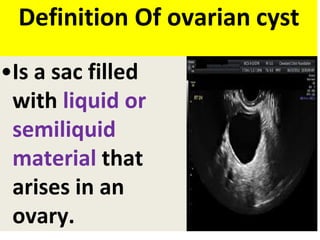
Definition Of ovarian cyst
•Is a sac filled
with liquid or
semiliquid
material that
arises in an
ovary.
Epidemiology of Ovarian Cysts?
Many types.
Different cause.
Occur from Fetus to menopause.
Majority during reproductive age.
Majority are asymptomatic.
Can cause serious problems.
Methods Of ovarian cyst
Aspiration
•Either by:
•1 ) Ultrasonic guided.
• OR
•2) laparoscopy ( Prior to ov. Cystectomy)
Rationale
Wide increase of ovarian
cysts aspiration by (GG )
due to its simplicity,
short hospital stay and
rapid recovery
To highlight awareness of Gynecologist regarding:
1. Principles of Diagnosis
2. Principles of management & choice line
3. Interventional (ultrasound – guided Aspiration ):
• Indications update
• Contraindications
• Disadvantages
Objective
Principles of Diagnosis
• History & Examination.
• Investigations
– Tumor markers – CA-125.
– Imaging techniques:
– TVS
– CT – assess LN, pelvic and abdominal structures.
– MRI – best for DD malignant from benign .
• DD
DD (common)
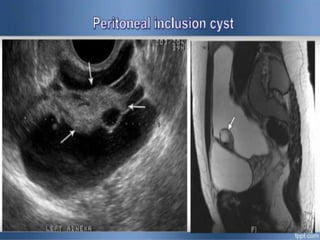
 Peritoneal Pseudo cyst ( inclusion cyst) .
Para ovarian cysts
Hydro salpinx
PCOM & Multicystic !!!!!!
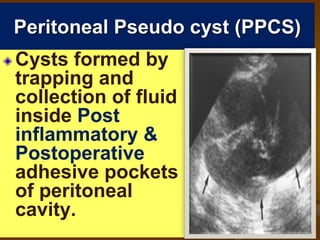
Peritoneal Pseudo cyst (PPCS)
Cysts formed by
trapping and
collection of fluid
inside Post
inflammatory &
Postoperative
adhesive pockets
of peritoneal
cavity.
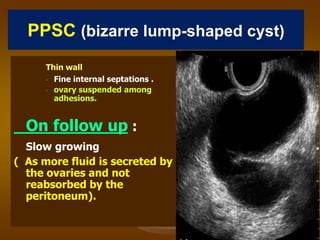
PPSC (bizarre lump-shaped cyst)
Thin wall
• Fine internal septations .
• ovary suspended among
adhesions.
On follow up :
Slow growing
( As more fluid is secreted by
the ovaries and not
reabsorbed by the
peritoneum).
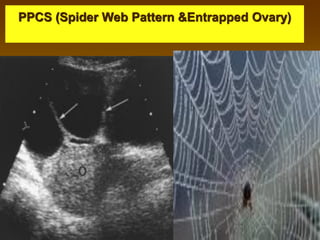
PPCS (Spider Web Pattern &Entrapped Ovary)
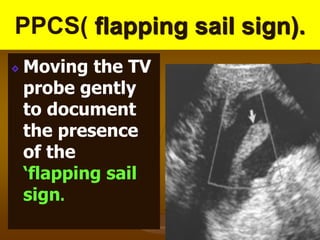
PPCS( flapping sail sign).
Moving the TV
probe gently
to document
the presence
of the
‘flapping sail
sign.
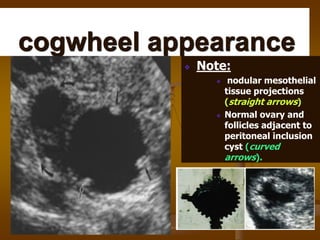
cogwheel appearance
Note:
nodular mesothelial
tissue projections
(straight arrows)
Normal ovary and
follicles adjacent to
peritoneal inclusion
cyst (curved
arrows).
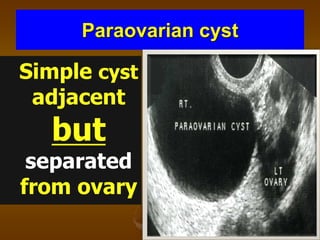
Paraovarian cyst
Simple cyst
adjacent
but
separated
from ovary
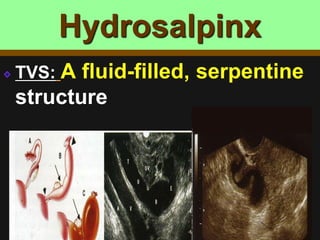
Hydrosalpinx
TVS: A fluid-filled, serpentine
structure
PCOM & Multicystic
ovary
Are NOT
OVARIAN CYST
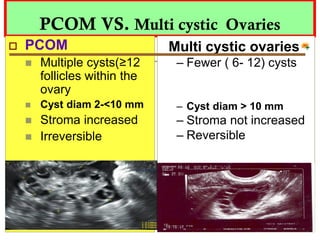
PCOM VS. Multi cystic Ovaries
 PCOM
 Multiple cysts(≥12
follicles within the
ovary
 Cyst diam 2-<10 mm
 Stroma increased
 Irreversible
Multi cystic ovaries
– Fewer ( 6- 12) cysts
– Cyst diam > 10 mm
– Stroma not increased
– Reversible
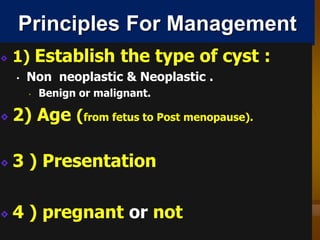
Principles For Management
1) Establish the type of cyst :
• Non neoplastic & Neoplastic .
• Benign or malignant.
2) Age (from fetus to Post menopause).
3 ) Presentation
4 ) pregnant or not
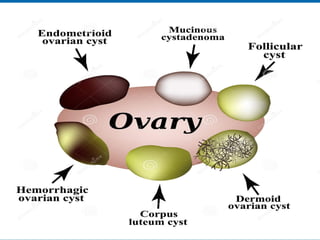
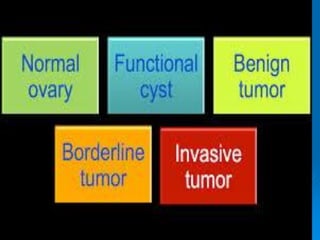
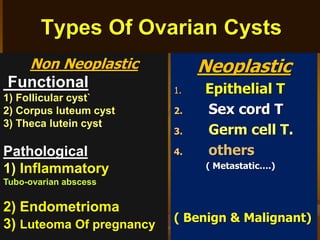
Types Of Ovarian Cysts
Neoplastic
1. Epithelial T
2. Sex cord T
3. Germ cell T.
4. others
( Metastatic….)
( Benign & Malignant)
Non Neoplastic
Functional
1) Follicular cyst`
2) Corpus luteum cyst
3) Theca lutein cyst
Pathological
1) Inflammatory
Tubo-ovarian abscess
2) Endometrioma
3) Luteoma Of pregnancy
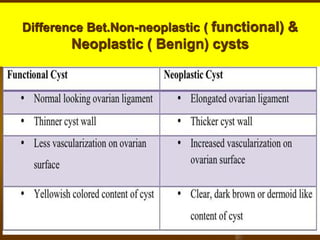
Difference Bet.Non-neoplastic ( functional) &
Neoplastic ( Benign) cysts
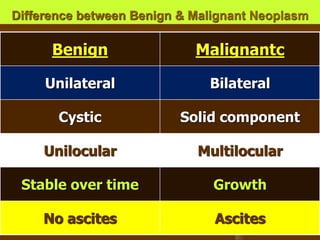
Difference between Benign & Malignant Neoplasm
Benign Malignantc
Unilateral Bilateral
Cystic Solid component
Unilocular Multilocular
Stable over time Growth
No ascites Ascites
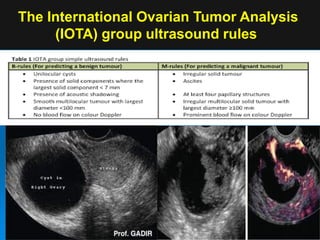
The International Ovarian Tumor Analysis
(IOTA) group ultrasound rules
11/3/2021 template from www.brainybetty.com copyright 2006 28
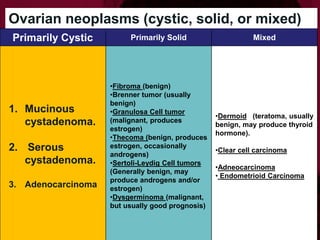
Primarily Cystic Primarily Solid Mixed
1. Mucinous
cystadenoma.
2. Serous
cystadenoma.
3. Adenocarcinoma
•Fibroma (benign)
•Brenner tumor (usually
benign)
•Granulosa Cell tumor
(malignant, produces
estrogen)
•Thecoma (benign, produces
estrogen, occasionally
androgens)
•Sertoli-Leydig Cell tumors
(Generally benign, may
produce androgens and/or
estrogen)
•Dysgerminoma (malignant,
but usually good prognosis)
•Dermoid (teratoma, usually
benign, may produce thyroid
hormone).
•Clear cell carcinoma
•Adneocarcinoma
• Endometrioid Carcinoma
Ovarian neoplasms (cystic, solid, or mixed).
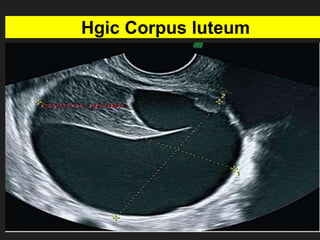
Hgic Corpus luteum
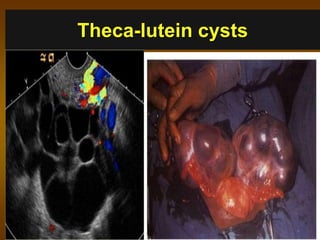
Theca-lutein cysts
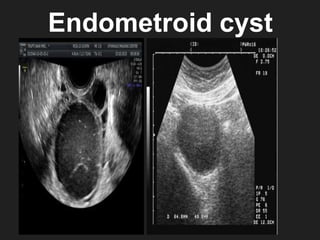
Endometroid cyst
Choice Line of ttt :
 Conservative
 surgery ( laparoscopy
& laparotomy).
Interventional
(ultrasound
Aspiration ).
Indications for Ovarian
Cyst Aspiration
1)Some Functional ovarian cysts.
2) During second trimester of pregnancy
3)Ovarian cysts in fetuses.
4) Retention cysts after GnRH
analogue during long protocol of ICSI.
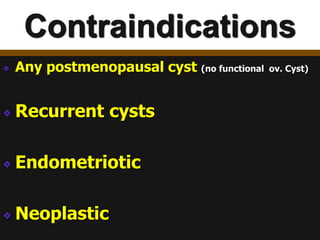
Contraindications
Any postmenopausal cyst (no functional ov. Cyst)
Recurrent cysts
Endometriotic
Neoplastic
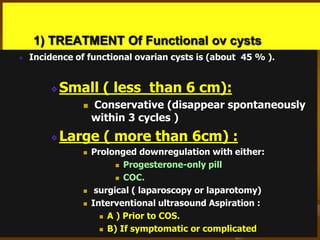
1) TREATMENT Of Functional ov cysts
Incidence of functional ovarian cysts is (about 45 % ).
Small ( less than 6 cm):
 Conservative (disappear spontaneously
within 3 cycles )
Large ( more than 6cm) :
 Prolonged downregulation with either:
 Progesterone-only pill
 COC.
 surgical ( laparoscopy or laparotomy)
 Interventional ultrasound Aspiration :
 A ) Prior to COS.
 B) If symptomatic or complicated
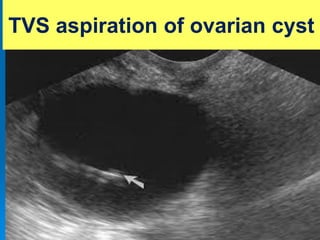
TVS aspiration of ovarian cyst
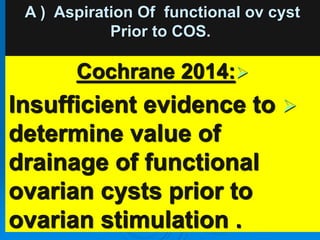
A ) Aspiration Of functional ov cyst
Prior to COS.

Cochrane 2014:

Insufficient evidence to
determine value of
drainage of functional
ovarian cysts prior to
ovarian stimulation .
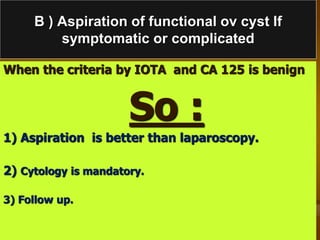
B ) Aspiration of functional ov cyst If
symptomatic or complicated
When the criteria by IOTA and CA 125 is benign
So :
1) Aspiration is better than laparoscopy.
2) Cytology is mandatory.
3) Follow up.
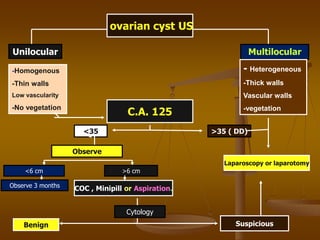
ovarian cyst US
Unilocular Multilocular
-Homogenous
-Thin walls
Low vascularity
-No vegetation
- Heterogeneous
-Thick walls
Vascular walls
-vegetation
C.A. 125
<35 >35 ( DD)
Laparoscopy or laparotomy
Observe
<6 cm >6 cm
Observe 3 months
COC , Minipill or Aspiration.
Cytology
Benign Suspicious
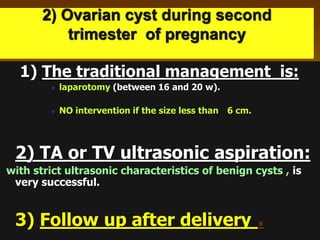
2) Ovarian cyst during second
trimester of pregnancy
1) The traditional management is:
laparotomy (between 16 and 20 w).
NO intervention if the size less than 6 cm.
2) TA or TV ultrasonic aspiration:
with strict ultrasonic characteristics of benign cysts , is
very successful.
3) Follow up after delivery .
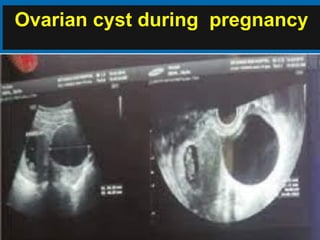
Ovarian cyst during pregnancy
3) Fetal Ovarian cysts
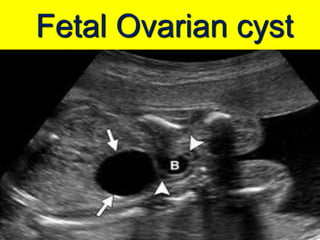
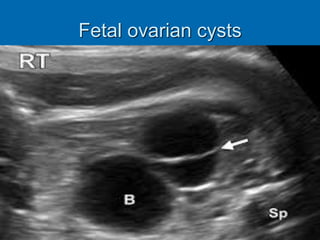
Usually detected during antenatal care & followed after
delivery as neonatal ovarian cyst.
Due to mechanical complications , in
utero aspiration of cysts > 6 cm may
prevent complications .
The safety and efficiency of this
approach , seem encouraging .
Fetal Ovarian cyst
Fetal ovarian cysts
4 ) Retention cysts during GnRH
analogue long protocol
Controversies:
1. Cancel the cycle +OCS.
2. The continuation of the cycle .
3. TVS aspiration.
This indication has regressed with wide
use of antagonist protocols
Advantages Of aspiration of the retention cyst
during long protocol of ICSI.
provide the continuation of the cycle
& minimize cancellation
Improve the follicular recruitment.
Improve the psychology of patient if
cycle is canceled.
Disadvantages of Ovarian Cyst Aspiration
Recurrence.
Inconclusive cytology .
Dissemination (Neoplastic cells).
Need frequent follow up.
Trials to minimize recurrence
GNRH a
Alternatives substances to fluid aspirated :
Methotrexate.
Sclerosing agents (ethanol,
bleomycin…..etc)
Tetracycline
Erythromycin
Conclusion
The correct diagnosis of ovarian cyst
allows conservative treatment &
Avoiding :
unnecessary surgery.
Abuse of aspiration.
conclusion
Following strict criteria to
exclude malignancy as :
TVS & IOTA
C.A. 125
will help in selection of cases for
U.S. guided cyst aspiration
Conclusion

There are 4 indications for
Ovarian cyst aspiration as an
alternative for laparotomy or
laparoscopy, with applications
of precautions to minimize
recurrence & dissemination of Neoplastic
cells.
Practical Message
Remember the number 4
1. Four important DD .
2. Four indications
3. Four contraindications
4. Four disadvantages
Mobile: 002/01223475579
Email. mae335@hotmail.com

Ovarian cyst aspiration

  • 2.
    BY Mohammad Emam Prof. OB&GYN Mansoura Faculty of Medicine Mansoura Integrated Fertility Center 2021 Ultrasonic – guided Ovarian Cyst Aspiration: Role Of Gynecologist
  • 3.
    Definition Of ovariancyst •Is a sac filled with liquid or semiliquid material that arises in an ovary.
  • 4.
    Epidemiology of OvarianCysts? Many types. Different cause. Occur from Fetus to menopause. Majority during reproductive age. Majority are asymptomatic. Can cause serious problems.
  • 7.
    Methods Of ovariancyst Aspiration •Either by: •1 ) Ultrasonic guided. • OR •2) laparoscopy ( Prior to ov. Cystectomy)
  • 8.
    Rationale Wide increase ofovarian cysts aspiration by (GG ) due to its simplicity, short hospital stay and rapid recovery
  • 9.
    To highlight awarenessof Gynecologist regarding: 1. Principles of Diagnosis 2. Principles of management & choice line 3. Interventional (ultrasound – guided Aspiration ): • Indications update • Contraindications • Disadvantages Objective
  • 10.
    Principles of Diagnosis •History & Examination. • Investigations – Tumor markers – CA-125. – Imaging techniques: – TVS – CT – assess LN, pelvic and abdominal structures. – MRI – best for DD malignant from benign . • DD
  • 12.
    DD (common)  PeritonealPseudo cyst ( inclusion cyst) . Para ovarian cysts Hydro salpinx PCOM & Multicystic !!!!!!
  • 13.
    Peritoneal Pseudo cyst(PPCS) Cysts formed by trapping and collection of fluid inside Post inflammatory & Postoperative adhesive pockets of peritoneal cavity.
  • 14.
    PPSC (bizarre lump-shapedcyst) Thin wall • Fine internal septations . • ovary suspended among adhesions. On follow up : Slow growing ( As more fluid is secreted by the ovaries and not reabsorbed by the peritoneum).
  • 15.
    PPCS (Spider WebPattern &Entrapped Ovary)
  • 16.
    PPCS( flapping sailsign). Moving the TV probe gently to document the presence of the ‘flapping sail sign.
  • 17.
    cogwheel appearance Note: nodular mesothelial tissueprojections (straight arrows) Normal ovary and follicles adjacent to peritoneal inclusion cyst (curved arrows).
  • 19.
  • 20.
  • 21.
  • 22.
    PCOM VS. Multicystic Ovaries  PCOM  Multiple cysts(≥12 follicles within the ovary  Cyst diam 2-<10 mm  Stroma increased  Irreversible Multi cystic ovaries – Fewer ( 6- 12) cysts – Cyst diam > 10 mm – Stroma not increased – Reversible
  • 23.
    Principles For Management 1)Establish the type of cyst : • Non neoplastic & Neoplastic . • Benign or malignant. 2) Age (from fetus to Post menopause). 3 ) Presentation 4 ) pregnant or not
  • 24.
    Types Of OvarianCysts Neoplastic 1. Epithelial T 2. Sex cord T 3. Germ cell T. 4. others ( Metastatic….) ( Benign & Malignant) Non Neoplastic Functional 1) Follicular cyst` 2) Corpus luteum cyst 3) Theca lutein cyst Pathological 1) Inflammatory Tubo-ovarian abscess 2) Endometrioma 3) Luteoma Of pregnancy
  • 25.
    Difference Bet.Non-neoplastic (functional) & Neoplastic ( Benign) cysts
  • 26.
    Difference between Benign& Malignant Neoplasm Benign Malignantc Unilateral Bilateral Cystic Solid component Unilocular Multilocular Stable over time Growth No ascites Ascites
  • 27.
    The International OvarianTumor Analysis (IOTA) group ultrasound rules
  • 28.
    11/3/2021 template fromwww.brainybetty.com copyright 2006 28 Primarily Cystic Primarily Solid Mixed 1. Mucinous cystadenoma. 2. Serous cystadenoma. 3. Adenocarcinoma •Fibroma (benign) •Brenner tumor (usually benign) •Granulosa Cell tumor (malignant, produces estrogen) •Thecoma (benign, produces estrogen, occasionally androgens) •Sertoli-Leydig Cell tumors (Generally benign, may produce androgens and/or estrogen) •Dysgerminoma (malignant, but usually good prognosis) •Dermoid (teratoma, usually benign, may produce thyroid hormone). •Clear cell carcinoma •Adneocarcinoma • Endometrioid Carcinoma Ovarian neoplasms (cystic, solid, or mixed).
  • 29.
  • 30.
  • 31.
  • 32.
    Choice Line ofttt :  Conservative  surgery ( laparoscopy & laparotomy). Interventional (ultrasound Aspiration ).
  • 33.
    Indications for Ovarian CystAspiration 1)Some Functional ovarian cysts. 2) During second trimester of pregnancy 3)Ovarian cysts in fetuses. 4) Retention cysts after GnRH analogue during long protocol of ICSI.
  • 34.
    Contraindications Any postmenopausal cyst(no functional ov. Cyst) Recurrent cysts Endometriotic Neoplastic
  • 35.
    1) TREATMENT OfFunctional ov cysts Incidence of functional ovarian cysts is (about 45 % ). Small ( less than 6 cm):  Conservative (disappear spontaneously within 3 cycles ) Large ( more than 6cm) :  Prolonged downregulation with either:  Progesterone-only pill  COC.  surgical ( laparoscopy or laparotomy)  Interventional ultrasound Aspiration :  A ) Prior to COS.  B) If symptomatic or complicated
  • 36.
    TVS aspiration ofovarian cyst
  • 37.
    A ) AspirationOf functional ov cyst Prior to COS.  Cochrane 2014:  Insufficient evidence to determine value of drainage of functional ovarian cysts prior to ovarian stimulation .
  • 38.
    B ) Aspirationof functional ov cyst If symptomatic or complicated When the criteria by IOTA and CA 125 is benign So : 1) Aspiration is better than laparoscopy. 2) Cytology is mandatory. 3) Follow up.
  • 39.
    ovarian cyst US UnilocularMultilocular -Homogenous -Thin walls Low vascularity -No vegetation - Heterogeneous -Thick walls Vascular walls -vegetation C.A. 125 <35 >35 ( DD) Laparoscopy or laparotomy Observe <6 cm >6 cm Observe 3 months COC , Minipill or Aspiration. Cytology Benign Suspicious
  • 40.
    2) Ovarian cystduring second trimester of pregnancy 1) The traditional management is: laparotomy (between 16 and 20 w). NO intervention if the size less than 6 cm. 2) TA or TV ultrasonic aspiration: with strict ultrasonic characteristics of benign cysts , is very successful. 3) Follow up after delivery .
  • 41.
  • 42.
    3) Fetal Ovariancysts Usually detected during antenatal care & followed after delivery as neonatal ovarian cyst. Due to mechanical complications , in utero aspiration of cysts > 6 cm may prevent complications . The safety and efficiency of this approach , seem encouraging .
  • 43.
  • 44.
  • 45.
    4 ) Retentioncysts during GnRH analogue long protocol Controversies: 1. Cancel the cycle +OCS. 2. The continuation of the cycle . 3. TVS aspiration. This indication has regressed with wide use of antagonist protocols
  • 46.
    Advantages Of aspirationof the retention cyst during long protocol of ICSI. provide the continuation of the cycle & minimize cancellation Improve the follicular recruitment. Improve the psychology of patient if cycle is canceled.
  • 47.
    Disadvantages of OvarianCyst Aspiration Recurrence. Inconclusive cytology . Dissemination (Neoplastic cells). Need frequent follow up.
  • 48.
    Trials to minimizerecurrence GNRH a Alternatives substances to fluid aspirated : Methotrexate. Sclerosing agents (ethanol, bleomycin…..etc) Tetracycline Erythromycin
  • 49.
    Conclusion The correct diagnosisof ovarian cyst allows conservative treatment & Avoiding : unnecessary surgery. Abuse of aspiration.
  • 50.
    conclusion Following strict criteriato exclude malignancy as : TVS & IOTA C.A. 125 will help in selection of cases for U.S. guided cyst aspiration
  • 51.
    Conclusion  There are 4indications for Ovarian cyst aspiration as an alternative for laparotomy or laparoscopy, with applications of precautions to minimize recurrence & dissemination of Neoplastic cells.
  • 52.
    Practical Message Remember thenumber 4 1. Four important DD . 2. Four indications 3. Four contraindications 4. Four disadvantages
  • 53.