ACTIVITY 1. CLASSIFY ME!
Primary Sources Secondary
Sources
LESSON II.
Prepared by: Maria Delcielo Bulala
Expanding the Content of
an Outline Using Notes
from Primary and
Secondary sources
OBJECTIVES
At the end of this lesson, students are expected to:
1. Define an outline;
2. Identify the types and the contents of an outline;
and
3. Write a composition using the expanded content
of an outline.
What is an outline?
An outline is a tool used to organize
your written ideas about a topic into a
logical order. Writers use outline when
writing their papers to know which topic to
cover and in what order.
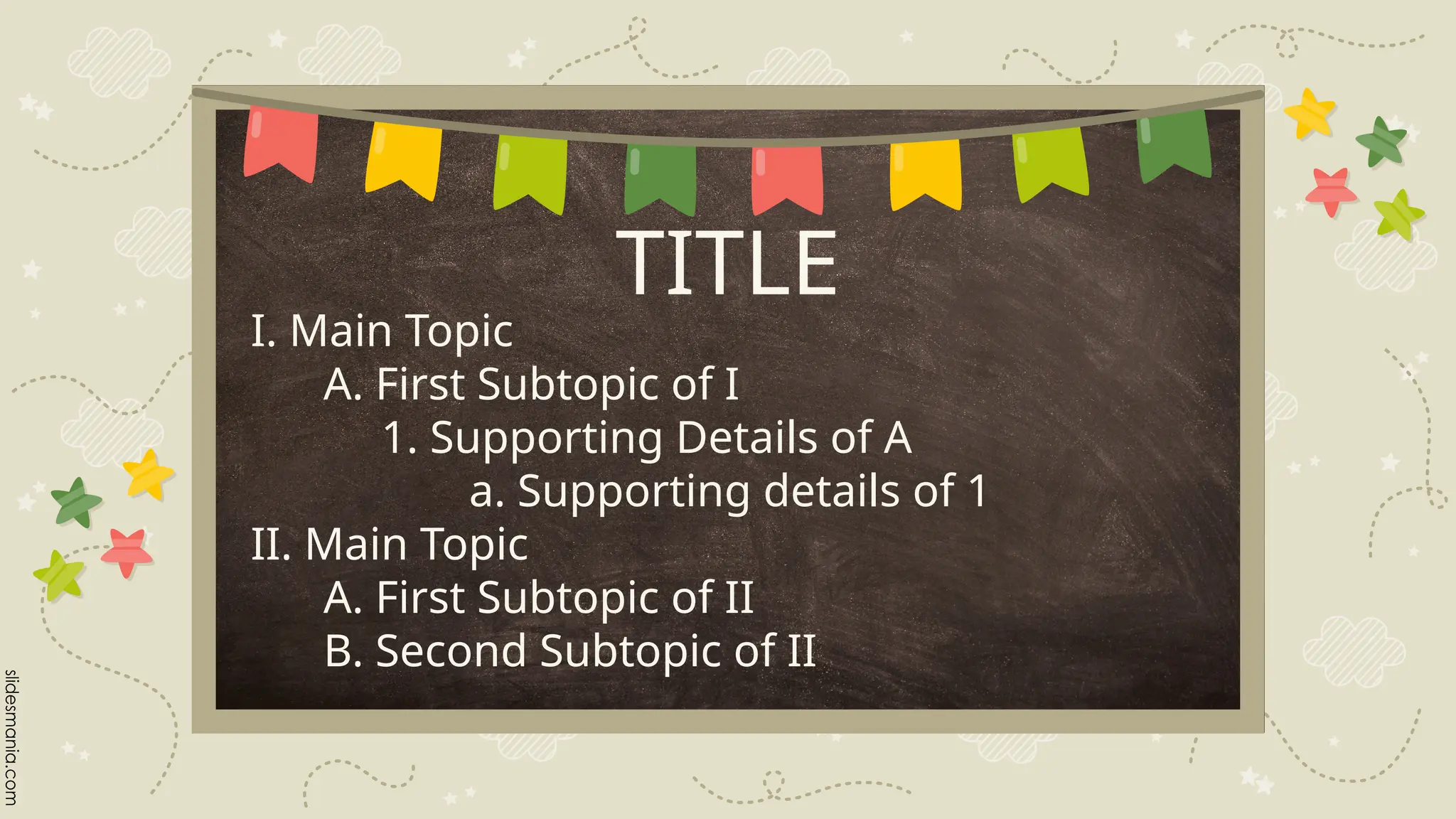
TITLE
I. Main Topic
A. First Subtopic of I
1. Supporting Details of A
a. Supporting details of 1
II. Main Topic
A. First Subtopic of II
B. Second Subtopic of II
TWO TYPES OF OUTLINE
1. Sentence Outline
The type of outline that presents the
thesis statement, major topics, subtopics, and
supporting details in sentence form. It allows
you to include those details in the sentences
instead of having to create an outline of many
short phrases that goes on page after page
Main/Major Topic
Subtopic
Supporting Details
I. Alcohol and drug abuse can affect one
economically.
A. The cost of alcohol abuse is high
and getting higher.
1. The costs of DUIs can be
enormous.
2. Alcohol cost are always rising
because of rising production costs
as well as state and local taxes.
B. The cost of drug abuse can be
high.
1. Even the arrest for the
possession of a minute amount
of drugs can result in high bail and
court cost.
2. The cost of drugs fluctuates
drastically according to the type
of drug, its availability, and the
amount.
Main topics are written with roman
numerals (e.g. I, II, III, IV, etc).
Subtopics are written with capital letter of the
alphabet (e.g. A, B, C, etc.).
Supporting details are written with
numbers (e.g. 1, 2, 3, etc.).
Economical, Psychological, and Physical Effects of Alcohol
and Drug Abuse
Outline
TWO TYPES OF OUTLINE
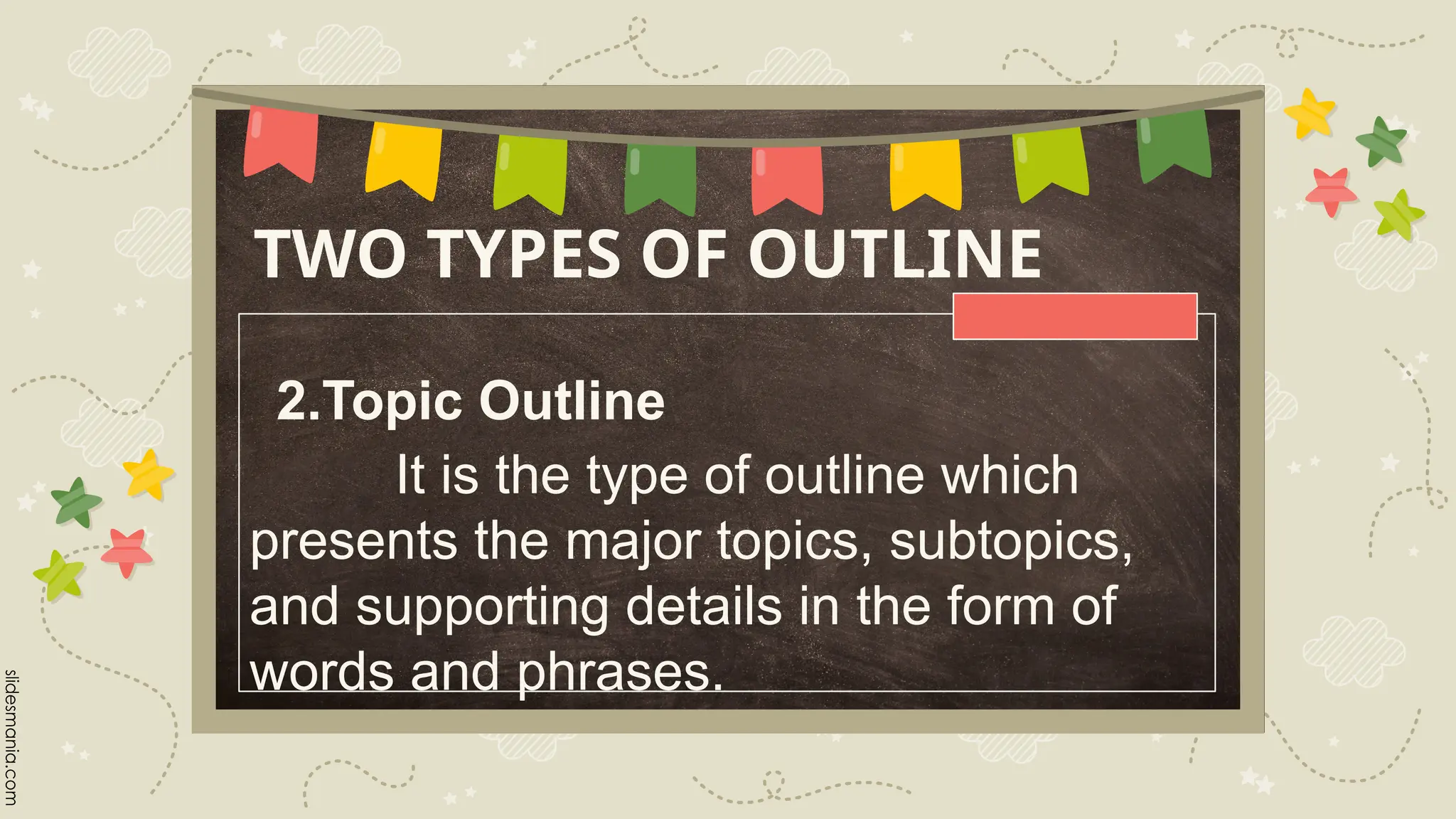
2.Topic Outline
It is the type of outline which
presents the major topics, subtopics,
and supporting details in the form of
words and phrases.
Main/Major Topic
Subtopic
Supporting details
Outline
I. Economical effects
A. Alcohol
1. Cost of alcohol
purchases
2. Cost of DUIs
B. Drugs
1. Cost of drug purchases
2. Cost of drugs arrest
II. Psychological effects
A. Alcohol
1. Mental impairment
2. Mental addiction
B. Drugs
1. Mental impairment
2. Mental Addiction
Major topics are written with roman numerals.
Unlike sentence outline, topic outline could be in a
word or in phrases.
Subtopics are written with alphabet. It could
be word or phrases.
Supporting details are written with numbers.
Economical, Psychological, and Physical Effects of Alcohol
and Drug Abuse
Contents of an Outline
Contents of an Outline Definition
Thesis Statement A thesis statement is one-sentence statement that
expresses the main idea of an essay.
Major topics Major topics refer to the major phrases/sentences which
are formed from the thesis statement.
Subtopics Subtopics refer to the minor phrases/sentences which
are formed from the thesis statement.
Supporting details Supporting details are phrases/sentences which provide
additional information to clarify or prove the main idea.
These details help you explain further the ideas
presented by the major topics and subtopics.
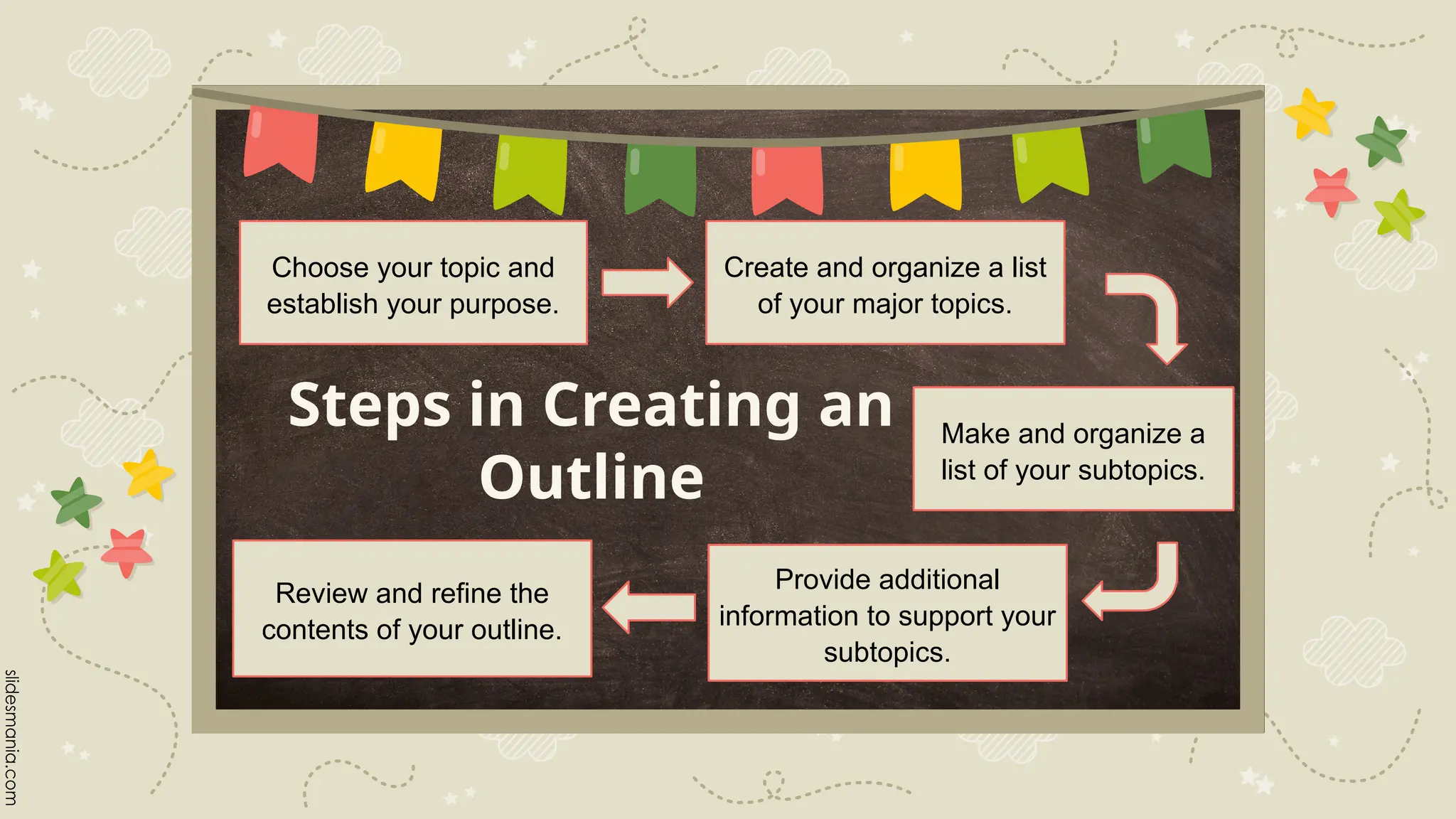
Steps in Creating an
Outline
Choose your topic and
establish your purpose.
Create and organize a list
of your major topics.
Make and organize a
list of your subtopics.
Provide additional
information to support your
subtopics.
Review and refine the
contents of your outline.
PRIMARY SOURCES
These are firsthand information taken
from original evidences such as reports on
discoveries and events and interviews from
persons in authority.
PRIMARY SOURCES
Examples of Primary Sources
Interview
Survey
Persons of Authority
Dairy
Memoirs
Autobiography
Original documents
Letters
Creative Artworks
Literature
Opinion pieces
Trial records
Speeches
Government
Documents
Birth Certificate
SECONDARY SOURCES
These are the secondhand information
taken from the primary sources. It gives
secondhand observation and details from
other researchers.
SECONDARY SOURCES
Examples of Secondary Sources
Journal Articles
Textbooks
Dictionaries
Encyclopedia
Political Commentary
Dissertations
Thesis
Biographies
Newspapers editorial
Literary Analysis
Music
Art works
Books that interprets
Books that analyze
Review
Activity 2. Complete Me!
Directions: Copy the graphic organizer on a
separate sheet of paper and fill in the blanks
with appropriate concepts and definitions.
Choose your answer from the Pool of Concepts
provided.
Lesson 2- Outline- primary and secondary

Lesson 2- Outline- primary and secondary

  • 1.
    ACTIVITY 1. CLASSIFYME! Primary Sources Secondary Sources
  • 2.
    LESSON II. Prepared by:Maria Delcielo Bulala Expanding the Content of an Outline Using Notes from Primary and Secondary sources
  • 3.
    OBJECTIVES At the endof this lesson, students are expected to: 1. Define an outline; 2. Identify the types and the contents of an outline; and 3. Write a composition using the expanded content of an outline.
  • 4.
    What is anoutline? An outline is a tool used to organize your written ideas about a topic into a logical order. Writers use outline when writing their papers to know which topic to cover and in what order.
  • 5.
    TITLE I. Main Topic A.First Subtopic of I 1. Supporting Details of A a. Supporting details of 1 II. Main Topic A. First Subtopic of II B. Second Subtopic of II
  • 6.
    TWO TYPES OFOUTLINE 1. Sentence Outline The type of outline that presents the thesis statement, major topics, subtopics, and supporting details in sentence form. It allows you to include those details in the sentences instead of having to create an outline of many short phrases that goes on page after page
  • 7.
    Main/Major Topic Subtopic Supporting Details I.Alcohol and drug abuse can affect one economically. A. The cost of alcohol abuse is high and getting higher. 1. The costs of DUIs can be enormous. 2. Alcohol cost are always rising because of rising production costs as well as state and local taxes. B. The cost of drug abuse can be high. 1. Even the arrest for the possession of a minute amount of drugs can result in high bail and court cost. 2. The cost of drugs fluctuates drastically according to the type of drug, its availability, and the amount. Main topics are written with roman numerals (e.g. I, II, III, IV, etc). Subtopics are written with capital letter of the alphabet (e.g. A, B, C, etc.). Supporting details are written with numbers (e.g. 1, 2, 3, etc.). Economical, Psychological, and Physical Effects of Alcohol and Drug Abuse Outline
  • 8.
    TWO TYPES OFOUTLINE 2.Topic Outline It is the type of outline which presents the major topics, subtopics, and supporting details in the form of words and phrases.
  • 9.
    Main/Major Topic Subtopic Supporting details Outline I.Economical effects A. Alcohol 1. Cost of alcohol purchases 2. Cost of DUIs B. Drugs 1. Cost of drug purchases 2. Cost of drugs arrest II. Psychological effects A. Alcohol 1. Mental impairment 2. Mental addiction B. Drugs 1. Mental impairment 2. Mental Addiction Major topics are written with roman numerals. Unlike sentence outline, topic outline could be in a word or in phrases. Subtopics are written with alphabet. It could be word or phrases. Supporting details are written with numbers. Economical, Psychological, and Physical Effects of Alcohol and Drug Abuse
  • 10.
    Contents of anOutline Contents of an Outline Definition Thesis Statement A thesis statement is one-sentence statement that expresses the main idea of an essay. Major topics Major topics refer to the major phrases/sentences which are formed from the thesis statement. Subtopics Subtopics refer to the minor phrases/sentences which are formed from the thesis statement. Supporting details Supporting details are phrases/sentences which provide additional information to clarify or prove the main idea. These details help you explain further the ideas presented by the major topics and subtopics.
  • 11.
    Steps in Creatingan Outline Choose your topic and establish your purpose. Create and organize a list of your major topics. Make and organize a list of your subtopics. Provide additional information to support your subtopics. Review and refine the contents of your outline.
  • 12.
    PRIMARY SOURCES These arefirsthand information taken from original evidences such as reports on discoveries and events and interviews from persons in authority.
  • 13.
    PRIMARY SOURCES Examples ofPrimary Sources Interview Survey Persons of Authority Dairy Memoirs Autobiography Original documents Letters Creative Artworks Literature Opinion pieces Trial records Speeches Government Documents Birth Certificate
  • 14.
    SECONDARY SOURCES These arethe secondhand information taken from the primary sources. It gives secondhand observation and details from other researchers.
  • 15.
    SECONDARY SOURCES Examples ofSecondary Sources Journal Articles Textbooks Dictionaries Encyclopedia Political Commentary Dissertations Thesis Biographies Newspapers editorial Literary Analysis Music Art works Books that interprets Books that analyze Review
  • 16.
    Activity 2. CompleteMe! Directions: Copy the graphic organizer on a separate sheet of paper and fill in the blanks with appropriate concepts and definitions. Choose your answer from the Pool of Concepts provided.