

Lesson Nine Example Text I
I will collect the following: First Draft Rough Outline Include you thesis statement at the top of your paper. Also,  label  your assignments at the top of the page or mark the page. Ne x t Week
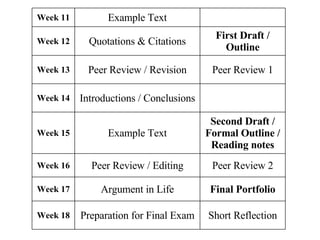
Short Reflection Preparation for Final Exam Week 18 Final Portfolio Argument in Life Week 17 Peer Review 2 Peer Review / Editing Week 16 Second Draft / Formal Outline / Reading notes Example Text Week 15   Introductions / Conclusions Week 14 Peer Review 1 Peer Review / Revision Week 13 First Draft / Outline Quotations & Citations Week 12   Example Text Week 11
Your portfolio will count as your  midterm . 10% Participation 20% Portfolio 70% Final Exam Grad i ng
Although we will be looking at many writing skills, we will pay special attention to how the writer develops her ideas by using body paragraphs. Today’s  O bjective
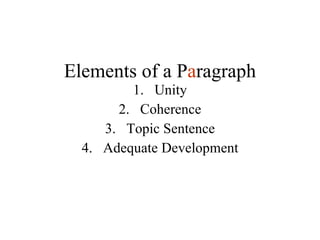
Elements of a P a ragraph Unity Coherence Topic Sentence Adequate Development
Argum e ntative Body Paragr a phs Supporting evidence (think: courtroom) Valleys and mountains (think: tour guide)
Methods  o f Guiding Methods of using supporting evidence and guiding your reader through the valleys and hilltops: Exposition Interpretation Signposts
Methods of G u iding Exposition: “ Discourse designed to convey information or explain what is difficult to understand.” facts / individual bits / evidence
M e thods of Guiding Interpretation: “ To explain or tell the meaning of something.” inductive / deductive reasoning
Methods of Gu i ding Signposts Signposts are internal aids to assist readers; they usually consist of several sentences or a paragraph outlining what the article has covered and where the article will be going.
E x position The most important material for exposition is source material.  How do we effectively incorporate source material into our body paragraphs?
Using Sour c es Use your sources as support for your insights, not as the backbone of your paper.
Using Sourc e s 2.  Summarize  (condense a text by stating the main ideas in your own words) and  paraphrase  (say the same thing in a different way) much more often than you use direct quotes (same words as the original, in quotation marks).
U s ing Sources 3.  Don't use direct quotes as fillers but because the author says something so aptly or dramatically that a paraphrase would lose that power. Or, if you're analyzing the language of a passage.
Usi n g Sources 4. Explain direct quotes. Readers have to know  why  you include source material where you do.
Using Sourc e s 5. If multiple sources say the same thing, summarize what they say and put a few key names in brackets at the end of the sentence.
U s ing Sources 6. When you do use direct quotes, the most fluid way to integrate them is to incorporate key words right into your text.  Example "We can see this change when Othello calls his wife a 'strumpet' (4.2.81) . . . ."
7. Don't summarize plots of primary sources. Assume your audience has read the work. Only explain as much as you need in order to establish context for an example.  Usin g  Sources
Computer Assist e d Instruction: Blessing or Bane? By Susan Sexton 1987
Subject:  Computer Assisted Instruction  Purpose:  Argumentative / Informative Audience:  Teachers / Parents Writ i ng Triangle
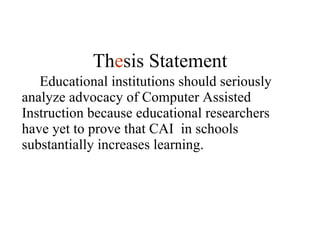
Educational institutions should seriously analyze advocacy of Computer Assisted Instruction because educational researchers have yet to prove that CAI  in schools substantially increases learning. Th e sis Statement
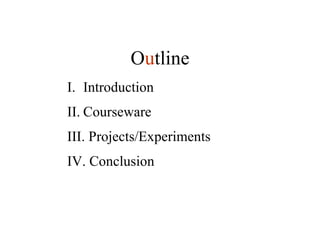
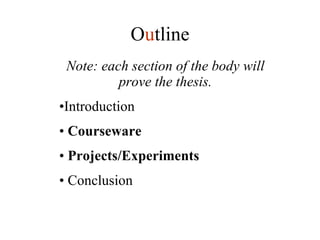
Introduction Courseware Projects/Experiments Conclusion O u tline
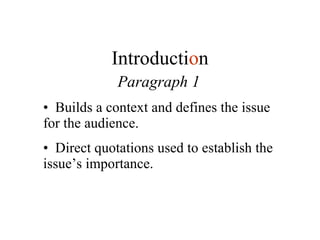
Paragraph 1 Builds a context and defines the issue for the audience. Direct quotations used to establish the issue’s importance. Introducti o n
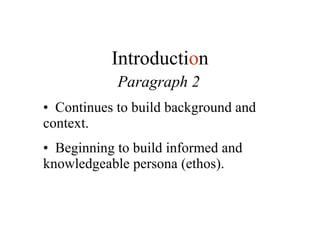
Paragraph 2 Continues to build background and context. Beginning to build informed and knowledgeable persona (ethos). Introducti o n
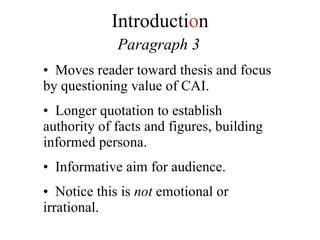
Paragraph 3 Moves reader toward thesis and focus by questioning value of CAI. Longer quotation to establish authority of facts and figures, building informed persona. Informative aim for audience. Notice this is  not  emotional or irrational. Introducti o n
Paragraph 4 Focuses the thesis statement even more.  Notice the thesis is not  entirely  explicitly stated or connected. Thesis/focus comes at the end of the introduction. Introducti o n
Educational institutions should seriously analyze advocacy of Computer Assisted Instruction because educational researchers have yet to prove that CAI  in schools substantially increases learning. Th e sis Statement
Note: each section of the body will prove the thesis. Introduction Courseware Projects/Experiments Conclusion O u tline
The following section on  courseware  will prove, according to the focus stated earlier in the introduction, that CAI may work, but only in ideal circumstances with ideal students . O u tline
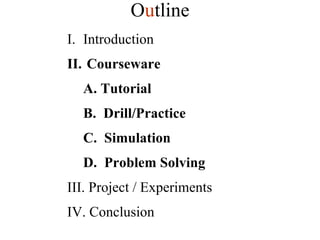
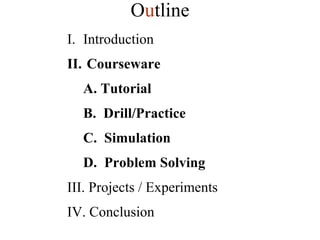
Introduction Courseware A. Tutorial B.  Drill/Practice C.  Simulation D.  Problem Solving III. Project / Experiments IV. Conclusion O u tline
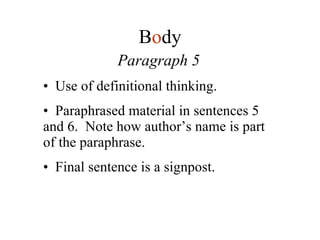
Paragraph 5 Use of definitional thinking. Paraphrased material in sentences 5 and 6.  Note how author’s name is part of the paraphrase. Final sentence is a signpost. B o dy
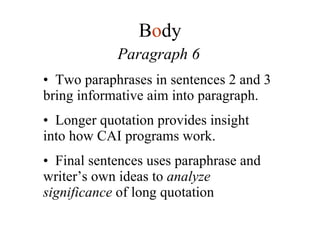
Paragraph 6 Two paraphrases in sentences 2 and 3 bring informative aim into paragraph. Longer quotation provides insight into how CAI programs work. Final sentences uses paraphrase and writer’s own ideas to  analyze significance  of long quotation B o dy
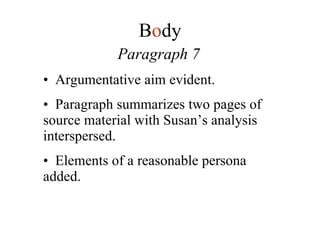
Paragraph 7 Argumentative aim evident. Paragraph summarizes two pages of source material with Susan’s analysis interspersed. Elements of a reasonable persona added. B o dy
Introduction Courseware A. Tutorial B.  Drill/Practice C.  Simulation D.  Problem Solving III. Projects / Experiments IV. Conclusion O u tline
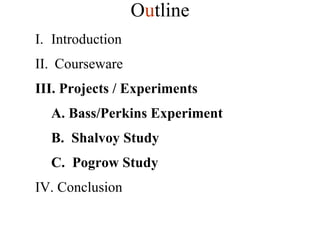
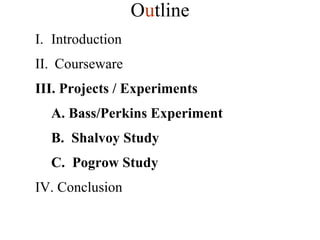
Introduction Courseware III.   Projects / Experiments A. Bass/Perkins Experiment B.  Shalvoy Study C.  Pogrow Study IV. Conclusion O u tline
Educational institutions should seriously analyze advocacy of Computer Assisted Instruction because educational researchers have yet to prove that CAI  in schools substantially increases learning. Th e sis Statement
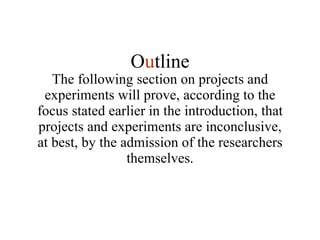
The following section on projects and experiments will prove, according to the focus stated earlier in the introduction, that projects and experiments are inconclusive, at best, by the admission of the researchers themselves. O u tline
Paragraph 8 Purely transitional paragraph, allowing the writer to shift the essay’s focus from types of CAI programs to the effects CAI has on “higher-order” thinking skills. A clear, precise summary of ideas creates a persona reflecting intelligence and reasonable objectivity. B o dy
Paragraph 9 A strongly argumentative paragraph, for the necessity of these “higher-order” thinking skills. Quotations used to define and analyze this need. B o dy
Paragraph 10 Argumentative aim again strongly present as the writer seeks to show weakness in how scholarly research on CAI has been used. Fourth sentence begins a summary that builds a context so that audience can understand the material in question. Quotation is obviously necessary because of the complexity of the material. B o dy
Paragraph 11 The paraphrase that opens the paragraph analyzes the previous quotation with a keen argumentative edge taken from Bass and Perkins’ own study. The writer uses researchers’ own admission of weakness to support her argument through a key, but telling, direct quotation. B o dy
Introduction Courseware III.   Projects / Experiments A. Bass/Perkins Experiment B.  Shalvoy Study C.  Pogrow Study IV. Conclusion O u tline
Draws together separate threads of the writer’s argument clearly and precisely. Concludes the essay with  implications  that both teachers and parents should consider. Persona appears concerned and intelligent. Concl u sion
I will collect the following: First Draft Rough Outline Include you thesis statement at the top of your paper. Also,  label  your assignments at the top of the page or mark the page. Ne x t Week

Lesson 9: Example Text I

  • 1.
  • 2.
    I will collectthe following: First Draft Rough Outline Include you thesis statement at the top of your paper. Also, label your assignments at the top of the page or mark the page. Ne x t Week
  • 3.
    Short Reflection Preparationfor Final Exam Week 18 Final Portfolio Argument in Life Week 17 Peer Review 2 Peer Review / Editing Week 16 Second Draft / Formal Outline / Reading notes Example Text Week 15   Introductions / Conclusions Week 14 Peer Review 1 Peer Review / Revision Week 13 First Draft / Outline Quotations & Citations Week 12   Example Text Week 11
  • 4.
    Your portfolio willcount as your midterm . 10% Participation 20% Portfolio 70% Final Exam Grad i ng
  • 5.
    Although we willbe looking at many writing skills, we will pay special attention to how the writer develops her ideas by using body paragraphs. Today’s O bjective
  • 6.
    Elements of aP a ragraph Unity Coherence Topic Sentence Adequate Development
  • 7.
    Argum e ntativeBody Paragr a phs Supporting evidence (think: courtroom) Valleys and mountains (think: tour guide)
  • 8.
    Methods of Guiding Methods of using supporting evidence and guiding your reader through the valleys and hilltops: Exposition Interpretation Signposts
  • 9.
    Methods of Gu iding Exposition: “ Discourse designed to convey information or explain what is difficult to understand.” facts / individual bits / evidence
  • 10.
    M e thodsof Guiding Interpretation: “ To explain or tell the meaning of something.” inductive / deductive reasoning
  • 11.
    Methods of Gui ding Signposts Signposts are internal aids to assist readers; they usually consist of several sentences or a paragraph outlining what the article has covered and where the article will be going.
  • 12.
    E x positionThe most important material for exposition is source material. How do we effectively incorporate source material into our body paragraphs?
  • 13.
    Using Sour ces Use your sources as support for your insights, not as the backbone of your paper.
  • 14.
    Using Sourc es 2. Summarize (condense a text by stating the main ideas in your own words) and paraphrase (say the same thing in a different way) much more often than you use direct quotes (same words as the original, in quotation marks).
  • 15.
    U s ingSources 3. Don't use direct quotes as fillers but because the author says something so aptly or dramatically that a paraphrase would lose that power. Or, if you're analyzing the language of a passage.
  • 16.
    Usi n gSources 4. Explain direct quotes. Readers have to know why you include source material where you do.
  • 17.
    Using Sourc es 5. If multiple sources say the same thing, summarize what they say and put a few key names in brackets at the end of the sentence.
  • 18.
    U s ingSources 6. When you do use direct quotes, the most fluid way to integrate them is to incorporate key words right into your text. Example "We can see this change when Othello calls his wife a 'strumpet' (4.2.81) . . . ."
  • 19.
    7. Don't summarizeplots of primary sources. Assume your audience has read the work. Only explain as much as you need in order to establish context for an example. Usin g Sources
  • 20.
    Computer Assist ed Instruction: Blessing or Bane? By Susan Sexton 1987
  • 21.
    Subject: ComputerAssisted Instruction Purpose: Argumentative / Informative Audience: Teachers / Parents Writ i ng Triangle
  • 22.
    Educational institutions shouldseriously analyze advocacy of Computer Assisted Instruction because educational researchers have yet to prove that CAI in schools substantially increases learning. Th e sis Statement
  • 23.
  • 24.
    Paragraph 1 Buildsa context and defines the issue for the audience. Direct quotations used to establish the issue’s importance. Introducti o n
  • 25.
    Paragraph 2 Continuesto build background and context. Beginning to build informed and knowledgeable persona (ethos). Introducti o n
  • 26.
    Paragraph 3 Movesreader toward thesis and focus by questioning value of CAI. Longer quotation to establish authority of facts and figures, building informed persona. Informative aim for audience. Notice this is not emotional or irrational. Introducti o n
  • 27.
    Paragraph 4 Focusesthe thesis statement even more. Notice the thesis is not entirely explicitly stated or connected. Thesis/focus comes at the end of the introduction. Introducti o n
  • 28.
    Educational institutions shouldseriously analyze advocacy of Computer Assisted Instruction because educational researchers have yet to prove that CAI in schools substantially increases learning. Th e sis Statement
  • 29.
    Note: each sectionof the body will prove the thesis. Introduction Courseware Projects/Experiments Conclusion O u tline
  • 30.
    The following sectionon courseware will prove, according to the focus stated earlier in the introduction, that CAI may work, but only in ideal circumstances with ideal students . O u tline
  • 31.
    Introduction Courseware A.Tutorial B. Drill/Practice C. Simulation D. Problem Solving III. Project / Experiments IV. Conclusion O u tline
  • 32.
    Paragraph 5 Useof definitional thinking. Paraphrased material in sentences 5 and 6. Note how author’s name is part of the paraphrase. Final sentence is a signpost. B o dy
  • 33.
    Paragraph 6 Twoparaphrases in sentences 2 and 3 bring informative aim into paragraph. Longer quotation provides insight into how CAI programs work. Final sentences uses paraphrase and writer’s own ideas to analyze significance of long quotation B o dy
  • 34.
    Paragraph 7 Argumentativeaim evident. Paragraph summarizes two pages of source material with Susan’s analysis interspersed. Elements of a reasonable persona added. B o dy
  • 35.
    Introduction Courseware A.Tutorial B. Drill/Practice C. Simulation D. Problem Solving III. Projects / Experiments IV. Conclusion O u tline
  • 36.
    Introduction Courseware III. Projects / Experiments A. Bass/Perkins Experiment B. Shalvoy Study C. Pogrow Study IV. Conclusion O u tline
  • 37.
    Educational institutions shouldseriously analyze advocacy of Computer Assisted Instruction because educational researchers have yet to prove that CAI in schools substantially increases learning. Th e sis Statement
  • 38.
    The following sectionon projects and experiments will prove, according to the focus stated earlier in the introduction, that projects and experiments are inconclusive, at best, by the admission of the researchers themselves. O u tline
  • 39.
    Paragraph 8 Purelytransitional paragraph, allowing the writer to shift the essay’s focus from types of CAI programs to the effects CAI has on “higher-order” thinking skills. A clear, precise summary of ideas creates a persona reflecting intelligence and reasonable objectivity. B o dy
  • 40.
    Paragraph 9 Astrongly argumentative paragraph, for the necessity of these “higher-order” thinking skills. Quotations used to define and analyze this need. B o dy
  • 41.
    Paragraph 10 Argumentativeaim again strongly present as the writer seeks to show weakness in how scholarly research on CAI has been used. Fourth sentence begins a summary that builds a context so that audience can understand the material in question. Quotation is obviously necessary because of the complexity of the material. B o dy
  • 42.
    Paragraph 11 Theparaphrase that opens the paragraph analyzes the previous quotation with a keen argumentative edge taken from Bass and Perkins’ own study. The writer uses researchers’ own admission of weakness to support her argument through a key, but telling, direct quotation. B o dy
  • 43.
    Introduction Courseware III. Projects / Experiments A. Bass/Perkins Experiment B. Shalvoy Study C. Pogrow Study IV. Conclusion O u tline
  • 44.
    Draws together separatethreads of the writer’s argument clearly and precisely. Concludes the essay with implications that both teachers and parents should consider. Persona appears concerned and intelligent. Concl u sion
  • 45.
    I will collectthe following: First Draft Rough Outline Include you thesis statement at the top of your paper. Also, label your assignments at the top of the page or mark the page. Ne x t Week