Outcome Based Education (OBE) Philosophy
Dr. Mahendra Chinthala
Assistant Professor
Department of Chemical Engineering
NIT Rourkela
• Outcome-based education (OBE) is an educational philosophy that focuses on achieving
specific, measurable outcomes or goals rather than simply covering content or following a
prescribed curriculum.
• The primary idea behind OBE is that all students should achieve predefined outcomes or
competencies by the end of a course or program, ensuring that they are prepared for real-
world challenges and have the necessary skills to succeed in life and their careers.
• OBE is student centered instruction that focuses on measuring student performance i.e.
outcomes
• Outcomes include;
 Knowledge
 Skills
 Attitude
What is Outcome-based Education (OBE) ?
Why Outcome-based Education (OBE) ?
• Technical institutions have traditionally followed a system of teaching
where the learning outcomes of students are not always clearly defined or
measured.
• To ensure quality assurance in engineering programs, it is essential to
establish a standardized approach.
• The Washington Accord highlights the importance of outcome-based
education.
• Graduating engineers must be assessed not only on their knowledge but
also on their perspectives and experiences, preparing them for global
opportunities.
• Therefore, it is both a necessity and a challenge for technical institutions to
equip and empower future students to thrive in a global environment.
Key Principles of Outcome-Based Education:
Clear Learning Outcomes:
• In OBE, the educational goals are clearly defined from the start. These
outcomes are usually specific, measurable, achievable, and time-bound
(SMART).
• They focus on what students are expected to know, be able to do, or
demonstrate by the end of the learning process.
Focus on Student Achievement:
• The emphasis is on student learning rather than teaching.
• Success is determined by how well students meet the defined learning
outcomes.
Flexibility in Teaching Methods:
• OBE allows educators to choose various teaching methods, materials, and
resources to support students in achieving the desired outcomes.
• It recognizes that different students may learn in different ways, so
flexibility is encouraged in how teaching is delivered.
Assessment based on Outcomes:
• Assessments in an OBE system are designed to measure how well students
have met the learning outcomes.
• These assessments can take various forms, such as exams, projects,
presentations, or practical applications, and they should align with the
outcomes.
Accountability and Transparency:
• In OBE, both teachers and students are held accountable for achieving the
outcomes. Teachers are responsible for creating learning environments
that enable student success, while students are responsible for their
learning and performance.
• The outcomes should be transparent to students at the beginning,
providing them with a clear understanding of what is expected.
Continuous Improvement:
• The OBE philosophy encourages a feedback loop where educational
programs are regularly evaluated and adjusted based on how well students
are meeting the outcomes.
• This allows for improvements in both curriculum and teaching methods,
making the educational experience more effective over time.
Challenges and Criticisms:
Overemphasis on Measurement: Some critics argue that focusing too
much on measurable outcomes can lead to "teaching to the test" and
undermine creativity or critical thinking.
Rigidity in Standards: Setting strict outcomes can limit flexibility in
addressing the unique needs or interests of students.
Implementation Complexity: Developing and continuously adjusting
appropriate assessment tools and outcomes can be time-consuming and
challenging for educators.
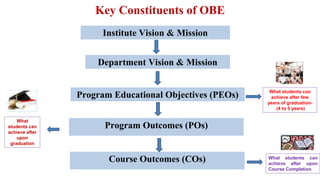
Institute Vision & Mission
Department Vision & Mission
Program Educational Objectives (PEOs)
Program Outcomes (POs)
Course Outcomes (COs)
Key Constituents of OBE
What students can
achieve after few
years of graduation-
(4 to 5 years)
What
students can
achieve after
upon
graduation
What students can
achieve after upon
Course Completion
Program Outcomes (POs)
1. Engineering knowledge: Apply the knowledge of mathematics, science, engineering fundamentals, and
engineering concepts to the solution of complex engineering problems.
2. Problem analysis: Identify, formulate, review research literature, and analyze complex engineering
problems reaching substantiated conclusions using first principles of mathematics, natural sciences, and
engineering sciences.
3. Design/development of solutions: Design and development of processes and equipment design considering
the public health and safety, and the cultural, societal, and environmental concerns.
4. Conduct investigations of complex problems: Use research-based knowledge and research methods
including design of experiments, analysis and interpretation of data, and synthesis of the information to
provide valid conclusions.
5. Modern tool usage: Create, select, and apply appropriate techniques, resources, and modern
engineering and IT tools including prediction and modeling to complex engineering activities with an
understanding of the limitations.
6. The engineer and society: Apply reasoning informed by the contextual knowledge to assess societal, health,
safety, legal and cultural issues and the consequent responsibilities relevant to the professional engineering
practice.
7. Environment and sustainability: Understand the impact of the professional engineering solutions in societal
and environmental contexts, and demonstrate the knowledge of, and need for sustainable development.
8. Ethics: Apply ethical principles and commit to professional ethics and responsibilities and norms of the
engineering practice
9. Individual and team work: Function effectively as an individual, and as a member or leader in diverse teams,
and in multidisciplinary settings.
10.Communication: Communicate effectively on complex engineering activities with the engineering
community and with society at large, such as, being able to comprehend and write effective reports and design
documentation, make effective presentations, and give and receive clear instructions.
11. Project management and finance: Demonstrate knowledge and understanding of the engineering and
management principles and apply these to one’s own work, as a member and leader in a team, to manage
projects and in multidisciplinary environments.
12. Life-long learning: Recognize the need for, and have the preparation and ability to engage in
independent and life-long learning in the broadest context of technological change.
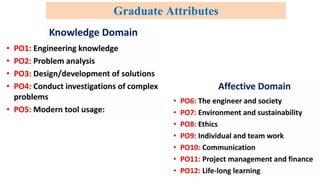
Graduate Attributes
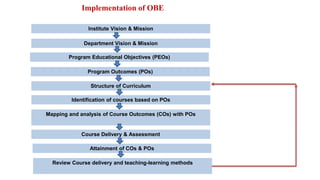
Institute Vision & Mission
Department Vision & Mission
Program Educational Objectives (PEOs)
Program Outcomes (POs)
Structure of Curriculum
Identification of courses based on POs
Mapping and analysis of Course Outcomes (COs) with POs
Course Delivery & Assessment
Attainment of COs & POs
Review Course delivery and teaching-learning methods
Implementation of OBE
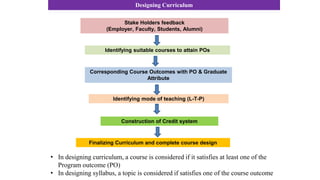
Stake Holders feedback
(Employer, Faculty, Students, Alumni)
Identifying suitable courses to attain POs
Corresponding Course Outcomes with PO & Graduate
Attribute
Identifying mode of teaching (L-T-P)
Construction of Credit system
Finalizing Curriculum and complete course design
• In designing curriculum, a course is considered if it satisfies at least one of the
Program outcome (PO)
• In designing syllabus, a topic is considered if satisfies one of the course outcome
Designing Curriculum
What is COURSE OUTCOME?
• Course Outcomes (COs) state what a student, on successfully completing the course and
earning a pass grade and the credit can perform/do/demonstrate with what he/she has
learnt in the course.
• Note that the emphasis is on using/applying the knowledge imparted/acquired by a
successful student in the course and not on the knowledge per se.
• Let us see OBE as a system – for design, implementation and continuous improvement
of technical education at the degree level
• COs are central to OBE
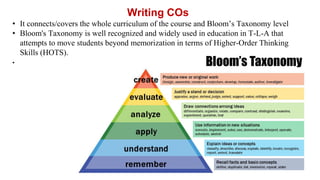
Writing COs
• It connects/covers the whole curriculum of the course and Bloom’s Taxonomy level
• Bloom's Taxonomy is well recognized and widely used in education in T-L-A that
attempts to move students beyond memorization in terms of Higher-Order Thinking
Skills (HOTS).
•
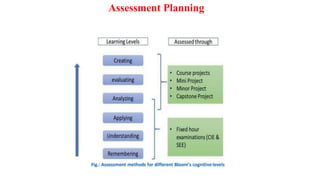
Assessment Planning
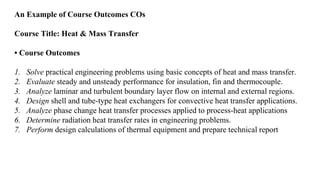
An Example of Course Outcomes COs
Course Title: Heat & Mass Transfer
• Course Outcomes
1. Solve practical engineering problems using basic concepts of heat and mass transfer.
2. Evaluate steady and unsteady performance for insulation, fin and thermocouple.
3. Analyze laminar and turbulent boundary layer flow on internal and external regions.
4. Design shell and tube-type heat exchangers for convective heat transfer applications.
5. Analyze phase change heat transfer processes applied to process-heat applications
6. Determine radiation heat transfer rates in engineering problems.
7. Perform design calculations of thermal equipment and prepare technical report
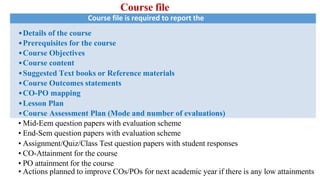
Course file
Course file is required to report the
•Details of the course
•Prerequisites for the course
•Course Objectives
•Course content
•Suggested Text books or Reference materials
•Course Outcomes statements
•CO-PO mapping
•Lesson Plan
•Course Assessment Plan (Mode and number of evaluations)
• Mid-Eem question papers with evaluation scheme
• End-Sem question papers with evaluation scheme
• Assignment/Quiz/Class Test question papers with student responses
• CO-Attainment for the course
• PO attainment for the course
• Actions planned to improve COs/POs for next academic year if there is any low attainments
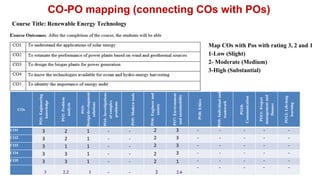
CO-PO mapping (connecting COs with POs)
COs
PO1:
Engineering
knowledge
PO2:
Problem
analysis
PO3:
Design/development
solutions
PO4:
Investigations
of
complex
problems
PO5:
Modern
tools
PO6:
Engineer
and
society
PO7:
Environment
and
sustainability
PO8:
Ethics
PO9:
Individual
and
teamwork
PO10:
Communication
PO11:
Project
management
and
finance
PO12:
Life-long
learning
CO1 3 2 1 - - 2 3 - - - - -
CO2 3 2 1 - - 2 3 - - - - -
CO3 3 1 1 - - 2 3 - - - - -
CO4 3 3 1 - - 2 3 - - - - -
CO5 3 3 1 - - 2 1 - - - - -
3 2.2 1 - - 2 2.6
- - - - -
Course Title: Renewable Energy Technology
Map COs with Pos with rating 3, 2 and 1
1-Low (Slight)
2- Moderate (Medium)
3-High (Substantial)
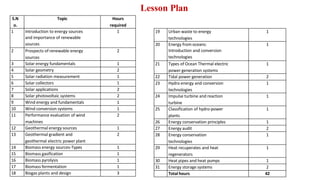
S.N
o.
Topic Hours
required
1 Introduction to energy sources
and importance of renewable
sources
1
2 Prospects of renewable energy
sources
2
3 Solar energy fundamentals 1
4 Solar geometry 2
5 Solar radiation measurement 1
6 Solar collectors 1
7 Solar applications 2
8 Solar photovoltaic systems 2
9 Wind energy and fundamentals 1
10 Wind conversion systems 1
11 Performance evaluation of wind
machines
2
12 Geothermal energy sources 1
13 Geothermal gradient and
geothermal electric power plant
2
14 Biomass energy sources-Types 1
15 Biomass gasification 1
16 Biomass pyrolysis 1
17 Biomass fermentation 1
18 Biogas plants and design 3
Lesson Plan
19 Urban waste to energy
technologies
1
20 Energy from oceans:
Introduction and conversion
technologies
1
21 Types of Ocean Thermal electric
power generation systems
1
22 Tidal power generation 2
23 Hydro energy and conversion
technologies
1
24 Impulse turbine and reaction
turbine
1
25 Classification of hydro-power
plants
1
26 Energy conservation principles 1
27 Energy audit 2
28 Energy conservation
technologies
1
29 Heat recuperates and heat
regenerators
1
30 Heat pipes and heat pumps 1
31 Energy storage systems 2
Total hours 42
What Max
Marks
Proof COs addressed
Direct
Assessment
Methods
Mid-Exam 30 Answer sheets 1,2,3
SEM End
Examination
50 Answer sheets 1,2,3,4,5
Teacher
Assessment
( TA)
20 Assignment
copies
1,2,3,4,5
Indirect
Assessment
Methods
Course End
survey
Questionnaire 1,2,3,4,5
Course Assessment Tools
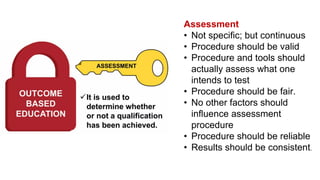
Assessment
• Not specific; but continuous
• Procedure should be valid
• Procedure and tools should
actually assess what one
intends to test
• Procedure should be fair.
• No other factors should
influence assessment
procedure
• Procedure should be reliable
• Results should be consistent.
CO attainment Calculation
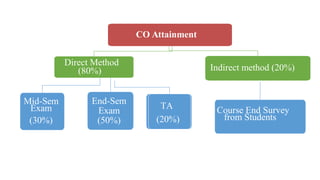
CO Attainment
Direct Method
(80%)
Mid-Sem
Exam
(30%)
End-Sem
Exam
(50%)
TA
(20%)
Indirect method (20%)
Course End Survey
from Students
Attainment of Course Outcomes
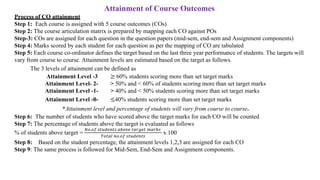
Process of CO attainment
Step 1: Each course is assigned with 5 course outcomes (COs)
Step 2: The course articulation matrix is prepared by mapping each CO against POs
Step-3: COs are assigned for each question in the question papers (mid-sem, end-sem and Assignment components)
Step 4: Marks scored by each student for each question as per the mapping of CO are tabulated
Step 5: Each course co-ordinator defines the target based on the last three year performance of students. The targets will
vary from course to course. Attainment levels are estimated based on the target as follows.
The 3 levels of attainment can be defined as
Attainment Level -3 ≥ 60% students scoring more than set target marks
Attainment Level- 2- > 50% and < 60% of students scoring more than set target marks
Attainment Level -1- > 40% and < 50% students scoring more than set target marks
Attainment Level -0- ≤40% students scoring more than set target marks
*Attainment level and percentage of students will vary from course to course.
Step 6: The number of students who have scored above the target marks for each CO will be counted
Step 7: The percentage of students above the target is evaluated as follows
% of students above target =
𝑁𝑜.𝑜𝑓 𝑠𝑡𝑢𝑑𝑒𝑛𝑡𝑠 𝑎𝑏𝑜𝑣𝑒 𝑡𝑎𝑟𝑔𝑒𝑡 𝑚𝑎𝑟𝑘𝑠
𝑇𝑜𝑡𝑎𝑙 𝑛𝑜.𝑜𝑓 𝑠𝑡𝑢𝑑𝑒𝑛𝑡𝑠
x 100
Step 8: Based on the student percentage, the attainment levels 1,2,3 are assigned for each CO
Step 9: The same process is followed for Mid-Sem, End-Sem and Assignment components.
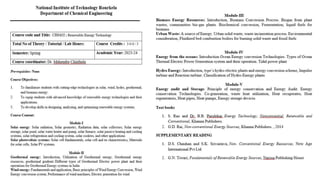
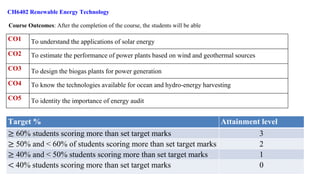
CH6402 Renewable Energy Technology
Course Outcomes: After the completion of the course, the students will be able
CO1 To understand the applications of solar energy
CO2 To estimate the performance of power plants based on wind and geothermal sources
CO3 To design the biogas plants for power generation
CO4 To know the technologies available for ocean and hydro-energy harvesting
CO5 To identity the importance of energy audit
Target % Attainment level
≥ 60% students scoring more than set target marks 3
≥ 50% and < 60% of students scoring more than set target marks 2
≥ 40% and < 50% students scoring more than set target marks 1
< 40% students scoring more than set target marks 0
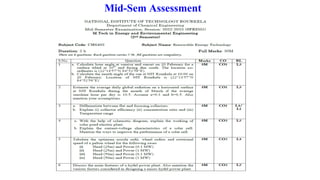
Mid-Sem Assessment
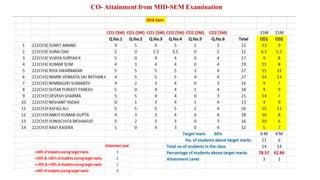
CO- Attainment from MID-SEM Examination
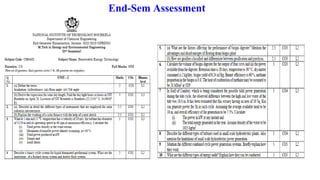
End-Sem Assessment
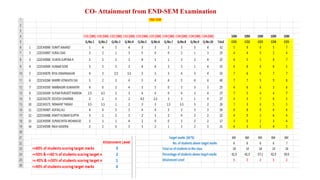
CO- Attainment from END-SEM Examination
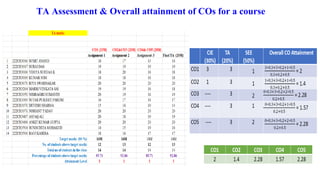
TA Assessment & Overall attainment of COs for a course
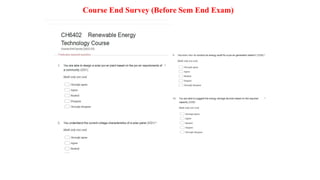
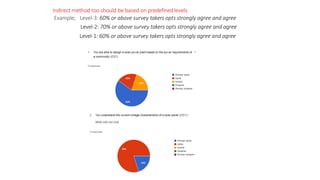
Course End Survey (Before Sem End Exam)
Indirect method too should be based on predefinedlevels
Example; Level-3: 60% or above survey takers opts strongly agree and agree
Level-2: 70% or above survey takers opts strongly agree and agree
Level-1: 60% or above survey takers opts strongly agree and agree
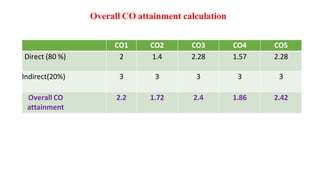
CO1 CO2 CO3 CO4 CO5
Direct (80 %) 2 1.4 2.28 1.57 2.28
Indirect(20%) 3 3 3 3 3
Overall CO
attainment
2.2 1.72 2.4 1.86 2.42
Overall CO attainment calculation
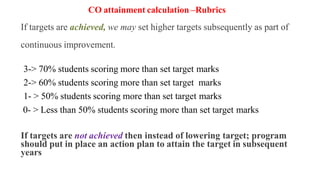
CO attainment calculation –Rubrics
If targets are achieved, we may set higher targets subsequently as part of
continuous improvement.
3-> 70% students scoring more than set target marks
2-> 60% students scoring more than set target marks
1- > 50% students scoring more than set target marks
0- > Less than 50% students scoring more than set target marks
If targets are not achieved then instead of lowering target; program
should put in place an action plan to attain the target in subsequent
years
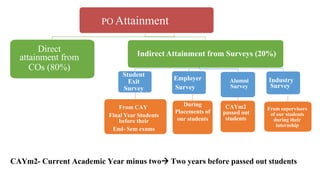
PO Attainment
PO Attainment
Direct
attainment from
COs (80%)
Indirect Attainment from Surveys (20%)
Student
Exit
Survey
From CAY
Final Year Students
before their
End- Sem exams
Employer
Survey
During
Placements of
our students
Alumni
Survey
CAYm2
passed out
students
Industry
Survey
From supervisors
of our students
during their
internship
CAYm2- Current Academic Year minus two Two years before passed out students
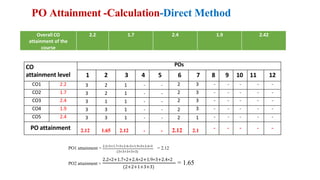
CO
attainment level
POs
1 2 3 4 5 6 7 8 9 10 11 12
CO1 2.2 3 2 1 - - 2 3 - - - - -
CO2 1.7 3 2 1 - - 2 3 - - - - -
CO3 2.4 3 1 1 - - 2 3 - - - - -
CO4 1.9 3 3 1 - - 2 3 - - - - -
CO5 2.4 3 3 1 - - 2 1 - - - - -
PO attainment 2.12 1.65 2.12 - - 2.12 2.1
- - - - -
PO1 attainment = 2.2∗3+1.7∗3+2.4∗3+1.9∗3+2.4∗3
= 2.12
(3+3+3+3+3)
PO2 attainment =
2.2∗2+1.7∗2+2.4∗2+1.9∗3+2.4∗2
(2+2+1+3+3)
= 1.65
Overall CO
attainment of the
course
2.2 1.7 2.4 1.9 2.42
PO Attainment -Calculation-Direct Method
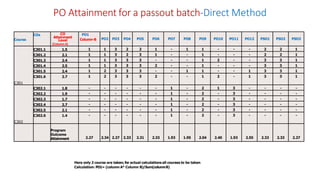
PO Attainment for a passout batch-Direct Method
Course
COs CO
Attainment
Level
(ColumnA)
PO1
Column-B PO2 PO3 PO4 PO5 PO6 PO7 PO8 PO9 PO10 PO11 PO12 PSO1 PSO2 PSO3
C301
C301.1 1.5 1 1 3 2 2 1 - 1 1 - - - 2 2 1
C301.2 2.1 1 1 3 2 3 1 - - 1 - - - 2 2 1
C301.3 2.4 1 1 3 3 3 - - - 1 2 - - 3 3 1
C301.4 2.5 1 1 3 3 3 2 - - 1 - - - 3 3 1
C301.5 2.4 1 2 3 3 3 - - 1 1 - - 1 3 3 1
C301.6 2.7 1 2 3 3 3 2 - - 1 2 - 1 3 3 1
C302
C302.1 1.8 - - - - - - 1 - 2 1 3 - - - -
C302.2 1.9 - - - - - - 1 - 2 - 3 - - - -
C302.3 1.7 - - - - - - 1 - 2 - 3 - - - -
C302.4 2.7 - - - - - - 1 - 2 - 3 - - - -
C302.5 2.1 - - - - - - 1 - 2 - 3 - - - -
C302.6 1.4 - - - - - - 1 - 2 - 3 - - - -
Program
Outcome
Attainment 2.27 2.34 2.27 2.33 2.31 2.33 1.93 1.95 2.04 2.40 1.93 2.55 2.33 2.33 2.27
Here only 2 course are taken; for actual calculations all courses to be taken
Calculation: PO1= (column A* Column B)/Sum(columnB)
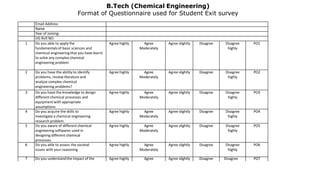
Email Address
Name
Year of Joining:
UG Roll NO.
1 Do you able to apply the
fundamentalsof basic sciences and
chemical engineering that you have learnt
to solve any complex chemical
engineering problem
Agree highly Agree
Moderately
Agree slightly Disagree Disagree
highly
PO1
2 Do you have the ability to identify
problems, review literature and
analyze complex chemical
engineering problems?
Agree highly Agree
Moderately
Agree slightly Disagree Disagree
highly
PO2
3 Do you have the knowledge to design
differentchemical processes and
equipment with appropriate
assumptions
Agree highly Agree
Moderately
Agree slightly Disagree Disagree
highly
PO3
4 Do you acquire the skills to
investigate a chemical engineering
research problem
Agree highly Agree
Moderately
Agree slightly Disagree Disagree
highly
PO4
5 Do you aware of differentchemical
engineering softwares used in
designing different chemical
processes
Agree highly Agree
Moderately
Agree slightly Disagree Disagree
highly
PO5
6 Do you able to assess the societal
issues with your reasoning
Agree highly Agree
Moderately
Agree slightly Disagree Disagree
highly
PO6
7 Do you understandthe impact of the Agree highly Agree Agree slightly Disagree Disagree PO7
B.Tech (Chemical Engineering)
Format of Questionnaire used for Student Exit survey
8 Do you apply ethical principles and
commit to professional ethics and
responsibilities
Agree highly Agree
Moderately
Agree slightly Disagree Disagree
highly
PO8
9 Do you able to work effectively as an
individual,and as a memberor leaderin diverse
teams
Agree highly Agree
Moderately
Agree slightly Disagree Disagree
highly
PO9
10 Do you able to communicate the
problems of chemical engineeringwith clear
instructions by oral and written documentation
Agree highly Agree
Moderately
Agree slightly Disagree Disagree
highly
PO10
11 Do you able to manage project works
in multidisciplinary environments
Agree highly Agree
Moderately
Agree slightly Disagree Disagree
highly
PO11
12 Do you recognize the need of life-long
learning in the context of technological
advances
Agree highly Agree
Moderately
Agree slightly Disagree Disagree
highly
PO12
13 Do you able to use your chemical
engineering concepts, as well as basic sciences
and humanities to solve and analyze
chemical engineering problems.
Agree highly Agree
Moderately
Agree slightly Disagree Disagree
highly
PSOI
14 Do you understand the usage of
simulation or computational tools to solve,
design, and optimize complex problems in
the chemical and related disciplines
Agree highly Agree
Moderately
Agree slightly Disagree Disagree
highly
PSO2
15 Do you acquire the ability to develop
and modify chemical processes, conduct
experiments, perform technical and
economic evaluations
Agree highly Agree
Moderately
Agree slightly Disagree Disagree
highly
PSO3
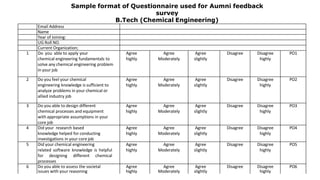
Email Address
Name
Year of Joining:
UG Roll NO.
Current Organization;
1 Do you able to apply your
chemical engineering fundamentals to
solve any chemical engineering problem
in your job
Agree
highly
Agree
Moderately
Agree
slightly
Disagree Disagree
highly
PO1
2 Do you feel your chemical
engineering knowledge is sufficient to
analyze problems in your chemical or
allied industry job
Agree
highly
Agree
Moderately
Agree
slightly
Disagree Disagree
highly
PO2
3 Do you able to design different
chemical processes and equipment
with appropriate assumptions in your
core job
Agree
highly
Agree
Moderately
Agree
slightly
Disagree Disagree
highly
PO3
4 Did your research based
knowledge helped for conducting
investigations in your core job
Agree
highly
Agree
Moderately
Agree
slightly
Disagree Disagree
highly
PO4
5 Did your chemical engineering
related software knowledge is helpful
for designing different chemical
processes
Agree
highly
Agree
Moderately
Agree
slightly
Disagree Disagree
highly
PO5
6 Do you able to assess the societal
issues with your reasoning
Agree
highly
Agree
Moderately
Agree
slightly
Disagree Disagree
highly
PO6
Sample format of Questionnaire used for Aumni feedback
survey
B.Tech (Chemical Engineering)
7 Do your chemical engineering
fundamentals helped you to
find your professional engineering solutions
for sustainable development
Agree highly Agree Moderately Agree slightly Disagree Disagree
highly
PO7
8 Do you apply ethical principles and
commit to professional ethics and
responsibilities
Agree highly Agree Moderately Agree slightly Disagree Disagree
highly
PO8
9 Do you able to work effectively as an
individual, and as a member or leader in
diverse teams
Agree highly Agree Moderately Agree slightly Disagree Disagree
highly
PO9
10 Do you able to communicate the
problems of chemical engineering with clear
instructions by oral and written documentation
Agree highly Agree Moderately Agree slightly Disagree Disagree
highly
PO10
11 Do you able to manage project works in
multidisciplinary environments
Agree highly Agree Moderately Agree slightly Disagree Disagree
highly
PO11
12 Do you recognize the need of life-long
learning in the context of technological
advances
Agree highly Agree Moderately Agree slightly Disagree Disagree
highly
PO12
13 Do you feel your chemical engineering
concepts, as well as basic sciences and
humanities are sufficient to solve and analyze
chemical engineering problems.
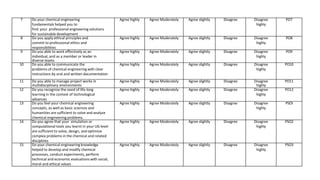
Agree highly Agree Moderately Agree slightly Disagree Disagree
highly
PSOI
14 Do you agree that your simulation or
computational tools you learnt in your UG level
are sufficient to solve, design, and optimize
complex problems in the chemical and related
disciplines
Agree highly Agree Moderately Agree slightly Disagree Disagree
highly
PSO2
15 Do your chemical engineering knowledge
helped to develop and modify chemical
processes, conduct experiments, perform
technical and economic evaluations with social,
moral and ethical values
Agree highly Agree Moderately Agree slightly Disagree Disagree
highly
PSO3
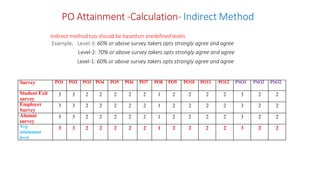
Survey PO1 PO2 PO3 PO4 PO5 PO6 PO7 PO8 PO9 PO10 PO11 PO12 PSO1 PSO2 PSO2
Student Exit
survey
3 3 2 2 2 2 2 1 2 2 2 2 3 2 2
Employer
Survey
3 3 2 2 2 2 2 1 2 2 2 2 3 2 2
Alumni
survey
3 3 2 2 2 2 2 1 2 2 2 2 3 2 2
Avg
attainment
level
3 3 2 2 2 2 2 1 2 2 2 2 3 2 2
PO Attainment -Calculation- Indirect Method
Indirect method too should be based on predefinedlevels
Example; Level-3: 60% or above survey takers opts strongly agree and agree
Level-2: 70% or above survey takers opts strongly agree and agree
Level-1: 60% or above survey takers opts strongly agree and agree
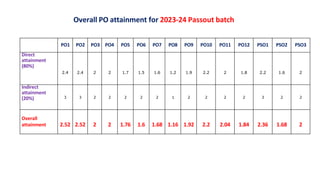
PO1 PO2 PO3 PO4 PO5 PO6 PO7 PO8 PO9 PO10 PO11 PO12 PSO1 PSO2 PSO3
Direct
attainment
(80%)
2.4 2.4 2 2 1.7 1.5 1.6 1.2 1.9 2.2 2 1.8 2.2 1.6 2
Indirect
attainment
(20%) 3 3 2 2 2 2 2 1 2 2 2 2 3 2 2
Overall
attainment 2.52 2.52 2 2 1.76 1.6 1.68 1.16 1.92 2.2 2.04 1.84 2.36 1.68 2
Overall PO attainment for 2023-24 Passout batch
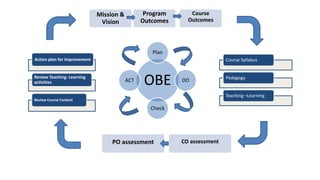
OBE
Plan
DO
Check
ACT
Mission &
Vision
Program
Outcomes
Course
Outcomes
Course Syllabus
Pedagogy
Teaching –Learning
PO assessment CO assessment
Action plan for improvement
Review Teaching- Learning
activities
Review Course Content
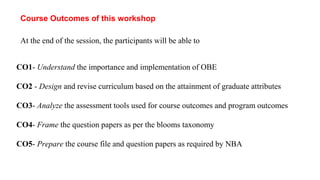
At the end of the session, the participants will be able to
Course Outcomes of this workshop
CO1- Understand the importance and implementation of OBE
CO2 - Design and revise curriculum based on the attainment of graduate attributes
CO3- Analyze the assessment tools used for course outcomes and program outcomes
CO4- Frame the question papers as per the blooms taxonomy
CO5- Prepare the course file and question papers as required by NBA
References
1. https://www.aicte-india.org/sites/default/files/ExaminationReforms.pdf
2. Prof C R Muthukrishnan Online program Organised by National Board ofAccreditation 2020
3. https://onlinecourses.nptel.ac.in/noc19_ge18/preview, Accreditation and Outcome based Learning By Prof. S
K. Das Mandal & Prof. Anup Kumar Ray, IIT Kharagpur
Thanks for your attention

Outcome Based Education (OBE) Philosophy.pdf

  • 1.
    Outcome Based Education(OBE) Philosophy Dr. Mahendra Chinthala Assistant Professor Department of Chemical Engineering NIT Rourkela
  • 2.
    • Outcome-based education(OBE) is an educational philosophy that focuses on achieving specific, measurable outcomes or goals rather than simply covering content or following a prescribed curriculum. • The primary idea behind OBE is that all students should achieve predefined outcomes or competencies by the end of a course or program, ensuring that they are prepared for real- world challenges and have the necessary skills to succeed in life and their careers. • OBE is student centered instruction that focuses on measuring student performance i.e. outcomes • Outcomes include;  Knowledge  Skills  Attitude What is Outcome-based Education (OBE) ?
  • 3.
    Why Outcome-based Education(OBE) ? • Technical institutions have traditionally followed a system of teaching where the learning outcomes of students are not always clearly defined or measured. • To ensure quality assurance in engineering programs, it is essential to establish a standardized approach. • The Washington Accord highlights the importance of outcome-based education. • Graduating engineers must be assessed not only on their knowledge but also on their perspectives and experiences, preparing them for global opportunities. • Therefore, it is both a necessity and a challenge for technical institutions to equip and empower future students to thrive in a global environment.
  • 4.
    Key Principles ofOutcome-Based Education: Clear Learning Outcomes: • In OBE, the educational goals are clearly defined from the start. These outcomes are usually specific, measurable, achievable, and time-bound (SMART). • They focus on what students are expected to know, be able to do, or demonstrate by the end of the learning process. Focus on Student Achievement: • The emphasis is on student learning rather than teaching. • Success is determined by how well students meet the defined learning outcomes.
  • 5.
    Flexibility in TeachingMethods: • OBE allows educators to choose various teaching methods, materials, and resources to support students in achieving the desired outcomes. • It recognizes that different students may learn in different ways, so flexibility is encouraged in how teaching is delivered. Assessment based on Outcomes: • Assessments in an OBE system are designed to measure how well students have met the learning outcomes. • These assessments can take various forms, such as exams, projects, presentations, or practical applications, and they should align with the outcomes.
  • 6.
    Accountability and Transparency: •In OBE, both teachers and students are held accountable for achieving the outcomes. Teachers are responsible for creating learning environments that enable student success, while students are responsible for their learning and performance. • The outcomes should be transparent to students at the beginning, providing them with a clear understanding of what is expected. Continuous Improvement: • The OBE philosophy encourages a feedback loop where educational programs are regularly evaluated and adjusted based on how well students are meeting the outcomes. • This allows for improvements in both curriculum and teaching methods, making the educational experience more effective over time.
  • 7.
    Challenges and Criticisms: Overemphasison Measurement: Some critics argue that focusing too much on measurable outcomes can lead to "teaching to the test" and undermine creativity or critical thinking. Rigidity in Standards: Setting strict outcomes can limit flexibility in addressing the unique needs or interests of students. Implementation Complexity: Developing and continuously adjusting appropriate assessment tools and outcomes can be time-consuming and challenging for educators.
  • 8.
    Institute Vision &Mission Department Vision & Mission Program Educational Objectives (PEOs) Program Outcomes (POs) Course Outcomes (COs) Key Constituents of OBE What students can achieve after few years of graduation- (4 to 5 years) What students can achieve after upon graduation What students can achieve after upon Course Completion
  • 9.
    Program Outcomes (POs) 1.Engineering knowledge: Apply the knowledge of mathematics, science, engineering fundamentals, and engineering concepts to the solution of complex engineering problems. 2. Problem analysis: Identify, formulate, review research literature, and analyze complex engineering problems reaching substantiated conclusions using first principles of mathematics, natural sciences, and engineering sciences. 3. Design/development of solutions: Design and development of processes and equipment design considering the public health and safety, and the cultural, societal, and environmental concerns. 4. Conduct investigations of complex problems: Use research-based knowledge and research methods including design of experiments, analysis and interpretation of data, and synthesis of the information to provide valid conclusions. 5. Modern tool usage: Create, select, and apply appropriate techniques, resources, and modern engineering and IT tools including prediction and modeling to complex engineering activities with an understanding of the limitations.
  • 10.
    6. The engineerand society: Apply reasoning informed by the contextual knowledge to assess societal, health, safety, legal and cultural issues and the consequent responsibilities relevant to the professional engineering practice. 7. Environment and sustainability: Understand the impact of the professional engineering solutions in societal and environmental contexts, and demonstrate the knowledge of, and need for sustainable development. 8. Ethics: Apply ethical principles and commit to professional ethics and responsibilities and norms of the engineering practice 9. Individual and team work: Function effectively as an individual, and as a member or leader in diverse teams, and in multidisciplinary settings. 10.Communication: Communicate effectively on complex engineering activities with the engineering community and with society at large, such as, being able to comprehend and write effective reports and design documentation, make effective presentations, and give and receive clear instructions. 11. Project management and finance: Demonstrate knowledge and understanding of the engineering and management principles and apply these to one’s own work, as a member and leader in a team, to manage projects and in multidisciplinary environments. 12. Life-long learning: Recognize the need for, and have the preparation and ability to engage in independent and life-long learning in the broadest context of technological change.
  • 11.
  • 12.
    Institute Vision &Mission Department Vision & Mission Program Educational Objectives (PEOs) Program Outcomes (POs) Structure of Curriculum Identification of courses based on POs Mapping and analysis of Course Outcomes (COs) with POs Course Delivery & Assessment Attainment of COs & POs Review Course delivery and teaching-learning methods Implementation of OBE
  • 13.
    Stake Holders feedback (Employer,Faculty, Students, Alumni) Identifying suitable courses to attain POs Corresponding Course Outcomes with PO & Graduate Attribute Identifying mode of teaching (L-T-P) Construction of Credit system Finalizing Curriculum and complete course design • In designing curriculum, a course is considered if it satisfies at least one of the Program outcome (PO) • In designing syllabus, a topic is considered if satisfies one of the course outcome Designing Curriculum
  • 14.
    What is COURSEOUTCOME? • Course Outcomes (COs) state what a student, on successfully completing the course and earning a pass grade and the credit can perform/do/demonstrate with what he/she has learnt in the course. • Note that the emphasis is on using/applying the knowledge imparted/acquired by a successful student in the course and not on the knowledge per se. • Let us see OBE as a system – for design, implementation and continuous improvement of technical education at the degree level • COs are central to OBE
  • 15.
    Writing COs • Itconnects/covers the whole curriculum of the course and Bloom’s Taxonomy level • Bloom's Taxonomy is well recognized and widely used in education in T-L-A that attempts to move students beyond memorization in terms of Higher-Order Thinking Skills (HOTS). •
  • 17.
  • 18.
    An Example ofCourse Outcomes COs Course Title: Heat & Mass Transfer • Course Outcomes 1. Solve practical engineering problems using basic concepts of heat and mass transfer. 2. Evaluate steady and unsteady performance for insulation, fin and thermocouple. 3. Analyze laminar and turbulent boundary layer flow on internal and external regions. 4. Design shell and tube-type heat exchangers for convective heat transfer applications. 5. Analyze phase change heat transfer processes applied to process-heat applications 6. Determine radiation heat transfer rates in engineering problems. 7. Perform design calculations of thermal equipment and prepare technical report
  • 19.
    Course file Course fileis required to report the •Details of the course •Prerequisites for the course •Course Objectives •Course content •Suggested Text books or Reference materials •Course Outcomes statements •CO-PO mapping •Lesson Plan •Course Assessment Plan (Mode and number of evaluations) • Mid-Eem question papers with evaluation scheme • End-Sem question papers with evaluation scheme • Assignment/Quiz/Class Test question papers with student responses • CO-Attainment for the course • PO attainment for the course • Actions planned to improve COs/POs for next academic year if there is any low attainments
  • 21.
    CO-PO mapping (connectingCOs with POs) COs PO1: Engineering knowledge PO2: Problem analysis PO3: Design/development solutions PO4: Investigations of complex problems PO5: Modern tools PO6: Engineer and society PO7: Environment and sustainability PO8: Ethics PO9: Individual and teamwork PO10: Communication PO11: Project management and finance PO12: Life-long learning CO1 3 2 1 - - 2 3 - - - - - CO2 3 2 1 - - 2 3 - - - - - CO3 3 1 1 - - 2 3 - - - - - CO4 3 3 1 - - 2 3 - - - - - CO5 3 3 1 - - 2 1 - - - - - 3 2.2 1 - - 2 2.6 - - - - - Course Title: Renewable Energy Technology Map COs with Pos with rating 3, 2 and 1 1-Low (Slight) 2- Moderate (Medium) 3-High (Substantial)
  • 22.
    S.N o. Topic Hours required 1 Introductionto energy sources and importance of renewable sources 1 2 Prospects of renewable energy sources 2 3 Solar energy fundamentals 1 4 Solar geometry 2 5 Solar radiation measurement 1 6 Solar collectors 1 7 Solar applications 2 8 Solar photovoltaic systems 2 9 Wind energy and fundamentals 1 10 Wind conversion systems 1 11 Performance evaluation of wind machines 2 12 Geothermal energy sources 1 13 Geothermal gradient and geothermal electric power plant 2 14 Biomass energy sources-Types 1 15 Biomass gasification 1 16 Biomass pyrolysis 1 17 Biomass fermentation 1 18 Biogas plants and design 3 Lesson Plan 19 Urban waste to energy technologies 1 20 Energy from oceans: Introduction and conversion technologies 1 21 Types of Ocean Thermal electric power generation systems 1 22 Tidal power generation 2 23 Hydro energy and conversion technologies 1 24 Impulse turbine and reaction turbine 1 25 Classification of hydro-power plants 1 26 Energy conservation principles 1 27 Energy audit 2 28 Energy conservation technologies 1 29 Heat recuperates and heat regenerators 1 30 Heat pipes and heat pumps 1 31 Energy storage systems 2 Total hours 42
  • 23.
    What Max Marks Proof COsaddressed Direct Assessment Methods Mid-Exam 30 Answer sheets 1,2,3 SEM End Examination 50 Answer sheets 1,2,3,4,5 Teacher Assessment ( TA) 20 Assignment copies 1,2,3,4,5 Indirect Assessment Methods Course End survey Questionnaire 1,2,3,4,5 Course Assessment Tools
  • 24.
    Assessment • Not specific;but continuous • Procedure should be valid • Procedure and tools should actually assess what one intends to test • Procedure should be fair. • No other factors should influence assessment procedure • Procedure should be reliable • Results should be consistent.
  • 25.
  • 26.
  • 27.
    Attainment of CourseOutcomes Process of CO attainment Step 1: Each course is assigned with 5 course outcomes (COs) Step 2: The course articulation matrix is prepared by mapping each CO against POs Step-3: COs are assigned for each question in the question papers (mid-sem, end-sem and Assignment components) Step 4: Marks scored by each student for each question as per the mapping of CO are tabulated Step 5: Each course co-ordinator defines the target based on the last three year performance of students. The targets will vary from course to course. Attainment levels are estimated based on the target as follows. The 3 levels of attainment can be defined as Attainment Level -3 ≥ 60% students scoring more than set target marks Attainment Level- 2- > 50% and < 60% of students scoring more than set target marks Attainment Level -1- > 40% and < 50% students scoring more than set target marks Attainment Level -0- ≤40% students scoring more than set target marks *Attainment level and percentage of students will vary from course to course. Step 6: The number of students who have scored above the target marks for each CO will be counted Step 7: The percentage of students above the target is evaluated as follows % of students above target = 𝑁𝑜.𝑜𝑓 𝑠𝑡𝑢𝑑𝑒𝑛𝑡𝑠 𝑎𝑏𝑜𝑣𝑒 𝑡𝑎𝑟𝑔𝑒𝑡 𝑚𝑎𝑟𝑘𝑠 𝑇𝑜𝑡𝑎𝑙 𝑛𝑜.𝑜𝑓 𝑠𝑡𝑢𝑑𝑒𝑛𝑡𝑠 x 100 Step 8: Based on the student percentage, the attainment levels 1,2,3 are assigned for each CO Step 9: The same process is followed for Mid-Sem, End-Sem and Assignment components.
  • 28.
    CH6402 Renewable EnergyTechnology Course Outcomes: After the completion of the course, the students will be able CO1 To understand the applications of solar energy CO2 To estimate the performance of power plants based on wind and geothermal sources CO3 To design the biogas plants for power generation CO4 To know the technologies available for ocean and hydro-energy harvesting CO5 To identity the importance of energy audit Target % Attainment level ≥ 60% students scoring more than set target marks 3 ≥ 50% and < 60% of students scoring more than set target marks 2 ≥ 40% and < 50% students scoring more than set target marks 1 < 40% students scoring more than set target marks 0
  • 29.
  • 30.
    CO- Attainment fromMID-SEM Examination
  • 31.
  • 32.
    CO- Attainment fromEND-SEM Examination
  • 33.
    TA Assessment &Overall attainment of COs for a course
  • 34.
    Course End Survey(Before Sem End Exam)
  • 35.
    Indirect method tooshould be based on predefinedlevels Example; Level-3: 60% or above survey takers opts strongly agree and agree Level-2: 70% or above survey takers opts strongly agree and agree Level-1: 60% or above survey takers opts strongly agree and agree
  • 36.
    CO1 CO2 CO3CO4 CO5 Direct (80 %) 2 1.4 2.28 1.57 2.28 Indirect(20%) 3 3 3 3 3 Overall CO attainment 2.2 1.72 2.4 1.86 2.42 Overall CO attainment calculation
  • 37.
    CO attainment calculation–Rubrics If targets are achieved, we may set higher targets subsequently as part of continuous improvement. 3-> 70% students scoring more than set target marks 2-> 60% students scoring more than set target marks 1- > 50% students scoring more than set target marks 0- > Less than 50% students scoring more than set target marks If targets are not achieved then instead of lowering target; program should put in place an action plan to attain the target in subsequent years
  • 38.
  • 39.
    PO Attainment Direct attainment from COs(80%) Indirect Attainment from Surveys (20%) Student Exit Survey From CAY Final Year Students before their End- Sem exams Employer Survey During Placements of our students Alumni Survey CAYm2 passed out students Industry Survey From supervisors of our students during their internship CAYm2- Current Academic Year minus two Two years before passed out students
  • 40.
    CO attainment level POs 1 23 4 5 6 7 8 9 10 11 12 CO1 2.2 3 2 1 - - 2 3 - - - - - CO2 1.7 3 2 1 - - 2 3 - - - - - CO3 2.4 3 1 1 - - 2 3 - - - - - CO4 1.9 3 3 1 - - 2 3 - - - - - CO5 2.4 3 3 1 - - 2 1 - - - - - PO attainment 2.12 1.65 2.12 - - 2.12 2.1 - - - - - PO1 attainment = 2.2∗3+1.7∗3+2.4∗3+1.9∗3+2.4∗3 = 2.12 (3+3+3+3+3) PO2 attainment = 2.2∗2+1.7∗2+2.4∗2+1.9∗3+2.4∗2 (2+2+1+3+3) = 1.65 Overall CO attainment of the course 2.2 1.7 2.4 1.9 2.42 PO Attainment -Calculation-Direct Method
  • 41.
    PO Attainment fora passout batch-Direct Method Course COs CO Attainment Level (ColumnA) PO1 Column-B PO2 PO3 PO4 PO5 PO6 PO7 PO8 PO9 PO10 PO11 PO12 PSO1 PSO2 PSO3 C301 C301.1 1.5 1 1 3 2 2 1 - 1 1 - - - 2 2 1 C301.2 2.1 1 1 3 2 3 1 - - 1 - - - 2 2 1 C301.3 2.4 1 1 3 3 3 - - - 1 2 - - 3 3 1 C301.4 2.5 1 1 3 3 3 2 - - 1 - - - 3 3 1 C301.5 2.4 1 2 3 3 3 - - 1 1 - - 1 3 3 1 C301.6 2.7 1 2 3 3 3 2 - - 1 2 - 1 3 3 1 C302 C302.1 1.8 - - - - - - 1 - 2 1 3 - - - - C302.2 1.9 - - - - - - 1 - 2 - 3 - - - - C302.3 1.7 - - - - - - 1 - 2 - 3 - - - - C302.4 2.7 - - - - - - 1 - 2 - 3 - - - - C302.5 2.1 - - - - - - 1 - 2 - 3 - - - - C302.6 1.4 - - - - - - 1 - 2 - 3 - - - - Program Outcome Attainment 2.27 2.34 2.27 2.33 2.31 2.33 1.93 1.95 2.04 2.40 1.93 2.55 2.33 2.33 2.27 Here only 2 course are taken; for actual calculations all courses to be taken Calculation: PO1= (column A* Column B)/Sum(columnB)
  • 42.
    Email Address Name Year ofJoining: UG Roll NO. 1 Do you able to apply the fundamentalsof basic sciences and chemical engineering that you have learnt to solve any complex chemical engineering problem Agree highly Agree Moderately Agree slightly Disagree Disagree highly PO1 2 Do you have the ability to identify problems, review literature and analyze complex chemical engineering problems? Agree highly Agree Moderately Agree slightly Disagree Disagree highly PO2 3 Do you have the knowledge to design differentchemical processes and equipment with appropriate assumptions Agree highly Agree Moderately Agree slightly Disagree Disagree highly PO3 4 Do you acquire the skills to investigate a chemical engineering research problem Agree highly Agree Moderately Agree slightly Disagree Disagree highly PO4 5 Do you aware of differentchemical engineering softwares used in designing different chemical processes Agree highly Agree Moderately Agree slightly Disagree Disagree highly PO5 6 Do you able to assess the societal issues with your reasoning Agree highly Agree Moderately Agree slightly Disagree Disagree highly PO6 7 Do you understandthe impact of the Agree highly Agree Agree slightly Disagree Disagree PO7 B.Tech (Chemical Engineering) Format of Questionnaire used for Student Exit survey
  • 43.
    8 Do youapply ethical principles and commit to professional ethics and responsibilities Agree highly Agree Moderately Agree slightly Disagree Disagree highly PO8 9 Do you able to work effectively as an individual,and as a memberor leaderin diverse teams Agree highly Agree Moderately Agree slightly Disagree Disagree highly PO9 10 Do you able to communicate the problems of chemical engineeringwith clear instructions by oral and written documentation Agree highly Agree Moderately Agree slightly Disagree Disagree highly PO10 11 Do you able to manage project works in multidisciplinary environments Agree highly Agree Moderately Agree slightly Disagree Disagree highly PO11 12 Do you recognize the need of life-long learning in the context of technological advances Agree highly Agree Moderately Agree slightly Disagree Disagree highly PO12 13 Do you able to use your chemical engineering concepts, as well as basic sciences and humanities to solve and analyze chemical engineering problems. Agree highly Agree Moderately Agree slightly Disagree Disagree highly PSOI 14 Do you understand the usage of simulation or computational tools to solve, design, and optimize complex problems in the chemical and related disciplines Agree highly Agree Moderately Agree slightly Disagree Disagree highly PSO2 15 Do you acquire the ability to develop and modify chemical processes, conduct experiments, perform technical and economic evaluations Agree highly Agree Moderately Agree slightly Disagree Disagree highly PSO3
  • 44.
    Email Address Name Year ofJoining: UG Roll NO. Current Organization; 1 Do you able to apply your chemical engineering fundamentals to solve any chemical engineering problem in your job Agree highly Agree Moderately Agree slightly Disagree Disagree highly PO1 2 Do you feel your chemical engineering knowledge is sufficient to analyze problems in your chemical or allied industry job Agree highly Agree Moderately Agree slightly Disagree Disagree highly PO2 3 Do you able to design different chemical processes and equipment with appropriate assumptions in your core job Agree highly Agree Moderately Agree slightly Disagree Disagree highly PO3 4 Did your research based knowledge helped for conducting investigations in your core job Agree highly Agree Moderately Agree slightly Disagree Disagree highly PO4 5 Did your chemical engineering related software knowledge is helpful for designing different chemical processes Agree highly Agree Moderately Agree slightly Disagree Disagree highly PO5 6 Do you able to assess the societal issues with your reasoning Agree highly Agree Moderately Agree slightly Disagree Disagree highly PO6 Sample format of Questionnaire used for Aumni feedback survey B.Tech (Chemical Engineering)
  • 45.
    7 Do yourchemical engineering fundamentals helped you to find your professional engineering solutions for sustainable development Agree highly Agree Moderately Agree slightly Disagree Disagree highly PO7 8 Do you apply ethical principles and commit to professional ethics and responsibilities Agree highly Agree Moderately Agree slightly Disagree Disagree highly PO8 9 Do you able to work effectively as an individual, and as a member or leader in diverse teams Agree highly Agree Moderately Agree slightly Disagree Disagree highly PO9 10 Do you able to communicate the problems of chemical engineering with clear instructions by oral and written documentation Agree highly Agree Moderately Agree slightly Disagree Disagree highly PO10 11 Do you able to manage project works in multidisciplinary environments Agree highly Agree Moderately Agree slightly Disagree Disagree highly PO11 12 Do you recognize the need of life-long learning in the context of technological advances Agree highly Agree Moderately Agree slightly Disagree Disagree highly PO12 13 Do you feel your chemical engineering concepts, as well as basic sciences and humanities are sufficient to solve and analyze chemical engineering problems. Agree highly Agree Moderately Agree slightly Disagree Disagree highly PSOI 14 Do you agree that your simulation or computational tools you learnt in your UG level are sufficient to solve, design, and optimize complex problems in the chemical and related disciplines Agree highly Agree Moderately Agree slightly Disagree Disagree highly PSO2 15 Do your chemical engineering knowledge helped to develop and modify chemical processes, conduct experiments, perform technical and economic evaluations with social, moral and ethical values Agree highly Agree Moderately Agree slightly Disagree Disagree highly PSO3
  • 46.
    Survey PO1 PO2PO3 PO4 PO5 PO6 PO7 PO8 PO9 PO10 PO11 PO12 PSO1 PSO2 PSO2 Student Exit survey 3 3 2 2 2 2 2 1 2 2 2 2 3 2 2 Employer Survey 3 3 2 2 2 2 2 1 2 2 2 2 3 2 2 Alumni survey 3 3 2 2 2 2 2 1 2 2 2 2 3 2 2 Avg attainment level 3 3 2 2 2 2 2 1 2 2 2 2 3 2 2 PO Attainment -Calculation- Indirect Method Indirect method too should be based on predefinedlevels Example; Level-3: 60% or above survey takers opts strongly agree and agree Level-2: 70% or above survey takers opts strongly agree and agree Level-1: 60% or above survey takers opts strongly agree and agree
  • 47.
    PO1 PO2 PO3PO4 PO5 PO6 PO7 PO8 PO9 PO10 PO11 PO12 PSO1 PSO2 PSO3 Direct attainment (80%) 2.4 2.4 2 2 1.7 1.5 1.6 1.2 1.9 2.2 2 1.8 2.2 1.6 2 Indirect attainment (20%) 3 3 2 2 2 2 2 1 2 2 2 2 3 2 2 Overall attainment 2.52 2.52 2 2 1.76 1.6 1.68 1.16 1.92 2.2 2.04 1.84 2.36 1.68 2 Overall PO attainment for 2023-24 Passout batch
  • 48.
    OBE Plan DO Check ACT Mission & Vision Program Outcomes Course Outcomes Course Syllabus Pedagogy Teaching–Learning PO assessment CO assessment Action plan for improvement Review Teaching- Learning activities Review Course Content
  • 49.
    At the endof the session, the participants will be able to Course Outcomes of this workshop CO1- Understand the importance and implementation of OBE CO2 - Design and revise curriculum based on the attainment of graduate attributes CO3- Analyze the assessment tools used for course outcomes and program outcomes CO4- Frame the question papers as per the blooms taxonomy CO5- Prepare the course file and question papers as required by NBA
  • 50.
    References 1. https://www.aicte-india.org/sites/default/files/ExaminationReforms.pdf 2. ProfC R Muthukrishnan Online program Organised by National Board ofAccreditation 2020 3. https://onlinecourses.nptel.ac.in/noc19_ge18/preview, Accreditation and Outcome based Learning By Prof. S K. Das Mandal & Prof. Anup Kumar Ray, IIT Kharagpur
  • 51.
    Thanks for yourattention