Chief Keith MatthewSimpcw First NationAugust 30, 2010BC Water Science Strategy Symposium“Water is the lifeblood of the land”: acting upon Indigenous water knowledge and rights to water
“We the Simpcw First Nation, affirm our relationship to Mother Earth and responsibility to future generations to raise our voices to speak for the protection of water.  We were placed in a sacred manner on this earth, each in our own sacred and traditional lands and territories to care for all creation and to care for water.”“Water is the Lifeblood of the Land": Acting upon Indigenous Knowledge of and Rights to Water  Chief Keith Matthew, Simpcw, August 30, 2010Intro: Simpcw Water Declaration
Simpcw Water Declaration: signed August 16, 2010Indigenous Peoples’ Relationship to Water, Conditions of our Waters, Right to Water and Self-Determination, Role of TEK, Requirements of Consultation and Accommodation, and Plan of ActionWater Declaration as a means to assert Indigenous Rights to Water and concurrent commitment to care for water“Water is the Lifeblood of the Land": Acting upon Indigenous Knowledge of and Rights to Water  Chief Keith Matthew, Simpcw, August 30, 2010Intro: Simpcw Water Declaration
Indigenous connections with waterTraditional Ecological KnowledgeImpacts of colonialism on our lands, waters, culture and knowledgeCurrent context: threats and opportunitiesConsidering a “BC Water Science Strategy” from a First Nations perspective“Water is the Lifeblood of the Land": Acting upon Indigenous Knowledge of and Rights to Water  Chief Keith Matthew, Simpcw, August 30, 2010Outline of Presentation
Cultures linked closely with and flow from the land and waterIndigenous laws about water thousands of years oldSacred duty to protect the water- availability and purityIndigenous practices of caring for water involve detailed knowledge “Water is the Lifeblood of the Land": Acting upon Indigenous Knowledge of and Rights to Water  Chief Keith Matthew, Simpcw, August 30, 2010Indigenous Connections with Water
Indigenous Rights to, and in water continue to flow from the relationship of Indigenous Peoples to our traditional territoriesInherent right to water includes a right of self-determinationContinue to sustain our waters for all life and future peoples; continue to implement these inherent rights and responsibilities“Water is the Lifeblood of the Land": Acting upon Indigenous Knowledge of and Rights to Water  Chief Keith Matthew, Simpcw, August 30, 2010Indigenous Connections with Water
The Simpcw First Nation has not ceded, released nor surrendered one square inch of territory or rights - extremely important in considering connections with water!!Aboriginal Title includes Water and Land, based on occupancy on land prior to European arrival in CanadaAboriginal Rights flow from Aboriginal Title“Water is the Lifeblood of the Land": Acting upon Indigenous Knowledge of and Rights to Water  Chief Keith Matthew, Simpcw, August 30, 2010Indigenous Connections with Water
Must protect Aboriginal water Rights so that Aboriginal people can make a moderate living, remain in traditional communities, and preserve traditional and contemporary Indigenous culturesSec. 35 of the Constitution recognizes and affirms the existing Aboriginal and Treaty Rights of the Aboriginal peoples of Canada“Water is the Lifeblood of the Land": Acting upon Indigenous Knowledge of and Rights to Water  Chief Keith Matthew, Simpcw, August 30, 2010Indigenous Connections with Water
Indigenous Rights to Water are supported by International Measures including:UN Declaration on Indigenous Peoples- broad scope water rightsConvention on Biological Diversity- key role of Indigenous knowledge in conservationILO Convention 169- right to manage resources including waters“Water is the Lifeblood of the Land": Acting upon Indigenous Knowledge of and Rights to Water  Chief Keith Matthew, Simpcw, August 30, 2010Indigenous Connections with Water
TEK based on natural and spiritual laws and ensures sustainable use through traditional resource conservationTEK for our people is way of life – not a scientific termTEK  combines the knowledge our ancestors on how to take care of and respect the water to ensure it is available for future peoples“Water is the Lifeblood of the Land": Acting upon Indigenous Knowledge of and Rights to Water  Chief Keith Matthew, Simpcw, August 30, 2010Traditional Ecological Knowledge
Not publicly availableHolders of TEK must be respected1997 Delgamuukw SCC decision recognized for the first time that oral history recognized as a legitimate evidence in court of law“Water is the Lifeblood of the Land": Acting upon Indigenous Knowledge of and Rights to Water  Chief Keith Matthew, Simpcw, August 30, 2010Traditional Ecological Knowledge
TEK is essential to use in water stewardship and decision makingIndigenous water practices are wholisticTEK goes hand in hand with Indigenous governance and management of water resourcesImpossible to draw on TEK without also addressing Indigenous water rights and governance“Water is the Lifeblood of the Land": Acting upon Indigenous Knowledge of and Rights to Water  Chief Keith Matthew, Simpcw, August 30, 2010Traditional Ecological Knowledge
Reserve system meant that we could not carry out sacred duty of caring for all our Lands and WatersGreatly reduced access to our waters created extreme challenges to our health, food security, and traditional lifestylesLegislatively denied access to our traditional Lands and Waters“Water is the Lifeblood of the Land": Acting upon Indigenous Knowledge of and Rights to Water  Chief Keith Matthew, Simpcw, August 30, 2010Impacts of Colonialism
BC’s Water Act developed in 1909- absence of any recognition of prior occupation by Indigenous peoplesWater Actdeveloped during time of colonization and exploitation of First Nations’ peoples, Lands (waters) and culturesWater Act not aimed at conservation (was not a mainstream concern then), but at usage of water for benefit of industry“Water is the Lifeblood of the Land": Acting upon Indigenous Knowledge of and Rights to Water  Chief Keith Matthew, Simpcw, August 30, 2010Impacts of Colonialism
Water Act (1909) features:BC asserts jurisdiction over all freshwater in BC, including surface and groundwaterWater licenses issued on “first come first serve” basis; did not initially record much-need water allocations to reserve landsWater license issuing not in-line with ecological concerns, can be over-issuedBased on “use” of water, without consideration to Indigenous long-term practices, or long term impacts of failure to protect water“Water is the Lifeblood of the Land": Acting upon Indigenous Knowledge of and Rights to Water  Chief Keith Matthew, Simpcw, August 30, 2010Impacts of Colonialism
Water Act falsely asserted provincial jurisdiction to permit and regulate all uses of water in BC, except for reserve landsThe Supreme Court now recognizes that if Aboriginal Title has not been addressed (most of BC) then the province cannot assert jurisdictionInherent problem: province regulating an area of Aboriginal Title and Rights concern“Water is the Lifeblood of the Land": Acting upon Indigenous Knowledge of and Rights to Water  Chief Keith Matthew, Simpcw, August 30, 2010Impacts of Colonialism
Updating how water is managed and regulated in BC is an exciting opportunity for First Nations if adequate consultation and accommodationAgree that Water Act (1909) out of dateIndigenous Rights to Water are becoming increasingly recognized through Indigenous declarations, court decisions, and international instruments“Water is the Lifeblood of the Land": Acting upon Indigenous Knowledge of and Rights to Water  Chief Keith Matthew, Simpcw, August 30, 2010Current Context: Threats and Opportunities
Threats: Water continues to be managed to the exclusion of Indigenous Rights to waterWater Act modernization proceeds without adequate consultation and accommodation with each and every First NationThird party interests are granted or expanded, then such economic interests protected at expense of Aboriginal Title and Rights (e.g. approval of mines on land under Title claim that impact clean water)“Water is the Lifeblood of the Land": Acting upon Indigenous Knowledge of and Rights to Water  Chief Keith Matthew, Simpcw, August 30, 2010Current Context: Threats and Opportunities
Threats (cont.): water continues to be managed without the benefit of Indigenous water knowledgeTEK sustained our waters for millenniaSignificant resource capacity development must be adequately funded in First Nations’ communities Must be recognition that TEK involves water governance and addressing Indigenous Rights to Water“Water is the Lifeblood of the Land": Acting upon Indigenous Knowledge of and Rights to Water  Chief Keith Matthew, Simpcw, August 30, 2010Current Context: Threats and Opportunities
In 2005, Indigenous leaders in BC on behalf of all First Nations entered into a New Relationship with provinceCommon vision of systemic changesCommitment to joint implementation of policy to acknowledge Aboriginal Title and Rightshttp://www.gov.bc.ca/arr/newrelationship/down/new_relationship.pdf“Water is the Lifeblood of the Land": Acting upon Indigenous Knowledge of and Rights to Water  Chief Keith Matthew, Simpcw, August 30, 2010Current Context: Threats and Opportunities
Opportunities: Start implementing New Relationship in current update to how water is managed (Water Act modernization).  Means:BC would acknowledge, recognize and address Indigenous Nations’ jurisdiction at every levelBC would work with each and every First Nation in province“Water is the Lifeblood of the Land": Acting upon Indigenous Knowledge of and Rights to Water  Chief Keith Matthew, Simpcw, August 30, 2010Current Context: Threats and Opportunities
BC Water Science Symposium Discussion Paper acknowledges:“First Nations people have a strong cultural and spiritual relationship with water.  Legally water is an area of Aboriginal Title, Rights, and Treaty Rights concern.  The courts have recognized Aboriginal Title continues to exist unless a Nation cedes this to the federal government.”“Water is the Lifeblood of the Land": Acting upon Indigenous Knowledge of and Rights to Water  Chief Keith Matthew, Simpcw, August 30, 2010BC Water Science Strategy from a First Nations Perspective
First Nations recognize the need to combine different forms of knowledge in order to protect our waters and all of the animals that depend on clean water to surviveA sound BC Water Science Strategy must address Indigenous jurisdiction over water resources in BCFirst Nations are involved in all aspects of a Water Science Strategy, and are holders of TEK, scientists, policy makers and end-users“Water is the Lifeblood of the Land": Acting upon Indigenous Knowledge of and Rights to Water  Chief Keith Matthew, Simpcw, August 30, 2010BC Water Science Strategy from a First Nations Perspective
Who will author, edit and approve a BC Water Science Strategy?How will each and every First Nation be involved?Will First Nations be adequately funded to participate in development of the Strategy?Who will use a BC Water Science Strategy, and what will it be used for?“Water is the Lifeblood of the Land": Acting upon Indigenous Knowledge of and Rights to Water  Chief Keith Matthew, Simpcw, August 30, 2010BC Water Science Strategy from a First Nations Perspective
“Our relationship with our lands, territories and water is the fundamental physical, cultural, and spiritual basis for our existence.  This relationship to our Mother Earth requires us to conserve our freshwaters and oceans for the survival of present and future generations.  We assert our role as caretakers with rights and responsibilities to defend and ensure the protection, availability, and purity of water.  We stand united to follow and implement our knowledge and traditional laws and exercise our right of self-determination to preserve water and to preserve life.” (Simpcw Water Declaration)“Water is the Lifeblood of the Land": Acting upon Indigenous Knowledge of and Rights to Water  Chief Keith Matthew, Simpcw, August 30, 2010Conclusion
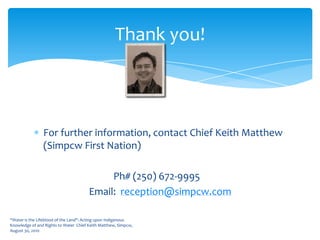
For further information, contact Chief Keith Matthew (Simpcw First Nation)Ph# (250) 672-9995   Email:  reception@simpcw.com“Water is the Lifeblood of the Land": Acting upon Indigenous Knowledge of and Rights to Water  Chief Keith Matthew, Simpcw, August 30, 2010Thank you!

Chief Keith Matthew, Simpcw First Nation - "Water is the lifeblood of the land": acting on Indigenous Water Knowledge and Rights to Water

  • 1.
    Chief Keith MatthewSimpcwFirst NationAugust 30, 2010BC Water Science Strategy Symposium“Water is the lifeblood of the land”: acting upon Indigenous water knowledge and rights to water
  • 2.
    “We the SimpcwFirst Nation, affirm our relationship to Mother Earth and responsibility to future generations to raise our voices to speak for the protection of water. We were placed in a sacred manner on this earth, each in our own sacred and traditional lands and territories to care for all creation and to care for water.”“Water is the Lifeblood of the Land": Acting upon Indigenous Knowledge of and Rights to Water Chief Keith Matthew, Simpcw, August 30, 2010Intro: Simpcw Water Declaration
  • 3.
    Simpcw Water Declaration:signed August 16, 2010Indigenous Peoples’ Relationship to Water, Conditions of our Waters, Right to Water and Self-Determination, Role of TEK, Requirements of Consultation and Accommodation, and Plan of ActionWater Declaration as a means to assert Indigenous Rights to Water and concurrent commitment to care for water“Water is the Lifeblood of the Land": Acting upon Indigenous Knowledge of and Rights to Water Chief Keith Matthew, Simpcw, August 30, 2010Intro: Simpcw Water Declaration
  • 4.
    Indigenous connections withwaterTraditional Ecological KnowledgeImpacts of colonialism on our lands, waters, culture and knowledgeCurrent context: threats and opportunitiesConsidering a “BC Water Science Strategy” from a First Nations perspective“Water is the Lifeblood of the Land": Acting upon Indigenous Knowledge of and Rights to Water Chief Keith Matthew, Simpcw, August 30, 2010Outline of Presentation
  • 5.
    Cultures linked closelywith and flow from the land and waterIndigenous laws about water thousands of years oldSacred duty to protect the water- availability and purityIndigenous practices of caring for water involve detailed knowledge “Water is the Lifeblood of the Land": Acting upon Indigenous Knowledge of and Rights to Water Chief Keith Matthew, Simpcw, August 30, 2010Indigenous Connections with Water
  • 6.
    Indigenous Rights to,and in water continue to flow from the relationship of Indigenous Peoples to our traditional territoriesInherent right to water includes a right of self-determinationContinue to sustain our waters for all life and future peoples; continue to implement these inherent rights and responsibilities“Water is the Lifeblood of the Land": Acting upon Indigenous Knowledge of and Rights to Water Chief Keith Matthew, Simpcw, August 30, 2010Indigenous Connections with Water
  • 7.
    The Simpcw FirstNation has not ceded, released nor surrendered one square inch of territory or rights - extremely important in considering connections with water!!Aboriginal Title includes Water and Land, based on occupancy on land prior to European arrival in CanadaAboriginal Rights flow from Aboriginal Title“Water is the Lifeblood of the Land": Acting upon Indigenous Knowledge of and Rights to Water Chief Keith Matthew, Simpcw, August 30, 2010Indigenous Connections with Water
  • 8.
    Must protect Aboriginalwater Rights so that Aboriginal people can make a moderate living, remain in traditional communities, and preserve traditional and contemporary Indigenous culturesSec. 35 of the Constitution recognizes and affirms the existing Aboriginal and Treaty Rights of the Aboriginal peoples of Canada“Water is the Lifeblood of the Land": Acting upon Indigenous Knowledge of and Rights to Water Chief Keith Matthew, Simpcw, August 30, 2010Indigenous Connections with Water
  • 9.
    Indigenous Rights toWater are supported by International Measures including:UN Declaration on Indigenous Peoples- broad scope water rightsConvention on Biological Diversity- key role of Indigenous knowledge in conservationILO Convention 169- right to manage resources including waters“Water is the Lifeblood of the Land": Acting upon Indigenous Knowledge of and Rights to Water Chief Keith Matthew, Simpcw, August 30, 2010Indigenous Connections with Water
  • 10.
    TEK based onnatural and spiritual laws and ensures sustainable use through traditional resource conservationTEK for our people is way of life – not a scientific termTEK combines the knowledge our ancestors on how to take care of and respect the water to ensure it is available for future peoples“Water is the Lifeblood of the Land": Acting upon Indigenous Knowledge of and Rights to Water Chief Keith Matthew, Simpcw, August 30, 2010Traditional Ecological Knowledge
  • 11.
    Not publicly availableHoldersof TEK must be respected1997 Delgamuukw SCC decision recognized for the first time that oral history recognized as a legitimate evidence in court of law“Water is the Lifeblood of the Land": Acting upon Indigenous Knowledge of and Rights to Water Chief Keith Matthew, Simpcw, August 30, 2010Traditional Ecological Knowledge
  • 12.
    TEK is essentialto use in water stewardship and decision makingIndigenous water practices are wholisticTEK goes hand in hand with Indigenous governance and management of water resourcesImpossible to draw on TEK without also addressing Indigenous water rights and governance“Water is the Lifeblood of the Land": Acting upon Indigenous Knowledge of and Rights to Water Chief Keith Matthew, Simpcw, August 30, 2010Traditional Ecological Knowledge
  • 13.
    Reserve system meantthat we could not carry out sacred duty of caring for all our Lands and WatersGreatly reduced access to our waters created extreme challenges to our health, food security, and traditional lifestylesLegislatively denied access to our traditional Lands and Waters“Water is the Lifeblood of the Land": Acting upon Indigenous Knowledge of and Rights to Water Chief Keith Matthew, Simpcw, August 30, 2010Impacts of Colonialism
  • 14.
    BC’s Water Actdeveloped in 1909- absence of any recognition of prior occupation by Indigenous peoplesWater Actdeveloped during time of colonization and exploitation of First Nations’ peoples, Lands (waters) and culturesWater Act not aimed at conservation (was not a mainstream concern then), but at usage of water for benefit of industry“Water is the Lifeblood of the Land": Acting upon Indigenous Knowledge of and Rights to Water Chief Keith Matthew, Simpcw, August 30, 2010Impacts of Colonialism
  • 15.
    Water Act (1909)features:BC asserts jurisdiction over all freshwater in BC, including surface and groundwaterWater licenses issued on “first come first serve” basis; did not initially record much-need water allocations to reserve landsWater license issuing not in-line with ecological concerns, can be over-issuedBased on “use” of water, without consideration to Indigenous long-term practices, or long term impacts of failure to protect water“Water is the Lifeblood of the Land": Acting upon Indigenous Knowledge of and Rights to Water Chief Keith Matthew, Simpcw, August 30, 2010Impacts of Colonialism
  • 16.
    Water Act falselyasserted provincial jurisdiction to permit and regulate all uses of water in BC, except for reserve landsThe Supreme Court now recognizes that if Aboriginal Title has not been addressed (most of BC) then the province cannot assert jurisdictionInherent problem: province regulating an area of Aboriginal Title and Rights concern“Water is the Lifeblood of the Land": Acting upon Indigenous Knowledge of and Rights to Water Chief Keith Matthew, Simpcw, August 30, 2010Impacts of Colonialism
  • 17.
    Updating how wateris managed and regulated in BC is an exciting opportunity for First Nations if adequate consultation and accommodationAgree that Water Act (1909) out of dateIndigenous Rights to Water are becoming increasingly recognized through Indigenous declarations, court decisions, and international instruments“Water is the Lifeblood of the Land": Acting upon Indigenous Knowledge of and Rights to Water Chief Keith Matthew, Simpcw, August 30, 2010Current Context: Threats and Opportunities
  • 18.
    Threats: Water continuesto be managed to the exclusion of Indigenous Rights to waterWater Act modernization proceeds without adequate consultation and accommodation with each and every First NationThird party interests are granted or expanded, then such economic interests protected at expense of Aboriginal Title and Rights (e.g. approval of mines on land under Title claim that impact clean water)“Water is the Lifeblood of the Land": Acting upon Indigenous Knowledge of and Rights to Water Chief Keith Matthew, Simpcw, August 30, 2010Current Context: Threats and Opportunities
  • 19.
    Threats (cont.): watercontinues to be managed without the benefit of Indigenous water knowledgeTEK sustained our waters for millenniaSignificant resource capacity development must be adequately funded in First Nations’ communities Must be recognition that TEK involves water governance and addressing Indigenous Rights to Water“Water is the Lifeblood of the Land": Acting upon Indigenous Knowledge of and Rights to Water Chief Keith Matthew, Simpcw, August 30, 2010Current Context: Threats and Opportunities
  • 20.
    In 2005, Indigenousleaders in BC on behalf of all First Nations entered into a New Relationship with provinceCommon vision of systemic changesCommitment to joint implementation of policy to acknowledge Aboriginal Title and Rightshttp://www.gov.bc.ca/arr/newrelationship/down/new_relationship.pdf“Water is the Lifeblood of the Land": Acting upon Indigenous Knowledge of and Rights to Water Chief Keith Matthew, Simpcw, August 30, 2010Current Context: Threats and Opportunities
  • 21.
    Opportunities: Start implementingNew Relationship in current update to how water is managed (Water Act modernization). Means:BC would acknowledge, recognize and address Indigenous Nations’ jurisdiction at every levelBC would work with each and every First Nation in province“Water is the Lifeblood of the Land": Acting upon Indigenous Knowledge of and Rights to Water Chief Keith Matthew, Simpcw, August 30, 2010Current Context: Threats and Opportunities
  • 22.
    BC Water ScienceSymposium Discussion Paper acknowledges:“First Nations people have a strong cultural and spiritual relationship with water. Legally water is an area of Aboriginal Title, Rights, and Treaty Rights concern. The courts have recognized Aboriginal Title continues to exist unless a Nation cedes this to the federal government.”“Water is the Lifeblood of the Land": Acting upon Indigenous Knowledge of and Rights to Water Chief Keith Matthew, Simpcw, August 30, 2010BC Water Science Strategy from a First Nations Perspective
  • 23.
    First Nations recognizethe need to combine different forms of knowledge in order to protect our waters and all of the animals that depend on clean water to surviveA sound BC Water Science Strategy must address Indigenous jurisdiction over water resources in BCFirst Nations are involved in all aspects of a Water Science Strategy, and are holders of TEK, scientists, policy makers and end-users“Water is the Lifeblood of the Land": Acting upon Indigenous Knowledge of and Rights to Water Chief Keith Matthew, Simpcw, August 30, 2010BC Water Science Strategy from a First Nations Perspective
  • 24.
    Who will author,edit and approve a BC Water Science Strategy?How will each and every First Nation be involved?Will First Nations be adequately funded to participate in development of the Strategy?Who will use a BC Water Science Strategy, and what will it be used for?“Water is the Lifeblood of the Land": Acting upon Indigenous Knowledge of and Rights to Water Chief Keith Matthew, Simpcw, August 30, 2010BC Water Science Strategy from a First Nations Perspective
  • 25.
    “Our relationship withour lands, territories and water is the fundamental physical, cultural, and spiritual basis for our existence. This relationship to our Mother Earth requires us to conserve our freshwaters and oceans for the survival of present and future generations. We assert our role as caretakers with rights and responsibilities to defend and ensure the protection, availability, and purity of water. We stand united to follow and implement our knowledge and traditional laws and exercise our right of self-determination to preserve water and to preserve life.” (Simpcw Water Declaration)“Water is the Lifeblood of the Land": Acting upon Indigenous Knowledge of and Rights to Water Chief Keith Matthew, Simpcw, August 30, 2010Conclusion
  • 26.
    For further information,contact Chief Keith Matthew (Simpcw First Nation)Ph# (250) 672-9995   Email:  reception@simpcw.com“Water is the Lifeblood of the Land": Acting upon Indigenous Knowledge of and Rights to Water Chief Keith Matthew, Simpcw, August 30, 2010Thank you!