11/15/99 Norm Herr (sample file)
Full Moon and New Moon
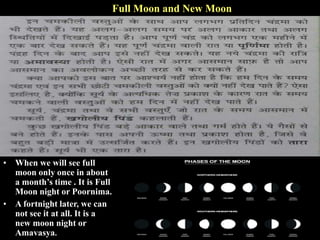
• When we will see full
moon only once in about
a month’s time . It is Full
Moon night or Poornima.
• A fortnight later, we can
not see it at all. It is a
new moon night or
Amavasya.
11/15/99 Norm Herr (sample file)
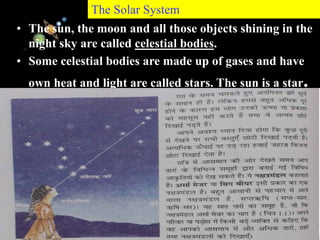
• The sun, the moon and all those objects shining in the
night sky are called celestial bodies.
• Some celestial bodies are made up of gases and have
own heat and light are called stars. The sun is a star.
The Solar System
11/15/99 Norm Herr (sample file)
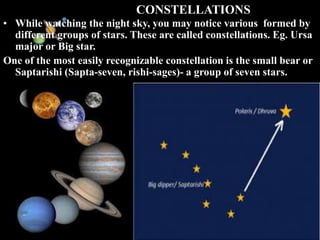
• While watching the night sky, you may notice various formed by
different groups of stars. These are called constellations. Eg. Ursa
major or Big star.
One of the most easily recognizable constellation is the small bear or
Saptarishi (Sapta-seven, rishi-sages)- a group of seven stars.
CONSTELLATIONS
11/15/99 Norm Herr (sample file)
• In ancient times, people used to determine directions during the
night with the help of stars. The North star indicates the north
directions . It is also called the POLE STAR.
• Some celestial bodies do not have their own heat and light. They
are lit by the light of the stars. Such bodies are called planets. The
word planet come from Greek word ‘Planetai’ which means
“wanderers”.
11/15/99 Norm Herr (sample file)
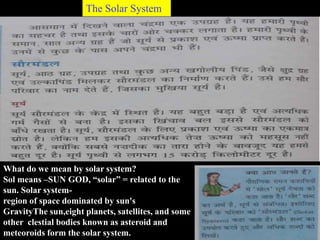
What do we mean by solar system?
Sol means –SUN GOD, “solar” = related to the
sun. Solar system-
region of space dominated by sun's
GravityThe sun,eight planets, satellites, and some
other clestial bodies known as asteroid and
meteoroids form the solar system.
The Solar System
11/15/99 Norm Herr (sample file)
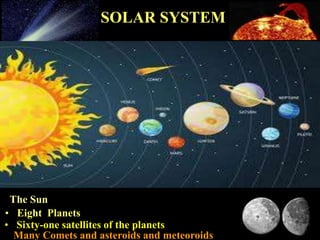
SOLAR SYSTEM
The Sun
• Eight Planets
• Sixty-one satellites of the planets
Many Comets and asteroids and meteoroids
11/15/99 Norm Herr (sample file)
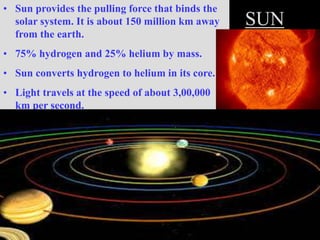
• Sun provides the pulling force that binds the
solar system. It is about 150 million km away
from the earth.
• 75% hydrogen and 25% helium by mass.
• Sun converts hydrogen to helium in its core.
• Light travels at the speed of about 3,00,000
km per second.
ssSUN
11/15/99 Norm Herr (sample file)
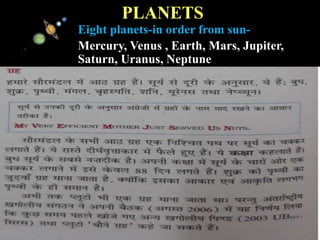
PLANETS
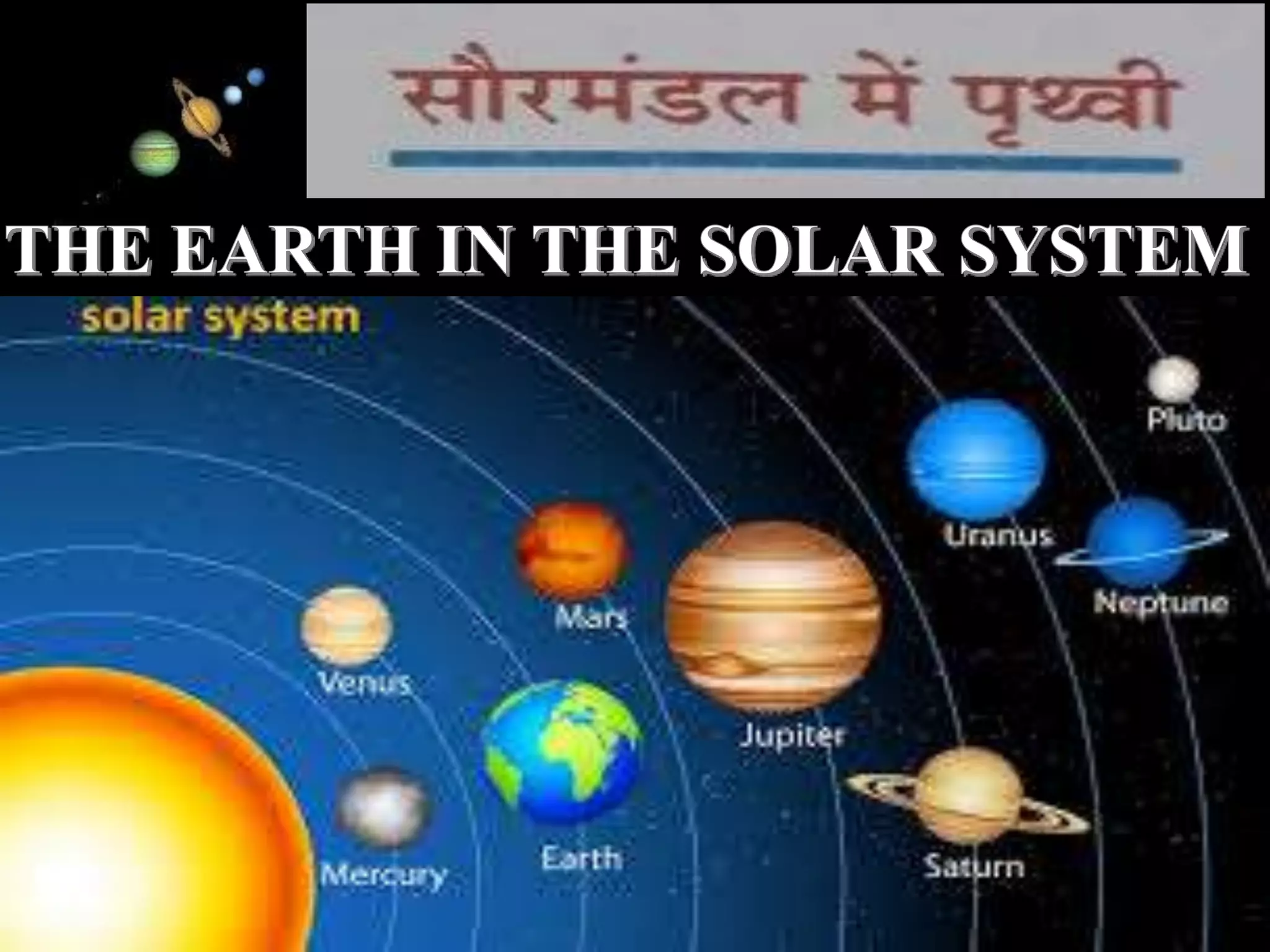
Eight planets-in order from sun-
Mercury, Venus , Earth, Mars, Jupiter,
Saturn, Uranus, Neptune
11/15/99 Norm Herr (sample file)
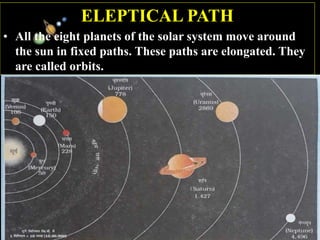
ELEPTICAL PATH
• All the eight planets of the solar system move around
the sun in fixed paths. These paths are elongated. They
are called orbits.
11/15/99 Norm Herr (sample file)
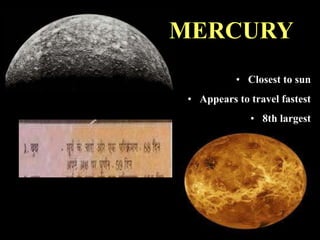
MERCURY
• Closest to sun
• Appears to travel fastest
• 8th largest
11/15/99 Norm Herr (sample file)
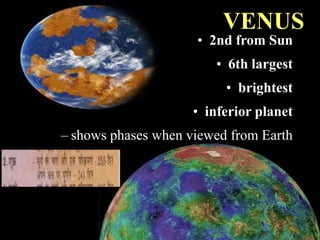
VENUS
• 2nd from Sun
• 6th largest
• brightest
• inferior planet
– shows phases when viewed from Earth
11/15/99 Norm Herr (sample file)
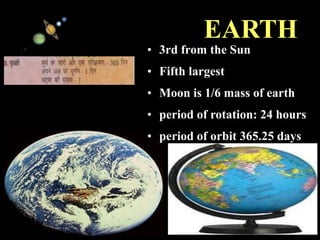
EARTH
• 3rd from the Sun
• Fifth largest
• Moon is 1/6 mass of earth
• period of rotation: 24 hours
• period of orbit 365.25 days
11/15/99 Norm Herr (sample file)
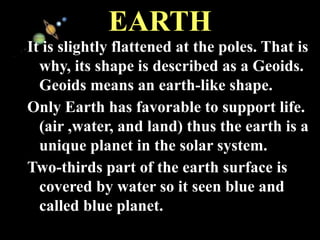
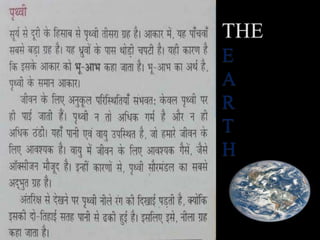
EARTH
It is slightly flattened at the poles. That is
why, its shape is described as a Geoids.
Geoids means an earth-like shape.
Only Earth has favorable to support life.
(air ,water, and land) thus the earth is a
unique planet in the solar system.
Two-thirds part of the earth surface is
covered by water so it seen blue and
called blue planet.
11/15/99 Norm Herr (sample file)
THE
E
A
R
T
H
11/15/99 Norm Herr (sample file)
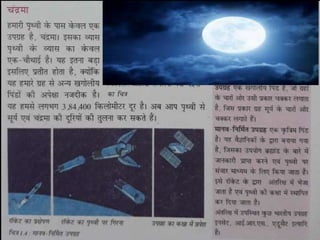
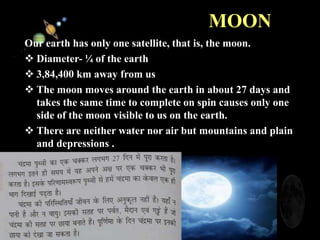
MOON
Our earth has only one satellite, that is, the moon.
 Diameter- ¼ of the earth
 3,84,400 km away from us
 The moon moves around the earth in about 27 days and
takes the same time to complete on spin causes only one
side of the moon visible to us on the earth.
 There are neither water nor air but mountains and plain
and depressions .
11/15/99 Norm Herr (sample file)
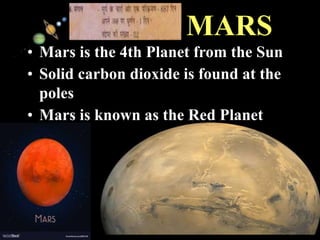
MARS
• Mars is the 4th Planet from the Sun
• Solid carbon dioxide is found at the
poles
• Mars is known as the Red Planet
11/15/99 Norm Herr (sample file)
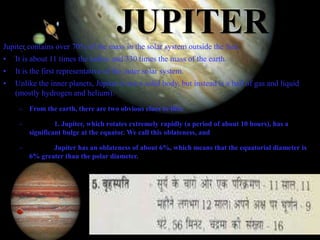
JUPITERJupiter contains over 70% of the mass in the solar system outside the Sun.
• It is about 11 times the radius and 330 times the mass of the earth.
• It is the first representative of the outer solar system.
• Unlike the inner planets, Jupiter is not a solid body, but instead is a ball of gas and liquid
(mostly hydrogen and helium).
– From the earth, there are two obvious clues to this:
– 1. Jupiter, which rotates extremely rapidly (a period of about 10 hours), has a
significant bulge at the equator. We call this oblateness, and
– Jupiter has an oblateness of about 6%, which means that the equatorial diameter is
6% greater than the polar diameter.
11/15/99 Norm Herr (sample file)
SATURN
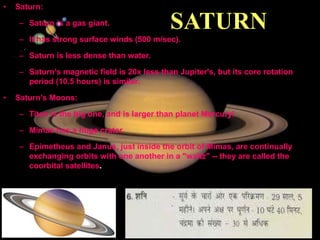
• Saturn:
– Saturn is a gas giant.
– It has strong surface winds (500 m/sec).
– Saturn is less dense than water.
– Saturn’s magnetic field is 20x less than Jupiter's, but its core rotation
period (10.5 hours) is similar.
• Saturn’s Moons:
– Titan is the big one, and is larger than planet Mercury!
– Mimas has a huge crater.
– Epimetheus and Janus, just inside the orbit of Mimas, are continually
exchanging orbits with one another in a "waltz" -- they are called the
coorbital satellites.
11/15/99 Norm Herr (sample file)
URANUS
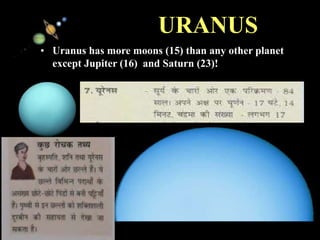
• Uranus has more moons (15) than any other planet
except Jupiter (16) and Saturn (23)!
11/15/99 Norm Herr (sample file)
NEPTUNE
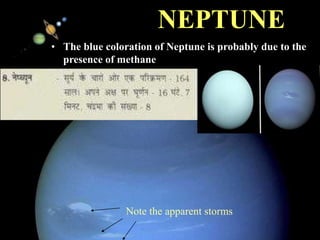
• The blue coloration of Neptune is probably due to the
presence of methane
Note the apparent storms
11/15/99 Norm Herr (sample file)
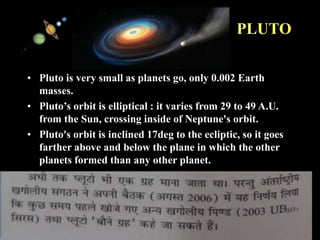
PLUTO
• Pluto is very small as planets go, only 0.002 Earth
masses.
• Pluto’s orbit is elliptical : it varies from 29 to 49 A.U.
from the Sun, crossing inside of Neptune's orbit.
• Pluto's orbit is inclined 17deg to the ecliptic, so it goes
farther above and below the plane in which the other
planets formed than any other planet.
11/15/99 Norm Herr (sample file)
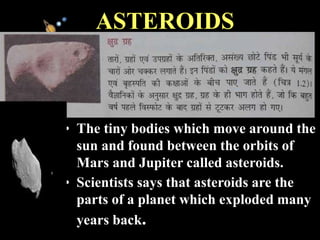
ASTEROIDS
• The tiny bodies which move around the
sun and found between the orbits of
Mars and Jupiter called asteroids.
• Scientists says that asteroids are the
parts of a planet which exploded many
years back.
11/15/99 Norm Herr (sample file)
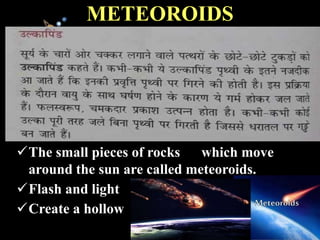
METEOROIDS
The small pieces of rocks which move
around the sun are called meteoroids.
Flash and light
Create a hollow
11/15/99 Norm Herr (sample file)
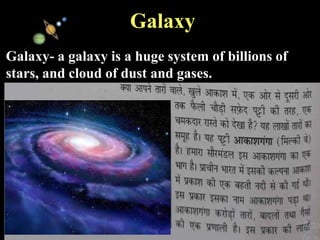
Galaxy
Galaxy- a galaxy is a huge system of billions of
stars, and cloud of dust and gases.
11/15/99 Norm Herr (sample file)
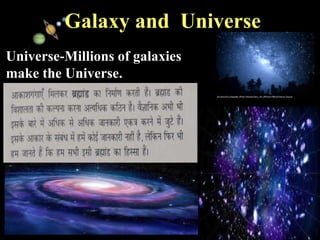
Galaxy and Universe
Universe-Millions of galaxies
make the Universe.
11/15/99
Norm THANK YOU
BALWANT KUMAR JHOD, TGT(SSOCIAL SCIENCE,
JNV PANDHANA,DISTT. KHANDWA, M.P.le file)

OUR EARTH IN THE SOLAR SYSTEM

  • 1.
    11/15/99 Norm Herr(sample file)
  • 2.
    11/15/99 Norm Herr(sample file)
  • 3.
    11/15/99 Norm Herr(sample file) Full Moon and New Moon • When we will see full moon only once in about a month’s time . It is Full Moon night or Poornima. • A fortnight later, we can not see it at all. It is a new moon night or Amavasya.
  • 4.
    11/15/99 Norm Herr(sample file) • The sun, the moon and all those objects shining in the night sky are called celestial bodies. • Some celestial bodies are made up of gases and have own heat and light are called stars. The sun is a star. The Solar System
  • 5.
    11/15/99 Norm Herr(sample file) • While watching the night sky, you may notice various formed by different groups of stars. These are called constellations. Eg. Ursa major or Big star. One of the most easily recognizable constellation is the small bear or Saptarishi (Sapta-seven, rishi-sages)- a group of seven stars. CONSTELLATIONS
  • 6.
    11/15/99 Norm Herr(sample file) • In ancient times, people used to determine directions during the night with the help of stars. The North star indicates the north directions . It is also called the POLE STAR. • Some celestial bodies do not have their own heat and light. They are lit by the light of the stars. Such bodies are called planets. The word planet come from Greek word ‘Planetai’ which means “wanderers”.
  • 7.
    11/15/99 Norm Herr(sample file) What do we mean by solar system? Sol means –SUN GOD, “solar” = related to the sun. Solar system- region of space dominated by sun's GravityThe sun,eight planets, satellites, and some other clestial bodies known as asteroid and meteoroids form the solar system. The Solar System
  • 8.
    11/15/99 Norm Herr(sample file) SOLAR SYSTEM The Sun • Eight Planets • Sixty-one satellites of the planets Many Comets and asteroids and meteoroids
  • 9.
    11/15/99 Norm Herr(sample file) • Sun provides the pulling force that binds the solar system. It is about 150 million km away from the earth. • 75% hydrogen and 25% helium by mass. • Sun converts hydrogen to helium in its core. • Light travels at the speed of about 3,00,000 km per second. ssSUN
  • 10.
    11/15/99 Norm Herr(sample file) PLANETS Eight planets-in order from sun- Mercury, Venus , Earth, Mars, Jupiter, Saturn, Uranus, Neptune
  • 11.
    11/15/99 Norm Herr(sample file) ELEPTICAL PATH • All the eight planets of the solar system move around the sun in fixed paths. These paths are elongated. They are called orbits.
  • 12.
    11/15/99 Norm Herr(sample file) MERCURY • Closest to sun • Appears to travel fastest • 8th largest
  • 13.
    11/15/99 Norm Herr(sample file) VENUS • 2nd from Sun • 6th largest • brightest • inferior planet – shows phases when viewed from Earth
  • 14.
    11/15/99 Norm Herr(sample file) EARTH • 3rd from the Sun • Fifth largest • Moon is 1/6 mass of earth • period of rotation: 24 hours • period of orbit 365.25 days
  • 15.
    11/15/99 Norm Herr(sample file) EARTH It is slightly flattened at the poles. That is why, its shape is described as a Geoids. Geoids means an earth-like shape. Only Earth has favorable to support life. (air ,water, and land) thus the earth is a unique planet in the solar system. Two-thirds part of the earth surface is covered by water so it seen blue and called blue planet.
  • 16.
    11/15/99 Norm Herr(sample file) THE E A R T H
  • 17.
    11/15/99 Norm Herr(sample file)
  • 18.
    11/15/99 Norm Herr(sample file) MOON Our earth has only one satellite, that is, the moon.  Diameter- ¼ of the earth  3,84,400 km away from us  The moon moves around the earth in about 27 days and takes the same time to complete on spin causes only one side of the moon visible to us on the earth.  There are neither water nor air but mountains and plain and depressions .
  • 19.
    11/15/99 Norm Herr(sample file) MARS • Mars is the 4th Planet from the Sun • Solid carbon dioxide is found at the poles • Mars is known as the Red Planet
  • 20.
    11/15/99 Norm Herr(sample file) JUPITERJupiter contains over 70% of the mass in the solar system outside the Sun. • It is about 11 times the radius and 330 times the mass of the earth. • It is the first representative of the outer solar system. • Unlike the inner planets, Jupiter is not a solid body, but instead is a ball of gas and liquid (mostly hydrogen and helium). – From the earth, there are two obvious clues to this: – 1. Jupiter, which rotates extremely rapidly (a period of about 10 hours), has a significant bulge at the equator. We call this oblateness, and – Jupiter has an oblateness of about 6%, which means that the equatorial diameter is 6% greater than the polar diameter.
  • 21.
    11/15/99 Norm Herr(sample file) SATURN • Saturn: – Saturn is a gas giant. – It has strong surface winds (500 m/sec). – Saturn is less dense than water. – Saturn’s magnetic field is 20x less than Jupiter's, but its core rotation period (10.5 hours) is similar. • Saturn’s Moons: – Titan is the big one, and is larger than planet Mercury! – Mimas has a huge crater. – Epimetheus and Janus, just inside the orbit of Mimas, are continually exchanging orbits with one another in a "waltz" -- they are called the coorbital satellites.
  • 22.
    11/15/99 Norm Herr(sample file) URANUS • Uranus has more moons (15) than any other planet except Jupiter (16) and Saturn (23)!
  • 23.
    11/15/99 Norm Herr(sample file) NEPTUNE • The blue coloration of Neptune is probably due to the presence of methane Note the apparent storms
  • 24.
    11/15/99 Norm Herr(sample file) PLUTO • Pluto is very small as planets go, only 0.002 Earth masses. • Pluto’s orbit is elliptical : it varies from 29 to 49 A.U. from the Sun, crossing inside of Neptune's orbit. • Pluto's orbit is inclined 17deg to the ecliptic, so it goes farther above and below the plane in which the other planets formed than any other planet.
  • 25.
    11/15/99 Norm Herr(sample file) ASTEROIDS • The tiny bodies which move around the sun and found between the orbits of Mars and Jupiter called asteroids. • Scientists says that asteroids are the parts of a planet which exploded many years back.
  • 26.
    11/15/99 Norm Herr(sample file) METEOROIDS The small pieces of rocks which move around the sun are called meteoroids. Flash and light Create a hollow
  • 27.
    11/15/99 Norm Herr(sample file) Galaxy Galaxy- a galaxy is a huge system of billions of stars, and cloud of dust and gases.
  • 28.
    11/15/99 Norm Herr(sample file) Galaxy and Universe Universe-Millions of galaxies make the Universe.
  • 29.
    11/15/99 Norm THANK YOU BALWANTKUMAR JHOD, TGT(SSOCIAL SCIENCE, JNV PANDHANA,DISTT. KHANDWA, M.P.le file)