The solar system   and beyond
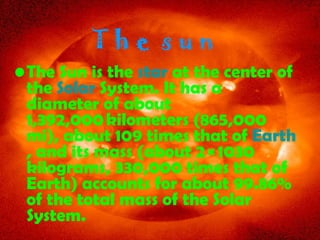
T h e  s u n The  Sun  is the  star  at the center of the  Solar   System .  It has a diameter of about 1,392,000 kilometers  ( 865,000 mi ) , about 109 times that of  Earth , and its mass  ( about 2 × 10 30  kilograms, 330,000 times that of Earth )  accounts for about 99.86% of the total mass of the Solar System .
T h e  M e r c u r y Mercury is the innermost  and smallest  planet  in the  Solar   System , [a]   orbiting  the  Sun  once every 87.969 Earth days .  The orbit of Mercury has the highest  eccentricity  of all the Solar System planets, and it has the smallest  axial   tilt .  It completes three rotations about its axis for every two orbits .  The  perihelion  of Mercury's orbit  precesses  around the Sun at an excess of 43  arcseconds  per century; a phenomenon that was explained in the 20th century by  Albert   Einstein 's  General   Theory   of   Relativity . .
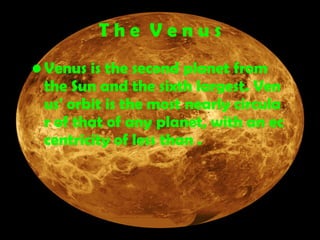
T h e  V e n u s Venus  is the second planet from the Sun and the sixth largest. Venus' orbit is the most nearly circular of that of any planet, with an eccentricity of less than .
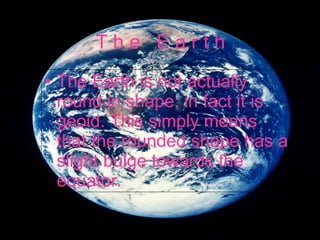
T h e  E a r t h The Earth is not actually round in shape; in fact it is geoid .  This simply means that the rounded shape has a slight bulge towards the equator .
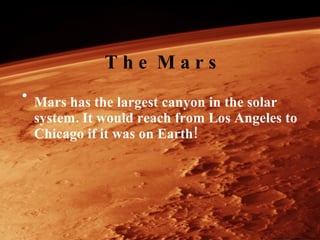
T h e  M a r s Mars has the largest canyon in the solar system .  It would reach from Los Angeles to Chicago if it was on Earth !
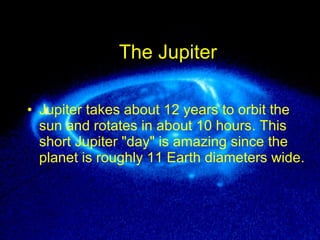
The Jupiter Jupiter takes about 12 years to orbit the sun and rotates in about 10 hours .  This short Jupiter  " day "  is amazing since the planet is roughly 11 Earth diameters wide .
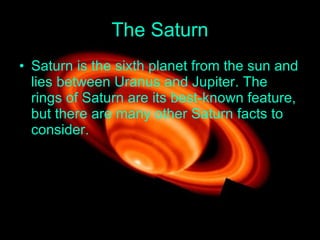
The Saturn Saturn is the sixth planet from the sun and lies between Uranus and Jupiter .  The rings of Saturn are its best - known feature, but there are many other Saturn facts to consider .
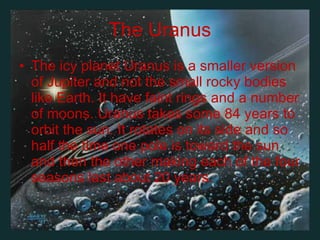
The Uranus The icy planet Uranus is a smaller version of Jupiter and not the small rocky bodies like Earth .  It have faint rings and a number of moons .  Uranus takes some 84 years to orbit the sun .  It rotates on its side and so half the time one pole is toward the sun and then the other making each of the four seasons last about 20 years .
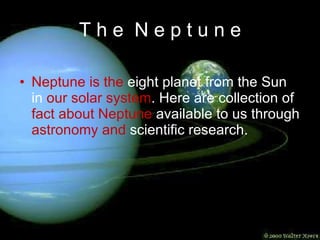
T h e  N e p t u n e Neptune is the   eight planet from the Sun in   our solar system .  Here are collection of   fact about Neptune   available to us through   astronomy and   scientific research .
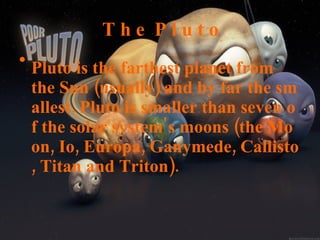
T h e  P l u t o Pluto  is the farthest planet from the Sun (usually) and by far the smallest. Pluto is smaller than seven of the solar system's moons (the Moon, Io, Europa, Ganymede, Callisto, Titan and Triton).
By Miss chadakarn  saiyarat 702  ( Fah ) Miss Sutthida watcharavijit 702  ( Ning )

Project with far

  • 1.
    The solar system and beyond
  • 2.
    T h e s u n The Sun is the star at the center of the Solar System . It has a diameter of about 1,392,000 kilometers ( 865,000 mi ) , about 109 times that of Earth , and its mass ( about 2 × 10 30 kilograms, 330,000 times that of Earth ) accounts for about 99.86% of the total mass of the Solar System .
  • 3.
    T h e M e r c u r y Mercury is the innermost and smallest planet in the Solar System , [a] orbiting the Sun once every 87.969 Earth days . The orbit of Mercury has the highest eccentricity of all the Solar System planets, and it has the smallest axial tilt . It completes three rotations about its axis for every two orbits . The perihelion of Mercury's orbit precesses around the Sun at an excess of 43  arcseconds per century; a phenomenon that was explained in the 20th century by Albert Einstein 's General Theory of Relativity . .
  • 4.
    T h e V e n u s Venus is the second planet from the Sun and the sixth largest. Venus' orbit is the most nearly circular of that of any planet, with an eccentricity of less than .
  • 5.
    T h e E a r t h The Earth is not actually round in shape; in fact it is geoid . This simply means that the rounded shape has a slight bulge towards the equator .
  • 6.
    T h e M a r s Mars has the largest canyon in the solar system . It would reach from Los Angeles to Chicago if it was on Earth !
  • 7.
    The Jupiter Jupitertakes about 12 years to orbit the sun and rotates in about 10 hours . This short Jupiter " day " is amazing since the planet is roughly 11 Earth diameters wide .
  • 8.
    The Saturn Saturnis the sixth planet from the sun and lies between Uranus and Jupiter . The rings of Saturn are its best - known feature, but there are many other Saturn facts to consider .
  • 9.
    The Uranus Theicy planet Uranus is a smaller version of Jupiter and not the small rocky bodies like Earth . It have faint rings and a number of moons . Uranus takes some 84 years to orbit the sun . It rotates on its side and so half the time one pole is toward the sun and then the other making each of the four seasons last about 20 years .
  • 10.
    T h e N e p t u n e Neptune is the eight planet from the Sun in our solar system . Here are collection of fact about Neptune available to us through astronomy and scientific research .
  • 11.
    T h e P l u t o Pluto is the farthest planet from the Sun (usually) and by far the smallest. Pluto is smaller than seven of the solar system's moons (the Moon, Io, Europa, Ganymede, Callisto, Titan and Triton).
  • 12.
    By Miss chadakarn saiyarat 702 ( Fah ) Miss Sutthida watcharavijit 702 ( Ning )