
Presentation
by
 Rakib
Hossa
in
ID:
11.02.
08.04
7
What is ocean thermal energy conversion
(OTEC)
 Temperature difference between cooler deep & warmer
surface to run a heat engine and produce electricity.
 Distance between surface & cooler deep should be
1000m.
 Mainly rankine cycle is used in the process .
 Refrigerants used- ammonia or R-134a .
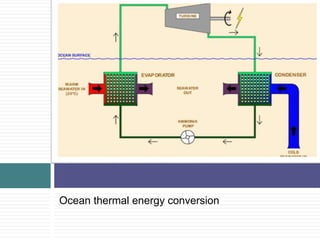
Ocean thermal energy conversion
Process of OTEC
 Cycles in OTEC >>>
 Open cycle
 Close cycle
 Hybrid cycle
Open cycle
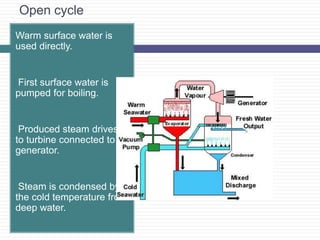
Warm surface water is
used directly.
First surface water is
pumped for boiling.
Produced steam drives
to turbine connected to
generator.
Steam is condensed by
the cold temperature from
deep water.
closed cycle
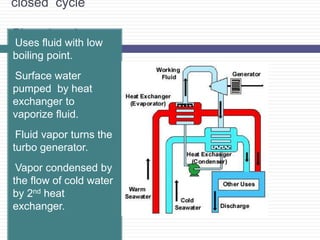
Closed cycle
•Uses fluid with low
boiling point.
•Surface water
pumped by heat
exchanger to
vaporize fluid.
•Fluid vapor turns the
turbo generator.
•Vapor condensed by
the flow of cold water
by 2nd heat
exchanger.
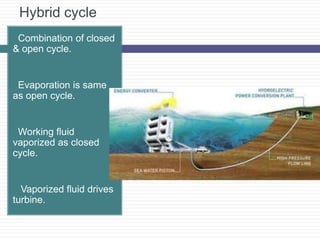
Hybrid cycle
Combination of closed
& open cycle.
Evaporation is same
as open cycle.
Working fluid
vaporized as closed
cycle.
 Vaporized fluid drives
turbine.
Working fluid
 Popular choice – ammonia >> easy availability >> but
toxic & flammable.
 Fluorinated carbon – CFC or HCFC >> not toxic or
flammable >> destroy ozone layer.
 Hydrocarbons >> highly flammable .
Thermodynamic efficiency
 Temperature difference between surface and deep water
is high in tropic , helps to run heat engine.
 It is 10 to 100 times more efficient than wave power of
ocean.
 It can supply continuous base load supply to power
generation system.
 It is considered as emerging technology.
Evolution of OTEC
 1880 >> 1st attempt to develop OTEC .
 1930 >> 1st OTEC plant built in Cuba . (22 kw) ,
destroyed by storm later .
 1967 >> 1st use of closed cycle of rankine system .
 Japan is the major contributor of OTEC since 1970.
 2002 >> OTEC plant in tamilnadu , India.
 OTEC plant is increasing day by day .
Different types of OTEC sites
 Land sites >>
near sea shore
Advantages >> do not need { sophisticated mooring, long cable,
extensive maintenance}
 Shelf based >>
Far from surf zone, near to cold water.
Disadvantages >> difficult product delivery, long cable needed,
more expensive.
 Floating sites >>
Operate off shore, optimal for large system.
Disadvantage >> complicates power delivery , possibility of
damage of cable, difficult to maintain & repair.
Related activities other than power generation
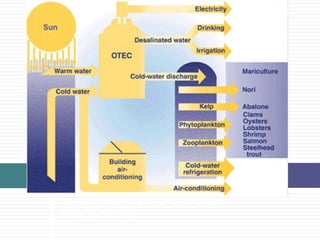
 Air conditioning
 Chilled soil agriculture
 Hydrogen production
 Producing distilled water
 Aqua culture
 irrigation
Figure of related activities other than
power generation
Cost & Economics
 It is a renewable energy .
 One study shows that its cost is US $ 0.07 per kilowatt –
hour.
 Beneficial fact : lack of waste products and fuel
consumption.
 Supplemental use of sea water.
 Many more useful fact other than power generation.
Environmental impact
 Carbon dioxide dissolve
 Unbalance ecological system
 Accidental condition of closed cycle
 Effect in commercial fishing
Conclusion
We need 6500 MW electricity per day , but we are
producing only 5500 MW .As it’s a low cost harmless
renewable energy to produce electricity , it could be
bless for our country.
For more info please visit ;
www.OTEC.org
Thank you all
Any
question??

Ocean thermal energy convertion

  • 1.
  • 2.
    What is oceanthermal energy conversion (OTEC)  Temperature difference between cooler deep & warmer surface to run a heat engine and produce electricity.  Distance between surface & cooler deep should be 1000m.  Mainly rankine cycle is used in the process .  Refrigerants used- ammonia or R-134a .
  • 3.
  • 4.
    Process of OTEC Cycles in OTEC >>>  Open cycle  Close cycle  Hybrid cycle
  • 5.
    Open cycle Warm surfacewater is used directly. First surface water is pumped for boiling. Produced steam drives to turbine connected to generator. Steam is condensed by the cold temperature from deep water.
  • 6.
    closed cycle Closed cycle •Usesfluid with low boiling point. •Surface water pumped by heat exchanger to vaporize fluid. •Fluid vapor turns the turbo generator. •Vapor condensed by the flow of cold water by 2nd heat exchanger.
  • 7.
    Hybrid cycle Combination ofclosed & open cycle. Evaporation is same as open cycle. Working fluid vaporized as closed cycle.  Vaporized fluid drives turbine.
  • 8.
    Working fluid  Popularchoice – ammonia >> easy availability >> but toxic & flammable.  Fluorinated carbon – CFC or HCFC >> not toxic or flammable >> destroy ozone layer.  Hydrocarbons >> highly flammable .
  • 9.
    Thermodynamic efficiency  Temperaturedifference between surface and deep water is high in tropic , helps to run heat engine.  It is 10 to 100 times more efficient than wave power of ocean.  It can supply continuous base load supply to power generation system.  It is considered as emerging technology.
  • 10.
    Evolution of OTEC 1880 >> 1st attempt to develop OTEC .  1930 >> 1st OTEC plant built in Cuba . (22 kw) , destroyed by storm later .  1967 >> 1st use of closed cycle of rankine system .  Japan is the major contributor of OTEC since 1970.  2002 >> OTEC plant in tamilnadu , India.  OTEC plant is increasing day by day .
  • 11.
    Different types ofOTEC sites  Land sites >> near sea shore Advantages >> do not need { sophisticated mooring, long cable, extensive maintenance}  Shelf based >> Far from surf zone, near to cold water. Disadvantages >> difficult product delivery, long cable needed, more expensive.  Floating sites >> Operate off shore, optimal for large system. Disadvantage >> complicates power delivery , possibility of damage of cable, difficult to maintain & repair.
  • 12.
    Related activities otherthan power generation  Air conditioning  Chilled soil agriculture  Hydrogen production  Producing distilled water  Aqua culture  irrigation
  • 13.
    Figure of relatedactivities other than power generation
  • 14.
    Cost & Economics It is a renewable energy .  One study shows that its cost is US $ 0.07 per kilowatt – hour.  Beneficial fact : lack of waste products and fuel consumption.  Supplemental use of sea water.  Many more useful fact other than power generation.
  • 15.
    Environmental impact  Carbondioxide dissolve  Unbalance ecological system  Accidental condition of closed cycle  Effect in commercial fishing
  • 16.
    Conclusion We need 6500MW electricity per day , but we are producing only 5500 MW .As it’s a low cost harmless renewable energy to produce electricity , it could be bless for our country. For more info please visit ; www.OTEC.org
  • 17.